The Obama Bull Market in Equity Prices Continues

S&P500 Index, March 9, 2009, to Nov 19, 2013

.

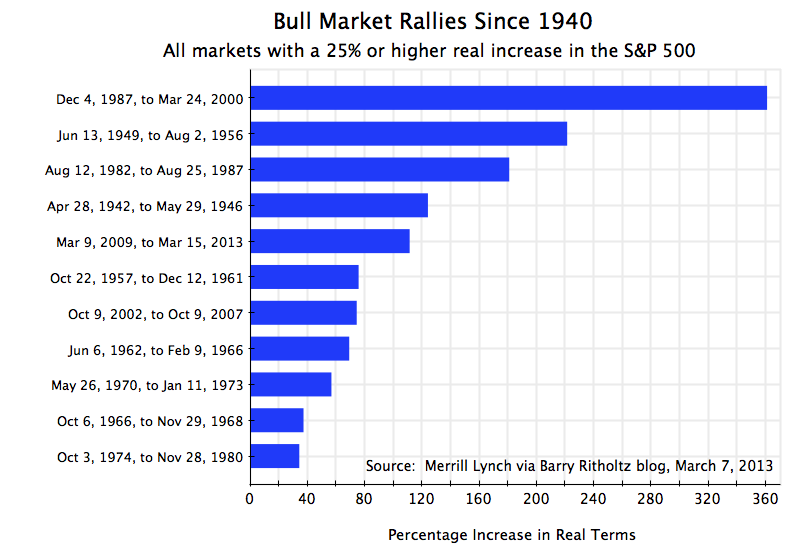
   Bull Market Rallies Since 1940
  Ranked by overall growth in real terms
    Nominal % Real % Real Rate
Start Date End Date Change Change of Growth
Dec 4, 1987 Mar 24, 2000 582% 361% 13%
Jun 13, 1949 Aug 2, 1956 267% 222% 18%
Aug 12, 1982 Aug 25, 1987 229% 181% 23%
Mar 9, 2009 Nov 15, 2013 166% 141% 21%
Apr 28, 1942 May 29, 1946 158% 124% 22%
Oct 22, 1957 Dec 12, 1961 86% 76% 15%
Oct 9, 2002 Oct 9, 2007 101% 75% 12%
Jun 26, 1962 Feb 9, 1966 80% 69% 16%
May 26, 1970 Jan 11, 1973 74% 57% 19%
Oct 6, 1966 Nov 29, 1968 48% 37% 16%
Oct 3, 1974 Nov 28, 1980 126% 34% 5%
         

Equity prices reached record levels on November 18, with the S&P 500 index hitting 1,800 in mid-day trading and the Dow Jones Industrial Average hitting 16,000, before both closed lower.  While any such index numbers are arbitrary, it might be timely for a brief update of a blog post from March of this year on the boom in equity prices, to see where things now stand.  That blog post noted that equity prices have boomed under Obama, to the extent that the stock market rally that began soon after he took office has been one of the largest of the last seven decades.

Since March, that rally in equity prices has continued.  The graph at the top of this post shows the path for the S&P 500 stock market index (a capitalization-weighted index that is generally taken as the benchmark for the market), from its trough on March 9, 2009, to its most recent peak (in terms of its daily closing price) on November 15.  It has now increased by 166% in nominal terms, and by 141% in real terms, since that low-point just six weeks after Obama was inaugurated.

The table above fits the on-going rally into all the bull market rallies since 1940.  These rallies are defined as increases in equity prices of 25% or more in nominal terms before ending with a correction of 20% or more.  The calculations are based on figures originally provided by Barry Ritholtz on his web site (which were in turn based on Merrill-Lynch figures), which were used in my March blog post.

There have been 11 such rallies since 1940, and the Obama market rally is now the fourth largest among these.  Since it is still on-going, it could also move up further in rank.  And the pace of the increase has been rapid.  The real rate of growth in equity prices over the course of this rally (of 21% per annum up to this point) is the third highest of any of these rallies.

Conservatives continue to charge that Obama’s policies have been terrible for business and for the economy.  Yet if that were true, one would not expect equity prices to be booming.  I should hasten to add that this rally could, of course, end tomorrow.  Stock market rallies always come to an end.  But until it does, it is hard to reconcile the view of conservatives that Obama has been bad for business with what we see happening in the markets.

Obama and Prices: The Markets Expect Inflation to Remain Low

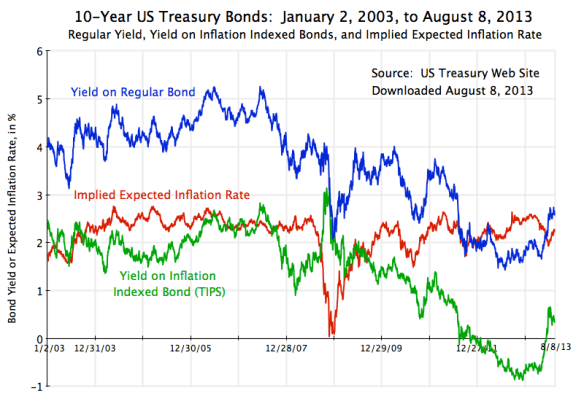
US Treasury Bond Yields, TIPS, and Expected Inflation, Jan 2, 2003, to Aug 8, 2013

Conservative critics of Obama argue his policies will inevitably lead to high inflation.  A previous blog post on this site showed that in fact inflation during the four years of Obama’s first term had been the lowest over any presidential four year term going back a half century.  Low inflation during Obama’s first term cannot be denied.

The conservative critics respond that while inflation may have been low so far, it is inevitable that inflation will soon rise.  The blog post cited above provides links to several examples of what they have been saying.  But this assertion can be examined as well.  In particular, the financial markets (which the conservative critics generally take as reflecting a sound view on such matters, as the investment returns of such investors will depend on getting this right) can be used to see what at least the markets believe inflation will be going forward.

Since 1997 the US Treasury has been issuing bonds of varying maturities whose principal is indexed to the US CPI price index.  These bonds, known as TIPS (for Treasury Inflation-Protected Securities), provide a return which will be the same in real terms regardless of what inflation turns out to be.  The yields on such bonds can be compared to the yields on regular US Treasury bonds of similar maturity.  Such regular US Treasury bonds will pay interest and at the end return the principal in certain dollar amounts, with a value in real terms which will vary depending on what inflation turned out to be.

Inflation is normally positive, so the regular bonds will pay rates which are higher than the rates on TIPS bonds.  But whether the higher rates are worthwhile will depend on how high inflation turns out to be.  To illustrate with some simple numbers, suppose the rate on a 10-year regular US Treasury bond is 3% while the rate on a 10-year TIPS is 1%.  If inflation turns out to be 2%, the bonds will be equally valuable.  But if inflation turns out to be 3%, it would have been better to have invested in the TIPS.  The TIPS will still pay out a 1% real return, while the regular US Treasury will yield a real return of only 0% (a 3% nominal return, but with 3% inflation the real yield will be zero).  Alternatively, suppose inflation turns out to be 1%.  The real return on the regular US Treasury will be 2% (equal to 3% minus 1%), while the TIPS will still yield the contracted 1% real return.  In one believes inflation will be just 1% over this period until maturity, it would have been better to have invested in the regular bonds.

The investors will therefore need to determine what they expect inflation to be.  They will bid up the price of one of the bonds (and bid down the price of the other) if they believe inflation over the time to maturity of the bond, will be higher or lower than the current gap in the yields between the two.  Where the prices of the two bonds settle, and therefore what the gap in yields is between the two, therefore reflects what the financial markets as a whole believe will be the rate of CPI inflation over the period until the bonds mature.  Since real money is riding on this, the investors will take it seriously.

The graph above shows the yields on regular 10-year US Treasury bonds (in blue) and on 10-year TIPS (in green), for the period from January 2, 2003, to August 8, 2013.  The data comes from the official US Treasury web site (where the data presented there goes back to January 2, 2003).  The implied 10-year expected rate of inflation (in red) is then calculated based on the difference between the two yields.

As can be seen in the graph, the yields on the regular 10-year US Treasury bond varied a fair amount over the period, from generally between 4 and 5% during the Bush presidency, falling over time to below 2% for much of 2012, and then rising to about 2 1/2% recently.  The 10-year TIPS yield similarly varied from around 2% during the Bush years, to negative levels for 2012 and the first half of 2013, and rising to a still low but positive 1/2% recently (and most recently just 1/3%).

Despite such fluctuations in the yields of the regular 10-year bond and the 10-year TIPS, the implied expected inflation rate (the difference between the two yields) has been relatively constant, at about 2 1/2% during the Bush years and a similar but slightly lower rate (on average) during the Obama presidency.  The one exceptional period, which should be excluded, would be during the period of economic and financial collapse in the final months of the Bush presidency, after Lehman Brothers went bankrupt and the financial markets were in chaos.  The TIPS yields went up while the regular US Treasury bond yields fell sharply, leading to an implied expectation of inflation of close to zero.  But the figures under such chaotic conditions should not be taken as meaningful.  The chaotic markets then stabilized within a short period of Obama taking office in January 2009, with the rates then returning to more normal levels.

The financial markets, which the conservative critics of Obama normally place a good deal of faith in, therefore do not show any indication that they expect inflation over the next decade to rise.  Rather, they expect inflation of around 2% a year to continue, which is consistent also with the rate of inflation the Fed targets.

Finally, the figures on the bond yields in the graph above also show that the US government has been able to borrow, and continues to be able to borrow, at incredibly low rates, whether in real or nominal terms.   The TIPS yield (the borrowing rate in real terms) was indeed negative in for most of 2012 and the first half of 2013, and is still only 1/2% or less.  Even were it not for the still high unemployment in the country, this is the period when the government should be undertaking investments in both new infrastructure and other assets, and in maintenance of existing assets.  Such investments are worthwhile even if they generate returns of only 1/2% in real terms.  Yet such investments, particularly in maintenance, will generate returns that are orders of magnitude greater than that.

It has been incredibly stupid that the Republican insistence on cutting government spending has blocked us from proceeding with such investments at a time when the borrowing costs to fund them have been so low.

The Obama Bull Market Rally in Equity Prices: One of the Biggest of the Last Seven Decades

Bull Markets, 1940-2013

 Bull Market Rallies Since 1940
  Ranked by overall growth in real terms
    Nominal % Real % Real Rate
Start Date End Date Change Change of Growth
Dec 4, 1987 Mar 24, 2000 582% 361% 13%
Jun 13, 1949 Aug 2, 1956 267% 222% 18%
Aug 12, 1982 Aug 25, 1987 229% 181% 23%
Apr 28, 1942 May 29, 1946 158% 124% 22%
Mar 9, 2009 Mar 15, 2013 131% 112% 21%
Oct 22, 1957 Dec 12, 1961 86% 76% 15%
Oct 9, 2002 Oct 9, 2007 101% 75% 12%
Jun 26, 1962 Feb 9, 1966 80% 69% 16%
May 26, 1970 Jan 11, 1973 74% 57% 19%
Oct 6, 1966 Nov 29, 1968 48% 37% 16%
Oct 3, 1974 Nov 28, 1980 126% 34% 5%
 

Obama has been called a socialist by his conservative critics.  He has been deemed anti-business and anti-private profit.  Were this the case, business would be suffering and equity prices would be depressed.  Yet corporate profits are now at record highs.  This was shown and discussed in an earlier post on this blog.  More recent figures are following the same upward trend, and are available in the National Income and Product Accounts produced by the BEA of the US Department of Commerce.

With profits at record highs, it will be a surprise only to those conservative critics that the stock market has been booming under Obama.  But what few might realize is the extent of the rally under Obama.  The current stock market rally is already the fifth largest of any stock market rally since 1940.  It is also still underway, while the others of course are not, so it may well move up in rank.

The chart and table above show the numbers.  The underlying figures were compiled by Merrill Lynch, and are available at the financial blog of Barry Ritholtz (the Merrill Lynch study itself appears to be available only privately to its clients, like much of the research of such brokerages).  For the numbers above I determined also the figures controlling for inflation (the originals were only in nominal terms), using the monthly CPI for the inflation index (from the BLS via FRED), and then ranked the rallies by the total returns in real terms.  I also updated the figures on the current rally to the numbers at market close on March 15.  The rallies shown are all those since 1940 (a total of 11) in which there was at least a 25% gain in nominal terms, which ended with a fall (a “correction”, as investors like to say) of at least 20%.

As noted, the Obama rally currently ranks number five on this list.  It began on March 9, 2009 (only six weeks from Obama’s inauguration on January 20), and as of Friday, March 15, 2013, the S&P 500 was 112% higher (in real terms) than where it was at the start.  Also noteworthy is the real rate of growth of 21% (at an annualized rate) over this four year period.  Of the 11 stock market rallies since 1940, this was the third fastest rate of growth, and only slightly below the rate of growth of the two faster rallies.

Depending on how long the current rally continues, the Obama bull market could well move up in rank.  While the market fell a bit on Friday as well as on Monday and was basically flat today (Tuesday), prior to that it had risen for 10 straight days.  This was the longest such daily streak since 1996.  While no one can predict what will happen to this rally, the increase achieved is already one for the records.

The assertions of the conservative critics that Obama is anti-business and has taken actions that suppress profits are therefore simply inconsistent with what the markets are telling us.  If this criticism of Obama had any basis, one would not be seeing such a rally in the markets.  Conservatives argue that the markets cannot be fooled, but here they are themselves ignoring what the markets are saying.

Of greater concern is not what has happened to profits, and share prices that reflected those profits, but rather what has happened to workers and their wages.  Unemployment is still high, at 7.7%.  While down from the peak of 10.0% reached in 2009 following the economic and financial collapse at the end of the Bush administration, a 7.7% unemployment rate is still well above the 5 to 6% rate one would see when the economy is at or close to full employment (there is always some unemployment, due to various frictions and mis-matches).  The recovery has been weak, and as has been discussed before in this blog, the weak recovery can be explained by the continued fiscal drag from cuts in government expenditures.

With the still high unemployment, it should not be surprising that workers have not had the power to bargain for substantial wage increases.  As was shown in the chart at the top of the recent post in this blog on the minimum wage, real compensation of workers has been flat to falling in recent years.  Yet as also seen in that chart, labor productivity has continued to rise.  With rising productivity but flat to falling wages, profits will rise.  Hence the economy has been good for profits and for a rising stock market.

The basic issue is that despite the assertions of the conservative critics that Obama has been fundamentally altering our economic structure, the truth is that Obama has not.  This is still an economy where wages have been depressed, rising well less than productivity growth since the 1980s.  Real average labor compensation (which includes both wages as well as compensation via benefits such as health insurance and pension plans) rose only by 35% between 1980 and 2012 (see the chart at the blog post cited above), for a growth rate of slightly below 1.0% a year.  But labor productivity grew by 86% over this period.  With productivity up, but wages almost flat, profits are far up.  And with profits mostly going to the already rich, the distribution of income has deteriorated sharply since Reagan was president.

Obama’s policies have not been bad for profits nor for the stock market.  The stock market rally is already one of the biggest since 1940, and is not yet over.  There is no evidence for the assertion that Obama has fundamentally changed the economic structure, to the detriment of business.  The problem, rather, is that Obama has not changed that structure.  As a result, and as has been the case since around 1980, labor has not been able to share fully in the gains from the growth in labor productivity.