
A. Introduction
After many months in development, although behind closed doors until near the end, Republicans in Congress approved on December 20 a sweeping change in the nation’s tax laws. Trump signed the measure on December 22, and it will go into effect in 2018.
However, this is not, in fact, a tax reform. Rather, the measures are primarily a series of tax cuts for certain favored groups. The greed on display was breathtaking, as special interest lobbyists were able to get many of their provisions included, with the legislation then rammed through on largely party-line votes. The specific legislative language was kept secret to as late as possible, no public hearings with expert testimony were held, and tax lawyers are already finding numerous newly created loopholes in the drafting. Instead of simplifying the tax system, the new law has created numerous opportunities for various special interests to game the system and avoid taxes that others must pay.
And it truly is a Republican tax plan, not just Trump’s. On the key votes, 100% of Republicans in the Senate voted for it, while 95% of Republicans in the House did so. No attempt was made to develop a bipartisan plan, and Democrats were never consulted on it. Thus, not surprisingly, no Democrats voted for it. For these reasons, I will refer to it below as the Republican tax plan.
A true tax reform would be quite different. The reforms themselves would be revenue neutral, with the focus on measures to simplify and rationalize the tax system. Tax rates would then be adjusted up or down, as necessary, to restore the revenues that would be lost or gained by the reform measures. But the measure passed is instead forecast to produce a net loss in revenues of $1.5 trillion over the next ten years (and many believe the cost will in fact be higher as the cost from the new loopholes created, as well as from rushed, and consequently poor, drafting language, will be greater than congressional staff forecast). But even at $1.5 trillion, the loss in tax revenues is not small.
But tax reform is possible, provided there is a modicum of political will, and reform is indeed certainly needed. This post will look at what a true tax reform could look like.
To start, any true tax reform would reflect three key principles:
a) Taxes due should not depend on the source of a person’s income (whether from wages or from wealth), but rather on that person’s total income from all sources.
b) Tax rates should be progressive. Those with a higher income should pay taxes at a higher rate than those with a lower income. As Warren Buffett has noted, he pays taxes (perfectly legally under the current system) at a lower rate than what his far less rich secretary pays. That is not fair.
c) And the system should be as simple as possible. Taxing income from all sources similarly would be a huge step to a simpler system, as much of the complexity arises from taxing different sources of income differently. But there is more that could be done beyond this to simplify the system. Indeed, one suspects that Congress has often added needless complexity to the tax code for purely political reasons.
The discussion below will be on reforms to taxes on income, whether corporate or individual. Much of the focus of the recently passed tax legislation has been on the corporate income tax, which would be permanently slashed. It is a complex topic, especially due to the international aspects of it (how to treat income earned abroad by US corporations, and income generated in the US by foreign-owned corporations). It is also inextricably linked to individual income taxes, as individuals ultimately own corporations and receive the incomes corporations generate. Thus income taxes on corporations and on individuals should be considered together.
The first section below thus will consider what a reform of corporate income taxes could look like, with the next section then looking at reforms to the individual income system. We will then look at rough estimates of the tax revenue implications of such reforms. Under the simplified system of taxes proposed, where all forms of income are taxed similarly, it is estimated that total tax revenues generated would rise, by close to $2.5 trillion over the next ten years. One could then adjust rates downward to yield the same tax revenues as is being generated by the fragmented system we have had up to now current.
A comprehensive tax reform would cover more, however, than just income taxes. This blog post will therefore be followed by two more: One on reforms to Social Security taxes in order to ensure the Social Security trust fund remains solvent (it will run out around 2034 if Congress does nothing), and one which proposes a tax on emissions of greenhouse gases (commonly referred to as a carbon tax, as it would apply to carbon dioxide emissions primarily) in order to address climate change. Both of these reforms would be designed to be revenue neutral, in the sense that Social Security taxes would be directed to what is required to fund Social Security benefits, while the revenues collected by a tax on greenhouse gas emissions would all be rebated to American households. Thus they can be treated separately from reforms to the corporate and individual income tax systems.
Note finally that in the discussion below, reforms will be discussed in terms of changes relative to the tax system that has been in place up to now. It will change as of January 1, 2018, under the recently passed Republican legislation, with many changes including new rates. But the aim here is to discuss what a true tax reform could have looked like. In addition, data we have on tax revenues (current and projected) are all in terms of the current tax system, not the new one, and we need such data to estimate what the revenue impacts would be of a true reform. Thus references to tax rates and other aspects of the tax system will all be in reference to what we have had up to now.
B. Corporate Income Taxes
Corporate income taxes (or corporate profit taxes – the terms will be used interchangeably) were a focus in the recent debate on taxes, with a good deal of hyperbole and confusion. It is also a complex and peculiar tax, which exists today in its current form probably more for historical reasons than as something one would create now if one were to start anew.
The reason is that a corporation is purely a legally constructed entity, which defines an organizational structure that can borrow money, hire workers, produce something, sell it, and then distribute the gains from this production in accordance with decisions made in a precisely defined decision-making structure. Whatever is gained is distributed to someone, or it is retained on the books of the corporation for use in the future.
But in taxing these corporate profits, including what is then distributed to individuals as their share of the profits, one is taxing the same gains twice – at the level of the company and then at the level of the individual. This is double taxation, and creates problems. The special, low, rate of tax paid on capital gains (on earnings from the sale of corporate shares, as well as from the sale of other assets) has been justified for this reason. But that low rate is then of special benefit to those who are well-off compared to others. This is not what one should want in a system of progressive taxation.
There are other problems as well, starting importantly with how one defines taxable corporate profits. Profits are revenues obtained from selling a product minus the cost of producing it, but how one defines “revenues” and “costs” is not a simple matter. Revenues, for example, may be paid in cash in the current period, but might also accrue now but only be paid at some future time (as credit is extended). How should one count the latter?
There are similar timing issues with costs, but also issues of what one counts in costs. Should one include the cost of interest on loans taken out to finance the company? How about the cost of dividends paid on the capital obtained from shareholders? Most definitions of costs include the former (interest) but not the latter (dividends), but the justification for this distinction is not clear. Investment is also clearly a cost, but for an asset which will last for more than one period (by definition – otherwise it would simply be treated as a current input). One should then include depreciation as a current year cost, but determining what that depreciation should be is not straightforward. And there are more complicated issues as well, such as how to include the cost of stock options provided to management. Finally and importantly, the law provides for a large range of various tax credits and tax deductions which are designed to provide special subsidies to various favored industries or owner categories. Different countries do this differently, and they of course change over time in any individual country as well.
Such difficulties have created a profitable industry of lawyers and tax accountants with expertise on how, legally, to minimize recorded taxable corporate profits. Together with changes in the underlying law, this has led to the steady decline in corporate profit taxes paid as a share of corporate profits (as defined in the GDP accounts), to where the actual rate paid now is in fact only around 20% (with this including what is paid at the state and local level, as well as to foreign governments).
Such factors also show why it is meaningless to compare the 35% rate in the US to that in other countries. Each country defines the portion of corporate profits that are treated as taxable in its own way, so the base to which the tax rate is being applied will differ across countries. Thus, while Trump has repeatedly asserted that US corporate taxes are the highest in the world, this is simply not true. One cannot look solely at the headline rate (35% in the US, which will be slashed to 21% in the new Republican tax plan). Indeed, based on what is actually paid, US corporate profit taxes at the headline rate of 35% are already lower on average than what is paid in most other OECD members. As a share of GDP, and using OECD data (where 2014 is the most recent year with comparable data for all members), corporate profit taxes were just 2.18% of GDP in the US. This was more than a quarter below the average of 3.00% of GDP across all OECD members. One cannot just focus on the 35% headline rate, but rather one must look at the system as a whole.
a) “Follow the money”: Tax dividends at the level of the individual, and treat it as a cost at the level of the corporation
How then to approach the taxation of incomes deriving from corporate activities? My primary recommendation is to “follow the money”, and tax such incomes at the level of the individuals receiving them. That is, the focus would be on a fair and progressive system of taxes on individuals receiving such income, with income to individuals from corporate sources taxed in the same way and at the same rate as income from any other source. How this would be done will be discussed in detail in the next section below, when we look at individual income taxes. But at the level of corporations, one would not separately tax the payments made by corporations (nor indeed any other business entity) to individuals liable for US income taxes. Rather, a Form 1099 would be filed by the company on what dividend payments they made and who they went to, as is in fact now done. And if the individual or entity is not subject to US income taxes (or has not told the corporation whether they are), the company would withhold taxes at the 35% rate, which the individual or other entity could later claim when they file their tax forms on US-source incomes. This is also as now.
Thus, one would not tax at the level of corporations what they pay lenders for interest on loans (as is the case now, as interest payments are treated as a cost to the company), but nor also for what they pay as dividends to their shareholders (who, like lenders, have also supplied capital to the corporations).
What would remain would then be profits that the corporation has retained rather than distributed (although with a provision for the cost of investment, to be discussed immediately below). These earnings, retained on the balance sheet and not invested in productive assets, would be subject to tax, and a 35% rate (as we have had prior to the new Republican tax legislation) would be reasonable. The income generated as a result of corporate activities would thus all be subject to tax, either at the level of the individual (if paid out) or at the level of the corporation (if, and only if, retained on the books). This would also ensure one is not leaving a loophole where incomes could be accumulated forever on the corporate balance sheet, and never be subject to the taxes that others are bearing.
b) Allow 100% expensing of investment costs
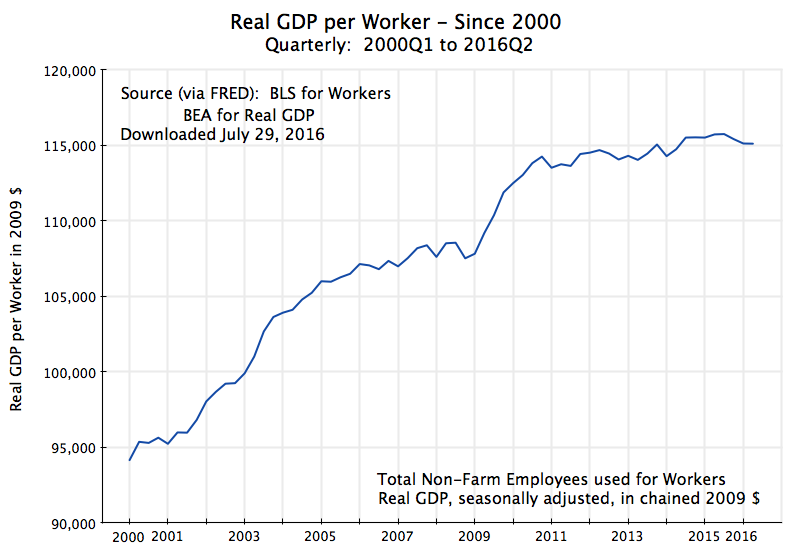
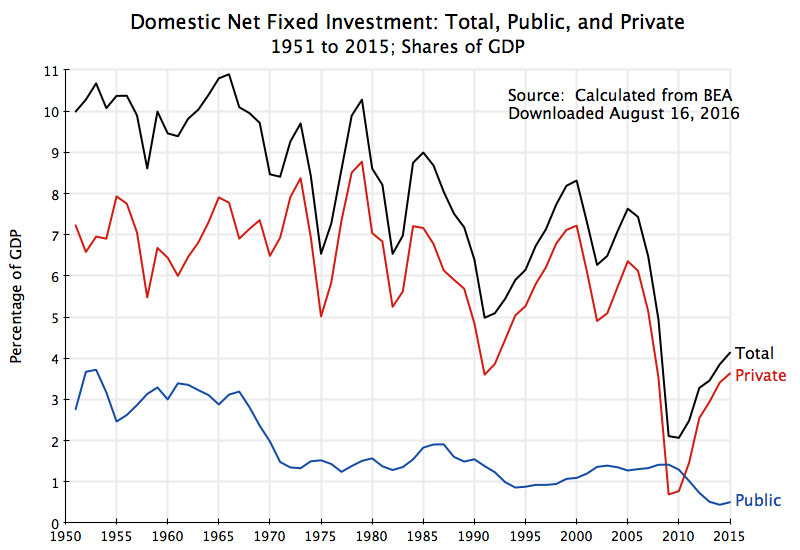
How then to treat investment? Investment is low in the US, and likely is a significant factor in why productivity growth has slowed in recent decades. As discussed in an earlier post on this blog, net private investment has declined in the US from over 7% of GDP between 1951 and 1980, to just half that now. Stagnant real wages have likely been a factor in this (why invest in new equipment if you can hire workers at low wages instead?). And while one will certainly want to take direct actions in the labor market to address this (most importantly by keeping the economy at close to full employment, thus strengthening the bargaining power of labor), tax policy can also contribute.
As discussed above, profits are defined as revenues minus costs, but the costs will in principle include only the extent to which invested assets have depreciated. The problem in practice is that it is impossible to know what that depreciation really is, so our accounting systems use various simplified rules. An example is the frequently used method of straight-line depreciation, where the investment is depreciated at a fixed percentage of its original cost for each year of some assumed lifetime. But commonly, as part of tax policy, depreciation at some accelerated pace is allowed, thus reducing what is considered to be taxable corporate profits in the current period. Costs are treated as if they were higher, by the extent of the higher depreciation allowed under the tax law. This then reduces the share of actual corporate profits that are treated as taxable.
One could extend this to the maximum limit and allow 100% of investment to be depreciated (or “expensed”) in the current year. Investment expenditures would be treated, in the period in which they are made, the same as any other input cost. This would greatly simplify the system, and also would provide a strong incentive to invest.
One would then have that only those corporate profits which are retained on the balance sheet, and not invested in productive assets nor distributed either as interest or as dividends, would be subject to the corporate profits tax (at the 35% rate). This would be close to a cash flow definition of profits (treating interest and similarly dividends as a cost for the capital used by the company), and would be straightforward to measure. Corporate income taxes would only apply to those profits which are neither invested nor paid out as interest or dividends, but rather simply allowed to build up in bank accounts.
c) Tax foreign operations of US corporations the same as their domestic operations, and tax foreign corporations operating in the US the same as a US corporation would be taxed on US operations
Corporations operate across borders, both US firms with operations overseas and foreign-owned corporations with operations in the US. This raises special issues. We will first look at the former (operations of US firms overseas), and then the latter (foreign-owned firms operating in the US).
The recently passed Republican tax legislation would partially exempt from US tax those profits earned by US companies on operations they undertake abroad. But there is no logic in this – why should their operations overseas be taxed at a lower rate than the same operations would be had they been located in the US? And it would also create a tremendous incentive for US companies to shift their operations to overseas locations, preferably to some tax haven. Why this would be considered as something good for American workers is not at all clear. Rather, and to create a level playing field, the earnings on such overseas operations should be subject to tax in the same way as corporate operations on American soil are. And they should be subject to tax at the time such profits are generated, rather than deferred.
One should recognize, again in the name of a level playing field, that corporate taxes paid abroad should count as a credit against their US taxes. This is to avoid what would otherwise be double-taxation (by both the country where the operations are being undertaken, and by the US), and is the standard practice in most of the countries where such operations exist (covered by double-taxation treaties). This is the same as now. But while the payment of such taxes to foreign governments should be recognized and treated as a cost of doing business there, what remains as income should be treated the same as if it were generated by operations in the US.
There is also the issue of what to do about the existing stock of accumulated, untaxed, corporate profits now held abroad. Under US tax law (prior to the recent legislation), profits earned by US companies on overseas operations have not been treated as taxable in the US until such profits are repatriated to the US. This has created the incentive to keep those profits in overseas accounts and investments, with this summing to at least an estimated $2.6 trillion (for 322 of the Fortune 500 top US companies that disclosed such figures, as of end 2016). There is no rational economic reason why such accumulated earnings should benefit from a tax amnesty (whether in full or partial, as the new Republican tax legislation grants). Rather, the taxes due on those funds should be paid and no longer deferred, in accord with the tax reform plan being presented here (distributions to shareholders would be taxed at the level of the individual, investments expensed, and remaining funds not invested in productive assets would be taxed at the 35% rate). One could, however, provide for a multi-year period (of perhaps five years or so) to spread the impact. And keep in mind that the corporations cannot argue that they cannot afford to make such payments. Those assets (of over $2.6 trillion for a sub-set of the larger companies) are sitting in accounts abroad right now.
Finally, there is the issue of how to treat profits from operations in the US of companies owned (wholly or partially) by overseas entities. The basic principle to follow, and to ensure a level playing field as well, is that they should be taxed the same as US owned companies would be. Note that any company operating in the US has to be incorporated in the US under US law (as is the case for companies operating in any country), and thus in principle are US companies. That is, Toyota or BMW car plants in the US are operated by US incorporated subsidiaries owned by (or primarily owned by) Toyota of Japan and BMW of Germany. But their foreign ownership raises special issues.
Such subsidiaries will generally transfer as “dividends” the profits they generate to their foreign parents. But there are other ways (perhaps not always so obvious) to pass along their profits. These include paying interest on loans provided by the corporate parent (possibly at especially high interest rates), or by paying royalties or licensing fees for patents, trademarks, or proprietary designs coming from the parent companies. All such transfers to corporate parents should be treated similarly as dividends.
Taxation of such entities should again follow the “follow the money” principle. To the extent any such payments (whether dividends, interest, or royalties or licensing fees) paid to corporate parents (or to other entities where there is an ownership interest) are made by the foreign-owned subsidiary in the US to US entities who themselves are subject to US taxes (whether individuals, or banks, or other corporate entities), the payments would be treated as a cost. The company would file (as US companies do) the Form 1099s that go to the IRS to inform them that such payments had been made. Tax would then be paid by those individuals or other US entities receiving such payments, on their regular tax forms and in accordance with what they individually owe.
If the entity receiving the payment is not otherwise subject to US taxes (or has not told the company whether they are or not), the foreign-owned US subsidiary would withhold taxes that might be due, at the 35% rate. The individuals or other entities could later file US income tax forms to cover the US taxes they might owe (on these distributions together with that owed on any other activities that generated taxable income in the US), and claim as a credit the taxes withheld on their behalf. If they choose not to file US tax forms, the taxes withheld (at the 35% rate) would constitute the equivalent of corporate profit taxes being paid at such a rate on these US operations. Again, the point is a level playing field between US and foreign-owned companies operating on US soil.
d) Subsidies provided through the tax system to specific industries, sectors, or owners, should end
Finally, the tax code is riddled with special provisions that favor particular industries, sectors, or types of owners. They are provided through a variety of means, including accelerated depreciation provisions in certain industries or for certain types of investments, various tax credits and deductions, and exemption from profit taxation (fully or partially) for those in certain industries.
Subsidies for certain of these activities might well be warranted. But if so, it would be less costly and more transparent to provide such subsidies directly, through the budget, rather than hiding them in the tax code.
It should also be noted that with full expensing of investments allowed under the proposed new system, there will be built-in, and non-discriminatory, advantages provided to all investments. The favored treatment of certain industries and not others, through granting of accelerated depreciation provisions for certain investments and not others, will no longer matter as all industries would be able to deduct 100% of the cost of investment in the year the investment was made. This would include investments made in research and development, where 100% expensing has generally been allowed in recent years. Such R&D costs would still enjoy this, but so would other investments.
As part of an overall reform of the corporate income tax, however, the many special, often industry specific, tax subsidies should end. We will examine below, in Section D, what the resulting savings from this might be.
e) Summary of corporate income tax reforms
In summary, the following is recommended to reform the system of corporate income taxes:
a) Corporate investment expenditures should be allowed to be fully expensed in the year they are incurred.
b) Dividend distributions should be treated as an expense, as interest on loans is now. Together with full expensing of investment expenditures, this would imply that taxable corporate profits will equal what was retained that year and neither distributed (as dividends or interest) nor invested. Those retained earnings, accumulating in bank accounts on the corporate balance sheet, would be taxed at 35% in the year they are so retained.
c) Companies would report the dividend distributions to individuals or other entities on Form 1099s, just like interest payments are now reported. If the individual or other entity has not provided their tax ID number to the company, then the company would withhold taxes on such distributions at the 35% rate. Foreign individuals or entities would be treated similarly, with the taxes withheld, which they could then claim credit for if they file US tax forms covering all their US source incomes.
d) Taxable corporate profits (as defined here) would apply not just to US-based operations, but also to the operations of US companies abroad. That is, the taxation will be the same on a worldwide basis, and there would be no tax incentive to relocate operations to some foreign jurisdiction. Like now, corporate income taxes paid in countries where double-taxation treaties have been negotiated would count as a credit.
e) Profits of US corporations that have accumulated abroad (of an estimated $2.6 trillion for a sub-set of the larger companies) would be subject to a one-time tax on the same basis as retained earnings would now be. One could allow a multi-year period, of perhaps five years, to spread this out.
f) The US subsidiaries of foreign corporations would report (on Form 1099s or their equivalent) any distributions they make. These would include payments of dividends or interest, but also royalties and licensing fees paid to corporate parents (or other entities with an ownership interest). For foreign entities receiving such distributions that are not otherwise subject to US taxes, or in cases where the entity has not provided notice of their US tax status, the companies would withhold taxes at a 35% rate.
g) Special tax subsidies for particular industries or purposes granted through the tax code should end. To the extent any such subsidies are warranted as a matter of public interest, it would be less costly to provide them directly and transparently through the budget.
These reforms would have a major impact on what is collected as corporate income taxes. As we will see below, income taxes paid directly by the corporations themselves would indeed be reduced. But this would in large part be a consequence of the shift of the locus at which such incomes are taxed, from the corporate level to the individuals receiving those incomes. One therefore needs to look at the revenue impact of these together, which we will do in Section D below after first discussing proposed reforms to individual income taxes.
C. Individual Income Taxes
There are six major areas where reforms to the individual income tax system should be enacted:
a) All forms of income should be taxed the same, and not at differing rates and brackets that vary depending on the source of that income;
b) Equal benefit from deductions and personal exemptions should be provided to all, rather than (as now) higher benefits to those in the higher tax brackets;
c) The cost basis of assets passed via inheritance should be retained at what they were, and not stepped-up;
d) Exemption levels on estates subject to tax should be restored to $1.0 million for individuals and $2.0 million for married couples, which is roughly where they were from the mid-1980s through the 1990s (in terms of today’s prices);
e) The use of life insurance to evade taxes on especially large estates should no longer be allowed;
f) Tax subsidies for special, favored, private business activities should end. Any such subsidies which are warranted can be provided at lower cost through the budget.
I have discussed the first three reforms on the list above in an earlier post on this blog. Those interested in further detail on those measures may refer to that earlier post. However, I will try to ensure the discussion here is sufficient to keep this post self-contained.
a) Tax all forms of income the same
Taxing all forms of income the same is a matter not only of basic fairness, but also for reasons of tax efficiency and simplification. To be clear, this does not mean one tax rate for all, but rather that income of one type (say wages) should be taxed the same as income from another source (such as capital gains). Under the current US system a person will pay tax at different rates depending on the source of that income: of up to 39.6% (37% in the recently passed legislation) on what is deemed “ordinary income” (such as wages), of up to 20% on income from capital gains on assets that have been held for more than a year, of also up to 20% on dividends paid on equity shares held for more than 60 days (but not on interest paid by those same companies), of up to 28% from capital gains on “collectibles” and certain small business stock, and of up to 25% from “unrecaptured Section 1250 gain” (whatever that is; I believe it is something primarily to do with real estate).
But this is not all. In addition to such basic rates, there are various add-ons that raise the actual or effective rates for certain households. For example, there has been a net investment income tax (applying to all forms of investment income, including capital gains as well as interest, dividends, rent, and so on) of 3.8% for households with incomes above $250,000 (when married filing jointly). There is also an additional tax for Medicare of 0.9% for wage and self-employment income for households with income above $250,000 (when married filing jointly). This is on top of the regular Medicare tax of 2.9% on all wage income (half technically “paid” by the employer and half by the individual, with the full 2.9% applying for the self-employed).
And then to add even further complexity, personal exemptions and itemized deductions are phased out for higher-income households (of more than $313,800 if married filing jointly in 2017). These are called the PEP and Pease phase-outs, respectively, and act in effect as a higher tax rate on such households up to a certain amount that varies by household (depending on the number of personal exemptions and the value of their declared deductions). Households who are extremely rich, with incomes above these phase-out amounts, then effectively pay a lower income tax rate than these more moderately well-off households pay. The phase-outs raise the effective income tax rate paid by such households by about 1% point for the itemized deductions phaseout (or a bit more if one accounts for interaction effects), and by about 1% point for each personal exemption (thus 2% for a household of two, or 5% for a household of five, and again a bit more with interaction effects).
Finally, on top of all this is the Alternative Minimum Tax, which applies to moderately well-off households, excludes certain exemptions and deductions (in whole or in part), and then taxes the resulting taxable income (as then defined) at a rate of 26% or 28%.
This is incredibly complex, and for no justifiable purpose other than possibly an intention to obfuscate what rate is actually being paid. And the complication does not come from the number of income tax brackets, but rather from taxing different forms of income differently, each with its own set of tax rates and tax brackets. This is not only complex to figure out, but also provides an incentive to try to shift one’s income to a category that is taxed at a lower rate. Thus, for example, suitably structured payments of stock options to high-level managers and other insiders allow them to switch what would otherwise be wage income (taxed at rates of up to 39.6% up to now) to long-term capital gains (taxed at 15% or 20%). Similarly, managers of investment funds are able to structure the payments they receive from successful deals (which they call “carried interest”) at the low capital gains rate, even though they have no money of their own invested and are being compensated for their work in putting together the deals.
The recently passed Republican tax plan does not address this fundamental cause of complexity in the individual income tax system. While some aspects would change (e.g. there would no longer be any personal exemptions, and hence no issue of personal exemptions being phased out), it would also create a new, highly favorable, treatment of what is termed “pass-through” income, that individuals obtain from businesses organized as partnerships, sole proprietorships, sub-chapter S corporations, and similar entities. Currently, such income is treated the same as other ordinary income (such as wages) and is taxed as ordinary income is. But under the new legislation, those in certain professions (but not others, where the rationale for including certain professions and not others is not clear), will be able to reduce their tax rate by 20%. That is, those in the favored professions (and meeting certain other conditions), would be able to reduce the tax due on such income from the 37% others pay to just 29.6%. This would create a strong incentive for such well-off individuals to structure the payments they receive for their work in such a way as to benefit from this lower rate (as the University of Kansas men’s basketball coach did when Kansas started to exempt such pass-through income from the state income tax). Trump himself would be a prime beneficiary of such a “reform”.
The differing tax rates for different forms of income also has major distributional consequences. For example, the special, low, rates on long-term capital gains and on dividends (on shares held for more than 60 days), primarily benefits those who enjoy a high income:
 The Congressional Budget Office, in a May 2013 report, estimated that fully 93% of the benefit of the preferential tax rates on capital gains and dividends accrued to the richest 20% of households (those with a minimum income of $162,800 for a family of four), and over two-thirds (68%) accrued to the richest 1% (those with a minimum income of $654,000 for a family of four). This is a special tax benefit that overwhelmingly favors the rich.
Taxing all forms of individual income the same thus would not only greatly simplify the system, but would also be distributionally positive. And it would be fair, as individuals would pay the same tax on the same total income, regardless of whether they received that income in one form (e.g. wages) or another (e.g. capital gains or dividends).
One issue that would need to be addressed would be to ensure all the income and gains are taxed in terms of today’s prices. This is not a problem for income received in the last year. One just adds up the various sources of income. But for capital gains on assets held for a number of years, accumulated general inflation can be a significant factor. However, it would not be difficult to take account of this. Each year, the IRS would publish a table for accumulated general inflation from any given prior year to today, and these tables would be used to adjust the cost basis of the assets to reflect today’s price level.
A simple example will illustrate what would be done. Suppose you sold shares in some company for $300,000 now, which you had bought for $100,000 ten years ago. The nominal gain would be $200,000. However, a significant share of this reflects inflation. Suppose, in this example, that inflation had averaged 2.0% per year over the ten years. Compounded, cumulative inflation over this period would then be 21.9%, and the $100,000 spent for the asset ten years ago would be equal to $121,900 in today’s prices. The taxable gain in today’s dollars would then be $178,100. One would add that amount to your other earnings this year to determine what your total taxable earnings are this year, in terms of today’s prices.
This would not add any real complication. One already must know the cost basis as well as the date the asset was acquired, and indeed, these are entered on our tax forms. One would just then need to multiply the cost basis by the inflation factor provided by the IRS to reflect the cost in today’s prices.
Another category of income that is taxed differently than other categories of income is interest income from bonds issued by state and local governments (commonly called municipal or “Muni” bonds), as well as Private Activity Bonds (PABs) that are treated similarly. Interest on such bonds is taxed at a special rate of zero (i.e. they are not taxed) at the federal level, and similarly not taxed at the level of most states and localities (for citizens of those jurisdictions).
With the interest income on such bonds not taxed federally (nor locally), the bonds can be issued at a lower interest rate. The market will be able to issue such bonds at a rate of, for example, say 4%, when similar bonds (with similar risks) can only be sold with an interest rate of say 6%. If one is in a 40% tax bracket, taxable interest earnings at 6% will equal 3.6% after taxes, so a similar risk bond paying 4% with no taxes due will be attractive.
This is done as a means to provide federal subsidy support to states and localities as they fund their investments and programs, but it is a terrible way to do it. The federal subsidy comes from the federal tax revenue that is given up by allowing such bonds to be issued tax-free. But it would cost less to the federal treasury if such subsidies were provided directly to the states and localities, rather than indirectly through this tax avoidance mechanism. The reason is that such bonds will be sold in the market at that price where the interest paid by them will match what the marginal individual buying such bonds would receive, after taxes, from a regular, taxable, bond of similar risk and maturity. At that price, the marginal individual buying such bonds would be indifferent between the two types of bonds. They would receive the same, after tax, interest on each.
This would normally be for someone in one of the middle tax brackets. Someone who is richer than that, in one of the higher tax brackets, will then receive a windfall gain equal to the difference between what they will earn from the tax-free bond, and what they would earn (after taxes) had the bond not been tax-free. In the example above, the windfall to someone in the 40% bracket would equal the difference between the 3.6% and 4.0% interest rates, times the value of such bonds that they hold. This is a direct windfall to the rich, and only the rich. It would be cheaper for the federal government to provide the subsidies directly to the states and localities, if such subsidies are warranted.
Private Activity Bonds have the same problem, as the interest on them is also tax-free. The original logic appears to be that such bonds would be used to finance infrastructure and other expenditures that states and localities have traditionally funded, but the allowable purposes for which such PABs can now be used is much broader. They are used for many real estate development projects, for some housing, for investments in “qualified enterprise zones”, for certain mortgages, and even for certain manufacturing and farm investments. They can be used for pro sports stadiums and arenas (although not for luxury skyboxes built in them). But while there are guidelines for the allowable purposes, there appears to be a good deal of discretion at the local level on what qualifies as eligible, and politically well-connected actors undoubtedly have an advantage in receiving such local approvals.
But even aside from whether PABs may be used for questionable purposes, they suffer from the same inherent excessive cost as Muni bonds do. If it made sense for the federal government to subsidize such activities, it would be cheaper to subsidize them directly through the federal budget. Providing the subsidy by granting such bonds tax-free treatment leads to a windfall going directly to the rich in the higher tax brackets.
To sum up, in replacement of the current complex system where different forms of income are often taxed differently, requiring different taxes to be computed on each and with resulting interactions among them, one should simply add up incomes earned each year from all sources (in current year prices), and pay a progressive tax on the total.
b) Provide equal tax benefits to all from deductions and exemptions
Under the current system, the cost to someone in, say, a 40% tax bracket for a $100 contribution to some charity is only $60. The charitable contribution is tax deductible, and hence the federal government is compensating someone in the 40% bracket $40 for the contribution to that charity. But someone in the middle class in, say, a 20% tax bracket, would only receive a $20 compensation from the federal government for a $100 contribution to that exact same charity. It would cost them a net $80. And someone even poorer, in a 10% tax bracket would receive only $10 back, so it would cost them $90 for a contribution to that exact same charity again (assuming they itemize deductions; if not, it would cost them the full $100).
This is not fair. The richer are receiving a bigger gift from the federal government for a $100 contribution to the same charity that the others have also contributed to. There is also no reason of practicality why the system needs to be structured in this way. Instead, one would simply add up all deductions (as now on Schedule A of the Form 1040), plus whatever amounts are set for personal exemptions ($4,050 per person in the household in 2017). Then, instead of deducting this total from gross income, with the tax then determined based on the various tax rates, one would deduct some share (perhaps 25%, but the same for everyone) as a credit from taxes due. That is, one would first determine taxes due on gross income, and then treat as a tax credit some fixed percentage of the total of what is now treated as deductions and exemptions.
As part of this, one would also eliminate the PEP and Pease phase-outs which in effect make those who are moderately well-off pay a higher tax rate than what they are nominally obliged to pay (and a higher rate than what those who are even wealthier have to pay). This just complicates the system. It is better to set the rates openly and clearly, and keep the rates progressive.
Under the proposed system, a $100 contribution to some charity would in effect then cost the taxpayer $75 (if a 25% rate is used) whether or not the person is rich, middle class, or poor. The rate to be used, 25% in the examples here, could be set at that level which would be neutral in terms of the overall impact on tax collections. It would in effect be a weighted average of what applies now to everyone in all tax brackets. One would also apply the same rate of 25% (or whatever) to the amount used for the standard deduction ($12,700 in 2017 for couples filing jointly), as well as to personal exemptions ($4,050 per person in 2017), and then treat them all similarly as a tax credit.
One would do this primarily to be fair to all. But it would also simplify the system.
c) Maintain the prior cost basis on inherited assets
Taxes are paid on the income obtained from capital gains when assets are sold. The gain is equal to the difference between the price received for the asset, and the price paid for it at some time before (the cost basis). As discussed above, as part of a general tax reform the cost basis should be adjusted for general inflation between when the asset was purchased and when it was sold (and then taxed at the same rate as any other source of income), but the principle remains that taxes are paid on the income received from buying and selling assets.
There is, however, an exception to this in the current tax system (and would remain an exception in the new Republican plan). When an asset is received via inheritance, the cost basis is reset to what the value of the asset is at the time it is inherited. That can be a major favor to those inheriting assets, and there is no justifiable reason for it.
Some have argued that the person inheriting the asset would not necessarily know the cost basis, but that could be easily remedied. First, the cost basis for financial assets traded through some broker such as Fidelity or Merrill Lynch will be recorded by that broker (and is reported to the IRS when the asset is sold). And the value at which real estate is bought and sold will be recorded by the local government and kept in its land records forever. Thus one will normally have the cost basis independently, from third-party sources. But should there be any other asset where there might not be an independent record of the cost basis, or should the cost basis change for some valid reason (such as for a major capital improvement in some real estate asset), one could always make sure the correct cost basis is recorded in an annex or something similar in any wills or trusts that convey the assets to the beneficiaries. Or that annex could indicate where to go to find the papers with the cost basis. Indeed, it would be good practice anyway to record those values (or where to go to find the values) in such documents for all assets being passed to heirs.
Another argument that might be made is that those inheriting the assets might not be able to afford to pay the tax if the income received is calculated based on the original cost basis of the asset, rather than a stepped-up value. But this would be a confused argument. First, the tax due would not arise until the asset is sold, which could be many years later. And second, when the asset is sold those inheriting the asset will receive a payment for the full amount of the sale. One will have the funds to pay any tax that is then due.
The current treatment of these assets, with a step-up in the cost basis to the value at the time of inheritance, is also of greatest benefit to the rich. This is not surprising: the wealthy will leave a larger estate to be inherited than the not so wealthy. The Congressional Budget Office has provided an estimate:
 While not so extremely skewed distributionally as the benefit gained from the low rate of tax on long-term capital gains (discussed above), two-thirds of the benefits of this tax provision still go to the richest 20% of households, and over 20% of the benefit goes to the richest 1%.
As part of a general tax reform, this provision should be eliminated. The cost basis of assets should remain at whatever it had been, and not stepped-up at the time the asset is inherited to whatever the value is then.
d) Restore the exemption levels for the estate tax to $1.0 million for individuals and $2.0 million for married couples
The estate tax is now paid by only a tiny percentage of high net worth estates, because the exemption level has been raised over time to extremely high levels. In 2017, estates with a net taxable value (after contributions to charity) of $5.49 million (or $10.98 million for married couples, if some standard arrangements have been made) are subject to this tax. Because this exemption level is now so high, and with other ways as well to avoid estate taxes (such as use of life insurance, to be discussed below), only a small percentage of estates, less than 0.2%, end up paying any estate tax at all. And under the recently passed Republican tax legislation, these floors on what is taxed would double, to $22 million for a married couple. Only an exceedingly small share of estates will need to be concerned with this tax.
Until the tax cuts passed in 2001 under George W. Bush, the exemption level of estates had been far less. It was raised as part of those tax cuts from $675,000 in 2001 to $1.0 million in 2002-03, and then by phases to the current $5.49 million (for 2017). Indeed, in one year (2010) it was removed altogether. Its complete removal has long been a goal of Republican leaders.
Returning the floor of what is subject to tax to $1.0 million for individuals and $2.0 million for married couples (with this inflation indexed going forward) would restore it to where it roughly was (in terms of today’s prices) from the mid-1980s through the 1990s. Based on what was observed in the late 1990s, it would apply only to the richest 2% of households, approximately. And this 2% share is indeed less than what the share was for most of the post-World War II period. On average, a bit over 3% of estates were subject to the tax between 1946 and 2001. There is no evidence that this tax at those levels did any harm to the economy.
e) Ensure life insurance proceeds on especially large estates are subject to normal taxation, and not used as a way to evade taxation
A common “tax planning” tool used by the very wealthy to evade estate (and any other) taxes on assets passed to their heirs has been the use of life insurance. Life insurance proceeds are not subject to tax. For those who use life insurance for its intended purpose (to provide for family members and other dependants in case of an unexpected death), this is reasonable. It should not then be subject to tax. But its use to evade estate taxes should not be allowed.
One would then need to distinguish between these two purposes, and the question is how. That could be done in various ways. One could establish certain criteria, such as that both the age of death at which it would apply would be the normal retirement age or greater (say at age 66), plus that those receiving the insurance proceeds would be individuals other than the spouse or non-adult dependants of the deceased, plus that the amount in total to be paid out would (together with other estate assets) exceed the exemption level for estates subject to tax (which would be, as proposed above, $1.0 million for individuals and $2.0 million for married couples).
Using life insurance proceeds as a tax planning tool to allow extremely large estates to pass tax-free to heirs is a loophole which evades the intent of the estate tax. It should be closed.
f) Stop providing tax subsidies for special private activities
Finally, like the corporate income tax, the individual income tax provides special tax subsidies for various private business activities. These include special deductions for certain “domestic production activities” (defined somehow in the tax code), favorable treatment of income earned abroad, and special advantages from the sale of certain categories of business stock. While various subsidies to clean energy sources and energy efficiency are also included here, they are only a small share of the total – less than 10%.
To the extent such subsidies serve a valid public purpose, it would be less costly and more transparent to provide them directly and explicitly through the budget. But many of these subsidies would not survive such public scrutiny. They should be ended.
D. An Estimate of the Impact of These Reforms on Tax Revenues
What would be the net impact on tax revenues from the reforms discussed above? Estimates for the totals over the ten-year period of FY2018 to FY2027 are:
|
Impact of Tax Reform on Revenues, in $ billions |
FY2018-27 |
|
Corporate Income Taxes: |
|
|
End deferral of tax on overseas income |
$1,500 |
|
End subsidies for special industries & activities |
$950 |
|
Expense investment at 100% |
-$200 |
|
Exclude dividends paid to domestic persons |
-$2,500 |
|
Sub-total |
-$250 |
|
Individual Income Taxes: |
|
|
Tax capital gains and dividends at ordinary rates |
$1,150 |
|
Tax interest from Muni bonds and PABs at ordinary rates |
$700 |
|
End step-up of cost basis of inheritance |
$450 |
|
Return estate tax exemption to $1.0 / $2.0 million |
$500 |
|
Tax large life insurance proceeds from estates at ordinary rates |
$250 |
|
End special tax subsidies for favored private business activities |
$250 |
|
End surtax on investment income |
-$400 |
|
End PEP and Pease phase-outs |
-$250 |
|
Sub-total |
$2,700 |
|
Overall Net Impact on Tax Revenues |
$2,450 |
|
% change in Tax Revenues as share of Individual Income Tax |
11.2% |
(Estimates rounded to nearest $50 billion, and totals are based on figures before rounding.)
I should emphasize that these are very rough estimates. I will discuss below the various sources and assumptions made to arrive at these figures, but would stress that the information available to make such estimates is limited, and also does not take into account interaction effects nor how agents would react should such reforms be enacted. Because they are rough, I have rounded each of the estimates to the nearest $50 billion (for the ten-year totals). Nevertheless, the figures should suffice to give a sense of the magnitudes, and how the individual impacts would add up.
I have also excluded here what would be a significant, but one time, source of tax revenues under the proposed reforms. Specifically, I have left out from the estimates here the taxes that would be paid on the accumulation of profits held overseas, on which taxes otherwise would have been due in the past had those profits been repatriated to the US. As noted above, those untaxed profits are estimated to total $2.6 trillion for a subset of the larger US companies (the subset where data could be obtained for an estimate). Those up-to-now untaxed profits would be subject to a 35% tax to the extent they are not either distributed to shareholders (in which case they would then be taxed at the individual level, at that individual’s rate) nor invested in productive assets (as investments could be fully expensed). It is impossible to say how companies would then respond, but if they did nothing, a 35% tax on $2.6 trillion would total $910 billion. This would be a significant addition to the ten-year totals. But it is one time (perhaps spread, as discussed above, over a five year period), plus companies would be expected to respond in some way. Thus I have left this figure, significant though it might be, out of the totals here. Rather, the focus is on what the on-going, long-term, impacts might be of the tax reforms.
On the sources: Most of the figures are derived from the most recent (January 2017) estimates of tax expenditures published by the Joint Committee on Taxation (JCT) of Congress. The JCT publishes such estimates annually, and cover around 250 individual items. Most are quite small, but they add up. The report shows them separately for corporations and for individuals, and by year although only for the five years of FY2016 through FY2020 in their most recent report. To scale them to the fiscal years of FY2018-27 (to make them comparable to the years discussed in the Republican tax legislation), I rescaled the totals for each category to FY2018-27 by multiplying them by the ratio of the Congressional Budget Office June 2017 forecasts of corporate or individual income tax revenues for FY2018-27 to what CBO is forecasting for FY2016-20 (separately for the corporate income tax and for the individual income tax).
Adjustments were needed for two of the proposed reform items. The JCT estimates of the impact of the special, low, capital gains tax rate applied to long-term capital gains and qualified dividends, is based on figures which do not reflect inflation indexing of the cost basis for long-term capital gains. Such inflation indexing would reduce the revenues collected significantly, but we do not have the data needed to provide a good estimate of how much. To arrive at the figure shown here, I first took out the qualified dividends share of the total taxed at the capital gains rate (where published IRS data shows that in 2015 the share was 31%), as such dividends are paid in the current year. The remainder reflects actual long-term capital gains. Arbitrarily but generously, I assumed such capital gains would be reduced by 50% due to inflation indexing of the cost basis. I suspect this is on the high side – the true reduction is likely to be less. But based on this assumption, I arrived at the figure shown in the table.
The second item in the JCT estimates that needed to be adjusted was the impact of no longer treating as tax-free the payments made under life insurance. As discussed above, some life insurance is used as a genuine tool to manage the financial risk of losing a provider for the family. But life insurance is also used as an estate planning tool by wealthy estates to convey, tax-free, the assets from an estate to heirs, and thus avoid the estate tax. In terms of dollar volumes, this latter use likely dominates. One would want to design the tax only to apply to the latter, which could be done through various ways (using age, who the heirs would be, and a large minimum size). For the purposes of the calculation of the tax revenue impact of such a reform, I assumed that the revenues generated would be reduced to 80% of the JCT estimates, as life insurance for the management of the financial risk of losing a family provider would remain tax exempt.
The January 2017 JCT report on tax expenditures did not have estimates for three of the tax items. One was what the impact would be from allowing 100% expensing of all corporate investment. However, a recent (November 14) JCT analysis of the tax revenue impacts of the House Republican tax plan did include, as a separate item, the cost of a proposed 100% expensing of corporate investment. While this expensing (under the then House Republican plan) would formally end in 2022, one can use the estimates shown for a separate 100% expensing item (for small business) to calculate what it would roughly be in the second half of the decade (the relative proportions would be similar). Note that the net tax revenue impact of 100% expensing diminishes over time. Full expensing essentially brings forward allowed depreciation, so instead of spreading depreciation over time, the asset is treated as if the full cost was borne in the initial period. This reduces taxable profits in the initial year, but then will raise it later (as the full depreciation has already been taken).
The second was the cost of returning exemption levels for estates to $1.0 million for individuals and $2.0 million for married couples. This was estimated based on figures from the Tax Policy Center on the revenues collected by this tax in the late 1990s (but converted into revenues in today’s prices), when the exemption levels then (in terms of today’s prices) were close to the proposed new levels. They were then forecast going forward to grow at the same rate as what the Congressional Budget Office forecast for the estate tax under current law. The net increase in revenues would then equal the difference between this stream of tax revenues (with the exemption levels at $1.0 / $2.0 million) and what the CBO is forecasting the revenues would be under current law.
Finally, the impact of shifting the taxation of dividends from the corporate level to the individual level (where it would be taxed at the same rate as other income) was estimated based on current figures from the GDP accounts on corporate dividends, less Tax Policy Center estimates on the share going to foreigners, with this then forecast to grow at the same rate as what the JCT is forecasting for dividends and capital gains.
The resulting figures are shown in the table, with each rounded to the nearest $50 billion. The net impact of the reforms on what would be collected directly through the corporate income tax would be a decline of $250 billion over the next ten years. There would be a reduction in taxes collected at the corporate level of $2.5 trillion from excluding dividends from taxable corporate profits, and a reduction of $200 billion from allowing investment to be 100% expensed. But this would mostly be offset by ending the deferral of taxes on income earned abroad by US corporate subsidiaries (generating $1.5 trillion in revenues), and by ending corporate subsidies for various special industries and activities (generating $950 billion).
Income tax collected at the individual level would, however, grow by an estimated $2.7 trillion over the ten year period. The largest component of this ($1.15 trillion) would be generated by taxing capital gains and dividends at ordinary income tax rates, rather than the special low rate (20% generally) they are granted now. Taxing interest on state and local government bonds (Munis) as well as private activity bonds (PABs), rather than not taxing them at all, would generate $700 billion over the ten years. Ending the step-up of cost basis on assets received via inheritance would generate $450 billion, while returning the exemption level for the estate tax to $1.0 million for individuals and $2.0 million for married couples would generate $500 billion. Taxing large life insurance proceeds from estates, used to evade estate taxes, would generate an estimated $250 billion. And ending special tax subsidies to individuals for favored private business activities would generate $250 billion.
Partially offsetting this, ending the surtax on certain rich households on investment income (so that it would be taxed the same as other income) would mean a reduction of $400 billion in tax revenues over the decade. And ending the complication of the PEP (personal exemption) and Pease (itemized deductions) phase-outs would reduce revenues by an estimated $250 billion.
Adding the impacts on both the corporate income tax and the individual income tax, the net effect would be to raise tax revenues collected by an estimated $2.45 trillion over the ten years. This is large, and can be contrasted with the loss of $1.5 trillion in tax revenues that would follow from the recently passed Republican tax plan. Even if several of my revenue estimates turn out to be too optimistic, the $2.45 trillion increase in revenues leaves a generous margin for uncertainties. The net impact of these tax reforms would almost certainly be budget positive.
But assuming the $2.45 trillion surplus is a reasonable estimate, what could be done with such an amount? First, I would note that some of the savings would come from ending various subsidies through the tax system. As discussed above, providing such subsidies through the tax system is both costly (it would cost less to provide the subsidies directly through the budget, as the current system provides a windfall to those in the higher tax brackets) and lacks transparency. Many of these subsidies should cease altogether, but some might well serve a valid public purpose. When this is the case, regular budget expenditures would rise, and one should use a portion of the $2.45 trillion for such expenditures.
One might also wish to use a portion of the $2.45 trillion for other urgently needed budget expenditures the nation requires, such as for infrastructure. As discussed in prior posts on this blog, government expenditures have been squeezed for many years, leaving a backlog of high priority needs. One might also use a portion of the $2.45 trillion to pay down part of the national debt, although the priority of this is not clear. Even the supposedly fiscally conservative Republicans see no problem with voting for a tax plan that would reduce tax revenues by $1.5 trillion over the next decade.
Finally, one could use the $2.45 trillion to adjust income tax rates downward. If the full $2.45 trillion were used for this, and if one were to apply the reduction in proportion to current rates (as of 2017), one can calculate (using the CBO forecasts of tax revenues under current law), that the top tax rate could be cut from the current 39.6% to a rate of 35.6%. The other tax rates would be similarly reduced (proportionally). This would even be close to the top rate of 35% that the Republican plans have been aiming for (at various times), but would have been achieved as a consequence of true reforms. That is, rather than setting a rate target (of 35% or whatever) and then trying to find sufficient measures to allow this to be met (including allowing for a net revenue loss of $1.5 trillion), the approach of a true reform is to start with several basic principles (uniform tax rates on all forms of income, progressivity, and simplification), work out what reforms would follow from this, and then set the rates accordingly for revenue neutrality.
E. Conclusion
The recent debate on tax policy was an opportunity to enact a true reform. We certainly need it. The current tax system is inequitable, overly complicated, has provisions which induce perverse behavior, and is costly to administer. Sadly, the recently passed Republican tax plan will make it worse, as just the example of the special treatment of pass-through income makes clear. The new law introduces new inequities (pass-through tax provisions that favor a narrow few), new complications (distinctions that cannot be logically explained as to whom will be able to cut their taxes on pass-through income, such as professionals in real estate but not certain others), provisions that will induce perverse behavior (such as newly-created business structures for doctors to sell and lease back their offices, in order to obtain some of the pass-through benefits that real estate companies will enjoy), and will be costly to administer (as the IRS tries to ensure the law is applied as intended despite the numerous complications, as for example again with regard to who will and will not be allowed to benefit from the tax cuts for pass-through income).
And the complications and inequities in the new Republican tax legislation extend far beyond what was done on pass-through income. Many new loopholes have been created, and the tax cuts provided have gone disproportionately to the rich. Along with differing treatments of different sources of income, the new system will be more complex than the old, and less progressive. Finally, it will not be revenue neutral. Rather, it will lead to $1.5 trillion more being borrowed in our budget over the next ten years. Our budget is in deficit and will remain so if nothing is done, even though now is the time, with the economy at full employment, that one should be moving to a budget surplus. In effect, we are borrowing a further $1.5 trillion over the next decade to hand out primarily to the rich.
In a simple and fair system of taxation, one would be paying the same in taxes whether one’s income came from working for wages, from business income, from dividends from corporations or interest from loans, from stock options, or from capital gains. Under our current tax system, each of these sources of income may be taxed at different rates. The result is undue complication, as one has to determine not only what total income is but also how it should be categorized. But in addition there are interaction effects, where the tax applied in some category depends not only on the income earned in that category, but also often on the income earned in other categories. And most importantly, there is then the incentive to try to arrange income payments so that they will come under a category where lower taxes are due (e.g. shifting wage income to stock options, or for hedge fund managers to shift what would be wage income to “carried interest”).
The new Republican tax plan will make this worse. Now there is a new general category treated preferentially, of pass-through income. Pass-through income had been taxed before the same as wage and other ordinary income. Now it will be taxed 20% less. This is a strong incentive, for those who are able, to try to arrange the payments they receive to qualify as pass-through income rather than wages. This is just a gift to the wealthy who are able to obtain such special treatment.
But there is no disagreement that a true tax reform is certainly needed in the US. The proposals outlined above show what could have been done. And such a reform now is more important than ever, as the Republican tax plan has moved us in the opposite direction of what we needed.





You must be logged in to post a comment.