Why Wages Have Stagnated While GDP Has Grown: The Proximate Factors

Real GDP per Capita & Median Weekly Earnings, 1980-2013

A.  Introduction

A healthy debate appears to be developing in the run up to the 2016 elections, with politicians of all parties raising the issue of stagnant wages.  Republicans have charged that this is a recent development, and the fault of Obama, but that is certainly not the case.  As the diagram above shows, real median wages have been stagnant since at least 1980, despite real GDP per capita which is 78% higher now than then.  Real median wages are only 5% higher (and in fact unchanged from 1979).  In a normally developing economy, one would expect real GDP per capita and real wages to move together, growing at similar rates and certainly not diverging.  But that has not been the case in the US since at least the early 1980s.

Why has such a large wedge opened up between worker earnings and GDP per capita?  This blog post will look at the immediate factors that lead from one curve to the other.  This will all be data and arithmetic, but will allow one to decompose the separation into several key underlying factors.  A future blog post will look at policies that would address those factors.

B.  Moving from Growth in GDP per Capita to Stagnant Real Wages

The progression from GDP per capita to real wages, with intermediate steps shown, looks as follows:

Going from GDP per Capita to Median Wage, 1947 to 2013:14

The chart here goes back further, to 1947, to show the divergence in recent decades in a longer term perspective.  The data come from the Bureau of Economic Analysis (BEA) or the Bureau of Labor Statistics (BLS).  As one sees, the curves moved together until around the mid-1970s, after which they began to diverge.

1)  Real GDP per Capita

Starting at the top, real GDP per capita (the curve in blue) measures the progression, in real terms, of GDP per person in the US.  GDP captures the value of all goods and services produced in the economy.  Its price index, the GDP deflator, is a price index for all those goods and services.  Although there have been temporary dips with periodic recessions, real GDP per capita has in fact grown at a remarkably stable long term rate of about 1.9% per annum going back all the way to 1870.  The growth rate was in fact a bit higher, at 2.0%, from 1947 to 2014, as the 1947 starting point was somewhat below the long term trend.  With this growth, real GDP per person was 3.75 times higher in 2014 than what it was in 1947.

2)  Real GDP per FTE Worker

But wages are paid to individual workers, and the share of workers in the population can change over time.  The share has in fact grown significantly over the post-war period, and in particular since about the mid-1960s, principally due to women entering the labor force.  There will also be demographic effects leading to changes in the shares of the very young and of retirees.

With a growing share of the population in the labor force, real GDP per full time equivalent (FTE) worker (the measure of the labor force used by the BEA) will grow by less than it will per person in the population.  The path of real GDP per FTE worker (the curve in green in the chart above), will rise more slowly than the path for real GDP per capita.  The curves start to diverge in the mid-1960s, when large numbers of women began to enter the labor force.

It should also be noted that the divergence in the two paths will not necessarily continue forever.  Indeed, the paths have in fact grown broadly in parallel from around 1997 until 2008 (when GDP per capita dipped in the downturn that began in the last year of the Bush administration).  The number of women entering the labor force reached a peak as a share of the labor force around 1997, and a decade later the first of the baby boomers started to retire.

Thus while such demographic factors and labor force participation decisions led to a significant divergence in the two paths (between GDP per capita and GDP per FTE worker) from the mid-1960s to the late-1990s, the impact since then has been broadly neutral, and might in fact go the other way going forward.

3)  Average Real Wages using the GDP Deflator

Next, workers are paid wages, not units of GDP.  Wages and salaries made up roughly half of GDP in 1947, with most of the rest accounted for by profits to capital.  And it stayed in the narrow range of 49 to 51% of GDP continuously until 1974.  The share then fell to 48%, where it held until 1981, and then began to deteriorate much more sharply, to just 42% as of 2013 (the most recent year with this data).

If the share of wages in GDP had remained constant, then the growth of wages per FTE worker would have exactly matched the growth of GDP per FTE worker.  But with a declining share of wages in GDP (with a growing share of profits as the mirror image), the curve (shown in brown in the chart above) of wages per FTE worker will rise by less than the curve of real GDP per FTE worker.

4)  Average Real Wages using the Consumer Price Index

The curves so far have been measured in real terms based on the GDP deflator.  The GDP deflator is a price index that takes into account all goods and services produced in the economy, and the weights in the price index will be in accordance with the shares of each of the goods or services in the overall economy.  But to an individual, what matters is the prices of goods and services that he or she buys.  This is measured by the consumer price index (cpi), where the weights used are in accordance with the expenditures shares of households on each of the items.  These weights can be significantly different than the weights of the items in GDP, as GDP includes more than simply what households consume.

The curve in orange in the chart above is then the average real wage but with the cpi rather than the GDP deflator used to account for inflation.  From 1978 onwards, the average real wage based on the cpi grew by significantly less than the average real wage measured in terms of the GDP deflator.  That is, inflation as measured by the items that make up the cpi grew at a faster rate, from 1978 onwards, than inflation as measured by the items (and their weights) that go into the GDP deflator.  Up until 1978, the cpi and the GDP deflator grew at remarkably similar rates, so the two curves (brown and orange in the chart) follow each other closely up to that year.

What happened after 1978?  The prices of several items whose weight in the cpi is greater than their weight in the GDP deflator began to rise more rapidly than other prices.  Especially important was the rise in medical costs in recent decades, but also important was the rise in housing costs as well as energy (with energy increases already from 1974).

Thus wages expressed in terms of what households buy (the cpi) rose by less, from 1978 onwards, than when expressed in terms of what the economy produces overall (the GDP deflator).

5)  Median Real Wages using the Consumer Price Index

The final step is to note that average wages can be misleading when the distribution of wages becomes more skewed.  If the wages of a few relatively well off wage earners (lawyers, say) rise sharply, the average wage can go up even though the median wage (the wage at which 50% of the workers are earning more and 50% are earning less) has been flat.  And that median wage is what is shown as the red curve in the chart.

[Technical Note:  The median wage series used here is the median weekly earnings of full time workers, adjusted for inflation using the cpi.  The series unfortunately only starts in 1979, but is the only series on the median, as opposed to average, wage I could find that the BLS publishes which goes back even as far as that.  The source comes from the Current Population Survey, which is the same survey of households used to estimate the nation’s unemployment rate, among other statistics.]

Since 1980 (and indeed since 1979, when the series starts), the median real wage has been flat.  This is not a new phenomenon, that only began recently.  But it is a problem nonetheless, and more so because it has persisted over decades.

C.  The Astounding Deterioration in the Distribution of Income Since 1980

Aside from demographic effects (including the impact of women entering the labor force), and the differential impact of certain price increases (medical costs, as well as others), the reason median real wages have been flat since around 1980 despite an increase of real GDP per capita of close to 80% over this period, is distributional.  The share of wages in GDP has been reduced while the share of profits has increased, and the distribution within wages has favored the better off compared to the less well off (leading to a rise in the average wage even though the median wage has been flat).

That is, the US has a distribution problem.  Wages have lost relative to profits (and profits largely accrue to the rich and wealthy), and the wages of lower paid workers have fallen even while the wages of higher paid workers have risen.

There are therefore two reasons for the distribution of income at the household level to have deteriorated since 1980.  And one sees this in the data:

Piketty - Saez 1945 to 2012, Feb 2015

This is an update of a chart presented in an earlier post, with data now available through 2012, and with the period from 1945 to 1980 included on the same chart as well.  The data came from the World Top Incomes Database (now part of the World Inequality Database), which is maintained by Thomas Piketty, Emmanuel Saez, and others.  The data is drawn from individual income tax return filings, and thus the distribution is formally by tax reporting unit (which will normally be households).  The incomes reported are total taxable incomes, whether from wages or from capital.

Over the 33 years from 1947 to 1980, average reported taxable incomes rose in real terms (using the cpi price index to adjust for inflation) by 87%.  The incomes of the bottom 90%, the top 10%, and the top 0.01%, rose by almost exactly the same amount, while the incomes of the top 1% and top 0.1% also rose substantially (by 57% and 63% respectively).  It is amazing how close together all these figures are.

This changed dramatically from 1980.  As the chart above shows, the curves then started to diverge sharply.  Furthermore, the average reported income rose only by 24% over 1980 to 2012, even though real GDP per capita rose by 73% over this period.  The 24% average increase can be compared to the 28% increase over the same years in the average real wage (based on the cpi).  While from two totally different sources of data (income tax returns vs. the national income accounts of the BEA) and measuring somewhat different concepts, these are surprisingly close.

But while average real incomes per household rose by 24%, the bottom 90% saw their real incomes fall by 6%.  Instead, the rich gained tremendously:  by 80% for the top 10%, by 178% for the top 1%, by 312% for the top 0.1%, and by an astounding 431% for the top 0.01%.

The US really does have a distribution problem, and this deterioration in distribution largely explains why real median wages have stagnated since 1980, while real GDP per capita grew at a similar rate to what it had before.

D.  Summary

To summarize, in the post-war period from 1947 to about the mid-1970s, measures of real income per person grew substantially and at similar rates.  Since then, real GDP per capita continued to grow at about the same pace as it had before, but others fell back.  The median real wage has been stagnant.

One can attribute this to four effects, each of which has been broadly similar in terms of the magnitude of the impact:

a)  Real GDP per worker has grown by less than real GDP per capita, as the share of those working the population (primarily women) has grown, with this becoming important from around the mid-1960s.  However, there has been no further impact from this since around 1997 (i.e. the curves then moved in parallel).  It may be close to neutral going forward, but was an important factor in explaining the divergence in the period from the mid-1960s to the late-1990s.

b)  The average real wage (in terms of the GDP deflator) has grown by less than real GDP per worker, as the share of GDP going to wages has gone down while the share going to profits (the mirror image) has gone up, especially since about 1982.

c)  The average real wage measured in terms of the cpi has grown by less than the average real wage measured in terms of the GDP deflator, because of the rising relative price since 1978 of items important in the household consumption basket, including in particular medical costs, but also housing and energy.

d)  The median real wage has grown by less than the average real wage (and indeed has not grown at all since the data series began in 1979), because of increasing dispersion in wage earnings between the relatively highly paid and the rest.

The implication of all this is that if one wants to attack the problem of stagnant wages, one needs to address the sharp deterioration in distribution that has been observed since 1980, and secondly address issues like medical costs.  Medical costs have in fact stabilized under Obama, as was discussed in a recent post on this blog.  But while several of the measures passed as part of the Affordable Care Act (aka ObamaCare) have served to hold down costs, it is too early to say that the previous relentless upward pressure of medical costs has ended.  More needs to be done.

Future blog posts will discuss what policy measures could be taken to address the problem of stagnant real wages and the deterioration in the distribution of income, as well as what can be done to address medical costs.
Rising Income Inequality: Full Employment Would Have Kept the Bottom 20% From Falling Behind

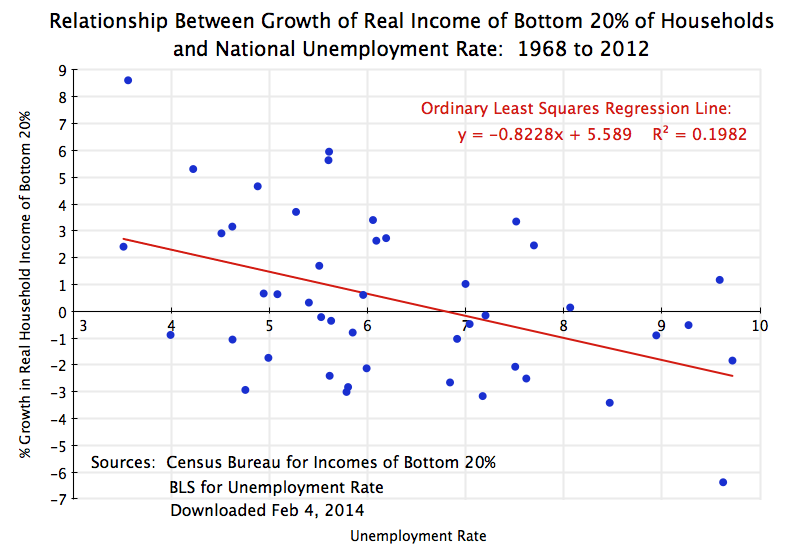
Real Income Growth of Bottom 20% vs Unemployment Rate, 1968-2012

A.  Introduction

President Obama highlighted in this year’s State of the Union address, as well as in other recent speeches and events, the importance of and concerns about the worsening distribution of income in the US.  As this blog noted in a post two years ago, income distribution has worsened markedly in the US since about 1980, when Reagan was elected.  This deterioration since 1980 is in sharp contrast to the period from the end of World War II until 1980, when incomes of all groups in the US moved upward together.  The paths then diverged sharply after 1980, with large increases in the incomes of the rich (and in particular the extremely rich:  the top 1%, top 0.1%, and especially the top 0.01%), while the real incomes of the bottom 90% were flat or even falling.

An important question, of course, is what to do to achieve more equitable growth, and in particular more rapid growth in the real incomes of those in the lower strata of the population.  Much of the discussion has focussed on measures such as improving our educational and training systems, to prepare workers for better paying jobs.  There is no doubt that such measures are important, and need to be done.  Their impact will, however, only be over the long term – in a generation for measures such as improvements in the educational system.

This blog post will focus on a more immediate action that can be taken:  returning the economy to full employment and keeping it there.  We will find that based on historic patterns, slack in the labor market due to less than full employment has been negatively associated with growth in the real incomes of the bottom 20% of households.  Furthermore, based on statistical regression parameters estimated from the historical data, the greater degree of slack in the US labor market since 1980 compared to that in the thirty years before 1980, largely suffices in itself to account for the relative deterioration of real incomes since 1980 of the bottom 20% of households compared to the top 20%.

This is an important result.  Note that the claim is not that greater slack in the labor market (on average) in the decades since 1980 was the sole cause of the deterioration of relative incomes of the poorest 20% vs. the richest 20%.  There were undoubtedly numerous reasons for this.  But what the finding does indicate is that had the unemployment rate after 1980 matched what it had been in the three decades before 1980, this would have largely sufficed in itself to offset the other factors, and would have led to a rate of growth in the real incomes of the bottom 20% close to what it was for the top 20%.

B.  The Relationship Between Real Income Growth of the Bottom 20% and the Unemployment Rate

The scatter diagram at the top of this post shows the relationship between the annual real income growth of the bottom 20% of households since 1968, and the average rate of unemployment in the same year.  The income data for the bottom 20% comes from the series produced by the US Census Bureau, and measures household cash income before tax and from all cash sources (so it will include Social Security, for example, but not payments under Medicare).  The series starts in 1967 (so 1968 is the first year for which one can compute the growth), and goes to 2012.  The unemployment rate comes from the standard series produced by the US Bureau of Labor Statistics, where the annual rate is the simple average of the monthly rates over the year.

The scatter diagram suggests there is a relationship between slack in the labor market (a higher unemployment rate) and the annual change in the real incomes of the bottom 20% of households, but that it is by no means a tight one.  Other factors matter as well.  But a simple ordinary least squares regression of the annual change in the real incomes of the bottom 20% against the average unemployment rate in that year, does suggest that the unemployment rate is an important and statistically significant factor.

The regression fitted line slopes downward with a coefficient of -0.8228, indicating that on average, a 1% point increase in the unemployment rate in the year will be associated with a 0.8228% point fall in the growth rate that year of the real incomes of the bottom 20%.  The t-statistic on the 0.8228 slope coefficient is 3.3, where any t-statistic greater than about 2.0 is generally seen as statistically significant (with a greater than 95% degree of confidence).  That is, with a greater than 95% degree of confidence, the results suggest that the coefficient is significantly different from zero (where zero would indicate no relationship).

The R-squared of the regression (an indication of correlation) is relatively modest at just 0.1982.  It can vary from zero to one.  This indicates that there is more than just the unemployment rate that accounts for the annual change in the real incomes of the bottom 20%.  But this does not mean that the unemployment rate does not matter.  The t-statistic for it is highly significant.  Rather, the modest R-squared indicates there are other factors as well which have not been identified here.

Similar regressions were run for the changes in the real incomes of the other quintiles of the household income groups.  The estimated coefficients became progressively closer to zero, from -0.82 for the bottom 20%, to -0.62 for the second 20%, to -0.52 for the middle 20%, to -0.47 for the fourth 20%, and then dropping sharply to -0.25 for the top 20%.  This suggests that the link to unemployment as a factor explaining the growth in the real incomes of the group became progressively less important for the richer groups.  And the t-statistic for the coefficient for the top 20% was only 1.0, indicating the estimated coefficient (of -0.25) was statistically not significantly different from zero (and hence that one cannot reject the hypothesis that no relationship is there).  The R-squareds for the regressions similarly fell steadily, from 0.1982 for the bottom 20%, to 0.19 for the second 20%, to 0.16 for the middle 20%, to 0.14 for the fourth 20%, and then dropping sharply to an extremely low 0.02 for the top 20%.

The results suggest that slackness in the labor market, as measured by the unemployment rate, was a significant factor in explaining the annual growth in the real incomes of the bottom 20% (with more unemployment leading to lower or indeed negative growth).  The results also suggest that higher unemployment did not have a statistically significant impact on the growth in real incomes of the top 20%.

C.  The Impact of Less Slack in the Labor Market

From 1950 to 1979, when growth was similar for all income groups (see this earlier blog post), the monthly unemployment rate averaged 5.17% in the US.  But from 1980 to 2012, the monthly rate averaged 6.44%, or 1.27% points higher.  The index of real incomes of the bottom 20% of households (in the US Census data cited above) had risen from 100.0 in 1967 (the earliest year with such data) to an index value of 118.9 in 1980.  But since then it has risen hardly at all, reaching only 119.5 in 2012.  The 1980 to 2012 growth rate was only 0.015% per year (note not 1.5% per year, but rather only one-hundreth of that).

Suppose the labor markets over 1980 to 2012 had been as close to full employment as they had been over the period 1950 to 1979.  Applying the estimated regression coefficient of -0.8228 to the 1.27% point difference in the average unemployment rates, the annual growth rate of the real incomes of the bottom 20% would have been 1.045% points higher (equal to 0.8228 x 1.27% points), and hence would have reached a growth rate of 1.06% a year (equal to 1.045% + 0.015%).  With such a growth rate, the real incomes of the bottom 20% would have reached an index value of 166.5 in 2012  This would have been close to the index value of the real incomes of the top 20% in that year of 169.8 (with 1967 set equal to 100.0).  Relative incomes would have grown similarly since 1967, and inequality (for the bottom 20% compared to the top 20%) would not have grown.

This is an interesting result.  It suggests that the higher unemployment rates we have on average suffered from since 1980 can account both for the stagnation of the real incomes of the bottom 20%, and the increasing inequality when comparing this group to the top 20%.  Note it does not offset all of the increasing inequality seen since Reagan was elected.  The real incomes of the top 1%, top 0.1%, and especially the top 0.01% have grown by far more than the incomes of the top 20%.  But keeping up with the top 20% would still be a major accomplishment.

A return to the economic performance that the US enjoyed in the three decades before Reagan would not be impossible.  To keep the average unemployment rate at the 5.17% rate achieved between 1950 and 1979 would not mean that all recessions need be avoided.  There were a number of recessions in the three decades before 1980.  But the recessions since 1980 (dating from January 1980 at the end of the Carter Administration, from July 1981 at the beginning of Reagan, from July 1990 during Bush I, from March 2001 at the beginning of Bush II and December 2007 at the end of Bush II) have been especially severe.  Avoiding those high peak rates of unemployment would have brought down the average.  Specifically, the average unemployment rate (based on the monthly figures) over 1980 to 2012 would have matched the 1950 to 1979 average if one would have been able to avoid those months since 1980 when the unemployment rate reached 6.4% or more.

D.  Conclusion

There is increasing recognition that the rise in inequality in the decades since 1980, and the stagnation since then in the real incomes of those in the lower strata of the population, cannot go on.  But the solutions commonly proposed, such as better education and training, will take decades to have an impact.

The analysis in this post indicates that the more immediate action of bringing the economy back to full employment and then keeping it close to full employment, would have a major positive impact on the real incomes of those in the bottom 20% of households, and would lead to a more equitable distribution.  The analysis suggests that had the unemployment rate over 1980 to 2012 been at the level achieved over 1950 to 1979, then the rate of income growth of the bottom 20% since 1980 would have been similar to that of the top 20%.  The higher rate of unemployment since 1980, on average, may well explain why growth was broadly equal among income groups in the three decades before 1980, but not in the three decades since.

While there are many factors that underlie income growth and distributional changes, particularly for those at the very top of the income distribution (the top 1% and higher), the results suggest that getting the economy back to full employment should be seen as critically important and valuable.  And there is no mystery in how to do this:  As earlier posts on this blog have noted, the fiscal drag from government cutbacks since 2009 can fully explain why full employment has yet to be achieved in this recovery.  Had government been spending been allowed to grow simply at its historical average rate, the economy would already have returned to full employment by now.  Had government spending been allowed to grow at the higher rate it had under Reagan, the US would likely have been back at full employment in 2011 or early 2012.

Unemployment matters.  Not only is it a direct and personal tragedy for those who have lost a job because of the macro mismanagement of the economy, it is also a waste of resources for the economy.  The evidence reviewed in this post suggests further that the greater degree of slack in the US labor market since 1980 may well explain the stagnation of real incomes of the poorer strata of the population, and the widening degree of inequality of recent decades for those other than in the extreme upper strata.

The Stagnation Over the Last Half Century of the Real Minimum Wage Is Even Worse Than It Looks: But May Not Be Easy to Solve

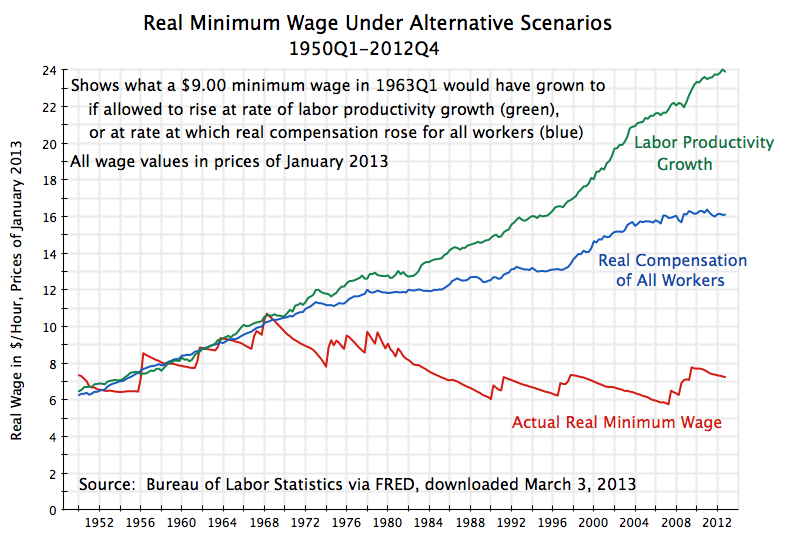
Real Min Wage Under Alternative Scenarios, 1950-2012

A.  Introduction

The previous post on this blog looked at whether the periodic increases in the minimum wage since 1950 in the US had led to jumps in unemployment of those workers making the minimum wage.  It concluded that there was no evidence of higher unemployment resulting from the changes of the magnitude observed.  And this was found whether by simply examining what happened to unemployment in the months following those sporadic increases, or in more rigorous econometric studies that have been undertaken over the last two decades.

That blog post noted that despite those sporadic increases in the nominal minimum wage, the minimum wage in real, inflation adjusted, terms had still fallen significantly over the last half century.  The minimum wage, in terms of today’s prices, had averaged about $9 per hour over the 25 years 1956-80 inclusive, and had reached a peak of $10.82 in February 1968.  Yet the minimum wage is only $7.25 today.  President Obama proposed to Congress in his State of the Union address that the minimum wage be raised to $9.00.  This would be a modest goal, as it would bring it back only to a level of a half century ago.  During that half century, US per capita GDP has more than doubled.  Yet even that modest increase has been strongly criticized by Republican leaders and conservatives.

B.  Two Scenarios

Staying flat in real terms is an exceedingly limited goal.  One would expect growth in a growing economy.  And at $9.00 an hour, a full time worker (40 hours a week, 52 weeks a year with no vacation) would still be earning almost 20% less than the poverty line for a family of four.  It is therefore of interest to ask what would the minimum wage be today if it were not simply flat in real terms, but had grown along with the rest of the economy?

The graph above shows two scenarios.  One is where the minimum wage would have grown at the same pace as overall labor productivity growth, and the other is where the minimum wage would have grown at the same pace as real compensation has for all workers.

There are several points worth noting.  First, it is very interesting that over the period 1950 to 1968, one finds that labor productivity, real compensation of all workers, and (with more jumpiness) the real minimum wage, all tracked basically the same path.  This is as one would expect in a normal growing economy.  Productivity grows, real wages grow at a similar rate (implying that profits will also grow at a similar rate), and similar increases in the real minimum wage will not create difficulties.

But the trends then diverged.  The minimum wage, set by government policy, was not allowed to keep up with inflation, leading to a significant fall in real terms.  The deterioration in the real minimum wage was especially sharp and steady during the presidencies of Richard Nixon (1969-74), Reagan (1981-88, and carrying over into 1989) and George W. Bush (2001-2007).  By June 2007, the minimum wage had reached a low of $5.75 (in terms of today’s prices) – lower than at any other point in time since before 1950 (I did not look at earlier data than this).  The real minimum wage was $7.38 in January 1950, during the presidency of Harry Truman.  It was 22% less in 2007, 57 years later.

C.  The Divergence Since the 1980s Between Growth in Labor Productivity and Growth in Labor Compensation

Labor productivity and real compensation of all workers continued to track each other for a few years after 1968.  But then some divergence started to open up in the mid-1970s, and this divergence began to grow sharply from about 1982/83.  It has continued since.

This divergence between productivity growth and real compensation of workers since the 1980s has been noted and discussed before in this blog.  It was noted there that the changes that occurred during the Reagan presidency, while lauded by conservatives, in fact did not lead to overall faster growth in output or productivity (growth in output and in productivity have in fact been slower since the Reagan presidency than it was before).  But the changes that began during the Reagan term did lead to sharply slower growth in real wages, and led as well to a far worse distribution of income.  The rich, and especially the very rich (the top 1%, and even more so the top 0.1% and 0.01%) have done extremely well since 1980.  But as that blog post showed, the real incomes of the bottom 90% have grown only modestly (and almost solely in the second half of the 1990s, during Clinton’s term).

By 2012, the average real compensation of all workers was fully one-third less than what it would have been had it grown after 1968 at the same pace as labor productivity growth.  This is not a small difference.

The causes for this divergence between labor productivity growth and real compensation of workers, largely since 1982/83, are not all known.  Policy was clearly an important part of it.  One policy was that of allowing the minimum wage to fall in real terms, which pulled down the wages of not only those at the minimum wage, but also the wages of those some distance above the minimum wage as the minimum wage affects the whole lower end of the wage structure.  Reagan’s policies to undermine the ability of labor unions to bargain for higher wages were also a factor.  Government policies to keep down the wages of government workers would also have contributed.

But in addition to such policy factors, there were technological and other economic issues that probably contributed.  As Erik Brynjolfsson and Andrew McAfee argue in their recent book, Race Against the Machine, the high rate of change in computer and communications technology, and the accompanying growth in robotics, not only diminished the demand for many middle class jobs such on the automobile production lines, but also for middle class jobs such as accountants, clerks, and other skilled positions where rules are followed which a computer can be programmed to do.  This same technological change in computers and communications also enabled globalization of production.  And the changes made possible by the new technologies led to the development of more and more “winner-take-all” sectors, where a few winners at the top can supply the whole market, leaving little for the rest.

D.  Could the Minimum Wage be Raised to Match?

As the graph above shows, had the minimum wage continued to grow after 1968 at the same pace as overall labor productivity grew (as it had before 1968), it would have reached $24 an hour by 2012.  Had it grown even at the slower pace that overall compensation of workers had grown, it would have reached $16 an hour.  But I would not advocate increasing the minimum wage today to $24 an hour, or even $16 an hour.  While the previous blog post had noted that changes in the minimum wage of a magnitude seen in the past had not led to higher unemployment, I am not so sure this would hold if the current minimum wage ($7.25 an hour) were more than doubled or tripled.  Without more data, I would indeed be wary of a rise in the minimum wage to more than perhaps $11 or $12 an hour.

One possible approach might therefore be as follows.  To start, one would raise the minimum wage to $9.00 an hour now, as Obama has proposed.  Obama has then also proposed to index this rate to inflation, so that one does not again see the regression in real terms observed repeatedly in the past.  But this would be too modest.  One would raise the rate to $9.00 an hour now, then to $10 a year later, then to $11 a year after that, and so on.  At each step, one would observe what the effects are.  If the impact on employment of minimum wage workers is modest, one would continue.  At some point one would start to observe significant adverse impacts, and at that point one would stop or even move back a step.

The fact that raising the minimum wage to $24 an hour now, or even to $16 an hour, is considered unimaginable, and indeed would likely lead to significant adverse employment impacts, is telling.  Something fundamentally flawed has developed in the economy which the US did not see before the 1980s.  And it does such harm for the working poor that even a full time worker at the minimum wage will still earn well less than the poverty line income.  There is a clear need to understand this better, but that should not keep us from following a more active approach, such as the step by step process suggested above, until we do.