
Unknown's avatar

About aneconomicsense

Economist

A Remarkable String of Extreme Climate Events in the Summer of 2023

A.  Introduction

I have been working for some time on a post that discusses how the Social Cost of Carbon is estimated in practice, reviews the inherent limitations in that process, and examines some of the controversies that have arisen – in particular with regard to what discount rate to use to discount back to the present the damages that will follow when a unit of carbon dioxide is released today, damages that can go on for centuries.

I hope to complete that post soon.  My original plan was to have a short section in the introduction listing some of the extreme climate events of this summer that show that our climate is indeed changing.  But the number of such events over just the past few months has grown remarkably, and what had been planned as just a short and illustrative list grew longer and longer.  I decided therefore to present it as a separate, stand-alone, post, together with a number of charts that illustrate several of the events and place them in a longer-term context.

The list is, I am sure, still incomplete.  It has a North American bias as those are the reports I have most likely come across, as I live in the US.  And some might dispute whether some of these events can be attributed to climate change.  That is always possible.  Climate change increases the likelihood of such events occurring, and it is rare when one can say with absolute certainty that some specific event was necessarily a consequence of our warmer planet.  But nor should that be the test.  We know (despite the denial of the tobacco companies for many years) that cigarette smoking increases the likelihood that a person will get cancer.  But while we cannot then say with certainty that a heavy smoker who died from lung cancer necessarily died because of their smoking habit, we can say with certainty that smoking greatly increases the chances that he or she did.

Similarly, while it is possible to argue that certain of the events listed below may have happened in the absence of a warming planet, it is difficult (indeed disingenuous) to argue that none of these events can be attributed to the warming planet.  Nor is it possible that this combination of so many extreme climate events could have happened in the absence of climate change.  Perhaps a few.  But not all of them.

The list also forces us to recognize that climate change is not something that may or may not happen at some point in the future.  These events are happening now.

B.  Record High Global Surface Temperatures in July 2023

One can start with global average surface temperatures in the month of July.  The chart at the top of this post shows what that temperature was for each July from 2023 going back to 1850, expressed in terms of the difference (or “anomaly” – the term used by specialists in the field) with what it was on average in the second half of the 1800s.  Temperatures in the second half of the 1800s are often taken as a reference period for what global temperatures were in the pre-industrial era.  The data for the chart comes from the National Centers for Environmental Information, National Oceanic and Atmospheric Administration (NOAA), US Department of Commerce, although I have rebased it from the original (where anomalies were defined relative to the 1901 to 2000 average) to an 1850 to 1899 base.

The July 2023 average global surface temperatures were a new record – at 1.27°C (or 2.29°F) higher in these NOAA estimates than what the average was in the pre-industrial period.  The Paris Climate Accords, ratified and agreed to by 194 nations of the world (the only ones that have not are Iran, Libya, and Yemen), has set the goal that global temperatures should be kept to “well below” 2°C over the pre-industrial average, and that efforts should be pursued to limit the increase to 1.5°C.  The 1.27°C of this July is already close to that, although the 1.5°C benchmark would be for each month in the year as a whole (over what they had previously been for those months), not simply for one of those months.

More worryingly, it was not just that this was a record high, but also that it shattered the previous record high – set in 2021 – by 0.20°C (or 0.36°F).  That is huge.  Previous records are normally only exceeded by small margins, just like previous Olympic records in a 100-meter dash are broken only by fractions of a second.  Climate is different – it is a complex adaptive system – leading to much greater swings than would be the case in a system without feedback loops.  But even in such a system, the 0.20°C by which the previous record temperature was broken is exceptional.  In the NOAA data going back to 1850, there was only one time when the July temperature exceeded the previous record by more – by 0.24°C in 1998.  In all but a few years, new temperature records exceeded the previous record by only 0.05°C or less.

C.  Exceptional Climate Events in June, July, and August, 2023

The higher summer temperatures have been associated with a series of dramatic climate events.  Based only on the news reports I have come across, one can note:

a)  To start, average global surface temperatures in June were already the highest they have ever been for the month of June in records going back to 1850.  And they broke the previous record (which had been set in June 2019) by 0.14°C (or 0.25°F).  As later for July, the record was broken not by some small incremental amount, but by a big leap.

b)  This was followed in early July when on July 3, global average surface temperatures were the highest ever recorded up to then.  But that record did not last long.  Global average temperatures were even higher on July 4.  They matched this on July 5 and were then higher still on July 6, and only slightly less on July 7 (with the average temperatures on July 7 the second highest ever, exceeded only by those on July 6).  And temperatures in the first week of July were the highest of any week in recorded history.  Finally, temperatures for the month of July as a whole were the highest of any month of any year in recorded history.  And while reliable, satellite-based, data on daily global average temperatures have only been available since 1979, it is almost certain that these temperatures have not been exceeded on our planet for at least 125,000 years.

c)  The daily average global surface temperatures (technically at a 2-meter height) going back to 1979 are provided in this chart:

Source:  Climate Reanalyzer, Climate Change Institute, University of Maine.  Underlying data from NOAA.  Downloaded August 26, 2023.

The dark black line is for 2023, and one can see not only that it has been at record highs (with this also the case in June), but also that the increases from the previous record highs are huge.  (Note that even though July is summer in the Northern Hemisphere, it is winter in the Southern Hemisphere.  However, global temperatures follow the pattern for the Northern Hemisphere as land accounts for a much higher share of the surface area of the planet in the Northern Hemisphere than in the Southern, and land heats and cools with far greater swings than ocean waters do.)

d)  These temperature records were not surprisingly matched by temperature records being set in numerous places around the globe during this period, including in China, in Northern and Southern Europe, in the Svalbard Archipelago of Norway (well above the Arctic Circle and just 860 miles from the North Pole), in the Middle East, in western and far northern Canada, in the American Southwest, and elsewhere.  In Phoenix, Arizona, for example, July was the hottest month for any US city ever, with an average temperature (day and night) of 39.3 °C (or 102.7 °F), and a day-time temperature exceeding 43.3 °C (or 110 °F) on each day for 31 days. A town in Canada at a latitude just 70 miles below the Arctic Circle hit a temperature of 37.8°C (or 100.0 °F).  While a record for the Western Hemisphere for a town so far north, the world record was set in Siberia in Russia – in a town just north of the Arctic Circle – in June 2020 at a reading of 38.0 °C (or 100.4 °F).  And while it is mid-winter in the Southern Hemisphere, temperatures have exceeded 37.8 °C (or 100 °F) in numerous locations where winter temperatures would normally be far less.

e)  When the heat dome that had been enveloping Europe was swept away by a cold front in late July, the result was extremely violent storms.  There were tornados, baseball-sized hailstones (with one measured at 20 cm, or 7.9 inches, just short of the 8.1 inch world record), and winds as strong as that in hurricanes – reaching 135 mph in western Switzerland.  While not sustained as in a hurricane, a wind speed of 135 mph would be that of a strong Category 4 hurricane.  And Hurricane Idalia, which as I write this just slammed into the portion of the Florida Gulf Coast called the “Big Bend”, was “only” a Category 3 storm when it made landfall, with a maximum wind speed of 125 mph.  Yet it was the strongest storm to hit that stretch of the Florida coast since 1896.

f)  The high temperatures so early in the Northern Hemisphere summer season have also led to record high ocean water temperatures.  And the ocean water temperatures also rose rapidly, at rates that left scientists baffled as well as alarmed.  The temperatures in waters surrounding Florida, for example, were in early July already at what was described as “downright shocking” levels.  In late July, recorded water temperatures hit 38.4 °C (or 101.1 °F) off southern Florida, setting a new world record (exceeding the previous world record set in 2020 in waters off Kuwait of 37.6 °C, or 99.7 °F).  There have also been record-breaking ocean temperatures in the ocean waters around the United Kingdom and Europe, as well as of the Mediterranean Sea, and indeed around the globe.

g)  As with surface air temperatures around the globe, surface sea temperatures have risen this year not simply to record high levels, but to record highs by a huge jump over what had been the record highs before:
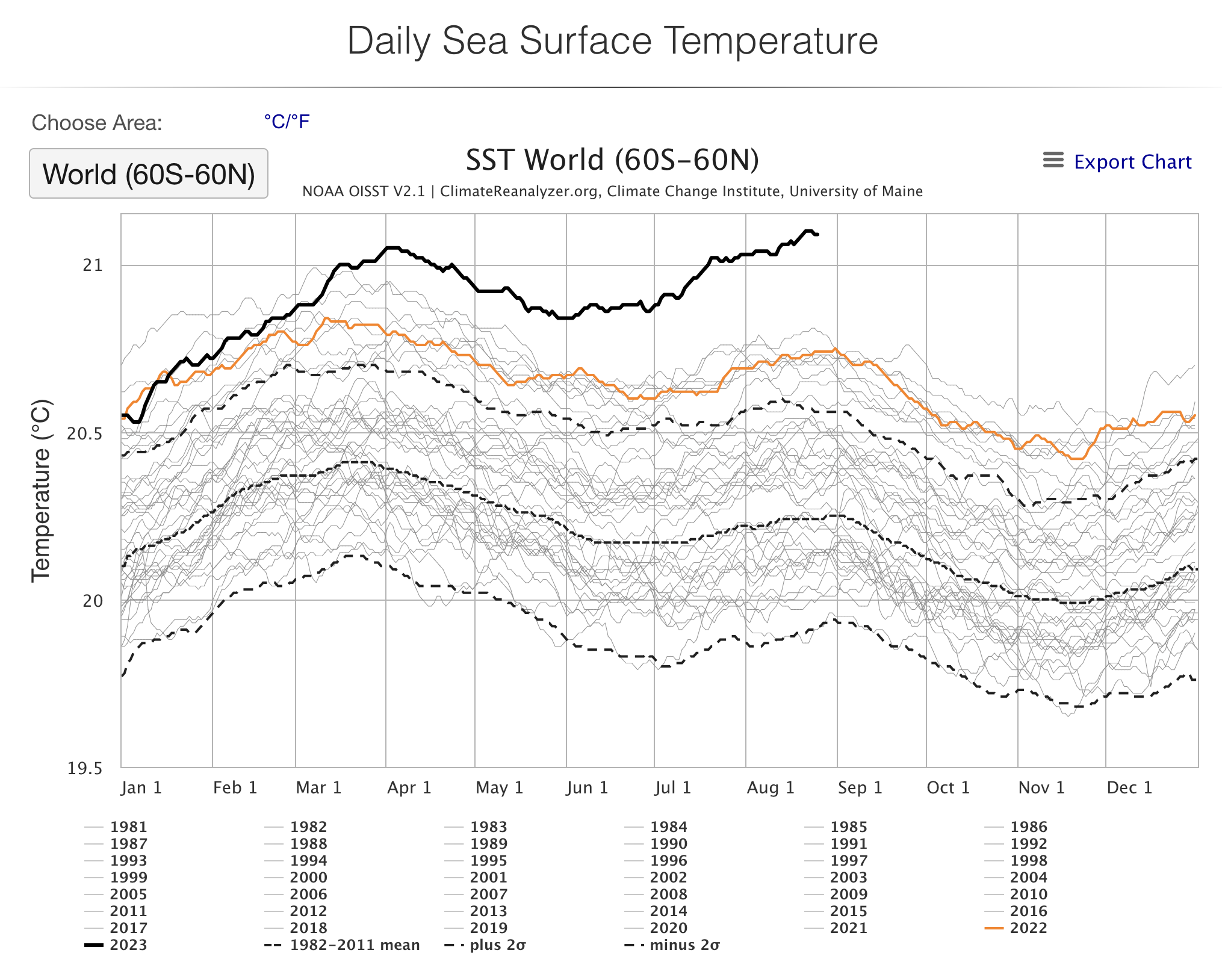
Source:  Climate Reanalyzer, Climate Change Institute, University of Maine. Underlying data from NOAA.  Downloaded August 26, 2023.

h)  The multi-year rise in global temperatures has had other consequences as well.  High heat and lack of rain have dried out soils and facilitated insect invasions as well, leading to devastating wildfires.  As of August 28, wildfires in Canada have already burned 15.2 million hectares so far in 2023.  The year is far from over, but this is already well more than double the previous high for area burned of 7.1 million hectares in an entire year.

Source:  Canadian Interagency Forest Fire Centre, Statistics.  Downloaded August 29, 2023.

i)  Those Canadian wildfires then led to hazardous air quality levels in New York, in Washington, DC, in Chicago and the midwest, and in major Canadian cities as well.  The color-coded air quality index goes from green to yellow to orange to red.  I had never realized before that it in fact goes to purple and then maroon, with maroon levels indicating air quality that is hazardous to everyone.  Air quality often hit maroon levels during these episodes.

j)  Warmer temperatures dry out soils due to greater evaporation, leading to droughts in some areas.  But warmer air can also hold more moisture.  Under the right conditions, that moisture-laden air can empty out in severe rainfalls, causing flooding.  There has been especially severe flooding in just the last couple of months in South Korea, in Japan, in northern India, in western Pennsylvania to New England, in Kentucky, in Chile, in Turkey, and in Nova Scotia.  And I am sure this list is not complete.

k)  Sea ice surrounding Antarctica builds up each year in the Southern Hemisphere winter.  But this year, it has built up by far less than before, and again with a margin over the previous record (low) levels that is shocking:

Source: Climate Reanalyzer, Climate Change Institute, University of Maine.  Underlying data from NOAA.  Downloaded August 26, 2023

l)  And while an event of late last year, a just released study estimated that about 10,000 emperor penguin chicks died when ice sheets surrounding Antarctica broke up early – already in November – near the start of the Southern Hemisphere summer.  Emperor penguins are in the “Near Threatened” category for endangered species, and their chicks depend on such ice to last until they are able to swim in the cold ocean waters.

m)  Finally, as an example of the indirect effects of a changing climate, the Panama Canal has had to limit the number of ships passing through the canal (as well as limit their weight) since drought is limiting the supply of water needed to work the series of locks that the ships pass through.  This is leading to long queues of ships waiting to be allowed through.  Rainfall is normally ample in Panama, and water in the high lakes is used to feed the canal with the water it needs to operate.  But drought, affecting Central America as well as Mexico in addition to Panama, has now severely limited that water supply, thus leading to the limits imposed on the number of ships being allowed to pass through.

D.  Conclusion

This is an exceptional string of climate-related events over a period of just a few months.  One cannot say for certain that every single one of these events was a consequence of our warming planet and the resulting changes in the climate, but the number of such events in just the last few months is stunning and should be worrying.

Several are record highs for directly recorded temperatures.  Most alarming, perhaps, is how much those temperatures have jumped this year over previous records, as well as what is seen in measures such as the area burned by wildfires in Canada.  And the string of record high temperatures in locations around the world, of numerous severe floods, and of especially violent storms, is startling.

Some of these events might have occurred in the absence of how climate has changed in recent decades.  The climate fluctuates.  But one would have to be in denial to believe that all of them could have arisen in the absence of a changing climate.

The Federal Deficit is High, Rising, and Unsustainable at This Level

The federal fiscal deficit fell sharply in Biden’s first year and a half in office.  This was largely due to the expiration of the huge Covid relief programs that had been approved both during Trump’s last year in office and then at the start of Biden’s term (totaling $5.7 trillion, and equivalent to 12.8% of the GDP of 2020 and 2021 together).  The deficit was an astonishing 16.5% of GDP in the last 12 months of the Trump administration, and peaked at 19.2% of GDP in the 12 months leading up to March 2021.  It then came down rapidly, reaching a trough of 3.9% of GDP in the 12 months leading up to July 2022.  But it then turned upward, and is now at about 8.5% of GDP.

The figures are shown in the chart above.  They were calculated from the regular Monthly Treasury Statement released by the US Treasury, which has monthly figures on federal government receipts (revenues collected), outlays (expenditures in a broad sense), and the resulting deficit.  The most recent such statement (the one used here) was released in mid-August with figures through July.  The figures once published are rarely changed, and thus appear to be actual revenue and expenditure numbers and not estimates of what they were in any given month.

The figures will always bounce around substantially from month to month, due to factors such as when major payments on income taxes are due (e.g. each April), when expenditures are bunched (due to the fiscal year cycle), and other such seasonal factors.  Thus for the chart here I have calculated 12-month rolling totals for the figures, ending on the dates shown.  And I have expressed them as a share of average GDP over the period.  Since GDP figures are only available on a quarterly basis, I estimated month-to-month GDP figures based on an assumed constant rate of growth over the three months within each quarter.  The GDP figures were downloaded from FRED.

I also extrapolated the figures to the end of fiscal year 2023 – i.e. through to September 2023.  I suspect there will be a good deal of discussion on the sharp growth in the federal fiscal deficit in FY2023 when the full fiscal year figures are released in early October.  This post can be considered a preview, where while the final numbers will not be exactly the same as those estimated here, they will likely be close.

For the extrapolation, I assumed that federal outlays, receipts, and resulting deficits in August and September 2023 will be the same as they were in August and September 2022.  This was more reasonable than extrapolating the recent trend as the monthly figures fluctuate sharply due to seasonal factors, as noted above.  But it may well underestimate what the deficits will be in August and September 2023 due to the underlying upward trend of the past year.

For GDP for the third quarter of 2023 (where the preliminary estimate will not be released until near the end of October), I used the most recent forecast of third-quarter GDP growth produced by the Atlanta Fed.   The Atlanta Fed’s “GDPNow” forecasts have generally been quite good (far better than various consensus forecasts of panels of economists), and are based on a mechanical method where the forecast is first produced and then updated in real-time when key data are released – during the course of the quarter – on elements of what goes into GDP.  Correlations were worked out based on historical data, with those correlations then used – every time new data is released – to update the forecast of what GDP will be when an estimate is ultimately provided by the BEA at the Department of Commerce.

I have gone into a bit of detail on the Atlanta Fed’s GDPNow forecasting process as its most recent forecast (as I write this) is for GDP growth in the third quarter of 2023 to be quite high – at an annualized real growth rate of 5.9%.  This is a good deal higher than the most recent official (BEA) estimates of GDP growth of 2.4% in the second quarter of 2023 and 2.0% in the first quarter.  It is also substantially higher than the “Blue Chip” consensus forecast of a panel of economists of just 1.6%.  We will see who ends up being closer to the final figure on GDP growth, but for the chart above I used the 5.9% rate.  With this relatively high rate of growth for GDP, the federal deficit and other figures as a share of GDP will be biased in the downward direction.  Despite this bias (as well as that following from the use of 2022 figures for August and September, despite the upward trend in the deficit this year), the resulting federal fiscal deficit for FY2023 (which ends in September 2023) is conservatively estimated to be 8.5% of GDP.

A fiscal deficit of 8.5% of GDP in a period when unemployment is low is huge.  The unemployment rate has been at 3.7% or less (and as low as 3.4% – with this all within the range of statistical uncertainty) since March 2022.  It has not been at a level so low for such an extended period since 1968/69 – more than a half-century ago.  The increase in federal expenditures certainly in part accounts for this (Keynes is once again shown to have been right), but a fiscal deficit of 8.5% of GDP is not sustainable.

The gross federal debt held by the public (the relevant concept, as intragovernmental holdings of public debt will net out) was 95% of GDP as of 2022.  Round this up to 100% of GDP.  It is then easy to see that if one assumes, going forward, that real GDP growth will average 2.0% per year, say (it averaged 1.93% per year from 2000 to 2023), and if the inflation rate (the GDP deflator) matches the 2.0% Fed target for general consumer inflation, then the public debt to GDP ratio will remain flat if the fiscal deficit equals 4.04% per year (as that equals the compounded effect of 2.0% real growth and 2.0% inflation).  A fiscal deficit of 8.5% of GDP is far above this.  At such a deficit, the debt to GDP ratio will grow.  At a deficit of 4% of GDP or less, then with 2% growth and 2% inflation the debt to GDP ratio will fall from where it is now.

Why has the fiscal deficit grown by so much since the trough at 3.9% of GDP in July 2022?  I do not know enough about the fiscal accounts to say, but a few points can be made.  First, it was not due to rising interest rates.  While the US Treasury will need to pay higher interest rates on newly issued debt as the Fed has been raising interest rates, most Treasury debt is longer term and only comes up for renewal slowly over time.  According to the July 2023 Monthly Treasury Report, gross interest payments rose by $136 billion in the fiscal year to date (i.e. from October 2022 through to July 2023) compared to the same period in the prior fiscal year.  This is just 0.6% of GDP if one extrapolates it out to a full 12-month period,

In terms of the broad categories shown on the chart above, what was far more important was a fall in federal receipts (revenues) over the last year.  Federal receipts came to 19.6% of GDP in the 12 months leading up to July 2022, and fell to 16.8% of GDP in the (forecast) 12 months leading up to September 2023.  This was a reduction in receipts of 2.8% of GDP, and accounts for about 60% of the increase in the deficit during this period (which went from 3.9% of GDP to a forecast 8.5%, an increase of 4.6% of GDP).  An increase in federal outlays, rising from 23.5% of GDP in the 12 months leading up to July 2022 to 25.3% in the 12 months leading up to September 2023 (an increase of 1.8% of GDP), accounts for the other 40%.

I am not sure why federal receipts fell over the last year, but a guess would be that they rose in the period from early 2021 to mid-2022 (keeping in mind that these will always be for trailing 12-month periods) due to rebound effects from the Covid relief programs.  Those programs included deferral of when taxes would be due, and also provided for higher government expenditures on a variety of Covid-related activities.  These would translate into higher incomes, with this then leading to higher taxes later becoming due.  There was also major direct income support, although most of this was not taxable.

But for whatever reason, federal government receipts as a share of GDP have fallen substantially since mid-2022 and account for the major share (60%) of the increase in the deficit.  However, it is also important to note that while federal receipts have fallen relative to mid-2022, they are now (as a share of GDP) roughly where they were in early 2020, prior to the onset of the Covid crisis.  In fact, they are a bit higher, at 16.8% of GDP now compared to 16.5% in the 12 months leading up to early 2020.

Federal outlays are, however, substantially higher than where they were in early 2020.  They are now at 25.3% of GDP, versus 21.4% of GDP in early 2020, an increase of 3.9% of GDP.  This more than accounts for the increase in the fiscal deficit since then – rising from 5.0% of GDP in early 2020 (during the Trump administration but pre-Covid) to 8.5% now.  I have discussed before why the deficit of 5% of GDP during the Trump years (pre-Covid) was unwise, exceptional for a period when the economy was at full employment, and not sustainable.  The same is true with a deficit of 8.5% of GDP during a period when the economy is also at full employment.

Much of the new expenditures of the Biden administration are certainly high priority.  Climate change needs to be addressed, for example, and the US has long neglected its public infrastructure and there is an urgent need to repair it.  But I do not have a detailed breakdown of the expenditures, how they compare to expenditures before, and the needs being addressed.  But regardless, the now Republican-controlled House of Representatives will certainly force major cuts in federal expenditures, just as the Republican-controlled House elected in 2010 forced through major expenditure cuts during the Obama presidency.  Fortunately, the economy is now at full employment, while unemployment was still high in 2011 when the Republicans started to force major expenditure cuts on the Obama administration.  There had not been such cuts in fiscal expenditures with unemployment still high in periods recovering from a recession since before World War II.  The result was the exceptionally slow pace of employment growth following the financial and economic collapse of 2008/2009.

Attention should also be given to increasing fiscal revenues as part of a program to reduce the fiscal deficit.  A return of federal receipts to the approximately 18% of GDP share towards the end of the Obama presidency in 2016 would help in reducing the deficit to a sustainable level.  A good start would be to reverse the Trump tax cuts rammed through the Republican-controlled Congress in late 2017 on party-line votes – tax cuts that led to corporate income taxes being reduced by half and which introduced numerous new tax loopholes and other measures favoring the rich.  But with Republicans now in control of the House, that will of course not happen.

A deficit of 8.5% of GDP is not sustainable.  It will need to come down, with a deficit of 4% of GDP or less a reasonable goal.  There is a need for a constructive debate on how best to do this.  Unfortunately, given the state of American politics, it is unlikely that any debate will be constructive.

=========================================================

Update:  October 31, 2023

Final figures have now been released for FY2023 federal government outlays and revenues, with the release of the September 2023 Monthly Treasury Statement. The initial estimate of GDP in the third quarter of 2023 has also now been provided.  From these, we can calculate what the federal fiscal deficit was as a share of GDP in FY2023, and compare that to the estimates made when only data through July 2023 were available.

The FY2023 fiscal deficit came in at 6.3% of GDP.  This deficit figure is still high – it is well above the 5% of GDP rule of thumb on when one should be concerned (in an economy at full employment), and above the figure of around 4% of GDP where the government debt to GDP ratio would be flat.

But the 6.3% of GDP deficit is substantially better than the 8.5% estimate provided in the post above.  That figure was based on extrapolations from data that, at the time, were only available through July 2023.  Why the difference?  It turns out to be due almost entirely due to substantially lower than expected fiscal outlays in the final two months of the fiscal year (i.e. August and September).  The estimates made in the post assumed that the fiscal deficit in August and September 2023 would be the same as the deficit in those two months in 2022.  But the deficit turned out to be 2.1% of annual GDP lower in 2023 than it was in those same two months in 2022.  Within round-off, this is the same as the 2.2% of GDP difference between the 8.5% of GDP forecast, and the 6.3% of GDP realization.

This was basically entirely due to lower federal expenditures (outlays).  Those expenditures were 2.3% less, in terms of annual GDP, in August and September 2023 than they were in those two months in 2022.  Federal revenues were also a bit less, but only by 0.2% of annual GDP.

Note that all these figures have been presented in terms of annual GDP for the fiscal years 2022 or 2023.  But GDP is a flow, and GDP in just the two months being considered will of course be far less.  Based on the advance estimate of GDP in the third quarter of 2023, and assuming GDP in the two months will be two-thirds of that in the three months in the quarter (and also taking GDP at the quarterly, not annual, rate), the reduction in the deficit in those two months relative to the same two months in 2022 comes to 12.3% of the GDP of those two months.  That is gigantic!  While there is substantial volatility in the monthly figures, it is surprising that fiscal expenditures would change by so much in that period compared to what it was in the same period of the prior year.


The Basic Economics of Carbon Pricing: The Social Cost of Carbon vs. the Abatement Cost of Carbon – Econ 101

A.  Introduction

Climate change is arguably the most important challenge facing the world today.  The damage being done by a warming world is already clear:  Extreme temperatures have become more common, and extreme weather events have become both more frequent and more severe.  Glaciers as well as the ice that used to cover the Artic Ocean are melting, as are the vast ice sheets covering Greenland and Antarctica.  And the melting glaciers and ice sheets, as well as thermal expansion as ocean water becomes warmer, are together leading the sea level to rise.  If this is not addressed, not only will coastal land be lost but our coastal cities will be inundated.

The problems will grow worse as long as greenhouse gases (mainly carbon dioxide – CO2 – but others as well) continue to be released into the air.  The gases accumulate in the atmosphere, with some, such as CO2, lasting for hundreds of years before being diminished by natural processes.  It is the cumulative total that matters as it is the concentrations of these gases in the atmosphere that lead to the higher temperatures.  And the damage increases more than proportionally with those higher temperatures, where the damage in going from, say, 2 degrees to 3 degrees above the pre-industrial average is far greater than in going from 1 degree to 2 degrees.  Global average surface temperatures are already about 1.2 degrees Celsius greater than what they were on average between 1850 and 1900.

There is, however, a good deal of confusion on the basic economics of what will be needed to address this.  One hears, for example, politicians and others saying that “we cannot afford” to address climate change.  But they have not recognized that the cost of not cutting back on greenhouse gas emissions can be far greater than the cost of reducing those emissions.  Indeed, the cost of reducing greenhouse gas emissions is actually often quite low, even though the cost of not addressing climate change is high.  Those two concepts are different but are sometimes not clearly distinguished.

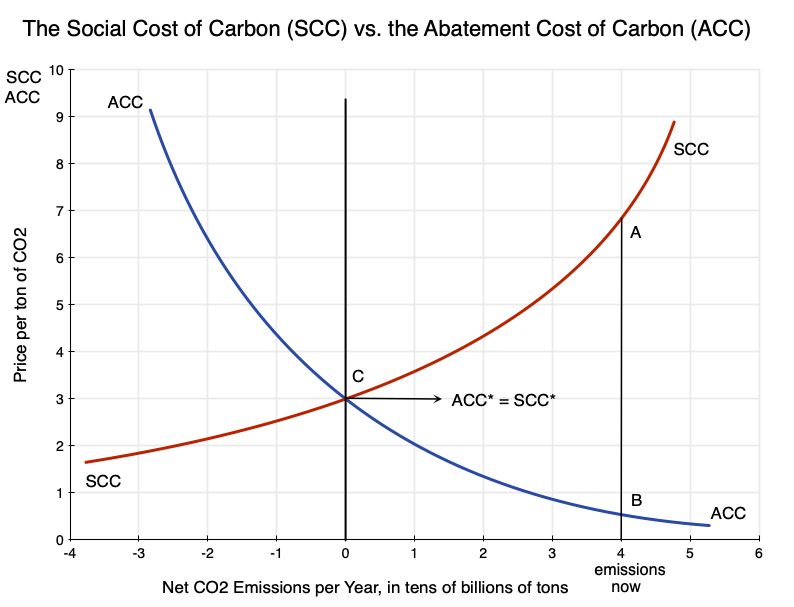
A diagram such as that at the top of this post can be helpful in keeping the concepts clear, as well as in understanding how they interact.  Many might immediately note the similarity to the standard supply and demand diagrams that economists (but few others) know and love, and there is indeed a similarity.  But there is an important difference:  In the supply and demand diagrams normally used, what is being produced and made available is something good, and hence one wants more of it.  But in the diagrams here, what is being produced (polluting greenhouse gases, and in particular CO2 as the primary greenhouse gas) is something bad.  Hence one wants less of it.  But it costs something to reduce those emissions.

The first section below will discuss this diagram, including the concepts behind it and how to interpret and use it to examine various issues.  This will all be just standard economics, but for something one wants less of rather than more of.  The basic measures – analogous to a demand price and a supply price – are the Social Cost of Carbon (SCC – what it costs society when an extra unit of CO2 is emitted) and what I have labeled here the Abatement Cost of Carbon (ACC- what it costs to reduce the emissions of CO2 by a unit).

The post will then discuss some of the implications that one can work out from this simple diagram.  One does not need to know precisely where those curves will be – just their basic relationship to each other.  And a fair amount can be found simply from the concepts themselves.  The key is to be clear as one thinks things through.  How one in practice determines estimates of specific values for the SCC and the ACC is also important, of course, but that issue is different and will be reviewed in subsequent posts on this blog.  There is an enormous literature on determining those values, a fair amount of controversy, and as practitioners always emphasize, also a good deal of uncertainty.  But there is much that follows from the basic concepts themselves, and this blog post will focus on that.

One point of disclosure:  The diagram above was derived from first principles.  And it is a diagram that I thought would be fairly commonly seen in the literature on climate change.  However, while I looked for references using it, I could not find any.  This does not mean that no one has ever produced something similar.  Someone almost certainly has.  But I have not been able to find an example.  At a minimum, it does not appear to be common, and thus reviewing the basic concepts here may be of interest.

July 25, 2023 – Update:  A reader of this blog flagged to me that there is indeed a text that presents a diagram very similar to what I discuss here.  The text is “Principles of Environmental Economics:  Economics, Ecology, and Public Policy”, by Ahmed M. Hussen (a professor of economics at Kalamazoo College in Michigan, USA).  I would like to thank Mr. Naren Mistry for bringing this reference to my attention.

Furthermore, I created the term “Abatement Cost of Carbon” used here – the cost to reduce the emissions of CO2 by a unit.  I believe it is a good description of the concept, but as will be discussed in the subsequent post on estimating the ACC, others have examined somewhat similar concepts with various names.

B.  The Social Cost of Carbon vs. the Abatement Cost of Carbon

The diagram at the top of this post presents schematically the relationship between the Social Cost of Carbon (SCC) and the Abatement Cost of Carbon (ACC).  These are drawn in relation to the net number of tons of CO2 emissions per year along the horizontal axis of the chart (or x-axis).  And while the diagram is shown in terms of CO2 emissions, CO2 is being taken as a proxy for all greenhouse gas emissions (which are often expressed in CO2 equivalent terms – equivalent in terms of their global warming impact over a period that is usually taken to be 100 years).

While one could measure the CO2 in any physical unit, I have labeled it as tens of billions of tons per year.  World emissions in 2021 were about 37 billion metric tons.  But the physical units one can use are arbitrary.  I also want to make clear that while the horizontal axis depicts CO2 emissions as so many tons (or tens of billions of tons) per year, this is simply a representation of the scale of production of those emissions per year.  The price (whether SCC or ACC) is then of one unit (one ton) of those CO2 emissions in any given year – not a price of one ton being emitted each year for multiple years.  It is the price for just one ton, once.

The Social Cost of Carbon (SCC) is the cost to society of a unit of CO2 being emitted into the atmosphere today, in a scenario where CO2 emissions overall are at the pace per year shown on the horizontal axis.  One can think of the SCC as what society would be willing to pay to avoid a unit of CO2 being released into the air.  Since CO2 will remain in the atmosphere for hundreds of years, the damage due to its incremental global warming effect will equal the damage this year, plus the damage next year, plus the year after that, and so on for hundreds of years.

These future damages will be discounted back to the present year based on some social discount rate.  The subsequent blog post on how the SCC is estimated, referred to above, discusses the question of what the appropriate social discount rate should be.  It will have a significant impact on the specific value of the SCC estimated, and is an issue that has been much debated.  For now we will simply assume that a suitable social discount rate has been used.  But an important and practical implication of discounting is that what matters most in the determination of the SCC estimate will only be the damages over the next century or so.  Beyond that, the discounted values are generally so small (depending on the specific social discount rate used) as not to materially affect the SCC estimate.

The damages caused by an extra unit of CO2 being emitted today will depend on how much CO2 (and other greenhouse gases) are already in the atmosphere.  Importantly, the resulting economic damage (which the SCC measures) per unit of global temperature increase will be highly non-linear.  As noted above, the incremental extra damages will be greater if the CO2 (and other greenhouse gases) have led global average temperatures to be, say 2 degrees higher than what they were in the pre-industrial era, than what the incremental damages were when those temperatures were 1 degree higher.  And those per unit damages will be greater still when coming on top of concentrations that would have led to temperatures 3 degrees higher (than in the pre-industrial period) compared to the incremental impact at 2 degrees higher.

In addition, and also importantly, there are feedback effects resulting from increasing concentrations of CO2 in the air that also lead to more than proportionally higher global temperatures.  An important example is the effect on permafrost.  A higher global temperature leads to permafrost that is on the margin of remaining frozen, instead to melt.  And melted permafrost then leads to additional greenhouse gases being released into the air (in particular the highly potent greenhouse gas methane), which then leads to even higher global temperatures.

For both of these reasons (the resulting economic damages, and the feedback effects) the SCC curve in the diagram above not only slopes upward but also bends upwards.

There is one shortcoming in such a schematic, however, that should be flagged.  Supply and demand diagrams are static and do not handle the time dimension well.  There are similar issues here.  In particular, as emissions accumulate in the atmosphere over time, the damages will be greater.  The SCC curve as shown (over its full length) can be viewed as what it would be for a given starting point for the concentration of CO2 in the air.  At higher atmospheric concentrations of CO2, it will shift upwards over its entire length.  This could in principle be handled by adding a third dimension to the diagram.  That is, one could add a third axis perpendicular to the other two (and going away – i.e. adding depth) for the stock of CO2 that had accumulated in the atmosphere.  The two-dimensional diagram shown here can then be thought of as a slice of that more complete three-dimensional chart – showing a slice for some given level of accumulated CO2.  But such a three-dimensional diagram would be complicated, and the two-dimensional one is adequate for our purposes here.

The Abatement Cost of Carbon (ACC) is what it would cost society to reduce the emissions of CO2 by one unit.  When emissions are high (the right side of the chart), it does not cost much to reduce those emissions by a unit.  There are a lot of relatively easy (low-cost) things that one can do.  But as emissions are reduced, ultimately to zero and then even into net negative levels, it becomes increasingly difficult (and hence increasingly costly) to reduce them further.  Hence the ACC curve goes from the upper left in the diagram to the lower right, and bends upwards as well.

The resulting SCC and ACC curves should therefore be expected to look like those shown.  The SCC curve starts high on the right side of the chart (as damages are great when CO2 emissions are high and assumed to remain so); they fall as one moves to the left to lower rates of emissions (with a resulting lower pace of CO2 being released into the air); and the curve bends upward.  The ACC curve, in contrast, starts low on the right – when a high rate of emissions means much could be done at a low cost to reduce those emissions by a unit – and then rises as one moves to the left to lower rates of emissions and it becomes increasingly more difficult (more costly) to reduce emissions by an additional unit.  It will also bend upwards.

At some point the ACC and SCC curves will cross.  In the diagram above, I have them cross at net emissions of zero.  The reason for that will be discussed below.  But there is no a priori reason why they should necessarily cross at zero net emissions.  Where they will cross is an empirical issue.  Rather, all one knows is that they will cross at some point.  (A contrarian might note that it is possible that the ACC curve might theoretically lie always and everywhere above the SCC curve – at least within the range of CO2 emissions shown on the diagram – and hence will never cross it.  But any reasonable estimate of the SCC and the ACC finds that that is not nearly the case in practice – and not by orders of magnitude.)

C.  Some Implications

With these basics, one can draw several implications of interest:

a)  First, at current levels of CO2 emissions (well to the right in the diagram), the SCC will be high and ACC will be low.  In the diagram at the top of this post, the SCC at point A is far above the ACC at point B.  To say that “we cannot afford” to reduce emissions of CO2 is simply wrong as the cost of not taking action to reduce emissions (the SCC at current emission rates) is well above what it would cost to reduce carbon emissions from their current pace (the ACC at current emission rates).  Indeed, the opposite is closer to the truth:  We cannot afford not taking action to reduce CO2 emissions.  And it will remain worthwhile to do this as long as the SCC is above the ACC.

b)  The SCC curve will intersect the ACC curve at some point.  At the point where they intersect the cost of reducing CO2 emissions by a further unit (the ACC) will match the benefit of doing so (the SCC, i.e. the cost to society from a unit of CO2 being emitted).  Beyond that (i.e. further to the left), the cost of further reducing CO2 emissions exceeds the benefits.  At the point where they intersect, the benefits will match the costs.

In the diagram, I have drawn the curves so that they cross at zero net emissions of CO2.  This is the “net zero” goal that the international community has targeted as the appropriate goal to address climate change.  Assuming the international community is acting fully rationally (a big stretch, I acknowledge), then that net zero goal is the appropriate one if the SCC and ACC curves cross at that point.  I have assumed that in the diagram, and the point where they cross is labeled as point C in the diagram, with ACC* = SCC* there.

c)  In reality, there is of course a good deal of uncertainty on where the SCC and ACC curves lie, and hence where they cross. But they do cross somewhere, and as we learn over time more about how the climate is changing, about the costs that the changing climate is imposing on the world, and what it would cost to cut back on CO2 emissions, we will become better able to determine where that intersection is.  But we do not need to know that with any precision right now.  All we need to know at the current moment is that the point where they cross is at a level of CO2 emissions that are well below where they now are, and that therefore we should be reducing CO2 emissions (i.e. moving to the left in the diagram).

d)  But the fact that the SCC is something positive even at net zero emissions brings out that even at net zero emissions – whenever that is achieved – there will still be damage being done from the CO2 that has accumulated in the atmosphere up to that point.  The planet would be as hot as it had ever been, with all the resulting consequences for the climate.  It would just not be getting even hotter (setting aside the complicated lags in the climate system – an important but separate issue).

e)  There would therefore be benefits from reducing the accumulated CO2 in the air from where it would be at that point, even if net emissions at that point were zero.  There is nothing special about net zero as a target – other than the ease with which it can be explained politically.  If it is the case that the cost of reducing CO2 emissions further at that point (the ACC curve) is below what the cost from damages would be of one more unit of CO2 in the air (the SCC curve), then it would make sense to reduce the net emissions of CO2 further.

It might well become significantly more difficult (more costly) to reduce CO2 emissions further once one has reached the net zero level.  It is easier to stop putting more CO2 into the air than it is to draw CO2 out of the air.  But there are ways to do this.  One can plant more trees, for example, or adopt agricultural practices that fix more carbon in the soil or in the oceans, or make use of more esoteric (and currently much more expensive) technologies that draw CO2 directly out from the air and then store it some manner where it will not end up in the air again.  But the fundamental point to recognize is that there is nothing that special about net zero emissions.  Depending on the cost (the ACC), one might well want to take action to reduce some of the CO2 we have put into the air.

f)  This brings us to the role of technology and how, over time, one should expect the technologies for reducing carbon emissions to continue to improve and thus continue to reduce the cost of abating carbon emissions.  The impact of such technological change in reducing the cost of abatement of emissions would be to shift the ACC curve downward, as shown here:

The appropriate goal would then be to reduce net CO2 emissions even further to the left, into the net negative levels at point D in the diagram rather than point C.  With the technology assumed to be available by the time society has reduced CO2 emissions to point C, the cost to reduce it further could by then be less.  At point C, the SCC cost shown in the diagram would be 3 (in some monetary units – dollars or euros or yen or whatever – per some given physical unit), but the ACC cost to reduce CO2 by one of those physical units would be less at a bit below 2 in this diagram.  Thus it would make sense to reduce CO2 emissions even further (into negative levels), where at D one would be matching the cost to society from it (the SCC) with the cost of reducing it making use of the technology available then (on the ACC’ curve).

D.  Summary and Conclusion

That there is a distinction between the costs that carbon emissions impose on society (the SCC) and what it would cost to reduce those emissions (the ACC) is obvious as soon as one thinks about it.  But many people – and especially politicians – often do not think about it, and have confused the two.

One can look at the issue with the simple tools of basic economics.  The only difference with what is normally done is that what is being produced here (CO2 emissions) are something bad – and hence one wants less of them – rather than something good.  And it costs something to reduce those CO2 emissions, even though there is a benefit when they are reduced.  This is in contrast to standard goods, where it costs something to produce more of them and there is a benefit when one has more of them.

Seen in this way, the SCC can be viewed as similar to but with an opposite sign to a demand price.  A demand price is what one would pay to obtain something good, while the SCC is a measure of the benefit one would obtain (what one would be willing to pay) in order to reduce CO2 emissions by a unit.  And while a standard supply price is how much it would cost to increase production by a unit, the ACC is how much it would cost to reduce emissions by a unit.

This then yields a simple diagram such as that at the top of this post, but where instead of a downward-sloping demand curve and an upward-sloping supply curve (as in a standard supply-demand diagram for a normal good – a good that one wants more of), the analog to the demand curve (the SCC curve) slopes up rather than down and the analog to the supply curve (the ACC) slopes down rather than up (all in going from left to right).

Several implications then follow.  The world is currently emitting high levels of CO2, and should that pace of emissions continue, the costs to society from climate change will be immense.  That is, the SCC is high.  But at these levels of CO2 emissions, there is a lot that can be done, at a low cost, to reduce those emissions by a unit.  That is, the ACC is low.  It is therefore mistaken to assert “we cannot afford” to reduce CO2 emissions.  The cost to society from not reducing them will be far greater.

The pace of CO2 emissions should then be reduced as long as the costs to society from releasing these greenhouse gases into the air (the SCC) exceeds the cost of reducing such emissions (the ACC).  At some point the curves will cross, and at that point it would no longer be worthwhile to reduce further the CO2 going into the air.  The now broadly accepted goal of the international community that net emissions of CO2 should go to zero would be logical if the SCC and ACC curves cross at net zero emissions (and I have drawn the diagram at the top of this post as if this is the case).  But there is uncertainty on precisely where those curves lie.  And it is indeed possible they cross at a net negative pace of emissions – i.e. where CO2 would be removed from the atmosphere by some means.  It is also likely that as technology improves, the position where they cross will move further to the left.

But there is no need to know today precisely where they might cross.  All we need to know right now is that with the social costs from emitting CO2 (the SCC) far in excess of what it would cost to reduce those emissions (the ACC), we should be reducing the CO2 we are putting into the air each year.  Progress on this will take time, but as CO2 emissions are reduced we will learn more about what the true costs are:  for the SCC as well as the ACC.  And with technology also advancing, it may well be the case that society will benefit not simply from reducing net emissions to zero, but then in moving beyond that – and possibly well beyond that – to removing CO2 from the atmosphere.

But that is something that we do not need to address today.  As the common saying goes, if you are digging yourself into a hole, the first thing to do is to stop digging.  That is, stop emitting the greenhouse gases that are warming the planet.  But once we have stopped digging the hole even deeper, there will be the issue of how far out of that hole we should want to go.

This post has covered only the basics.  The practical question remains of how one estimates what the SCC and ACC figures are.  That will come in subsequent posts that I hope to put up soon.