Trump’s Attack on Social Security

Trump famously promised in his 2016 campaign for the presidency that he would never cut Social Security.  He just did.  How much is not yet clear.  It could be minor or it could be major, depending on how he follows up (or is allowed to follow up) on the executive order he signed on Saturday, August 8 while spending a weekend at his luxury golf course in New Jersey.  The executive order (one of four signed at that time) would defer collection of the 6.2% payroll tax paid by employees earning up to $104,000 a year for the pay periods between September 1 and December 31 (usefully straddling election day, as many immediately noted).

What would then happen on December 31?  That is not clear.  On signing the executive order, Trump said that “If I’m victorious on November 3rd, I plan to forgive these taxes and make permanent cuts to the payroll tax.  I’m going to make them all permanent.”  He later added:  “In other words, I’ll extend beyond the end of the year and terminate the tax.”

The impact on Social Security and the trust fund that supports it will depend on how far this goes.  If Trump is re-elected and he then, as promised, defers beyond December 31 collection of the payroll tax that workers pay for their Social Security, the constitutional question arises of what authority he has to do this.  While temporary deferrals of collections are allowed during a time of crisis, what happens when the president says he will bar the IRS from collecting them ever?  The president swore in his oath of office that he would uphold the law, the law clearly calls for these taxes to be collected, and a permanent deferral would clearly violate that.  But would repeated “temporary” deferrals become a violation of the statutory obligations of a president?  And he has clearly already said that he wants to make the suspension permanent and to “terminate the tax”.

There is much, therefore, which is not yet clear.  But one can examine what the impact would be under several scenarios.  They are all adverse, undermining the system of retirement benefits that has served the country well since Franklin Roosevelt signed the program into law.

Some of the implications:

a)  Deferring the collection of the Social Security payroll taxes will lead to a huge balloon payment coming due on December 31:

The executive order that Trump signed directs that firms need not (and he wants that they should not) withhold from employee paychecks the 6.2% that goes to fund the employee share of the Social Security tax.  But under current law the taxes are still due, and would need to be paid in full by December 31.

Suppose firms did decide not to withhold the 6.2% tax, and instead allow take-home pay to rise by that amount over this four-month period straddling election day.  Unless deferred further, the total of what would have been withheld will now come due on December 31, in one large balloon payment.  For those on a two-week paycheck cycle, that balloon payment would have grown to 54% of their end of the year paycheck.  It is doubtful that many employees would be very happy to see that cut in end-year pay.  Plus how would firms collect on the taxes due on workers who had been with the firm but had left for any reason before December 31?  By tax law, the firms are still obliged to pay to the IRS the payroll taxes that were due when the workers were employed with them.

Hence most expect that firms will continue to withhold for the payroll taxes due, as they always have.  The firms would likely hold off on forwarding these payments to the IRS until December 31 and instead place the funds in an escrow account to earn a bit of interest, but they would still withhold the taxes due in each paycheck just as they always have (and as their payroll systems are set up to do).  This also then defeats the whole purpose of Trump’s re-election gambit.  Workers would not see a pre-election bump up in their take-home pay.

b)  But even in this limited impact scenario, there will still be a loss to the Social Security Trust Fund:

Thus there is good reason to believe that Trump’s executive order will likely be basically just ignored.  There would, however, still be a loss to the Social Security Trust Fund, although that loss would be relatively small.

Payroll taxes paid for Social Security go directly into the Social Security Trust Fund, where they immediately begin to earn interest (at the long-term US Treasury rate).  Based on what was paid in payroll taxes in FY2019 ($1,243 billion according to the Congressional Budget Office), and adjusting for the fewer jobs now due to the sharp downturn this year, the 6.2% component of payroll taxes due would generate approximately $40 billion in revenue each month.  Assuming the $160 billion total (over four months) were then all paid in one big balloon payment on December 31 rather than monthly, the Social Security Trust Fund would lose what it would have earned in interest on the amounts deferred.  At current (low) interest rates, the total loss to Social Security would come to approximately $250 million.  Not huge, but still a loss.

c)  If collection of the 6.2% payroll tax is deferred further, beyond December 31, the losses to the Social Security Trust Fund would then grow further, and exponentially, and become disastrous if terminated:

Trump promised that “if re-elected” he would defer collection by the IRS of the taxes due further, beyond December 31.  How much further was not said, but Trump did say he would want the tax to be “terminated” altogether.  This would of course be disastrous for Social Security.  Even if the employer share of the payroll tax for Social Security (an additional 6.2%) continued to be paid in (where what would happen to it is not clear), the loss to Social Security of the employee share would lead the Trust Fund to run out in less than six years.  At that point, under current law the amounts paid to Social Security beneficiaries (retirees and dependents) would be sharply scaled back, by 50% or more (assuming the employer share of 6.2% continued to be paid).

d)  Even if the Social Security Trust Fund were kept alive by Congress acting to replenish it from other sources of tax revenues, under current law individual benefits would be reduced on those who saw their payroll tax contributions diminished:

There is also an issue at the level of individual benefits, which I have not seen mentioned but which would be significant.  The extent of this impact would depend on the particular scenario assumed, but suppose that the payroll taxes that would have come due and collected from September 1 to December 31 were permanently suspended.  For each individual, this would affect how much they had paid in to the Social Security system, where benefits are calculated by a formula based on an individual’s top 35 years of earnings (with earnings from prior years adjusted to current prices as of the year of retirement eligibility based on an average wage inflation index).

The impact on the benefits any individual will receive will then depend on the individual’s wage profile over their lifetime.  Workers may typically have 20 or 25 or maybe even 30 years of solid earnings, but then also a number of years within the 35 where they may have been not working, e.g. to raise a baby, or were unemployed, or employed only part-time, or employed in a low wage job (perhaps when a student, or when just starting out), and so on.

There would thus be a good deal of variation.  In an extreme case, the loss of four months of contributions to the Social Security Trust Fund from their employment history might have almost no impact.  This would be the case where a worker’s income in their 36th year of employment history was very similar to what it was in their 35th, and the loss in 2020 of four months of employment history would lead to 2020 dropping out of their employment top 35 altogether.  But this situation is likely to be rare.

More likely is that 2020 would remain in the top 35 years for the individual, but now with four months less of payroll contributions being recorded.  One can then calculate how much their Social Security retirement benefits would be reduced as a result.

The formulae used can be found at the Social Security website (see here, here, and here).  Using the parameters for 2020, and assuming a person had earned each year the median wages for the year (see table 4.B.3 of the 2019 Annual Statistical Supplement of Social Security), one can calculate what the benefits would be with a full year of earnings recorded for 2020 and what they would be with four months excluded, and hence the difference.

In this scenario of median earnings throughout 35 years, annual benefits to the retiree would be reduced by $105 (from $17,411 without the four months of non-payment, to $17,306 with the four months of the payroll tax not being paid).  Not huge, but not trivial either when benefits are tied to a full 35 years of earnings.  That $105 annual reduction in benefits would have been in return for the one-time reduction of $669 in payroll taxes being paid (6.2% for four months where median annual earnings of $32,378 in 2019 were assumed to apply also in 2020 despite the economic downturn).  That is, the $669 not paid in now would lead to a $105 reduction in benefits (15.8%) each and every year of retirement (assuming retirement at the Social Security normal retirement age).

The loss in retirement benefits would be greater in dollar amount if the period of non-payment of the payroll tax were extended.  Assuming, for example, a scenario where it was extended for a full year (and one then had just 34 years of contributions being paid in, with the rest at zero), with wages at the median level throughout those now 34 years, the reduction in retirement benefits would be $316 each year (three times as much as for the four-month reduction).  Payroll taxes paid would have been reduced by $2,007 in this scenario, and the $316 annual reduction is again (given how the arithmetic works) 15.8% of the $2,007 one-time reduction in payroll taxes paid.

All this assumes Social Security would continue to pay out retiree benefits in accordance with current law and assumes the Trust Fund remained adequate.  The suspension of these payroll taxes would make this difficult, as noted above, unless there was then some general bailout enacted by Congress.  But any such bailout would raise further issues.

e)  If Congress were to appropriate funds to ensure the Social Security Trust Fund remained adequately funded, the resulting gains would be far greater for those who are well off than for those who are poor:

Suppose Congress allowed these payroll taxes to be “terminated”, as Trump has called for, but then appropriated funds to ensure benefits continued to be paid as per the current formulae.  Who would gain?

For at least this part of the transaction (the origin of the funds is not clear), it would be the rich.  The savings in the payroll taxes that would be paid in order to keep one’s benefits would be five times as high for someone earning $100,000 a year as for someone earning $20,000.  The tax is a fixed 6.2% for all earnings up to the ceiling (of $137,700 in 2020, after which the tax is zero).  The difference in terms of the benefits paid would be less, since the formulae for benefits have a degree of progressivity built-in, but one can calculate with the formulae that the change in benefits from such a Congressional bailout would still be 2.3 times higher for those earning $100,000 than for those earning $20,000.

One might question whether this is the best use of such funds.  Normally one would want that the benefits accrue more to the poor than to those who are relatively well off.  The opposite would be the case here.

f)  Importantly, none of this helps those who are unemployed:

Unemployment has shot up this year due to the mismanagement of the Covid-19 crisis, with the unemployment rate rising to a level not seen in the US since the Great Depression.  Unemployment insurance, expanded in this crisis, has proven to be a critical lifeline not only to the unemployed but also to the economy as a whole, which would have collapsed by even more without the expanded programs.

Yet cutting payroll taxes for those who have a job and are on a payroll will not help with this.  If you are on a payroll you are still earning a wage, and that wage is, except in rare conditions, the same as what you had been earning before.  You have not suffered, as the newly unemployed have, due to this crisis.  Why, then, should you then be granted, in the middle of this crisis where government deficits have rocketed to unprecedented levels, a tax cut?

It makes no sense.  Some other motive must be in play.

g)  This does make sense, however, if your intention is to undermine Social Security:

Trump pushed for a cut in the payroll taxes supporting Social Security when discussions began in July in the Senate on the new Covid-19 relief bill (the House had already passed such a bill in May).  But even the Republicans in the Senate said this made no sense (as did business groups who are normally heavily in favor of tax cuts, such as the US Chamber of Commerce), and they kept it out of the bill they were drafting.

The primary advisor pushing this appears to have been Stephen Moore, an informal (unpaid) White House advisor close to Trump.  He co-authored an opinion column in The Wall Street Journal just a week before Trump’s announcement advocating the precise policy of deferring collection of the Social Security payroll tax.  Joining Moore were Arthur Laffer (author of the repeatedly disproven Laffer Curve, whom Trump had awarded the Presidential Medal of Freedom in 2019), and Larry Kudlow (Trump’s primary economic advisor and a strong advocate of tax cuts).

Moore has long been advocating for an end to Social Security, arguing that individual retirement accounts (such as 401(k)s for all) would be preferable.  As discussed above, the indefinite deferral of collection of the payroll taxes that support Social Security would, indeed, lead to a collapse of the system.  Thus this policy makes sense if you want to end Social Security.  It does not otherwise.

Yet Social Security is popular, and critically important.  Fully one-third of Americans aged 65 or older depend on Social Security for 90% or more of their income in retirement.  And 20% depend on Social Security for 100% of their income in retirement.  Cuts have serious implications, and Social Security is a highly popular program.

Thus advocates for ending Social Security cannot expect that their proposals would go far, particularly just before an election.  But suspending the payroll taxes that support the program, with a promise to terminate those taxes if re-elected, might appear to be more attractive to those who do not see the implications.

The issue then becomes whether enough see what those implications are, and vote accordingly in the election.

An Update on the Different Employment Estimates from the Survey of Establishments and the Survey of Households, And the Resulting Job Growth Under Trump vs. Obama

A.  Revisions in the Jobs Numbers

The pace of job growth in 2019 was slower than had originally been estimated.  While such revisions to the initial job growth estimates are not unusual (there is a regular annual process that adjusts them based on more complete data), the result for 2019 was that they now estimate there were 0.5 million fewer net new jobs than had been thought before.  Along with other revisions in the estimates going further back, the result is that the pace of job growth under Trump has slowed down by even more than had been thought earlier.  While this is not surprising (unemployment is low), it does point up even more strongly that Trump is simply wrong in his assertions that the pace of job growth during his term in office is “historic”, “unthinkable” (by anyone other than himself), and far faster than before.  See, for example, Trump’s remarks in January 2020 at the Davos meetings.  It was not true before the revisions – it is even less true now.

There were earlier indications that the jobs figures would be revised downwards.  A post on this blog in May 2019 discussed an inconsistency pointing to this that had developed in two estimates of employment growth in the US.  Both come from the Bureau of Labor Statistics (BLS), with one based on the Bureau’s monthly survey of households (the CPS, for Current Population Survey) and the other based on its monthly survey of business establishments (the CES, for Current Establishment Statistics survey).  Figures from these two surveys are released each month in the BLS Employment Situation report, which provides updated estimates on the unemployment rate, net job growth, and other such closely watched numbers.

Both the CPS and the CES provide estimates on employment growth, but they arrive at those estimates from two different sources.  And while there are some small differences in how “employment” is defined in the two (as discussed in that earlier blog post, where the impact of those differing definitions was examined), the two series over time will move together.  However, in the two years leading up to April 2019 the two series drifted significantly apart.  The CPS survey (of households) indicated a slower pace of net job creation than the CES survey (of establishments) did.

With the release of the January 2020 estimates on February 7, we now have updated figures.  And they indicate that job growth has indeed been slower than what the earlier CES figures had indicated.  The chart at the top of this post shows the differences, where all the figures are defined in terms of the change in jobs relative to their level in April 2017.  The curves (with the circles or squares) ending in April 2019 reproduce the chart from the earlier post (with the labor force figures removed, for less clutter), with the estimates on jobs as known at that point.  The curves (with no circles or squares) that end in January 2020 then show the more recent, updated, estimates.

The curves in blue, of the changes in employment as estimated from the CPS survey of households, show some revisions, but generally small and with no strong trend.  While there is a much greater degree of month to month volatility in the figures from the household survey, the revised figures basically follow what had been estimated before.  As was discussed in the earlier blog post, the CPS survey of households uses an effectively far smaller sample size for its employment estimates than the CES survey of business establishments has.  The CPS surveys a sample of 60,000 households each month, and a household will normally have only one or two members employed.  The CES survey, in contrast, surveys 145,000 businesses, covering almost 700,000 different worksites, and each worksite can have dozens if not hundreds of employees.

The employment estimates from the CES survey, shown in the curves in black on the chart, therefore show far less month to month fluctuation, due to the lesser degree of statistical noise.  But the new versus old estimates began to drift apart from each other around June 2018, with the discrepancy then continuing to widen steadily over time.  And the new estimates of employment based on the CES survey (the curve in black) now follows much more closely to the trend in the estimates of employment from the CPS survey (the curve in blue).  They came especially close to each other in the figures for October 2019, but have drifted apart by some since then (although not nearly as apart as what we saw in April 2019).

The changes are significant.  For April 2019, for example, the earlier estimates from the CES were that there were 151.1 million employed in the US (employed as defined in the CES).  The new estimate is that there were only 150.5 million employed in that month, a difference of about 600,000.  When looking at job growth, i.e. changes in the number employed over time, that difference is significant.

B.  Job Growth Under Trump Compared to Under Obama 

The updated estimates provide a clearer picture of how the job market has progressed in recent years.  But it is not as Trump often boasts.

With the publication of the January 2020 estimates, we now have figures on job growth for exactly three years into Trump’s presidential term.  These figures can be compared to the growth seen in the final three years of Obama’s presidency:

This presentation of the CES monthly employment growth figures is not original with me.  A number of news sources have presented something similar (although I have constructed the chart here from the original source BLS numbers).  But it makes the point well.

As one can see, there is a substantial degree of month to month volatility, even in these CES figures.  They are estimates of the month to month changes in total employment, and during Trumps’s presidential term thus far have varied from a high of over 400,000 in one month (February 2018) to a low of zero in another (February 2019).  But the average over the 36 months of Trump’s term in office thus far has been a monthly growth of 182,200.

This is well below the pace of employment growth during Obama’s last 36 months in office.  The average then was 224,400 net new jobs per month.  Trump’s repeated assertions that job creation is now faster is simply not true.

Nor was it true even with the earlier job growth estimates.  It is just even less true now:

Net Employment Growth

As Earlier Estimated

As Revised

Last 36 Months of Obama

Total

8,128,000

8,079,000

Per Month

225,800

224,400

First 36 Months of Trump

Total

6,913,000

6,559,000

Per Month

192,000

182,200

Difference in Job Growth

Total

1,215,000

1,520,000

Per Month

33,800

42,200

Under the earlier estimates, job growth had been an average of 225,800 per month over the last 36 months of Obama’s presidency, and 192,000 per month over the first 36 months of Trump’s term.  The difference was 33,800 more jobs per month under Obama compared to the period under Trump.  The difference as estimated now is 42,200 more.

And while these differences in the monthly averages may not appear to be much, over time they accumulate to a quite substantial difference.  The total growth in employment over the last 36 months of Obama’s presidency was 8,079,000.  Over Trump’s first 36 months it was slower, at a total of 6,559,000.  The difference is a not insubstantial 1.5 million jobs.  And it is higher than the 1.2 million job difference in the earlier estimates.

So Trump’s claims are simply not true.  That is important.  Trump is once again making assertions without bothering with whether or not they follow the facts.  But having said that, I would also note that this slowdown in the pace of job growth should not be at all surprising.  The unemployment rate has been low, it cannot go much if any lower, and hence an increase in the number employed can only come either from regular population growth or from an increase in the share of that population choosing to participate in the labor force.  The adult population grew by 150,600 per month during Trump’s 36 months in office, and the labor force by 137,800 per month.  This accounted for most of the 182,200 net new employment over the period.  The rest was from the reduction in the unemployment rate, from an already low rate of 4.7% when Trump took office, to the 3.6% now.  But the unemployment rate cannot go much lower.  Hence one should not be surprised that employment growth has slowed.

Still, it should not be a big request to expect honesty from a president.

The Performance of the Stock Market During Trump’s Term in Office: Not So Special

A.  Introduction

Stock market performance is often taken to be a good measure of how the economy as a whole is performing.  But it is not.  For most Americans it is simply irrelevant, as the overwhelming share of investments in the stock markets are held by only a small segment of the population (the wealthy).  And its track record as a broader indicator of how the economy is performing is imperfect at best.

Still, many do focus on stock market returns, and Trump brags that the performance of the market during his term in office has been spectacular.

That is not the case.  This post will look at how the stock market has performed during Trump’s term in office thus far, and compare it to what that performance was under presidents going back to Reagan up to the same point in their terms.

First, however, we will briefly discuss to what extent one should expect stock market prices to reflect actions a president might be taking.  And the answer is some, but there is much more going on.

B.  Presidential Policies and the Stock Market

Owning shares of a firm entitles the owner to a share of the profits generated by that firm, both now and into the future.  And while there are many complications, a simple metric commonly used to assess the price of a share in a firm, is the price/earnings ratio.  If earnings (profits) go up, now and into the future, then for a given price/earnings ratio the price of the stock would go up in proportion.

Economic policies affect profits.  And in a thriving economy, profits will also be rising.  The policies of a presidential administration will affect this, and although the link is far from a tight one (with important lags as well), policies that are good for the economy as a whole will generally also lead to a rising stock market.

But there is also a more specific link to policy.  What accrues to the shareholders are not overall profits, but profits after taxes.  And this changed significantly as a result of the new tax law pushed through Congress by Trump and the Republicans in December 2017.  It resulted in the effective corporate profits (income) tax being cut by more than half:

This chart is an update of one prepared for an earlier post on this blog (where one can see a further discussion of what lies behind it).  It shows corporate profit taxes at the federal level as a share of corporate profits (calculated from figures in the national income accounts issued by the BEA).  While Trump and the Republicans in Congress asserted the 2017 tax bill would not lead to lower corporate profit taxes being paid (as loopholes would be closed, they asserted), in fact they did.  And dramatically so, with the effective corporate tax rate being slashed by more than half –  from around 15 to 16% prior to 2017, to just 7% or so since the beginning of 2018 (and to just 6.3% most recently).

This cut therefore led to a significant increase in after-tax profits for any given level of before-tax profits, which has accrued to the shareholders.  Note that this would not be due to the corporations becoming more productive or efficient, but rather simply from taxing profits less and shifting the tax burden then on to others (i.e. a redistributive effect).  And based on a reduction in the taxes from 16% of corporate profits to 7%, after-tax profits would have gone from 84% of profits to 93%, an increase of about 11%.  For any given price/earnings ratio, one would then expect stock prices, for this reason alone, to have gone up by about 11%.

[Side note:  Technically one should include in this calculation also the impact of taxes on profits by other government entities – primarily those of state and local governments.  These have been flat at around 3 1/2% of profits, on average.  With these taxes included, after-tax profits rose from 80 1/2% of before-tax profits to 89 1/2%, an increase that is still 11% within round-off.]

One should therefore expect that stock prices following this tax cut (or in anticipation of it) would have been bumped up by an additional 11% above what they otherwise would have been.  Other things equal, the performance of the stock market under Trump should have looked especially good as a result of the shift in taxes away from corporations onto others.  But what has in fact happened?

C.  Trump vs. Obama

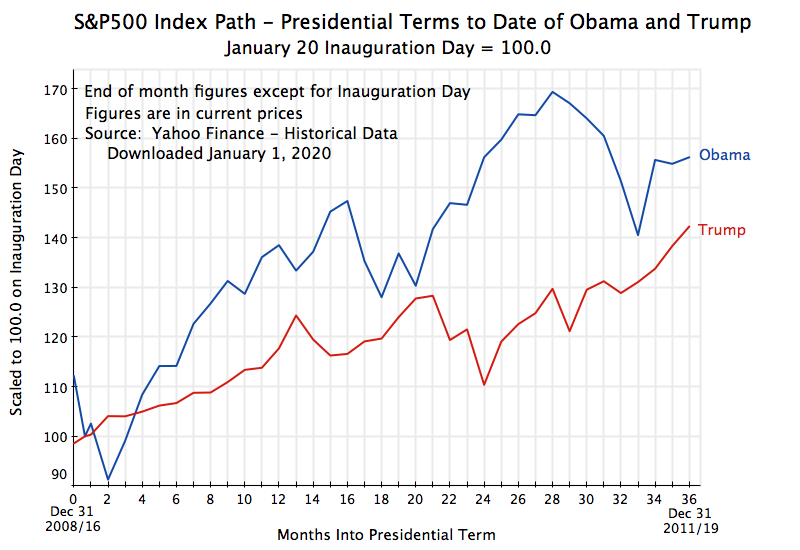
The chart at the top of this post compares the performance of the stock market during Trump’s term in office thus far (through December 31, 2019) to that under Obama to the same point in his first term in office.  The difference is clear.  Other than during Obama’s first few months in office, when he inherited from George W. Bush an economy in freefall, stock market performance under Obama was always better than it has been under Trump.  Even after slashing corporate profit taxes by more than half, the stock market under Trump did not do exceptionally well.

The S&P500 Index is being used as the measure of the US stock market.  Most professionals use this index as the best indicator of overall stock market performance, as it is comprehensive and broad (covering the 500 largest US companies as measured by stock market value, with the companies weighted in the index based on their market valuations).  The data were downloaded from Yahoo Finance, where it is conveniently available (with daily values for the index going back to 1927), but can be obtained from a number of sources.  The chart shows end-of-month figures, starting from December 31 of the month before inauguration, and going through to December 31 of their third year in office.  The index is scaled to 100.0 on exactly January 20 (with this presented as “month” 0.65).

So if one wants to claim “bragging rights” for which president saw a better stock market performance, Obama wins over Trump, at least so far in their respective terms.

D.  Trump vs. All Presidents Since Reagan

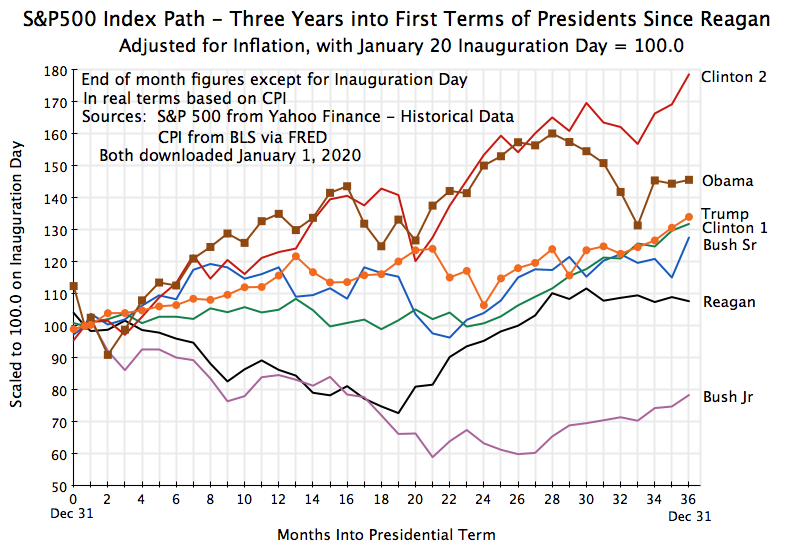
A comparison to just one president is limited.  How does the performance under Trump compare to that under other US presidents up to the same points in their terms in office?  Trump is roughly in the middle:

This chart tracks the performance under each president since Reagan up through the third year of their first terms in office.  I have adjusted here for inflation (using the CPI), as inflation was substantially higher during the Reagan and Bush Sr. terms in office than it has been since.  (I left the chart at the top of this post of just Obama vs. Trump in nominal terms as inflation in recent years has been steady and low.  But for those interested in the impact of this, one can see the Obama and Trump numbers in real terms in the current chart.)  I have included in this chart only the first terms of each president (with one exception) as the chart is already cluttered and was even more so when I had all the presidential terms.

The exception is that I included for perspective the stock market performance during Clinton’s second term in office.  The stock market rose over that period by close to 80% in real terms, which was substantially higher than under any other president since at least before Reagan in either their first or second terms.  The performance in Obama’s first term (of 146% in real terms) was the second-highest.  There was then a set of cases which, at the three-year mark, showed surprising uniformity in performance, with increases of between 32% and 34% in the second Reagan term, the first Clinton term, the second Obama term, and Trump’s term so far.  Bush Sr. was not far behind this set with an increase of 28%.

The worst performances were under Bush Jr. ( a fall of 22% to the third-year point in his first term), and Reagan (an increase of just 8% to that point in his first term).

So the performance of the market under Trump is in the middle – not the worst, but well below the best.

E.  Single Year Increases in the S&P500 from 1946 to 2019

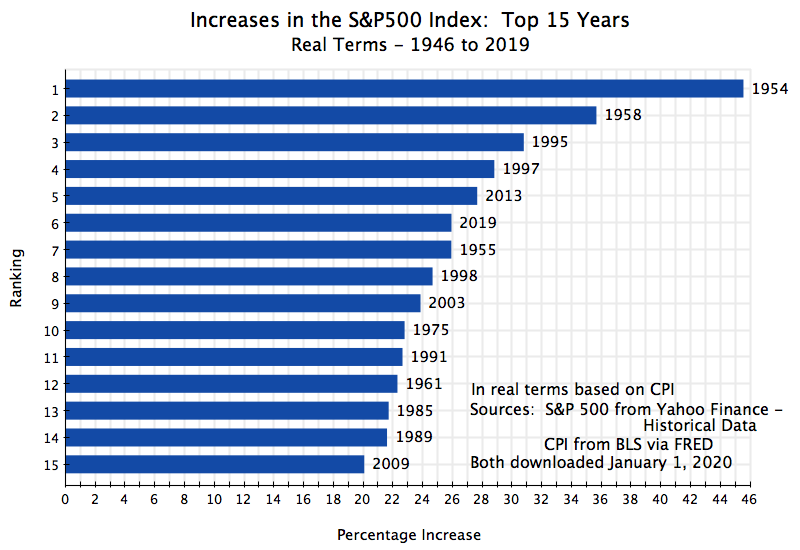
Finally, was the increase under Trump in his best single year so far (2019) a record?  No, it was not.  Looking at the single year performances (in real terms) since 1946, the top 15 were:

The increase in 2019, of 25.9%, was good, but only the sixth-highest of the 74 years between 1946 and 2019 (inclusive).  The stock market rose by more in 2013 during Obama’s term in office (by 27.7%), and in 1997 (28.8%) and 1995 (30.8%) which were both Clinton years.  And the highest increases were in 1958 (35.7%) and 1954 (45.6%) when Eisenhower was president.

The market also rose substantially in 2017, in Trump’s first year in office, by 16.9%.  But it then fell by 8.0% in 2018, in Trump’s second year in office.  Overall, the average rank (out of the 74 years from 1946 to 2019) of the individual year performances over the three years Trump has been in office so far, would place Trump in the middle third.  Not the worst, but also far from the best.  And comparing the three-year average while Trump has been president to rolling three-year averages since 1946, Trump’s average (of 11.6%) is well below the best.  The highest was an average return of 25.3% in 1995-97 during Clinton’s term in office.  And the three-year average return was also higher at 16.7% in 2012-14 during Obama’s term.

F.  Summary and Conclusion

Trump likes to brag that the performance of the stock market during his term in office has been exceptional.  But despite a slashing of corporate profit taxes (which, other things being equal would be expected to increase stock prices by 11%), the performance of the market during Trump’s term in office would put him in the middle.  Specifically:

a)  The market rose by more during the first three years of Obama’s term in office than it has under Trump;

b)  Compared to the first three years in office of all presidents since Reagan (whether first terms only, or first and second terms) would place Trump in the middle.  Indeed, the increase under Trump so far was almost exactly the same as the increases seen (at the three-year point) in Obama’s second term, in Reagan’s second term, and in Clinton’s first term.  And the return under Trump was well below that seen in Obama’s first term, and especially far below that in Clinton’s second term.

c)  The individual year performances during Trump’s three years have also not been exceptional.  While the performance in 2019 was good, it was below that of a number of other years since World War II, and below that of individual years during Obama’s and Clinton’s terms in office.

But as noted at the start of this post, stock market returns should not be over-emphasized.  An increase in the stock market does little for those who do not have the wealth to have substantial holdings in the stock market, and as a broader indicator of how the overall economy is performing, stock market returns are imperfect at best.

Still, one should be accurate in one’s claims.  And as on many things, Trump has not been.