The Impact of the Reagan and Bush Tax Cuts: Not a Boost to Employment, nor to Growth, nor to the Fiscal Accounts

Private Employment Following Tax Law Changes

A.  Introduction

The belief that tax cuts will spur growth and new jobs, and indeed even lead to an improvement in the fiscal accounts, remains a firm part of Republican dogma.  The tax plans released by the main Republican presidential candidates this year all presume, for example, that a spectacular jump in growth will keep fiscal deficits from increasing, despite sharp cuts in tax rates.  And conversely, Republican dogma also holds that tax increases will kill growth and thus then lead to a worsening in the fiscal accounts.  The “evidence” cited for these beliefs is the supposed strong recovery of the economy in the 1980s under Reagan.

But the facts do not back this up.  There have been four major rounds of changes in the tax code since Reagan, and one can look at what happened after each.  While it is overly simplistic to assign all of what followed solely to the changes in tax rates, looking at what actually happened will at least allow us to examine the assertion underlying these claims that the Reagan tax cuts led to spectacular growth.

The four major changes in the tax code were the following.  While each of the laws made numerous changes in the tax code, I will focus here on the changes made in the highest marginal rate of tax on income.  The so-called “supply-siders” treat the highest marginal rate to be of fundamental importance since, under their view, this will determine whether individuals will make the effort to work or not, and by how much.  The four episodes were:

a)  The Reagan tax cuts signed into law in August 1981, which took effect starting in 1982. The highest marginal income tax rate was reduced from 70% before to 50% from 1982 onwards.  There was an additional round of tax cuts under a separate law passed in 1986, which brought this rate down further to 38.5% in 1987 and to 28% from 1988 onwards. While this could have been treated as a separate tax change episode, I have left this here as part of the Reagan legacy.  Under the Republican dogma, this should have led to an additional stimulant to growth.  We will see if that was the case.  There was also a more minor change under George H.W. Bush as part of a 1990 budget compromise, which brought the top rate partially back from 28.0% to 31.0% effective in 1991.  While famous as it went against Bush’s “read my lips” pledge, the change was relatively small.

b)  The tax rate increases in the first year of the Clinton presidency.  This was signed into law in August 1993, with the tax rate increases applying in that year.  The top marginal income tax rate was raised to 39.6%.

c)  The tax cuts in the George W. Bush presidency that brought the top rate down from 39.6% to 38.6% in 2002 and to 35.0% in 2003.  The initial law was signed in June 2001, and then an additional act passed in 2003 made further tax cuts and brought forward in time tax cuts being phased in under the 2001 law.

d)  The tax rate increases for those with very high incomes signed into law in December 2012, just after Obama was re-elected, that brought the marginal rate for the highest income earners back to 39.6%.

We therefore have four episodes to look at:  two of tax cuts and two of tax increases.  For each, I will trace what happened from when the tax law changes were signed up to the end of the administration responsible (treating Reagan and Bush I as one).  The questions to address are whether the tax cut episodes led to exceptionally good job growth and GDP growth, while the the tax increases led to exceptionally poor job and GDP growth. We will then look at what happened to the fiscal accounts.

B.  Jobs and GDP Growth Following the Changes in Tax Law

The chart at the top of this post shows what happened to private employment, by calendar quarter relative to a base = 100 for the quarter when the new law was signed. The data is from the Bureau of Labor Statistics (downloaded, for convenience, from FRED).  A chart using total employment would look almost exactly the same (but one could argue that government employment should be excluded as it is driven by other factors).

As the chart shows, private job growth was best following the Clinton and Obama tax increases, was worse under Reagan-Bush I, and abysmal under Bush II.  There is absolutely no indication that big tax cuts, such as those under Reagan and then Bush II, are good for job growth.  I would emphasize that one should not then jump to the conclusion that tax increases are therefore good for job growth.  That would be overly simplistic.  But what the chart does show is that the oft-stated claim by Republican pundits that the Reagan tax cuts were wonderful for job growth simply has no basis in fact.

How about the possible impact on GDP growth?  A similar chart shows (based on BEA data on the GDP accounts):

Real GDP Following Tax Law Changes

Once again, growth was best following the Clinton tax increases.  Under Reagan, GDP growth first fell following the tax cuts being signed into law (as the economy moved down into a recession, which by NBER dating began almost exactly as the Reagan tax cut law was being signed), and then recovered.  But the path never catches up with that followed during the Clinton years.  Indeed after a partial catch-up over the initial three years (12 calendar quarters), the GDP path began to fall steadily behind the pace enjoyed under Clinton.  Higher taxes under Clinton were clearly not a hindrance to growth.

The Bush II and Obama paths are quite similar, even though growth during these Obama years has had to go up against the strong headwinds of fiscal drag from government spending cuts.  Federal government spending on goods and services (from the GDP accounts, with the figures in real, inflation-adjusted, terms) rose at a 4.4% per annum pace during the eight years of the Bush II administration, and rose at a 5.6% rate during Bush’s first term.  Federal government spending since the late 2012 tax increases were signed under Obama have fallen, in contrast, at a 2.8% per annum rate.

There is therefore also no evidence here that tax cuts are especially good for growth and tax increases especially bad for growth.  If anything, the data points the other way.

C.  The Impact on the Fiscal Accounts

The argument of those favoring tax cuts goes beyond the assertion that they will be good for growth in jobs and in GDP.  Some indeed go so far as to assert that the resulting stimulus to growth will be so strong that tax revenues will actually rise as a result, since while the tax rates will be lower, they will be applied against resulting higher incomes and hence “pay for themselves”.  This would be nice, if true.  Something for nothing. Unfortunately, it is a fairy tale.

What happened to federal income taxes following the changes in the tax rates?  Using CBO data on the historical fiscal accounts:

Real Federal Income Tax Revenues Following Tax Law Changes

Federal income tax revenues (in real terms) either fell or at best stagnated following the Reagan and then the Bush II tax cuts.  The revenues rose following the Clinton and Obama tax increases.  The impact is clear.

While one would think this should be obvious, the supply-siders who continue to dominate Republican thinking on these issues assert the opposite has been the case (and would be, going forward).  Indeed, in what must be one of the worst economic forecasts ever made in recent decades by economists (and there have been many bad forecasts), analysts at the Center for Data Analysis at the conservative Heritage Foundation concluded in 2001 that the Bush II tax cuts would lead government to “effectively pay off the publicly held federal debt by FY 2010”.  Publicly held federal debt would fall below 5% of GDP by FY2011 they said, and could not go any lower as some federal debt is needed for purposes such as monetary operations.  But actual publicly held federal debt reached 66% of GDP that year.  That is not a small difference.

Higher tax revenues help then make it possible to bring down the fiscal deficit.  While the deficit will also depend on public spending, a higher revenue base, all else being equal, will lead to a lower deficit.

So what happened to the fiscal deficit following these four episodes of major tax rate changes?  (Note to reader:  A reduction in the fiscal deficit is shown as a positive change in the figure.)

Change in Fiscal Deficit Relative to Base Year Following Tax Law Changes

The deficit as a share of GDP was sharply reduced under Clinton and even more so under Obama.  Indeed, under Clinton the fiscal accounts moved from a deficit of 4.5% of GDP in FY1992 to a surplus of 2.3% of GDP in FY2000, an improvement of close to 7% points of GDP.  And in the period since the tax increases under Obama, the deficit has been reduced by over 4% points of GDP, in just three years.  This has been a very rapid base, faster than that seen even during the Clinton years.  Indeed, the pace of fiscal deficit reduction has been too fast, a consequence of the federal government spending cuts discussed above.  This fiscal drag held back the pace of recovery from the downturn Obama inherited in 2009, but at least the economy has recovered.

In contrast, the fiscal deficit deteriorated sharply following the Reagan tax cuts, and got especially worse following the Bush II tax cuts.  The federal fiscal deficit was 2.5% of GDP in FY1981, when Reagan took office, went as high as 5.9% of GDP in FY1983, and was 4.5% of GDP in FY1992, the last year of Bush I (it was 2.5% of GDP in FY2015 under Obama).  Bush II inherited the Clinton surplus when he took office, but brought this down quickly (on a path initially similar to that seen under Reagan).  The deficit was then 3.1% of GDP in FY2008, the last full year when Bush II was in office, and hit 9.8% of GDP in FY2009 due largely to the collapsing economy (with Bush II in office for the first third of this fiscal year).

Republicans continue to complain of high fiscal deficits under the Democrats.  But the deficits were cut sharply under the Democrats, moving all the way to a substantial surplus under Clinton.  And the FY2015 deficit of 2.5% of GDP under Obama is not only far below the 9.8% deficit of FY2009, the year he took office, but is indeed lower than the deficit was in any year under Reagan and Bush I.  The tax increases signed into law by Clinton and Obama certainly helped this to be achieved.

D.  Conclusion

The still widespread belief among Republicans that tax cuts will spur growth in jobs and in GDP is simply not borne out be the facts.  Growth was better following the tax increases of recent decades than it was following the tax cuts.

I would not conclude from this, however, that tax increases are therefore necessarily good for growth.  The truth is that tax changes such as those examined here simply will not have much of an impact in one direction or the other on jobs and output, especially when a period of several years is considered.  Job and output growth largely depends on other factors.  Changes in marginal income tax rates simply will not matter much if at all. Economic performance was much better under the Clinton and Obama administrations not because they raised income taxes (even though they did), but because these administrations managed better a whole host of factors affecting the economy than was done under Reagan, Bush I, or Bush II.

Where the income tax rates do matter is in how much is collected in income taxes.  When tax rates are raised, more is collected, and when tax rates are cut, less is collected.  This, along with the management of other factors, then led to sharp reductions in the fiscal deficit under Clinton and Obama (and indeed to a significant surplus by the end of the Clinton administration), while fiscal deficits increased under Reagan, Bush I, and Bush II.

Higher tax collections when tax rates go up and lower collections when they go down should not be a surprising finding.  Indeed, it should be obvious.  Yet one still sees, for example in the tax plans issued by the Republican presidential candidates this year, reliance on the belief that a miraculous jump in growth will keep deficits from growing.

There is no evidence that such miracles happen.

The Impact of Increased Inequality on the Social Security Trust Fund, and What To Do Now

Social Security Trust Fund to GDP, with benefit changes, 90% of Wages from 1984 or 2016, 1970 to 2090, revised

A.  Introduction

It is well known that with current Social Security tax and benefit rates, the Social Security Trust Fund is projected to run out by the 2030s.  The most recent projection is that this will happen in 2034.  And it is commonly believed that this is a consequence of lengthening life spans.  However, that is not really true.  Later in this century (in the period after the 2030s), life spans that are now forecast to be longer than had been anticipated before will eventually lead, if nothing is done, to depletion of the trust funds.  But the primary cause of the trust funds running out by the currently projected 2034 stems not from longer life spans, but rather from the sharp growth in US income inequality since Ronald Reagan was president.  Had inequality not grown as it has since the early 1980s, and with all else as currently projected, the Social Security Trust Fund would last to about 2056.

This particular (and important) consequence of the growing inequality in American society over the last several decades does not appear to have been recognized before.  Rather, the problems being faced by the Social Security Trust Fund are commonly said to be a consequence of lengthening life expectancies of Americans (where it is the life expectancy of those at around age 65, the traditional retirement age, that is relevant).  I have myself stated this in earlier posts on this blog.

But this assertion that longer life spans are to blame has bothered me.  Social Security tax rates and benefit formulae have been set based on what were thought at the time to be levels that would allow all scheduled benefits to be paid for the (then) foreseeable future, based on the forecasts of the time (of life expectancies and many other factors). Thus it is not correct to state that it is longer life spans per se that can be to blame for the Social Security Trust Fund running out.  Rather, it would be necessary for life spans to be lengthening by more than had been expected before for this to be the case.

This blog post will look first at these projections of life expectancy – what path was previously forecast in comparison to what in fact happened (up to now) and what is forecast (now) for the future.  We will find that the projections used to set the current Social Security tax and benefit rates (last changed in the early 1980s) had in fact forecast life spans which would be longer than what transpired in the 1980s, 1990s, and 2000s.  That is, actual life expectancies have turned out to be shorter than what had been forecast for those three decades.  However, life spans going forward are currently forecast to be longer than what had been projected earlier.  On average, it turns out that the earlier forecasts were not far off from what happened or is now expected through to 2034.  Unexpectedly longer life spans do not account for the current forecast that the Social Security Trust Fund will run out by 2034.

Rather, the problem is due to the sharp increase in wage income inequality since the early 1980s.  Only wages up to a ceiling (of $118,500 in 2016) are subject to Social Security tax.  Wages earned above that ceiling amount are exempt from the tax.  In 1982 and also in 1983, the ceiling then in effect was such that Social Security taxes were paid on 90% of all wages earned.  But as will be discussed below, increasing wage inequality since then has led to an increasing share of wages above the ceiling, and hence exempt from tax.  It is this increasing wage income inequality which is leading the Social Security Trust Fund to an expected depletion by 2034, if nothing is done.

This blog post will look at what path the Social Security Trust Fund would have taken had wage inequality not increased since 1983.  Had that been the case, 90% of wages would have been covered by Social Security tax since 1984, in the past and going forward.  But since it is now 2016 and we cannot change history, we will also look at what the path would be if the ceiling were now returned, from 2016 going forward, to a level covering 90% of wages.  The final section of the post will then look at what would happen if the wage ceiling were lifted altogether so that the rich would pay at the same rate of tax as the poor.

One final point for this introduction:  In addition to longer life spans, many commentators assert that it is the retiring baby boom generation which is depleting the Social Security Trust Fund.  But this is also not true.  The Social Security tax and benefit rates were set in full knowledge of how old the baby boomers were, and when they would be reaching retirement age.  Demographic projections are straightforward, and they had a pretty good estimate 64 years ago of how many of us would be reaching age 65 today.

B.  Projections of Increasing Life Spans for Those in Retirement

Life expectancies have been growing.  But this has been true for over two centuries, and longer expected life spans have always been built into the Social Security calculations of what the Social Security tax rates would need to be in order to provide for the covered benefits.  The issue, rather, is whether the path followed for life expectancies (actual up to now and as now expected for the future) is higher or lower than the path that had been expected earlier.

What we have seen in recent decades is that while life spans for those of higher income have continued to grow, they have increased only modestly for the bottom half of income earners.  Part of the reason for this stagnation of life expectancy for the bottom half of the income distribution is undoubtedly a consequence of stagnant real incomes for lower income earners.  As discussed in an earlier post on this blog, median real wages have hardly risen at all since 1980.  And indeed, average real household incomes of the bottom 90% of US households were lower in 2014 than they were in 1980.

Thus it is an open question whether life spans are turning out to be longer than what had been projected before, when Social Security tax and benefit rates were last adjusted.  The most recent such major adjustment was undertaken in 1983, following the report of the Greenspan Commission (formally titled the National Commission on Social Security Reform).  President Reagan appointed Alan Greenspan to be the chair (and later appointed him to be the head of the Federal Reserve Board), with the other members appointed either by Reagan or by Congress (with a mix from both parties).

The Greenspan Commission made recommendations on a set of measures (which formed the basis for legislation enacted by Congress in 1983) which together would ensure, based on the then current projections, that the Social Security Trust Fund would remain adequate through at least 2060.  They included a mix of increased tax rates (with the Social Security tax rate raised from 10.8% to 12.4%, phased in over 7 years, with this for both the old-age pensions and disability insurance funds and covering both the employer and employee contributions) and reduced benefits (with, among other changes, the “normal” retirement age increased over time).

It is now forecast, however, that the Trust Funds will run out by 2034.  What changed? The common assertion is that longer life spans account for this.  However, this is not true. The life spans used by the Greenspan Commission (see Appendix K of their report, Table 12) were in fact too high, averaging male and female together, up to about 2010, but are now forecast to be too low going forward.  More precisely, comparing those forecasts to those in the most recent 2015 Social Security Trustees Report:

Projected Life Expectancies at Age 65 - As of 1982 vs 2015, Up to 2090


The chart shows the forecasts (in blue) used by the Greenspan Commission (which were in turn taken from the 1982 Social Security Trustees Report) overlaid on the current (2015, in red) history and projections.  The life span forecasts used by the Greenspan Commission turned out actually to be substantially higher than what were the case or are forecast now to be the case for females to some point past 2060, higher up to the year 2000 for males, and based on the simple male/female average, higher up to about 2010 for all, than what were estimated in the 2015 report.  For the full period from 1983 to 2034 (using interpolated figures for the periods when the 1982 forecasts were only available for every 5 and then every 10 years), it turns out that the average over time of the differences in the male/female life expectancy at age 65 between the 1982 forecasts and those from 2015, balances almost exactly. The difference is only 0.01 years (one-hundreth of a year).

For the overall period up to 2034, the projections of life expectancies used by the Greenspan Commission are on average almost exactly the same as what has been seen up to now or is currently forecast going forward (cumulatively to 2034).  And it is the cumulative path which matters for the Trust Fund.  Unexpectedly longer life expectancies do not explain why the Social Security Trust Fund is now forecast to run out by 2034.  Nor, as noted above, is it due to the pending retirement of more and more of the baby boom generation.  It has long been known when they would be reaching age 65.

C.  The Ceiling on Wages Subject to Social Security Tax

Why then, is the Social Security Trust Fund now expected to run out by 2034, whereas the Greenspan Commission projected that it would be fine through 2060?  While there are many factors that go into the projections, including not just life spans but also real GDP growth rates, interest rates, real wage growth, and so on, one assumption stands out. Social Security taxes (currently at the rate of 12.4%, for employee and employer combined) only applies to wages up to a certain ceiling.  That ceiling is $118,500 in 2016. Since legislation passed in 1972, this ceiling has been indexed in most years (1979 to 1981 were exceptions) to the increase in average wages for all employees covered by Social Security.

The Greenspan Commission did not change this.  Based on the ceiling in effect in 1982 and again in 1983, wages subject to Social Security tax would have covered 90.0% of all wages in the sectors covered by Social Security.  That is, Social Security taxes would have been paid on 90% of all wages in the covered sectors in those years.  If wages for the poor, middle, and rich had then changed similarly over time (in terms of their percentage increases), with the relative distribution thus the same, an increase in the ceiling in accordance with changes in the overall average wage index would have kept 90% of wages subject to the Social Security tax.

However, wages did not change in this balanced way.  Rather, the changes were terribly skewed, with wages for the rich rising sharply since the early 1980s while wages for the middle classes and the poor stagnated.  When this happens, with wages for the rich (those earning more than the Social Security ceiling) rising by more (and indeed far more) than the wages for others, indexing the ceiling to the average wage will not suffice to keep 90% of wages subject to tax.  Rather, the share of wages paying Social Security taxes will fall.  And that is precisely what has happened:

Social Security Taxable Wages as Share of Total Wages, 1982 to 2090

Due to the increase in wage income inequality since the early 1980s, wages paying Social Security taxes fell from 90.0% of total wages in 1982 and again in 1983, to just 82.7% in 2013 (the most recent year with data, see Table 4.B1 in the 2014 Social Security Annual Statistical Supplement).  While the trend is clearly downward, note how there were upward movements in 1989/90/91, in 2001/02, and in 2008/09.  These coincided with the economic downturns at the start of the Bush I administration, the start of the Bush II administration, and the end of the Bush II administration.  During economic downturns in the US, wages of those at the very top of the income distribution (Wall Street financiers, high-end lawyers, and similar) will decline especially sharply relative to where they had been during economic booms, which will result in a higher share of all wages paid in such years falling under the ceiling.

Why did the Greenspan Commission leave the rule for the determination of the ceiling on wages subject to Social Security tax unchanged?  Based on the experience in the decades leading up to 1980, this was not unreasonable.  In the post-World War II decades up to 1980, the distribution of incomes did not change much.  As discussed in an earlier post on this blog, incomes of the rich, middle, and poor all grew at similar rates over that period, leaving the relative distribution largely unchanged.  It was not unreasonable then to assume this would continue.  And indeed, there is a footnote in a table in the annex to the Greenspan Commission report (Appendix K, Table 15, footnote c) which states:  [Referring to the column showing the historical share in total wages of wages below the ceiling, and hence subject to Social Security tax] “The percent taxable for future years [1983 and later] should remain relatively stable as the taxable earnings base rises automatically based on increases in average wage levels.”

Experience turned out to be quite different.  Income inequality has risen sharply since Reagan was president.  This reduced the share of wages subject to Social Security tax, and undermined the forecasts made by the Greenspan Commission that with the changes introduced, the Social Security Trust Fund would remain adequate until well past 2034.

Going forward, the current forecasts for the path of the share of wages falling under the ceiling and hence subject to Social Security tax are shown as the blue curve in the chart. The forecasts (starting from 2013, the year with the most recent data when the Social Security Administration prepared these projections) are that the share would continue to decline until 2016.  However, they assume the share subject to tax will then start a modest recovery, reaching a share of 82.5% 2024 at which it will then remain for the remainder of the projection period (to 2090).  (The figures are from the Social Security Technical Panel Report, September 2015, see page 64 and following.  The annual Social Security Trustees Report does not provide the figures explicitly, even though they are implicit in their projections.)

This stabilization of the share of wages subject to Social Security tax at 82.5% is critically important.  Should the wage income distribution continue to deteriorate, as it has since the early 1980s, the Social Security Trust Fund will be in even greater difficulty than is now forecast.  And it is not clear why one should assume this turnaround should now occur.

Finally, it should be noted for completeness that the share of wages subject to tax varied substantially over time in the period prior to 1982.  Typically, it was well below 90%.  When Social Security began in 1937, the ceiling then set meant that 92% of wages (in covered sectors) were subject to tax (see Table 4.B1 in the 2014 Social Security Annual Statistical Supplement).  But the ceiling was set in nominal terms (initially at $3,000), which meant that it fell in real terms over time due to steady, even if low, inflation.  Congress responded by periodically adjusting the annual ceiling upward in the 1950s, 1960s, and 1970s, but always simply setting it at a new figure in nominal terms which was then eroded once again by inflation.  Only when the new system was established in the 1970s of adjusting the ceiling annually to reflect changes in average nominal wages did the inflation issue get resolved.  But this failed to address the problem of changes in the distribution of wages, where an increasing share of wages accruing to the rich in recent decades (since Reagan was president) has led to the fall since 1983 in the share subject to tax.

Thus an increasing share of wages has been escaping Social Security taxes.  The rest of this blog post will show that this explains why the Social Security Trust Fund is now projected to run out by 2034, and what could be achieved by returning the ceiling to where it would cover 90% of wages, or by lifting it entirely.

D.  The Impact of Keeping the Ceiling at 90% of Total Wages

The chart at the top of this post shows what the consequences would be if the ceiling on wages subject to Social Security taxes had been kept at levels sufficient to cover 90% of total wages (in sectors covered by Social Security), with this either from 1984 going forward, or starting from 2016.  While the specific figures for the distant future (the numbers go out to 2090) should not be taken too seriously, the trends are of interest.

The figures are calculated from data and projections provided in the 2015 Social Security Trustees Annual Report, with most of the specific data coming from their supplemental single-year tables (and where the share of wages subject to tax used in the Social Security projections are provided in the 2015 Social Security Technical Panel Report).  Note that throughout this blog post I am combining the taxes and trust funds for Old-Age Security (OASI, for old age and survivor benefits) and for Disability Insurance (DI).  While technically separate funds, these trust funds are often combined for analysis, in part because in the past they have traditionally been able to borrow from each other (although Republicans in Congress are now trying to block this flexibility).

The Base Case line (in black) shows the path of the Social Security Trust Fund to GDP ratio based on the most recent intermediate case assumptions of Social Security, as presented in the 2015 Social Security Trustees Annual Report.  The ratio recovered from near zero in the early 1980s to reach a high of 18% of GDP in 2009, following the changes in tax and benefit rates enacted by Congress after the Greenspan Commission report.  But it then started to decline, and is expected to hit zero in 2034 based on the most recent official projections.  After that if would grow increasingly negative if benefits were to continue to be paid out according to the scheduled formulae (and taxes were to continue at the current 12.4% rate), although Social Security does not have the legal authority to continue to pay out full benefits under such circumstances.  The projections therefore show what would happen under the stated assumptions, not what would in fact take place.

But as noted above, an important assumption made by the Greenspan Commission that in fact did not hold true was that adjustments (based on changes in the average wage) of the ceiling on wages subject to Social Security tax, would leave 90% of wages in covered sectors subject to the tax.  This has not happened due to the growth in wage income inequality in the last 35 years.  With the rich (and especially the extreme rich) taking in a higher share of wages, the wages below a ceiling that was adjusted according to average wage growth has led to a lower and lower share of overall wages paying the Social Security tax.  The rich are seeing a higher share of the high wages they enjoy escaping such taxation.

The blue curves in the chart show what the path of the Social Security Trust Fund to GDP ratio would have been (and would be projected going forward, based on the same other assumptions of the base case) had the share of wages subject to Social Security taxes remained at 90% from 1984.  The dark blue curve shows what path the Trust Fund would have taken had Social Security benefits remained the same.  But since benefits are tied to Social Security taxes paid, the true path will be a bit below (shown as the light blue curve). This takes into account the resulting higher benefits (and income taxes that will be paid on these benefits) that will accrue to those paying the higher Social Security taxes.  This was fairly complicated, as one needs to work out the figures year by year for each age cohort, but can be done.  It turns out that the two curves end up being quite close to each other, but one did not know this would be the case until the calculations were done.

Had the wage income distribution not deteriorated after 1983, and with all else as in the base case path of the Social Security Trustees Report (actual for historical, or as projected going forward), the Trust Fund would have grown to a peak of 26% of GDP in 2012, before starting on a downward path.  It would eventually still have turned negative, but only in 2056.  Over the long term, the forecast increase in life expectancies (beyond what the Greenspan Commission had assumed) would have meant that further changes beyond what were enacted following the Greenspan Commission report would eventually have become necessary to keep the Trust Fund solvent.  But it would have occurred more than two decades beyond what is now forecast.

At this point in time, however, we cannot go back in time to 1984 to keep the ceiling sufficient to cover 90% of wages.  What we can do now is raise the ceiling today so that, going forward, 90% of wages would be subject to the tax.  Based on 2014 wage distribution statistics (available from Social Security), one can calculate that the ceiling in 2014 would have had to been raised from the $117,000 in effect that year, to $185,000 to once again cover 90% of wages (about $187,000 in 2016 prices). 

The red curves on the chart above show the impact of starting to do this in 2016.  The Trust Fund to GDP ratio would still fall, but now reach zero only in 2044, a decade later than currently forecast.  Although there would be an extra decade cushion as a result of the reform, there would still be a need for a longer term solution.   

E.  The Impact of Removing the Wage Ceiling Altogether

The financial impact of removing the wage ceiling altogether will be examined below.  But before doing this, it is worthwhile to consider whether, if one were designing a fair and efficient tax structure now, would a wage ceiling be included at all?  The answer is no. First, it is adds a complication, and hence it is not simple.  But more importantly, it is not fair.  A general principle for tax systems is that the rich should pay at a rate at least as high as the poor.  Indeed, if anything they should pay at a higher rate.  Yet Social Security taxes are paid at a flat rate (of 12.4% currently) for wages up to an annual ceiling, and at a zero rate for earnings above that ceiling.

While it is true that this wage ceiling has been a feature of the Social Security system since its start, this does not make this right.  I do not know the history of the debate and political compromises necessary to get the Social Security Act passed through Congress in 1935, but could well believe that such a ceiling may have been necessary to get congressional approval.  Some have argued that it helped to provide the appearance of Social Security being a self-funded (albeit mandatory) social insurance program rather than a government entitlement program.  But for whatever the original reason, there has been a ceiling.

But the Social Security tax is a tax.  It is mandatory, like any other tax.  And it should follow the basic principles of taxation.  For fairness as well as simplicity, there should be no ceiling.  The extremely rich should pay at least at the same rate as the poor.

One could go further and argue that the rates should be progressive, with marginal rates rising for those at higher incomes.  There are of course many options, and I will not go into them here, but just note that Social Security does introduce a degree of progressivity through how retirement benefits are calculated.  The poor receive back in pensions a higher amount in relation to the amounts they have paid in than the rich do.  One could play with the specific parameters to make this more or less progressive, but it is a reasonable approach.  Thus applying a flat rate of tax to all income levels is not inconsistent with progressivity for the system as a whole.

Leaving the Social Security tax rate at the current 12.4% (for employer and employee combined), but applying it to all wages from 2016 going forward and not only wages up to an annual ceiling, would lead to the following path for the Trust Fund to GDP ratio:

Social Security Trust Fund to GDP, with benefit changes, All Wages from 2016, 1970 to 2090, revised

The Trust Fund would now be projected to last until 2090.  Again, the projections for the distant future should not be taken too seriously, but they indicate that on present assumptions, eliminating the ceiling on wages subject to tax would basically resolve Trust Fund concerns for the foreseeable future.  A downward trend would eventually re-assert itself, due to the steadily growing life expectancies now forecast (see the chart in the text above for the projections from the 2015 Social Security Trustees Annual Report). Eventually there will be a need to pay in at a higher rate of tax if taxes on earnings over a given working life are to support a longer and longer expected retirement period, but this does not dominate until late in the forecast period.

As a final exercise, how high would that tax rate need to be, assuming all else (including future life expectancies) are as now forecast?  The chart below shows what the impact would be of raising the tax rate to 13.0% from 2050:

Social Security Trust Fund to GDP, with benefit changes, All Wages from 2016, 1970 to 2090, revised #2

The Social Security Trust Fund to GDP ratio would then be safely positive for at least the rest of the century, assuming the different variables are all as now forecast.  This would be a surprisingly modest increase in the tax rate from the current 12.4%.  If separated into equal employer and employee shares, as is traditionally done, the increase would be from a 6.2% tax paid by each to a 6.5% tax paid by each.  Such a separation is economically questionable, however.  Most economists would say that, under competitive conditions, the worker will pay the full tax.  Whether labor markets can be considered always to be competitive is a big question, but beyond the scope of this blog post.

F.  Summary and Conclusion

To summarize:

1)  The Social Security Trust Fund is projected to be depleted under current tax and benefit rates by the year 2034.  But this is not because retirees are living longer.  Increasing life spans have long been expected, and were factored into the estimates (the last time the rates were changed) of what the tax and benefit rates would need to be for the Trust Fund not to run out.  Nor is it because of aging baby boomers reaching retirement.  This has long been anticipated.

2)  Rather, the Social Security Trust Fund is now forecast to run out by the 2030s because of the sharp increase in wage income inequality since the early 1980s, when the Greenspan Commission did its work.  The Greenspan Commission assumed that the distribution of wage incomes would remain stable, as it had in the previous decades since World War II.  But that turned out not to be the case.

3)  If relative inequality had not grown, then raising the ceiling on wages subject to Social Security tax in line with the increase in average wages (a formula adopted in legislation of 1972, and left unchanged following the Greenspan Commission) would have kept 90% of wages subject to Social Security tax, the ratio it covered in 1982 and again in 1983.

4)  But wage income inequality has grown sharply since the early 1980s.  With the distribution increasingly skewed distribution, favoring the rich, an increasing share of wages is escaping Social Security tax.  By 2013, the tax only covered 82.7% of wages, with the rest above the ceiling and hence paying no tax.

5)  Had the ceiling remained since 1984 at levels sufficient to cover 90% of wages, and with all other variables and parameters as experienced historically or as now forecast going forward, the Social Security Trust Fund would be forecast to last until 2056.  While life expectancies (at age 65) in fact turned out on average to be lower than forecast by the Greenspan Commission until 2010 (which would have led to a higher Trust Fund balance, since less was paid out in retirement than anticipated), life expectancies going forward are now forecast to be higher than what the Greenspan Commission assumed.  This will eventually dominate.

6)  If the wage ceiling were now adjusted in 2016 to a level sufficient to cover once again 90% of wages ($187,000 in 2016), the Trust Fund would turn negative in 2044, rather than 2034 as forecast if nothing is done.

7)  As a matter of equity and following basic taxation principles, there should not be any wage ceiling at all.  The rich should pay Social Security tax at least at the same rate as the poor.  Under the current system, they pay zero on wage incomes above the ceiling.

8)  If the ceiling on wages subject to Social Security tax were eliminated altogether, with all else as in the base case Social Security projections of 2015, the Trust Fund would be expected to last until 2090.

9)  If the ceiling on wages subject to Social Security tax were eliminated altogether and the tax rate were raised from the current 12.4% to a new rate of 13.0% starting in 2050, with all else as in the base case Social Security projections of 2015, the Trust Fund would be expected to last to well beyond the current century.

There is No Reason to Expect Increased Labor Force Participation Rates to be a Source of Spectacular Growth

Labor Force Participation Rate, Ages 25 to 54, All, Male, Female, Jan 1948 to Feb 2016

A.  Introduction

An important issue in the current presidential campaign, although somewhat technical, is whether one should expect that employment could jump to substantially higher levels than where it is now, if only economic policy were better.  The argument is that while the unemployment rate as officially measured (4.9% currently) might appear to be relatively low and within the range normally considered “full employment”, this masks that many people (it is asserted) have given up looking for jobs and make up a large reservoir of “hidden unemployed”.  If only the economy were functioning better, it is said, more jobs would be created and taken up by these hidden unemployed, the economy would then be producing more, and everyone would be better off.

This is important for the Republicans, not only as part of their criticism of Obama, but also as a basis for their tax plans.  As discussed in the previous post on this blog, the Republican tax plans would all cut tax rates sharply, leading to such revenue losses that deficits would rise dramatically even if non-defense discretionary budget expenditures were cut all the way to zero.  The Republican candidates have asserted that deficits would not rise (even with sharply higher spending for defense, which they also want), because the tax cuts would spur such a large increase in growth of GDP that the tax revenues from the higher output would offset the reductions from lower tax rates.  Aside from the fact that there is no evidence to support the theory that such tax cuts would spur growth by any amount, much less the jump they are postulating (see the earlier blog post for a discussion), any rise in GDP of such magnitude would also depend on there being unemployed labor to take on such jobs.  With the economy now at close to full employment (with the unemployment rate of 4.9%), this could only be achieved if a large pool of hidden unemployed exists to enter (or re-enter) the labor force.

Given the huge magnitudes involved, few economists see these Republican tax plans as serious.  One cannot have such massive tax cuts and expect deficits not to rise.  And Democrats have long criticized such Republican plans for being unrealistic (there were similar, although not as extreme, Republican tax plans in the 2012 campaign, and Paul Ryan’s budget plans also relied on completely unrealistic assumptions).

Unfortunately, the Bernie Sanders campaign this year on the Democratic side has similarly set out proposals that are economically unrealistic.  A detailed assessment of the Bernie Sanders economic program by Professor Gerald Friedman of the University of Massachusetts at Amherst concluded that the Sanders program would raise GDP growth rates by more than even the Republicans are claiming.  But even left-wing commentators have criticized it heavily.  Kevin Drum at Mother Jones, for example, said the Sanders campaign had “crossed into neverland”.

A more detailed and technical evaluation from Professors Christina Romer and David Romer of UC Berkeley (with Christina Romer also the first Chair of the Council of Economic Advisers in the Obama Administration), concluded Friedman’s work was “highly deficient”, as they more politely put it.  And an open letter issued by four former Chairs of the Council of Economic Advisers under Obama and Bill Clinton (including Christina Romer) said “the economic facts do not support these fantastical claims”.

This is important.  In recent decades, it was the Republican candidates who have set out economic programs which did not add up or which depended on completely unrealistic assumptions of how the economy would respond.  The analysis by Professor Friedman of the Sanders program is similarly unrealistic.  As the four former Chairs of the CEA put it in their open letter:

“As much as we wish it were so, no credible economic research supports economic impacts of these magnitudes. Making such promises runs against our [Democratic] party’s best traditions of evidence-based policy making and undermines our reputation as the party of responsible arithmetic. These claims undermine the credibility of the progressive economic agenda and make it that much more difficult to challenge the unrealistic claims made by Republican candidates.”

To be fair, the relationship of the Friedman work to the Sanders campaign is not fully clear. At least one news report said the analysis was prepared at the request of Sanders, while others said not.  But upon its release, the Sanders campaign did explicitly say it was “outstanding work” which should receive more attention.  And when the work began to be criticized by economists such as the former chairs of the CEA, the response of the Sanders campaign was that their criticism should be dismissed, as they were of “the establishment of the establishment”.  Rather than engage on the real issues raised, the Sanders campaign simply dismissed the criticisms.  This does not help.

Both the Republican plans and the Sanders program depend on the assumption that so many workers would enter or re-enter the labor force that GDP could take a quantum leap up from what current projections consider to be possible.  (Both depend on other assumptions as well, such as unrealistically high assumptions on what would happen to productivity growth.  But it is not the purpose of this blog post to go into all such issues. Rather, it is to address the single issue of labor force participation.)  Their plans depend on a higher share of the population participating in the labor force than currently choose to do so, leading to an employment to population ratio that would thus rise sharply.  We will look in this post at whether this is possible.  An earlier post on this blog examined similar issues.  This post will come at it from a slightly different direction, and will update the figures to reflect the most recent numbers.

The key chart will be the one shown at the top of this post.  But to get to it, we will first go through a series of charts that set the story.  The data all come from the Bureau of Labor Statistics (BLS), either directly, or via the data set maintained by the Federal Reserve Bank of St. Louis (FRED).

B.  Recent Behavior of the Employment to Population Ratio

Many observers, from both the left and the right of the political spectrum, have looked at how the employment to population ratio has moved in the recent downturn, and concluded that there must be a significant reservoir of hidden unemployed.  Specifically, they have looked at charts such as the following:

Employment to Popul only, Jan 2007 to Feb 2016

Employment as a share of the population fell rapidly and sharply with the onset of the economic downturn in 2008, in the last year of the Bush Administration, and reached a low point in late 2009.  From about 63% in 2007 to around 58 1/2% in late 2009, it fell by over 7%.  It then remained at such low levels until 2013, rising only slowly, and since then has risen somewhat faster.

But at the current reading of 59.8%, it remains well below the 63% levels of 2007.  And it remains even more below the peak it reached in the history of the series of 64.7% in April 2000.  If this does, in fact, reflect a pool of hidden unemployed, then GDP could be significantly higher than it is now.  Assuming for simplicity that GDP would rise in proportion to the increase in workers employed, annual GDP would be close to a trillion dollars higher if the employment to population ratio rose from the current 59.8% to the 63% that prevailed in 2007.  And annual GDP would be close to $1.5 trillion higher if the ratio could revert to where it was in April 2000.  With a share of about 25% of this accruing in taxes, this would be a significant pot of money, which could be used for many things.

But is this realistic?  The short answer is no.  The population has moved on, with important demographic as well as social changes that cannot be ignored.

C.  Adding the Labor Force Participation Rate

A problem with the employment to population measure is that people will not be employed not just due to unemployment (are looking but cannot find a job), but also because they might not want to be working at the moment.  If older, they might be retired, and happily so.  If younger (the figures are for all adults in the civilian population, defined as age 16 or older), they might be students in high school or college.  And not all those in middle age will want to be working:  Until recent decades, a large share of adult women did not participate in the formal labor force.  Women’s participation in the formal labor force has, however, changed significantly over time, and is one of the key factors underlying the rise seen in the overall labor force participation rate over time.  Such factors should not be ignored, but are being ignored when one looks solely at the employment to population ratio.

The first step is to take into account unemployment.  Unemployment accounts for the difference between the employment to population ratio and the labor force participation rate (which is, stated another way, the labor force to population ratio).  Adding the labor force participation rate to the diagram yields:

Employment to Popul and Labor Force Participation Rate, Jan 2007 to Feb 2016

Note the unemployment rate as traditionally referred to (currently 4.9%) is not the simple difference, in percentage points, between the labor force participation rate (62.9% in February 2016) and the employment to population ratio (59.8% in February 2016).  The unemployment rate is traditionally defined as a ratio to the labor force, not to population, while the two measures of labor force participation rate and employment to population ratio are both defined as shares of the population.  Note that if you take the difference here (62.9% – 59.8% = 3.1% points in February 2016), and divide it by the labor force participation rate (62.9%), one will get the unemployment rate of 4.9% of the labor force. But all this is just arithmetic.

The key point to note for the chart above is that while the employment to population ratio fell sharply in the 2008-2009 downturn, and then recovered only slowly, the labor force participation rate has been moving fairly steadily downward throughout the period.  There is month to month variation for various reasons, including that all these figures are based on surveys of households.  There will therefore be statistical noise.  But the downward trend over the period is clear.  The question is why.  Does it perhaps reflect people dropping out of the labor force due to an inability to find jobs when the labor market is slack with high unemployment (the “discouraged worker” effect)?  Some commentators have indeed noted that the upward bump seen in the figures in the last few months (since last November), with the unemployment rate now low and hence jobs perhaps easier to find, might reflect this.  Or is it something else?

D.  The Longer Term Trend

A first step, then, is to step back and look at how the labor force participation rate has moved over a longer period of time.  Going back to 1948, when the data series starts:

Labor Force Participation Rate, Overall, All Ages, Jan 1948 to Feb 2016

The series peaked in early 2000, at a rate of 67.3%, and has moved mostly downward since.  It was already in 2007 well below where it had been in 2000, and the decline since then continues along largely the same downward path (where the flattening out between 2004 and 2007 was temporary).  Prior to 2000, it had risen strongly since the mid-1960s.

One does see some downward deviation from the trend whenever there was an economic downturn, but then that the series soon returned to trend.  Thus, for example, the labor force participation rate rose rapidly during the years of Jimmy Carter’s presidency in the late 1970s, but then leveled off in the economic downturn of the early 1980s during the Reagan years.  The unemployment rate peaked at 10.8% in late 1982 under Reagan (significantly more than the 10.0% it peaked at in 2009 under Obama), and one can see that the labor force participation rate leveled off in those years rather than continued the rise seen in the years before.  But these are relatively mild “bumps” in the broader long-term story of a rise to 2000 and then a fall.

The long term trend has therefore been a fairly consistent rise over the 35 years from the mid-1960s to 2000, and then a fairly consistent fall in the 16 years since then.  The question to address next is why has it behaved this way.

E.  Taking Account of an Aging Society, Students in School, and Male / Female Differences

As people age, they seek to retire.  Normal retirement age in the US has been around age 65, but there is no rigid rule that it has to be at that precisely that age.  Some retire a few years earlier and some a few years later.  But as one gets older, the share that will be retired (and hence not in the formal labor force) will increase.  And with the demographic dynamics where an increasing share of the US population has been getting older over time (due in part to the baby boom generation, but not just that), one would expect the labor force participation rate to decline over time, and especially so in recent years as the baby boom generation has reached its retirement years.

At the other end of the age distribution, an increasing share of the adult population (defined as those of age 16 or more) in school in their late teens and 20s will have a similar impact.  Over this period, the share of the population (of age 16 or more) in school or college has been increasing.

The other key factor to take into account is male and female differences in labor force participation.  A half century ago, most women did not participate in the formal labor force, and hence were not counted in the labor force participation rate.  Now they do.  This has had a major impact on the overall (male plus female) labor force participation rate, and this change over time has to be taken into account.

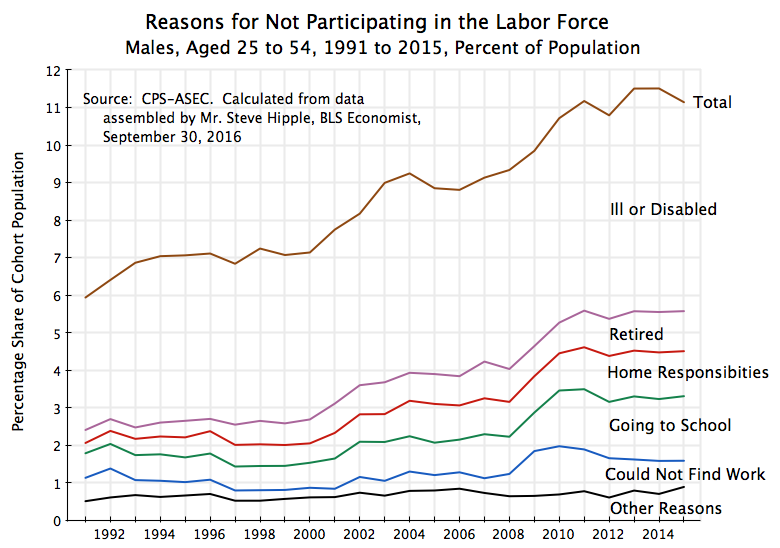
The impact of these factors can be seen in the key chart shown at the top of this blog. Male and female rates are shown separately, and to take into account the increasing share of the population in their retirement years or in school, the figures presented are for those in the prime working age span of 25 to 54.  The trends now come out clearly.

The most important trend is the sharp rise in female participation in the formal labor force, from just 34% (of those aged 25 to 54) at the start of 1948 to a peak of over 77% in early 2000.  The male rate for this age group, in contrast, has followed a fairly steady but slow downward trend from 97 to 98% in the early 1950s to about 88% in recent years.  As a result, the combination of the male and female rates rose (for this age group) from 65% in 1948 to a peak of 84% in 2000, and then declined slowly to 81% now.

Seen in this way, the recent movement in the labor force participation rate does not appear to be unusual at all.  Rather, it is simply the continuation of the trends observed over the last 68 years.  The male rate fell slowly but steadily, and the female rate at first rose until 2000, and then followed a path similar to the male rate.  The overall rate reflected the average between these two, and was driven mostly by the rise in the female rate before 2000, and then the similar declines in the male and female rates since then.

F.  The Female Labor Force Participation Rate as a Ratio to the Male Rate

Finally, it is of interest to look at the ratio of the female labor force participation rate to the male rate:

Ratio of Female to Male LFPR, Ages 25 to 54 only, Jan 1948 to Feb 2016

This ratio rose steadily until 2000.  But what is perhaps surprising is how steady this ratio has been since then, at around 83 to 84%.  An increasing share of females entered the labor force until 2000, but since then the female behavior has matched almost exactly the male behavior.  For both, the share of those in the age span of 25 to 54 in the labor force declined since 2000, but only slowly and at the same pace.  The male rate continued along the same trend path it had followed since the early 1950s; the female rate first caught up to a share of the male rate, and then followed a similar and parallel downward path.

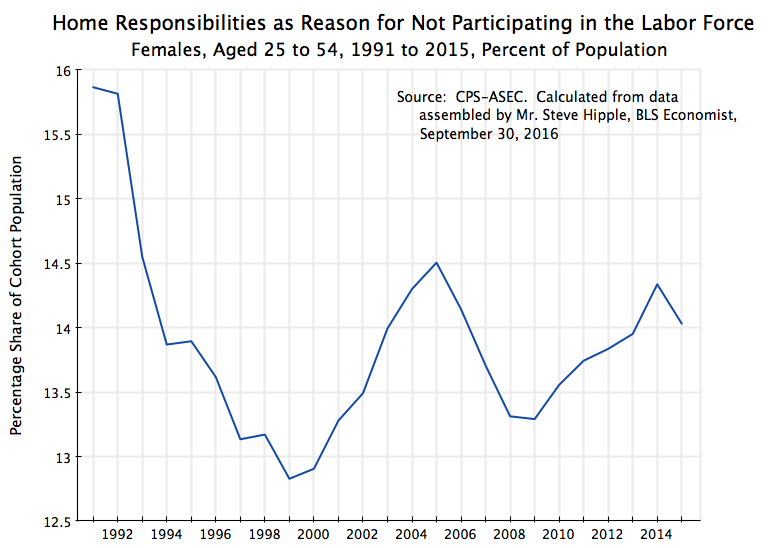
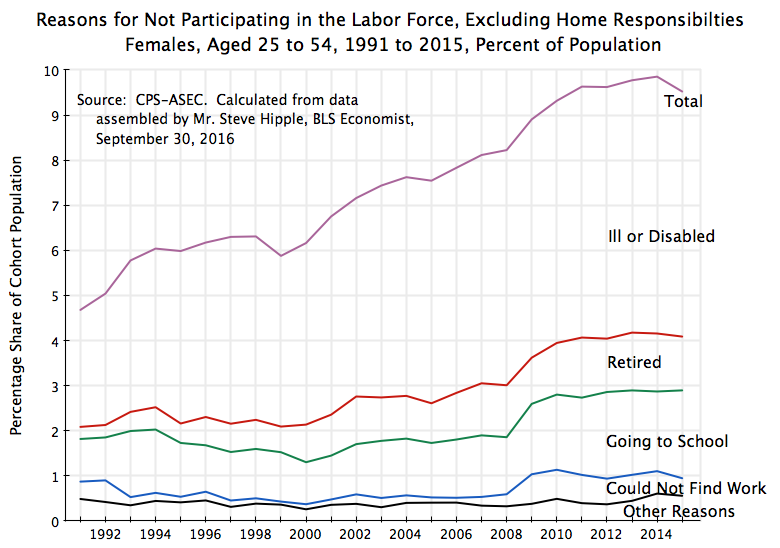
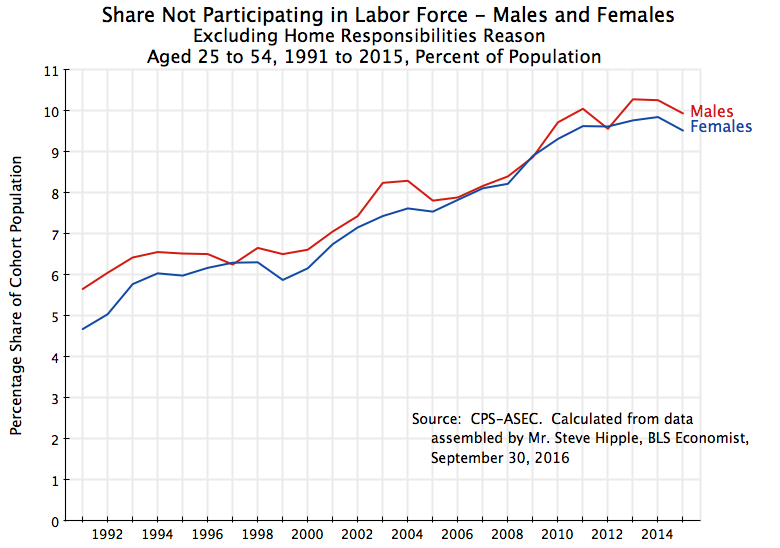
Why the female and male rates moved at such a similar and parallel pace since 2000, and at a 83 to 84% proportion, would be interesting issues to examine, but is beyond the scope of this blog post.  One hypothesis is that the parallel downward movements since 2000 reflect increasing enrollment in graduate level education of men and women older than age 25 (and hence included in the 25 to 54 age span).  But I do not know whether good data exists for this.  Another hypothesis might be that very early retirement (at age 54 or before), while perhaps small, has become more common.  And the ratio of the female rate to the male rate of a steady 83 to 84% might reflect dropping out of the labor force temporarily for child rearing, which most affects women.

More data would be required to test any of these hypotheses.  But it appears to be clear that long-term factors are at play, whether demographic, social, or cultural.  And the pattern seen since 2000 has been quite steady for 16 years now.  There is no indication that one should expect it to change soon.

G.  Conclusion

The downward movement in the employment to population ratio in 2008 and 2009 reflected the sharp rise in unemployment sparked by the economic and financial collapse of the last year of the Bush administration.  Unemployment then peaked in late 2009, as the economy began to stabilize soon after Obama took office, with Congress passing Obama’s stimulus program and the aggressive actions of the Fed.  From late 2009, the employment to population ratio was at first flat and then rose slowly, as falling unemployment was offset by a steadily falling labor force participation rate.

But the fall since 2007 in the labor force participation rate did not represent something new.  Rather, it reflected a continuation of prior trends.  Once one takes into account the increasing share of the population either in retirement or in school (by focussing on the behavior of those in the prime working ages of 25 to 54), and most importantly by taking into account female and male differences, the trends are quite steady and clear.  The movement since 2007 in the recent downturn has not been something special, inconsistent with what was observed before.

The implications for the economic programs of the Republican presidential candidates as well as Bernie Sanders on the Democratic side, are clear.  While there will be month to month fluctuation in the data, and perhaps some further increase in the labor force participation rate, one should not assume that there is a large reservoir of hidden unemployed who could be brought into gainful employment and allow there to be a large jump in GDP.

Economic performance can certainly be improved.  The rate of growth of GDP should be higher.  But do not expect a quantum leap.  One should not expect miracles.