
The Recovery of Private Jobs Under Obama, versus the Fall Under Bush. And the Cuts in Government Jobs Under Obama, versus the Rise Under Bush.

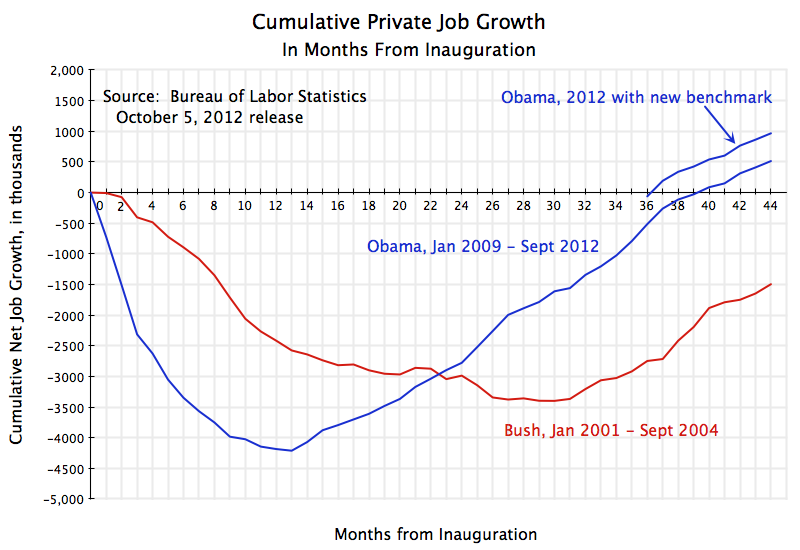
Cumulative growth of private jobs, from January 2009 to September 2012 for Obama, and from January 2001 to September 2004 for Bush

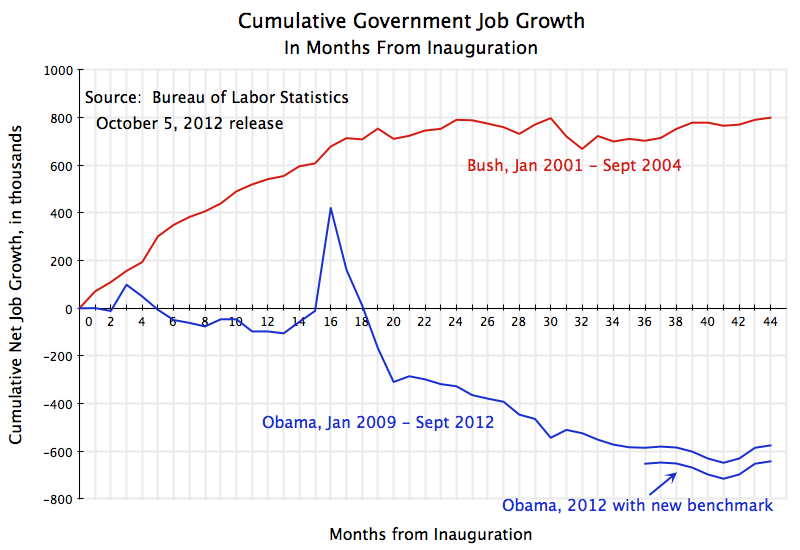
Cumulative growth of government jobs, from January 2009 to September 2012 for Obama, and from January 2001 to September 2004 for Bush


[Update on February 2, 2013:  A more recent analysis of these issues, with these charts now covering the full first term of Obama, is available here.]

Private jobs have grown under President Obama while they fell during the similar period of the administration of President Bush.  And government jobs have fallen during Obama’s term while they rose under Bush.  The figures above, prepared from data from the Bureau of Labor Statistics, shows the cumulative change in the number of private and government jobs, respectively, from their inaugurations to September of the fourth year of their administrations.  This updates similar graphs and analysis posted earlier on this blog (here and here), although with a focus now on only Obama and Bush.

Obama has been heavily criticized by Republican nominee Mitt Romney and by Republicans more generally for doing a terrible job on jobs.  Their repeated theme is that the US has to return to the policies of George W. Bush of tax cuts, deregulation, and small government in order to create a “business friendly” environment in which private businessmen will then create jobs.

But as the top graph shows, private jobs have grown under Obama, in contrast to a fall under Bush.  Obama was faced with a collapsing economy when he took office, with private jobs falling by 800,000 a month as he was taking office.  He was able to turn this around within only a few months, as the stimulus package and other measures entered into effect, and jobs growth turned positive after just one year in office.  This was a strong turnaround from the sharpest downturn the US economy had faced since the Great Depression.

Since then, private job growth has continued each and every month, but at an overall pace that has been criticized.  But the pace of recovery has in fact been better than that observed under Bush, where the number of private jobs had fallen steadily for the first two and a half years into his term (and with the fall starting only after he took office, in the Spring of 2001).

Based on the current official numbers, there were about 0.5 million more private jobs in September 2012 than when Obama took office.  This already contradicts the Republican claim that Obama’s policies have been destroying jobs.  And the growth in private jobs has in fact been even higher.  The BLS recently announced their preliminary estimate that in their regular annual re-benchmarking process, the number of private jobs were 453,000 higher in March 2012 than previously estimated.  This would be an increase of 0.4% over the previous BLS estimate for private employment, and such a change is about average.  Over the eleven years of 2002 to 2012, the changes due to the annual benchmark re-estimates have ranged between 0.1% and 0.9% (in absolute terms) – sometimes positive and sometimes negative.  The BLS has not yet revised their job estimates reflecting this new benchmark; this will be done in early February 2013, when the revisions will be announced along with the January 2013 job figures.

Based on the pattern observed in the previous annual re-benchmarking exercises, the March figure is likely to change by about the amount of the benchmark change (it will not be exactly the same for a number of reasons), with changes before that reaching back into 2011 diminishing as one goes back to the previous March 2011 benchmark period, and the changes increasing as one goes forward in 2012 from the March 2012 benchmark.

Until the new analysis is done by the BLS experts and the standard models run, there is no way to say what the changes will be.  For the diagrams above, I have very simplistically simply raised each of the 2012 private job estimates by 453,000, to give one a visual sense of the magnitude of the change.  In reality, the increase will be phased in rather than jump abruptly as depicted, but it is not yet known how it will be phased in so I have not tried to show this.

Based on this simple assumption, private jobs during Obama’s term from his inauguration to September 2012 have increased by about 1.0 million.  During the similar period under Bush, private jobs fell by 1.5 million.  Yet Obama is criticized for his job growth record, while Bush is praised.

Furthermore, since the turnaround in jobs that Obama was able to achieve after just one year in office, private jobs have increased by 4.7 million based on the current official estimates, or by 5.2 million with the adjustment made for the new benchmark

While private jobs have grown under Obama (in contrast to the fall under Bush), government jobs have fallen under Obama (and grew under Bush).  Again, this contradicts the repeated Republican charge that Obama has presided over an explosion of government jobs and government spending, which is simply not true.  (Note that the temporary blip seen in the 16th month after Obama’s inauguration is the temporary hiring for the 2010 census.  After a few months, government jobs returned to their previous path of decline.)

As seen in the figure above, government jobs have fallen by 575,000 during Obama’s term up through September 2012, using the current official BLS estimates.  But the BLS benchmark revision, discussed above, estimates that there were 67,000 fewer government jobs in March 2012 than previously estimated.  Adding this as a simple adjustment, government jobs fell by 642,000 during Obama’s term in office so far.  Keep in mind that these are primarily state and local government jobs, as they account for 87% of government jobs in the US.  But federal jobs have been flat over this period with no sharp increase either, and fell if one excludes an increase in the number of Defense Department employees.

And in contrast to the fall in government jobs during Obama’s tenure, government jobs rose during the similar Bush period.  Between his inauguration in January 2001 and September 2004, government jobs rose by 800,000 under Bush.  There would be over 1.4 million additional jobs (mostly of school teachers, police, and other state and local workers) due to the direct impact alone if government jobs had been allowed to grow as they had under Bush rather than fall as they have under Obama.  With a multiplier of two, there would be 2.8 million more jobs, and unemployment would be 6.0% instead of 7.8%.  Unemployment would then be at the top end of what is generally considered to be the full employment range of unemployment (which will never be zero, due to turnover and other frictions).

The myth is therefore quite different from the reality.  Government jobs have been cut back during Obama’s term, and this has acted as a considerable drag on the economy.  If government jobs had been allowed to increase during Obama’s term by as much as they had under Bush, we would now be at, or close to, full employment  (see some further estimates at this blog posting).  Yet Republicans continue to call for further and drastic cut-backs in government, with no recognition that there have already been sharp cuts and that these cuts have held back the pace of recovery.

Employment Growth: Positive, but Still Sluggish

US employment, monthly change, private and government, December 2005 to September 2012

The Bureau of Labor Statistics released this morning its regular monthly report on employment and unemployment.  There will be one more such report on Friday, November 2, but this will be just a few days prior to the November 6 election.  The current report will likely be more heavily scrutinized, and commented upon, in the period leading up to the election.

The report indicates that while employment growth in the US remains positive, it remains sluggish.  The estimate is that total employment rose by 114,000, of which 104,000 were private jobs, and 10,000 were government jobs.  While positive, this is less than the estimated 200,000 to 250,000 new jobs required each month which this blog has indicated  in an earlier post needs to be sustained for unemployment to fall on a consistent basis.

This estimate of 114,000 new jobs is less than the revised estimates of net new jobs created in July and August.  All the estimates are preliminary for the most recent two months, as the BLS revises the estimates as new numbers come in through the regular reporting system.  The July and August net new jobs estimates were revised upwards to 181,000 in July (from an estimate of 141,000 last month) and to 142,000 in August (from an estimate of 96,000 last month), for a net addition of 86,000 jobs over these two months over what was estimated before.

Almost all of the revisions were in the figures on government jobs, to growth of 18,000 in July (versus a decline of 21,000 estimated before) and growth of 45,000 in August (versus a decline of 7,000 estimated before).  But government jobs remain depressed:  Despite the recent growth, as of September 2012 there were 575,000 fewer government jobs than when Obama took office in January 2009 (mostly at the state and local level, as they account for 87% of government jobs in the US).  As this blog has noted before, if government jobs had been allowed to grow in the downturn following the 2008 collapse as they had in previous downturns (including in particular when Reagan was in office) or as they had when Bush, Jr., was in office, we would now be at, or close to, full employment.

Despite the disappointing growth in total jobs in September (of just 114,000), it is interesting and encouraging that the estimated unemployment rate fell sharply, to 7.8% from the previous 8.1%.  How could this be?  It is important to remember that the estimated employment figure comes from a survey of about 140,000 business establishments (including government agencies and non-profit entities), while the unemployment estimate comes from a separate survey of 60,000 households.  There are significant differences between the two surveys, both statistical and conceptual.  Statistically, they are both estimates taken from samples.  Conceptually, they measure different things:  The household survey asks the household if they (and other household members) are employed, including as self-employed, as unpaid family labor, as private household workers, or in farm work.  The business survey excludes farm workers, and the others (the self-employed, etc.) will be excluded as well as they are not employed in business establishments.  But if a person has two jobs, the business survey will count them as holding two different jobs, while the household survey will merely record them once, as employed.

Bearing this in mind, it is still interesting that the household survey estimated that the number of employed jumped by 873,000 in September (the biggest such jump since 2003), while the business survey only estimated an additional 114,000 were employed.  Analysts generally discount the employment estimate from the household survey, as it is subject to greater statistical fluctuation (due not only to the smaller sample size, but more importantly since the business establishments surveyed will have many workers generally, while households will generally have only one or two workers).  The household estimates bounce around a good deal more.

But still, a jump of 873,000 employed in one month is a lot.  In part, this was a bounce back from estimated negative growth in the number employed in the household survey in July and August (of -195,000 in July and -119,000 in August).  It also suggests that the creeping up of the unemployment rate in recent months (from 8.1% in April, rising to 8.3% in July) may have been an aberration.  The 7.8% rate of September indicates a return to the previous trend.  And the 7.8% figure may have some political significance as that was the unemployment rate in January 2009 when Obama took office, although rising rapidly at that time until the stimulus program and other measures were able to turn it around.

There are also indications that the recent employment estimates from the business establishment survey may have been low.  First, there was a BLS announcement on September 27 that the preliminary estimate in its regular annual re-benchmarking analysis was that employment in March 2012 was 386,000 higher than previously estimated.  This will be further analyzed still, and the employment figures shown above do not yet reflect this new estimate for the benchmark.  Re-estimated figures for 2011 and 2012 will be provided, as they always are, when the January 2013 employment report is issued on the first Friday of February.  With the new benchmark estimate, they will show that employment levels, as well as employment growth, has been considerably higher in the latter part of 2011 and into 2012 than is being currently estimated.

Second, one can compare the estimates on the growth in the number of employed from the household survey to the number of employed from the business survey.  As noted above, the two surveys measure slightly different concepts.  But over time one would expect that they will move together, with the ratio of one to the other close to constant, although with month to month volatility.

A reasonable time span to look at would be the averages over a year, such as between September 2011 and September 2012.  Over this time period, the household survey indicated employment grew by an average of 238,900 per month, while the business survey indicated employment growth of just 150,500 per month.  Once the new, higher, benchmark is incorporated into the business survey employment figures, the employment growth estimate from the business survey will move towards the higher figure suggested by the household survey.

One can also calculate what employment growth as measured in the business survey would have been in September 2012, if the ratio of employment as estimated in the household survey to employment as estimated in the business survey (keeping in mind they are measuring somewhat different things), was the same in September 2012 as it had been in September 2011.  If it were, one can calculate that employment growth as estimated by the business survey would have been an average of 223,400 per month over that period.

There are therefore indications that employment growth over the past year has been stronger than the current estimates from the business survey indicate.  It looks like employment growth over the last year might have averaged between 200,000 and 250,000 per month.  As noted above, growth in such a range is consistent with a falling (although slowly falling) rate of unemployment.  And the unemployment rate did indeed fall slowly over this period, from 9.0% in September 2011 to 7.8% in September 2012, or an average of 0.1% point per month.

There is therefore some evidence that employment growth in 2011 and so far in 2012 has been somewhat higher than currently estimated.  It has been high enough to lead to a fall in the unemployment rate to the current 7.8%.  But this progress is still disappointingly slow, as drag from cuts in fiscal expenditures (including for government employment) has held back the economy.

New Housing Starts, While Better, Are Still Depressed

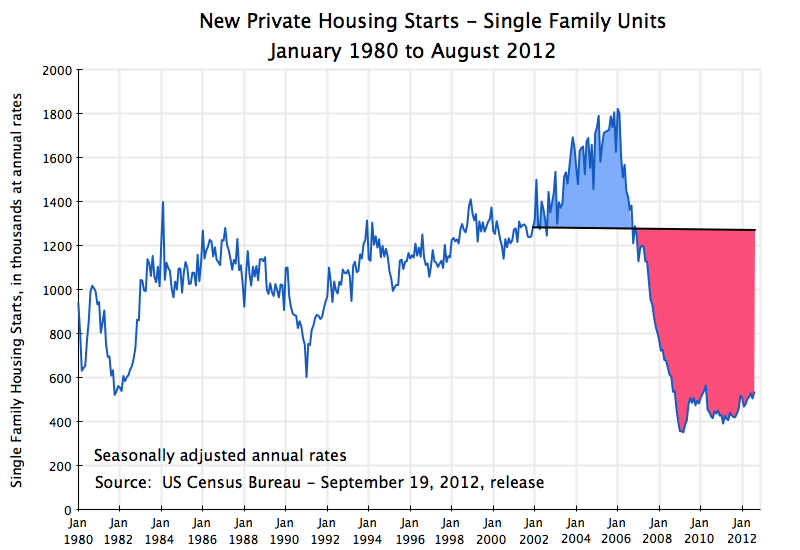
US housing starts, private single family homes, January 1980 to August 2012The US Census Bureau released this morning its regular monthly report on US housing starts.  News reports were positive, noting that housing starts are rising and are now well above where they were.  Starts on private single family homes in August grew by 27% over what they were a year ago to a pace of 535,000 (at a seasonally adjusted annual rate), while starts on all private housing units, including multi-family units such as apartments, grew by 29% over the year ago figure to a pace of 750,000.

Such growth rates are substantial.  But looking at the figures over a longer period than just a year shows that the increases, while welcome, are not as strong as they would appear.  The housing market remains depressed, with housing construction still far below what a more normal level might be, and even further below where it was during the 2002 to 2006 housing bubble.  The graph above puts the recent figures in the longer term context.

The graph shows how new private housing starts (monthly, but at seasonally adjusted annual rates) have moved since 1980.  Housing starts can be volatile, but they have never been so volatile (going back to 1980) as the recent boom and collapse.  The housing bubble started to build in early 2002, and new starts reached an annualized (and seasonally adjusted) peak of over 1.8 million new units in January 2006.  They then fell steadily, and the collapse in the housing market was the major underlying cause of the overall economic collapse in 2008, in the last year of the Bush Administration.  They reached a trough of 358,000 in January 2009, the month Obama was inaugurated, a fall of 80% from the peak.  Since then they have increased, to 535,000 last month, but remain far below what they had been.

A recovery to the previous bubble peak would be unwarranted (on a sustained basis), as it was the build-up of an excess supply of housing which led to the bubble collapsing.  But the American population continues to grow and needs housing, and it is clear that the current pace of construction is insufficient (based on historical patterns).  Prior to 2002, new housing starts was on an upward trend, but at a moderate pace.  But to keep things simple and conservative, one can take as a reasonable floor of where housing starts need to be as the average in 2001, when 1.27 million units were started.

Based on this conservative benchmark, the new housing starts of 535,000 single family homes in August 2012 would need to increase by a factor of  almost 2 1/2 to return to a more normal level.  While this is better than where it was last year in August (when it would have had to triple to reach the benchmark), it still has a long way to go.

But as has been noted previously in this blog (see the posts here and here), the shortfall in home construction since the collapse of the bubble indicates suggests a substantial potential, once housing begins to recover.  (Note that these earlier blog posts focused on new home sales, while the current post focuses on the broader concept of new home starts.  The starts figure includes starts of home units that would not only be sold, but also those which would eventually be rented, whether by original intention or because the new home could not be sold, plus homes which were built by or for a specific owner.)  The need for new homes remains, as the population continues to grow.  In the short-run, families double up, or adult children continue to live with their parents, as was discussed in the blog posts cited above.  But as soon as they are able, these people want to buy their own homes.

Based on a 1.27 million units per year norm, the graph above shows the excess of new homes (shaded in blue) between 2002 and late 2006, and then the deficiency (shaded in red) since then to now.  Based on this norm, the excess of housing started during the bubble totaled 1.3 million units over the full period.  This excess has now been more than worked off.  The cumulative shortfall (shaded in red) comes to 3.9 million units, or triple the previous excess.  Stated another way, there is now a shortfall of a net 2.6 million single family housing units.  There will be pressure to catch up on this once the economy, and the housing market, begins to recover.

Such a catch-up on the accumulated short-fall in new home construction of recent years could serve as a significant stimulus to the economy, as was discussed in the blog posts cited above.  Other commentators, such as Paul Krugman recently, have noted this as well.  But while such a stimulus to demand would be welcome, one needs also to recognize that fiscal drag has been quantitatively more important than the collapse in residential construction in explaining the lack of a strong recovery from the 2008 collapse.  This was discussed in a posting on this blog from last March.  Residential construction is only 2.4% of GDP currently, down from over 6% of GDP at the peak of the bubble, and about 4% of GDP in more normal times.  Government consumption and investment (as in the GDP accounts) is about 20% of GDP, and total government spending (including transfer payments, such as for Social Security or Medicare) is 36% of GDP.  Government is a much larger share of the economy than is residential construction.  Because of this, reversing the fiscal drag resulting from the scaling back of government expenditures in recent years (particularly at the state and local level) and allowing it to grow as it had during the Reagan years, would add more to the economy than a recovery in housing, welcome as a recovery in housing would be.  Numbers are provided in the March post cited above.

In summary, while there have been recent positive signs, housing construction remains depressed.  However, because housing construction has been so depressed for so long, there is now a shortfall in housing units relative to what is needed for a growing population.  Hence a recovery in new home construction should be expected as the economy begins to recover, and could lead to a doubling or tripling of new home construction from where it is now.  This would be a welcome stimulus to the economy.  But welcome as this would be, allowing government expenditures to recover would make an even larger contribution.