New Housing Starts, While Better, Are Still Depressed

US housing starts, private single family homes, January 1980 to August 2012The US Census Bureau released this morning its regular monthly report on US housing starts.  News reports were positive, noting that housing starts are rising and are now well above where they were.  Starts on private single family homes in August grew by 27% over what they were a year ago to a pace of 535,000 (at a seasonally adjusted annual rate), while starts on all private housing units, including multi-family units such as apartments, grew by 29% over the year ago figure to a pace of 750,000.

Such growth rates are substantial.  But looking at the figures over a longer period than just a year shows that the increases, while welcome, are not as strong as they would appear.  The housing market remains depressed, with housing construction still far below what a more normal level might be, and even further below where it was during the 2002 to 2006 housing bubble.  The graph above puts the recent figures in the longer term context.

The graph shows how new private housing starts (monthly, but at seasonally adjusted annual rates) have moved since 1980.  Housing starts can be volatile, but they have never been so volatile (going back to 1980) as the recent boom and collapse.  The housing bubble started to build in early 2002, and new starts reached an annualized (and seasonally adjusted) peak of over 1.8 million new units in January 2006.  They then fell steadily, and the collapse in the housing market was the major underlying cause of the overall economic collapse in 2008, in the last year of the Bush Administration.  They reached a trough of 358,000 in January 2009, the month Obama was inaugurated, a fall of 80% from the peak.  Since then they have increased, to 535,000 last month, but remain far below what they had been.

A recovery to the previous bubble peak would be unwarranted (on a sustained basis), as it was the build-up of an excess supply of housing which led to the bubble collapsing.  But the American population continues to grow and needs housing, and it is clear that the current pace of construction is insufficient (based on historical patterns).  Prior to 2002, new housing starts was on an upward trend, but at a moderate pace.  But to keep things simple and conservative, one can take as a reasonable floor of where housing starts need to be as the average in 2001, when 1.27 million units were started.

Based on this conservative benchmark, the new housing starts of 535,000 single family homes in August 2012 would need to increase by a factor of  almost 2 1/2 to return to a more normal level.  While this is better than where it was last year in August (when it would have had to triple to reach the benchmark), it still has a long way to go.

But as has been noted previously in this blog (see the posts here and here), the shortfall in home construction since the collapse of the bubble indicates suggests a substantial potential, once housing begins to recover.  (Note that these earlier blog posts focused on new home sales, while the current post focuses on the broader concept of new home starts.  The starts figure includes starts of home units that would not only be sold, but also those which would eventually be rented, whether by original intention or because the new home could not be sold, plus homes which were built by or for a specific owner.)  The need for new homes remains, as the population continues to grow.  In the short-run, families double up, or adult children continue to live with their parents, as was discussed in the blog posts cited above.  But as soon as they are able, these people want to buy their own homes.

Based on a 1.27 million units per year norm, the graph above shows the excess of new homes (shaded in blue) between 2002 and late 2006, and then the deficiency (shaded in red) since then to now.  Based on this norm, the excess of housing started during the bubble totaled 1.3 million units over the full period.  This excess has now been more than worked off.  The cumulative shortfall (shaded in red) comes to 3.9 million units, or triple the previous excess.  Stated another way, there is now a shortfall of a net 2.6 million single family housing units.  There will be pressure to catch up on this once the economy, and the housing market, begins to recover.

Such a catch-up on the accumulated short-fall in new home construction of recent years could serve as a significant stimulus to the economy, as was discussed in the blog posts cited above.  Other commentators, such as Paul Krugman recently, have noted this as well.  But while such a stimulus to demand would be welcome, one needs also to recognize that fiscal drag has been quantitatively more important than the collapse in residential construction in explaining the lack of a strong recovery from the 2008 collapse.  This was discussed in a posting on this blog from last March.  Residential construction is only 2.4% of GDP currently, down from over 6% of GDP at the peak of the bubble, and about 4% of GDP in more normal times.  Government consumption and investment (as in the GDP accounts) is about 20% of GDP, and total government spending (including transfer payments, such as for Social Security or Medicare) is 36% of GDP.  Government is a much larger share of the economy than is residential construction.  Because of this, reversing the fiscal drag resulting from the scaling back of government expenditures in recent years (particularly at the state and local level) and allowing it to grow as it had during the Reagan years, would add more to the economy than a recovery in housing, welcome as a recovery in housing would be.  Numbers are provided in the March post cited above.

In summary, while there have been recent positive signs, housing construction remains depressed.  However, because housing construction has been so depressed for so long, there is now a shortfall in housing units relative to what is needed for a growing population.  Hence a recovery in new home construction should be expected as the economy begins to recover, and could lead to a doubling or tripling of new home construction from where it is now.  This would be a welcome stimulus to the economy.  But welcome as this would be, allowing government expenditures to recover would make an even larger contribution.

Employment Growth: Better, but Still Too Slow

US employment, December 2005 to July 2012, monthly change, private sector and government

The Bureau of Labor Statistics released yesterday its initial estimates for unemployment and for employment growth in July (along with the normal updated estimates for earlier figures).  While generally an improvement over the numbers for the last few months, the results were still not as good as they need to be.

The unemployment rate was essentially unchanged, even though the headline number rose from 8.2% in June to 8.3% in July.  This appearance of a rise was largely due to the way the rounding off worked.  In the raw, unrounded, numbers, the calculated unemployment rate would have been 8.217% in June and 8.254% in July.  But such accuracy is spurious.  The figures come from surveys, and it is generally taken that changes of 0.1% points are not statistically significant in any case, even aside from round-off.

The growth in total net employment was 163,000.  This is a good deal better than the figures of 68,000, 87,000, and 64,000 of the previous three months (April, May, and June, respectively).  But while better than the previous abysmal numbers, growth of 163,000 jobs per month is still not sufficient to bring down unemployment on a sustainable basis.  As has been noted previously in this blog, the US needs to add between 200,000 and 250,000 jobs per month for the unemployment rate to start to fall on a consistent basis, given the US population and growth of its labor force.  At 163,000, we are short of that.

Still, it is positive growth, and is all due to growth in private employment as government continues to cut back.  The graph above shows the monthly figures on employment growth in the private sector and in government, going back to December 2005.  Private employment began to fall with the bursting of the housing bubble in early 2006, and was plummeting in 2008 at the end of the Bush Administration as the economy collapsed.  This turned around quickly under Obama, soon after the passage of the fiscal stimulus package (and supported as well by an aggressive response by the US Fed and by other actions).  The monthly loss of private jobs at first slowed and then turned to net gains by early 2010.  Since then the private sector has been consistently adding jobs.

But the growth in jobs have not been enough to bring down unemployment by enough.  While the unemployment rate has come down from its peak of 10.0% to its current 8.3%, the unemployment rate at what is considered full employment would be between 5 and 6% (5 to 6% as there is always job turnover, with some people out of jobs even at what is considered full employment).

As has been noted before in this blog, this disappointing growth in total jobs can be attributed to fiscal drag, as government has been steadily cutting back the number of government workers during the term Obama has been in office.  Most of this has been at the state and local level (as state and local government accounts for 87% of government employment in the US), but has happened at the federal level as well.

This cut back in government employment during the Obama term is in sharp contrast to the growth in government employment during the Bush terms.  We are now close enough to the end of Obama’s first term that a reasonable projection for his full first term is possible.  Using the actual numbers through July 2012, and then projecting August 2012 to January 2013 to continue at the same pace as that observed so far in 2012, one can arrive at the following estimates:

Net Job Growth Government Private
Bush:   January 2001 to January 2005 +900,000 -913,000
Obama:  January 2009 to January 2013* -711,000 +1,179,000
* August 2012 to January 2013 projected at monthly pace of January 2012 to July 2012

Government employment grew by 900,000 during Bush’s first term (it grew by a similar and further 841,000 in his second term).  In sharp contrast, at the current pace government employment will have been cut back by 711,000 in Obama’s first term.  Yet Mitt Romney and other Republicans repeatedly assert that government exploded under Obama, while they avow support for the small government conservatism of Bush.

Romney and his follow Republicans also repeatedly assert that the tax cut and deregulation policies of Bush are what is needed to restore private job growth.  Yet private jobs fell by 913,000 during Bush’s first term, while on the current pace, they will have risen by 1,179,000 during Obama’s first term.

Had government been allowed to grow during Obama’s first term at the same pace as it had during Bush’s, there would be an additional 1.6 million (900,000 + about 700,000) school teachers, policemen, firemen, and others directly employed.  The country could certainly use their services.  And by itself, employing 1.6 million more would bring down the unemployment rate to 7.2%.  With a conservative multiplier of two, the unemployment rate would be brought down to 6.2%, or close to full employment.

Obama may well lose the election due to the still high unemployment.  Romney and his fellow Republicans have repeatedly and loudly charged that this has been due to an explosion of government during Obama’s term in office.  But the truth is that government has been cut back sharply during Obama’s term.  And the great irony is that had government been allowed to grow as it had under the previous Republican administration of Bush, Obama would now be certain of re-election.

GDP Growth in the Second Quarter of 2012: Even Slower

BEA release of 7/27/12. Seasonally adjusted annualized rates       Percent Growth Contribution to GDP      Growth
2011Q4 2012Q1 2012Q2 2011Q4 2012Q1 2012Q2
Total GDP 4.1 2.0 1.5 4.1 2.0 1.5
A.  Personal Consumption Expenditure 2.0 2.4 1.5 1.45 1.72 1.05
B.  Gross Private Fixed Investment 10.0 9.8 6.1 1.19 1.18 0.76
 1.  Non-Residential Fixed Investment 9.5 7.5 5.3 0.93 0.74 0.54
 2.  Residential Fixed Investment 12.1 20.5 9.7 0.26 0.43 0.22
C.  Change in Private Inventories nm* nm* nm* 2.53 -0.39 0.32
D.  Net Exports nm* nm* nm* -0.64 0.06 -0.31
E.  Government -2.2 -3.0 -1.4 -0.43 -0.60 -0.28
Memo:  Final Sales 1.5 2.4 1.2 1.52 2.38 1.23
    nm* = not meaningful
$ Value of Change in Private Inventories (2005 prices) $70.5b $56.9b $66.3b

The initial estimates for US GDP growth in the second quarter of 2012 were released by the BEA of the US Department of Commerce on July 27, and indicated that a slowly growing economy was growing even more slowly than before.  GDP growth of 4.1% in the last quarter of 2011 (based on revised figures issued on July 27 as well), had slowed to just 2.0% growth in the first quarter of 2012, and then to an estimated 1.5% growth in the second quarter.  The figures are subject to revision, but it is unlikely that the basic story will change significantly.

This slowdown in growth in 2012 had in fact been predicted on this blog in a posting on January 27, when the initial estimates for growth in the last quarter of 2011 were issued.  While growth at the end of 2011 was relatively robust, it was noted there that much of this had occurred due to an increase in private inventory accumulation.  As has been explained in an Econ 101 posting on this blog, it is the change in the change in private inventories which contributes to GDP growth, and that change in the change in private inventories had been large in the fourth quarter of 2011.  Using the figures from the current BEA estimates, the change in private inventories was essentially zero in the third quarter of 2011 (a fall of just $4.3 billion at 2005 prices), but then rose by $70.5 billion in the fourth quarter.  This increase by a net $74.8 billion added 2.53% points to GDP in the fourth quarter, accounting for over 60% of the now estimated 4.1% growth in that period.  Without this (that is, if inventory accumulation had been at the same pace as before), GDP growth would not have been 4.1% but only 1.5% in that period (the growth of final sales).  Since over time the pace of inventory accumulation is relatively steady on average, even though there can be significant swings in any given quarter, it was predicted that GDP growth could well slow in 2012.

That is what happened.  GDP growth slowed to a pace of just 2.0% in the first quarter of 2012 and to an initial estimate of just 1.5% in the second quarter.  There are many other changes going on of course, but the swings in the change in change in inventory accumulation can have a significant impact in any given quarter.  In the first quarter of 2012, the pace of inventory accumulation slowed to $56.9 billion.  This was still positive (inventories grew), but was a slower pace than the $70.5 billion accumulation in the fourth quarter of 2011.  That is, inventories were still growing at a fairly high rate in the first quarter of 2012, but by not as rapid a rate as they had in the last quarter of 2011, so this subtracted from GDP growth.  It subtracted 0.39% points from what GDP growth otherwise would have been (see the figure on Contribution to GDP Growth in the table above).  The initial estimate for the second quarter of 2012 is that private inventories grew by $66.3 billion, which was an increase from the $56.9 billion pace of the first quarter, and so contributed 0.32% points to GDP growth.  But will this continue?

Inventories are held only because of an expectation that the goods will be sold, and businesses do not wish to hold too much in inventories.  Inventory accumulation must be financed, and goods can deteriorate in value if not soon sold (this is especially the case for anything where technology changes rapidly, such as the latest electronic gadgets).  Rapid accumulation of inventories is indeed normally a sign that goods are not being sold as rapidly as the producers of these goods had expected, so a rapid rise in inventories is often a disturbing sign.  Production is still going on, and hence GDP is being generated, but a rapid accumulation of inventories will often then lead producers to cut back on production, and GDP growth will slow or even become negative.

This could happen now.  Private inventories have grown by a total of almost $200 billion in the last three quarters together (at constant prices of 2005), and have not grown by so much over a three quarter period since 2006.  Should producers decide to limit production so that total inventories stay where they are now in the next quarter (and succeed in doing this, as there is unpredictability in what sales will be), inventory accumulation will drop back to zero.  This is not unusual:  As noted above, inventory accumulation was essentially zero (in fact slightly negative) in the third quarter of 2011.  But if this happens, GDP growth would fall by 2.0% points (given the current pace of inventory accumulation) below what it would otherwise be, and could easily push GDP growth into negative territory.

Because of these swings in inventory accumulation from quarter to quarter, it is wise to look at what is happening to final sales.  This will often provide a better picture of what is happening in the basic underpinnings to short run growth.  As seen in the table above, final sales have grown at rates of 1.5%, 2.4%, and 1.2% in the most recent three quarters, respectively.  On average, GDP growth will tend to match these rates over time.  They show that the economy has been fundamentally weak over this period.

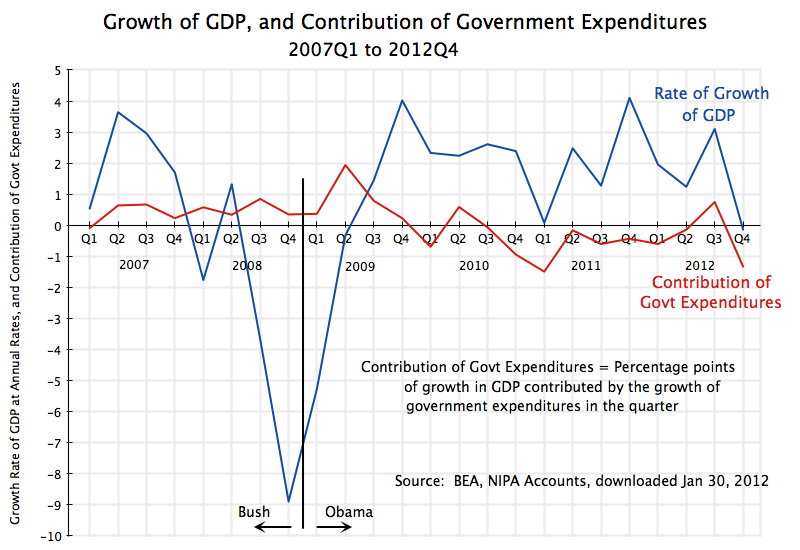
And the concerns are not just with what may happen to inventories.  Aside from inventory accumulation, the other elements making up GDP growth all show a weakening in the second quarter of 2012 compared to what their growth had been in the first quarter.  Private consumption expenditure only rose by 1.5% (at annualized rates) in the second quarter, compared to growth at a rate of 2.4% in the first quarter.  Private fixed investment only grew at a 6.1% rate, vs. a 9.8% rate in the first quarter.  Of this, non-residential fixed investment grew at a 5.3% rate vs 7.5% before, and residential fixed investment (a bright spot in the first quarter) slowed to a 9.7% rate of growth vs. 20.5% before.  Net exports (the net between exports and imports) subtracted from growth, and once again, government expenditure contracted and acted as a drag on growth.  As has been discussed before in this blog, if government expenditure had been allowed to grow during the Obama term by as much as it had during the same period under Reagan, the economy would likely now be at full employment.

There is therefore little to be encouraged by in these initial estimates for growth in the second quarter of 2012.  With Europe already in a double-dip recession, as they have foolishly pushed fiscal austerity policies despite their high unemployment, there is a good chance that US growth will slow to below 1%, and quite possibly even to something negative, in the second half of 2012.  Regardless of who should be blamed for this, it is likely that Obama will be the one blamed.