The Shift from Equitable to Inequitable Growth After 1980: Helping the Rich Has Not Helped the Not-So-Rich

I.  Introduction

Central in the debate in this year’s presidential election is whether government provision of new benefits and additional tax breaks to the rich will in the end also help the not-so-rich.  Mitt Romney, himself a good representative of those who have become extremely rich through finance, as well as other Republicans, argue that the rich must be helped and given further tax breaks as they are the “job creators” who in the end help us all.  The alternative view is that at best the help to the rich will be kept by the rich, and whatever goes to the rich (whether through additional government provided benefits to the rich, or through how the economy itself benefits the rich) will come dollar for dollar from what would otherwise go to the not-so-rich, thus worsening their position.

This blog posting will examine evidence behind this issue, through a look at long-term growth in the US (going back to 1870), and how this growth has been distributed between the rich and the not-so-rich (for the period we have data, from 1917).  It will find that long-run growth (growth in economic capacity) has been remarkably constant since 1870, which calls into question whether government policies have had much of an effect one way or the other on growth over the long term.

But it will also find that how this growth is distributed among income groups has changed markedly over time.  Growth was equitable from World War II (following the reforms of the New Deal era) until 1980, with all income groups (rich and not-so-rich) benefiting similarly.  But this changed markedly after about 1980, following the measures deemed the “Reagan Revolution”.  Since 1980, the rich have become much richer indeed, while the bottom 90% of households have seen their real incomes stagnate or even decline.

II.  The Growth in GDP per Capita in the US

We start with a look at the growth of per capita GDP in the United States, going back to 1870:

Levels of US GDP per capita, 1870 to 2011, in constant dollars, long-run growth

The numbers are principally from data put together by the late Angus Maddison, who in his career at the OECD and elsewhere assembled a remarkable set of data on growth over the long term of not only the US, but also of much of the rest of the world.  The Maddison numbers were extended to cover 2007 to 2011 based on figures in the regular GDP accounts of the US issued by the BEA in the US Department of Commerce.

The figure shows the growth of US per capita GDP from about $3,500 in 1870 (in terms of 2005 prices) to $43,000 today.  By way of comparison, China’s GDP per capita is currently about $4,800 (in 2005 prices), which is about where the US was in the late 1880s.

While there have been some fluctuations (notably in the downturn in the 1930s during the Great Depression, and then the spike in the early 1940s during World War II), it is difficult to see in a figure such as this whether growth in recent decades has been faster or slower or the same as in earlier periods.  But this can be easily seen if the numbers are converted into their logarithmic equivalent.  In logarithms, a constant rate of growth will be a straight line; an increasing rate of growth will be seen as a line bending upwards; while a decreasing rate of growth will be seen as a line bending downwards.  If you are not familiar with logarithms, you can either take my word for this or consult your high school math textbook.

Converting the GDP per capita numbers into their logarithmic equivalent (these are in 1990 prices, which Maddison had used, but the base year for this does not matter), one finds:

Natural logarithms of US GDP per capita, 1870 to 2011, straight line growth

The red line drawn through this is a straight line, indicating a steady rate of growth of per capita GDP over this 141 year period (at a rate of 1.9% per year, or 1.869% per year to be more precise).  This is remarkable.  REMARKABLE!   There are significant year to year variations, and sometimes decade long variations (such as in the 1930s during the Great Depression, and the spike during World War II).  But eventually, even after the shocks of the Great Depression and of World War II, the economy has always returned to the same path it had been on before, not to a different one.

The path can perhaps best be interpreted as the growth in productive capacity when all resources, and in particular all labor resources, are being fully employed.  This capacity limit for the economy grows over time based on growth in technology and in the skills applied in using that technology as well as in using labor and other resources.  And for some reason we do not understand, the rate of growth on that path has been the same for over 140 years.

It is remarkable that that rate of growth in productive capacity was the same in the closing decades of the 20th century as it was in the closing decades of the 19th century, and in the connecting periods in between.  That is, the rate of growth in the age of steam and rail in the latter 1800s, or growth in the age of microchips and information in recent decades, and everything in between, has always been the same.

This finding should be rather disconcerting to economists.  Hardly a week goes by that a book is not published which says that the key to faster growth is to do … (with each saying something different).  Yet the steady pace of long-term growth at 1.9% per capita a year suggests that for a developed country like the US, operating close to what technology allows in terms of overall production, growth in capacity will be little affected by less regulation or by more regulation, by more investment in education or by less investment in education, by more spending on research and development or by less spending on research and development, and so on.  All of these have varied greatly over time.  But the long-run rate of growth has not.

To be fair, merely showing such constancy in long-run growth does not prove anything.  It is possible that policies have varied over time in such a way that changes which would have raised the long-run rate of growth were offset by policies that reduced the long-run rate of growth by the same amount.  This is possible, but it would be an amazing coincidence if there were always such exact offsets.

What is fair to say is that the reasons behind this long-term constancy in the rate of growth are not well understood, and that economists, politicians, and others should be modest when they advocate one policy or another.

III.  The Distribution of the Income Produced by That Growth

While there has been constancy in the growth of average per capita income, this does not mean that different income groups have necessarily shared equally in that growth.  But while such distributional data are not assembled in the regular national income (GDP) accounts, Thomas Piketty and Emmanuel Saez (as part of a larger international effort) have assembled such data based on US income tax returns.  The concept of income is not exactly the same.  GDP measures the value of all production in any specific year (which ultimately accrues to someone), while tax returns report on taxable household incomes in any year, including realized capital gains but not items such as unrealized capital gains.  But over long periods of time they will move similarly.  By using US income tax return data, Piketty and Saez are able to arrive at estimates going back to 1917 (and 1913 for some of the data, the year the modern US Income Tax system began).  And by using tax return data, Piketty and Saez are able to arrive at accurate figures on the incomes of the very rich (including the top 1%, top 0.1% and top 0.01%), which survey based methods cannot cover well as the numbers in such groups will be relatively small in any broad-based sample.

Using the Piketty-Saez data, one can arrive at the following:

real incomes by distributional shares, 1917 to 2010

This is an unconventional presentation, as the aim is to focus on how real per capita (actually per tax unit, which is normally a household) distributional shares have varied against each other over time.  In this presentation, the incomes (in logarithms) are presented relative to what they were in 1980.  The 1980 figures could have all been set equal to 100.  But to facilitate comparison with the figure above on average GDP per capita (in logarithms), the scale is set to average per capita GDP in 1980.  To state this point again:  All incomes were not equal in 1980.  The top 0.01% earned far more than the bottom 90%.  But to show the changes relative to 1980 as the base year, all incomes were scaled to the same number in 1980 (which could have been anything, such as 100, but which in this case was set to the log of per capita GDP in 1980).

Several things are clear in this figure.  First, the very rich (top 1% and higher) did very well in the 1920s, even though the bottom 90% saw their incomes stagnate.  The “Roaring 20s” were not a boom for everyone.  But everyone then saw their incomes collapse with the on-set of the Great Depression in the 1930s, with only a slow and partial recovery during the decade until the largest fiscal stimulus program in history (spending in World War II) was implemented in the early 1940s.

Then, from the middle of World War II to 1980, the incomes of all of the groups rose by similar proportions (with each of the groups enjoying an increase in real incomes of about 80% per household), with only limited differences between the groups.  This was a period of not only growth, but equitable growth.

Things then changed in the early 1980s.  While overall growth continued (although perhaps at a somewhat slower rate, depending on the precise dates chosen), all of the benefits of this growth was accruing to the rich (the top 1%) and especially the very rich (the top 0.1%, and the top 0.01% even more so).  The bottom 90% saw their incomes stagnate, or even decline depending on the year chosen for comparison.

Note that there is no mathematical reason leading to the top 0.01% seeing their incomes necessarily grow by more than the top 0.1%, who in turn saw their incomes grow by more than the top 1%, and so on.  The figure shows the proportional changes in the real incomes in these different groups defined relative to what they were in 1980, and one can see in the diagram periods in the past where the top 0.01% fared worse than the top 0.1%, for example.  It is only since 1980 that one sees this non-overlapping stratification, with the incomes of the absolute richest increasing by more than the incomes of the very rich, with these increasing by more than the incomes of the moderately rich, and so on down the scale.  The changes in the economy since 1980, whether due to Reagan or for other reasons, not only benefited the rich, but benefited the absolute richest the most of all.

But what is true mathematically is that if the average per capita income is growing at some rate as it has historically, as it appears to have since 1870, then a higher share going to the rich and especially the very rich must be matched by a lower share going to the not-so-rich.  This is then not a story where helping the rich will help us all, but rather a story that what goes to the rich must be coming from the not-so-rich.  And that, unfortunately, seems to be consistent with the data depicted above, where the rich have done very well since 1980, while the bottom 90% have seen their real incomes stagnate and indeed decline to below 1980 levels following the 2008 collapse.

IV.  The Changes in the Real Incomes of the Different Groups Since 1980

The proportional changes in the incomes of the different groups in absolute values (not logarithms) since 1980 has been as follows:

US real income growth by distributional shares, 1980 to 2010

The rich have done very well since the 1980s and the start of the “Reagan Revolution”.  Even following the 2008 economic and financial collapse in the last year of the Bush Administration, the top 0.01% in 2010 earned 333% more in real terms than what they earned in 1980.  The average income of those in the top 0.01% bracket in 2010 was $23.8 million.  And they were doing much better in 2007 before the 2008 economic collapse, when their income was 570% above what it had been in 1980 in real terms, and they earned an average of $36.9 million (in prices of 2010) each.

In contrast to the rich, the bottom 90% have seen their incomes stagnate since 1980.  In 2010, their income was 5% below what it was in 1980.  They were doing modestly better during the Clinton years, and their real incomes peaked at 11% above their 1980 level in 2000.  But their incomes then fell, to only 3% higher in 2003 than in 1980, recovered a bit to 9% higher in 2007, but then fell again in the 2008 collapse.

Note also that it really is the super-rich who have benefited in this post-Reagan economic system.  Even the top 10% saw their incomes grow by only 65% over the thirty years from 1980 to 2010.  Thirty years of growth at the long-term rate for US per capita GDP of 1.9% would have led to a 76% increase in their real incomes.  And the top 10% includes the top 1% (and richer), whose huge income increases will raise the average for the top 10%.  Excluding the top 1%, the real incomes of the remaining 9% (i.e., those with incomes between the 90th and 99th percentiles) rose by only 35% over this thirty year period.

V.  Summary and Conclusion

In summary:

a)  The long-run rate of growth in the US has been remarkably stable since 1870, at 1.9% a year.  It has maintained this rate from the age of steam and rail, to the current age of microchips and information.  Economists have no good explanation of this, which suggests a good deal of skepticism is warranted when economists, politicians, or others suggest they know the secret to how to raise the rate of long-term growth.

b)  In contrast to this stable rate of long-term growth, the pattern of how this growth has been distributed across the population has varied a good deal, at least back to 1917 (the earliest year for which we have complete data).  Distribution worsened in the 1920s and became less unequal only with the start of the massive stimulus program of World War II.  Then from the middle of that war to 1980, the economy grew with both the rich and the not-so-rich sharing similarly in growth.

c)  This then changed after 1980, with massive growth in real incomes for the very rich, while the bottom 90% saw their incomes stagnate or get worse.

The Republican policies launched by Reagan of low taxes on the rich plus financial and other deregulation were justified on the basis of the assertion that they would lead the economy to grow faster, and that all income groups would benefit from this.  There is no evidence in the data that this has occurred.  Growth has not accelerated.  If anything, growth has decelerated, although this could still reflect a downswing from which the economy could eventually recover as it did following the 1930s.  The rich have nonetheless gotten very rich since 1980, while the bottom 90% have suffered.  The data suggest that the Reagan policies have not acted to accelerate growth for all, but rather have acted to transfer the gains that there were to the rich from those in not so advantageous a position.

Given how Mitt Romney himself has benefited from this Reagan program, it should not be surprising that not only does he support it, but that he wants to extend it even further.  But it is not clear why those not in his super-rich class should agree.

_______________________________________________________________________

Update – April 19, 2013

A reader of this blog has asked me a very good question through the Contact Me form.  As others may have a similar question, I thought it best to try to provide an answer here, for all to see.

The question raised was that in the final graph shown on the blog (titled “Changes in Real Per Unit  Incomes by Distributional Shares”), average real income per unit is reported to have risen by only 19% between 1980 and 2010.  Yet if real GDP per capita had grown at the long term trend of 1.9% per year over this period, real GDP per capita would have increased by 76%.  Why the big difference?

The difference is indeed very large.  One would not normally expect such a divergence.  But there are several reasons for this.  I had noted one in the original posting, but there are others as well.

In the original post I noted that the Piketty-Saez data, based on incomes reported on tax returns, will differ from incomes as reported in the GDP accounts as they are measuring different concepts of income.  The GDP accounts measure the value of all production in any given year.  While that income will eventually accrue to someone, it will differ from incomes reported by households on their annual tax returns.  A major part of income in the GDP accounts, for example, will first be earned by corporate entities.  While corporations do pay a portion of this in dividends to their owners, a portion is retained and not immediately paid out.  The portions can vary over time.  And household taxable income includes not only what is currently earned in wages or received in dividends, but also capital gains that are realized through the purchase and sale of assets.  Such capital gains are not part of the GDP accounts, as they do not reflect the value of current production.

But there are other reasons as well for the difference.  Specifically:

  1. First, while growth at the trend rate of 1.9% per year would have led to a rise in real GDP per capita of 76% over 30 years, the actual GDP per capita growth over 1980 to 2010 was 65%.  Due to the 2008 downturn, from which there has been only a partial recovery, GDP in 2010 was about 6% below the capacity level of GDP in that year. One can see in the graph above of GDP per capita in logarithms how the actual per capita GDP fell below the trend from 2008.  And while all economists expect the economy to recover eventually, it is not known how long this will take (it will depend on policy).
  2. The change in real GDP is determined using the GDP deflator for the price index. The GDP deflator is based on the prices of all goods that make up GDP, which includes not only the goods that households consume, but also investment goods as well as the prices of imports and exports.  Piketty-Saez, in contrast, are focused on household real incomes, and therefore have used the Consumer Price Index (CPI) as their price deflator.  The two price indices differed markedly over the 1980 to 2010 time period:  the GDP deflator rose by 32% while the CPI used by Piketty-Saez rose by 52%.  Had GDP per capita been deflated by the CPI rather than the GDP deflator, measured real per capita GDP would have risen by 43% instead of 65%.
  3. Real GDP per capita is based on the whole US population, while the Piketty-Saez data is based on reporting tax units.  Tax units are generally households.  Over the 1980 to 2010 period, the number of households rose at a faster pace than population, as the average household size fell (fewer children as well as more households reflecting a single adult).  Over 1980 to 2010, population rose by 36% while the number of tax units (households) rose by 57%.  Adjusting for this, real per unit GDP (based on the CPI, as per above) would have risen by 25% based on the number of tax units rather than 43% based on population.
  4. The final difference between this 25% increase and the 19% increase in real per unit average incomes reported in the Piketty-Saez data can be accounted for by the differences in definition between taxable household income and GDP.

Employment in Manufacturing: Parties Do Matter

US manufacturing employment, 1953Q1 to 2012Q2, trends by Presidential terms

Manufacturing employment in the US plummeted during the term of George W. Bush, and has started to recover under Obama.  There were 27% fewer manufacturing jobs in the US when Bush left office than when he took the oath of office in January 2001, an overall loss of 4.6 million jobs in the sector.  The fall was often rapid, but what is striking is that they fell in each and every year of his administration.  And this collapse in manufacturing took place during a period when the economy grew overall.

Economists debate whether manufacturing jobs are inherently better for the economy than jobs outside manufacturing at the same wage (where the arguments center on the linkages to the rest of the economy, and on whether manufacturing experience leads to more rapid growth in technology and hence productivity or not).  But regardless of the position taken on this debate, economists agree that the sharp fall of manufacturing jobs during the Bush period was unhealthy.  Economic imbalances built up during the eight years Bush was president:  The housing bubble developed, there was an excess of consumption (and hence a fall in savings) spurred by the Bush tax cuts and by financial deregulation (easy loans), and there were the large fiscal deficits under Bush due to these tax cuts as well as spending on two major wars that were not paid for except by borrowing.  This led to record high trade deficits, appreciation of the dollar, and a manufacturing sector that could not then compete with imports.

Manufacturing jobs have begun to recover under Obama.  Such jobs were plummeting and at an accelerating pace when he took office, falling by 297,000 in January 2009 alone.  This started to turn around almost immediately after he took office (along with total employment), due to the stimulus package and other measures.  The loss of manufacturing jobs immediately started to slow, and by early 2010 started to grow for the first time since Clinton.  It is still early, but the change in trend is clear.

It is also interesting to go back further.  The figure above shows the number of jobs in manufacturing in the US going back to Eisenhower (the data is from the Bureau of Labor Statistics).  I have broken up the figure by presidential terms.  Excluding Obama (as his term is not yet complete), there have been seven presidential periods (combining terms with presidents of the same political party):  four Republican and three Democratic.  Manufacturing jobs fell in each of the Republican periods, while they rose in each of the Democratic periods.

And the pattern indeed goes back further.  Manufacturing jobs rose under Roosevelt and under Truman (even if one treats Truman as a separate period, and despite Truman taking office when war time manufacturing employment was still high).  They fell under Hoover.  One has to go back all the way to Calvin Coolidge, President from 1925 to 1929, for a Republican during whose term manufacturing jobs rose.

Much has of course varied over so many decades, plus there have been wars and other such factors affecting the numbers.  But there has also been a certain degree of consistency of policies within each party, with changes that are generally gradual (reflecting evolution over time) rather than abrupt.  Senior officials in each new administration will have generally served in some capacity in a prior administration of the same party.

It is nevertheless striking that there has been this 100% consistency in performance between the two parties when it comes to jobs in manufacturing:  The number of jobs have always improved under the Democrats, and have always (since Coolidge) deteriorated under the Republicans.  If you are interested in seeing such jobs grow, vote Democratic, not Republican.

Restoring Government Employment as a Way to Restore Full Employment

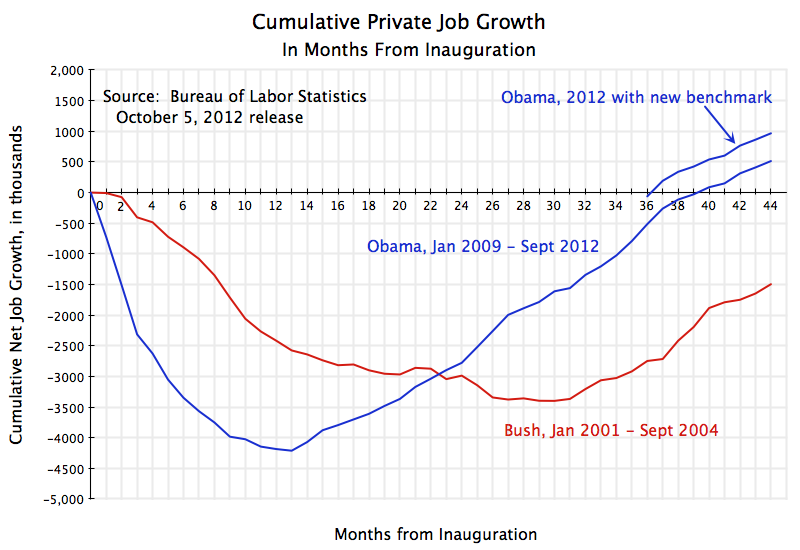
cumulative growth in private jobs by month from inauguration, Bush I, Clinton, Bush II, Obama, through June 2012

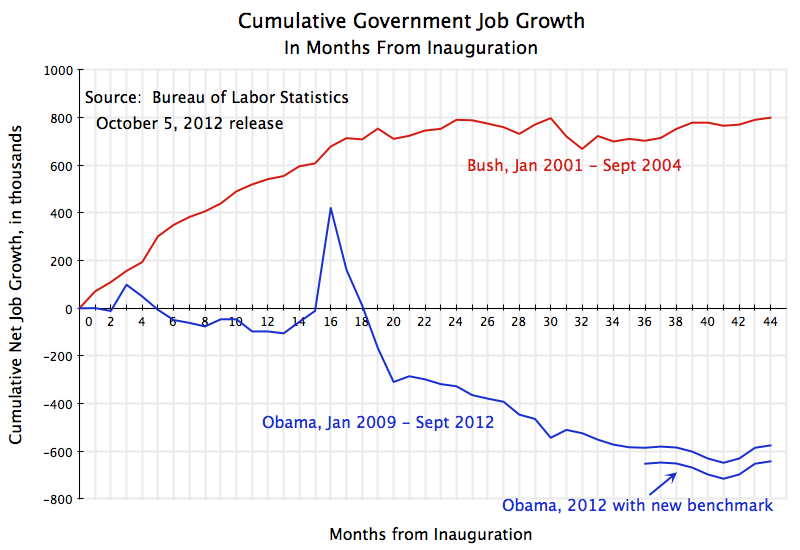
cumulative growth in government jobs by month from inauguration, Bush I, Clinton, Bush II, Obama, through June 2012


[Update on February 2, 2013:  A more recent analysis of these issues, with these charts now covering the full first term of Obama, is available here.] 

I.  Introduction

The purpose of this blog post is two-fold:  First, to update the graphs that were first presented in an April 26 posting on this web site to reflect the more recent data (an additional three months) now available.  And second, to discuss and present some numbers on what would be implied if government employment, which has fallen sharply under Obama, were allowed to recover to the increase seen during the George W. Bush presidency.  A posting on July 6 on this site noted that this by itself would bring the unemployment rate down to 7.3% from the direct effect of employing these teachers, policemen, and other government workers who have been laid off (or new ones not hired), and an unemployment rate of 6.4% with a conservative estimate of a multiplier of two.  This post will discuss this in more detail, including an estimate of what the cost would be.

II.  Private Job Growth

The figures above show what cumulative job growth has been, for private jobs and then for government jobs, from the month of inauguration to June 2012 for Obama (the most recent data now available), and to the equivalent points in the presidencies of the first Bush, Clinton, and the second Bush.

Under Obama, private jobs are now back to where they were (and in fact slightly above) when he was inaugurated.  The economy was in free fall at that inauguration, with the economy losing 800,000 private jobs per month.  The stimulus package Obama was able to get passed a month after taking office, as well as aggressive actions by the Federal Reserve Board and other measures, started to bend this curve almost right away, leading to positive job growth starting a year after Obama took office.  Since then, 4.4 million new private jobs have been created under Obama.

In contrast, private jobs fell during the similar period under the presidency of George W. Bush.  Private jobs were steady in the first few months after he took office, but then started to fall, and continued to fall for the first two and a half years of his presidency.  They then started to recover, but at the similar point in his presidency (June 2004) there were still 1.8 million fewer private jobs than when he took the oath of office.  Yet Romney and other Republican Party leaders are calling for a return to the tax cut and financial deregulation (or non-regulation) policies of Bush.  The pace of private job growth did pick up starting in 2004 under Bush, and this continued into 2005 and 2006 as the housing bubble built up.  But then this bubble burst, private employment started to fall in 2007, and private employment was crashing in 2008.

The graph also shows the strong and steady private job growth during the Clinton period. And under the first Bush, private employment grew for the first year of his presidency (although at a slower pace than under Clinton), but then leveled off and began to fall.  At this point in the presidency of the first Bush, private jobs were barely above where they were when he was inaugurated.

III.  Government Job Growth

The second graph above shows what happened to growth in government jobs during these presidencies.  Government job growth (primarily at the state and local level, which accounts for 87% of all government jobs) was significant during the administrations of both of the Bush presidencies.  It was also significant during the Clinton period, although at a slower pace than under either Bush I or Bush II.

In stark contrast, government employment has fallen sharply during the Obama term (except for the temporary spike at the time of the hiring for the decennial census, after which it returned to the previous downward trend).  From Obama’s inauguration to June 2012, total government employees fell by 633,000.  During the similar period under Bush II, government employment rose by 766,000.  Yet Romney and other Republicans assert loudly and in the face of such evidence that the government sector has grown enormously during the Obama term, while Bush II was a small government conservative.  There was a similar growth of government workers (by 776,000) during the similar period of Bush II’s second term, from his inauguration to June 2008.

Had government grown during the Obama term as much as it had during the similar period in Bush II’s terms (either first or second), there would now be 1.4 million more public sector workers employed (633,000 + 766,000).  This is not a small number.  The implications of this loss on the labor market and on unemployment will be discussed in the next section.

IV.  The Gains from Bringing Back Government Jobs

These cut-backs in government employment during Obama’s term as president have acted as a significant drag on the labor market and on the economy as a whole.  Keep in mind that these are mostly state and local government workers, where the largest numbers of such employees are in public education (teachers) and public safety (police, firemen, and similar).  State and local governments have cut back on the number of such workers either out of necessity (as their tax revenues collapsed in the downturn, and there are often tight limits on what they can borrow), or in some cases out of choice (as conservative and mostly Republican governors and other officials have used the downturn to cut back on such government employment, ofter while simultaneously cutting corporate and other taxes).  But schools and other public services have suffered.

The 1.4 million workers not employed in government equals 0.9% of the labor force.  The direct effect of employing such teachers and others rather than leaving them unemployed would bring down the rate of unemployment from the current 8.2% to a rate of 7.3%.  But there will be further employment impacts when such workers move from unemployed to employed.  They will now have income to spend in their communities and in the economy, and additional workers will be employed to provide these goods and services.  They will not necessarily spend all of their additional income (some will be used to pay down debt, or saved by other means), but a significant portion will be.  Furthermore, the newly employed workers (newly employed to provide such goods and services to the additional teachers and other government workers) will themselves spend a high portion of their income on goods and services provided by other workers, continuing the process.

This is the concept of what economists call the multiplier.  Views and estimates vary on the size of the multiplier, in part as the multiplier itself varies depending on the types of workers employed (those with high incomes will likely save more and hence spend less, for example), on how close the economy is to full employment, and on other factors.  But note that the multiplier for expenditures for the direct hiring of low and middle income government workers (such as teachers, policemen, health care workers, and so on), will be substantially higher than the multiplier one would expect from providing tax cuts, for example.  Tax cuts primarily go to those with higher incomes (as they account for a higher share of taxes), and those with higher income will save a large share of such tax cuts.  As another example, increasing government expenditures in such areas as weapons procurement will also have a lower multiplier, as the funds there will be used to hire relatively skilled and hence relatively high income aerospace and technology workers, or will accrue as profits to defense firms like Boeing or Lockheed, with a significant share saved.  Similarly, the multiplier resulting from government spending for construction projects or others done via procurement from private firms, should be expected to be less than that from directly hiring teachers and similar low and middle income government workers.

There is therefore no unique “multiplier” which applies in all circumstances.  But for hiring low and middle income government workers such as teachers and so on, a reasonable estimate is that in current circumstances the multiplier would at least be two.  Many would argue it could be three or even higher, although there are also some conservatives who would argue it is less than one or even zero.  But with a multiplier of just two, hiring 1.4 million workers directly (to bring government employment back to the path it was on before) would lead to an overall increase of national employment of 2.8 million (1.4 million government workers, and 1.4 million others). This would bring unemployment down to a rate 6.4% from the current 8.2%.  With a multiplier of 2 1/2, so that an additional 3.5 million Americans would be employed, the unemployment rate would fall to just below 6%.  There is always some unemployment (due to labor market turnover) even when the economy is at “full employment”, with this generally taken to be unemployment somewhere in the range of 5 to 6%.  Therefore, such a program of hiring 1.4 million government workers to bring government employment back to the path it was on before, would likely suffice by itself to bring the economy back to, or close to, full employment.

Stated another way, the reason the job market performance has been so poor during the term of the Obama presidency, with national unemployment still exceedingly high at 8.2%, is that we allowed government (primarily at the state and local level) to lay off so many government workers in this downturn (or not hire new ones to replace those departing), rather than stay on the previous path.

Note that bringing back 1.4 million government workers to return to the previous path would lead to an increase of just 6.4% in the number of government workers from where they are now (at 21.9 million workers).  This is not such a huge increase, and as noted, simply brings the number back to the path it was on before.  Another way to look at the number is as a share of the US population.  The US population is growing, and a growing population needs more government services.  If the share of government workers in the US population were the same in June 2012 as it was in January 2009, we would have 1.3 million more government workers employed now.  This 1.3 million figure is close to the 1.4 million needed to return to the previous growth path.

The cost of hiring 1.4 million more teachers, policemen, firemen, and other public workers is also quite manageable.  The average cost of employing government workers at the state and local level is $85,612, based on data drawn from the most recent report of the Bureau of Labor Statistics on Employer Cost of Employee Compensation.  Of this cost, about two-thirds is in wages paid directly to the employees, and one-third covers the cost of various benefits (primarily the costs of paid holidays and leave, health insurance, and retirement).  But note that the average cost of existing government workers will be higher than the cost of new hires, as new hires will come in at lower wages and benefits to start.  Hence using this figure is a conservative estimate of the cost, and in reality the cost of hiring 1.4 million new government workers will be less.  But even using the $85,612 figure, hiring 1.4 million new public workers would cost $120 billion per year.  This is equal to 0.8% of current GDP.  And as a double check on this figure, recall that the 1.4 million new workers would be equal to 0.9% of the labor force.  The figures are similar, as one would expect.

A cost of $120 billion is not small, but should be put in context.  Romney has proposed a tax plan which in the year 2015 alone would reduce Federal Government revenues by $900 billion relative to what they would be if current law is followed, or $480 billion less revenues if one allows the Bush tax cuts to be extended in full.  If one can afford $900 billion a year in tax cuts, most of which will go to the rich, or even $480 billion, then one can easily afford $120 billion to employ the teachers, policemen, and other government workers who have been laid off or not hired.

And as has been noted previously in this blog, Obama has signed into law a total of $1.5 trillion in tax cuts so far in his presidency, of which $1.4 trillion were cuts that applied Fiscal Years 2009 to 2012.  That is an average of $350 billion in tax cuts per year over these four years.  Spending $120 billion per year to bring the economy back to full employment is far less than this.  One might immediately wonder how this could be, but it is important to keep two points in mind.  First, tax cuts do act to stimulate the economy, but as discussed above, are not terribly efficient as a form of stimulus as the bulk of tax cuts go to the relatively well off, who will simply save a high share of what they receive in tax cuts.  Second, the tax cuts, while inefficient (and taken in combination with other measures, such as some stimulus spending and aggressive actions by the US Federal Reserve) have brought the economy to where it is now.  The economy was in free fall when Obama took the oath of office, and these measures reversed the collapse and have brought the rate of unemployment down from a peak of 10% to the current 8.2%.  But the recovery has not gone farther because, in sharp contrast to the path taken in other US recoveries (see the blog posting here), government has been laying off rather than hiring workers.

V.  Conclusion

Government employment has been cut back sharply during this downturn, in sharp contrast to the paths followed by other recent Presidents (see the graph above) or in contrast to the paths followed in any other downturn in the US of the last four decades (see the blog post cited above or here).  As a result, there are now 1.4 million fewer government workers than there would have been, had government employment been allowed to grow as it had under Bush.  This has added significantly to unemployment.

Had such teachers, policemen, and others been kept employed, the economy would likely now be at, or close to, full employment.  By itself, the cuts can account for the weak recovery that Obama is now being blamed for.