
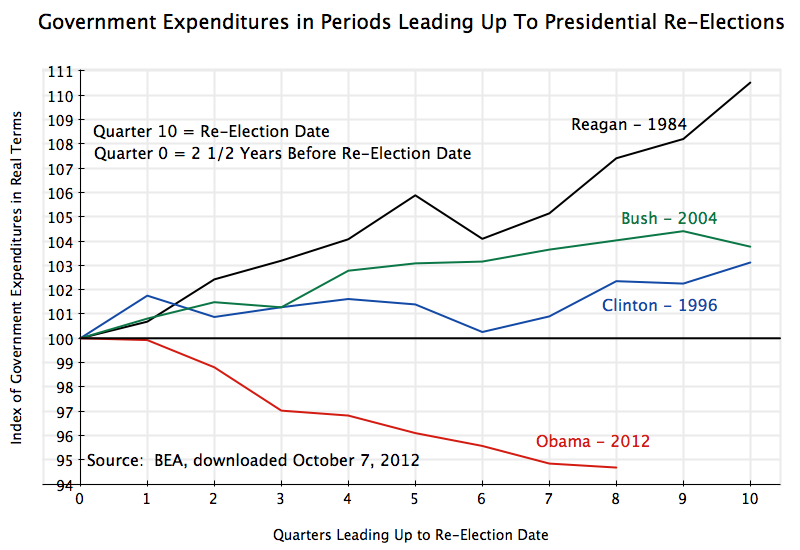
Government Expenditures Leading Up To Presidential Re-Elections: Falling Under Obama, While Rising for Others

US Government expenditures before Presidential re-elections, Reagan, Clinton, Bush, Obama

Despite the continued rhetoric that government expenditures have exploded under Obama, the truth is the opposite.  Government expenditures have been contracting in the period leading up to the election.  This contraction has led to slower economic growth and has hurt Obama’s re-election chances.

Previous posts on this blog (here, here, and here) have looked at the paths of government expenditures and government employment from either presidential inauguration dates or around business cycle peaks.  This post will look at the paths leading up to re-election dates.

The figure above shows the path government expenditures have followed in the 2 1/2 years leading up to the presidential re-election dates, for Obama as well as Reagan, Clinton, and the second Bush.  The data is taken from the GDP accounts, and shows real government expenditures on consumption and investment, a component of GDP.  They come from the Bureau of Economic Analysis of the US Department of Commerce.  Note that this is all of government, including state and local.  We do not yet have data yet for the third quarter of 2012 (the initial estimate will be released later in October) nor obviously for the fourth quarter.  But the pattern is clear.

Government expenditures (including state and local) have been falling steadily and sharply under Obama in the period leading up to the re-election date, and as of the second quarter of 2012 were over 5% below where they were in the second quarter of 2010.  At the comparable point under Clinton they were over 2% higher, under Bush Jr. they were 4% higher, and under the conservative idol Reagan they were 7 1/2% higher.  Stated another way, government spending under Obama as of the second quarter of 2012 would have had to been 13.4% higher to have matched where it was under Reagan.

Government expenditures continued to rise rapidly under Reagan.  By the date of the 1984 election, the expenditures were 10 1/2% higher in real terms than 2 1/2 years before.  While Reagan is praised as a small government conservative, his re-election was helped immensely by this rapid growth of government.  This growth in government spending led to growth in demand for the production that could be provided from the then unemployed workers, and sparked the recovery from the 1981/82 downturn.  Unemployment reached a peak of 10.8% in late 1982 under Reagan, substantially higher than the peak of 10.0% under Obama.  But with government then expanding under Reagan, rather than contracting as under Obama, the unemployment rate fell rapidly under Reagan to 7.3% in September 1984, vs. 7.8% under Obama in September 2012.

The impact of the growth in government under Reagan instead of the contraction under Obama can be estimated using the GDP accounts issued by the BEA.  The growth of GDP can be broken down into the contributions to that growth from the individual components making up GDP, one of which is government spending.  During the ten quarters from mid-1982 to the last quarter of 1984, GDP growth averaged 5.2% at an annualized rate under Reagan.  This was indeed a good rate of growth from the sharp downturn experienced in 1981/82 at the start of the Reagan term.  Of this 5.2% rate of growth, the growth in government spending accounted for 0.85% points.  In contrast, the rate of growth under Obama from mid-2010 to the second quarter of 2012 (the most recent period with data) was 2.0% (annualized), well below the 5.2% rate of growth under Reagan.  But Obama’s growth was dragged down by a contracting government, by 0.55% points.  The figures are summarized in the following table:

Impact of Govt growth at level of other president
Govt contribution to GDP growth (annualized) GDP growth (annualized) Direct Impact Multiplier of Two
Reagan – 1982Q3 to 1984Q4 0.85% 5.2% 3.8% 2.4%
Obama – 2010Q3 to 2012Q2 -0.55% 2.0% 3.4% 4.8%
difference 1.40%

With government growth adding 0.85% points of GDP growth under Reagan, but subtracting 0.55% points under Obama, the net difference is 1.40% points of growth.  If government spending under Reagan had fallen as it had under Obama (that is, had the contribution been 1.4% points less), the rate of growth of GDP under Reagan leading up to the election would have been only 3.8% annualized due to the direct impact alone, and only 2.4% with a multiplier of two on such expenditures.  Looked at from the base of what growth was during the Obama period, growth (from the direct impact alone) would have been at a 3.4% rate had government been allowed to expand during the Obama term at the rate it had under Reagan, and growth would have been at a 4.8% rate with a multiplier of two.

Put another way, if government spending had declined during the Reagan period at the rate it had during Obama’s term, the estimated resulting growth rate of 2.4% a year (assuming a multiplier of two) would have been similar to the 2.0% rate seen under Obama.  Symmetrically, if government spending during the Obama period had been allowed to grow as it had under Reagan, the estimated resulting growth rate of 4.8% would have been similar to the 5.2% seen under Reagan.  These resulting growth rates are similar for each.  The different paths followed for government spending can by itself account for the differences in the growth rates observed between the Reagan and Obama periods, when government spending rose under Reagan but fell under Obama.

A final issue to address is whether the fall in government spending under Obama since mid-2010 is a reflection of a sharp jump early in his administration (due perhaps to the stimulus package or whatever), from which a decline would be easy.  This is not the case.  Government spending in the second quarter of 2010 was 3.9% higher (total, not annualized) than it was in the fourth quarter of 2008, the last quarter of Bush.  The total growth under the similar period under Reagan was 2.8%.  The difference is just 1.1%.  But as noted above, government spending was 13.4% higher by the second quarter of 1984 than it was at the same point in the Obama term.  The 1.1% is minor compared to this 13.4%.

The stories being told on the efficacy of the Obama and Reagan policies might therefore be quite different if one recognizes that despite the rhetoric, government expanded under Reagan while it contracted under Obama.  Had government spending grown during the Obama term at the pace it had during the Reagan term, the economy would have grown similarly fast.  Obama could then be running similar “Morning in America” ads as Reagan did, rather than explaining that while America has been heading in the right direction, there is much more to do.

Employment Growth: Positive, but Still Sluggish

US employment, monthly change, private and government, December 2005 to September 2012

The Bureau of Labor Statistics released this morning its regular monthly report on employment and unemployment.  There will be one more such report on Friday, November 2, but this will be just a few days prior to the November 6 election.  The current report will likely be more heavily scrutinized, and commented upon, in the period leading up to the election.

The report indicates that while employment growth in the US remains positive, it remains sluggish.  The estimate is that total employment rose by 114,000, of which 104,000 were private jobs, and 10,000 were government jobs.  While positive, this is less than the estimated 200,000 to 250,000 new jobs required each month which this blog has indicated  in an earlier post needs to be sustained for unemployment to fall on a consistent basis.

This estimate of 114,000 new jobs is less than the revised estimates of net new jobs created in July and August.  All the estimates are preliminary for the most recent two months, as the BLS revises the estimates as new numbers come in through the regular reporting system.  The July and August net new jobs estimates were revised upwards to 181,000 in July (from an estimate of 141,000 last month) and to 142,000 in August (from an estimate of 96,000 last month), for a net addition of 86,000 jobs over these two months over what was estimated before.

Almost all of the revisions were in the figures on government jobs, to growth of 18,000 in July (versus a decline of 21,000 estimated before) and growth of 45,000 in August (versus a decline of 7,000 estimated before).  But government jobs remain depressed:  Despite the recent growth, as of September 2012 there were 575,000 fewer government jobs than when Obama took office in January 2009 (mostly at the state and local level, as they account for 87% of government jobs in the US).  As this blog has noted before, if government jobs had been allowed to grow in the downturn following the 2008 collapse as they had in previous downturns (including in particular when Reagan was in office) or as they had when Bush, Jr., was in office, we would now be at, or close to, full employment.

Despite the disappointing growth in total jobs in September (of just 114,000), it is interesting and encouraging that the estimated unemployment rate fell sharply, to 7.8% from the previous 8.1%.  How could this be?  It is important to remember that the estimated employment figure comes from a survey of about 140,000 business establishments (including government agencies and non-profit entities), while the unemployment estimate comes from a separate survey of 60,000 households.  There are significant differences between the two surveys, both statistical and conceptual.  Statistically, they are both estimates taken from samples.  Conceptually, they measure different things:  The household survey asks the household if they (and other household members) are employed, including as self-employed, as unpaid family labor, as private household workers, or in farm work.  The business survey excludes farm workers, and the others (the self-employed, etc.) will be excluded as well as they are not employed in business establishments.  But if a person has two jobs, the business survey will count them as holding two different jobs, while the household survey will merely record them once, as employed.

Bearing this in mind, it is still interesting that the household survey estimated that the number of employed jumped by 873,000 in September (the biggest such jump since 2003), while the business survey only estimated an additional 114,000 were employed.  Analysts generally discount the employment estimate from the household survey, as it is subject to greater statistical fluctuation (due not only to the smaller sample size, but more importantly since the business establishments surveyed will have many workers generally, while households will generally have only one or two workers).  The household estimates bounce around a good deal more.

But still, a jump of 873,000 employed in one month is a lot.  In part, this was a bounce back from estimated negative growth in the number employed in the household survey in July and August (of -195,000 in July and -119,000 in August).  It also suggests that the creeping up of the unemployment rate in recent months (from 8.1% in April, rising to 8.3% in July) may have been an aberration.  The 7.8% rate of September indicates a return to the previous trend.  And the 7.8% figure may have some political significance as that was the unemployment rate in January 2009 when Obama took office, although rising rapidly at that time until the stimulus program and other measures were able to turn it around.

There are also indications that the recent employment estimates from the business establishment survey may have been low.  First, there was a BLS announcement on September 27 that the preliminary estimate in its regular annual re-benchmarking analysis was that employment in March 2012 was 386,000 higher than previously estimated.  This will be further analyzed still, and the employment figures shown above do not yet reflect this new estimate for the benchmark.  Re-estimated figures for 2011 and 2012 will be provided, as they always are, when the January 2013 employment report is issued on the first Friday of February.  With the new benchmark estimate, they will show that employment levels, as well as employment growth, has been considerably higher in the latter part of 2011 and into 2012 than is being currently estimated.

Second, one can compare the estimates on the growth in the number of employed from the household survey to the number of employed from the business survey.  As noted above, the two surveys measure slightly different concepts.  But over time one would expect that they will move together, with the ratio of one to the other close to constant, although with month to month volatility.

A reasonable time span to look at would be the averages over a year, such as between September 2011 and September 2012.  Over this time period, the household survey indicated employment grew by an average of 238,900 per month, while the business survey indicated employment growth of just 150,500 per month.  Once the new, higher, benchmark is incorporated into the business survey employment figures, the employment growth estimate from the business survey will move towards the higher figure suggested by the household survey.

One can also calculate what employment growth as measured in the business survey would have been in September 2012, if the ratio of employment as estimated in the household survey to employment as estimated in the business survey (keeping in mind they are measuring somewhat different things), was the same in September 2012 as it had been in September 2011.  If it were, one can calculate that employment growth as estimated by the business survey would have been an average of 223,400 per month over that period.

There are therefore indications that employment growth over the past year has been stronger than the current estimates from the business survey indicate.  It looks like employment growth over the last year might have averaged between 200,000 and 250,000 per month.  As noted above, growth in such a range is consistent with a falling (although slowly falling) rate of unemployment.  And the unemployment rate did indeed fall slowly over this period, from 9.0% in September 2011 to 7.8% in September 2012, or an average of 0.1% point per month.

There is therefore some evidence that employment growth in 2011 and so far in 2012 has been somewhat higher than currently estimated.  It has been high enough to lead to a fall in the unemployment rate to the current 7.8%.  But this progress is still disappointingly slow, as drag from cuts in fiscal expenditures (including for government employment) has held back the economy.

What Mitt Romney Believes, Part 1: Campaign Contributions From Corporates are OK, but Not From Public Sector Unions

Mitt Romney in an interview with Brian Williams of NBC News on September 25, 2012:

“We have a very unusual system in this country. It’s not just related to teachers unions. It relates more broadly. But people are able to give — in the case of the Democratic Party, I don’t mean to be terribly partisan, but I kind of am — in case of the Democratic Party, the largest contributors to the Democratic Party are the teachers unions, the federal teachers unions.

And so, if they can elect someone, then that person is supposed to be representing the public vis-a-vis the teachers union, but actually most of the money came from the teachers union. It’s an extraordinary conflict of interest. That’s something I think is a problem and should be addressed.”

In a television interview with NBC News, Mitt Romney said it is “an extraordinary conflict of interest” and a “problem” that “should be addressed”, that teachers unions specifically, and public sector unions more generally, negotiate contracts with government officials that they may have provided campaign contributions for.

One could indeed argue that there is a conflict of interest.  But why limit this to public sector unions?  There is also a conflict of interest when aerospace giants like Boeing and Lockheed provide campaign contributions and then negotiate contracts worth tens of billions of dollars a year with the public officials they helped elect.  The same is true of the oil and gas companies, who negotiate oil and gas leases on federal land, and indeed almost any corporate interest one can imagine, as all negotiate contracts or regulations or tax treatment with government officials.  Yet Romney does not appear to recognize that this represents conflicts of interest as well.

The same is true of the multi-million dollar campaign contributions being made to the Republican campaign from billionaires such as Sheldon Adelson, the Koch Brothers, and others.  Sheldon Adelson, a casino mogul, is worth over $20 billion, has contributed already over $70 million to Republican campaigns in this electoral cycle and has said he would contribute up to $100 million (or “whatever it takes”) before it is over.  Yet he would stand to gain far more if Romney is elected and gets his tax proposals passed.  An analysis published by the Center for American Progress Action Fund estimates that Adelson would see his tax bill cut by over $2 billion in the near term (mostly from Romney’s pledge to exempt from US taxation any corporate profits earned overseas), with a further reduction of almost $9 billion later due to repeal of the estate tax, which his heirs will benefit from.

All large corporate entities and the super-wealthy will have a conflict of interest when they provide significant campaign contributions to political candidates.  If they win, the politicians will later decide on policies that affect their campaign contributors.  The only way to avoid this will be to limit campaign contributions to registered voters, with a modest ceiling on the maximum they can give.

Unfortunately, the US Supreme Court, with its current Republican majority, has ruled that it is unconstitutional to limit the right of corporate entities (as well as unions and individuals) to contribute whatever they wish to political campaigns.  Yet it is not clear why corporations are treated the same as individuals.  Individuals can vote, while corporations can not (at least not yet).  Corporations are never mentioned in the US Constitution, and are legal constructs providing limited liability and other benefits that are important for the organization of economic production.

Why such a legal construct should have the same right as individuals to influence elections through their campaign contributions is not clear.  If Mitt Romney is in fact opposed to campaign contributions from entities with a “conflict of interest”, he would be opposed to such corporate contributions as well.  But of course he is not.