
Employment Growth During the Presidencies of Obama and Bush

Cumul Private Job Growth from Inauguration to May 2014

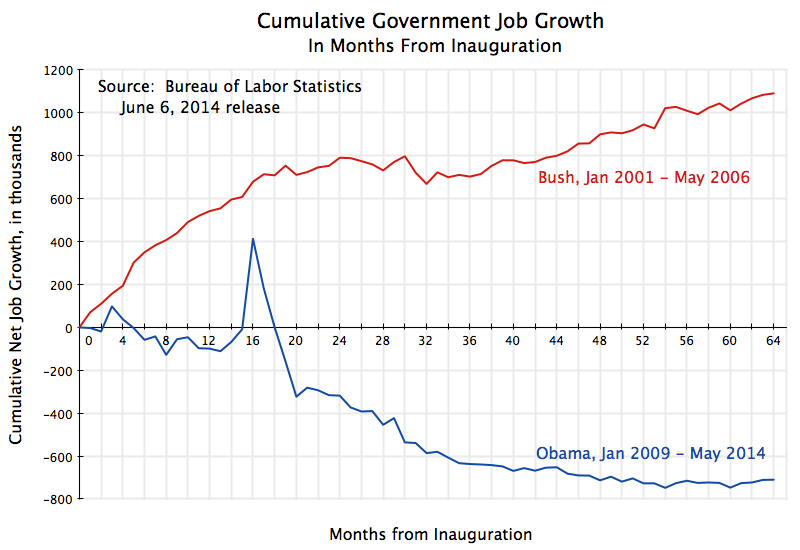
Cumul Govt Job Growth from Inauguration to May 2014

The Bureau of Labor Statistics released its regular monthly jobs report on June 6.  Nonfarm payroll employment rose by 217,000 – a broadly similar pace as in recent months.   But most news reports focussed on noting that total jobs in the US (actually, total nonfarm payroll jobs) have now for the first time exceeded the peak previously reached in January 2008, before the sharp fall that began in the last year of the Bush presidency.  It took the economy six years and four months to get back to the level of employment it had then.

While this is a significant benchmark, it is not all that meaningful by itself.  The labor force has continued to grow over the last six years, so unemployment remains high (at a rate of 6.3% currently).  Conservative critics have charged that the pace of job creation under Obama has been slow, and assert that the slow pace is due to Obama’s anti-business administration (they allege), with high taxes and increased regulation, the negative effects (they assert) of the measures under the Affordable Care Act to make it possible for the uninsured to obtain health insurance coverage, plus an allegation of “increased uncertainty”, as all acting to hold back the private sector from creating new jobs.

To judge such allegations, one might examine the pace of job creation during Obama’s term to the pace during the term of George W. Bush, a conservative Republican who was purportedly pro-business and anti-regulation, and who presided over record tax cuts.  One needs also to separate net job growth in the private sector from net job growth in the public sector to understand the story.

The two charts above do this, and update similar charts in previous posts on the blog that have examined the issue (the most recent from January 2013).  Points to note include:

1)  Net private job growth has been far higher under Obama than under Bush.  As the top chart shows, there were 5.2 million additional private sector jobs in May 2014 compared to when Obama was inaugurated, and an additional 9.4 million private jobs from the trough reached in February 2010, a little over a year after Obama took office.  Private jobs were disappearing at a rate of over 800,000 every month when Obama was taking the oath of office.  This was soon turned around as a result of stimulus measures and the aggressive actions of the Fed, with the rate of decline at first diminishing and then positive job growth appearing a year later.

Under Bush, in contrast, there were only 2.4 million more private jobs at the same point in his presidency relative to when he took office.  A primary reason for this difference is that while the economy was collapsing when Obama took office (which he then turned around within a year), the downturn at the start of the Bush term in 2001 began after he took office.  The economy then began to turn around (in terms of job growth) only two and a half years into Bush’s term in office.  Only then did private jobs begin to grow under Bush.

2)  Once the private job growth began (13 months into Obama’s term, and 30 months into Bush’s term), the pace of that job growth has been remarkably steady in both administrations.  There were month to month variations, of course, particularly in the data as originally announced (but then later revised, in the regular process to incorporate more complete data as it becomes available).  That is, the lines in the chart above for private job growth are both remarkably straight once the turning points were reached.

3)  Not only was the pace of private job growth remarkably steady after the turning points, they are also remarkably similar in terms of that pace for Obama and Bush.  That is, the two lines in the graph above are roughly parallel to each other after the respective troughs.  The pace of private job growth has been 184.5 thousand per month under Obama up to now, and a bit less, at 168.2 thousand per month, under Bush from his trough up to the same point in his presidency.

Thus there is no support in this data for the assertion that private sector job growth has been especially slow under Obama, due to an alleged anti-business administration.  Private sector job growth under Obama has been similar to, and in fact a somewhat higher than, the pace under Bush during the respective recoveries.  And total private job growth is far higher under Obama than it was at the same point in the Bush presidency, as the recovery was earlier under Obama.

4)  Where Obama and Bush do differ, and markedly so, has been in net government job growth.  Government jobs grew strongly under Bush (as they have for all recent presidents other than Obama; see this blog post).  But net government jobs have fallen sharply and consistently under Obama.  Only in the last year or so have they leveled off, but with no recovery in number.  Keep in mind that government jobs include jobs at all levels of government, including state and local government.  It is not just the federal administration that is covered here.  But the impact on the economy is similar whether it is a locally employed school teacher being laid off, or a researcher employed by the National Institutes of Health.

Bush is viewed as the small government conservative.  But government jobs grew by 1.1 million from the month of his inauguration to May 2006.  Government jobs fell by 710,000 over the similar period in Obama’s term.

5)  Thus part of the reason net overall job growth has been disappointing during Obama’s term is not that private job growth has been slow, but rather that government has cut back on those it employs, hence bringing down the overall total.  If government jobs had simply remained flat during Obama’s term in office, rather than fall by 710,000, the direct impact on the unemployment rate would have been to bring that rate down to 5.8% from the current 6.3%.  But that would be the direct impact only.  There would also be indirect impacts.  The now employed school teacher or researcher would spend their newly earned income on what they need, which would lead to increased demand for products and employment of additional workers to make them.  (See this Econ 101 blog post on the multiplier and what it means.)  Assuming a not unreasonable employment multiplier of 2 under current conditions, the impact of simply keeping government employment steady rather than allowing it to fall by 710,000 would have been to bring the unemployment rate down to 5.4%.

Had government employment been allowed to grow under Obama as it had under Bush, the impacts would have been significantly larger.  The direct impact alone (before the multiplier) would have brought the unemployment rate down to 5.1%.  Mechanically applying a multiplier still of 2 would imply an unemployment rate brought down to 4.0%.  But this would have then been at the low end of the range normally taken to represent full employment (of perhaps 4% to 5 1/2%, depending on the assessments of different analysts), and it would no longer be correct to assume a multiplier would have remained at 2.  Rather, and as discussed in the blog post cited above on multipliers, there would have been other reactions, including most likely by the Federal Reserve Board.  With the unemployment rate having been brought down to the full employment range, one would expect that the Fed would have shifted back to a more normal interest rate and monetary policy from its current policy (due to the still high unemployment) of targeting interest rates to as close to zero as possible.

Summary and Conclusion

To conclude,  far more private jobs have been created during the Obama presidential term  than during the same period in the term of George W. Bush.  In part this was due to the more rapid recovery under Obama (due to the stimulus and other measures taken) from the economic collapse he inherited from the last year of the Bush administration, than the recovery under Bush from the downturn that began a few months after he became president in 2001.  But it is interesting to see that once the respective recoveries began, the pace of private job growth was similar during the Obama recovery as under the Bush recovery (and indeed somewhat faster under Obama).  And this is despite the contractionary policies followed by government since 2010.  For the first time since at least the 1970s (I did not look back further in that blog post), government spending has been cut in an economic downturn, rather than allowed to rise to make up for insufficient aggregate demand.

Where the Obama and Bush periods differ, and substantially, is in government employment.  Government employment grew under Bush (as is normal, and as has been the case under every prior president since at least Eisenhower), but has been cut sharply under Obama.  It is because of these cuts that total employment growth under Obama has been disappointing.  Without those cuts, the economy would have returned to full employment some time ago.
ObamaCare Has Not Led to a Shift of Employees From Full-Time to Part-Time Work

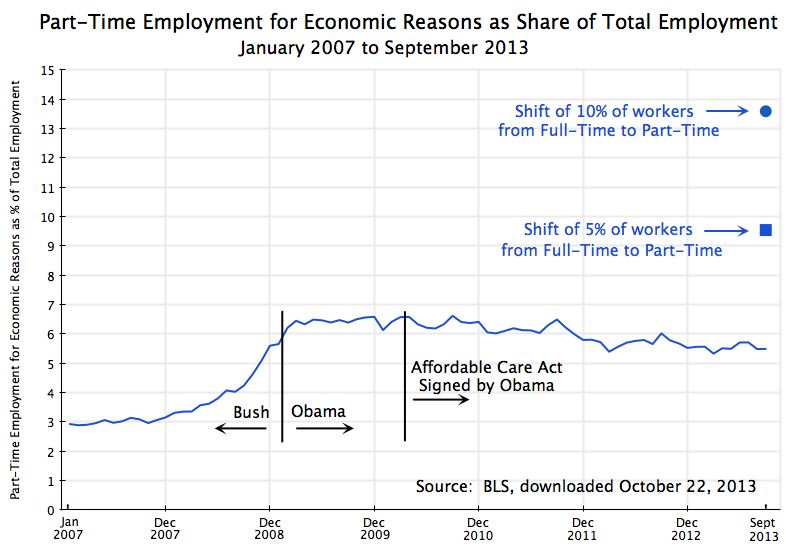
Part-Time Employment #2 as Share of Total Employment, Jan 2007 to Sept 2013

Conservative media have repeatedly asserted that due to ObamaCare (formally the Affordable Care Act), there has been and will be a big shift of workers from full-time to part-time status.  Publications such as Forbes, the Wall Street Journal, and of course Fox News, have asserted that this is a fact and a necessary consequence of ObamaCare.  The argument is that since ObamaCare will require employers to include health care benefits as part of the wage compensation package to full time employees (defined as those who normally work more than 30 hours a week for the firm), firms will have the incentive, and by competition the necessity, of shifting workers to part-time status.  It is argued that instead of employing three workers for 40 hours each (for 120 employee hours), firms will instead employ four part time workers at just below 30 hours each to obtain the 120 employee hours.

There are a number of problems with this argument.  First, the ObamaCare requirements for health coverage only apply to firms with more than 50 full time employees.  There is no change for firms employing fewer than 50 workers.  Second, almost all of the firms in the US with more than 50 employees, and indeed a majority also of the workers in firms of fewer than 50 employees, are already in firms that provide health insurance coverage for their workers.   Specifically, 97% of the workers in firms with more than 50 employees are in firms offering health insurance coverage as part of their wage compensation package.  ObamaCare will require this (to avoid a per worker penalty) to go from 97% to 100%, which is not a big change.  And even though ObamaCare will not have such a requirement for firms employing fewer than 50 workers, it is already the case that 53% of the workers in such firms are in firms providing health insurance coverage.   Firms provide health insurance coverage as part of the total compensation package they pay their employees both because they have a direct interest in having healthy workers, but also because there are tax and financial advantages to doing so.

Notwithstanding these issues, the conservative media and Republican politicians continue to assert that ObamaCare is leading to a large substitution of part-time for full-time workers.  But as Jason Furman, the Chairman of the Council of Economic Advisors in the White House has recently noted, this is not seen in the data.  The graph at the top of this blog post is one way to look at this data.

The graph shows the share of part-time workers (part time for economic reasons and not part time by choice) in all workers, by month, for the period from January 2007 to September 2013.  The data come from the Bureau of Labor Statistics.  If ObamaCare is leading to a large shift of workers from full-time to part-time status, then this ratio would be rising since ObamaCare was passed or at some more recent date.  But it is not.

The share of part-time workers in all workers rose in the last year of the Bush administration due to the economic crisis, from about 3% before to about 6 1/2% after.  It was rising rapidly as Obama took office, but stabilized soon thereafter as the economy began to stabilize with the passage of Obama’s stimulus package and aggressive actions by the Fed.  Since then the ratio has trended downwards, albeit slowly.  As has been noted previously in this blog, the continued fiscal drag from government expenditure cuts since 2010 has held back the economy and hence the recovery in the job market.  The blog post noted that if government spending had simply been allowed to grow at its long term average rate, we would likely have already returned to full employment (and would have returned to full employment in 2011, if government expenditures had been allowed to rise at the same pace as they had during the Reagan years).

The Affordable Care Act was signed by Obama in March 2010.  As the graph above indicates, there was no sharp change in trend once that act was signed.  If anything, the share of part-time workers in all workers then began to decline from a previous steady level.  Such a response is the opposite of what the conservative media and Republican politicians have asserted has been the result of ObamaCare coming into effect.

To put the figures in perspective, the graph above also shows how high the ratio of part-time workers to all workers would have had to jump, had either just 5% (the square point) or 10% (the round point) of full-time workers been substituted for by an equal number of part-time workers, additional to where the September 2013 ratio in fact was.   An equal number is used between the full-time and part-time workers to be conservative in the estimate.  The argument being made by the critics is in fact that a higher number of part-time workers would have been hired to substitute for the full-time workers let go, to get the same number of working hours.  But even with an equal number being substituted, such a shift of 5% of the workers would have led to rise in the ratio by 74% relative to where it was in September 2013, and a shift of 10% would have led to a rise of 148%.  One does not see anything like this.

It is not known what the paths would have been to reach those 5% or 10% shifts, but the resulting changes in the paths would have been obvious.  Such changes did not occur.  Since one is comparing the figures to what otherwise would have been the case, the conservative critics would need to argue that the ratio of part-time to all workers would have plummeted in the absence of ObamaCare.  There is no reason given on why this would have been so.  Furthermore, for the case of a 10% shift the number of part-time workers would have had to be negative in the absence of ObamaCare, which is of course impossible.

There is simply no evidence to support the assertion in the conservative media that ObamaCare is leading a significant share of firms to shift workers from full-time to part-time status.

A Disappointing March Jobs Report

Employment, Monthly Change, Dec 2005 - March 2013

The Bureau of Labor Statistics released this morning its regular monthly report on employment.  Growth in jobs in March was disappointingly low, at just 88,000 net new jobs created.  The expectation among analysts (averaging across all their forecasts) prior to the report coming out was that 193,000 net new jobs had been created in March.  Private sector job growth in the BLS figures was just 95,000, while government once again brought down job growth with a cut of 7,000 public sector jobs.  While one should not read too much in one month’s report, and it follows a fairly good February report, the slow-down in March appears to indicate that the recent signs of improvement (including that February jobs report) are being undermined by the decisions being made in Washington on government spending.

The worst of the government cut-backs are yet to come.  The sequester, under which $85 billion in spending authority in the remainder of fiscal year 2013 has been cut (roughly 1% of GDP over this seven month period), only entered into effect on March 1.  It appears that most of the cuts will be enforced through mandatory furloughs, where government workers will be forced not to come to work for a certain number of days (varying by agency) and then not be paid for those days.  These furloughs will only start in April, as a 30 day notice is required.  The furloughed workers will not show up directly in the unemployment statistics, but with their resulting lower incomes (about 5% on average it appears) they will have less to spend in this still weak economy, thus depressing demand and private jobs.  We will see how this works out over the coming months.

There are in fact some early signs of the sequester having an adverse impact on the private sector.  For example, in the past week, both Delta Air Lines and then US Airways announced that their March revenues were weak, which they attributed at least in part to the sequester (leading not only to less travel by government workers, but also and more importantly, less travel by government contractors).  But it is still early.  And since the impact on the GDP numbers will not become significant until the second quarter, we will not know until July (when the initial GDP estimate is published) what the impact on GDP growth has been.

The BLS jobs report also reported that the unemployment rate had fallen to 7.6% from the previous 7.7%.  However, this was more than entirely due to the estimate that the number of workers in the labor force had declined by almost a half million.  The unemployment figures are obtained from a survey of households, while the figures on net new jobs created are from a separate survey of business establishments (along with government and non-profit entities).  There is more volatility in the figures from the household survey, as the effective sample size is a good deal less (each household surveyed will generally have only one or two household members in the labor force, while a business establishment can have thousands of workers).

Thus the published figures from the household survey from a single month are viewed with caution.  It is not clear why the estimated population in the labor force would have fallen by a half million in a single month, and analysts will want to see whether this holds up in coming months.  And while also figures from just one month, it is still disconcerting that the household survey estimated that the number of people with jobs actually fell by 290,000 in the month (while the number of unemployed fell by close to 210,000, with these two numbers together adding up to the half million fewer household members in the labor force).

The March jobs report was not a good one.  And with government cutbacks due to the sequester now becoming greater, there is reason to be concerned that the picture will become even worse in coming months.