GDP Growth in the First Half of 2025: All of It Is From the AI Investment Boom

Chart 1

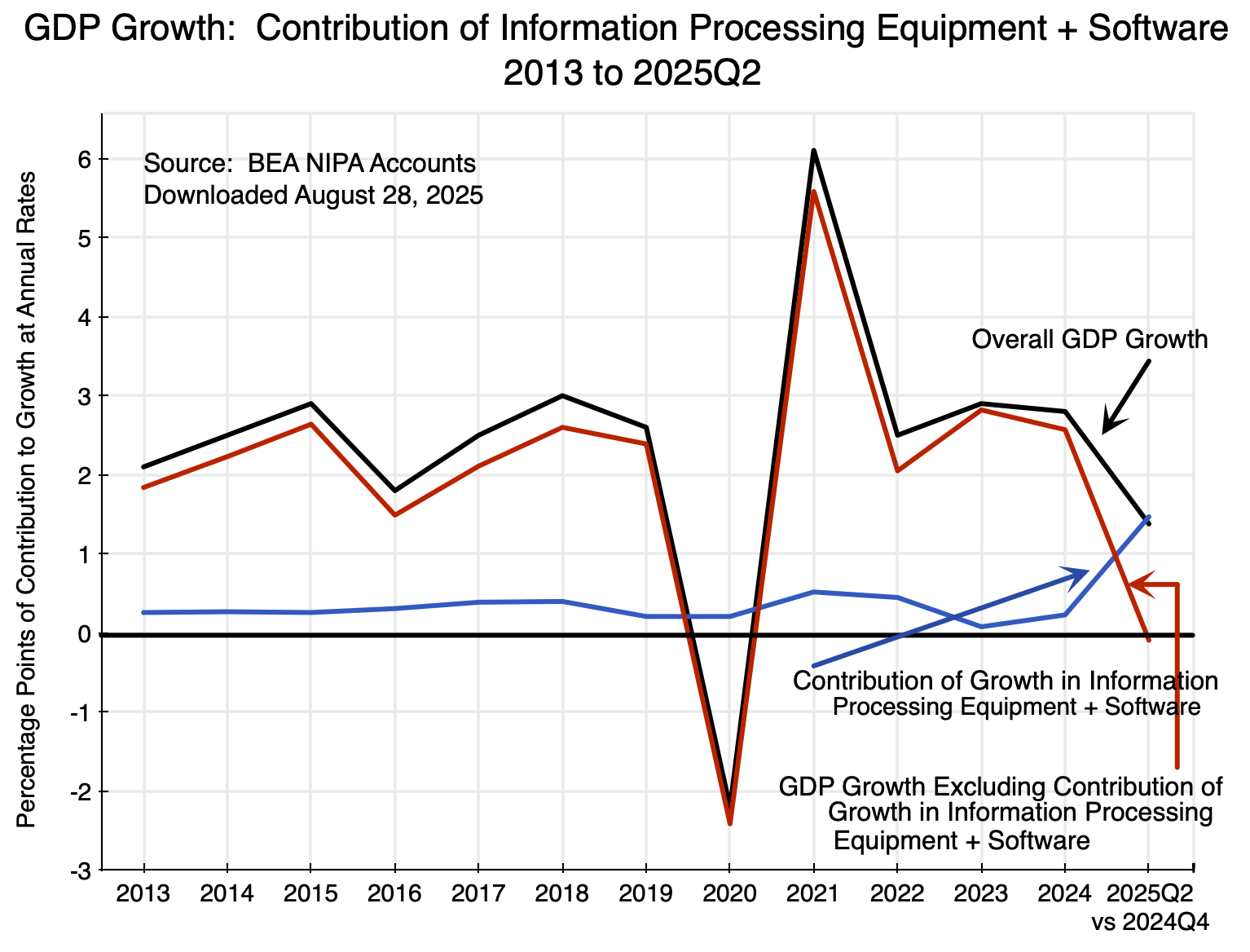
Exceptional growth in private investment in information processing equipment and in software has accounted for all of GDP growth in the first half of 2025.  The BEA released on August 28 its second estimate for GDP growth in the second quarter of this year, and most commentary focused on the upward revision in overall GDP growth in the second quarter from 3.0% (at an annual rate) in its advance estimate released last month to 3.3% now.  But what I believe is of more interest is that all of the growth so far this year has come from private investment in new information processing equipment and software:  i.e. from the AI investment boom.

As we are all taught in Econ 101, the nation’s GDP is equal to what is spent during the period for private consumption, for private investment, for government consumption and investment, and for net exports (exports less imports).  One should keep in mind that GDP is a measure of what is produced domestically during the period in gross terms (i.e. before depreciation) – hence the name Gross Domestic Product.  But since any change in inventories is included within private investment, one can measure what was produced by how it was used (with inventory accumulation as one use; see this earlier post on this blog).  Furthermore, we know from Keynes that in a modern economy, the primary driver of production (up to some capacity limit) comes from demand, i.e. from these demand-side components of overall GDP.

From this, one can calculate how much of the growth in GDP was driven by each of the demand-side components.  The change in overall GDP in dollar terms from one period to the next will, by definition, equal the sum of the change in each of the demand-side expenditure items in dollar terms.  It is of most interest to calculate these in terms of constant prices, and with this then expressed as a percentage of GDP in the prior period, to arrive at an accounting of the contribution of each of the demand components to the growth in GDP in the period.

Furthermore, the demand-side components of GDP are not simply the total levels of private consumption, private investment, and so on.  Those aggregate components of GDP can be broken down into individual types of products that add up to the aggregates. That is, the personal consumption component of GDP can be broken down into consumption of goods and consumption of services, consumption of goods can be further broken down into durable goods and nondurable goods, and durable goods further broken down into types of durable goods, etc.

The BEA provides such figures on the contribution to GDP growth from each of the demand-side components in the online Table 1.5.2 of the NIPA (National Income and Product) tables, which it updates whenever it issues a new set of GDP estimates.  The table provides figures on how much of the growth in overall GDP from the prior period is accounted for by the growth (in percentage points) in the demand-side components of GDP.  The contributions will sum to the increase in percent in overall GDP relative to the prior period.

One can also calculate the contribution figures directly, using Table 1.5.6 of the BEA’s NIPA accounts, which shows – in constant prices – GDP and its demand-side components at the same level of detail as in Table 1.5.2, for each period whether quarterly or annually.  One needs to use the figures in this table when calculating the contributions to the growth in GDP relative to a period other than the prior one (and was used here to compare the growth in GDP in the first half of 2025, i.e. between the last quarter of 2024 and the second quarter of 2025).

Of interest to us here is that two of the line items in these detailed GDP accounts are the contribution to the growth in GDP from private fixed investment in information processing equipment and from private fixed investment in software.  One can then calculate how much of the growth in GDP can be accounted for by these two components, and then what GDP growth would have been from everything else.

The chart above shows this using annual data from 2013 through 2024 (to provide context), and then for the first half of 2025.  The annual figures for 2013 through 2024 came directly from Table 1.5.6 of the NIPA accounts, and show the growth in each year relative to the prior year in overall GDP (the line in black) and then the contribution to that growth that came from private investment in information processing equipment and in software (the line in blue) and the contribution of everything else in the economy (the line in red).

Up through 2024, the contribution to the growth in GDP from private investment in information processing equipment and software was always small – averaging only 0.3% points to the growth in GDP in each period.  This is not surprising.  While a dynamic component of demand (it grew at an average rate of 7.8% per annum from 2013 to 2024, while overall GDP grew at an average rate of 2.4%), private investment in information processing equipment and software was only 4.1% of GDP in 2024 – a small component of GDP.  Thus the growth of everything on the demand side of GDP other than private investment in information processing equipment and software (the line in red) is always close to overall GDP growth up through 2024.  That is, it accounted for almost all of GDP growth over the period, as one would expect.

This then changed dramatically in the first half of 2025.  Comparing GDP in the second quarter of 2025 to what it was in the last quarter of 2024 (i.e. in the first half year of the new Trump term in office), overall GDP growth fell to just 1.4% at an annual rate.  GDP growth had been 2.8% in 2024 in the last year of the Biden presidency (and 6.1%, 2.5%, and 2.9% in 2021 to 2023 respectively), before this fall in the first half of 2025.

But more interesting is that all of the growth in GDP in the first half of 2025 (i.e. in what GDP had grown to as of the second quarter compared to what it was in the last quarter of 2024) came from growth in private investment in information processing equipment and software.  The growth of everything else in GDP was in fact slightly negative, and by itself would have led to a 0.1% fall in GDP over the period.  Growth in private investment in information processing equipment and software contributed a positive 1.5% points to GDP growth, with the two together thus leading to the 1.4% growth in GDP over the period (all at annual rates).

Private investment in information processing equipment and software by itself grew at an astounding annualized rate of 28.3% over the first half of 2025.  This is the AI boom that is underway.  Without it, GDP in the second quarter of 2025 would be below where it was in the last quarter of 2024.

Or put another way, all of the growth in GDP so far in 2025 was due to (and absorbed by) the growth in private investment in information processing equipment and software.  On a net basis, everything else was stagnant and indeed fell slightly.

Imports Do Not Subtract From GDP: Econ 101

Chart 1

A.  Introduction

Trump has undermined what had been a strong US economy more quickly than most expected.  The BEA released on April 30 its initial estimate (what it labels the “advance estimate”) of the growth in GDP in the first quarter of 2025.  The economy contracted by 0.3% at an annual rate.  Real GDP grew at solid – indeed excellent – rates while Biden was in office.  The economy grew by 6.1% in 2021 as it emerged from the Covid crisis – faster than in any year since 1984 – and by 2.5% in 2022.  It then grew at a rate of 2.9% in 2023 and 2.8% in 2024.  While the GDP estimate for the first quarter of 2025 will be revised as additional data becomes available in the coming months, this is a terrible start for the new administration.

The cause of this fall in GDP in the first quarter of the Trump administration has been misinterpreted by many.  Prominent among them was Peter Navarro, the primary trade advisor in the White House.  In an interview on CNBC, Navarro asserted:

“when you strip out inventories and the negative effects of the surge in imports because of the tariffs, you had 3% growth.”

No:  Output did not grow.  It fell at a 0.3% rate.  There was indeed an extraordinary surge in imports.  Trump began to impose major tariffs on imports soon after taking office, with a promise of far higher rates to come.  And indeed, on April 2 he announced extraordinarily high (and highly variable) tariff rates on every “country” in the world (including one occupied only by penguins), only to back down on April 9, saying they would be postponed for 90 days.  In anticipation of what might come, imports of goods and services rose in the first quarter of 2025 at an astounding 41% annualized rate and imports of goods only (which can be stored) rose at a 51% rate.

But an increase in imports does not – in itself – affect the calculation of GDP.  GDP is a measure of domestic production (that is what the D stands for in GDP:  Gross Domestic Product).  Domestic production is what it is in the accounting regardless of how much is imported.

The confusion of Navarro and many in the news media stems from the formula that all are taught in an introductory Econ 101 macroeconomics class:

GDP = Consumption + Fixed Investment + Investment in Inventories + Exports – Imports

(where government consumption and investment can be combined with private consumption and investment, which we will do here for simplicity).  Imports are subtracted out at the end of this formula because Consumption, Fixed Investment, Investment in Inventories, and Exports all include the imports that help supply (directly or indirectly) these components of demand.  That is, Consumption (for example) includes consumption of domestic production as well as consumption of whatever is imported and used for that purpose.  And similarly for the other demand components.  Total Imports must then be subtracted out (as it is at the end of the formula) to arrive at what domestic production was.  That domestic production is GDP.

While it is easy to see why there would be such a mistake in the interpretation of how GDP is determined, there is no excuse for policy officials as well as journalists who write on economic issues to make such a mistake.

I have discussed before on this blog how GDP is estimated (see here and here).  But given this widespread misinterpretation of the 2025Q1 figures, it is worth reviewing the issue again.  That will be covered in the first section below.  The section that follows will then discuss the new GDP estimates themselves, and what those figures are telling us about how the economy has responded to the new Trump administration.  This concrete example will also help to reinforce the understanding on how imports enter.

The concluding section will then briefly look at what is in prospect for the GDP figures, both in the coming months and beyond.  While the economy is probably not yet in a recession, the policies of the new Trump administration (and its chaotic implementation) make it increasingly clear that the US will soon enter into a recession, unless Trump quickly reverses what he is doing.  And there is little likelihood of Trump doing that.

B.  Econ 101:  What GDP Means and How it is Estimated

Numerous news sources (as well as the official White House press release) misinterpreted the impact of imports on the GDP estimate for the first quarter of 2025.  As one example among many, the CNBC report on the GDP figures stated:

“Imports subtract from GDP, so the contraction in growth may not be viewed as negatively given the potential for the trend to reverse in subsequent quarters. Imports took more than 5 percentage points off the headline reading.”

Which is wrong.

GDP is an acronym for Gross Domestic Product.  “Product” means what is produced; “Domestic” means what is domestically produced; and “Gross” refers to the gross level of investment being counted rather than investment net of an estimate of depreciation (the latter measure of investment would then lead to Net Domestic Product, or NDP).

So how is GDP estimated?  As was discussed in the earlier blog posts referred to above, the BEA (the government agency that produces the GDP accounts) does this in three different ways.  In principle, all three should lead to the same estimate for GDP.  Because they are all estimates based on surveys and other statistics, they don’t although they should be close. There will always be statistical noise, and the three different estimates serve as a good check on each other to help find whether a mistake was made somewhere.

One approach is to estimate domestic production directly – sector by sector.  However, data for this is the most difficult to come by, and the first BEA estimate of GDP by this method is only provided three months after the end of a calendar quarter, i.e. in late June for the January to March quarter.  A second approach is to estimate domestic production by the incomes generated.  Since whatever is produced and sold will be reflected in incomes (in the wages of the workers employed, and then in the profits that remain following the payments for all the inputs used in production plus the wages paid), this should in principle also sum to GDP.  The BEA provides its first estimate of GDP using this approach (which, to limit confusion, it labels Gross Domestic Income, or GDI) two months after the end of a calendar quarter, i.e. in late May for the January to March quarter.

The third approach – and the one most commonly considered when GDP is referred to – is to estimate GDP from the uses of whatever is produced.  Whatever is produced is used, and if those uses can be estimated, this can be used to arrive at an estimate of what is produced, i.e. GDP.  The BEA can also provide a reasonable estimate of GDP this way relatively quickly after the end of each calendar quarter.  It issues its initial estimate one month after the end of each calendar quarter, i.e. in late April for the January to March quarter.  While the estimate will be revised as more data become available in the subsequent months, it is this estimate of GDP that receives the most attention as it is the first to be released.  Keeping track of the various demands for production is also important in a modern economy since we know from Keynes that production (up to a limit set by full employment) will largely follow from what the demands are.

This estimate is also built around the well-known equation referred to in the introduction above.  Starting with the simplest form in order to make clear that GDP is a measure of domestic production and not of demand, consider an economy where there is no foreign trade.  The equation is then:

GDP = Consumption + Fixed Investment + Investment in Inventories

The final uses of (the final demands for) goods and services are that they are either consumed or invested.  But what is consumed or invested in a period will normally differ from what is produced.  The simple trick, then, is to include along with the final demands the amount that is added to inventories (if production exceeds the sum of the final demands in the period) or taken out of inventories (if production falls short of the sum of the final demands in the period).  Hence by adding the net change in inventories (inventory accumulation, which is an investment) to the final demands for goods and services, one will arrive at what was produced in that period.  (Note that the terms “additions to inventories”, “investment in inventories”, and “accumulation of inventories” all refer to the same thing and are used interchangeably.)

Simple, although it can easily lead to the mistake of treating the demand for goods and services as GDP, when GDP is in fact the production of goods and services.

We can add foreign trade in goods and services to this.  There will be exports (also a final demand for goods and services) as well as imports.  Imports are an additional source of supply of goods and services that add to what is domestically produced.  Putting the supply of goods and services on the left and the demand for goods and services on the right, one has:

Supply of goods and services = Demand for goods and services

GDP + Imports =  Consumption + Fixed Investment + Investment in Inventories + Exports

The supplies of goods and services – whether from domestic production (GDP) or foreign production (Imports) – are used to meet the final demands for Consumption, Investment, and Exports, along with any accumulation of inventories if the total supplied exceeds the final demands (or decumulation of inventories if final demands exceed supplies).

Moving Imports to the right side of the equation, one then has the well-known:

GDP = Consumption + Fixed Investment + Investment in Inventories + Exports – Imports

It is important to keep in mind that imports typically enter indirectly, as an input to what is being produced and thus enabling a greater overall supply.  But one cannot map what share of Consumption, say, came from domestic supply and how much from foreign supply.  Imports are a resource that enables the nation to provide more.  How can one know, for example, whether a gallon of fuel, say, that was imported was used to help produce an item for consumption, or an item for investment, or an item for exports, or was added to inventories?  And even if the imported item can be individually identified, the complex nature of multi-level production (where intermediate goods produced can be used for a variety of different final goods) often makes it impossible to trace what an imported item ended up being used for.

As a result, the BEA cannot produce individual estimates of how much of Consumption, say, came from domestically supplied items and how much came from items produced with imports as a resource.  All it can provide are estimates of each of the demand components (including any addition to – or subtraction from – inventories), and then subtract total imports from the total demands to arrive at an estimate of what domestic production (GDP) was.

Imports in this accounting thus do not subtract from GDP, even though numerous news sources (and Trump officials) asserted precisely that.  If imports had been $1 billion higher, say, then there would have been $1 billion more in Consumption, or in Fixed Investment, or in Investment in Inventories, or in Exports (or some combination).  Subtracting that extra $1 billion at the end of the equation then leaves GDP exactly the same.

This is all accounting, or as economists refer to it, national income accounting.  Domestic production – GDP – did indeed fall at an annual rate of 0.3% in this initial estimate of GDP for the first quarter of 2025.  This was a sharp reduction from the strong and steady growth the country had enjoyed under Biden.  The country had nothing close to “3% growth”, as Peter Navarro wrongly asserted.

The figures for GDP and the components of demand that sum to GDP nevertheless acted in highly unusual ways in this first quarter of the Trump administration.  The next section of this post will examine those.

C.  GDP and Its Demand Components in the First Quarter of 2025

As noted before, the GDP estimates released by the BEA on April 30 are its initial or “advance” estimates of GDP and related figures in the National Income and Product Accounts.  Updated estimates based on more complete data will be provided with the second estimate in late May and again with the third estimate in late June. These estimates will likely differ to some degree from these initial estimates.

Historically, the average change in the estimated growth rate of GDP (in percentage points) from BEA’s advance estimate to its second estimate has only been 0.1% points, and also only 0.1% from the advance estimate to the third estimate.  But one has to keep in mind that those are changes on average, where sometimes the initial estimates are revised up and sometimes revised down.  The very small average difference (only 0.1%) means that there is little bias in the initial estimates historically:  they are as often revised up as revised down.  In absolute terms (i.e. ignoring whether the revisions were positive or negative), the average change from the advance estimate to the second estimate was 0.5%, and from the advance estimate to the third estimate was 0.7%.  Such changes are more significant, and there are even larger changes in periods when, such as now, the economy is going through major disruptions.

Due to the far from normal increase in imports resulting from uncertainty on what tariffs Trump will impose (which appear often to be based on a whim, and announced on social media posts), it is certainly possible and indeed likely that the GDP estimates for 2025Q1 will be revised by more than they normally have in the past.  Investment in inventory accumulation is especially difficult to estimate, and may see an especially large revision.

It is therefore quite possible that once revisions to the accounts are made based on more complete data, growth in real GDP will shift from the small negative (-0.3%) in the current estimate to possibly a small positive.  This should not, however, be viewed as terribly significant.  There is no chance that the revisions will bring growth anywhere close to the almost 3% rates the nation enjoyed under Biden in 2023 and 2024.  So while the analysis here has to be based on the figures released in the advance GDP estimates, the basic story should hold as the second and third estimates of GDP are released in the coming months.

This table summarizes the key figures:

Growth in Real GDP and Its Demand Components

2025Q1 vs 2024Q4 % change $ billion change
Real GDP -0.3%   -$16.2
Personal Consumption  1.8%   $72.4
Gross Fixed Investment  7.8%    $80.9
  o/w Information Processing Equipment 69.3%   $73.6
Investment in Inventories  $131.2
Government Expenditure -1.5%  -$14.6
  Federal Government -5.1%  -$19.8
    o/w Defense Spending -8.0%  -$18.0
  State & Local Government   0.8%     $4.9
Exports  1.8%   $11.6
Imports 41.3% $333.3
Seasonally adjusted annual rates; 2017 constant$

Starting from the top:  Domestic production in real terms (real GDP) fell at an annual rate of 0.3%.  In dollar terms (in constant 2017 prices) the fall was $16.2 billion.  This change in domestic production was far surpassed by the increase in imports (foreign production) of $333.3 billion in real terms, as individuals and businesses sought to get in front of Trump’s promised tariffs.

Much of the increase in imports likely went into the increase in inventories, which rose by $131.2 billion in real terms.  As discussed above, it is not possible to estimate for each of the demand components (the change in inventories being one) how much can be attributed to domestic supplies and how much to imported supplies.  It is likely, however, that with such a sizeable jump in imports (41.3% at an annual rate), a substantial share went into inventories.

But a significant share of the increase in imported supply was also used directly or indirectly for the final demand components of GDP.  As discussed before, each of these reflects the use of a combination of both domestic and imported supplies.  Take Gross Fixed Investment, for example.  It rose at the very fast rate of 7.8% in annual terms.  If one digs into the reported components for this, one will see (in Table 3 of the BEA release) that fixed investment in Information Processing Equipment rose by $73.6 billion in the quarter (69.3% at an annual rate).  That one component of investment accounted for over 90% of the overall increase in Gross Fixed Investment in the period (which was $80.9 billion).  Investment in Information Processing Equipment had not been booming before:  It in fact fell by $10.0 billion in the prior quarter, rose by $21.6 billion in the quarter before that, and rose by $9.7 billion in the quarter before that.

The highly unusual behavior in such investment in the first quarter of 2025 coincided with the uncertainty generated by Trump’s tariffs.  And Information Processing Equipment is the type of equipment that firms will often import directly and have installed.  It will thus count as part of Gross Fixed Investment in the GDP accounts.  Fixed investment rose in the first quarter of 2025, but it is likely that this primarily reflected a rush to import specialized equipment before even higher tariffs (whatever they will be) are imposed by Trump.

There was likely a similar factor that affected the Personal Consumption component, although to a lesser extent than what was seen for Fixed Investment.  Personal Consumption rose by 1.8% in real terms at an annual rate.  That is not all that high (it rose at a 4.0% rate in the fourth quarter of 2024 – the last quarter of the Biden administration – and by 3.7% in the third quarter of 2024).  But at least part of this would have come from businesses and individuals importing items before prices go up due to Trump’s tariffs.  Indeed, it is possible – and indeed likely – that net of what was imported to supply this demand (directly or indirectly), the domestic supply for Personal Consumption may well have decreased.  As a personal example, my wife and I decided to go ahead and buy now a new Apple iMac computer (which is assembled in China) for our home use.  Prices may soon skyrocket.  That purchase counted in the Personal Consumption category of the GDP accounts.

It is therefore a mistake to assert, as Trump officials did, that domestic production grew at a healthy rate.  The Navarro quote cited above refers to 3% growth, and the White House press release (that Navarro may have helped prepare) similarly says:  “Core GDP grew at a robust 3.0%.  This signals strong underlying economic momentum that occurred after President Trump’s inauguration.”  What they both appear to be referring to is what the BEA calls “Final sales to private domestic purchasers”.  It grew at a 3.0% rate.  It is defined as the growth in Personal Consumption and in Gross Fixed Investment together.  But as just discussed, much and possibly more than all of that growth reflected the surge in imports before tariffs go up.  Navarro (and others as well) do not realize that those items in the GDP accounts include imports.

The other items in the demand components of the GDP accounts did not change as much.  Federal government expenditures on goods and services (i.e. federal government consumption expenditures and gross investment) fell by $19.8 billion in annual terms (5.1%).  But this cannot be attributed to cuts pursued by Elon Musk and his DOGE group.  Of the $19.8 billion fall, $18.0 billion was due to a reduction in Defense Spending.  That has not been a DOGE focus.  Rather, with a change in administrations, decisions on payments and on new procurement contracts are often delayed as the new team comes in.

Finally, a technical note:  Some may have noticed that if one adds up the $ changes in the above table for Consumption, Investment, and so on in the well-known GDP equation, the sum comes to a dollar change of -$51.8 billion.  This is more than the reported fall of -$16.2 billion.  The reason for this difference is that the BEA uses chain-weighted price indices to deflate the nominal estimates of the GDP demand components.  (For a discussion of chain-weighted indices, in the context of how the CPI and Personal Consumption Expenditures – PCE – price deflators are calculated, see this earlier post on this blog.)

Chain-weighted price indices are based on weights derived from expenditure shares of individual items in the current period and in the prior one.  The BEA uses chain-weighted price indices for all the price deflators it calculates.  A property of chain-weighted price indices is, however, that a sum (such as real GDP here) will not necessarily be equal to the sum of the individual components (such as demand components here) in real terms.  The sum will in general be close, but the BEA warns readers that they will not be the same.

D.  Prospects and Conclusion

In the near term, and as noted above, the BEA will issue its second estimate of the GDP accounts for 2025Q1 in late May and its third estimate in late June.  It will then start the quarterly cycle again with its advance estimate of the GDP accounts for 2025Q2 in late July, and so on.

With the major disruptions to the economy due to Trump, there will likely be significant changes in a number of the figures when the second and third GDP estimates are released.  The import estimates will likely not be among them (despite the 41.3% jump in the period, or $333.3 billion) as the foreign trade accounts are fairly well known in real time (as imports are recorded as they go through customs).  But investment in inventories is much more difficult to estimate.  The BEA advance estimate is that they rose by $131.2 billion (in real terms), but I would not be surprised if, in the updated figures based on more complete data reports, inventory accumulation turns out to be higher.  If so, then the estimated growth in GDP will be higher.  If (purely for the sake of illustration – I am not predicting this), investment in inventories turns out to be $50 billion higher than shown in the advance estimate (i.e. $181.2 billion rather than $131.2 billion), and all else is the same as estimated now, then GDP would have grown at a +0.6% rate rather than fallen at a -0.3% rate.

A change of such a magnitude would not be surprising.  GDP growth would still be low, and far below the growth rates achieved when Biden was in office, but possible.  But the basic underlying story would remain that businesses urgently brought in imports out of concern (and great uncertainty) about how high tariffs might soon be.

The continued incoherence in Trump’s policies does not augur well for the economy for the rest of the year either.  This was demonstrated on April 2 as Trump announced (on what he called “Liberation Day”) his so-called “reciprocal tariffs” at rates as high as 50% (and higher for China).  Businesses were in shock, and it took some time before anyone could figure out how Trump’s rates had been set.  They were not at all reciprocal, but rather calculated based on the bilateral trade deficit of the US (for goods only, i.e. excluding trade in services) divided by US imports of goods from the country.  Trump then backed down a week later, and said he would postpone them for 90 days while a series of deals with countries were negotiated.

Businesses are now basically frozen.  They cannot decide on what investments to make – if any – as they cannot know what tariff regime they will be operating in.  They have also seen that Trump is more than willing to use the powers of the state to punish companies that upset him, and to take actions that are in blatant violation of the law (knowing that the judicial system takes time to act, and that once it does act they will be faced with a fait accompli).  A sound legal system that all must abide by – including a president – is fundamental to any modern economy.

Households are similarly wary.  Consumer expectations have plunged, and both the index of consumer sentiment of the University of Michigan and the Consumer Confidence Index of The Conference Board have dropped each and every month of Trump’s term in office from a peak in November/December 2024.  It is especially surprising that such indices of consumer sentiment have fallen so much so fast even though the unemployment rate has been steady.  Firms are not yet laying off workers, but rather remain basically “frozen”, as they wait for greater clarity on what will happen to the economy.  Keeping workers on the payroll while GDP falls means, however, that labor productivity has gone down.  One can easily calculate that GDP per worker employed fell at a 1.6% annual rate in 2025Q1.  This also puts pressure on costs and hence prices.

On top of this, Trump through Musk and his DOGE team have sought to slash federal government expenditures.  The reality is that not much has in fact been cut thus far, but this may soon change.  As of May 8, federal government spending in CY2025 was $133.50 billion higher than it was as of the same date in CY2024.  The day before Inauguration Day, it was $13.9 billion lower.

But eventually the Trump/Musk/DOGE cuts may materialize.  The US economy will then be faced with lower government expenditures, lower private investment as businesses hold back due to the uncertainty, and lower personal consumption spending as households fear what will come next from this administration.  All of this is a recipe for a downturn.  And once unemployment starts to rise, conditions can quickly deteriorate.

At the same time, Trump’s trade wars are now causing major supply disruptions.  Imports from China have basically shut down, and the major US West Coast ports were seeing a steep drop in vessel traffic already in mid-April.  There may soon be empty shelves at US stores, which is certainly unlikely to boost consumer confidence.  As I write this, the Trump administration has just announced that it is backing down on its confrontation with China, and that it will reduce its tariffs on imports from China to “just” 30% for the next 90 days.  But such tariffs are still high and will have a major impact on costs and hence prices.

Along with the other tariffs Trump has imposed (10% on everyone, 25% on steel and aluminum, 25% on autos and auto parts with some exceptions, and a variety of others), costs and hence prices will go up.  The Fed may thus not be able to reduce interest rates in response to a downturn.  Not much commented on in the recent BEA report was that the Fed’s primary indicator of inflation (the deflator calculated by the BEA for Personal Consumption Expenditures excluding food and energy, i.e. the core PCE deflator) already rose at a 3.5% rate in the first quarter of 2025.  This is well above the Fed’s 2.0% target, and was an increase from a 2.6% rate in the last quarter of 2024.  The overall PCE deflator rose at a 3.6% rate, and the GDP deflator rose at a 3.7% rate.  And this was before the numerous new and/or higher tariffs Trump imposed since the start of April.

An economic recession is thus likely soon.  How long it will last will depend on how soon Trump recognizes the harm he has caused to the economy and reverses what he has done.  But Trump has never shown much of a willingness to recognize his mistakes, and will certainly never publicly acknowledge that they were mistakes.  The possibility of an extended downturn is high.

What GDP Means: A Not Terribly Surprising Lack of Understanding by Elon Musk and Trump’s Secretary of Commerce

Update, March 28, 2025:  The BEA released on March 27 its initial estimate of GDP as measured from wage and profit income for the fourth quarter of 2024.  The BEA labels this, to avoid confusion, Gross Domestic Income – GDI.  In principle, it should be the same as GDP but will differ as data from different sources are used to estimate both; see the discussion in the post below.  The BEA also released its initial estimate for the fourth quarter of 2024 of value-added produced by sector, from which one can calculate growth in production by private industries and in production by government.  The two together sum to GDP.  Charts 1 and 3 in the post and related text have been updated to reflect these new estimates.

Economic growth was strong in the last quarter of 2024 – the last full quarter of the Biden administration.  Real GDP grew at a 2.4% annual pace when estimated from demand-side measures, and at a substantially faster 4.5% pace when estimated from income-side measures (i.e. GDI).  Growth in the average of the two measures – GDI and GDP – was 3.5%.  This is exceptionally strong.  And price inflation was modest, with growth in the Personal Consumption Expenditures (PCE) price deflator of 2.4% at an annual rate, and 2.6% in the core PCE price deflator.

Along with an unemployment rate of just 4.0% (as of January), Trump has inherited an extremely strong economy from Biden.  We will now see what develops.


A. Introduction

On February 28, Elon Musk posted on his social media site X the comment:

“A more accurate measure of GDP would exclude government spending.

Otherwise, you can scale GDP artificially high by spending money on things that don’t make people’s lives better.”

Two days later, on March 2, Secretary of Commerce Howard Lutnick followed up on this and said in an interview on Fox News:

“You know that governments historically have messed with GDP.  They count government spending as part of GDP.  So I’m going to separate those two and make it transparent.”

These statements reveal a lack of understanding of what GDP means by two of the most prominent officials (or in Musk’s case, a non-official official) in the Trump administration – both key players on economic issues.  While that lack of understanding is not surprising – how GDP is defined is a technical issue – what is worrying is that these prominent Trump appointees would assert this with confidence and without bothering to check first with experts whether it was in fact true.  Such arrogance is unfortunately now the norm in this administration.

Lutnick’s assertion that “governments have historically messed with GDP” (in fact they have not) is also worrisome as it looks like preparation for the Trump administration to do precisely that.  GDP estimates are prepared by the Bureau of Economic Analysis (BEA), a bureau in the Department of Commerce now headed by Lutnick.  Also, just a few days before his confused statement on GDP Lutnick disbanded the standing external technical advisory committee that advised the BEA on how GDP estimates might be improved.  Committee members were professionals at universities and in industry who were specialists on these issues.  They were not paid and only had their travel costs covered when meetings were called.  At the same time, Lutnick also disbanded several similar committees of unpaid specialists advising the Census Bureau – also part of the Department of Commerce.

The concern is that Lutnick is setting things up precisely to “mess with” how GDP is estimated.  The concern is that he could very well order the BEA to manipulate the standard methodology and estimation process to come up with figures that make it look like the economy is in less trouble than it in fact is in the coming years of Trump’s second presidential term.

Musk and Lutnick do not appear to realize that GDP – which stands for Gross Domestic Product – is a measure of the market value of all the economy produces in a given period (normally expressed in annualized terms).  Gross Domestic Product is a measure of production; production that takes place domestically (i.e. within the nation’s borders); and in gross terms (meaning without depreciation of capital taken out).  The BEA also produces estimates with depreciation subtracted – which it calls Net Domestic Product or NDP – but less attention is paid to those figures as depreciation is especially hard to estimate, both conceptually and in practice.

The aim of the GDP measure is thus to arrive at an estimate of how much the nation’s economy is producing.  How that production is used is not the purpose of the measure, and there is no assessment of whether that use should be considered “good” or “not so good”.  But it is disparaging to assert (as Musk and Lutnick have) that the services that the government provides – such as the services of the school teacher pictured above – are worthless and hence should not be counted.

Those statements of Musk and Lutnick do, however, provide a “teachable moment”.  Many others – including some in the news media – are also confused about what GDP means and signifies.  This post will seek to sort through those confusions.  The first section below will review what GDP means and how it is estimated.  Those are two separate things.  Lutnick and Musk are conflating what GDP is designed to measure (i.e. production) with one way in which GDP may be estimated (from the demand side, by estimating how that production is used).  The BEA in fact estimates GDP in three different ways, with this serving to provide also cross-checks on the estimates.  In principle, GDP as estimated by each of the three methods should be the same.  But one is dealing with real-world data, there will always be statistical noise, and hence by using three different approaches the BEA can arrive at a more robust overall estimate.

Lutnick also asserted there is a lack of transparency in the GDP figures, in that the BEA includes figures on government spending in GDP.  This is confused and it is also defamatory to assert that the BEA is anything other than transparent.  The BEA issues each month regularly updated figures not just on GDP but also on much else in what is more formally called the National Income and Product Accounts (NIPA).  In these, the BEA provides estimates on all sorts of aggregates with and without government spending.  While Lutnick and Musk are not clear about what they are seeking, one guess is that they are looking for a figure on domestic production that excludes whatever is produced directly by government (such as the services of the public school teacher pictured above).  But the BEA in fact provides this:  It is called Value-Added by Private Industries.  The BEA provides estimates of this for each calendar quarter and in both real and nominal terms.  Charts below will show (using the published BEA figures) what growth would have been whether measured by GDP as defined or by a measure of growth that excludes government-produced services.

We will also look at some simple measures of the productivity of federal government workers over time.  The calculations are of necessity rough, but if one counts only the management of federal discretionary expenditures, the growth in federal worker productivity in fact matched (over the period 1997 to 2023) the growth in overall labor productivity in the economy.  And if one includes also the management of mandatory spending (entitlement programs such as Social Security and Medicare), federal worker productivity has grown far faster than overall labor productivity in the economy.  These estimates should not be taken too seriously, as there is no way to assess how well-managed the programs are.  But in simple but crude terms, there is no evidence that growth in federal worker productivity has lagged what the rest of the economy has achieved.  Indeed, by one measure it was far better.

The post will end with some final comments.  While I am sure Musk and Lutnick do not realize it, their notion of what GDP should and should not include is in many respects similar to concepts used in the Material Balances System of national accounts (also called the Material Product System) developed in the 1930s by Gosplan in Stalin’s USSR.  It was then used (by command – there was no choice here) in the communist countries of Eastern Europe up until 1990.  Those systems excluded the concept of certain services as contributing to production, similar to what Musk and Lutnick are advocating now.  It was built on the concept from Karl Marx of productive and unproductive labor, with Musk and Lutnick asserting that certain labor (those employed in government) is unproductive.

It is ironic that senior figures in the Trump administration appear to be advocating for a system similar in nature to that developed in Stalin’s USSR.  We know that that did not end well.

B.  The Meaning of GDP versus How GDP is Estimated

GDP – Gross Domestic Product – is a measure of the market value of what the economy is producing.  That is not the same concept as what the economy is using.  While statisticians can make use of data on how output is being used in order to arrive at an estimate of what was produced, confusion on this point appears to have led to the error Musk and Lutnick made.  While what they did mean is not fully clear, they mistakenly asserted that eliminating one of the uses of output (that by government) would yield “a more accurate measure of GDP” (as Musk put it in the quote above).  That is not correct.  It would no longer be GDP.

The confusion – which others have made as well – stems from how GDP is estimated.  The BEA (and also the international standard on national account concepts) estimates GDP in three different ways.  The three should in principle yield the same figure for GDP (after some minor adjustments to reflect indirect taxes and subsidies).  But with real-world data, the three estimates will normally differ only by some – hopefully small – amount.  The three approaches will serve, however, as cross-checks on each other, and can flag that there is an issue if one of the estimates differs significantly from the others.

An earlier post on this blog discussed those three methods for estimating GDP.  Readers may wish to read that post (which covers also how recessions are identified and formally declared) for a more complete discussion.  And for a much more detailed review, they may refer to Chapter 2 of the NIPA Handbook issued by the BEA.  But briefly, GDP is estimated by:

a)  The initial, and most widely viewed, estimate of GDP comes not from estimates of what is produced, but rather from how that production is used.  As those who have studied any economics know, GDP will be equal to the sum of Personal Consumption, Private Investment, Government Consumption and Investment, and Net Exports (i.e. Exports less Imports).  This holds not because Personal Consumption and the other uses of GDP are themselves producers of GDP (although some commentators often imply that), but rather because Private Investment includes investment in inventory accumulation.  Whatever is produced and not sold will accumulate in inventories, and with this as a balancing item one can go from the sum of all the uses of output to what production itself was.

It is a simple trick, but often misunderstood.  It allows the BEA to arrive at a fairly good estimate of how much production (GDP) grew in any calendar quarter just one month after the end of each quarter.  The BEA formally calls this its “Advance Estimate” of GDP, although many refer to it as the first or initial estimate of GDP.  It is then revised a month later (to produce the “Second Estimate”), and again a month after that (to produce the “Third Estimate”), as more complete data become available to the BEA.

The components of demand are also interesting and important in themselves.  They provide figures on what happened to personal consumption, fixed as well as inventory investment, and the other demand components of GDP.  To many, these figures on spending are of more interest than what happened in a particular sector of production.  And perhaps more importantly, in a modern economy production itself is largely driven by what producers can sell.  As Keynes taught us, production cannot be taken as a given at some “full employment” level, but rather will respond to what producers believe they can sell at a price that will cover their costs.

If, as Musk and Lutnick appear to be saying (again, they are not fully clear), the use of production by government (or some portion of that use) were to be subtracted from GDP, then the sum of what is used in the economy will no longer match what is produced by the economy.  That simple identity will no longer hold.

b)  GDP is also estimated by summing up the incomes (wages and profits) generated by the act of production.  This is based primarily on data obtained by the BLS from its monthly survey of business establishments (the Current Employment Statistics – or CES – survey; most commonly known for the monthly employment estimates it provides); from the Quarterly Census of Employment and Wages (QCEW) also of the BLS and with more detail on earnings; from the Quarterly Financial Report (QFR) of the Census Bureau (that obtains, for a sample of business firms, statistics on their financial positions and profits); and from a range of other sources to fill in the gaps (e.g. on farm incomes).

The value of all that is produced in the economy will accrue as someone’s income.  Thus by arriving at an estimate of aggregate incomes, the BEA will have a second approach to estimating GDP.  Those incomes include wages and other compensation paid to labor (e.g. health insurance, pension contributions, and such) plus the profits (or gross margin) accruing to the owners of the firms.  Since GDP is a gross concept (meaning before any deduction for depreciation of capital), the profit concept will be profits before any deduction for depreciation allowances.

The BEA does not try to provide an estimate of GDP by this approach in its Advance (first) Estimate of GDP released one month after the end of each quarter.  It does not yet have sufficient data to do this.  Rather, its first estimate is only (normally) provided with its Second Estimate of the GDP accounts two months after the end of each quarter.  At that time it issues a revised estimate of its demand-side estimate of GDP, and its initial estimate of GDP as arrived at from its income-side figures.  To avoid confusion, it calls this estimate Gross Domestic Income (GDI) rather than GDP, although in principle they should be the same.  But in the real world, the GDP and GDI figures will differ by some (hopefully small) amount, and to be fully transparent, the BEA shows this difference with the label of “Statistical Discrepancy”.  The BEA also provides a figure for the simple average of the GDP (demand-side) and GDI (income-side) estimates.  Many professionals take the quarterly changes in that simple average to be a better estimate of what growth has been in the economy – better than either GDP or GDI alone.

[Side note:  The initial GDI estimates are normally provided at the time of the Second Estimate of the GDP accounts, i.e. two months following the end of each quarter.  But the figures for the fourth quarter of the year are an exception, as extra time is allowed for businesses to complete their end-of-year accounting.  Thus the initial GDI estimates for the fourth quarter of each year are not released in late February but rather in late March.]

It is not clear what would happen to this GDI estimate should the BEA be required by Lutnick (its boss) to not count government spending (or some portion of government spending) in its GDP estimates.  Not only do government workers (civil servants) earn incomes, but wages are paid and profits are earned on the production of what government purchases.  While it would be straightforward (although silly) to exclude wages earned by government workers from the total incomes earned in society, it would be far more difficult to try to cancel out wages and profits earned on production sold to government.  But unless one did that, GDI would no longer match up with the concept of GDP that Musk and Lutnick appear to be calling for.

c)  The third approach the BEA uses to estimate GDP is to estimate directly what each sector in the economy produces and then add it up.  This is, however, the most difficult.  Hence the initial estimate of GDP in this way is not issued until the third month following the end of each calendar quarter (at which time the BEA issues also a second set of revised estimates of GDP from the demand side and a first set of revised estimates of GDP from the income side (i.e. GDI).  And while in principle this direct production-side estimate of GDP should match the other two estimates of GDP, the BEA does not publish what they arrived at for overall GDP from that production-side estimate.  Rather, for whatever reason (possibly limited confidence in the adequacy of the data they have at the time, or to avoid confusion by the public) the BEA scales their sector-by-sector estimates of production to match their (twice-revised) demand-side estimate of GDP.

To avoid double-counting, only the value that is added in each sector is counted (“value-added”).  The value-added in a sector of production is the gross revenues from the sale of what is produced minus what that sector purchases from other sectors – which are called intermediate inputs.  Thus, for example, the value-added of a bakery will equal the revenues of the bread that it sells less the cost of the inputs it had purchased – the flour, energy, water, and other ingredients it used.  A portion of that value-added is paid to the workers in wages and other compensation, and what is left is the gross margin or profits (the BEA uses the term “gross operating surplus”) of the bakery.  And for Gross Domestic Product (as opposed to Net National Product), it will be the profits before any deduction for depreciation.

Adding up value-added across all sectors of the economy should then match GDP as estimated from the demand side and GDP (GDI) as estimated from the income side.  But a question that then arises is how do they estimate value-added by the part of government that does not sell its output on the market?  While government enterprises (such as the Post Office, government-owned public utilities such as water companies, certain toll roads, and similarly) are an exception, they are a relatively small share of what government does.  A similar issue arises for non-profits who do not sell what they provide.

For what is called “general government” (government excluding government enterprises), as well as non-profits who do not sell what they provide on the market, the BEA follows standard international guidelines and sets the value-added of such entities to equal what it pays in wages and other compensation to government workers plus an estimate of what depreciation was on the capital assets of the government (or the non-profits).  The estimated depreciation is added in order to make these figures comparable to the figures for value-added in the sectors where goods and services are sold in the market.

Adding value-added estimated in this way for general government (and non-profits) to the figures for value-added in the sectors of the economy that sell in the markets (including by government enterprises), will then yield an estimate for GDP that in principle will match both GDP as estimated from the demand side (how the production was used, including for any inventory accumulation) and from the income side (wages and profits).

A generous interpretation of the comments of Musk and Lutnick is that they would exclude the counting of any value from the services that government itself provides when measured in the way described above.  That does not appear to be the case, but it is a possible interpretation and would indeed make more sense than excluding government spending (or some portion of government spending) from the demand side estimate of GDP.  That is, under this interpretation of Musk and Lutnick, the BEA would be instructed to provide an estimate of all that is produced in the economy excluding that provided by government.

But the BEA already publishes precisely such a figure.  It is the sum of value-added across all of the private sectors of the economy (which the BEA labels “Private Industries”).  Quarterly estimates on this are provided in the table titled “Gross Domestic Product by Industry Group” which is part of their publication of the Third Estimates of GDP, released three months following the end of each quarter.  The contribution to GDP from Private Industries plus the contribution from Government sums to their overall estimate of GDP.  The BEA is fully transparent on this.

What difference would it make if we assume Musk and Lutnick are referring to this concept of production as a measure of how the economy is performing?  The next section will examine this.

C.  Growth in GDP Compared to Growth in Private Production

How much would growth differ if it were measured based on the figures the BEA provides (and has been providing for many years) on private production as opposed to GDP?  There would be some difference, but not all that much.  What may be interesting is that, at least during recent presidential terms, growth in private production has been consistently higher than growth in overall GDP – although not by a substantial amount.  That is, growth in government production has been kept constrained through tight budgets, which has kept overall GDP growth below the growth in private production.  This is the opposite of the assertions of Musk and Lutnick that government spending has been some kind of artificial boost to the recorded figures on GDP growth.

It is interesting to compare the figures on growth by presidential term.  Comparing that under Biden and in Trump’s first term:
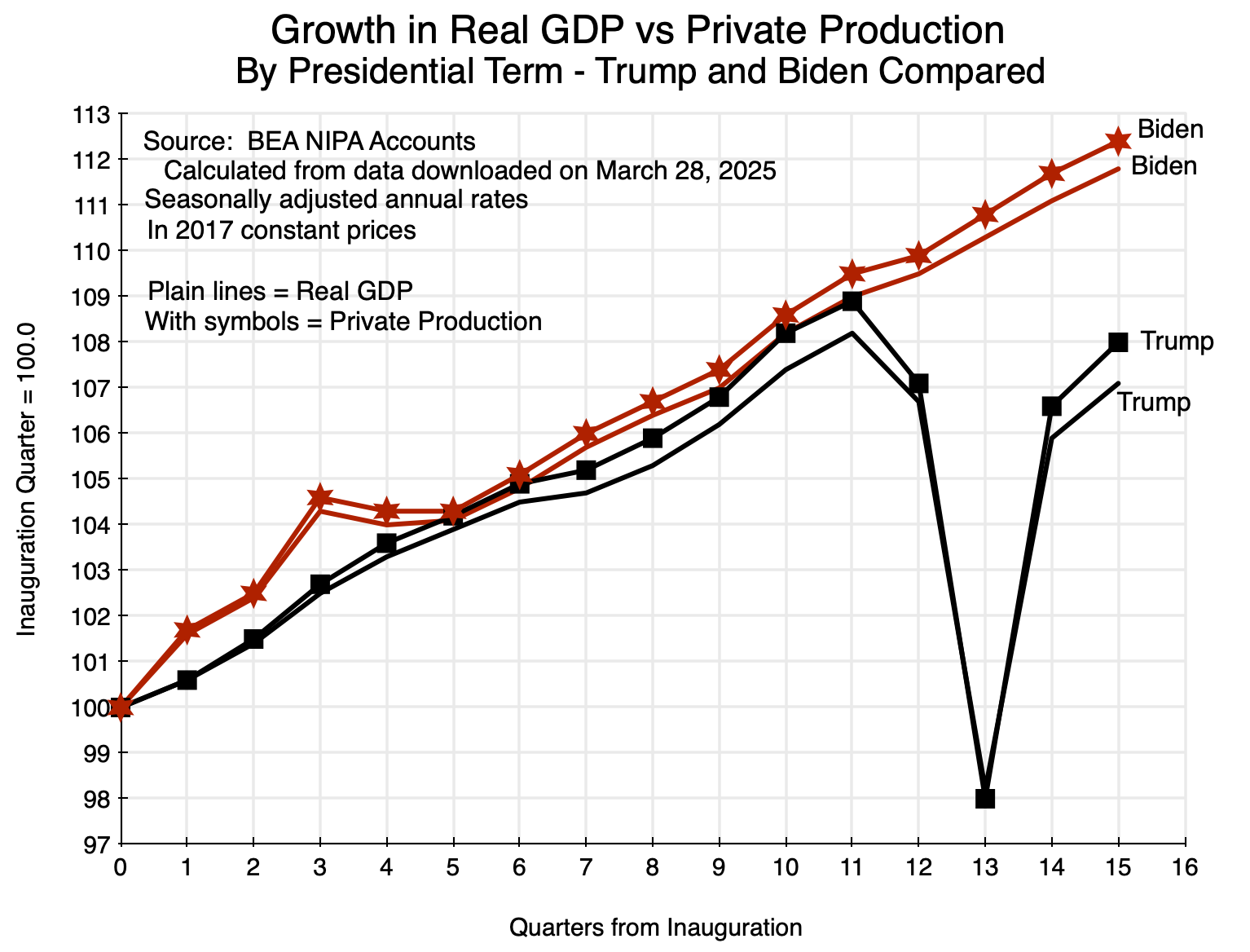
Chart 1

The plain lines show the levels of real GDP compared to what it was in the first quarter of each presidential term, while the lines of the same color but with symbols show what real growth was in private production (what the BEA labels Private Industries).  Private production was consistently somewhat higher, although not by much.  In terms of growth rates, real GDP grew at a 1.7% rate during Trump’s first term and at a rate of 2.8% during Biden’s.  Growth in 2020 was hurt, of course, due to the Covid crisis, and Trump’s mismanagement of the crisis made it worse than it would have been.  Private production grew at a faster rate for both presidents:  at a 1.9% rate under Trump and a substantially higher 3.0% rate under Biden.

One can draw a similar chart for Obama’s two terms in office:

Chart 2

The same pattern holds, with growth in private production faster than the growth in GDP as a whole.  The four-year growth rates were 1.8% and 2.25% for GDP in Obama’s two terms, and 2.1% and 2.5% for private production.

Since GDP is the sum of output of private industries and of government (both in value-added terms, as discussed in Section B above), the implication is that the growth in government value-added was slower than the growth in private value-added in each of these four presidential terms.  This is not surprising, as government growth has been kept constrained by tight budgets limiting what government was allowed to do.

Presidents – together with Congress – are responsible for government spending at the federal level.  Examining this, growth in federal government production (in value-added terms) was indeed flat or modest in each of the terms of Biden and Obama.  But it grew quickly under Trump:

Chart 3

Note that this federal production under Trump was already growing rapidly well before the start of the special programs passed by Congress in response to the Covid crisis.  Those special programs began only in the second quarter of 2020 – quarter #13 of his term in office.  They were also largely transfer programs, and hence separate from what would be counted in government value-added.  They do not explain the rapid growth in government during Trump’s first term in office, in contrast to the only modest growth, or even zero growth (in Obama’s second term), in federal programs when the Democrats were in office.

With this growth in federal production under Trump, why do we still see a substantially greater growth in private production than in overall GDP during Trump’s term (Chart 1 above)?  The reason is that government value-added as a component of GDP will include not only production by the federal government, but also production by state and local governments.  Furthermore, state and local level government production accounts for about two-thirds (68% in 2023) of overall government production (in value-added terms) in the US.  Federal programs account only for one-third.  And value-added in the state and local government sector fell at a 0.5% annual rate during Trump’s term in office, thus holding down overall government value-added despite the sharp rise in federal spending under Trump.

D.  Growth in Federal Worker Productivity Over Time

Musk and Lutnick also assert that government civil servants are unproductive whose contribution should not be counted in GDP.  It is, however, difficult to come up with a good measure of their contribution.  What metric would one use?

While it is difficult to come up with some absolute measure, one can conceive of a measure of the efficiency with which civil servants have, over time, managed their basic work.  Most of the work of federal civil servants is in the management and oversight of government-funded contracts or of federal transfer programs.  Examples of the first (discretionary government spending) include the management of contracts for medical research, or to buy tanks and planes for the military, or via state and local governments for the building of public infrastructure.  Examples of the second (mandatory government spending) include Social Security and Medicare.

There will be a dollar value associated with all such programs.  A crude measure of growth in federal government worker productivity would be how the dollar value of the contracts they have managed has changed over time – in real terms – per federal worker.  Relative to 1997 (the earliest year possible with a consistent series for all the data required), federal spending (in real terms) managed per federal worker has increased substantially:

Chart 4

Two curves are shown for federal government spending per federal worker (where only federal civilian workers are included; active duty military is excluded).  One counts discretionary government spending only, and excludes mandatory spending (for programs such as Social Security and Medicare) as well as interest on government debt and wages of the federal workers themselves.  This curve is shown here in blue.  While there have been substantial fluctuations, as of 2023 it was almost 50% higher than what it was in 1997.  And as of 2023, the increase was almost exactly the same as the increase in productivity for the economy as a whole, i.e. of real GDP per worker.

An alternative measure would include federal spending on mandatory programs in addition to spending on discretionary programs.  These are highly efficient programs, with administrative spending by government entities far below what is seen at private entities managing similar programs.  As was shown in an earlier post on this blog, the administrative cost of private health insurance is on average five times more expensive than the administrative cost for Medicare health insurance.  And administrative costs paid on an average 401(k) retirement accounts are more than an order of magnitude higher than the administrative costs of the Social Security system.  As discussed in another earlier post on this blog, the administrative costs of managing the Social Security system are only 0.5% of the benefits paid out each year.  In contrast, the annual cost of the fees paid out to private accounting and financial institutions on a 401(k) is generally between 2 and 3% of the outstanding balance in the 401(k) account.  The government designed programs are large, simple, and far more efficiently managed than private programs for similar matters.

Including these (and other) mandatory federal programs along with federal discretionary spending, the dollar values of the spending managed per federal worker doubled between 1997 and 2023 (see Chart 4).  This was far greater than the almost 50% increase in real GDP per worker in the economy as a whole.  It spiked even higher in 2020 and 2021 due to the massive Covid relief programs of those years.

This metric cannot assess how well federal workers are managing these programs in absolute terms.  But in terms of the effectiveness (in dollar costs per federal worker) with which they are being managed, federal worker productivity has grown substantially over the past quarter century.

E.  Concluding Comments – Similarities with the Material Product System of National Accounts of the USSR

While I am pretty sure Musk and Lutnick did not have it in mind when they asserted that “GDP” would be better measured by excluding the value of what government workers provide (or government spending in general), their proposal has parallels with the national accounts system developed by Gosplan in the 1930s in Stalin’s USSR.  That system – called the Material Product System (or also Material Balance Planning) – placed a value only on the production of material goods and not of certain services.  The concept for overall output in this system was not GDP but rather what the system defined as Net Material Product (NMP).  In contrast to GDP, NMP excluded the value of what it called “non-productive” services, which in that system included government services as well as health care, education, housing, passenger (but not freight) transport, financial services, and more.

Gosplan developed their system of national accounts based on the concept from Marx of productive and unproductive labor.  Only the production of material goods was viewed as productive, while labor used in the production of non-material goods was unproductive.  Thus whatever was provided by the latter should be excluded from their concept of overall output – i.e. excluded from their NMP.

I doubt that Musk and Lutnick were trying to follow some version of these Marxist concepts in their assertion that “GDP” should exclude the value of what government provides.  But the parallels are interesting.  The Material Product System of national accounts was used in the USSR and then in the post-war period in the Communist countries of Eastern Europe until 1990.  As we know, that did not end well.  One of the problems was that with their system of national accounts, they did not have a good view of what was in fact happening in their economies as conditions deteriorated over the decades.

There will be basic inconsistencies as well in trying to exclude one component of GDP in the integrated NIPA accounts, claiming that government does not contribute to GDP.  The three-way equality of GDP based on how production is used, the wage and profit income generated in production, and the value-added produced in all sectors of the economy, will then no longer hold.

A generous interpretation of Musk and Lutnick would be that they are calling for national income accounts that would count in GDP only the value of what is produced in private activities, i.e. excluding government.  One could do this, but it would no longer be GDP.  Rather, one would then have simply the sum of value-added across all private industries.  But if that is what they want, the BEA already provides it.

Not understanding national income accounting is, of course, minor in comparison to what Trump and his administration have done since taking office in January.  The disregard of basic laws and indeed the Constitution, the firing for no cause of thousands of civil servants and the closure of agencies established by Congress, and the vindictiveness of Trump’s attacks – and his willingness to use raw government power – on American media, universities, law firms, and individuals who have criticized him, are all of far greater consequence.

But the confident assertions of Musk and Lutnick on what should count in GDP is a further example of the self-confident arrogance of this administration.