The Ridership Forecasts for the Baltimore-Washington SCMAGLEV Are Far Too High

The United States desperately needs better public transit.  While the lockdowns made necessary by the spread of the virus that causes Covid-19 led to sharp declines in transit use in 2020, with (so far) only a partial recovery, there will remain a need for transit to provide decent basic service in our metropolitan regions.  Lower-income workers are especially dependent on public transit, and many of them are, as we now see, the “essential workers” that society needs to function.  The Washington-Baltimore region is no exception.

Yet rather than focus on the basic nuts and bolts of ensuring quality services on our subways, buses, and trains, the State of Maryland is once again enamored with using the scarce resources available for public transit to build rail lines through our public parkland in order to serve a small elite.  The Purple Line light rail line was such a case.  Its dual rail lines will serve a narrow 16-mile corridor, passing through some of the richest zip codes in the nation, but destroying precious urban parkland.  As was discussed in an earlier post on this blog, with what will be spent on the Purple Line one could instead stop charging fares on the county-run bus services in the entirety of the two counties the Purple Line will pass through (Montgomery and Prince George’s), and at the same time double those bus services (i.e. double the lines, or double the service frequency, or some combination).

The administration of Governor Hogan of Maryland nonetheless pushed the Purple Line through, although construction has now been halted for close to a year due to cost overruns leading the primary construction contractor to withdraw.  Hogan’s administration is now promoting the building of a superconducting, magnetically-levitating, train (SCMAGLEV) between downtown Baltimore and downtown Washington, DC, with a stop at BWI Airport.  Over $35 million has already been spent, with a massive Draft Environmental Impact Statement (DEIS) produced.  As required by federal law, the DEIS has been made available for public comment, with comments due by May 24.

It is inevitable that such a project will lead to major, and permanent, environmental damage.  The SCMAGLEV would travel partially in tunnels underground, but also on elevated pylons parallel to the Baltimore-Washington Parkway (administered by the National Park Service).  The photos at the top of this post show what it would look like at one section of the parkway.  The question that needs to be addressed is whether any benefits will outweigh the costs (both environmental and other costs), and ridership is central to this.  If ridership is likely to be well less than that forecast, the whole case for the project collapses.  It will not cover its operating and maintenance costs, much less pay back even a portion of what will be spent to build it (up to $17 billion according to the DEIS, but likely to be far more based on experience with similar projects).  Nor would the purported economic benefits then follow.

I have copied below comments I submitted on the DEIS forecasts.  Readers may find them of interest as this project illustrates once again that despite millions of dollars being spent, the consulting firms producing such analyses can get some very basic things wrong.  The issue I focus on for the proposed SCMAGLEV is the ridership forecasts.  The SCMAGLEV project sponsors forecast that the SCMAGLEV will carry 24.9 million riders (one-way trips) in 2045.  The SCMAGLEV will require just 15 minutes to travel between downtown Baltimore and downtown Washington (with a stop at BWI), and is expected to charge a fare of $120 (roundtrip) on average and up to $160 at peak hours.  As one can already see from the fares, at best it would serve a narrow elite.

But there is already a high-speed train providing premier-level service between Baltimore and Washington – the Acela service of Amtrak.  It takes somewhat longer – 30 minutes currently – but its fare is also somewhat lower at $104 for a roundtrip, plus it operates from more convenient stations in Baltimore and Washington.  Importantly, it operates now, and we thus have a sound basis for forecasts of what its ridership might be in the future.

One can thus compare the forecast ridership on the proposed SCMAGLEV to the forecast for Acela ridership (also in the DEIS) in a scenario of no SCMAGLEV.  One would expect the forecasts to be broadly comparable.  One could allow that perhaps it might be somewhat higher on the SCMAGLEV, but probably less than twice as high and certainly less than three times as high.  But one can calculate from figures in the DEIS that the forecast SCMAGLEV ridership in 2045 would be 133 times higher than what they forecast Acela ridership would be in that year (in a scenario of no SCMAGLEV).  For those going just between downtown Baltimore and downtown Washington (i.e. excluding BWI travelers), the forecast SCMAGLEV ridership would be 154 times higher than what it would be on the comparable Acela.  This is absurd.

And it gets worse.  For reasons that are not clear, the base year figures for Acela ridership in the Baltimore-Washington market are more than eight times higher in the DEIS than figures that Amtrak itself has produced.  It is possible that the SCMAGLEV analysts included Acela riders who have boarded north of Baltimore (such as in Philadelphia or New York) and then traveled through to DC (or from DC would pass through Baltimore to ultimate destinations further north).  But such travelers should not be included, as the relevant travelers who might take the SCMAGLEV would only be those whose trips begin in either Baltimore or in Washington and end in the other metropolitan area.  The project sponsors have made no secret that they hope eventually to build a SCMAGLEV line the full distance between Washington and New York, but that would at a minimum be in the distant future.  It is not a source of riders included in their forecasts for a Baltimore to Washington SCMAGLEV.

The Amtrak forecasts of what it expects its Acela ridership would be, by market (including between Baltimore and Washington) and under various investment scenarios, come from its recent NEC FUTURE (for Northeast Corridor Future) study, for which it produced a Final Environmental Impact Statement.  Using Amtrak’s forecasts of what its Acela ridership would be in a scenario where major investments allowed the Acela to take just 20 minutes to go between Baltimore and Washington, the SCMAGLEV ridership forecasts were 727 times as high (in 2040).  That is complete nonsense.

My comment submitted on the DEIS, copied below, goes further into these results and discusses as well how the SCMAGLEV sponsors could have gotten their forecasts so absurdly wrong.  But the lesson here is that the consultants producing such forecasts are paid by project sponsors who wish to see the project built.  Thus they have little interest in even asking the question of why they have come up with an estimate that 24.9 million would take a SCMAGLEV in 2045 (requiring 15 minutes on the train itself to go between Baltimore and DC) while ridership on the Acela in that year (in a scenario where the Acela would require 5 minutes more, i.e. 20 minutes, and there is no SCMAGLEV) would be about just 34,000.

One saw similar issues with the Purple Line.  An examination of the ridership forecasts made for it found that in about half of the transit analysis zone pairs, the predicted ridership on all forms of public transit (buses, trains, and the Purple Line as well) was less than what they forecast it would be on the Purple Line only.  This is mathematically impossible.  And the fact that half were higher and half were lower suggests that the results they obtained were basically just random.  They also forecast that close to 20,000 would travel by the Purple Line into Bethesda each day but only about 10,000 would leave (which would lead to Bethesda’s population exploding, if true).  The source of this error was clear (they mixed up two formats for the trips – what is called the production/attraction format with origin/destination), but it mattered.  They concluded that the Purple Line had to be a rail line rather than a bus service in order to handle their predicted 20,000 riders each day on the segment to Bethesda.

It may not be surprising that private promoters of such projects would overlook such issues.  They may stand to gain (i.e. from the construction contracts, or from an increase in land values next to station sites), even though society as a whole loses.  Someone else (government) is paying.  But public officials in agencies such as the Maryland Department of Transportation should be looking at what is the best way to ensure quality and affordable transit services for the general public.  Problems develop once the officials see their role as promoters of some specific project.  They then seek to come up with a rationale to justify the project, and see their role as surmounting all the hurdles encountered along the way.  They are not asking whether this is the best use of scarce public resources to address our very real transit needs.

A high-speed magnetically-levitating train (with superconducting magnets, no less), may look attractive.  But officials should not assume such a shiny new toy will address our transit issues.

—————————————————————————————————

May 22, 2021

Comment Submitted on the DEIS for SCMAGLEV

The Ridership Forecasts Are Far Too High

A.  Introduction

I am opposed to the construction of the proposed SCMAGLEV project between Baltimore and Washington, DC.  A key issue for any such system is whether ridership will be high enough to compensate for the environmental damage that is inevitable with such a project.  But the ridership forecasts presented in the DEIS are hugely flawed.  They are far too high and simply do not meet basic conditions of plausibility.  At more plausible ridership levels, the case for such a project collapses.  It will not cover its operating costs, much less pay back any of the investment (of up to $17 billion according to the DEIS, but based on experience likely to be far higher).  Nor will the purported positive economic benefits then follow.  But the damage to the environment will be permanent.

Specifically, there is rail service now between Baltimore and Washington, at three levels of service (the high-speed Acela service of Amtrak, the regular Amtrak Regional service, and MARC).  Ridership on the Acela service, as it is now and with what is expected with upgrades in future years, provides a benchmark that can be used.  While it could be argued that ridership on the proposed SCMAGLEV would be higher than ridership on the Acela trains, the question is how much higher.  I will discuss below in more detail the factors to take into account in making such a comparison, but briefly, the Acela service takes 30 minutes today to go between Baltimore and Washington, while the SCMAGLEV would take 15 minutes.  But given that it also takes time to get to the station and on the train, and then to the ultimate destination at the other end, the time savings would be well less than 50%.  The fare would also be higher on the SCMAGLEV (at an average, according to the DEIS, of $120 for a round-trip ticket but up to $160 at peak hours, versus an average of $104 on the Acela).  In addition, the stations the SCMAGLEV would use for travel between downtown Baltimore and downtown Washington are less conveniently located (with poorer connections to local transit) than the Acela uses.

Thus while it could be argued that the SCMAGLEV would attract more riders than the Acela, even this is not clear.  But being generous, one could allow that it might attract somewhat more riders.  The question is how many.  And this is where it becomes completely implausible.  Based on the ridership forecasts in the DEIS, for both the SCMAGLEV and for the Acela (in a scenario where the SCMAGLEV is not built), the SCMAGLEV in 2045 would carry 133 times what ridership would be on the Acela.  Excluding the BWI ridership on both, it would be 154 times higher.  There is no way to describe this other than that it is just nonsense.  And with other, likely more accurate, forecasts of what Acela ridership would be in the future (discussed below) the ratios become higher still.

Similarly, if the SCMAGLEV will be as attractive to MARC riders as the project sponsors forecast it will be, then most of those MARC riders would now be on the modestly less attractive Acela.  But they aren’t.  The Acela is 30 minutes faster than MARC (the SCMAGLEV would be 45 minutes faster), yet 28 times as many riders choose MARC over Acela between Baltimore and Washington.  I suspect the fare difference ($16 per day on MARC, vs. $104 on the Acela) plays an important role.  The model used could have been tested by calculating a forecast with their model of what Acela ridership would be under current conditions, with this then compared this to what the actual figures are.  Evidently this was not done.  Had they, their predicted Acela ridership would likely have been a high multiple of the actual and it would have been clear that their modeling framework has problems.

Why are the forecasts off by orders of magnitude?  Unfortunately, given what has been made available in the DEIS and with the accompanying papers on ridership, one cannot say for sure.  But from what has been made available, there are indications of where the modeling approach taken had issues.  I will discuss these below.

In the rest of this comment I will first discuss the use of Acela service and its ridership (both the actual now and as projected) as a basis for comparison to the ridership forecasts made for the SCMAGLEV.  They would be basically similar services, where a modest time saving on the SCMAGLEV (15 minutes now, but only 5 minutes in the future if further investments are made in the Acela service that would cut its Baltimore to DC time to just 20 minutes) is offset by a higher fare and less convenient station locations.  I will then discuss some reasons that might explain why the SCMAGLEV ridership forecasts are so hugely out-of-line with what plausible numbers might be.

B.  A Comparison of SCMAGLEV Ridership Forecasts to Those for Acela  

The DEIS provides ridership forecasts for the SCMAGLEV for both 2030 (several years after the DEIS says it would be opened, so ridership would then be stable after an initial ramping up) and for a horizon year of 2045.  I will focus here on the 2045 forecasts, and specifically on the alternative where the destination station in Baltimore is Camden Yards.  The DEIS also has forecasts for ridership in an alternative where the SCMAGLEV line would end in the less convenient Cherry Hill neighborhood of Baltimore, which is significantly further from downtown and with poorer connections to local transit options.  The Camden Yards station is more comparable to Penn Station – Baltimore, which the Acela (and Amtrak Regional trains and one of the MARC lines) use.  Penn Station – Baltimore has better local transit connections and would be more convenient for many potential riders, but this will of course depend on the particular circumstances of the rider – where he or she will be starting from and where their particular destination will be.  It will, in particular, be more convenient for riders coming from North and Northeast of Baltimore than Camden Yards would be.  And those from South and Southwest of Baltimore would be more likely to drive directly to the DC region than try to reach Camden Yards, or they would alight at BWI.

The DEIS also provides forecasts of what ridership would be on the existing train services between Baltimore and Washington:  the Acela services (operated by Amtrak), the regular Amtrak Regional trains, and the MARC commuter service operated by the State of Maryland.  Note also that the 2045 forecasts for the train services are for both a scenario where the SCMAGLEV is not built and then what they forecast the reduced ridership would be with a SCMAGLEV option.  For the purposes here, what is of interest is the scenario with no SCMAGLEV.

The SCMAGLEV would provide a premium service, requiring 15 minutes to go between downtown Baltimore and downtown Washington, DC.  Acela also provides a premium service and currently takes 30 minutes, while the regular Amtrak Regional trains take 40 to 45 minutes and MARC service takes 60 minutes.  But the fares differ substantially.  Using the DEIS figures (with all prices and fares expressed in base year 2018 dollars), the SCMAGLEV would charge an average fare of $120 for a round-trip (Baltimore-Washington), and up to $160 for a roundtrip at peak times.  The Acela also has a high fare for its also premium service, although not as high as SCMAGLEV, charging an average of $104 for a roundtrip (using the DEIS figures).  But Amtrak Regional trains charge only $34 for a similar roundtrip, and MARC only $16.

Acela service thus provides a reasonable basis for comparison to what SCMAGLEV would provide, with the great advantage that we know now what Acela ridership has actually been.  This provides a firm base for a forecast of what Acela ridership would be in a future year in a scenario where the SCMAGLEV is not built.  And while the ridership on the two would not be exactly the same, one should expect them to be in the same ballpark.

But they are far from that:

  DEIS Forecasts of SCMAGLEV vs. Acela Ridership, Annual Trips in 2045

Route

SCMAGLEV Trips

Acela Trips

Ratio

Baltimore – DC only

19,277,578

125,226

154 times as much

All, including BWI

24,938,652

187,887

133 times as much

Sources:  DEIS, Main Report Table 4.2-3; and Table D-4-48 of Appendix D.4 of the DEIS

Using estimates just from the DEIS, the project sponsor is forecasting that annual (one-way) trips on the SCMAGLEV in 2045 would be 133 times what they would be in that year on the Acela (in a scenario where the SCMAGLEV is not built).  And it would be 154 times as much for the Baltimore – Washington riders only.  This is nonsense.  One could have a reasonable debate if the SCMAGLEV figures were twice as high, and maybe even if they were three times as high.  But it is absurd that they would be 133 or 154 times as high.

And it gets worse.  The figures above are all taken from the DEIS.  But the base year Acela ridership figures in the DEIS (Appendix D.4, Table D.4-45) differ substantially from figures Amtrak itself has produced in its recent NEC FUTURE study.  This review of future investment options in Northeast Corridor (Washington to Boston) Amtrak service was concluded in July 2017.  As part of this it provided forecasts of what future Acela ridership would be under various alternatives, including one (its Alternative 3) where Acela trains would be substantially upgraded and require just 20 minutes for the trip between downtown Baltimore and downtown Washington, DC.  This would be quite similar to what SCMAGLEV service would be.

But for reasons that are not clear, the base year figures for Acela ridership between Baltimore and Washington differ substantially between what the SCMAGLEV DEIS has and what NEC FUTURE has.  The figure in the NEC FUTURE study (for a base year of 2013) puts the number of riders (one-way) between Baltimore and Washington (and not counting those who boarded north of Baltimore, at Philadelphia or New York for example, and then rode through to Washington, and similarly for those going from Washington to Baltimore) at just 17,595.  The DEIS for the SCMAGLEV put the similar Acela ridership (for a base year of 2017) at 147,831 (calculated from Table D.4-45, of Appendix D.4).  While the base years differ (2013 vs. 2017), the disparity cannot be explained by that.  It is far too large.  My guess would be that the DEIS counted all Acela travelers taking up seats between Baltimore and Washington, including those who alighted north of Baltimore (or whose destination from Washington was north of Baltimore), and not just those travelers traveling solely between Washington and Baltimore.  But the SCMAGLEV will be serving only the Baltimore-Washington market, with no interconnections with the train routes coming from north of Baltimore.

What was the source of the Acela ridership figure in the DEIS of 147,831 in 2017?  That is not clear.  Table D.4-45 of Appendix D.4 says that its source is Table 3-10 of the “SCMAGLEV Final Ridership Report”, dated November 8, 2018.  But that report, which is available along with the other DEIS reports (with a direct link at https://bwmaglev.info/index.php/component/jdownloads/?task=download.send&id=71&catid=6&m=0&Itemid=101), does not have a Table 3-10.  Significant portions of that report were redacted, but in its Table of Contents no reference is shown to a Table 3-10 (even though other redacted tables, such as Tables 5-2 and 6-3, are still referenced in the Table of Contents, but labeled as redacted).

One can only speculate on why there is no Table 3-10 in the Final Ridership Report.  Perhaps it was deleted when someone discovered that the figures reported there, which were then later used as part of the database for the ridership forecast models, were grossly out of line with the Amtrak figures.  The Amtrak figure for Acela ridership for Baltimore-Washington passengers of 17,595 (in 2013) is less than one-eighth of the figure on Acela ridership shown in the DEIS or 147,831 (in 2017).

It can be difficult for an outsider to know how many of those riding on the Acela between Washington and Baltimore are passengers going just between those two cities (as well as BWI).  Most of the passengers riding on that segment will be going on to (or coming from) cities further north.  One would need access to ticket sales data.  But it is reasonable to assume that Amtrak itself would know this, and therefore that the figures in the NEC FUTURE study would likely be accurate.  Furthermore, in the forecast horizon years, where Amtrak is trying to show what Acela (and other rail) ridership would grow to with alternative investment programs, it is reasonable to assume that Amtrak would provide relatively optimistic (i.e. higher) estimates, as higher estimates are more likely to convince Congress to provide the funding that would be required for such investments.

The Amtrak figures would in any case provide a suitable comparison to what SCMAGLEV’s future ridership might be.  The Amtrak forecasts are for 2040, so for the SCMAGLEV forecasts I interpolated to produce an estimate for 2040 assuming a constant rate of growth between the forecast SCMAGLEV ridership in 2030 and that for 2045.  Both the NEC FUTURE and SCMAGLEV figures include the stop at BWI.

    Forecasts of SCMAGLEV (DEIS) vs. Acela (NEC FUTURE) Ridership between Baltimore and Washington, Annual Trips in 2040 

Alternative

SCMAGLEV Trips

Acela Trips

Ratio

No Action

22,761,428

26,177

870 times as much

Alternative 1

22,761,428

26,779

850 times as much

Alternative 2

22,761,428

29,170

780 times as much

Alternative 3

22,761,428

31,291

727 times as much

Sources:  SCMAGLEV trips interpolated from figures on forecast ridership in 2030 and 2045 (Camden Yards) in Table 4.2-3 of DEIS.  Acela trips from NEC FUTURE Final EIS, Volume 2, Appendix B.08.

The Acela ridership figures are those estimated under various investment scenarios in the rail service in the Northeast Corridor.  NEC FUTURE examined a “No Action” scenario with just minimal investments, and then various alternative investment levels to produce increasingly capable services.  Alternative 3 (of which there were four sub-variants, but all addressing alternative investments between New York and Boston and thus not affecting directly the Washington-Baltimore route) would upgrade Acela service to the extent that it would go between Baltimore and Washington in just 20 minutes.  This would be very close to the 15 minutes for the SCMAGLEV.  Yet even with such a comparable service, the SCMAGLEV DEIS is forecasting that its service would carry 727 times as many riders as what Amtrak has forecast for its Acela service (in a scenario where there is no SCMAGLEV).  This is complete nonsense.

To be clear, I would stress again that the forecast future Acela ridership figures are a scenario under various possible investment programs by Amtrak.  The investment program in Alternative 3 would upgrade Acela service to a degree where the Baltimore – Washington trip (with a stop at BWI) would take just 20 minutes.  The NEC FUTURE study forecasts that in such a scenario the Baltimore-Washington ridership on Acela would total a bit over 31,000 trips in the year 2040.  In contrast, the DEIS for the SCMAGLEV forecasts that there would in that year be close to 23 million trips taken on the similar SCMAGLEV service, requiring 15 minutes to make such a trip.  Such a disparity makes no sense.

C.  How Could the Forecasts be so Wrong?

A well-known consulting firm, Louis Berger, prepared the ridership forecasts, and their “Final Ridership Report” dated November 8, 2018, referenced above, provides an overview on the approach they took.  Unfortunately, while I appreciate that the project sponsor provided a link to this report along with the rest of the DEIS (I had asked for this, having seen references to it in the DEIS), the report that was posted had significant sections redacted.  Due to those redactions, and possibly also limitations in what the full report itself might have included (such as summaries of the underlying data), it is impossible to say for sure why the forecasts of SCMAGLEV ridership were close to three orders of magnitude greater than what ridership has been and is expected to be on comparable Acela service.

Thus I can only speculate.  But there are several indications of what may have led the SCMAGLEV estimates to be so out of line with ridership on a service that is at least broadly comparable.  Specifically:

1)  As noted above, there were apparent problems in assembling existing data on rail ridership for the Baltimore-Washington market, in particular for the Acela.  The ridership numbers for the Acela in the DEIS were more than eight times higher in their base year (2017) than what Amtrak had in an only slightly earlier base year (2013).  The ridership numbers on Amtrak Regional trains (for Baltimore-Washington riders) were closer but still substantially different:  409,671 in Table D.4-45 of the DEIS (for 2017), vs. 172,151 in NEC FUTURE (for 2013).

Table D.4-45 states that its source for this data on rail ridership is a Table 3-10 in the Final Ridership Report of November 8, 2018.  But as noted previously, such a table is not there – it was either never there or it was redacted.  Thus it is impossible to determine why their figures differ so much from those of Amtrak.  But the differences for the Acela figures (more than a factor of eight) are huge, i.e. close to an order of magnitude by itself.  While it is impossible to say for sure, my guess (as noted above) is that the Acela ridership numbers in the DEIS included travelers whose trip began, or would end, in destinations north of Baltimore, who then traveled through Baltimore on their way to, or from, Washington, DC.  But such travelers are not part of the market the SCMAGLEV would serve.

2)  In modeling the choice those traveling between Baltimore and Washington would have between SCMAGLEV and alternatives, the analysts collapsed all the train options (Acela, Amtrak Regional, and MARC) into one.  See page 61 of the Ridership Report.  They create a weighted average for a single “train” alternative, and they note that since (in their figures) MARC ridership makes up almost 90% of the rail market, the weighted averages for travel time and the fare will be essentially that of MARC.

Thus they never looked at Acela as an alternative, with a service level not far from that of SCMAGLEV.  Nor do they even consider the question of why so many MARC riders (67.5% of MARC riders in 2045 if the Camden Yards option is chosen – see page D-56 of Appendix D-4 of the DEIS) are forecast to divert to the SCMAGLEV, but are not doing so now (nor in the future) to Acela.  According to Table D-45 of Appendix D.4 of the DEIS, in their data for their 2017 base year, there are 28 times as many MARC riders as on Acela between downtown Baltimore and downtown Washington, and 20 times as many with those going to and from the BWI stop included.  Evidently, they do not find the Acela option attractive.  Why should they then find the SCMAGLEV train attractive?

3)  The answer as to why MARC riders have not chosen to ride on the Acela almost certainly has something to do with the difference in the fares.  A round-trip on MARC costs $16 a day.  A round trip on Acela costs, according to the DEIS, an average of $104 a day.  That is not a small difference.  For someone commuting 5 days a week and 50 weeks a year (or 250 days a year), the annual cost on MARC would be $4,000 but $26,000 a year on the Acela.  And it would be an even higher $30,000 a year on the SCMAGLEV (based on an average fare of $120 for a round trip), and $40,000 a year ($160 a day) at peak hours (which would cover the times commuters would normally use).  Even for those moderately well off, $40,000 a year for commuting would be a significant expense, and not an attractive alternative to MARC with its cost of just one-tenth of this.

If such costs were properly taken into account in the forecasting model, why did it nonetheless predict that most MARC riders would switch to the SCMAGLEV?  This is not fully clear as the model details were not presented in the redacted report, but note that the modelers assigned high dollar amounts for the time value of money ($31.00 to $46.50 for commuters and other non-business travel, and $50.60 to $75.80 for business travel – see page 53 of the Ridership Report).  However, even at such high values, the numbers do not appear to be consistent.  Taking a SCMAGLEV (15 minute trip) rather than MARC (60 minutes) would save 45 minutes each way or 1 1/2 hours a day.  Only at the very high end value of time for business travelers (of $75.80 per hour, or $113.70 for 1 1/2 hours) would this value of time offset the fare difference of $104 (using the average SCMAGLEV fare of $120 minus the MARC fare of $16).  And even that would not suffice for travelers at peak hours (with its SCMAGLEV fare of $160).

But there is also a more basic problem.  It is wrong to assume that travelers on MARC treat their 60 minutes on the train as all wasted time.  They can read, do some work, check their emails, get some sleep, or plan their day.  The presumption that they would pay amounts similar to what some might on average earn in an hour based on their annual salaries is simply incorrect.  And as noted above, if it were correct, then one would see many more riders on the Acela than one does (and similarly riders on the Amtrak Regional trains, that require about 40 minutes for the Washington to Baltimore trip, with an average fare of $34 for a round trip).

There is a similar issue for those who drive.  Those who drive do not place a value on the time spent in their cars equal to what they would earn in an hourly equivalent of their regular salary.  They may well want to avoid traffic jams, which are stressful and frustrating for other reasons, but numerous studies have found that a simple value-of-time calculation based on annual salaries does not explain why so many commuters choose to drive.

4)  Data for the forecasting model also came in part from two personal surveys.  One was an in-person survey of travelers encountered on MARC, at either the MARC BWI Station or onboard Penn Line trains, or at BWI airport.  The other was an online internet survey, where they unfortunately redacted out how they chose possible respondents.

But such surveys are unreliable, with answers that depend critically on how the questions are phrased.  The Final Ridership report does not include the questionnaire itself (most such reports would), so one cannot know what bias there might have been in how the questions were worded.  As an example (and admittedly an exaggerated example, to make the point) were the MARC riders simply asked whether they would prefer a much faster, 15 minute, trip?  Or were they asked whether they would pay an extra $104 per day ($144 at peak hours) to ride a service that would save them 45 minutes each way on the train?

But even such willingness to pay questions are notoriously unreliable.  An appropriate follow-up question to a MARC rider saying they would be willing to pay up to an extra $144 a day to ride a SCMAGLEV, would be why are they evidently not now riding the Acela (at an extra $88 a day) for a ride just 15 minutes longer than what it would be on the SCMAGLEV.

One therefore has to be careful in interpreting and using the results from such a survey in forecasting how travelers would behave.  If current choices (e.g. using the MARC rather than the Acela) do not reflect the responses provided, one should be concerned.

5)  Finally, the particular mathematical form used to model the choices the future travelers would make can make a big difference to the findings.  The Final Ridership Report briefly explains (page 53) that it used a multinomial logit model as the basis for its modeling.  Logit functions assign a continuous probability (starting from 0 and rising to 100%) of some event occurring.  In this model, the event is that a traveler going from one travel zone to another will choose to travel via the SCMAGLEV, or not.  The likelihood of choosing to travel via the SCMAGLEV will be depicted as an S-shaped function, starting at zero and then smoothly rising (following the S-shape) until it reaches 100%, depending on, among other factors, what the travel time savings might be.

The results that such a model will predict will depend critically, of course, on the particular parameters chosen.  But the heavily redacted Final Ridership Report does not show what those parameters were nor how they were chosen or possibly estimated, nor even the complete set of variables used in that function.  The report says little (in what remains after the redactions) beyond that they used that functional form.

A feature of such logit models is that while the choices are discrete (one either will ride the SCMAGLEV or will not), it allows for “fuzziness” around the turning points, that recognize that between individuals, even if they confront a similar combination of variables (a combination of cost, travel time, and other measured attributes), some will simply prefer to drive while some will prefer to take the train.  That is how people are.  But then, while a higher share might prefer to take a train (or the SCMAGLEV) when travel times fall (by close to 45 minutes with the SCMAGLEV when compared to their single “train” option that is 90% MARC, and by variable amounts for those who drive depending on the travel zone pairs), how much higher that share will be will depend on the parameters they selected for their logit.

With certain parameters, the responses can be sensitive to even small reductions in travel times, and the predicted resulting shifts then large.  But are those parameters reasonable?  As noted previously, a test would have been whether the model, with the parameters chosen, would have predicted accurately the number of riders actually observed on the Acela trains in the base year.  But it does not appear such a test was done.  At least no such results were reported to test whether the model was validated or not.

Thus there are a number of possible reasons why the forecast ridership on the SCMAGLEV differs so much from what one currently observes for ridership on the Acela, and from what one might reasonably expect Acela ridership to be in the future.  It is not possible to say whether these are indeed the reasons why the SCMAGLEV forecasts are so incredibly out of line with what one observes for the Acela.  There may be, and indeed likely are, other reasons as well.  But due to issues such as those outlined here, one can understand the possible factors behind SCMAGLEV ridership forecasts that deviate so markedly from plausibility.

D.  Conclusion

The ridership forecasts for the SCMAGLEV are vastly over-estimated.  Predicted ridership on the SCMAGLEV is a minimum of two, and up to three, orders of magnitude higher than what has been observed on, and can reasonably be forecast for, the Acela.  One should not be getting predicted ridership that is more than 100 times what one observes on a comparable, existing (and thus knowable), service.

With ridership on the proposed system far less than what the project sponsors have forecast, the case for building the SCMAGLEV collapses.  Operational and maintenance costs would not be covered, much less any possibility of paying back a portion of the billions of dollars spent to build it, nor will the purported economic benefits follow.

However, the harm to the environment will have been done.  Even if the system is then shut down (due to the forecast ridership never materializing), it will not be possible to reverse much of that environmental damage.

The US very much needs to improve its public transit.  It is far too difficult, with resulting harm both to the economy and to the population, to move around in the Baltimore-Washington region.  But fixing this will require a focus on the basic nuts and bolts of operating, maintaining, and investing in the transit systems we have, including the trains and buses.  This might not look as attractive as a magnetically levitating train, but will be of benefit.  And it will be of benefit to the general public – in particular to those who rely on public transit – and not just to a narrow elite that can afford $120 fares.  Money for public transit is scarce.  It should not be wasted on shiny new toys.
The “Threat” of Job Losses is Nothing New and Not to be Feared: Issues Raised in the Democratic Debate

A.  Introduction

The televised debate held October 15 between twelve candidates for the Democratic presidential nomination covered a large number of issues.  Some were clear, but many were not.  The debate format does not allow for much explanation or nuance.  And while some of the positions taken refected sound economics, others did not.

In a series of upcoming blog posts, starting with this one, I will review several of the issues raised, focussing on the economics and sometimes the simple arithmetic (which the candidates often got wrong).  And while the debate covered a broad range of issues, I will limit my attention here to the economic ones.

This post will look at the concern that was raised (initially in a question from one of the moderators) that the US will soon be facing a massive loss of jobs due to automation.  A figure of “a quarter of American jobs” was cited.  All the candidates basically agreed, and offered various solutions.  But there is a good deal of confusion over the issue, starting with the question of whether such job “losses” are unprecedented (they are not) and then in some of the solutions proposed.

A transcript of the debate can be found at the Washington Post website, which one can refer to for the precise wording of the questions and responses.  Unfortunately it does not provide pages or line numbers to refer to, but most of the economic issues were discussed in the first hour of the three hour debate.  Alternatively, one can watch the debate at the CNN.com website.  The discussion on job losses starts at the 32:30 minute mark of the first of the four videos CNN posted at its site.

B.  Job Losses and Productivity Growth

A topic on which there was apparently broad agreement across the candidates was that an unprecedented number of jobs will be “lost” in the US in the coming years due to automation, and that this is a horrifying prospect that needs to be addressed with urgency.  Erin Burnett, one of the moderators, introduced it, citing a study that she said concluded that “about a quarter of American jobs could be lost to automation in just the next 10 years”.  While the name of the study was not explicitly cited, it appears to be one issued by the Brookings Institution in January 2019, with Mark Muro as the principal author.  It received a good deal of attention when it came out, with the focus on its purported conclusion that there would be a loss of a quarter of US jobs by 2030 (see here, here, here, here, and/or here, for examples).

[Actually, the Brookings study did not say that.  Nor was its focus on the overall impact on the number of jobs due to automation.  Rather, its purpose was to look at how automation may differentially affect different geographic zones across the US (states and metropolitan areas), as well as different occupations, as jobs vary in their degree of exposure to possible automation.  Some jobs can be highly automated with technologies that already exist today, while others cannot.  And as the Brookings authors explain, they are applying geographically a methodology that had in fact been developed earlier by the McKinsey Global Institute, presented in reports issued in January 2017 and in December 2017.  The December 2017 report is most directly relevant, and found that 23% of “jobs” in the US (measured in terms of hours of work) may be automated by 2030 using technologies that have already been demonstrated as technically possible (although not necessarily financially worthwhile as yet).  And this would have been the total over a 14 year period starting from their base year of 2016.  This was for their “midpoint scenario”, and McKinsey properly stresses that there is a very high degree of uncertainty surrounding it.]

The candidates offered various answers on how to address this perceived crisis (which I will address below), but it is worth looking first at whether this is indeed a pending crisis.

The answer is no.  While the study cited said that perhaps a quarter of jobs could be “lost to automation” by 2030 (starting from their base year of 2016), such a pace of job loss is in fact not out of line with the norm.  It is not that much different from what has been happening in the US economy for the last 150 years, or longer.

Job losses “due to automation” is just another way of saying productivity has grown.  Fewer workers are needed to produce some given level of output, or equivalently, more output can be produced for a given number of workers.  As a simple example, suppose some factory produces 100 units of some product, and to start has 100 employees.  Output per employee is then 100/100, or a ratio of 1.0.  Suppose then that over a 14 year period, the number of workers needed (following automation of some of the tasks) reduces the number of employees to just 75 to produce that 100 units of output (where that figure of 75 workers includes those who will now be maintaining and operating the new machines, as well as those workers in the economy as a whole who made the machines, with those scaled to account for the lifetime of the machines).  The productivity of the workers would then have grown to 100/75, or a ratio of 1.333.  Over a 14 year period, that implies growth in productivity of 2.1% a year.  More accurately, the McKinsey estimate was that 23% of jobs might be automated, and with this the increase in productivity would be to 100/77 = 1.30.  The growth rate over 14 years would then be 1.9% per annum.

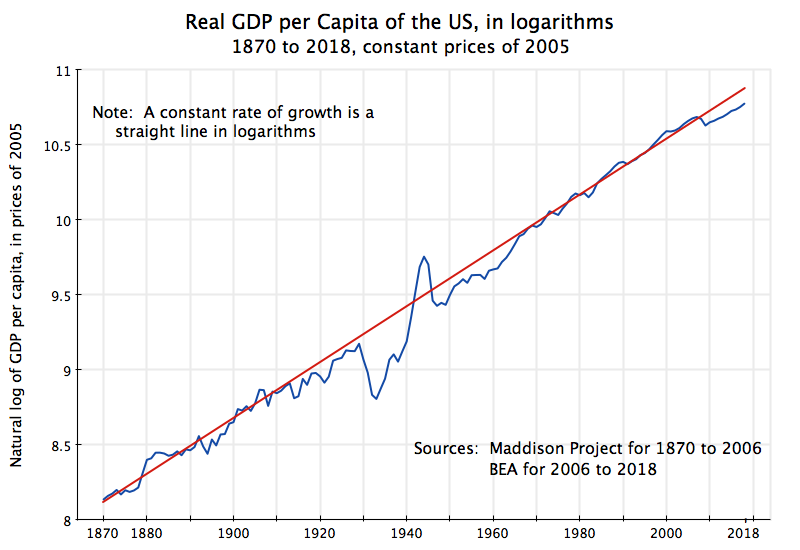
Such an increase in productivity is not outside the norm for the US.  Indeed, it matches what the US has experienced over at least the last century and a half.  The chart at the top of this post shows how GDP per capita has grown since 1870.  The chart is plotted in logarithms, and those of you who remember their high school math will recall that a straight line in such a graph depicts a constant rate of growth.  An earlier version of this chart was originally prepared for a prior post on this blog (where one can find further discussion of its implications), and it has been updated here to reflect GDP growth in recent years (using BEA data, with the earlier data taken from the Maddison Project).

What is remarkable is how steady that rate of growth in GDP per capita has been since 1870.  One straight line fits it extraordinarily well for the entire period, with a growth rate of 1.9% a year (or 1.86% to be more precise).  And while the US is now falling below that long-term trend (since around 2008, from the onset of the economic collapse in the last year of the Bush administration), the deviation of recent years is not that much different from an earlier such deviation between the late 1940s to the mid-1960s.  It remains to be seen whether there will be a similar catch-up to the long-term trend in the coming years.

One might reasonably argue that GDP per capita is not quite productivity, which would be GDP per employee.  Over very long periods of time population and the number of workers in that population will tend to grow at a similar pace, but we could also look at GDP per employee:

This chart is based on BEA data, the agency which issues the official GDP accounts for the US, for both real GDP and the number of employees (in full time equivalent terms, so part-time workers are counted in proportion to the number of hours they work).  The figures unfortunately only go back to 1929, the oldest year for which the BEA has issued estimates.  Note also that the rise in GDP during World War II looks relatively modest here, but that is because measures of “real” GDP (when carefully estimated using standard procedures) can deviate more and more as one goes back in time from the base year for prices (2012 here), coupled with major changes in the structure of production (such as during a major war).  But the BEA figures are the best available.

Once again one finds that the pace of productivity growth was remarkably stable over the period, with a growth rate here of 1.74% a year.  It was lower during the Great Depression years, but then recovered during World War II, and was then above the 1929 to 2018 trend from the early 1950s to 1980.  And the same straight line (meaning a constant growth rate) then fit extremely well from 1980 to 2010.

Since 2010 the growth in labor productivity has been more modest, averaging just 0.5% a year from 2010 to 2018.  An important question going forward is whether the path will return to the previous trend.  If it does, the implication is that there will be more job turnover for at least a temporary period.  If it does not, and productivity growth does not return to the path it has been on since 1929, the US as a whole will not be able to enjoy the growth in overall living standards the economy had made possible before.

The McKinsey numbers for what productivity growth might be going forward, of possibly 1.9% a year, are therefore not out of line with what the economy has actually experienced over the years.  It matches the pace as measured by GDP per capita, and while the 1.74% a year found for the last almost 90 years for the measure based on GDP per employee is a bit less, they are close.  And keep in mind that the McKinsey estimate (of 1.9% growth in productivity over 14 years) is of what might be possible, with a broad range of uncertainty over what will actually happen.

The estimate that “about” a quarter of jobs may be displaced by 2030 is therefore not out of line with what the US has experienced for perhaps a century and a half.  Such disruption is certainly still significant, and should be met with measures to assist workers to transition from jobs that have been automated away to the jobs then in need of more workers.  We have not, as a country, managed this very well in the past.  But the challenge is not new.

What will those new jobs be?  While there are needs that are clear to anyone now (as Bernie Sanders noted, which I will discuss below), most of the new jobs will likely be in fields that do not even exist right now.  A careful study by Daron Acemoglu (of MIT) and Pascual Restrepo (of Boston University), published in the American Economic Review in 2018, found that about 60% of the growth in net new jobs in the US between 1980 and 2015 (an increase of 52 million, from 90 million in 1980 to 142 million in 2015) were in occupations where the specific title of the job (as defined in surveys carried out by the Census Bureau) did not even exist in 1980.  And there was a similar share of those with new job titles over the shorter periods of 1990 to 2015 or 2000 to 2015.  There is no reason not to expect this to continue going forward.  Most new jobs are likely to be in positions that are not even defined at this point.

C.  What Would the Candidates Do?

I will not comment on all the answers provided by the candidates (some of which were indecipherable), but just a few.

Bernie Sanders provided perhaps the best response by saying there is much that needs to be done, requiring millions of workers, and if government were to proceed with the programs needed, there would be plenty of jobs.  He cited specifically the need to rebuild our infrastructure (which he rightly noted is collapsing, and where I would add is an embarrassment to anyone who has seen the infrastructure in other developed economies).  He said 15 million workers would be required for that.  He also cited the Green New Deal (requiring 20 million workers), as well as needs for childcare, for education, for medicine, and in other areas.

There certainly are such needs.  Whether we can organize and pay for such programs is of course critical and would need to be addressed.  But if they can be, there will certainly be millions of workers required.

Sanders was also asked by the moderator specifically about his federal jobs guarantee proposal (and indeed the jobs topic was introduced this way).  But such a policy proposal is more problematic, and separate from the issue of whether the economy will need so many workers.  It is not clear how such a jobs guarantee, provided by the federal government, would work.  The Sanders campaign website provides almost no detail.  But a number of questions need to be addressed.  To start, would such a program be viewed as a temporary backstop for a worker, to be used when he or she cannot find another reasonable job at a wage they would accept, or something permanent?  If permanent, one is really talking more of an expanded public sector, and that does not seem to be the intention of a jobs guarantee program.  But if a backstop, how would the wage be set?  If too high, no workers would want to leave and take a different job, and the program would not be a backstop.  And would all workers in such a program be paid the same, or different based on their skills?  Presumably one would pay an engineer working on the design of infrastructure projects more than someone with just a high school degree.  But how would these be determined?  Also, with a job guarantee, can someone be fired?  Suppose they often do not show up for work?

So there are a number of issues to address, and the answers are not clear.  But more fundamentally, if there is not a shortage of jobs but rather of workers (keep in mind that the unemployment rate is now at a 50 year low), why does one need such a guarantee?  It might be warranted (on a temporary basis) during an economic downturn, when unemployment is high, but why now, when unemployment is low?  [October 28 update:  The initial version of this post had an additional statement here saying that the federal government already had “something close to a job guarantee”, as you could always join the Army.  However, as a reader pointed out, while that once may have been true, it no longer is.  So that sentence has been deleted.]

Andrew Yang responded next, arguing for his proposal of a universal basic income that would provide every adult in the country with a grant of $1,000 per month, no questions asked.  There are many issues with such a proposal, which I will address in a subsequent blog post, but would note here that his basic argument for such a universal grant follows from his assertion that jobs will be scarce due to automation.  He repeatedly asserted in the debate that we have now entered into what has been referred to as the “Fourth Industrial Revolution”, where automation will take over most jobs and millions will be forced out of work.

But as noted above, what we have seen in the US over the last 150 years (at least) is not that much different from what is now forecast for the next few decades.  Automation will reduce the number of workers needed to produce some given amount, and productivity per worker will rise.  And while this will be disruptive and lead to a good deal of job displacement (important issues that certainly need to be addressed), the pace of this in the coming decades is not anticipated to be much different from what the country has seen over the last 150 years.

A universal basic income is fundamentally a program of redistribution, and given the high and growing degree of inequality in the US, a program of redistribution might well be warranted.  I will discuss this is a separate blog post.  But such a program is not needed to provide income to workers who will be losing jobs to automation, as there will be jobs if we follow the right macro policies.  And $12,000 a year would not nearly compensate for a lost job anyway.

Elizabeth Warren’s response to the jobs question was different.  She argued that jobs have been lost not due to automation, but due to poor international trade policies.  She said:  “the data show that we have had a lot of problems with losing jobs, but the principal reason has been bad trade policy.”

Actually, this is simply not true, and the data do not support it.  There have been careful studies of the issue, but it is easy enough to see in the numbers.  For example, in an earlier post on this blog from 2016, I examined what the impact would have been on the motor vehicle sector if the US had moved to zero net imports in the sector (i.e. limiting car imports to what the US exports, which is not very much).  Employment in the sector would then have been flat, rather than decline by 17%, between the years 1967 and 2014.  But this impact would have been dwarfed by the impact of productivity gains.  The output of the motor vehicle (in real terms) was 4.5 times higher in 2014 than what it was in 1967.  If productivity had not grown, they would then have required 4.5 times as many workers.  But productivity did grow – by 5.4 times.  Hence the number of workers needed to produce the higher output actually went down by the 17% observed.  Banning imports would have had almost no effect relative to this.

D.  Summary and Conclusion

Automation is important, but is nothing new.  The Luddites destroyed factory machinery in the early 1800s in England due to a belief that the machines were taking away their jobs and that they would then be left with no prospects.  And data for the US that goes back to at least 1870 shows such job “destroying” processes have long been underway.  They have not accelerated now.  Indeed, over the past decade the pace has slowed (i.e. less job “destruction”).  But it is too soon to tell whether this deceleration is similar to fluctuations seen in the past, where there were occasional deviations but then always a return to the long-term path.

Looking forward, careful studies such as those carried out by McKinsey have estimated how many jobs may be exposed to automation (using technologies that we know already to be technically feasible).  While they emphasize that any such forecasts are subject to a great deal of uncertainty, McKinsey’s midpoint scenario estimates that perhaps 23% of jobs may be substituted away by automation between 2016 and 2030.  If so, such a pace (of 1.9% a year) would be similar to what productivity growth has been historically in the US.  There is nothing new here.

But while nothing new, that does not mean it should be ignored.  It will lead, just as it has in the past, to job displacement and disruption.  There is plenty of scope for government to assist workers in finding appropriate new jobs, and in obtaining training for them, but the US has historically never done this all that well.  Countries such as Germany have been far better at addressing such needs.

The candidate responses did not, however, address this (other than Andrew Yang saying government supported training programs in the US have not been effective).  While Bernie Sanders correctly noted there is no shortage of needs for which workers will be required, he has also proposed a jobs guarantee to be provided by the federal government.  Such a guarantee would be more problematic, with many questions not yet answered.  But it is also not clear why it would be needed in current circumstances anyway (with an economy at full employment).

Andrew Yang argued the opposite:  That the economy is facing a structural problem that will lead to mass unemployment due to automation, with a Fourth Industrial Revolution now underway that is unprecedented in US history.  But the figures show this not to be the case, with forecast prospects similar to what the US has faced in the past.  Thus the basis for his argument that we now need to do something fundamentally different (a universal basic income of $1,000 a month for every adult) falls away.  And I will address the $1,000 a month itself in a separate blog post.

Finally, Elizabeth Warren asserted that the problem stems primarily from poor international trade policy.  If we just had better trade policy, she said, there would be no jobs problem.  But this is also not borne out by the data.  Increased imports, even in the motor vehicle sector (which has long been viewed as one of the most exposed sectors to international trade), explains only a small fraction of why there are fewer workers needed in that sector now than was the case 50 years ago.  By far the more important reason is that workers in the sector are now far more productive.

The Increasingly Attractive Economics of Solar Power: Solar Prices Have Plunged

A.  Introduction

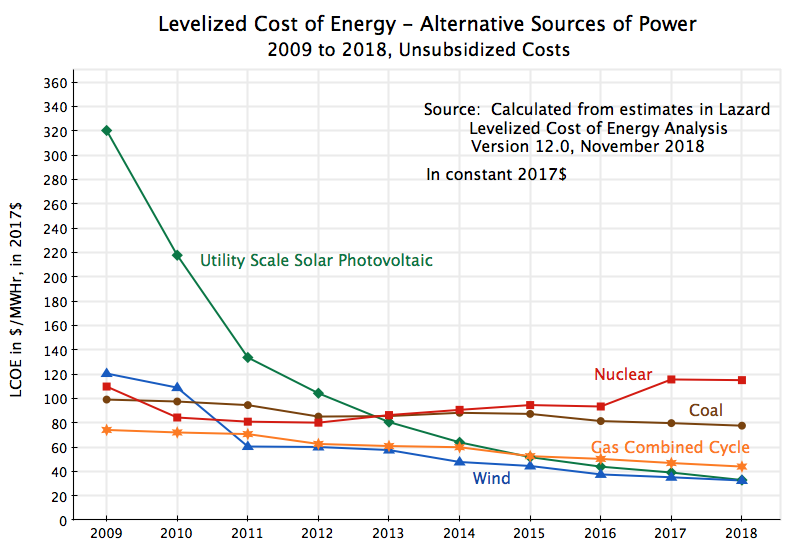
The cost of solar photovoltaic power has fallen dramatically over the past decade, and it is now, together with wind, a lower cost source of new power generation than either fossil-fuel (coal or gas) or nuclear power plants.  The power generated by a new natural gas-fueled power plant in 2018 would have cost a third more than from a solar or wind plant (in terms of the price they would need to sell the power for in order to break even); coal would have cost 2.4 times as much as solar or wind; and a nuclear plant would have cost 3.5 times as much.

These estimates (shown in the chart above, and discussed in more detail below) were derived from figures estimated by Lazard, the investment bank, and are based on bottom-up estimates of what such facilities would have cost to build and operate, including the fuel costs.  But one also finds a similar sharp fall in solar energy prices in the actual market prices that have been charged for the sale of power from such plants under long-term “power purchase agreements” (PPAs).  These will also be discussed below.

With the costs where they are now, it would not make economic sense to build new coal or nuclear generation capacity, nor even gas in most cases.  In practice, however, the situation is more complex due to regulatory issues and conflicting taxes and subsidies, and also because of variation across regions.  Time of day issues may also enter, depending on when (day or night) the increment in new capacity might be needed.  The figures above are also averages, particular cases vary, and what is most economic in any specific locale will depend on local conditions.  Nevertheless, and as we will examine below, there has been a major shift in new generation capacity towards solar and wind, and away from coal (with old coal plants being retired) and from nuclear (with no new plants being built, but old ones largely remaining).

But natural gas generation remains large.  Indeed, while solar and wind generation have grown quickly (from a low base), and together account for the largest increment in new power capacity in recent years, gas accounts for the largest increment in power production (in megawatt-hours) measured from the beginning of this decade.  Why?  In part this is due to the inherent constraints of solar and wind technologies:  Solar panels can only generate power when the sun shines, and wind turbines when the wind is blowing.  But more interestingly, one also needs to look at the economics behind the choice as to whether or not to build new generation capacity to replace existing capacity, and then what sources of capacity to use.  Critical is what economists call the marginal cost of such production.  A power plant lasts for many years once it is built, and the decision on whether to keep an existing plant in operation for another year depends only on the cost of operating and maintaining the plant.  The capital cost has already been spent and is no longer relevant to that decision.

Details in the Lazard report can be used to derive such marginal cost estimates by power source, and we will examine these below.  While the Lazard figures apply to newly built plants (older plants will generally have higher operational and maintenance costs, both because they are getting old and because technology was less efficient when they were built), the estimates based on new plants can still give us a sense of these costs.  But one should recognize they will be biased towards indicating the costs of the older plants are lower than they in fact are.  However, even these numbers (biased in underestimating the costs of older plants) imply that it is now more economical to build new wind and possibly solar plants, in suitable locales, than it costs to continue to keep open and operate coal-burning power plants.  This will be especially true for the older, less-efficient, coal-burning plants.  Thus we should be seeing old coal-burning plants being shut down.  And indeed we do.  Moreover, while the costs of building new wind and solar plants are not yet below the marginal costs of keeping open existing gas-fueled and nuclear power plants, they are on the cusp of being so.

These costs also do not reflect any special subsidies that solar and wind plants might benefit from.  These vary by state.  Fossil-fueled and nuclear power plants also enjoy subsidies (often through special tax advantages), but these are long-standing and are implicitly being included in the Lazard estimates of the costs of such traditional plants.

But one special subsidy enjoyed by fossil fuel burning power plants, not reflected in the Lazard cost estimates, is the implicit subsidy granted to such plants from not having to cover the cost of the damage from the pollution they generate.  Those costs are instead borne by the general public.  And while such plants pollute in many different ways (especially the coal-burning ones), I will focus here on just one of those ways – their emissions of greenhouse gases that are leading to a warming planet and consequent more frequent and more damaging extreme weather events.  Solar and wind generation of power do not cause such pollution – the burning of coal and gas do.

To account for such costs and to ensure a level playing field between power sources, a fee would need to be charged to reflect the costs being imposed on the general population from this (and indeed other) such pollution.  The revenues generated could be distributed back to the public in equal per capita terms, as discussed in an earlier post on this blog.  We will see that a fee of even just $20 per ton of CO2 emitted would suffice to make it economic to build new solar and wind power plants to substitute not just for new gas and coal burning plants, but for existing ones as well.  Gas and especially coal burning plants would not be competitive with installing new solar or wind generation if they had to pay for the damage done as a result of their greenhouse gas pollution, even on just marginal operating costs.

Two notes before starting:  First, many will note that while solar might be fine for the daytime, it will not be available at night.  Similarly, wind generation will be fine when the wind blows, but it may not always blow even in the windiest locales.  This is of course true, and should solar and wind capacity grow to dominate power generation, there will have to be ways to store that power to bridge the times from when the generation occurs to when the power is used.

But while storage might one day be an issue, it is mostly not an issue now.  In 2018, utility-scale solar only accounted for 1.6% of power generation in the US (and 2.3% if one includes small scale roof-top systems), while wind only accounted for 6.6%.  At such low shares, solar and wind power can simply substitute for other, higher cost, sources of power (such as from coal) during the periods the clean sources are available.  Note also that the cost figures for solar and wind reflected in the chart at the top of this post (and discussed in detail below) take into account that solar and wind cannot be used 100% of the time.  Rather, utilization is assumed to be similar to what their recent actual utilization has been, not only for solar and wind but also for gas, coal and nuclear.  Solar and wind are cheaper than other sources of power (over the lifetime of these investments) despite their inherent constraints on possible utilization.

But where the storage question can enter is in cases where new generation capacity is required specifically to serve evening or night-time needs.  New gas burning plants might then be needed to serve such time-of-day needs if storage of day-time solar is not an economic option.  And once such gas-burning plants are built, the decision on whether they should be run also to serve day-time needs will depend on a comparison of the marginal cost of running these gas plants also during the day, to the full cost of building new solar generation capacity, as was discussed briefly above and will be considered in more detail below.

This may explain, in part, why we see new gas-burning plants still being built nationally.  While less than new solar and wind plants combined (in terms of generation capacity), such new gas-burning plants are still being built despite their higher cost.

More broadly, California and Hawaii (both with solar now accounting for over 12% of power used in those states) are two states (and the only two states) which may be approaching the natural limits of solar generation in the absence of major storage.  During some sunny days the cost of power is being driven down to close to zero (and indeed to negative levels on a few days).  Major storage will be needed in those states (and only those states) to make it possible to extend solar generation much further than where it is now.  But this should not be seen so much as a “problem” but rather as an opportunity:  What can we do to take advantage of cheap day-time power to make it available at all hours of the day?  I hope to address that issue in a future blog post.  But in this blog post I will focus on the economics of solar generation (and to a lesser extent from wind), in the absence of significant storage.

Second, on nomenclature:  A megawatt-hour is a million watts of electric power being produced or used for one hour.  One will see it abbreviated in many different ways, including MWHr, MWhr, MWHR, MWH, MWh, and probably more.  I will try to use consistently MWHr.  A kilowatt-hour (often kWh) is a thousand watts of power for one hour, and is the typical unit used for homes.  A megawatt-hour will thus be one thousand times a kilowatt-hour, so a price of, for example, $20 per MWHr for solar-generated power (which we will see below has in fact been offered in several recent PPA contracts) will be equivalent to 2.0 cents per kWh.  This will be the wholesale price of such power.  The retail price in the US for households is typically around 10 to 12 cents per kWh.

B.  The Levelized Cost of Energy 

As seen in the chart at the top of this post, the cost of generating power by way of new utility-scale solar photovoltaic panels has fallen dramatically over the past decade, with a cost now similar to that from new on-shore wind turbines, and well below the cost from building new gas, coal, or nuclear power plants.  These costs can be compared in terms of the “levelized cost of energy” (LCOE), which is an estimate of the price that would need to be charged for power from such a plant over its lifetime, sufficient to cover the initial capital cost (at the anticipated utilization rate), plus the cost of operating and maintaining the plant,

Lazard, the investment bank, has published estimates of such LCOEs annually for some time now.  The most recent report, issued in November 2018, is version 12.0.  Lazard approaches the issue as an investment bank would, examining the cost of producing power by each of the alternative sources, with consistent assumptions on financing (with a debt/equity ratio of 60/40, an assumed cost of debt of 8%, and a cost of equity of 12%) and a time horizon of 20 years.  They also include the impact of taxes, and show separately the impact of special federal tax subsidies for clean energy sources.  But the figures I will refer to throughout this post (including in the chart above) are always the estimates excluding any impact from special subsidies for clean energy.  The aim is to see what the underlying actual costs are, and how they have changed over time.

The Lazard LCOE estimates are calculated and presented in nominal terms.  They show the price, in $/MWHr, that would need to be charged over a 20-year time horizon for such a project to break even.  For comparability over time, as well as to produce estimates that can be compared directly to the PPA contract prices that I will discuss below, I have converted those prices from nominal to real terms in constant 2017 dollars.  Two steps are involved.  First, the fixed nominal LCOE prices over 20 years will be falling over time in real terms due to general inflation.  They were adjusted to the prices of their respective initial year (i.e. the relevant year from 2009 to 2018) using an inflation rate of 2.25% (which is the rate used for the PPA figures discussed below, the rate the EIA assumed in its 2018 Annual Energy Outlook report, and the rate which appears also to be what Lazard assumed for general cost escalation factors).  Second, those prices for the years between 2009 and 2018 were all then converted to constant 2017 prices based on actual inflation between those years and 2017.

The result is the chart shown at the top of this post.  The LCOEs in 2018 (in 2017$) were $33 per MWHr for a newly built utility-scale solar photovoltaic system and also for an on-shore wind installation, $44 per MWHr for a new natural gas combined cycle plant, $78 for a new coal-burning plant, and $115 for a new nuclear power plant.  The natural gas plant would cost one-third more than a solar or wind plant, coal would cost 2.4 times as much, and a nuclear plant 3.5 times as much.  Note also that since the adjustments for inflation are the same for each of the power generation methods, their costs relative to each other (in ratio terms) are the same for the LCOEs expressed in nominal cost terms.  And it is their costs relative to each other which most matters.

The solar prices have fallen especially dramatically.  The 2018 LCOE was only one-tenth of what it was in 2009.  The cost of wind generation has also fallen sharply over the period, to about one-quarter in 2018 of what it was in 2009.  The cost from gas combined cycle plants (the most efficient gas technology, and is now widely used) also fell, but only by about 40%, while the cost of coal or nuclear were roughly flat or rising, depending on precisely what time period is used.

There is good reason to believe the cost of solar technology will continue to decline.  It is still a relatively new technology, and work in labs around the world are developing solar technologies that are both more efficient and less costly to manufacture and install.

Current solar installations (based on crystalline silicon technology) will typically have conversion efficiencies of 15 to 17%.  And panels with efficiencies of up to 22% are now available in the market – a gain already on the order of 30 to 45% over the 15 to 17% efficiency of current systems.  But a chart of how solar efficiencies have improved over time (in laboratory settings) shows there is good reason to believe that the efficiencies of commercially available systems will continue to improve in the years to come.  While there are theoretical upper limits, labs have developed solar cell technologies with efficiencies as high as 46% (as of January 2019).

Particularly exciting in recent years has been the development of what are called “perovskite” solar technologies.  While their current efficiencies (of up to 28%, for a tandem cell) are just modestly better than purely crystalline silicon solar cells, they have achieved this in work spanning only half a decade.  Crystalline silicon cells only saw such an improvement in efficiencies in research that spanned more than four decades.  And perhaps more importantly, perovskite cells are much simpler to manufacture, and hence much cheaper.

Based on such technologies, one could see solar efficiencies doubling within a few years, from the current 15 to 17% to say 30 to 35%.  And with a doubling in efficiency, one will need only half as many solar panels to produce the same megawatts of power, and thus also only half as many frames to hold the panels, half as much wiring to link them together, and half as much land.  Coupled with simplified and hence cheaper manufacturing processes (such as is possible for perovskite cells), there is every reason to believe prices will continue to fall.

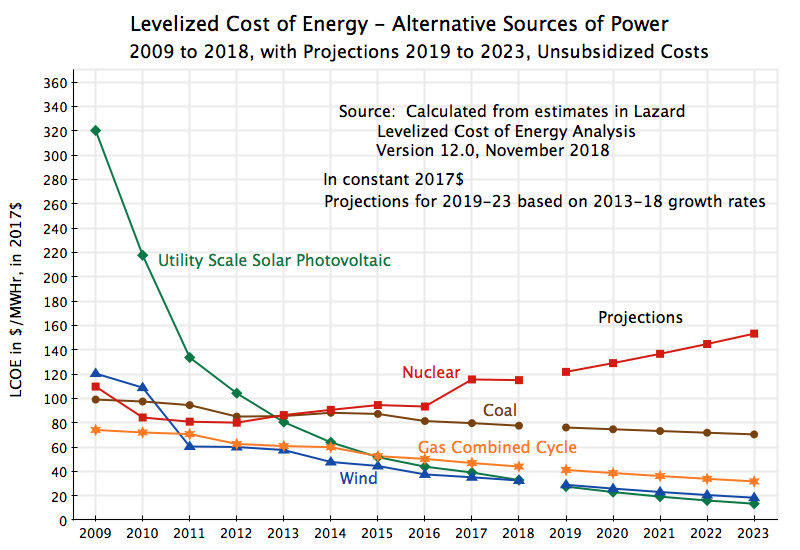
While there can be no certainty in precisely how this will develop, a simple extrapolation of recent cost trends can give an indication of what might come.  Assuming costs continue to change at the same annual rate that they had over the most recent five years (2013 to 2018), one would find for the years up to 2023:

If these trends hold, then the LCOE (in 2017$) of solar power will have fallen to $13 per MWHr by 2023, wind will have fallen to $18, and gas will be at $32 (or 2.5 times the LCOE of solar in that year, and 80% above the LCOE of wind).  And coal (at $70) and nuclear (at $153) will be totally uncompetitive.

This is an important transition.  With the dramatic declines in the past decade in the costs for solar power plants, and to a lesser extent wind, these clean sources of power are now more cost competitive than traditional, polluting, sources.  And this is all without any special subsidies for the clean energy.  But before looking at the implications of this for power generation, as a reality check it is good first to examine whether the declining costs of solar power have been reflected in actual market prices for such power.  We will see that they have.

C.  The Market Prices for Solar Generated Power

Power Purchase Agreements (PPAs) are long-term contracts where a power generator (typically an independent power producer) agrees to supply electric power at some contracted capacity and at some price to a purchaser (typically a power utility or electric grid operator).  These are competitively determined (different parties interested in building new power plants will bid for such contracts, with the lowest price winning) and are a direct market measure of the cost of energy from such a source.

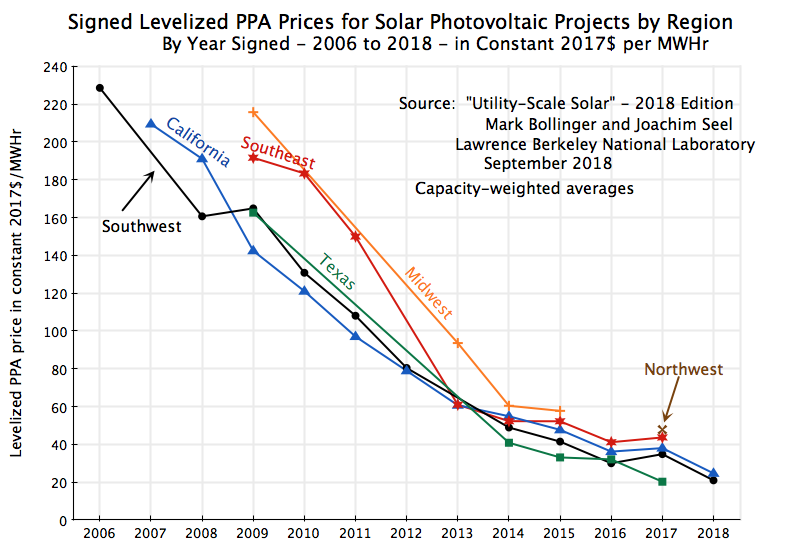
The Lawrence Berkeley National Lab, under a contract with the US Department of Energy, produces an annual report that reviews and summarizes PPA contracts for recent utility-scale solar power projects, including the agreed prices for the power.  The most recent was published in September 2018, and covers 2018 (partially) and before.  While the report covers both solar photovoltaic and concentrating solar thermal projects, the figures of interest to us here (and comparable to the Lazard LCOEs discussed above) are the PPAs for the solar photovoltaic projects.

The PPA prices provided in the report were all calculated by the authors on a levelized basis and in terms of 2017 prices.  This was done to put them all on a comparable basis to each other, as the contractual terms of the specific contracts could differ (e.g. some had price escalation clauses and some did not).  Averages by year were worked out with the different projects weighted by generation capacity.

The PPA prices are presented by the year the contracts were signed.  If one then plots these PPA prices with a one year lag and compare them to the Lazard estimated LCOE prices of that year, one finds a remarkable degree of overlap:

This high degree of overlap is extraordinary.  Only the average PPA price for 2010 (reflecting the 2009 average price lagged one year) is off, but would have been close with a one and a half year lag rather than a one year lag.  Note also that while the Lawrence Berkeley report has PPA prices going back to 2006, the figures for the first several years are based on extremely small samples (just one project in 2006, one in 2007, and three in 2008, before rising to 16 in 2009 and 30 in 2010).  For that reason I have not plotted the 2006 to 2008 PPA prices (which would have been 2007 to 2009 if lagged one year), but they also would have been below the Lazard LCOE curve.

What might be behind this extraordinary overlap when the PPA prices are lagged one year?  Two possible explanations present themselves.  One is that the power producers when making their PPA bids realize that there will be a lag from when the bids are prepared to when the winning bidder is announced and construction of the project begins.  With the costs of solar generation falling so quickly, it is possible that the PPA bids reflect what they know will be a lag between when the bid is prepared and when the project has to be built (with solar panels purchased and other costs incurred).  If that lag is one year, one will see overlap such as that found for the two curves.

Another possible explanation for the one-year shift observed between the PPA prices (by date of contract signing) and the Lazard LCOE figures is that the Lazard estimates labeled for some year (2018 for example) might in fact represent data on the cost of the technologies as of the prior year (2017 in this example).  One cannot be sure from what they report.  Or the remarkable degree of overlap might be a result of some combination of these two possible explanations, or something else.

But for whatever reason, the two estimates move almost exactly in parallel over time, and hence show an almost identical rate of decline for both the cost of generating power from solar photovoltaic sources and in the market PPA prices for such power.  And it is that rapid rate of decline which is important.

It is also worth noting that the “bump up” in the average PPA price curve in 2017 (shown in the chart as 2018 with the one year lag) reflects in part that a significant number of the projects in the 2017 sample of PPAs included, as part of the contract, a power storage component to store a portion of the solar-generated power for use in the evening or night.  But these additional costs for storage were remarkably modest, and were even less in several projects in the partial-year 2018 sample.  Specifically, Nevada Energy (as the offtaker) announced in June 2018 that it had contracted for three major solar projects that would include storage of power of up to one-quarter of generation capacity for four hours, with overall PPA prices (levelized, in 2017 prices) for both the generation and the storage of just $22.8, $23.5, and $26.4 per MWHr (i.e. 2.28 cents, 2.35 cents, and 2.64 cents per kWh, respectively).

The PPA prices reported can also be used to examine how the prices vary by region.  One should expect solar power to be cheaper in southern latitudes than in northern ones, and in dry, sunny, desert areas than in regions with more extensive cloud cover.  And this has led to the criticism by skeptics that solar power can only be competitive in places such as the US Southwest.

But this is less of an issue than one might assume.  Dividing up the PPA contracts by region (with no one-year lag in this chart), one finds:

Prices found in the PPAs are indeed lower in the Southwest, California, and Texas.  But the PPA prices for projects in the Southeast, the Midwest, and the Northwest fell at a similar pace as those in the more advantageous regions (and indeed, at a more rapid pace up to 2014).  And note that the prices in those less advantageous regions are similar to what they were in the more advantageous regions just a year or two before.  Finally, the absolute differences in prices have become relatively modest in the last few years.

The observed market prices for power generated by solar photovoltaic systems therefore appear to be consistent with the bottom-up LCOE estimates of Lazard – indeed remarkably so.  Both show a sharp fall in solar energy prices/costs over the last decade, and sharp falls both for the US as a whole and by region.  The next question is whether we see this reflected in investment in additions to new power generation capacity, and in the power generated by that capacity.

D.  Additions to Power Generation Capacity, and in Power Generation

The cost of power from a new solar or wind plant is now below the cost from gas (while the cost of new coal or nuclear generation capacity is totally uncompetitive).  But the LCOEs indicate that the cost advantage relative to gas is relatively recent in the case of solar (starting from 2016), and while a bit longer for wind, the significant gap in favor of wind only opened up in 2014.  One needs also to recognize that these are average or mid-point estimates of costs, and that in specific cases the relative costs will vary depending on local conditions.  Thus while solar or wind power is now cheaper on average across the US, in some particular locale a gas plant might be less expensive (especially if the costs resulting from its pollution are not charged).  Finally, and as discussed above, there may be time-of-day issues that the new capacity may be needed for, with this affecting the choices made.

Thus while one should expect a shift towards solar and wind over the last several years, and away from traditional fuels, the shift will not be absolute and immediate.  What do we see?

First, in terms of the gross additions to power sector generating capacity:

The chart shows the gross additions to power capacity, in megawatts, with both historical figures (up through 2018) and as reflected in plans filed with the US Department of Energy (for 2019 and 2020, with the plans as filed as of end-2018).  The data for this (and the other charts in this section) come from the most recent release of the Electric Power Annual of the Energy Information Agency (EIA) (which was for 2017, and was released on October 22, 2018), plus from the Electric Power Monthly of February, 2019, also from the Energy Information Agency (where the February issue each year provides complete data for the prior calendar year, i.e. for 2018 in this case).

The planned additions to capacity (2019 and 2020 in the chart) provide an indication of what might happen over the next few years, but must be interpreted cautiously.  While probably pretty good for the next few years, biases will start to enter as one goes further into the future.  Power producers are required to file their plans for new capacity (as well as for retirements of existing capacity) with the Department of Energy, for transparency and to help ensure capacity (locally as well as nationally) remains adequate.  But these reported plans should be approached cautiously.  There is a bias as projects that require a relatively long lead time (such as gas plants, as well as coal and especially nuclear) will be filed years ahead, while the more flexible, shorter construction periods, required for solar and wind plants means that these plans will only be filed with the Department of Energy close to when that capacity will be built.  But for the next few years, the plans should provide an indication of how the market is developing.

As seen in the chart, solar and wind taken together accounted for the largest single share of gross additions to capacity, at least through 2017.  While there was then a bump up in new gas generation capacity in 2018, this is expected to fall back to earlier levels in 2019 and 2020.  And these three sources (solar, wind, and gas) accounted for almost all (93%) of the gross additions to new capacity over 2012 to 2018, with this expected to continue.

New coal-burning plants, in contrast, were already low and falling in 2012 and 2013, and there have been no new ones since then.  Nor are any planned.  This is as one would expect based on the LCOE estimates discussed above – new coal plants are simply not cost competitive.  And the additions to nuclear and other capacity have also been low.  “Other” capacity is a miscellaneous category that includes hydro, petroleum-fueled plants such as diesel, as well as other renewables such as from the burning of waste or biomass. The one bump up, in 2016, is due to a nuclear power plant coming on-line that year.  It was unit #2 of the Watts Bar nuclear power plant built by the Tennessee Valley Authority (TVA), and had been under construction for decades.  Indeed the most recent nuclear plant completed in the US before this one was unit #1 at the same TVA plant, which came on-line 20 years before in 1996.  Even aside from any nuclear safety concerns, nuclear plants are simply not economically competitive with other sources of power.

The above are gross additions to power generating capacity, reflecting what new plants are being built.  But old, economically or technologically obsolete, plants are also being retired, so what matters to the overall shift in power generation capacity is what has happened to net generation capacity:

What stands out here is the retirement of coal-burning plants.  And while the retirements might appear to diminish in the plans going forward, this may largely be due to retirement plans only being announced shortly before they happen.  It is also possible that political pressure from the Trump administration to keep coal-burning plants open, despite their higher costs (and their much higher pollution), might be a factor.  We will see what happens.

The cumulative impact of these net additions to capacity (relative to 2010 as the base year) yields:

Solar plus wind accounts for the largest addition to capacity, followed by gas.  Indeed, each of these accounts for more than 100% of the growth in overall capacity, as there has been a net reduction in the nuclear plus other category, and especially in coal.

But what does this mean in terms of the change in the mix of electric power generation capacity in the US?  Actually, less than one might have thought, as one can see in a chart of the shares:

The share of coal has come down, but remains high, and similarly for nuclear (plus miscellaneous other) capacity.  Gas remains the highest and has risen as a share, while solar and wind, while rising at a rapid pace relative to where it was to start, remains the smallest shares (of the categories used here).

The reason for these relatively modest changes in shares is that while solar and wind plus gas account for more than 100% of the net additions to capacity, that net addition has been pretty small.  Between 2010 and 2018, the net addition to US electric power generation capacity was just 58.8 thousand megawatts, or an increase over eight years of just 5.7% over what capacity was in 2010 (1,039.1 thousand megawatts).  A big share of something small will still be small.

So even though solar and wind are now the lowest cost sources of new power generation, the very modest increase in the total power capacity needed has meant that not that much has been built.  And much of what has been built has been in replacement of nuclear and especially coal capacity.  As we will discuss below, the economic issue then is not whether solar and wind are the cheapest source of new capacity (which they are), but whether new solar and wind are more economic than what it costs to continue to operate existing coal and nuclear plants.  That is a different question, and we will see that while new solar and wind are now starting to be a lower cost option than continuing to operate older coal (but not nuclear) plants, this development (a critically important development) has only been recent.

Why did the US require such a small increase in power generation capacity in recent years?  As seen in the chart below, it is not because GDP has not grown, but rather because energy efficiency (real GDP per MWHr of power) improved tremendously, at least until 2017:

From 2010 to 2017, real GDP rose by 15.7% (2.1% a year on average), but GDP per MWHr of power generated rose by 18.3%.  That meant that power generation (note that generation is the relevant issue here, not capacity) could fall by 2.2% despite the higher level of GDP.  Improving energy efficiency was a key priority during the Obama years, and it appears to have worked well.  It is better for efficiency to rise than to have to produce more power, even if that power comes from a clean source such as solar or wind.

This reversed direction in 2018.  It is not clear why, but might be an early indication that the policies of the Trump administration are harming efficiency in our economy.  However, this is still just one year of data, and one will need to wait to see whether this was an aberration or a start of a new, and worrisome, trend.

Which brings us to generation.  While the investment decision is whether or not to add capacity, and if so then of what form (e.g. solar or gas or whatever), what is ultimately needed is the power generated.  This depends on the capacity available and then on the decision of how much of that capacity to use to generate the power needed at any given moment.  One needs to keep in mind that power in general is not stored (other than still very limited storage of solar and wind power), but rather has to be generated at the moment needed.  And since power demand goes up and down over the course of the day (higher during the daylight hours and lower at night), as well as over the course of the year (generally higher during the summer, due to air conditioning, and lower in other seasons), one needs total generation capacity sufficient to meet whatever the peak load might be.  This means that during all other times there will be excess, unutilized, capacity.  Indeed, since one will want to have a safety margin, one will want to have total power generation capacity of even more than whatever the anticipated peak load might be in any locale.

There will always, then, be excess capacity, just sometimes more and sometimes less.  And hence decisions will be necessary as to what of the available capacity to use at any given moment.  While complex, the ultimate driver of this will be (or at least should be, in a rational system) the short-run costs of producing power from the possible alternative sources available in the region where the power is needed.  These costs will be examined in the next section below.  But for here, we will look at how generation has changed over the last several years.

In terms of the change in power generation by source relative to the levels in 2010, one finds:

Gas now accounts for the largest increment in generation over this period, with solar and wind also growing (steadily) but by significantly less.  Coal powered generation, in contrast, fell substantially, while nuclear and other sources were basically flat.  And as noted above, due to increased efficiency in the use of power (until 2017), total power use was flat to falling a bit, even as GDP grew substantially.  This reversed in 2018  when efficiency fell, and gas generated power rose to provide for the resulting increased power demands.  Solar and wind continued on the same path as before, and coal generation still fell at a similar pace as before.  But it remains to be seen whether 2018 marked a change in the previous trend in efficiency gains, or was an aberration.

Why did power generation from gas rise by more than from solar and wind over the period, despite the larger increase in solar plus wind capacity than in gas generation capacity?  In part this reflects the cost factors which we will discuss in the next section below.  But in part one needs also to recognize factors inherent in the technologies.  Solar generation can only happen during the day (and also when there is no cloud cover), while wind generation depends on when the wind blows.  Without major power storage, this will limit how much solar and wind can be used.

The extent to which some source of power is in fact used over some period (say a year), as a share of what would be generated if the power plant operated at 100% of capacity for 24 hours a day, 365 days a year, is defined as the “capacity factor”.  In 2018, the capacity factor realized for solar photovoltaic systems was 26.1% while for wind it was 37.4%.  But for no power source is it 100%.  For natural gas combined cycle plants (the primary source of gas generation), the capacity factor was 57.6% in 2018 (up from 51.3% in 2017, due to the jump in power demand in 2018).  This is well below the theoretical maximum of 100% as in general one will be operating at less than peak capacity (plus plants need to be shut down periodically for maintenance and other servicing).

Thus increments in “capacity”, as measured, will therefore not tell the whole story.  How much such capacity is used also matters.  And the capacity factors for solar and wind will in general be less than what they will be for the other primary sources of power generation, such as gas, coal, and nuclear (and excluding the special case of plants designed solely to operate for short periods of peak load times, or plants used as back-ups or for cases of emergencies).  But how much less depends only partly on the natural constraints on the clean technologies.  It also depends on marginal operating costs, as we will discuss below.

Finally, while gas plus solar and wind have grown in terms of power generation since 2010, and coal has declined (and nuclear and other sources largely unchanged), coal-fired generation remains important.  In terms of the percentage shares of overall power generation:

While coal has fallen as a share, from about 45% of US power generation in 2010 to 27% in 2018, it remains high.  Only gas is significantly higher (at 35% in 2010).  Nuclear and other sources (such as hydro) accounts for 29%, with nuclear alone accounting for two-thirds of this and other sources the remaining one-third.  Solar and wind have grown steadily, and at a rapid rate relative to where they were in 2010, but in 2018 still accounted only for about 8% of US power generation.

Thus while coal has come down, there is still very substantial room for further substitution out of coal, by either solar and wind or by natural gas.  The cost factors that will enter into this decision on substituting out of coal will be discussed next.

E.  The Cost Factors That Enter in the Decisions on What Plants to Build, What Plants to Keep in Operation, and What Plants to Use

The Lazard analysis of costs presents estimates not only for the LCOE of newly built power generation plants, but also figures that can be used to arrive at the costs of operating a plant to produce power on any given day, and of operating a plant plus keeping it maintained for a year.  One needs to know these different costs in order to address different questions.  The LCOE is used to decide whether to build a new plant and keep it in operation for a period (20 years is used); the operating cost is used to decide which particular power plant to run at any given time to generate the power then needed (from among all the plants up and available to run that day); while the operating cost plus the cost of regular annual maintenance is used in the decision of whether to keep a particular plant open for another year.

The Lazard figures are not ideal for this, as they give cost figures for a newly built plant, using the technology and efficiencies available today.  The cost to maintain and operate an older plant will be higher than this, both because older technologies were less efficient but also simply because they are older and hence more liable to break down (and hence cost more to keep running) than a new plant.  But the estimates for a new plant do give us a sense of what the floor for such costs might be – the true costs for currently existing plants of various ages will be somewhat higher.

Lazard also recognized that there will be a range of such costs for a particular type of plant, depending on the specifics of the particular location and other such factors.  Their report therefore provides both what it labels low end and high end estimates, and with a mid-point estimate then based usually on the average between the two.  The figures shown in the chart at the top of this post are the mid-point estimates, but in the tables below we will show the low and high end cost estimates as well.  These figures are helpful in providing a sense of the range in the costs one should expect, although how Lazard defined the range they used is not fully clear.  They are not of the absolutely lowest possible cost plant nor absolutely highest possible cost plant.  Rather, the low end figures appear to be averages of the costs of some share of the lowest cost plants (possibly the lowest one third), and similarly for the high end figures.

The cost figures below are from the 2018 Lazard cost estimates (the most recent year available).  The operating and maintenance costs are by their nature current expenditures, and hence their costs will be in current, i.e. 2018, prices.  The LCOE estimates of Lazard are different.  As was noted above, these are the levelized prices that would need to be charged for the power generated to cover the costs of building and then operating and maintaining the plant over its assumed (20 year) lifetime.  They therefore need to be adjusted to reflect current prices.  For the chart at the top of this post, they were put in terms of 2017 prices (to make them consistent with the PPA prices presented in the Berkeley report discussed above).  But for the purposes here, we will put them in 2018 prices to ensure consistency with the prices for the operating and maintenance costs.  The difference is small (just 2.2%).

The cost estimates derived from the Lazard figures are then:

(all costs in 2018 prices)

A.  Levelized Cost of Energy from a New Power Plant:  $/MWHr

Solar

Wind

Gas

Coal

Nuclear

low end

$31.23

$22.65

$32.02

$46.85

$87.46

mid-point

$33.58

$33.19

$44.90

$79.26

$117.52

high end

$35.92

$43.73

$57.78

$111.66

$147.58

B.  Cost to Maintain and Operate a Plant Each year, including for Fuel:  $/MWHr

Solar

Wind

Gas

Coal

Nuclear

low end

$4.00

$9.24

$24.38

$23.19

$23.87

mid-point

$4.66

$10.64

$26.51

$31.30

$25.11

high end

$5.33

$12.04

$28.64

$39.41

$26.35

C.  Short-term Variable Cost to Operate a Plant, including for Fuel:  $/MWHr

Solar

Wind

Gas

Coal

Nuclear

low end

$0.00

$0.00

$23.16

$14.69

$9.63

mid-point

$0.00

$0.00

$25.23

$18.54

$9.63

high end

$0.00

$0.00

$27.31

$22.40

$9.63

A number of points follow from these cost estimates:

a)  First, and as was discussed above, the LCOE estimates indicate that for the question of what new type of power plant to build, it will in general be cheapest to obtain new power from a solar or wind plant.  The mid-point LCOE estimates for solar and wind are well below the costs of power from gas plants, and especially below the costs from coal or nuclear plants.

But also as noted before, local conditions vary and there will in fact be a range of costs for different types of plants.  The Lazard estimates indicate that a gas plant with costs at the low end of a reasonable range (estimated to be about $32 per MWHr) would be competitive with solar or wind plants at the mid-point of their cost range (about $33 to $34 per MWHr), and below the costs of a solar plant at the high end of its cost range ($36) and especially a wind plant at its high end of its costs ($44).  However, there are not likely to be many such cases:  Gas plants with a cost at their mid-point estimate would not be competitive, and even less so for gas plants with a cost near their high end estimate.

Furthermore, even the lowest cost coal and nuclear plants would be far from competitive with solar or wind plants when considering the building of new generation capacity.  This is consistent with what we saw in Section D above, of no new coal or nuclear plants being built in recent years (with the exception of one nuclear plant whose construction started decades ago and was only finished in 2016).

b)  More interesting is the question of whether it is economic to build new solar or wind plants to substitute for existing gas, coal, or nuclear plants.  The figures in panel B of the table on the cost to operate and maintain a plant for another year (all in terms of $/MWHr) can give us a sense of whether this is worthwhile.  Keeping in mind that these are going to be low estimates (as they are the costs for newly built plants, using the technologies available today, not for existing ones which were built possibly many years ago), the figures suggest that it would make economic sense to build new solar and wind plants (at their LCOE costs) and decommission all but the most efficient coal burning plants.

However, the figures also suggest that this will not be the case for most of the existing gas or nuclear plants.  For such plants, with their capital costs already incurred, the cost to maintain and operate them for a further year is in the range of $24 to $29 (per MWHr) for gas plants and $24 to $26 for nuclear plants.  Even recognizing that these costs estimates will be low (as they are based on what the costs would be for a new plant, not existing ones), only the more efficient solar and wind plants would have an LCOE which is less.  But they are close, and are on the cusp of the point where it would be economic to build new solar and wind plants and decommission existing gas and nuclear plants, just as this is already the case for most coal plants.

c)  Panel C then provides figures to address the question of which power plants to operate, for those which are available for use on any given day.  With no short-term variable cost to generate power from solar or wind sources (they burn no fuel), it will always make sense to use those sources first when they are available.  The short-term cost to operate a nuclear power plant is also fairly low ($9.63 per MWHr in the Lazard estimates, with no significant variation in their estimates).  Unlike other plants, it is difficult to turn nuclear plants on and off, so such plants will generally be operated as baseload plants kept always on (other than for maintenance periods).

But it is interesting that, provided a coal burning plant was kept active and not decommissioned, the Lazard figures suggest that the next cheapest source of power (if one ignores the pollution costs) will be from burning coal.  The figures indicate coal plants are expensive to maintain (the difference between the figures in panel B and in panel C) but then cheap to run if they have been kept operational.  This would explain why we have seen many coal burning plants decommissioned in recent years (new solar and wind capacity is cheaper than the cost of keeping a coal burning plant maintained and operating), but that if the coal burning plant has been kept operational, that it will then typically be cheaper to run rather than a gas plant.

d)  Finally, existing gas plants will cost between $23 and $27 per MWHr to run, mostly for the cost of the gas itself.  Maintenance costs are low.  These figures are somewhat less than the cost of building new solar or wind capacity, although not by much.

But there is another consideration as well.  Suppose one needs to add to night-time capacity, so solar power will not be of use (assuming storage is not an economic option).  Assume also that wind is not an option for some reason (perhaps the particular locale).  The LCOE figures indicate that a new gas plant would then be the next best alternative.  But once this gas plant is built, it will be available also for use during the day.  The question then is whether it would be cheaper to run that gas plant during the day also, or to build solar capacity to provide the day-time power.

And the answer is that at these costs, which exclude the costs from the pollution generated, it would be cheaper to run the gas plant.  The LCOE costs for new solar power ranges from $31 to $36 per MWHr (panel A above), while the variable cost of operating a gas plant built to supply nighttime capacity ranges between $23 and $27 (panel C).  While the difference is not huge, it is still significant.

This may explain in part why new gas generation capacity is not only being built in the US, but also is then being used more than other sources for additional generation, even though new solar and wind capacity would be cheaper.  And part of the reason for this is that the costs imposed on others from the pollution generated by burning fossil fuels are not being borne by the power plant operators.  This will be examined in the next section below.

F.  The Impact of Including the Cost of Greenhouse Gas Emissions

Burning fossil fuels generates pollution.  Coal is especially polluting, in many different ways. But I will focus here on just one area of damage caused by the burning of fossil fuels, which is that from their generation of greenhouse gases.  These gases are warming the earth’s atmosphere, with this then leading to an increased frequency of extreme weather events, from floods and droughts to severe storms, and hurricanes of greater intensity.  While one cannot attribute any particular storm to the impact of a warmer planet, the increased frequency of such storms in recent decades is clearly a consequence of a warmer planet.  It is the same as the relationship of smoking to lung cancer.  While one cannot with certainty attribute a particular case of lung cancer to smoking (there are cases of lung cancer among people who do not smoke), it is well established that there is an increased likelihood and frequency of lung cancer among smokers.

When the costs from the damage created from greenhouse gases are not borne by the party responsible for the emissions, that party will ignore those costs.  In the case of power production, they do not take into account such costs in deciding whether to use clean sources (solar or wind) to generate the power needed, or to burn coal or gas.  But the costs are still there and are being imposed on others.  Hence economists have recommended that those responsible for such decisions face a price which reflects such costs.  A specific proposal, discussed in an earlier post on this blog, is to charge a tax of $40 per ton of CO2 emitted.  All the revenue collected by that tax would then be returned in equal per capita terms to the American population.  Applied to all sources of greenhouse gas emissions (not just power), the tax would lead to an annual rebate of almost $500 per person, or $2,000 for a family of four.  And since it is the rich who account most (in per person terms) for greenhouse gas emissions, it is estimated that such a tax and redistribution would lead to those in the lowest seven deciles of the population (the lowest 70%) receiving more on average than what they would pay (directly or indirectly), while only the richest 30% would end up paying more on a net basis.

Such a tax on greenhouse gas emissions would have an important effect on the decision of what sources of power to use when power is needed.  As noted in the section above, at current costs it is cheaper to use gas-fired generation, and even more so coal-fired generation, if those plants have been built and are available for operation, than it would cost to build new solar or wind plants to provide such power.  The costs are getting close to each other, but are not there yet.  If gas and coal burning plants do not need to worry about the costs imposed on others from the burning of their fuels, such plants may be kept in operation for some time.

A tax on the greenhouse gases emitted would change this calculus, even with all other costs as they are today.  One can calculate from figures presented in the Lazard report what the impact would be.  For the analysis here, I have looked at the impact of charging $20 per ton of CO2 emitted, $40 per ton of CO2, or $60 per ton of CO2.  Analyses of the social cost of CO2 emissions come up with a price of around $40 per ton, and my aim here was to examine a generous span around this cost.

Also entering is how much CO2 is emitted per MWHr of power produced.  Figures in the Lazard report (and elsewhere) put this at 0.51 tons of CO2 per MWHr for gas burning plants, and 0.92 tons of CO2 per MWHr for coal burning plants.  As has been commonly stated, the direct emissions of CO2 from gas burning plants is on the order of half of that from coal burning plants.

[Side note:  This does not take into account that a certain portion of natural gas leaks out directly into the air at some point in the process from when it is pulled from the ground, then transported via pipelines, and then fed into the final use (e.g. at a power plant).  While perhaps small as a percentage of all the gas consumed (the EPA estimates a leak rate of 1.4%, although others estimate it to be more), natural gas (which is primarily methane) is itself a highly potent greenhouse gas with an impact on atmospheric warming that is 34 times as great as the same weight of CO2 over a 100 year time horizon, and 86 times as great over a 20 year horizon.  If one takes such leakage into account (of even just 1.4%), and adds this warming impact to that of the CO2 that is produced by the gas that has not leaked out but is burned, natural gas turns out to have a similar if not greater atmospheric warming impact as that resulting from the burning of coal.  However, for the calculations below, I will leave out the impact from leakage.  Including this would lead to even stronger results.]

One then has:

D.  Cost of Greenhouse Gas Emissions:  $/MWhr

Solar

Wind

Gas

Coal

Nuclear

Tons of CO2 Emitted per MWHr

0.000

0.000

0.510

0.920

0.000

Cost at $20/ton CO2

$0.00

$0.00

$10.20

$18.40

$0.00

Cost at $40/ton CO2

$0.00

$0.00

$20.40

$36.80

$0.00

Cost at $60/ton CO2

$0.00

$0.00

$30.60

$55.20

$0.00

E.  Levelized Cost of Energy for a New Power Plant, including Cost of Greenhouse Gas Emissions (mid-point figures):  $/MWHr

Solar

Wind

Gas

Coal

Nuclear

Cost at $20/ton CO2

$33.58

$33.19

$55.10

$97.66

$117.52

Cost at $40/ton CO2

$33.58

$33.19

$65.30

$116.06

$117.52

Cost at $60/ton CO2

$33.58

$33.19

$75.50

$134.46

$117.52

F.  Short-term Variable Cost to Operate a Plant, including Fuel and Cost of Greenhouse Gas Emissions (mid-point figures):  $/MWHr

Solar

Wind

Gas

Coal

Nuclear

Cost at $20/ton CO2

$0.00

$0.00

$35.43

$36.94

$9.63

Cost at $40/ton CO2

$0.00

$0.00

$45.63

$55.34

$9.63

Cost at $60/ton CO2

$0.00

$0.00

$55.83

$73.74

$9.63

Panel D shows what would be paid, per MWHr, if greenhouse gas emissions were charged for at a rate of $20 per ton of CO2, of $40 per ton, or of $60 per ton.  The impact would be significant, ranging from $10 to $31 per MWHr for gas and $18 to $55 for coal.

If these costs are then included in the Levelized Cost of Energy figures (using the mid-point estimates for the LCOE), one gets the costs shown in Panel E.  The costs of new power generation capacity from solar or wind sources (as well as nuclear) are unchanged as they have no CO2 emissions.  But the full costs of new gas or coal fired generation capacity will now mean that such sources are even less competitive than before, as their costs now also reflect, in part, the damage done as a result of their greenhouse gas emissions.

But perhaps most interesting is the impact on the choice of whether to keep burning gas or coal in plants that have already been built and remain available for operation.  This is provided in Panel F, which shows the short-term variable cost (per MWHr) of power generated by the different sources.  These short-term costs were primarily the cost of the fuel used, but now also include the cost to compensate for the damage from the resulting greenhouse gas emissions.

If gas as well as coal had to pay for the damages caused by their greenhouse gas emissions, then even at a cost of just $20 per ton of CO2 emitted they would not be competitive with building new solar or wind plants (whose LCOEs, in Panel E, are less).  At a cost of $40 or $60 per ton of CO2 emitted, they would be far from competitive, with costs that are 40% to 120% higher.  There would be a strong incentive then to build new solar and wind plants to serve what they can (including just the day time markets), while existing gas plants (primarily) would in the near term be kept in reserve for service at night or at other times when solar and wind generation is not possible.

G.  Summary and Conclusion

The cost of new clean sources of power generation capacity, wind and especially solar, has plummeted over the last decade, and it is now cheaper to build new solar or wind capacity than to build new gas, coal, and especially nuclear capacity.  One sees this not only in estimates based on assessments of the underlying costs, but also in the actual market prices for new generation capacity (the PPA prices in such contracts).  Both have plummeted, and indeed at an identical pace.

While it was only relatively recently that the solar and wind generation costs have fallen below the cost of generation from gas, one does see these relative costs reflected in the new power generation capacity built in recent years.  Solar plus wind (together) account for the largest single source of new capacity, with gas also high.  And there have been no new coal plants since 2013 (nor nuclear, with the exception of one plant coming online which had been under construction for decades).

But while solar plus wind plants accounted for the largest share of new generation capacity in recent years, the impact on the overall mix was low.  And that is because not that much new generation capacity has been needed.  Up until to at least 2017, efficiency in energy use was improving to such an extent that no net new capacity was needed despite robust GDP growth.  A large share of something small will still be something small.

However, the costs of building new solar or wind generation capacity have now fallen to the point where it is cheaper to build new solar or wind capacity than it costs to maintain and keep in operation many of the existing coal burning power plants.  This is particularly the case for the older coal plants, with their older technologies and higher maintenance costs.  Thus one should see many of these older plants being decommissioned, and one does.

But it is still cheaper, when one ignores the cost of the damage done by the resulting pollution, to maintain and operate existing gas burning plants, than it would cost to build new solar or wind plants to generate the power they are able to provide.  And since some of the new gas burning plants being built may be needed to add to night-time generation capacity, this means that such plants will also be used to generate power by burning gas during the day, instead of installing solar capacity.

This cost advantage only holds, however, because gas-burning plants do not have to pay for the costs resulting from the damage their pollution causes.  While they pollute in many different ways, one is from the greenhouse gases they emit.  But if one charged them just $20 for every ton of CO2 released into the atmosphere when the gas is burned, the result would be different.  It would then be more cost competitive to build new solar or wind capacity to provide power whenever they can, and to save the gas burning plants for those times when such clean power is not possible.

There is therefore a strong case for charging such a fee.  However, many of those who had previously supported such an approach to address global warming have backed away in recent months, arguing that it would be politically impossible.  That assessment of the politics might be correct, but it really makes no sense.  First, it would be politically important that whatever revenues are generated are returned in full to the population, and on an equal per person basis.  While individual situations will of course vary (and those who lose out on a net basis, or perceive that they will, will complain the loudest), assessments based on current consumption patterns indicate that those in the lowest seven deciles of income (the lowest 70%) will on average come out ahead, while only those in the richest 30% will pay more.  It is the rich who, per person, account for the largest share of greenhouse gas emissions, creating costs that others are bearing.  And a redistribution from the richest 30% to the poorest 70% would be a positive redistribution.

But second, the alternative to reducing greenhouse gas emissions would need to be some approach based on top-down directives (central planning in essence), or a centrally directed system of subsidies that aims to offset the subsidies implicit in not requiring those burning fossil fuels to pay for the damages they cause, by subsidizing other sources of power even more.  Such approaches are not only complex and costly, but rarely work well in practice.  And they end up costing more than a fee-based system would.  The political argument being made in their favor ultimately rests on the assumption that by hiding the higher costs they can be made politically more acceptable.  But relying on deception is unlikely to be sustainable for long.

The sharp fall in costs for clean energy of the last decade has created an opportunity to switch our power supply to clean sources at little to no cost.  This would have been impossible just a few years ago.  It would be unfortunate in the extreme if we were to let this opportunity pass.