A Disappointing March Jobs Report

Employment, Monthly Change, Dec 2005 - March 2013

The Bureau of Labor Statistics released this morning its regular monthly report on employment.  Growth in jobs in March was disappointingly low, at just 88,000 net new jobs created.  The expectation among analysts (averaging across all their forecasts) prior to the report coming out was that 193,000 net new jobs had been created in March.  Private sector job growth in the BLS figures was just 95,000, while government once again brought down job growth with a cut of 7,000 public sector jobs.  While one should not read too much in one month’s report, and it follows a fairly good February report, the slow-down in March appears to indicate that the recent signs of improvement (including that February jobs report) are being undermined by the decisions being made in Washington on government spending.

The worst of the government cut-backs are yet to come.  The sequester, under which $85 billion in spending authority in the remainder of fiscal year 2013 has been cut (roughly 1% of GDP over this seven month period), only entered into effect on March 1.  It appears that most of the cuts will be enforced through mandatory furloughs, where government workers will be forced not to come to work for a certain number of days (varying by agency) and then not be paid for those days.  These furloughs will only start in April, as a 30 day notice is required.  The furloughed workers will not show up directly in the unemployment statistics, but with their resulting lower incomes (about 5% on average it appears) they will have less to spend in this still weak economy, thus depressing demand and private jobs.  We will see how this works out over the coming months.

There are in fact some early signs of the sequester having an adverse impact on the private sector.  For example, in the past week, both Delta Air Lines and then US Airways announced that their March revenues were weak, which they attributed at least in part to the sequester (leading not only to less travel by government workers, but also and more importantly, less travel by government contractors).  But it is still early.  And since the impact on the GDP numbers will not become significant until the second quarter, we will not know until July (when the initial GDP estimate is published) what the impact on GDP growth has been.

The BLS jobs report also reported that the unemployment rate had fallen to 7.6% from the previous 7.7%.  However, this was more than entirely due to the estimate that the number of workers in the labor force had declined by almost a half million.  The unemployment figures are obtained from a survey of households, while the figures on net new jobs created are from a separate survey of business establishments (along with government and non-profit entities).  There is more volatility in the figures from the household survey, as the effective sample size is a good deal less (each household surveyed will generally have only one or two household members in the labor force, while a business establishment can have thousands of workers).

Thus the published figures from the household survey from a single month are viewed with caution.  It is not clear why the estimated population in the labor force would have fallen by a half million in a single month, and analysts will want to see whether this holds up in coming months.  And while also figures from just one month, it is still disconcerting that the household survey estimated that the number of people with jobs actually fell by 290,000 in the month (while the number of unemployed fell by close to 210,000, with these two numbers together adding up to the half million fewer household members in the labor force).

The March jobs report was not a good one.  And with government cutbacks due to the sequester now becoming greater, there is reason to be concerned that the picture will become even worse in coming months.

The Job Record in Obama’s First Term: Private Jobs Grew, and Government Jobs Were Cut

Cumul Private Job Growth from Inauguration, to Jan 2013

Cumul Govt Job Growth from Inauguration, to Jan 2013

With the recent release by the Bureau of Labor Statistics of the January job numbers, we can now look at the job record of Obama over his full first term, and compare it to that in the first term of Bush or others.  These new BLS numbers also reflect the impact of the re-benchmarking revisions (done each year at this time), which we noted in a post on this blog in October would likely show a substantial upward revision in the private job estimates in 2012, along with a substantial downward revision in the government job estimates.  The graphs above reflect these new numbers, and show cumulative job growth, private and government, over the full first terms of Obama and Bush.

Mitt Romney and his fellow Republicans repeatedly charged in the recent campaign that private job creation plummeted under Obama, while he boosted government spending and jobs for bureaucrats.  The exact opposite happened.  Private jobs were indeed plummeting when Obama took the oath of office in January 2009, as he inherited the economic crisis that had begun in the last year of Bush.  But through the stimulus package and other measures (including in particular aggressive action by the Fed), he was able to turn this around quickly.  The economy started to grow again six months after he took office, and private jobs began to grow a year after he took office (see the top graph above).  Private job growth has continued at a fairly steady rate since, and by the time Obama took the oath of office for his second term, there were over 1.9 million more workers employed in private sector jobs than when he took the oath of office for his first term.  More significantly, there were 6.1 million more private sector jobs when Obama ended his first term term than there were at the trough a year after he took office.  And as the graph above shows, the pace of new private job creation has not slowed since that trough three years ago.

In contrast to the Obama record, private jobs fell during the first term of George W. Bush.  There were 950,000 fewer workers employed in private jobs when Bush started his second term than when he started his first.  They were also not plummeting when he first took office, as they had been under Obama, but only started to fall a few months later.  They then continued to fall for the first two and a half years of his term before finally starting to rise.  And when they finally started to rise, they grew at a slower pace (102,000 per month) for the last year and a half of Bush’s first term, than they did (at a pace of 170,000 per month) over the final three years of Obama’s first term.

Yet Republicans continue to argue that the policies under Bush, of tax cuts and lax or no proper regulation, are necessary to support the “job creators” and lead them to create private sector jobs.  The record shows that the approach followed under Obama was far more successful.

Government jobs followed a very different pattern.  Government jobs (at all levels of government, including state and local) grew by 900,000 over the four years of Bush’s first term, but they fell by 720,000 over the four years of Obama’s first term.  This is a net difference of 1.62 million jobs.  (The sharp peak in quarter 16 was due to hiring to fill temporary jobs for the decennial census.  Government jobs soon returned to their previous declining path as these census jobs ended.)

With a current labor force in the US of 156 million, the simple direct impact, had one allowed government jobs to have grown during Obama’s term as they had during Bush’s first term (the net difference of 1.62 million jobs), would have been to reduce the unemployment rate by 1.0%.  That is, the direct impact would have been to reduce the unemployment rate to 6.9% from the current 7.9%.

But there would also have been indirect impacts, as the newly employed government workers would have purchased goods and services with their new income, which would have in turn employed workers to produce those goods and services.  With a conservative estimate of this multiplier at two, unemployment would now be at 5.9%, which is within the range of 5 to 6% unemployment which is generally considered to be full employment (unemployment will never be zero).

There would of course also be a budgetary cost to employing more government workers.  But it is not that much.  Using BLS data on the average total compensation costs (including benefits) for government workers, employing an additional 1.62 million public sector workers would cost $140 billion per year.  While significant, this is only 2.5% of the $5.7 trillion that government spends each year (at all government levels) in the US currently.  Furthermore, the net impact on the budget will be a good deal less as there will be increased tax revenues generated as more people are employed (both directly and indirectly).

The still high unemployment in the US can therefore be accounted for by the decline in government employment during Obama’s first term.  Had government jobs been allowed to grow as they had under Bush, we would now be at, or at least close to, full employment.  Furthermore, while the calculations here use the growth of government employment during Bush’s first term as the benchmark, that growth of 900,000 government workers under Bush was not out of the ordinary.  Government employment grew by a bit less during Clinton’s first term (by 690,000), but by more during the term of Bush’s father (by 1,240,000).  Government employment also grew by 850,000 during Bush’s second term.

One would expect government to grow in an economy that is growing with a population that is growing.  The growth in government employment during Bush’s first (and second) terms was not unusual nor was it inappropriate.  Rather, what was unprecedented was the sharp fall during Obama’s first term.  Never before in US history (at least as far back as 1939, when the BLS statistics start) has government employment fallen by so much during a presidential term.  The only instance that can rival it is the fall after World War II during the 1945-49 term, when government employment fell by half as much as it had under Obama (by 360,000 then, vs. by 720,000 under Obama).

The sharp cut-back in government jobs under Obama is therefore historic.  It can account for the still high rate of unemployment.  It would not cost that much to hire back the school teachers, health care workers, policemen and firemen that have lost their jobs or have not been able to get such jobs.  Yet despite such historic cuts, Obama is still seen by conservatives as a socialist presiding over a government exploding in size.

Employment Growth: Positive, but Still Sluggish

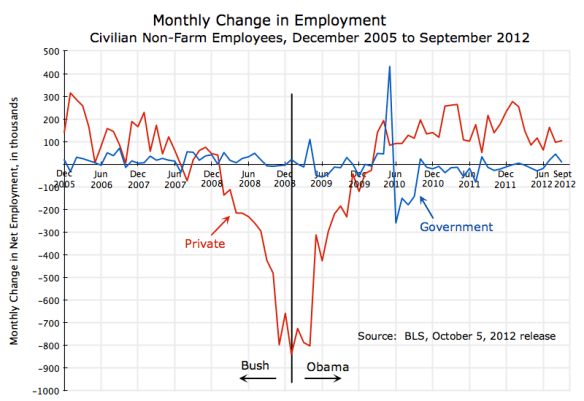
US employment, monthly change, private and government, December 2005 to September 2012

The Bureau of Labor Statistics released this morning its regular monthly report on employment and unemployment.  There will be one more such report on Friday, November 2, but this will be just a few days prior to the November 6 election.  The current report will likely be more heavily scrutinized, and commented upon, in the period leading up to the election.

The report indicates that while employment growth in the US remains positive, it remains sluggish.  The estimate is that total employment rose by 114,000, of which 104,000 were private jobs, and 10,000 were government jobs.  While positive, this is less than the estimated 200,000 to 250,000 new jobs required each month which this blog has indicated  in an earlier post needs to be sustained for unemployment to fall on a consistent basis.

This estimate of 114,000 new jobs is less than the revised estimates of net new jobs created in July and August.  All the estimates are preliminary for the most recent two months, as the BLS revises the estimates as new numbers come in through the regular reporting system.  The July and August net new jobs estimates were revised upwards to 181,000 in July (from an estimate of 141,000 last month) and to 142,000 in August (from an estimate of 96,000 last month), for a net addition of 86,000 jobs over these two months over what was estimated before.

Almost all of the revisions were in the figures on government jobs, to growth of 18,000 in July (versus a decline of 21,000 estimated before) and growth of 45,000 in August (versus a decline of 7,000 estimated before).  But government jobs remain depressed:  Despite the recent growth, as of September 2012 there were 575,000 fewer government jobs than when Obama took office in January 2009 (mostly at the state and local level, as they account for 87% of government jobs in the US).  As this blog has noted before, if government jobs had been allowed to grow in the downturn following the 2008 collapse as they had in previous downturns (including in particular when Reagan was in office) or as they had when Bush, Jr., was in office, we would now be at, or close to, full employment.

Despite the disappointing growth in total jobs in September (of just 114,000), it is interesting and encouraging that the estimated unemployment rate fell sharply, to 7.8% from the previous 8.1%.  How could this be?  It is important to remember that the estimated employment figure comes from a survey of about 140,000 business establishments (including government agencies and non-profit entities), while the unemployment estimate comes from a separate survey of 60,000 households.  There are significant differences between the two surveys, both statistical and conceptual.  Statistically, they are both estimates taken from samples.  Conceptually, they measure different things:  The household survey asks the household if they (and other household members) are employed, including as self-employed, as unpaid family labor, as private household workers, or in farm work.  The business survey excludes farm workers, and the others (the self-employed, etc.) will be excluded as well as they are not employed in business establishments.  But if a person has two jobs, the business survey will count them as holding two different jobs, while the household survey will merely record them once, as employed.

Bearing this in mind, it is still interesting that the household survey estimated that the number of employed jumped by 873,000 in September (the biggest such jump since 2003), while the business survey only estimated an additional 114,000 were employed.  Analysts generally discount the employment estimate from the household survey, as it is subject to greater statistical fluctuation (due not only to the smaller sample size, but more importantly since the business establishments surveyed will have many workers generally, while households will generally have only one or two workers).  The household estimates bounce around a good deal more.

But still, a jump of 873,000 employed in one month is a lot.  In part, this was a bounce back from estimated negative growth in the number employed in the household survey in July and August (of -195,000 in July and -119,000 in August).  It also suggests that the creeping up of the unemployment rate in recent months (from 8.1% in April, rising to 8.3% in July) may have been an aberration.  The 7.8% rate of September indicates a return to the previous trend.  And the 7.8% figure may have some political significance as that was the unemployment rate in January 2009 when Obama took office, although rising rapidly at that time until the stimulus program and other measures were able to turn it around.

There are also indications that the recent employment estimates from the business establishment survey may have been low.  First, there was a BLS announcement on September 27 that the preliminary estimate in its regular annual re-benchmarking analysis was that employment in March 2012 was 386,000 higher than previously estimated.  This will be further analyzed still, and the employment figures shown above do not yet reflect this new estimate for the benchmark.  Re-estimated figures for 2011 and 2012 will be provided, as they always are, when the January 2013 employment report is issued on the first Friday of February.  With the new benchmark estimate, they will show that employment levels, as well as employment growth, has been considerably higher in the latter part of 2011 and into 2012 than is being currently estimated.

Second, one can compare the estimates on the growth in the number of employed from the household survey to the number of employed from the business survey.  As noted above, the two surveys measure slightly different concepts.  But over time one would expect that they will move together, with the ratio of one to the other close to constant, although with month to month volatility.

A reasonable time span to look at would be the averages over a year, such as between September 2011 and September 2012.  Over this time period, the household survey indicated employment grew by an average of 238,900 per month, while the business survey indicated employment growth of just 150,500 per month.  Once the new, higher, benchmark is incorporated into the business survey employment figures, the employment growth estimate from the business survey will move towards the higher figure suggested by the household survey.

One can also calculate what employment growth as measured in the business survey would have been in September 2012, if the ratio of employment as estimated in the household survey to employment as estimated in the business survey (keeping in mind they are measuring somewhat different things), was the same in September 2012 as it had been in September 2011.  If it were, one can calculate that employment growth as estimated by the business survey would have been an average of 223,400 per month over that period.

There are therefore indications that employment growth over the past year has been stronger than the current estimates from the business survey indicate.  It looks like employment growth over the last year might have averaged between 200,000 and 250,000 per month.  As noted above, growth in such a range is consistent with a falling (although slowly falling) rate of unemployment.  And the unemployment rate did indeed fall slowly over this period, from 9.0% in September 2011 to 7.8% in September 2012, or an average of 0.1% point per month.

There is therefore some evidence that employment growth in 2011 and so far in 2012 has been somewhat higher than currently estimated.  It has been high enough to lead to a fall in the unemployment rate to the current 7.8%.  But this progress is still disappointingly slow, as drag from cuts in fiscal expenditures (including for government employment) has held back the economy.