The Long-Term Downward Trend in Federal Government Employment Has Continued Under Obama

Fed Govt Employment as % of US Population, Jan 1953 - June 2014


A.  The Long-Term Downward Trend in Federal Government Employment

Previous posts on this blog have reported on the fall in total government employment (federal, state, and local) during Obama’s presidential term, in stark contrast to the increases seen during the term of George W. Bush as well as during the terms of other recent presidents.  The same pattern, of government jobs falling under Obama and rising under other presidents, is seen when one takes as the starting point the beginning of an economic downturn rather than the date of inauguration.  Government jobs have been cut compared to what they were at the start of the most recent downturn, in contrast to the increases approved in previous downturns.  These cuts in government jobs during Obama’s tenure, as well as the cuts in government spending, are of course exactly the opposite of what one should do during an economic downturn.  An earlier post estimated that if government spending been allowed to grow at the pace it had under Reagan, the economy would likely have reached full employment output already in 2011.

In terms of overall fiscal impact on the economy, a focus on total government employment and spending makes sense.  The total impact depends on what is being done at all levels of government – federal, state, and local.  But a president has only limited influence on what is happening at the state and local government levels.  It is federal government employment and spending that a president, together with the congress, determine.  Hence in terms of assessing the direction of policy during different presidential terms, limiting the analysis to the federal level makes sense.  The question to be addressed is whether, as many conservatives charge, the number of federal employees has grown sharply under Obama.

The chart at the top of this post shows federal government employment as a share of the US population going back to January 1953, the month Eisenhower was inaugurated.  The government employment figures come from the Bureau of Labor Statistics.  Note that federal government employment excludes active duty military personnel (but includes civilian employees of the Department of Defense).  The population numbers come from the Census Bureau (most conveniently accessed via FRED).

The chart shows that federal government employment as a share of the US population is now well below what it has been historically, and that it has fallen further during the presidential term of Obama.  Federal government employment is now only 0.85% of the US population, or over a third less than the 1.3% share it averaged from the second half of the 1950s through to the end of the 1980s (more than a third of a century).  There were sharp cuts at the start of the Eisenhower administration as the Korean War came to an end, and significant increases in the mid-1960s due to the Vietnam War and Great Society programs, but the averages, over any of the decades, were each still within round-off of 1.3%.  [Note:  While the government employment figures exclude active duty military, there are still major increases in government civilian employment during times of war in the Department of Defense and elsewhere.]

But since the mid-1960s (with the major exception of most of the Reagan term), federal government employment has been on a downward trend, most sharply during the presidential terms of Clinton and now Obama.  The recent fall during Obama’s term might be less of a concern if it was a reversal from a recent sharp increase, or as a reversal of an upward trend.  But government employment is already a third below (as a share of population) where it was through the 1980s, and is being cut further.  A fall by a third is huge.

B.  Federal Government Employment in Specific Presidential Terms

While government employment as a share of population is most appropriate when examining long term trends, some might want also to see the figures in terms of absolute numbers of employees over the course of presidential terms.  Here are the recent ones:

Number of Federal Government Jobs
       (numbers in thousands) Start  End
Reagan:  Jan 1981 to Jan 1989 2,961 3,158  197
Bush I:  Jan 1989 to Jan 1993 3,158 3,092 -66
Clinton:  Jan 1993 to Jan 2001 3,092 2,753 -339
Bush II:  Jan 2001 to Jan 2009 2,753 2,786  33
Obama:  Jan 2009 to June 2014 2,786 2,713 -73

As has been noted before, federal government employment rose sharply during Reagan’s presidential term.  It then fell during the term of Bush I, although not by enough to offset the increase under Reagan (when Bush was the Vice President).  There was then a sharp fall under Clinton, which was reversed to an increase under Bush II.  But federal government employment is now falling again under Obama.

Reagan and Bush II have been celebrated by Republicans as small government conservatives.  But federal government employment rose during their terms.  Clinton and Obama have been denounced by conservatives as big government liberals.  But federal employment fell sharply during their presidencies.  And federal employment also fell during the term of Bush I, the most moderate of recent Republican presidents.  The facts are simply not consistent with the stories told of these presidents.

C.  An Example of The Adverse Impact on Government Capacity

Federal government employment is thus now at a historic low (as a share of population) over a period of at least six decades.  It should not then be a surprise that government programs may be inadequately administered.  One often simply needs more personnel to do it.  A clear recent example of this is the crisis in the Veterans Administration.  The number of veterans has increased sharply in recent years due to the legacy of the Iraq and Afghanistan wars, and veterans from the Vietnam War are now of the age when they most need health care.  A significant number of aged World War II and Korean War veterans also remain and need care.  But the number of doctors, nurses, and other staff at the VA hospitals have been held back from the number needed to provide good care.  And it cannot be said that the existing staff are lazy.  The doctors are fully booked.

Rather than face up to this, lower level staff have for many years now been falsifying records to make it appear that veterans can see a doctor within a reasonable time, when that is not the case.  This of course has made the problem worse, as no one then faced up to the problem and did something about it.  Senior officials in the VA have stated that they were unaware of what was going on.  Having worked in a large bureaucracy myself for most of my career (the World Bank), I can readily believe this to be true.  Senior officials are often unaware of what is common knowledge among front-line staff.  But covering it up by falsifying records only served to make the problem worse.

A bipartisan deal appears to be close to congressional approval to provide additional funding to the Veterans Administration, to go at least some way to resolving the problem.  An additional $5 billion in funds will be provided to hire more doctors, nurses, and other staff needed to provide the care veterans have a right to, while $10 billion will be provided to allow veterans to go to more expensive private health care providers in those cases where they cannot receive a VA doctor’s appointment within 30 days, or when they live more than 40 miles from a VA hospital or clinic.  Whether this funding will suffice is not clear, and has been questioned.  Earlier estimates on the funding needed were far higher.  But Republicans in Congress have refused to approve more, and as of this writing, a final vote on the proposed measure still awaits.  However, any extra funding will at least help.

The veterans issue illustrates well the fundamental problem.  While it is certainly true in any large organization, private or public, that employees exist who are not providing effective service, there are in practice limits to how much one can cut before service suffers.
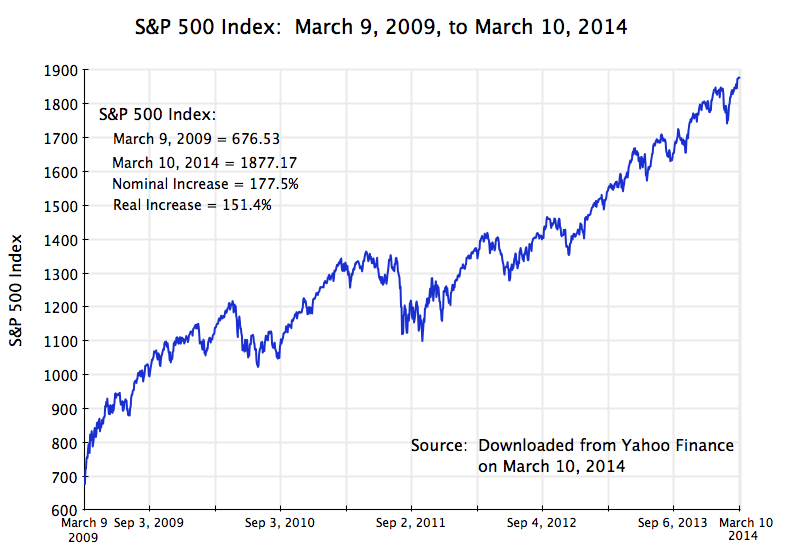
The Obama Bull Market Rally on Its Fifth Anniversary

S&P 500 Index, March 9, 2009, to March 10, 2014

Bull Markets, 1940-2014, updated to March 10, 2014

 
   Bull Market Rallies Since 1940
  Ranked by overall growth in real terms
Start Date End   Date Calendar Days Nominal % Change Real % Change Real Rate of Growth
Dec 4, 1987 Mar 24, 2000 4,494 582% 361% 13%
Jun 13, 1949 Aug 2, 1956 2,607 267% 222% 18%
Aug 12, 1982 Aug 25, 1987 1,839 229% 181% 23%
Mar 9, 2009 Mar 10, 2014 1,827 177% 151% 20%
Apr 28, 1942 May 29, 1946 1,492 158% 124% 22%
Oct 22, 1957 Dec 12, 1961 1,512 86% 76% 15%
Oct 9, 2002 Oct 9, 2007 1,826 101% 75% 12%
Jun 26, 1962 Feb 9, 1966 1,324 80% 69% 16%
May 26, 1970 Jan 11, 1973 961 74% 57% 19%
Oct 6, 1966 Nov 29, 1968 785 48% 37% 16%
Oct 3, 1974 Nov 28, 1980 2,248 126% 34% 5%

Today marks the fifth anniversary of the Obama bull market rally.  The rally began on March 9, 2009, just six weeks after Obama was inaugurated.  A reader of this blog suggested that on this anniversary, an update of previous posts on the strong performance of the stock market during Obama’s tenure (see here and here) might therefore be timely and of interest.

Stock market prices have indeed continued to rise, and as the table above shows, stocks during Obama’s term in office have now posted the fourth highest gains of any stock market rally since 1940.  Market rallies are defined as at least a 25% rise in the S&P 500 Index (in real terms), without a 20% fall.  Equity prices (as measured by the S&P 500) have risen by 177% in nominal terms since March 9, 2009, as of the close today.  The increase in real terms (using the CPI inflation index) has been 151%.  And since this rally is on-going, it could move further up in rank.  In addition, in just twelve more days (assuming the rally does not suddenly collapse) this rally will be the third longest in terms of calendar days of all market rallies since 1940.

It is also interesting to see how steady the upward progression has been, especially since September 2011.  This is shown in the graph at the top of this post.  I do not believe anyone had predicted this.

The rally could also end tomorrow.  All rallies eventually come to an end, and this one will as well.  But the rise in prices already achieved, the fourth largest since 1940, needs to be recognized.

Should Obama be given credit for this historic market rally?  Not fully.  I doubt that equity prices in themselves are a primary objective of what Obama has been trying to achieve.   Rather, the objective has been a stronger economy.  Regulatory as well as policy measures have been taken with the aim of strengthening the system, and this ultimately benefits business (as well as the population) as a whole.  This then helps equity prices.  Unfortunately, and as this blog has discussed in earlier posts, fiscal drag from cuts in government spending has held back the pace of the recovery, and this fiscal drag is continuing.  The economy could be doing better.  Nevertheless, there has been a partial recovery.  But it is not yet complete, nor as rapid as one would have had without the fiscal drag.

But what this strong growth in the stock market does clearly indicate is that the charges by Republican politicians that Obama has been bad for business (indeed a disaster for business many of them have said), has no basis.  If there were any truth to the charge, stock market prices would not be up by 177% in nominal terms (and by 151% in real terms) over the last five years, leading to the fourth biggest rally in stock prices in three-quarters of a century.

The Continued Fall in Government Spending Under Obama

Govt Spending on Goods & Services by Presidential Term, Quarterly

A.  Introduction

Government spending continues to fall under Obama.  As this blog has noted in earlier posts, the fiscal drag from this reduction in demand for the goods and services that unemployed workers could have been producing can fully explain why the recovery from the 2008 has been so slow.  As another blog post noted, if government spending had merely been allowed to grow under Obama at the same pace as it had historically, the economy would by now be back at full employment.  The public debt to GDP ratio would also be lower, as GDP would be higher.  And if government spending had been allowed to grow as it had under Reagan, we would likely have returned to full employment by 2011.

Fiscal drag is therefore important.  Yet it is still not yet commonly recognized that government spending has been falling in real absolute terms for the last several years (and even more so when measured as a share of GDP).  Earlier blog posts have reviewed this.  The trends have unfortunately continued and indeed strengthened over the last year.  Whether this will now change with government spending finally leveling off, and perhaps even start to recover, remains to be seen.  The budget compromise for fiscal years 2014 and 2015 reached by Senator Patty Murray and Congressman Paul Ryan in December, and passed by Congress in January, will reverse part of the impact of the budget sequester.  According to calculations by the Committee for a Responsible Federal Budget (fiscal hawks in favor of budget cuts), the agreement for FY2014 will lead to a small (1.8%) rise in nominal terms in budget authority compared to the FY2013 post-sequester levels.  This would still be flat to negative in real terms, based on inflation of about 2%.  And the FY2014 sum would still represent a 3.7% fall compared to what the FY2013 pre-sequester levels would have been.

Possibly more important would be government spending at the state and local level.  This was cut back as a result of the 2008 collapse and slow recovery, due to lower revenues and the requirement in many states and localities of a balanced budget.  While expenditures were still falling in 2013, revenues have started to grow (due to the positive, though still slow, recovery of GDP) and state and local budgets as a result can now start to recover as well.  But it also remains to be seen if that will happen.

This blog post will update the government spending figures during the Obama term through the fifth year of his administration.  And it will present the figures from a different perspective than before, by tracing the paths during the course of each presidential term (going back to Carter’s) relative to what the spending was at the start of their respective presidencies.

[Note that all the government spending figures used in this post will be in real, inflation-adjusted, terms.]

B.  Government Spending on Consumption and Investment

The graph at the top of this post shows the tracks of real government spending on consumption and investment during each presidential term going back to Carter, as a ratio to what it was at the start of their terms.  The base period is always taken as the last quarter before their inauguration (i.e. in the fourth quarter of the calendar year preceding their January 20 inauguration).  The data is computed from the figures in the standard National Income and Product Accounts (NIPA accounts, also commonly referred to as the GDP accounts) of the Bureau of Economic Analysis (BEA) of the US Department of Commerce, and are seasonally adjusted.  Note that all levels of government are included here – federal, state, and local.  We will examine below spending at the federal level only, as well as spending including transfer payments.

This government spending has fallen by 5 1/2% in real terms by the end of the fifth year (the 20th quarter) of Obama’s term in office.  It rose by 2 1/2% during Obama’s first year, which one might note is similar to the increases seen by that point under Carter, Reagan, and Bush I, and with a significantly greater increase by that point under Bush II.  Spending during Obama’s term has since been falling steadily, leading to the fiscal drag referred to above, to a point where it is now 8% lower in real terms than it was in his first year, or a net 5 1/2% fall from when he took office.

There has been no such fall in government spending under any other presidential term since Carter.  The closest was spending during the Clinton period, but there was still a 3% rise by the end of his fifth year in office.  The increases by the end of the fourth year under Carter and Bush I (single term presidencies) were 8% and 6 1/2% respectively.  And the increases by the end of the fifth year in office were 13% during the term of Bush II, and by a full 21% in real terms under Reagan.  Government spending also continued to grow under Bush II and Reagan, reaching increases of 21% and 33% respectively by the end of their eight years in office.

Yet Reagan and Bush II are seen as small government conservatives, while Obama is deemed by conservatives to be a big spending liberal.  The facts simply do not support this.

C.  Government Spending Including Transfers

Government spending for the direct purchase of goods and services (used for consumption or investment), reviewed above, is a direct component of GDP demand.  When there are substantial unemployed resources (as now), such government spending will have a significant positive impact in spurring economic expansion.  As was discussed in an Econ 101 post on this blog, under such circumstances the fiscal multiplier will be positive and high.  Hence the fiscal drag from the cut-back in government spending during Obama’s term in office has kept the recovery below what it would have been.

But there is also government spending on transfers to households (such as for Social Security, food stamps, or unemployment insurance).  Such transfers are ultimately spent by households for their consumption of goods and services (or will in part be saved, including through the pay-down of debt such as mortgage debt).  It will enter into GDP demand by way of the spending of households for consumption, and the impact on GDP will depend on the behavior of households in deciding what share of those transfers they will spend or save.

Such spending rose more sharply during Obama’s first year in office, as he faced an economy in free fall as he was taking his inaugural oath:

Govt Spending, Total incl Transfers, by Presidential Term, Quarterly

The economy was losing 800,000 jobs per month at that time, pushing the unemployment roles up rapidly and plunging the incomes of many in the population to levels where they qualified for food stamps.  Government spending including transfers therefore rose by almost 9% by the third quarter of 2009, and reached a peak of 9.8% in the third quarter of 2010.  Since then, however, total government spending including transfers has been modestly falling, and is now 7 1/2% above where it was when Obama took office.

[Note all figures are in real terms.  The personal consumption expenditures deflator in the NIPA accounts was used to adjust transfer payments for inflation.]

Only during the Clinton period did one see a modestly smaller increase, of about 6 1/2%.  But there was a 16 1/2% increase in such spending at the same point in the term of Bush II, and an increase of over 22% under Reagan.  It was also higher by the end of their fourth years in office for both Carter and Bush I.

The differences are not small.

D.  Federal Government Spending on Consumption and Investment

What matters to the economy when demand is inadequate and unemployment is high is spending at all levels of government.  Yet while we commonly blame the president in office for the performance of the economy, they at best can only influence the federal budget (and influence it only partially, as Congress decides on the budget).  Hence it may be of interest also to examine the paths of only federal government spending.

Such federal spending on direct consumption and investment at first rose during the Obama term, reaching a peak 8% increase in the third quarter of his second year in office.  It then fell sharply, to a point where it is now 5 1/2% below where it was when Obama took office:

Federal Govt Spending on Goods & Services by Presidential Term, Quarterly

The initial increase in federal spending was in part due to the stimulus package that served to restart the economy (GDP was falling from 2008 through the first half of 2009; it then began to recover).  Note that while federal spending rose by 8% by the third quarter of 2010, overall government spending (including state and local) rose only by 2 1/2% at that point.  State and local government was cutting back, as they were forced to do by the balanced budget requirements of many of them, so federal spending and the stimulus it could provide was partially being offset by their cut-backs.

But after this initial increase in the first two years of the Obama presidency, federal spending has been cut substantially, to the point where it is now 5 1/2% below in real absolute terms where it was when Obama took office.  Federal spending also fell during the Clinton term, by 11% at the same point in his term.  In contrast, federal spending rose sharply under Bush II (by 27% at the same point) and especially under Reagan (by over 31%).

E.  Federal Government Spending Including Transfers

Finally, federal government spending including transfers:

Fed Govt Spending, Total incl Transfers, Quarterly

[Technical Note:  Federal government transfers in the NIPA accounts include transfers to individuals as well as transfers to the states or localities for all purposes, including road construction, for example.  Such intra-government transfers are netted out in the accounts when government as a whole – federal, state, and local – is examined, so that remaining government transfers are then solely transfers to individuals, such as for Social Security.]

Such spending is now lower under Obama than under any of the presidencies examined, including Clinton.  Federal spending including transfers rose to a peak in 2010 of 10% above where it was when Obama took office, but has since declined to just 1% above that level.  It was 4% higher at that point in Clinton’s term, 23% higher at the point in the term of Bush II, and 25 1/2% higher at that point in the term of Reagan.

F.  Conclusion

Republicans in Congress and conservatives generally continue to criticize Obama as being responsible for runaway government spending.  But after an initial modest increase in the first two years of his term, as he sought to stop the economic free fall he inherited on taking office (and succeeded), government spending has come down under any measure one takes.  The resulting fiscal drag has held back the economy, leading to an only slow recovery.  And the fiscal drag during Obama’s term in office is in sharp contrast to the large increases in government spending observed during the terms of George W. Bush and especially Ronald Reagan. Yet they have been viewed as small government conservatives.