
Federal Government Expenditures Under Obama: Close to Flat, in Contrast to the Big Increases of His Republican Predecessors

Federal Government Budget Real Expenditures, Government Outlays, Reagan, Bush Sr., Clinton, Bush, Jr., Obama

There is perhaps no more firmly held view in Republican (and especially Tea Party) circles than that federal government expenditures have exploded under Obama.  But it is simply not true.  Previous analysis in this blog has shown that total government expenditures (including state and local) traced over the course of each business cycle in the US since the mid-1970s, rose less during the Obama period than in any of the others.  Indeed, that analysis indicated that if government spending under Obama had been allowed to increase as much as it did under Reagan following the 1981 downturn, then we would now likely be at or close to full employment.

But when President Obama noted in a speech in Iowa on May 24 that the pace of federal spending had grown at the slowest pace in his term of any presidency in sixty years, the remarks were met with widespread incredulity in the press and on the internet.  Given the repeated Republican attacks asserting the opposite, many did not believe it could be true.

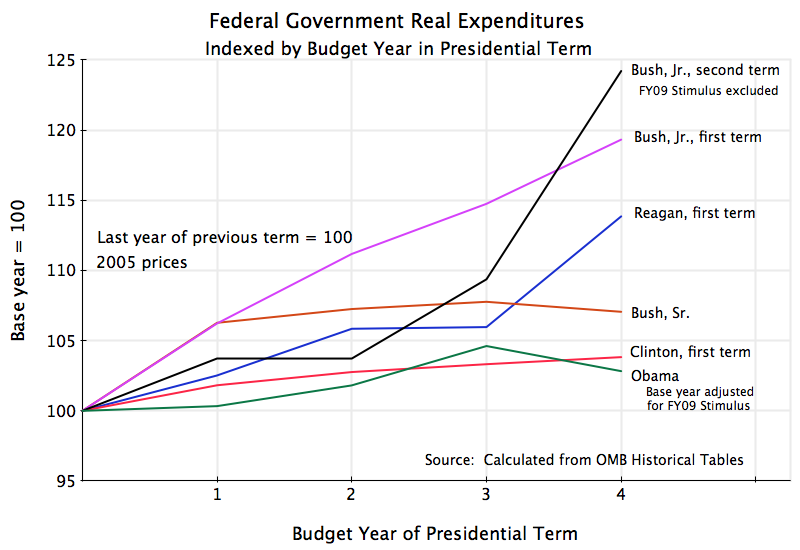
But it is true.  The graph above shows the levels of real federal spending in the first terms (and Bush’s second term) of each president since Reagan.  Growth in real federal spending in each presidential term prior to that was also higher than under Obama, going back to Eisenhower.  (Under Eisenhower there was a fall in real spending, as Korean War expenditures, at a peak when he took office, came down as the war ended.  There was an even larger fall during the Truman term as World War II came to an end.  But these cases are not terribly relevant.)

The figure above shows real federal spending levels in each presidential term since Reagan, indexed with the year preceding their first budget set equal to 100, and then showing the levels in real (inflation-adjusted) terms for the four budget years of their presidencies.  Only the first terms are shown for two term presidents other than Bush Jr., to make it comparable to the Obama term thus far, to reduce clutter in the figure, and because it made no real difference (increases during the second Reagan and Clinton terms were in the middle of the ranges shown above, with four-year increases of 7% and 8% respectively).

Federal government spending under Obama has been largely flat, increasing by less than a total of only 3% in real terms by his fourth budget year (FY13, where I used the budget proposal made to Congress in February by Obama for this figure; any actions by Congress will likely result in further cuts, not increases, in this).  The only recent president with spending at all close to this was Clinton in his first term, when spending rose by a total of 4% in real terms.  The biggest spending increases by far were by Bush, Jr., in both his first and second terms.  Real spending rose by 19% in Bush’s first term, and by 24% in his second term (even adjusting for spending approved as part of the FY09 Stimulus package:  see the technical note below).  Reagan, revered for his small government conservatism, oversaw an increase of 14% in real government spending during his first term.

The Democratic presidents Obama and Clinton have therefore kept federal government spending tightly under control, while the Republican presidents of Reagan and especially Bush, Jr., oversaw large expansions in real federal spending.  Obama’s conservatism on this has certainly hurt the economy at a time when unemployment remains high due to a lack of demand in the aggregate for what such labor could produce.  But he has been criticized, without any basis in fact, for the opposite.

———————————————–

Technical Note

It is important to be aware that budget (or fiscal) years do not coincide with presidential terms.  Presidents are inaugurated in January, while budget years start in October.  A president therefore takes office with a budget year already one-third over, Congressional appropriations already set (or at least largely set), and little ability, with rare exceptions, to influence spending in the year they take office.

Thus in the figure above, the base year of expenditures (set equal to 100) will be the budget year in the middle of which a president took office, and the final year will be the budget year underway at the end of his term.  The figures are calculated from data in the Historical Tables issued by the Office of Management and Budget.

The one exception where a president has had a major impact on spending levels in his first year would be spending under the Stimulus package that Obama signed into law, which was approved on February 17, 2009.  This package provided for a total of $971 billion in measures, but $420 billion of this was for tax cuts, and $551 billion for spending.  Of this $551 billion in spending, only $114 billion (according to the most recent estimates of the Congressional Budget Office) was spent in FY2009, approximately as planned.  The figure above adjusts for this, with the $114 billion (equal to $103 billion in 2005 prices) taken out of the fourth year of the Bush second term expenditures, and with the same amount also used to adjust the base year of the Obama expenditures.  Without these adjustments, federal government expenditures in the Bush second term would have gone up by a total of 28% (rather than 24%), and Obama’s expenditures by his fourth year would have declined by 0.5% (rather than increasing by 3%).

Why Have Productivity and Profits Gone Up During Obama’s Term?

In the post immediately preceding this one (see directly below, or here), I noted that a glance at the economic data makes clear that productivity and profitability have both increased under Obama.  Hence, the argument made by Mitt Romney and the other Republican candidates that onerous regulations imposed by Obama are the cause of disappointing job and output growth, is simply not correct.  If new regulations were such a problem, one would have expected productivity and especially profitability to have suffered, and yet both have improved.  Indeed, profitability has sky-rocketed.

For convenience, here is the basic graph again:

But this naturally then also raises the question of why productivity and especially profitability have gone up by so much under Obama.  Indeed, some might wonder whether Obama’s administration has deliberately favored profits at the expense of wages.

While a full analysis cannot be done here, I find no reason to jump to such a conclusion.  The path of profits is what one would expect over the last few years, with the sharp collapse in output at the end of the Bush Administration and then only a slow recovery with unemployment staying high.  There is the separate issue of the longer term trends, where profits have been growing as a share of National Income since about 1980 (for the last decade, see here, and for the underlying data and the longer term see the BEA data at here).  But the fluctuations over the last few years can be well understood in terms of the short term dynamics of the economic collapse and subsequent slow recovery.

Specifically, profits fell sharply in the economic downturn at the end of the Bush Administration, and started to to fall (per unit of production) as far back as 2006.  It is worth noting that housing prices peaked in the first half of 2006, and the economy began to slow after that.  A collapse in profits when the economy collapsed is as one would expect.

In response to the economic downturn, the Federal Reserve Board cut interest rates, ultimately to historically low levels of essentially zero for rates on risk-free assets.  Coupled with other aggressive Fed measures, as well as the TARP program to stabilize the banks (launched by Bush) and then the Obama stimulus program, the collapse was halted and the economy then started to grow in the middle of 2009.  Profitability then recovered.

The business response to the downturn was to lay off workers, as they always do in a downturn, and then later they invested in new machinery and equipment.  The investment was spurred in part by the low interest rates following from the Fed policies, and indeed the recovery in non-residential private fixed investment was surprisingly strong (see here).  Both these actions increased labor productivity, as shown in the diagram above.

But aggregate demand growth remained sluggish, despite the growth in private investment.   The downturn was due primarily to the bursting of the housing price bubble that the Bush Administration regulators had allowed to build up (or at least made no attempt to limit).  As housing prices collapsed, home owners became poorer and many ended up with mortgages that were larger than the now lower values of their homes.  Stock prices also fell, hurting retirement and savings accounts.  Coupled also with worries generated by high unemployment, households hunkered down to consume less and try to save more.  Private consumption stagnated.  And after the Obama stimulus plan was passed (helping to stop the free-fall in output and to turn around the economy), political pressures from the Republican Party and especially the Tea Party wing made it impossible for government to maintain a high enough demand to fill in the still large gap in aggregate national demand.

As a consequence, the recovery in growth was limited and unemployment has stayed high.    This has kept wages largely flat.  But labor productivity rose due to the large early lay-offs and later the growth in business investment.  With wages flat but labor productivity higher, unit labor costs fell.

In addition, there are non-labor costs (not shown in the diagram) which also fell.  The main component of such costs that fell was interest payments, which the Fed reduced to the maximum extent it could to try to spur the economy.

With both unit labor costs and non-labor costs down, profits rose and rose sharply.

Employment Growth Continues, But at Too Low a Rate

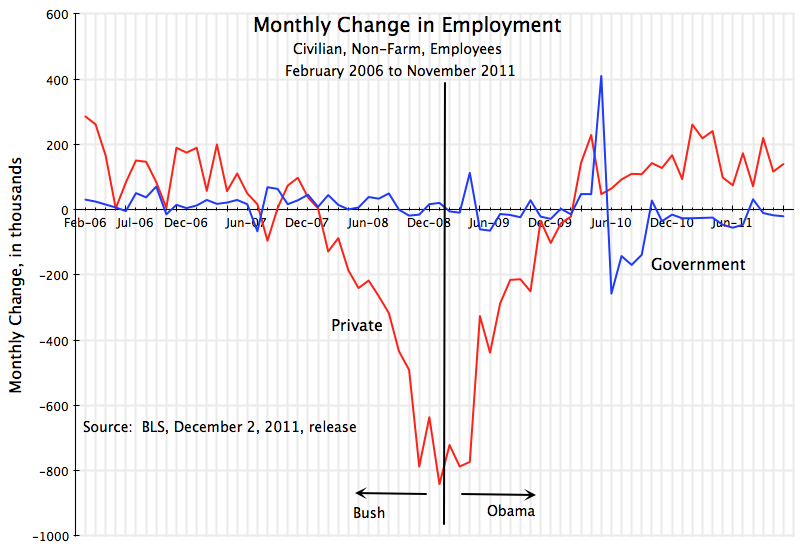
The monthly change in employment figures continue to show growth in total employment, although at rates that remain too low for a reasonable recovery.  Total non-farm employment, both private sector and government, grew by 120,000 in November, based on the Establishment Survey conducted by the Bureau of Labor Statistics.  This total of 120,000 reflected an increase of 140,000 in private employment, offset by a decline in 20,000 in government employment (primarily state and local governments, which account for 87% of government employment in the US).

The 120,000 figure is too low.  Based on employment growth seen during recent periods of growth in the US, the figure would need to be roughly 200 to 250,000 per month for a sustained period for unemployment to decline on a sustainable basis.

The decline in government employment is hurting this.  If government employment were growing at a more historically normal rate of 20,000 per month rather than falling by 20,000 per month, total employment would growth in November would have been 160,000 by this direct effect alone.  That would by itself have accounted for about half the increase one would need to get to the lower end of the 200 to 250,000 band one needs (160,000 is half way between 120,000 and 200,000).  Furthermore, once one recognizes that there will be multiplier effects as well from such increased direct government employment in this economy (with its still very high unemployment), then with a multiplier of only just one (i.e. one additional private job for every additional government job, due to the resulting demand for goods and services from the new government workers), one would have gotten all the way to the 200 to 250,000 band.  And with a not unreasonable multiplier of two, one would be at 240,000, near the top end of this band.  That is, a major reason for the sluggish growth in employment in the US is the cut-backs being forced by conservative politicians on our government.  And they say they are forcing these cut-backs in the interest of “job creation”.

It is also of interest to look at the monthly employment figures in the longer term context.  Obama is being repeatedly blamed by Republican politicians for the high unemployment in the US, but the graph above clearly shows the turn-around that began precisely at his inauguration in January 2009.  At that point, the economy was in free-fall.  This first decelerated, and then, from the summer of 2009, the economy started to grow.  The turnaround and subsequent growth was a result of a large number of government programs rapidly put in place (including, to be fair, programs put in place at the end of the Bush Administration, such as TARP).  Note that the bump in government employment in the spring of 2010 was due to temporary workers hired for the decennial population census, where these jobs then were finished a few months later.  Indeed, the figures do not show a significant number of net new government jobs created in 2009 or since as a result of the stimulus package of Obama.  Government employment has in fact declined since Obama took office.  At most, the stimulus programs reduced the number of government job losses that might otherwise have taken place.

In sum, employment turned around dramatically in January 2009, when Obama took office, and there has been positive overall job growth since early 2010.  But job growth needs to be higher for unemployment to decline to acceptable levels, and it has proven difficult to do this in the face of a contracting government sector.