The Increase in Covid-19 Cases is Real: Hospitalization Has Gone Up in Trump States

Cases of Covid-19 infection are going up in the US.  Indeed, the daily number of new confirmed cases have been hitting record levels, with almost all of the recent increase recorded in states that Trump won in 2016.  But Trump has continued to insist the record highs are only because his administration has done such a great job in making tests finally available.  Health professionals who actually have expertise in such issues dispute this.  And many more people are seeking tests, even waiting in lines in their cars that are miles (and many hours) long.  You don’t do this if it does not look serious.

But while it is true that there would be fewer cases confirmed if we did not know about them due to fewer tests, one statistic this would not affect would be the number of those being sent to a hospital having contracted a severe case of the infection.  Numbers on those hospitalized due to the virus are available for most US states (with Florida an important exception – this will be discussed below).  One then gets the chart above when the hospitalization numbers for those states won by Trump in 2016 are compared to those won by Clinton (as a proxy for the more conservative, mostly Republican, states compared to the more liberal, mostly Democratic, ones).

The chart shows that there has been a marked increase in hospitalizations in the Trump states since about June 15.  Excluding Florida, hospitalizations in the Trump states have grown to almost 20,000 as of June 29 from only about 12,000 in early June, an increase of two-thirds.  In contrast, hospitalizations in the states won by Clinton rose fast early, but then fell.  Little was known early on about the virus and how fast it was spreading in the US, particularly in dense urban locations, in part because of the early blunders of the Trump administration that severely limited testing in February and into most of March.  But from a peak in hospitalizations in mid-April in the states won by Clinton, the numbers have come down steadily, although with some leveling off since mid-June.  They are now well below the number hospitalized in the Trump states.

The data comes from figures assembled by the CovidTracking project, a private initiative launched by The Atlantic Monthly.  The project has assembled, on a daily basis, figures officially reported by US states and territories on Covid-19 tests being conducted (and the positive or negative results), the number of deaths, the numbers hospitalized, those in an ICU and those on ventilators, and more.  The data available, and its quality, are only as good, however, as what the states and territories report.  While the figures on confirmed positive tests and on deaths appear to be of fairly good quality and completeness, what the states report on the other variables is uneven and often incomplete.  One then has to be careful in interpreting the numbers, as figures not reported by certain states (or on certain dates) are left blank and then treated as a zero when the national numbers are aggregated.  The figures on numbers in ICU beds or on ventilators are notably incomplete.  And one should be especially careful with the earlier numbers, as they are often quite partial.  The later numbers are more complete and generally more reliable.

The figures on those hospitalized due to Covid-19 are complete (as I write this) except for four states:  Kansas, Idaho, Hawaii, and notably Florida.  The number of cases in Kansas, Idaho, and especially Hawaii are all relatively small, in part as all three are relatively small states.  Based on a 7-day moving average to smooth out day to day fluctuations, the daily number of new confirmed cases in the three states totaled only 482 as of June 29 (with only 12 in the case of Hawaii, which has done a superb job of containing the virus that causes Covid-19).  In contrast, Florida alone averaged 6,589 cases daily in the 7-day period ending on June 29, or almost 14 times the other three states combined.  Florida matters – the other three states not so much.

But data reporting on the spread of Covid-19 by Florida has been especially poor, and politicized.  Rebekah Jones, the state employee who developed the Florida “dashboard” that presented the Covid-19 results by county was fired in May when she refused to manipulate the data in a way to make it appear that much of the state was meeting the criteria for reopening when in fact they were not.  She has since developed and made available over the internet a dashboard similar to the one she had developed for the State of Florida, but with data that has not been so manipulated.

The underlying problem was that Florida Governor Ron DeSantis (a close ally of Trump) had been declaring victory over the virus that causes Covid-19 already in early May, as he proceeded to reopen the state early and aggressively.  He held news conferences, including at the White House, claiming he had succeeded where others had failed, and that Florida should serve as a model for the country.  Trump lavished praise on the governor, saying he was doing a “spectacular job”.

It is therefore more than a bit embarrassing for DeSantis that cases in Florida have been rising so fast since his May 1 reopening.  For the US as a whole, the average number of daily new cases for the 7-day period ending June 29 was 37% higher than what it was for the period ending on May 1.  But in Florida, the number of daily new cases for the 7-day period ending June 29 was 11.0 times higher than what it was for the 7-day period ending May 1.

With the high number of cases in Florida, it is worthwhile to try to estimate, even if only roughly, what the hospitalization figures would look like if Florida reported its results.  They do have such data – they have reported on the number of new hospitalizations each day.  But this is incompatible with what most other states report.  And knowing the number of those infected with the virus who are currently hospitalized is closely monitored everywhere as it is important to know how close one is to current hospital limits on the ability to handle more cases.  But Florida has not made these figures available.

One can, however, make a rough estimate of what the impact would be if figures for Florida were available.  Other states with a similarly sharp rise in new cases since mid-June include Texas, Arizona, and Georgia.  Hospitalization figures are available for each.  In those states, the ratio of the number currently hospitalized (where one should keep in mind that those hospitalized for Covid-19 are always there for at least several days, and sometimes several weeks), to the 7-day average daily number of new cases, averages across the three states and on two dates to 1.015 (with not much variation around this average).  Using that ratio, one can estimate what the hospitalization figures in Florida might be, given the number of new cases found in Florida.

The result is shown in the curve in orange in the chart above.  The number of patients hospitalized due to the coronavirus in the Trump states would, with this estimate for Florida, have risen to over 26,000 as of June 29.  This is a third higher than the 19,600 hospitalized in the Trump states as of that date excluding Florida.  Or in another comparison, the increase in hospitalizations in the Trump states between June 15 and June 29 was 51% excluding Florida.  But with these estimates for Florida included, the increase over that period was an even higher 78%.

Trump’s reaction to this sharp increase in cases, concentrated in states that supported him in 2016?  It appears that he simply does not know what to do.  So while it has become clear that the increase in cases is real, with the increase in hospitalizations now also confirming this, Trump appears to have retreated into a fantasy world where the virus that causes Covid-19 simply disappears.  In an interview on June 29 on the Trump-friendly Fox Business Network, Trump said:

“I think we’re going to be very good with the coronavirus. I think that at some point that’s going to sort of just disappear”

He then added, “I hope”.  During the worst health crisis the nation has been through since the Spanish Flu pandemic of 1918/19, the US has a president who is lost, does not know what to do, and is reduced to hoping it will just go away.

The Spread of Covid-19: Trump States vs. Clinton States

Update:  A more recent post, with data for these charts through July 16, is now available.

It has been much noted in the news in recent days that confirmed cases of Covid-19 have been soaring in a number of states in the US, primarily in the south and southwest.  But it is of interest to examine how widespread this is, and how it correlates with the politics of the different states.  With the politicization by Trump of what should be a matter of public health, states (and their residents) are responding differently in their management of this public health crisis.

One way to look at this is to group the states according to who won there in 2016:  Trump or Clinton.  This divides the country roughly in half, between more liberal and more conservative areas.  The chart above shows what then results for daily new confirmed cases (on a 7-day moving average).

The division is stark.  The states won by Clinton (which included New York, New Jersey, the Northeast, Illinois, California, and Washington) were exposed early to Covid-19.  These states are generally more highly urbanized and there is more international travel by both residents and visitors.  This left them especially vulnerable as the virus that causes Covid-19 started to spread (first with little knowledge of how fast it was spreading, due to blunders in rolling out the necessary testing program in February and into much of March).  But after peaking in April, these states brought down the daily number of new cases by over 60%, although with a partial and still limited reversal in the past week.

The pattern in the Trump states is quite different.  Confirmed cases rose in the period leading up to April (in part as testing only became broadly available then), but then leveled off in these states through essentially all of April and May.  Furthermore, the numbers leveled off at roughly 10,000 cases a day, or less than half the 21,000 cases per day seen in the Clinton states at their peak.  The Trump states are often more rural, and there is less international travel (by both residents and visitors), so the lower numbers there were taken by some as indicating they were less vulnerable to this infectious disease.

But this then changed markedly at the end of May.  As the states that voted for Trump relaxed their lockdown and social distancing measures, often rapidly, the case numbers began to rise.  And over the last ten days they have accelerated markedly.  The number of confirmed new cases is now significantly higher in the Trump states than they ever were in the Clinton states.  And there is no sign yet of this leveling off.  Quite the contrary – it is accelerating rapidly.

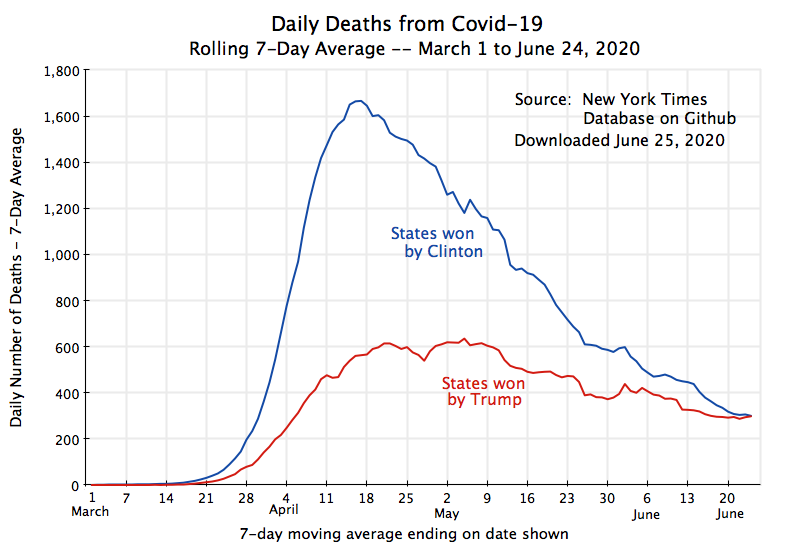
The similar figure for the number of deaths per day from Covid-19:

The number of daily deaths (again using 7-day moving averages) peaked in the Clinton states in mid-April at about 1,670, and has since come down to about 300 (or by 82%).  In the Trump states the peak was only around 600, but it stayed there longer and then came down more slowly, to also around 300 now (so by half).

That the death rates have come down in each is encouraging, but it is still too early to know precisely why.  It may be a combination of factors, including that doctors and hospitals know better now how to treat the most severe cases (with some therapeutics, such as dexamethasone and remdesivir, showing promise, while the doctors also now know that the therapeutic promoted strongly by Trump, hydroxychloroquine, may in fact increase death rates – the FDA has warned against its use).  Also, hospitals have become less crowded at centers of the outbreak, at least until recently, which has allowed them to provide better care.  Finally (and I would guess likely the most important reason, although I have seen no data on this), lower death rates would result if the age distribution of those infected has shifted to those who are younger.  Death rates for the elderly are an order of magnitude higher than for the middle-aged (and two orders of magnitude higher than for the young), so even a relatively modest shift in the age distribution of those infected could lead to a marked change in mortality rates.

Finally, deaths from Covid-19 come only with an average lag that may be a month or more from the day of initial exposure (with this also differing by age).  The number of daily confirmed cases began to rise less than a month ago in the Trump states (around May 30), and more sharply about ten days ago.  We will see in the days and weeks ahead whether this will now lead to a rise in the death figures.  So far, it appears that the daily death numbers have leveled off (since June 17 in the Trump states, and June 21 in the Clinton states), while they had been declining before.

But the sharp increase in the number of new cases over the last month, in particular in the Trump states as social distancing measures were lifted, suggests a number of lessons.  One is that social distancing measures worked.  When they were in place they brought down the number of new cases and deaths from the disease, while lifting them (or increasingly, ignoring them even while formally still in place) has led to a sharp rebound in the number of cases.  Trump has now made this into a political issue, with his flagrant refusal to wear a mask or to keep a distance from others.  In other times this would be considered bizarre behavior in a public health crisis, but is seen here by his supporters as a signal of freedom and independence rather than as a behavior that will lead many of them, as well as others, to become sick (and some to die).

The problem starts at the top.  Rather than model responsible behavior, Trump has insisted he will never wear a mask in public – he believes it hurts his image.  Trump also orchestrated his daily press briefings on the crisis so that through most of March the other officials present were crowded around him, shoulder to shoulder, with no masks.  This only changed (and changed only partially) later.  And now Trump has restarted his political rallies in large indoor arenas, with people crowded tightly together but with few wearing masks, while loud cheering is strongly encouraged.

Most importantly, the Trump administration has failed to address the real and important challenges of this pandemic.  Rather, he has said recently (such as on an interview on June 17 on Fox News) that the coronavirus is “fading away, it’s going to fade away” even if no vaccine is ever developed.  Similarly, at a rally at a megachurch in Phoenix, Arizona, on June 23, to an estimated 3,000 (mostly young) cheering supporters (with few, if any, wearing protective masks), Trump asserted that “It’s going away” while claiming his administration had done a wonderful job.  And over the last week he has repeatedly said that he has asked for less testing to be done, since with less testing there will be fewer cases confirmed.  See, for example, this June 23 tweet, where he says “With smaller [sic] testing we would show fewer cases!”.  Certainly true, but why he would think this wise is worrisome.

Over 124,000 Americans are now dead from the virus (as of today).  This is well more than in any other country in the world (Brazil is second at 55,000).  The US has had 377 deaths per million of population.  In contrast, Japan has had 8 deaths per million, South Korea 6, Australia 4, New Zealand 4, Singapore 4, Hong Kong 0.9, and Taiwan 0.3.  As noted in an earlier post on this blog, the US could learn a lot by simply examining why those countries, all with far closer interactions with China through travel and trade than is the case for the US, have been able to contain the virus while the US has not.

While there are a number of elements to a successful program, one simple but key component is the wearing of masks.  This is common in East Asia, and no one there treats the wearing or not of a mask as a political statement (nor did anyone in the US, until this crisis).  It is simply something easy to do that will protect the health of you, the ones you love, and others.

Yet even now, a full half-year since the start of this crisis, it remains difficult to find in the US the N-95 masks that are the most protective against a viral infection.  Supplies are short, and the masks that are available are provided (as they should be under the circumstances) only to health professionals (although even here there are shortages).  The regular population cannot find such masks other than on a black market (with those available of uncertain pedigree and reliability).  Yet N-95 masks are not hard to make.  3M is the major manufacturer, it is based here in the US, and it would be straightforward to open up additional production lines.  Why hasn’t the Trump administration done something to ensure an adequate supply?

Consider, for example, what a more capable administration might have done.  After ensuring an adequate supply, a box of say a dozen masks per person could be mailed to every household in the US.  With 120 million households (an average of 2.6 people per household), and assuming a production and mailing cost of $20 per household, the total cost would be $2.4 billion.  This is less than one / one-thousandth of the $2.8 trillion that Congress has already approved to be spent to provide partial relief to the effects of the economic crisis brought on by the pandemic.  If everyone then wore such a mask every time they left their home, within a few weeks there would likely be a major knock-back of the infection chain to where focused efforts on the hotspots that might then still remain, or hotspots that later spring up, could be very effective.

This might well be unrealistic.  But even if feasible it would not go far in the current political environment.  Even if an adequate supply of such masks were made available, the politicization by Trump of this public health crisis means that many of his supporters would refuse to wear a mask.  They now see it as a statement of their political, and indeed cultural, beliefs to openly and flagrantly refuse.

As others have noted, it would be hard to find a time when the US was more poorly served by its president than now.

Covid-19: The US Lags Others in the Recovery Thus Far

In those countries where the spread of Covid-19 was not addressed early, all that policy-makers could then do to break its exponential growth was to lockdown the economy.  Schools were closed; non-essential businesses such as theaters, retail establishments, barbershops and hair salons, and similar were also all closed; workers were told to work from home whenever possible; and travel by other than private means was sharply curtailed.

This did succeed in reversing what had been an exponential rise in the spread of the disease, although at a tremendous cost to the economy.  While figures are not yet available on the extent of the downturn, it is clear that this will be the sharpest fall in the US economy since at least the Great Depression.  And the suddenness of the fall is unprecedented.

But as noted, the lockdowns did stabilize the number each day of new cases and of deaths, and started to bring those numbers down.  The disease was still spreading, but not at the pace of before.  There is now pressure from some quarters to lift or even fully end those lockdowns, and that process has indeed already started in much of the US as well as in other countries.  It is still too early, however, to say whether such easing will lead to a resurgence of the disease.  As was seen in January through March, several weeks will go by before one observes whether the number of daily cases will have been affected, and a further two or three weeks before one will see an impact on the daily number of deaths.

One can, however, at this point examine what the impact was of the lockdowns on the spread of the disease.  For the US, those lockdown measures were introduced starting in mid-March and lasted through end-April before they started to be partially lifted in certain jurisdictions.  And one can compare the US record to that of a number of Western European nations who also failed to stop the spread of the virus early, who then had to impose lockdown measures to break the exponential growth and start to bring it down.

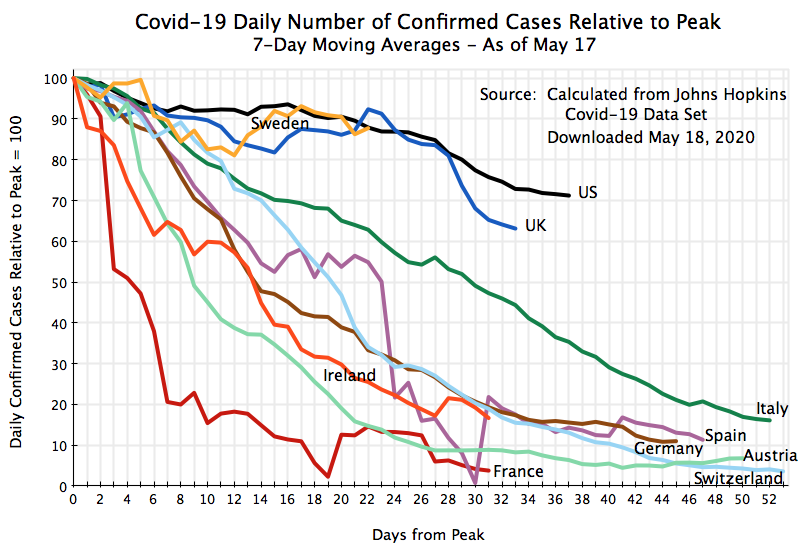
The chart at the top of this post shows how the US record compares to that of a number of Western European countries in terms of the number of daily deaths from Covid-19.  It is not good.  The US is an outlier, with significantly less of a decline in the daily number of deaths than what all of these comparator countries have been able to achieve.

The chart tracks, by days from the peak day in the country, the daily deaths from the disease (using 7-day moving averages to even out the day to day fluctuations in the statistics), with the figures for each country indexed to 100 for the number of deaths on its peak day.  The data cover the period through May 17, and were calculated from the cross-country data assembled by Johns Hopkins.

Thus, for the US there were 29 days (as of May 17) since the peak day in the US of April 18, and by that point the number of daily deaths (using 7-day moving averages) was about 65% of what it was on the peak day.  In terms of absolute numbers, the US had 2,202 deaths (in terms of the 7-day average ending on that day) on April 18, and by May 17 (29 days later) the number of deaths had fallen to 1,434 (or 65% of 2,202).

European countries all did better.  By 29 days after their respective peaks, the number of deaths had fallen to 47% of what it had been in the UK, and to just 13% of what it had been in Austria (with Ireland tracking even lower, but only on its day 22).  The other European countries are all in between.  More could have been added.  I had originally included five other Western European countries in the chart, but it was then hopelessly cluttered.  So I removed those five as they were generally smaller countries (Belgium, the Netherlands, Denmark, Finland, and Portugal), plus their curves all fell in between those of Ireland on the low side and the UK on the high side.

Would the record be different if one drew a similar chart for the number of confirmed cases rather than the number of deaths?  Not really:

Here the UK curve tracks more closely to the US curve until day 28 from the respective peaks, but then fell below.  While this is speculation, one wonders if those in the UK started to take the social distancing measures more seriously once their prime minister, Boris Johnson, ended up in the intensive care unit of a hospital due to the disease (where one should keep in mind that the number of cases will then be affected only several weeks later).

Sweden may also be of interest.  In contrast to other countries, Sweden never issued legally binding lockdown orders, but rather just guidelines.  The result, however, was that the number of cases has not come down much from its peak (see the chart).  While still early, the number of daily new cases is close to 90% of what it was at its peak.  This is similar to what it was for the US at the same point in terms of the number of days from the respective peaks.  The UK path was also broadly similar at that point.

There is a difference, however, in terms of how far deaths had come down (the chart at the top of this post).  The path for Sweden has been below that of the US and in the range of other European countries.  From these observations alone one cannot say why Sweden has seen a greater reduction in its daily number of deaths (relative to their respective peaks) despite a similar number of cases as the US (relative to their peaks).  It might be because Sweden enjoys a much better health care system than the US (despite the US spending 60% more than Sweden as a share of GDP).  The age composition of those coming down with the disease might also be a factor, if younger people are, on average, a higher share of those being infected in Sweden than in the US.

But overall, the key question is why has the US performed more poorly than all the others in bringing down the number of deaths?  There are a number of possible reasons, and these reasons are not mutually exclusive – they could all be contributory.  They include:

a)  There was no national lockdown order given, but rather different states issued their orders at different times, mostly between mid-March and the beginning of April.  Indeed, a few, generally less populous, states never even issued formal lockdown orders, but simply guidelines.  This would spread out the impact, leading to less of a fall in the number of deaths relative to the national peak for any given day.

b)  Those lockdown orders varied greatly in terms of their degree of strictness.  Some were strong, and some notably lax.  Furthermore, enforcement was typically lax.  The lockdown orders were usually more serious (and much more seriously enforced) in Europe (but with Sweden as an exception).

c)  Cultural factors undoubtedly also entered.  Some Americans took social distancing measures seriously – others did not.  Indeed, some have been especially loud and insistent on not obeying such orders, in a childish display of contrariness.  They assert they have a constitutional right to do as they please (even if this may infect others with a deadly disease).

But perhaps the most important reason for the poor record of the US has been the failure of responsible presidential leadership.  There has been no coherent, and scientifically informed, national policy.  Trump spent two months denying that the virus was a concern, and the US failed to take the critical early actions which could have stemmed the spread (as the developed countries of East Asia and the Pacific were all able to do, and successfully so).  Then, when he was finally forced to admit the obvious (spurred more by a crashing stock market than by the disease itself), he has only reluctantly backed the measures needed to address the crisis.  And he has personally not modeled the behavior that the federal government’s own guidelines call for:

a)  He refused, and continues to refuse, to wear a mask in public.

b)  He continued to shake hands with those close by (leading to awkward, and amusing, moments when the other party had begun some other action of greeting).

c)  Rather than follow the social distancing guidelines at his highly publicized daily press briefings, for several weeks he had for the cameras a large number of officials and assistants all standing shoulder to shoulder around him.

d)  Most recently, Trump confirmed that he has started to take the controversial drug hydroxychloroquine, despite FDA warnings that to do so was dangerous.  Indeed, a recent study found that a higher share of Covid-19 patients who took the drug ended up dying than did those not given the drug.  Along with some of his other suggestions (such as to examine ingesting bleach or some other disinfectant to kill the virus – which health officials hastened to tell everyone not to do as it could kill them), Trump has conveyed to the public a disrespect for science and instead to do what he believes “in his gut”.

Coupled with Trump’s twitter outbursts (including the early encouragement of small, but well-organized, groups of gun-brandishing demonstrators in several states calling for an immediate lifting of the lockdown measures), it should not be a surprise that the US has been a laggard compared to what other nations have been able to accomplish.

Politicizing this public health crisis, as Trump has, will now also make it more difficult to emerge from it.  Guidelines that had been prepared by the CDC on how to safely reopen the economy, and which would have been issued on May 1, were instead suppressed by the White House.  Trump instead announced (following intensive lobbying by affected industries), that he did not want cautions to continue, but rather that everything should be quickly reopened back to “where it was” three months ago.

With such political pressures superseding the recommendation of health professionals, many will approach any opening even more cautiously than they otherwise would have.  With uncertainty as to whether restaurants, say, were re-opened because it was truly safe or because of political pressures, many will hold off on patronizing them for an extended time.  I certainly will.