Unknown's avatar

About aneconomicsense

Economist

Trump’s Claims on the Economy and the Reality: A Comparison of Trump to Biden and Obama

“We had the greatest economy in the history of the world.  We had never done anything like it. … Nobody had seen anything like it.”

Donald Trump, Republican National Convention, Milwaukee, July 18, 2024

A.  Introduction

Donald Trump is fond of asserting that the US “had the greatest economy in the history of the world” while he was president.  He claimed this when he accepted the nomination at the Republican National Convention (as quoted above); he claimed it when he debated President Biden in June; and it is a standard line repeated at his campaign rallies.  He also asserts that this is all in sharp contrast to the economy he inherited from Obama and to where it is now under Biden.  In a June 22 speech, for example, Trump said “Under Biden, the economy is in ruins.”

These assertions of Trump are not new.  He was already repeatedly making this claim in 2018 – in the second year of his administration – asserting that the US was then enjoying “the greatest economy that we’ve had in our history” (or with similar wording).  And he repeated it.  The Washington Post Fact Checker recorded in their database that Trump made this claim in public fora at least 493 different times (from what they were able to find and verify) by the end of his term in January 2021.

Repetition does not make something true.  And numerous fact-checkers have shown that the assertion is certainly not true (see, for example, here, here, and here, and for the 2018 statements here).  But readers of this blog may nonetheless find a review of the actual data to be of interest, and in charts so that the extent to which Trump is simply making this up is clear.

The post will focus on Trump’s record compared to that of Obama’s second presidential term (immediately before Trump) and Biden’s presidential term (immediately after).  The post will also show that even if you just focus on the first three years of his presidential term – thus excluding the economic collapse in his fourth year during the Covid crisis – Trump’s record is nothing special.  The collapse in that fourth year was certainly severe, and with that included Trump’s record would have been one of the worst in US history.  But Covid would have been difficult to manage even by the most capable of administrations.  Trump’s was far from that, and that mismanagement had economic consequences, but Trump’s record is not exceptional even if you leave that fourth year out.

This post complements and basically updates a longer post on this blog from September 2020.  That post compared Trump’s economic record not only to that of Obama but also to that of American presidents going back to Nixon/Ford.  I will not repeat those comparisons here as they would not have changed.  I will focus this post on just a few of the key comparisons, adding in the record of Biden.

B.  The Record on Growth

The two charts at the top of this post show how Trump’s record compares to that of Obama and Biden in the two measures most commonly taken as indicators of economic performance – growth in national output (real GDP) and growth in total employment (jobs).  This section will focus on Trump’s not-so-special record on growth, while the section following will focus on employment.

Trump has repeatedly asserted that economic growth while he was president surpassed that of any in history.  This is not remotely true in comparison to growth under a number of post-World War II presidents.  (Quarterly GDP statistics only began in 1947 so older comparisons are more difficult, but there were certainly many other cases further back as well.)  Giving Trump the benefit of excluding the economic collapse in 2020 during the Covid crisis, real GDP grew at an annual rate of 2.8% over the first three years of Trump’s presidential term.  But real GDP grew at an annual rate of 5.3% during the eight years of the Kennedy/Johnson presidency; at a rate of 3.7% during the Clinton presidency; 3.4% during Reagan; and 3.4% as well during the Carter presidency.  The 2.8% during the first three years of Trump is not so historic.  Carter’s economic record is often disparaged (inappropriately), but Carter’s record on GDP growth is significantly better than that of Trump – even when one leaves out the collapse in the fourth year of Trump’s presidency.

Nor is the Trump record on growth anything special compared to that of Biden or Obama.  As seen in the chart at the top of this post, growth under Biden over the first three years of his presidency matched what Trump bragged about for that period (it was in fact very slightly higher for Biden).  GDP growth then remained strong in the fourth year of Biden’s presidency instead of collapsing.  Growth in the Obama presidential term immediately preceding Trump was also similar:  sometimes a bit above and sometimes a bit below, and with no collapse in the fourth year.  It was also similar in Obama’s first term once he had turned around the economy from the economic and financial collapse he inherited from the last year of the Bush presidency.

Trump’s repeated assertion that “we had the greatest economy in the history of the world” was a result – he claimed – of the tax cuts that Republicans rammed through Congress (with debate blocked) in December 2017.  While the law did cut individual income tax rates to an extent (heavily weighted to benefit higher income groups), the centerpiece was a cut in the tax rate on corporate profits from 35% to just 21%.  The argument made was that this dramatic slashing of taxes on corporate profits would lead the companies to invest more, and that this spur to investment would lead to faster growth in GDP benefiting everyone.

That did not happen.  As we have already seen, real GDP did not grow faster under Trump than it had before (nor since under Biden).  Nor, as one can see in the chart at the top of this post, was there any acceleration in the pace of GDP growth starting in 2018 when the new tax law went into effect in the second year of his presidential term (i.e. starting in Quarter 5 in the charts).

The promised acceleration in growth was supposed to be a consequence of a sustained spur to greater private investment from the far lower taxes on corporate profits.  There is no evidence of that either:

The measure here is of fixed investment (i.e. excluding inventories), by the private sector (not government), in real terms (not nominal), and nonresidential (not in housing but rather in factories, machinery and equipment, office structures, and similar investments in support of production by private firms).

This private investment grew as fast or often faster under Obama (when the tax rate on corporate profits was 35%) as under Trump (when the tax rate was cut to just 21%).  Growth under Biden has also been similar, even though the tax rate on corporate profits remains at 21%.  This similar growth is, in fact, somewhat of a surprise, as the Fed raised interest rates sharply starting in March 2022 with the aim of slowing private investment and hence the economy in order to bring down inflation.

With the far lower corporate profit tax rates going into effect in the first quarter of 2018 and the Fed raising interest rates starting in the first quarter of 2022 – both cases in the fifth quarter of the Trump and Biden presidential terms respectively – a natural question is what happened to private investment in the periods following those changes?  Rebasing real private non-residential fixed investment to 100 in the fourth quarter of the presidential terms, one has:

The paths followed by private investment under Biden (facing the higher interest rates of the Fed) and under Trump (following corporate profit taxes being slashed) were largely the same – with the path under Biden often a bit higher.  They diverged only in the 12th quarter of each administration (the fourth quarter of 2019 for Trump, and the fourth quarter of 2023 for Biden).  Under Trump, private investment fell in that quarter – well before Covid appeared – and then collapsed once Covid did appear.  Under Biden, in contrast, it kept rising up until the most recent period for which we have data.

It is also worth noting that private investment during the similar period in Obama’s second term rose by even more than under Trump (and for a period faster than under Biden, although later it rose by more under Biden).  This was despite a tax rate on corporate profits that was still at 35% when Obama was in office.  There is no evidence the tax rate mattered.  And although not shown in the chart here, private investment rose by far more in the similar period during Obama’s first term (although from a low base following the 2008 economic collapse).

With similar growth in such investment in all three presidential terms (leaving out the collapse in 2020), the conclusion one can draw is that taxes at such rates on corporate profits simply do not have a meaningful impact on investment decisions.  Decisions on how much to invest and on what depend on other factors, with a tax rate on profits of 21% or of 35% not being central.  Nor did the Fed’s higher interest rates matter all that much to investment during Biden’s term.  With a strong economy under Biden, firms recognized that there were investment opportunities to exploit, and they did.

The far lower tax rate of 21% on corporate profits did, however, lead to a windfall gain for those who owned these companies.  Far less was paid in such taxes.  That is, the tax cuts did have distributional consequences.  But they did not spur private investment nor overall growth.  They did not lead to “the greatest economy in the history of the world”.

C.  The Record on Employment

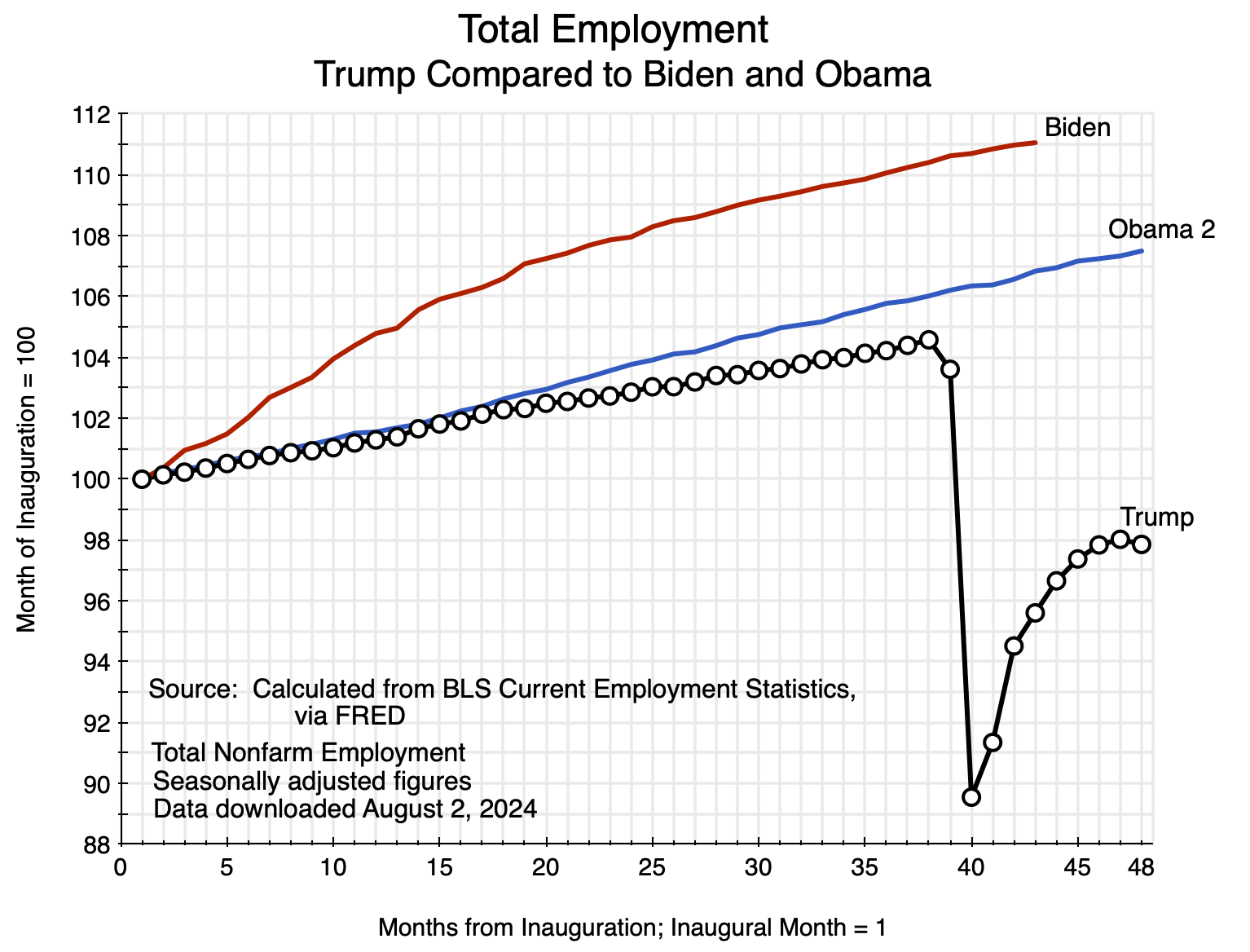
As seen in the chart at the top of this post, growth in total employment was higher under Obama than it was under Trump, and has been far higher under Biden – even if you restrict the comparison to the first three years of the respective presidential terms.  In the face of this clear evidence in favor of Biden’s record, Trump has now started to assert that the growth in jobs under Biden was due to a “bounce back” in jobs following the collapse in the last year of his administration, or that they all went to new immigrants.  But neither is true.

First, as one can see in the chart there has been strong growth in the number employed not only early in Biden’s administration but on a sustained basis throughout.  And second, nor was the growth only in the employment of immigrants.  The Bureau of Labor Statistics provides figures from its Current Population Survey (CPS) of households on the employment of those who were born in the US (the native-born) and those born abroad (the foreign-born).  Leaving out the collapse in 2020, employment growth over the first three years of Trump’s presidential term of the native-born averaged 1.3% per year.  During the first three years of the Biden presidential term, employment growth of the native-born averaged 1.8% per year.  The growth in employment of the native-born was not zero under Biden – as Trump claims – but rather was faster under Biden than under Trump.  While there is a good deal of noise in the CPS figures (which will be discussed below), these numbers do not provide support for Trump’s assertion.

There has also been concern expressed in the media with what was interpreted as a “disappointing” growth in employment in July.  The BLS “Employment Situation” report for July, released on August 2, indicated that employment rose by an estimated 114,000 in the month.  This is a good deal below the average in the 12 months leading up to July of 209,300 per month.  But an increase of 114,000 net new jobs in the month is substantial.  While there will often be large month-to-month fluctuations, one should not expect more on average going forward.

With the economy basically at full employment (the recent uptick in the unemployment rate – to a still low 4.3% – will be discussed below), the number employed cannot grow on a sustained basis faster than the labor force does.  And the labor force will grow at a monthly pace dictated by growth in the adult civilian population (i.e. age 16 and over) and what share of that adult population chooses to participate in the labor force.  The labor force participation rate in July was 62.7% and has been trending downward over the past several decades.  While a number of factors are behind this, the primary one has been the aging of the population structure with the Baby Boom generation moving into their normal retirement years.

The BLS report (using figures obtained from the Census Bureau) indicates that the adult civilian population rose by an average of 136,800 per month in the 12 months leading up to July.  At a labor force participation rate of 62.7%, the labor force would thus have increased by 85,800 per month.  Without an increase in the labor force participation rate, employment cannot grow faster than this on a sustained basis going forward.

In the past 12 months, however, the BLS report for July indicates that the labor force in fact grew at an average pace of 109,700 per month.  How was this possible?  The reason is that although the labor force participation rate is on a long-term downward trend due to the aging population, there can be and have been fluctuations around this trend.  And a small fluctuation can have a significant effect.  The labor force participation rate one year ago in July 2023 was 62.6%, and thus the rate in fact rose by 0.1% from July 2023 to July 2024.  If the labor force participation rate in July 2023 had in fact been 62.7%, then the labor force in July 2023 would have been 167,410,000 rather than the actual 167,113,000, and the increase over the 12 months leading to July 2024 would have averaged 84,900.  Within round-off, this is the same as the 85,800 figure calculated in the preceding paragraph for a constant 62.7% labor force participation rate,  (With more significant digits, the labor force participation rates were 62.589% and 62.696% respectively, and a constant 62.696% participation rate would have yielded the 85,800 figure for labor force growth.)

We should therefore not expect, going forward, that monthly employment will increase on a sustained basis by more than about 90,000 or so, or even less.  It could be higher if the labor force participation rate increases (and a small change can have a major effect), but the trend over the past couple of decades has been downward – as noted already – due to the aging of the population.  How then, was it possible for employment to have gone up by an average of 209,300 per month over the past year?  And this was also a period where the estimated unemployment rate rose from 3.5% in July 2023 to 4.3% in July 2024, which “absorbed” a share of the increase in the labor force as well.

The reason for these not fully consistent numbers is that employment estimates come from the Current Employment Statistics (CES) survey of establishments where people are employed, while the labor force and unemployment estimates come from the different Current Population Survey (CPS) – a survey of households.  The CES is a survey of nonfarm employers in both the private and public sectors, and covers 119,000 different establishments at 629,000 different worksites each month.  The “sample” (if it can be called that) covers an estimated one-third of all employees.

The CPS, in contrast, is a survey of about 60,000 households each month.  There will only generally be one or two members of the labor force in each household, so the share of the labor force covered will be far less than in the CES.  If each household had two members in the labor force, for example, the total of 120,000 would be only 0.07% of the labor force –  a sharp contrast to the one-third covered in the CES.  There is therefore much more statistical noise in the CPS data.  There are also definitional differences:  The CPS will include not only those employed on farms but also the self-employed and those employed in households.  Also, a person with two or more jobs will be counted as one person “employed” in the CPS.  The CES, in contrast, counts the employees of a firm, and the employers will not know if the individual may be working at a second job as well.  Thus a person working two jobs at two different firms will be counted as two “employees” in the CES.

These definitional differences are not major, however, and in part offset each other.  An earlier post on this blog looked at these differences in detail, and how, in an earlier period (2018/2019) there was a substantial deviation in the employment growth figures between the estimates in the CES and the CPS.  This was the case even with the figures adjusted (to the extent possible) to the same definition of “employment” in each.  There is a similar deviation between the employment estimates in the CES and in the CPS currently, with this accounting for a strong growth in employment as estimated by the CES (of 209,300 net new jobs each month over the past year) even though the labor force has grown -according to the CPS – by a more modest 109,700 per month over this period.

The labor market remains tight, however, even with the rise in the estimated unemployment rate to 4.3% in July:

The unemployment rate fell rapidly under Biden, following the chaos of 2020.  It was at a rate of 3.9% or less for over two years (27 months), despite the efforts by the Fed to slow the economy by raising interest rates.  The unemployment rate was also 3.9% or less for a period under Trump (for 20 months).  But as one sees in the chart, during the first three years of Trump’s term it basically followed the same downward path as it had under Obama.  It then shot up in March 2020 when the nation was caught unprepared for Covid.  As with the other key economic indicators (the growth in GDP, in employment, and in private investment), the paths followed by the economy during the first three years of Trump’s term were basically the same as – although usually not quite as good as – the paths set during Obama’s presidency.  They all then collapsed in Trump’s fourth year.

Any unemployment rate near 4%, and indeed near 5%, is traditionally seen as low.  Economists have defined the concept of the “Non-Accelerating Inflation Rate of Unemployment” (NAIRU) as the rate of unemployment that can be sustained without being so low that inflation will start to rise.  While one can question how robust this concept is (as will be discussed below), the NAIRU rate of unemployment has generally been estimated (for example by the staff at the Federal Reserve Board) to be between 5 and 6%.  An unemployment rate of 4.3% is well below this.  While the unemployment rate has gone up some in recent months, it is still extremely low.

D.  The Record on Real Living Standards

Ultimately, what matters is not the growth in overall output (GDP) or in employment, but rather in real living standards.  Many have asserted that because of recent inflation, living standards have gone down during Biden’s presidential term.  This is not true, as we will see below.  But first we will look at inflation.

Inflation rose significantly early in Biden’s presidential term.  The pace moderated in mid-2022, but until recently prices continued to rise:

Inflation was less during Trump’s term in office but was even lower under Obama.  Indeed, consumer price inflation has been low since around 1997, during Clinton’s presidency, until the jump in 2021.  Why did that happen?

The rise in 2021 can be attributed to both demand and supply factors.  On the demand side, both Trump and Biden supported and signed into law a series of genuinely huge fiscal packages to provide relief and support during the Covid crisis.  The packages were popular – especially the checks sent to most Americans (up to a relatively high income ceiling) that between the various packages totaled $3,200 per person.  But the overall cost for all the various programs supported was $5.7 trillion.  That is huge.  The funds were spent mostly over the two years of 2020 (under Trump) and 2021 (under Biden), and $5.7 trillion was the equivalent of 12.8% of GDP over those two years.  Or, as another comparison, the total paid in individual income taxes in the US in the single year of FY2023 was “only” $2.2 trillion.

While there was this very substantial income support provided through the series of Covid relief packages, households were limited in how much they could spend – out of both these income transfers and their regular incomes – in 2020 due to the Covid pandemic.  One went out only when necessary, and kept only to shopping that was necessary.  This carried over into early 2021.  But people could become more active as the Biden administration rolled out the massive vaccination campaign in the first half of 2021.  People then had a backlog of items to buy as well as the means to do so from what had been saved in 2020 and early 2021.  Demand rose sharply, and indeed Personal Consumption Expenditures in the GDP accounts rose by more in 2021 (by 8.4%) than in any year since 1946 (when it rose by 12.4%, and for similar reasons).

But at the same time, supply was constrained.  Supply chains had been sharply disrupted in 2020 worldwide due to Covid, and took some time to return to normal.  There was then the additional shock from the Russian invasion of Ukraine in February 2022, leading oil and many other commodity prices to spike.

Supply chains did, however, return more or less to normal early in the summer of 2022.  And as they did, one saw a sudden and sharp reduction in pressures on prices, in particular on the prices of goods that can be traded:
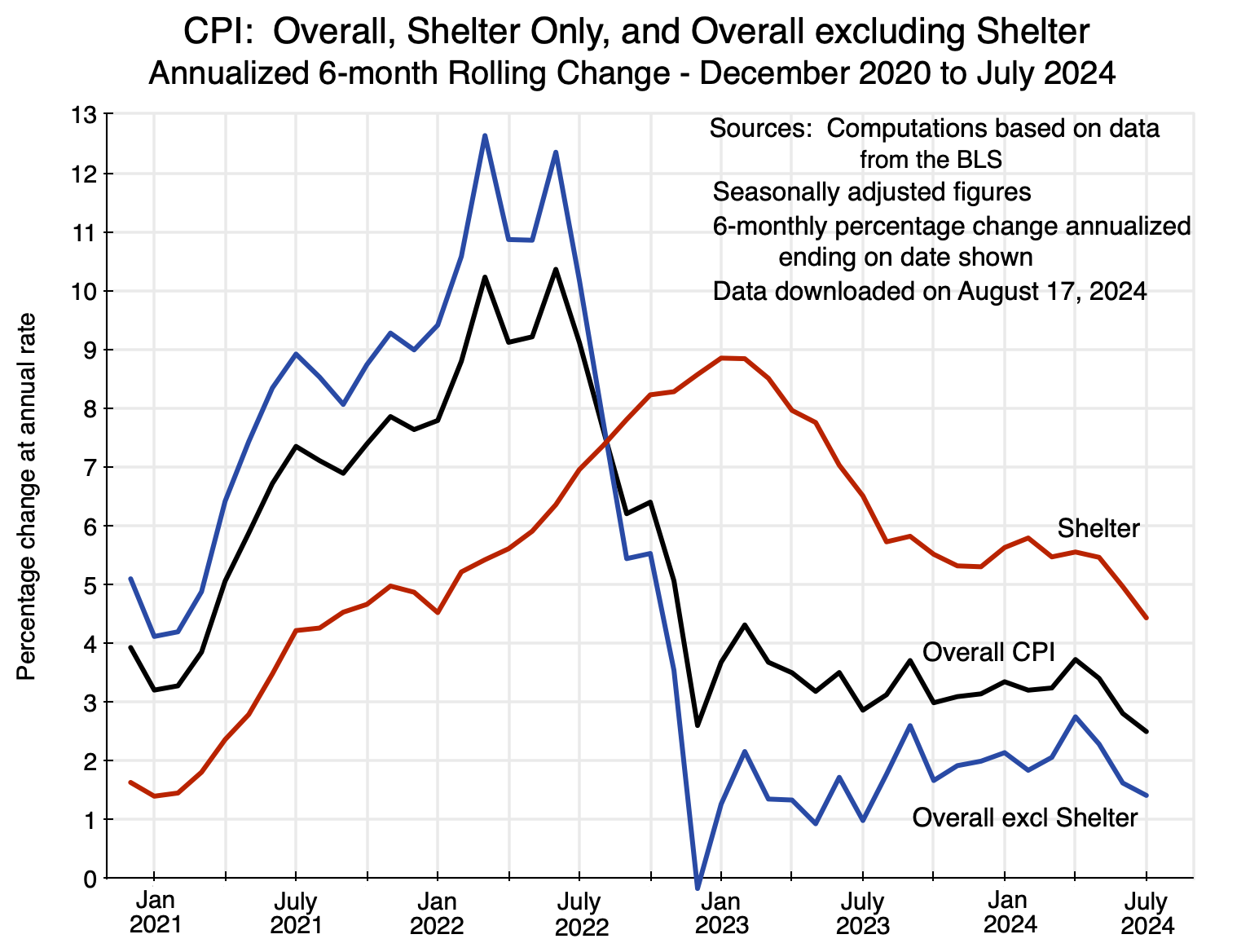
This chart shows the annualized inflation rates for 6-month rolling periods (ending on the dates shown) for the overall CPI, for the shelter component of the CPI, and for the CPI excluding shelter.  The overall inflation rate rose from an annualized rate of 3.2% in the six months ending in January 2021 (the end of Trump’s term) to a peak of 10.4% in the six months ending in June 2022.  It then fell remarkably fast, to an annualized rate of just 2.6% in the six months ending in December 2022.

This sudden drop in the inflation rate is seen even more clearly in the CPI index of prices for everything but shelter:  The annualized rate fell from 12.4% in the first half of 2022 (the six months ending in June) to a negative 0.2% rate in the second half of 2022 (the six months ending in December).  Why?  There was not a sudden collapse in consumer or other demand.  Rather, supply chains finally normalized in the summer of 2022, and this shifted pricing behavior.  When markets are supply constrained (as they were with the supply chain problems), firms can and will raise prices as competitors cannot step in and supply what the purchaser wants – they are all supply constrained.  But as the supply chains normalized, pricing returned to its normal condition where higher demand can be met by higher production – whether by the firm itself or, if it is unwilling, by its competitors.  It is similar to a phase change in conditions.

Shelter is different.  It covers all living accommodations (whether owned or rented), and as has been discussed in earlier posts on this blog (see here and here), the cost of shelter is special in the way it is estimated for the CPI.  It is also important, with a weight of 36% in the overall CPI index (and 45% in the core CPI index, where the core index excludes food and energy).  The data for the shelter component of the CPI comes from changes observed in the rents paid by those who rent their accommodation, and rental contracts are normally set for a year.  Hence, rental rates (and therefore the prices of the shelter component of the CPI) respond only with a lag.  One can see that in the chart above, with the peak in the inflation rate for shelter well after the peak in the inflation rate for the rest of the CPI.

Since mid-2022, the rate of inflation as measured by the overall CPI has generally been in the range of 3 to 4% annualized.  Increases in the cost of shelter have kept it relatively high and above the Fed’s target of about 2% per annum.  But as seen in the chart, it has recently come down – falling to an annualized rate of 2.5% in the six months ending in July.  For everything but shelter, the rate in the six months ending in July was only 1.4%.

One question that some might raise is whether the very tight labor markets – with an unemployment rate that was 4% or less until two months ago – might have led to the inflation observed.  The answer is no.  As noted above, inflation in all but shelter fell suddenly in mid-2022, falling from a rate of 12.4% in the first half of the year to a negative 0.2% in the second half, even though the unemployment rate was extremely low at 4% or less throughout (and only 3.5 or 3.6% in all of the second half of 2022).  Unemployment has remained low since while inflation has come down.  If the cause was tight labor markets, then the rate of inflation would have gone up rather than down.

Similarly, inflation as measured by the CPI was not high in 2018 nor in 2019 when labor markets were almost as tight during Trump’s presidency – with overall inflation then between 2 and 3% on an annual basis.  Nor did inflation go up during the similarly tight labor market of 1999 and 2000 during the Clinton presidency:  CPI inflation was generally in the 1 1/2 to 3 1/2 % range during that period.  All this calls into question the NAIRU concept, with its estimate that an unemployment rate below somewhere in the 5 to 6% range will lead to pressures that will raise the rate of inflation.

Managing inflation coming out of the chaos of 2020 was certainly difficult.  Inflation spiked in most countries of the world following the Covid crisis, reaching a peak in 2022.  But the rate of inflation has since come down as supply conditions normalized.  That does not mean that the absolute level of prices came down, only that they were no longer increasing at some high rate.  Wages and other sources of income will then adjust to the new price levels, and what matters in the end is whether real levels of consumption improve or not.  And they have:

The chart shows the paths followed for per capita real levels of personal consumption expenditures, as measured in the GDP accounts, during the presidential terms of Trump, Biden, and the second term of Obama.  The path followed under Trump was basically the same as that followed under Obama – until the collapse in the last year of Trump’s term.  The path followed under Biden has been substantially higher than either.  It was boosted in his first year as the successful vaccination campaign allowed people to return to their normal lives.  They could then purchase items with not only their then current incomes, but also with the savings they had built up in 2020.  But even if one excludes that first year, the growth under Biden has been similar to that under Obama and under Trump up to the collapse in Trump’s fourth year.

Once again, there is no basis for Trump’s claim of the “greatest economy”.

E.  Summary and Conclusion

The economy during Trump’s presidency was certainly not “the greatest in the history of the world”.  Nor was it even if you leave out the disastrous fourth year of his presidency.  Covid would have been difficult to manage even by the most capable of administrations, and Trump’s was far from that.  Instead of preparing for the shock this highly contagious disease would bring, Trump’s response was to insist – repeatedly – “it’s going to go away”.

Trump’s economic record was certainly nothing special.  Real GDP grew as fast or faster under Obama and Biden as it had under Trump.  Trump insisted that growth would be – and was – spurred by the tax cuts that he signed into law in late 2017 that slashed the tax on corporate profits.  But there is no indication of this in the data.  Nor is there even any indication that private investment rose as a result of the lower taxes.

Employment has grown far faster under Biden than it had under Trump, and also grew faster in Obama’s second term – even leaving out Trump’s disastrous fourth year.  Unemployment fell during the first three years of Trump’s term in office (before sky-rocketing in his fourth year), but here it just followed a very similar path to that under Obama.  For this, as with GDP and employment growth, perhaps the biggest accomplishment of Trump’s first three years in office was that he did not mess up the path that had been set under Obama.  And unemployment has been even lower under Biden.

Inflation was certainly higher in 2021 as the US came out of the Covid crisis.  Supply chains were still snarled, but there was pent-up demand from consumers who had had to avoid shopping in 2020 due to Covid and who also benefited from a truly huge set of Covid relief packages passed under both Trump and Biden.  Supply chains then normalized in mid-2022, sharply reducing pricing pressures for goods other than shelter.  Due in part to lags in how rental rates for housing are set (as they are normally fixed for a year) and then estimated by the BLS, the cost of the shelter component of the CPI came down more slowly than the cost of the rest of the CPI.  This kept inflation as measured higher than what the Fed aims for, although recently (in the last half year) it has come down again.  Most anticipate that the Fed will soon start to cut interest rates from their current high levels.  The inflationary episode resulting from the Covid crisis appears to be coming to an end.

There is thus no justification for the claim by Trump that “we had the greatest economy in the history of the world”.  Yet he has repeatedly asserted it, both now and when he was president.  Why?  Stephanie Grisham, who served in the Trump administration as press secretary and in other senior positions, and who had been – by her own description – personally close to Trump, explained it well in a speech she made on August 20 to the Democratic National Convention.  She noted that Trump used to tell her:  “It doesn’t matter what you say, Stephanie.  Say it enough, and people will believe you.”

Many do appear to believe that the economy was exceptionally strong when Trump was president:  that it was “the greatest in history”.  But that is certainly not true.  Facts matter; reality matters; and a president needs to know that they matter.
Incomes by Field of Study for College Graduates: The Distribution Matters More Than the Average

There are numerous articles and studies on the average earnings of college graduates broken down by what they majored in when in college.  Some provide estimates for a comprehensive list of college majors, while some focus on the earnings of the top 10 or bottom 10 ten college majors.  Some focus on earnings soon after college graduation, some on earnings at mid-career, and some on earnings over a lifetime.  And some use private sources of data while others use publicly available data provided by the Census Bureau or some other government agency.  See, as examples, here, here, here, here, here, here, here, here, here, here, here, here, here, here, here, here, here, or here.

Also, some report average earnings while some report median earnings (where 50% of the individuals earn more and 50% earn less).  But all focus on such a single measure of the earnings a graduate might expect had they chosen to major in a given field of study.

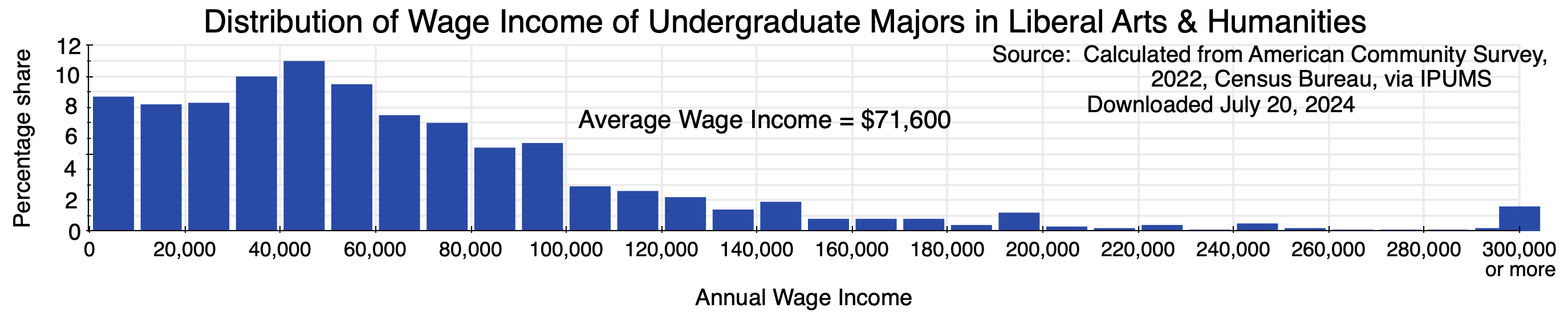
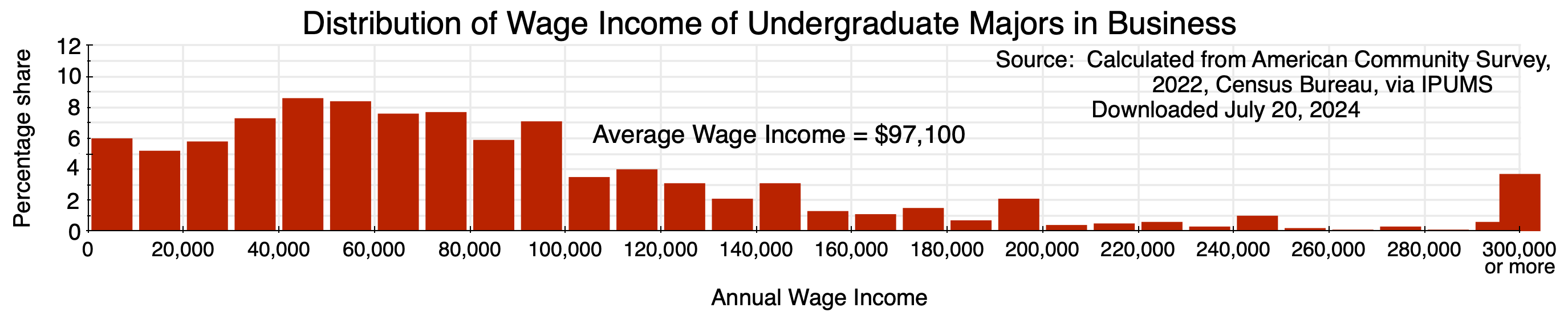
This misses a lot.  No one earns the average nor the median.  There is, rather, a range of earnings above and below those average (or median) figures, and as we see in the charts at the top of this post, it is a very wide range.  The distributions overlap each other a lot, and the peak share is not all that high.

In the examples presented above, the average wage and salary earnings of those who majored in Business ($97,100) are more than a third higher than the average earnings of those who majored in one of the fields in the Liberal Arts & Humanities ($71,600).  (The source of the data for these estimates is discussed in a note at the end of this post.)  But despite the average for Business majors being more than a third higher, the earnings at the top end (the top third, say) of those who majored in one of the Liberal Arts & Humanities fields were far higher than the earnings of those who were at the bottom end (the bottom third, say) for the Business majors.

That is, it is not just the averages that matter.  It is much more important whether your earnings will be towards the top end of a given field rather than closer to the bottom end of some alternative field, even if average earnings in that alternative field may be higher.  The choices students make on what field to study in college can and should take this into account.

Instead of deciding to major in some field where the numerous articles available advise you may earn a higher income on average, it is far more worthwhile and consequential to decide on a field of study based on where you believe you can do well:  a field you can fully master and where you perform exceptionally well, and thus where there is good reason to expect you will be able to do better than others in that area.  Indeed, you should only major in a field where you have a sound basis for the belief you can be at or close to the very top in that field.

This will likely also be a field that you personally enjoy.  Expertise in a field and personal enjoyment in it usually go hand-in-hand.  You enjoy working in areas that you are good at.  And due to the broad overlap in the distributions of earnings across the different fields, this will likely also lead to far higher earnings than majoring in a field that one is not terribly good at, even if the average earnings in that field are higher.

There is, or at least there should be, of course much more than earnings to consider.  But this is a further reason to choose a field based on what one is good at, as that will likely lead to a more fulfilling career as well.

The most difficult part of this is determining what field of study will, in fact, be one where you are relatively good compared to others in that field.  The only way to discover this is to try a range of possible fields and see where you do well.  The first two years of college should normally be such a time of exploration, where you take courses in a range of subjects and see where you excel and where you struggle.  You will also see what you enjoy and what you do not.  And one should not be surprised if you end up choosing a field you had not expected.  Personally, none of my friends in college ended up majoring in the field they thought they would when starting out as a freshman, and nor did I.  There is absolutely nothing wrong with this.

The difficult part is recognizing where one can in fact perform near the top of those in the field and where you are fooling yourself.  Numerous studies have shown that people typically overestimate their skills relative to others.  For example, a now classic study from 1981 found that 93% of Americans in a sample believed they were more skillful car drivers than the median driver, and 88% were safer drivers.  Of course, only 50% can be more skillful, or safer, than the median.  The study has more recently (in 2023) been replicated, while a meta-study from 2019 confirmed the general problem:  Most of us feel we are better-than-the-average in many domains.

So how can we keep from fooling ourselves?  While not easy, the grades received in the range of courses taken when in the exploration stage of college should be an indication.  But for this, one needs to take challenging courses and not simply those where one can get a high grade without much in terms of effort or performance.  It also requires professors willing and able to provide grades that are true indicators of performance, and not simply uniformly high grades to everyone as the easy path to follow.  While it may not feel like it at the time, the most valuable gift one can receive is to get a poor grade in a field you are considering to major in but in which you in fact are not performing all that well.  It is far better to discover this when in college, rather than years later in a career in a field that you are not all that good at.

That is also why one should not pay much attention to an overall grade point average.  While grades in your senior year can demonstrate whether you have mastered the field, grades as a freshman or sophomore should reflect experimentation over a range of subject areas in those years, where some of those grades may be good and some not-so-good.

College should be a time of discovery – a time when you can explore many different fields and find out where you can in fact do well and where not.  It should be a time when you receive what I would term a true “education” by mastering in depth some particular field of study.  By the time of graduation one should have learned “how to think like a _____ ” (with the blank filled in based on the specific field).  That is, have you developed a deep and thorough understanding of the field?  Or have you basically only memorized some of its findings or conclusions, without a good understanding of how they were reached?  A career can be built on the former, but the latter soon dissipates.


=======================

Note on the Data:

The data for the charts come ultimately from the American Community Survey (ACS) of the US Census Bureau.  The ACS is an annual survey (with the most recently released data from 2022) based on a very large sample of about 2 million households interviewed each year.   While the Census Bureau provides easy access to tables based on the ACS for average figures, to obtain the full distribution of earnings – such as in the charts above – one needs to extract data from the Public Use Microdata Sample.  This provides, for a representative sample of the households surveyed, the full set of responses to the questionnaire at the level of the individual household.  One can then extract the wage and salary earnings of those individuals with a Bachelor’s degree who majored in a given field, and from this determine the full distribution of those earnings, not just the average.  I included all adults with a Bachelor’s degree at all age levels.

Operationally, I extracted the data via the IPUMS USA website (an institute based at the University of Minnesota – IPUMS is an acronym for “Integrated Public Use Microdata Series”).  IPUMS provides easy access to the ACS data through an online data analysis tool so no special statistical analysis software (such as SPSS or SAS) is required (although those are supported as well at the IPUMS site).  The IPUMS USA site includes data not only from the most recent ACS survey, but from each of the ACS surveys going back to 2000, and to the decennial US census going all the way back to 1790.  In addition, there are separate IPUMS sites for a range of other microdata files, both for the US and internationally.

Maintaining Social Security Benefit Payments Once the Trust Fund is Depleted Will NOT Increase the Government Deficit

A.  Introduction

As many are aware, based on the most recent forecast and if nothing is done, the Social Security Trust Fund is expected to be fully depleted by 2035.  Under current law that sets the operating rules for the Social Security system, benefit payments made to retirees and the disabled would then have to be scaled back to a level that would match the Social Security taxes being paid into the system each year.  This would mean a reduction of about 16% (based on current forecasts) from the payments that retirees and other beneficiaries of the system would have otherwise received in 2035.

That would be catastrophic.  Retirees and others depend on their monthly Social Security checks, and slashing those by 16% would mean a dramatic fall in the living standards of many.  In the aggregate, the cut in payments would amount to about 1% of GDP.  Even if one were to ignore the impact on the retirees who depend on their Social Security checks, a sudden scaling back of those payments by 1% of GDP could very well throw the economy into a recession.

What would happen if Congress were instead to fund that shortfall through the regular federal budget?  The amount is certainly large, at 1% of GDP or, in terms of the GDP forecast for 2035, about $425 billion.  How much would the federal deficit (and federal borrowing needs) then increase relative to what it would have been before the Trust Fund was depleted?

The answer is:  Nothing.  None.  Zero.  Zilch.  Nada.  Not a dime.

There would be no impact on the deficit.  Government borrowing in the financial markets would be exactly the same as before.  It is true that the deficit would fall if Social Security payments were slashed by 16% from one day to the next.  Leaving aside the resulting disruption this would cause for the economy – as a sudden cut in payments of 1% of GDP would certainly depress output and increase unemployment – the fiscal deficit would indeed be smaller if Social Security payments were reduced.  But compared to what it was the day before the Trust Fund was depleted, keeping up the Social Security payments in their promised amounts by covering this through the regular federal budget would have no impact on the deficit nor on federal borrowing needs.

Many may not realize this, and I have not seen a discussion of this point in the media or in other accounts of what might happen when the Social Security Trust Fund is depleted.  To be honest, I had not really thought this through before myself, and had operated on the (incorrect) assumption that maintaining Social Security benefit payments at their scheduled levels once the Trust Funds had been depleted would add to the federal deficit and borrowing requirements.  But it would not.  That is important, but I have not seen any discussion of it nor its policy implications.

This post will examine how the Social Security Trust Fund works, its history over the last half-century and its prospects, and briefly on why it is now expected to be depleted by about 2035.  The mechanics of the Social Security Trust Fund operations will then be examined in the context of the federal fiscal accounts, showing why it is an accounting mechanism but one that does not itself affect the federal fiscal deficit nor the federal government’s borrowing needs in the markets.  It will be seen that maintaining Social Security benefit payments as currently scheduled and promised in 2035 and after would not add to the deficit nor to government borrowing needs.  Some of the policy implications will then be considered.

But before starting, some of the terms should be clarified.  My references to the “Social Security Trust Fund” (or simply “Trust Fund”) are to the combined Old Age Security (OAS) and Disability Insurance (DI) trust funds.  Formally these are two separate trust funds, but they are commonly combined and referred to as the OASDI Trust Fund.  Payments from Social Security taxes have on more than one occasion (most recently in 2016 to 2018) been shifted between the OAS and DI accounts as a short-term fix when one of the funds was getting close to depletion (the DI fund in the 2016 to 2018 case).  In reports, the OAS and DI funds are often aggregated as if there were one OASDI fund, and I will treat them that way here as well.

Also, the more formal name for the taxes that go into the Social Security accounts is FICA (for Federal Insurance Contributions Act) taxes.  FICA taxes are applied on wages (i.e. not on other earnings) at current rates for the worker and the employer together of 10.6% for the OAS and 1.8% for the DI accounts – a total of 12.4%.  While these are formally “paid” half by the worker and half by the employer, all analysts agree that these payments in fact all come out of the worker’s wages.  The tax applies up to a ceiling on wage earnings of $168,600 in 2024, after which the tax rate is zero.  In addition, there are also FICA taxes of 2.9% for Medicare Hospital Insurance (with no ceiling on wage earnings).  The Medicare funding will not be addressed here, and when I refer to “Social Security taxes” I will be referring to the 12.4% for the OAS and DI trust funds (OASDI together).

B.  How the Social Security Trust Fund Works

Each year, there are workers who are paying Social Security taxes on their wages (at the 12.4% rate) and retirees (and other Social Security recipients, such as spouses, dependents, and the disabled) who are receiving benefit payments from Social Security.  The taxes paid go into the Social Security Trust Fund and the benefit payments made are drawn out of it.  When the tax payments going in are greater than the current benefit payments going out, the excess accumulates in the Trust Fund.  And in those years when the tax payments in are less than the current benefit payments out, the Trust Fund redeems a share of its assets to cover the difference.

The Trust Fund is invested in specially issued US Treasury obligations – essentially special US Treasury bonds.  The Trust Fund earns interest on those US Treasury holdings at a rate set by law to equal the weighted average yield observed in the markets as of the last business day of the prior month on US Treasury bonds that are not due or callable for 4 years or more.  That interest is added to the Trust Fund.  The Trust Fund also receives income taxes paid by certain retirees on their Social Security benefits (from retirees with incomes above a certain threshold).  There are also some other, generally minor, transfers to the Trust Fund.

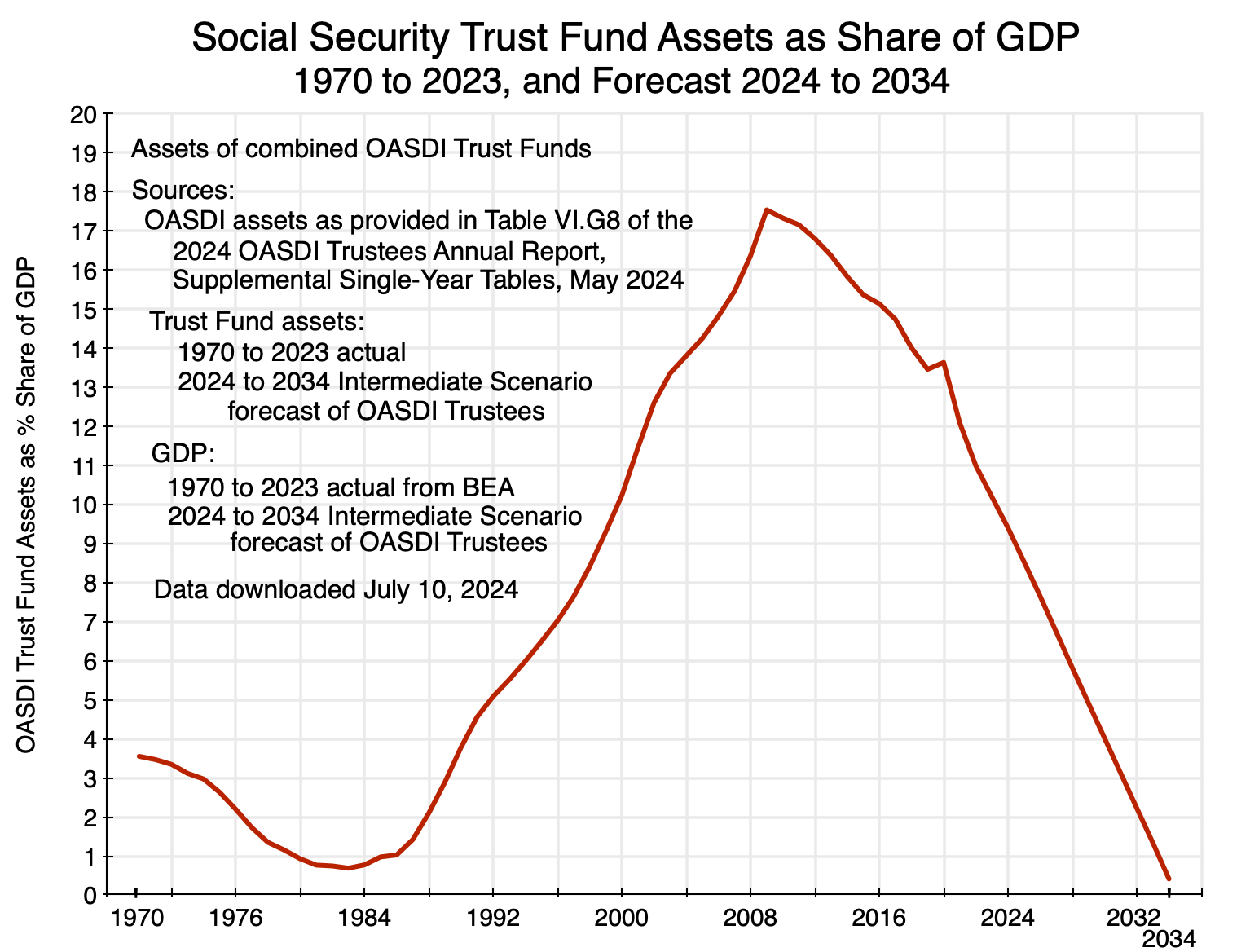
The resulting accumulated balances in the Social Security Trust Fund, as of the end of each year and expressed as a share of GDP of the year, are shown in the chart at the top of this post.  It has varied over time, and one can see that the Trust Fund came close to being depleted before – in the early 1980s.  Before that, the Social Security system had been managed in a more ad hoc way, with benefit levels, eligibility, tax rates, the income ceiling on which Social Security taxes were due, and more frequently adjusted by Congress.  Indexing for inflation was only introduced in the 1970s.

By 1981, the forecast was that the Social Security Trust Fund would be fully depleted by 1983.  In response, President Reagan with Congress appointed a commission in 1981 chaired by Alan Greenspan (and subsequently usually referred to as the Greenspan Commission) to provide recommendations for what would return the system to viability.  The Commission issued its recommendations in early 1983, with a combination of higher tax rates, adjustments to benefit levels, an increase in the retirement age for full eligibility, and numerous more minor changes.  Congress approved these in 1983.

The Greenspan Commission recommendations were based on forecasts of what changes would be needed to lead to the Trust Fund remaining solvent (i.e. not depleted at any point) for at least 75 years.  Starting in 1982, the 75 years would carry the forecasts through to 2057.  This did not mean that the Trust Fund would be brought to zero in the 75th year, but rather that it would still be solvent at that point.  They did not try to look beyond that.

Knowing that the large Baby Boom generation was then in its prime working-age years and that they would be retiring starting around 2010, the changes were designed so that the Trust Fund would be built up in the 1980s, 90s, and 2000s, and then begin to be used to pay out benefits on a net basis as the Baby Boomers retired.  This produced the large “hump” seen in the chart at the top of this post with the Trust Fund growing from less than 1% of GDP to 17 1/2% of GDP in 2009, after which it began to decline.

The decline as a share of GDP was planned.  However, under the forecasts of the Greenspan Commission in 1983, the Trust Fund would not have been fully depleted by 2035.  While it is often stated in the media that this is a consequence of the Baby Boomers reaching retirement age and of longer life expectancies, that is not in fact true.  The Greenspan Commission was well aware of how many Baby Boomers would be reaching retirement age in those years – they had already been born.  And the issue is not whether life expectancies have been rising, but whether life expectancies have been rising by more than what the Greenspan Commission assumed in their forecasts.  And it has not.  Indeed, life expectancy in the US has actually been decreasing since 2014 (and then plummeted in 2020/21/22 due to Covid), is well below that enjoyed in comparable countries, and is well below what the Greenspan Commission forecast.

As was discussed in an earlier post on this blog, the Social Security Trust Fund is now expected to be depleted well before the Greenspan Commission anticipated not because of the Baby Boomers nor because of life expectancies growing longer, but rather because the Greenspan Commission did not anticipate that wage inequality would grow so dramatically following Reagan.  This matters, because it led a higher share of wage earnings to be drawn above the ceiling on which Social Security taxes are paid, where they are not taxed at all.  The Greenspan Commission’s assumption that the share of wages that would be subject to tax would remain where it was (at about 90% of total wages) was not unreasonable at the time, as that share had remained fairly steady in the post-World War II period up to the early 1980s.  But then it deteriorated sharply in the subsequent decades.

Due to that increase in wage income inequality, the Trust Fund is now forecast to be depleted in 2035.  In my earlier post on this issue, I calculated that had the share of wages subject to Social Security taxes remained at the 90% share (and taking into account what this would also mean for higher benefit payments for the high-income wage earners who would then still be paying into the system), the Trust Fund would have been forecast to last until 2056.  The calculations assumed that all else would then be as it was historically when my forecasts were made in 2016, or as the Social Security then forecast in the years from 2016 onwards.

But wage inequality rose in the decades since 1983 and the Social Security Trust Fund is now expected to run out by 2035.  Under the current law that governs the Social Security system, Social Security benefits would then be scaled back to a level that would match amounts being paid into the Trust Fund by the workers in those years.  This would require a scaling back of benefits of about 16% based on current forecasts.  This would be devastating for many.  In a biennial report issued by the Social Security Administration (last issued in 2016 with data for 2014 – it appears the Trump administration stopped it, and it has not been restarted), it was estimated that Social Security benefits accounted for 100% of the income of 20% of the population aged 65 or older, and for 90% or more of the income of a third of the population.  Saying that again, one-third of Americans aged 65 or older depend on Social Security for 90% or more of their income.

Furthermore, not only do a high share of those over 65 depend on their Social Security checks for almost all of their income in their old age, but the checks themselves are not that high.  As of June 2024, the average monthly benefit was only $1,781, or $21,372 on an annual basis.  And most of those who especially depend on their Social Security checks also receive well less than these average payments.

A high share of those aged 65 or older in the US depend critically on Social Security.  A sudden cut of 16% would be devastating.

C.  Federal Borrowing Before and After the Trust Fund is Depleted   

As described above, when the amount being paid into the Social Security Trust Fund in Social Security taxes exceeds what is being paid out in Social Security benefits, the excess is invested in interest-earning US Treasury obligations.  That excess will reduce what the US Treasury will need to borrow from the markets to cover whatever the federal deficit might be from all of its other revenues less expenditures (i.e. everything other than from Social Security revenues and expenditures).  The Social Security Trust Fund will, in such years, be built up as it was from 1983 to 2009.

The opposite happens in years when Social Security tax revenues fall short of what Social Security is paying out in benefits.  In those years, the Social Security system will redeem a portion of the US Treasury obligations it holds and from this receive the cash it needs to pay the scheduled benefits.  When it does this, the US Treasury will then need to borrow in the markets the amount required to cover the US Treasury obligations that the Social Security system has redeemed.  That is, as the Social Security Administration redeems a share of the US Treasury obligations that it holds in the Trust Fund, the Treasury will need to issue new debt to the public to obtain the cash it needs to pay to Social Security for those redemptions.

Now suppose the Trust Fund has been fully depleted, and it no longer holds any balance of US Treasury obligations.  This is the forecast for what will be faced in 2035.  It no longer has US Treasury obligations that it can redeem.  Under the current law for the Social Security system, it would then be required to scale back benefit payments to the amount it is then receiving from Social Security taxes being paid by those then working.  The current forecast is that this would require a scaling back of 16%.  (Note that this is not 100%, as some people appear to believe.  Social Security is not being shut down in some kind of “bankruptcy”.  Rather, Social Security payments would continue – just not at the scheduled benefit levels.)

But what would happen in terms of federal government borrowing requirements if, instead of scaling back benefits by 16%, the government instead funded those payments in full from the general budget?  The amount would be far from small, at a forecast 1% of GDP to cover that 16% shortage.  But what would then happen to what the US Treasury would need to borrow from the public?

The answer is nothing.  There would be no change at all.  As explained above, when the funds come out of the Social Security Trust Fund holdings of US Treasury obligations, the Treasury will need to borrow from the public whatever is redeemed by the Trust Fund.  That is where the cash comes from.  When the Trust Fund no longer has any holdings of the US Treasury obligations, then the cash needed to cover the 16% Social Security payment gap from the general budget will be exactly the same.  That is, the amount the US Treasury will need to borrow from the public will be the same whether it needs the cash to cover redemptions of US Treasury obligations from the Trust Fund, or to cover the 16% gap in what is needed to pay Social Security benefits in full.

The fiscal deficit will also be the same, whether the full Social Security payments are made out of redemptions from the Trust Fund or are made out of transfers from the general government budget.  Social Security taxes (i.e. FICA taxes) are included as revenues going to the government, the same as personal income taxes or other sources of government revenues.  Similarly, payments for Social Security benefits are treated as government expenditures – whether or not they are covered by redemptions from the Social Security Trust Fund.

To illustrate with numbers from FY2023 (and using the recent, June 2024, budget figures from the Congressional Budget Office), and expressed as a share of GDP:  Outlays for the Social Security system (for retirees and their dependents, as well as for the disabled) was 5.0% of GDP.  Payroll taxes for Social Security (the 12..4% on wages) was 4.4% of GDP, leaving 0.6% of GDP to be obtained by drawing down the Social Security Trust Fund.  This accounted for part of the overall fiscal deficit in FY2023 of 6.3% of GDP.  If the 0.6% of GDP gap had been covered by direct fiscal transfers from the general government budget instead of by redemptions from the Social Security Trust Fund, the overall fiscal deficit (6.3% of GDP) as well as government borrowing requirements (whether to fund the deficit or to cover the Trust Fund redemptions) would have been the same.

(Note:  I have left out here the relatively much smaller amounts coming from the transfer of income tax revenues arising from taxation of Social Security benefits in households meeting certain income thresholds, and the interest earned on Trust Fund assets during the year.  These are both covered elsewhere in the fiscal accounts.)

It is in this sense that it is accurate to describe Social Security as a “pay-as-you-go” system.  While it is not always clear what is being referred to when speakers refer to Social Security as pay-as-you-go (different speakers appear to be referring to different things), it would be accurate to say that this is the case from the point of view of the government’s fiscal accounts and of its borrowing requirements in the markets.  What Social Security pays out in benefits in any given year will match what Social Security obtains as revenues in that year (primarily from the Social Security share of the FICA taxes) plus what is provided to the system from the US Treasury.  Whether those amounts transferred from the US Treasury are matched by a drawdown on the Treasury obligations in the Social Security Trust Fund, or come directly from the budget, the overall fiscal deficit as well as the Treasury’s borrowing requirements in the market will be the same.

D.  Policy Implications and Conclusion

Recognizing this, what does it imply for what should be done in 2035 (or whenever the Social Security Trust Fund is fully depleted)?  Under current law, and what is repeatedly stated in the media, is that scheduled Social Security benefit payments would have to be scaled back drastically (by about 16% in the current forecasts).  If that is done, that would indeed be a disaster for many given their dependence on the Social Security checks they receive.

But as explained above, there would be no impact on the deficit, nor on government borrowing requirements, if the scheduled benefit payments were kept in full and not scaled back from the scheduled levels, but rather with the gap covered instead by appropriations from the regular budget.  Congress could approve this if they wished.

Seen in this perspective, the question then becomes how best to fund the Social Security system along with all other government programs in the budget.  One should not restrict consideration only to adjustments in the payroll taxes that are currently tied to the Social Security system, nor to possible reductions in benefit levels by, for example, raising the normal retirement age.  Consideration should thus be given to possible other changes in the overall tax system – for example in personal income taxes and/or corporate income (profit) taxes.  The payroll tax is regressive, with a flat 12.4% on wages (and only wages) and only up to a ceiling ($168,600 in 2024).  Greater reliance on progressive income taxes is an attractive alternative to a regressive payroll tax.

One should therefore take a more holistic view as to what the tax system should be and not treat the issue as one for Social Security taxes in isolation.  While there could very well be political advantages to defining a trust fund for Social Security into which certain taxes are paid and from which benefit payments are then made, one should recognize that fundamentally this is only presentation.  Covering a portion of the Social Security benefit payments through the general budget, and hence through the overall system of income and other taxes, could well be preferred to exclusive reliance on payroll taxes.

Note also there is precedent for this.  Medicare taxes are also paid on wages (at a 2.9% rate, but with no ceiling on the wages subject to tax) and go into a trust fund, plus there are direct monthly premia paid for Medicare coverage.  However this funding does not suffice to cover all of what Medicare now costs.  The difference is made up by direct fiscal transfers.  It is certainly a major government expense, but no one argues Medicare payments should be limited to whatever is paid in Medicare taxes and premia.

As noted, sustaining payments once the Social Security Trust Fund has been fully depleted would require a change in the law that governs the Social Security system.  That law has been changed numerous times in the past, and could certainly be changed on this.  The real problem is that with Congressional gridlock, obtaining approval for such a change may well be difficult.  Republicans have been opposed to Social Security ever since its origin in the Social Security Act of 1935 under Roosevelt.  As Social Security became popular and demonstrated its success in reducing poverty among the elderly, that political criticism became less overt but has remained.  And those opposed to Social Security will likely use the imminent prospect of the Trust Fund being depleted by 2035 as an opportunity to scale the system back.  A reduction in expenditures of 1% of GDP would be huge.

But as examined above, maintaining Social Security benefit payments at scheduled levels once the Trust Fund is depleted would have no fiscal effects in itself.  Government revenues, expenditures, and borrowing requirements would be the same the day after the Trust Fund was depleted as it was the day before.