Fiscal Drag Continues to Pull Down the Economy

Private employment, government employment, December 2010 to May 2012

A pair of disappointing reports, from this morning (June 1) and yesterday (May 31), indicate that the economy continues to grow only slowly, with consequent slow growth in employment and indeed a small rise in the rate of unemployment to 8.2% from 8.1% last month.  Posts on this blog in January, on GDP growth and on employment, had flagged that growth, which at that time appeared to be improving, could well fall back in 2012.  Unfortunately, that appears to be happening.  Cut-backs in government spending account for a major part of that disappointing growth.

The Bureau of Labor Statistics, in its June 1 release this morning on employment, found that total US employment grew in May by a net 69,000 jobs, with an increase of 82,000 private jobs and a fall of 13,000 government jobs.  Based on the growth rate of the labor force over the ten year period of 2002 to 2012 (there is a good deal of fluctuation in monthly figures), the labor force is growing at about 83,000 workers per month on average.  Employment growth in May of just 69,000 jobs does not keep up with this, much less make a dent in the still high unemployment.

The figures released this morning were also disappointing in the revised numbers they showed for April.  Last month, the initial estimates were that April total employment had risen by 115,000 jobs, with private jobs growing by 130,000.  These were already not good, but the revised estimates issued this morning based on more complete data indicate total jobs in April grew by only 77,000 jobs, with private jobs growing by just 87,000 jobs.  With the May numbers of 69,000 and 82,000 for total and private jobs, respectively, we now have two months of disappointing job growth.  Unless the May numbers are significantly revised when more complete data becomes available, we cannot say that this is only a one month fluke.

As one can note from these numbers, private job growth has been consistently above total job growth.  That is because government continues to cut back on the number of workers it employs, despite assertions by Mitt Romney and other Republicans that government has been growing.  The graph above shows the monthly changes in employment of both private and government employees over the last year and a half, where one sees that government employment has been falling in all but two of these months.  Note that the government figures in the graph are for total government, including at the state and local level.  But the underlying figures show that the fall has been in employment both at the federal and at the state and local levels.

This steady fall in government employment depresses overall job growth, and adds up over time.  Between January 2009, when Obama was inaugurated, and May 2012, total government jobs fell by 607,000.  In contrast, over January 2005 and May 2008, the comparable period in Bush’s second term, total government employment rose by 743,000.  If government employment had been allowed to grow as much during the Obama period as it had during the Bush period, the difference would have been an additional 1.35 million jobs.   This difference alone would have brought the unemployment rate down from the current 8.2%, to just 7.3%.  But one would expect with the still depressed economy, with unemployment high, that increased government employment would have spurred some private job growth.  Assuming conservatively a multiplier of two (i.e. there would be one additional private job for each additional government job, to produce what the now employed government workers will spend on), the unemployment rate would have dropped to just 6.5%.

That is, had government employment been allowed to grow during the Obama period by as much as it had during the comparable Bush period, unemployment would have dropped to 6.5%.  With full employment generally considered to be in the range of 5 to 6% currently, this would have brought employment most of the way to full employment.

The other disappointing report was on estimated GDP growth in the first quarter of 2012, released by the Bureau of Economic Analysis on May 31.  This was the regular first revision of the initial estimate of GDP growth that had been released a month ago.  The initial estimate of GDP growth in the first quarter of 2012 was discussed in a posting on this blog in April.  The initial estimate was that GDP had grown at a 2.2% annualized rate in the first quarter.  This estimate has now been revised downward to 1.9%.

The revision is not large, but is not in a good direction.  And it is interesting to note that two-thirds of that downward change (0.2% points of the 0.3% points reduction) was due to a downward revised figure on government spending.  Government spending was already falling, and the initial estimate, discussed in the blog post cited above, was that it took 0.6% points away from what GDP growth would have been.  The revised estimate increases that reduction to 0.8% points of GDP.  Government spending on goods and services (for all government, including state and local) is estimated to have declined at an annualized rate of 3.9% in the first quarter, similar to the 4.2% rate fall in the fourth quarter of 2011.

The reduction in government demand for goods and services leads to a reduction in GDP in present circumstances since unemployment is high, there is substantial excess capacity, and hence goods and services produced for sale to government will not come from goods and services that could be sold elsewhere.  There is plenty of capacity to produce whatever people demand, and the problem is there is no demand for additional goods and services to be sold elsewhere.

This fall in government spending, especially in the last half year (i.e. the fourth quarter of 2011 and the first quarter of 2012), can explain a large part of the recent slow growth.  As noted above, the revised GDP estimates indicate that the fall in government spending in the first quarter of 2012 subtracted 0.8% points from what GDP growth would have been.  There was a similar 0.8% point reduction in the fourth quarter of 2011.

But far from simply not falling, government spending will grow in a normally growing economy.  Hence the basis of comparison should not be to zero government spending growth, but rather something positive.  One comparison to use would be the growth seen during the Bush administration.  Over 2001 to 2008, government spending growth on average accounted for 0.42% points of GDP growth at an annualized rate.  Keep in mind that this spending growth is for all government, not simply federal spending (which was high), but also state and local government spending.  Also, government spending in the GDP accounts is for direct goods and services only, and excludes spending via transfers (such as Social Security).

Finally, government spending growth in periods such as now, when unemployment is high and there is excess capacity, will have a multiplier impact, for the reasons discussed above.  A reasonable and conservative multiplier to use would be a multiplier of two.

The table below summarizes the impact of these assumptions for what growth would have been in 2011Q4 and 2012Q1:

      Annualized growth rate of GDP 2011Q4 2012Q1
GDP Growth Observed 3.0 1.9
GDP Growth if Government had not contracted 3.8 2.6
GDP Growth if Government had grown at the Bush rate 4.2 3.1
GDP Growth if Government had grown at the Bush rate, with a multiplier of two 5.5 4.3

GDP growth as actually happened was at a 3.0% rate in the fourth quarter of 2011 and 1.9% in the first quarter of 2012.  Had reductions in government spending not taken away 0.8% points from these growth rates in each of these two periods, growth would have been 3.8% and 2.6% respectively.  But this implicitly places government spending growth at zero.  Had government been allowed to grow as it had between 2001 and 2008 during the Bush terms, growth would have been 4.2% and 3.1% even with no multiplier.  With a multiplier of two, the rates would have been 5.5% and 4.3% respectively.

Such growth rates of about 5% on average is what the economy needs if it is to recover.  At 2% or so, growth is insufficient to create sufficient demand for labor to bring down unemployment on a sustainable basis, as we have just seen in the report this morning.  And a 2% growth rate is so modest that it is vulnerable to shocks, such as from Europe (where Germany and the EU still have not addressed what needs to be done to resolve the Euro crisis), or from a spike in oil prices (should the Iran situation blow up, literally), or even from swings in inventories (as discussed before in this blog).

With government contracting as it has, despite the high unemployment and excess capacity, fiscal drag is acting as a severe constraint on economic growth.  There is a not a small danger that growth could slip back to negative rates, and that is not good for an incumbent President in an election year.
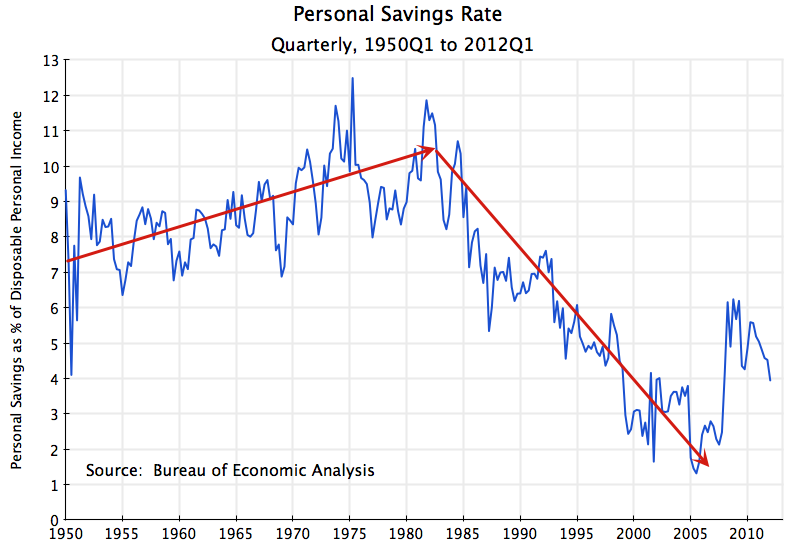
The US Personal Savings Rate: A Recent Fall, but Still Well Above the Rate of a Few Years Ago

US personal savings rates, 1950 to 2012, US personal savings as a percentage of disposable personal income

In a posting yesterday on this blog on the initial GDP estimates for the first quarter of 2012, I noted that GDP growth had slowed further (to just 2.2%) from a rate that was already less than what it needs to be in a recovery.  The primary reason for this slow growth was the continued cuts (yes cuts, despite what Romney has been saying) in government expenditures, which reduced GDP growth by 0.6% points from what it otherwise would have been.  The cuts in government expenditures are now at the federal level in addition to cuts at the state and local level, and they act as a substantial drag on demand for production.  GDP growth also decelerated, although to a lesser extent, due to a fall in business fixed investment (which reduced GDP growth by 0.2% points for what it would otherwise have been).

The primary bright spot in the new numbers was the acceleration in growth of personal consumption expenditure, which grew at a 2.9% rate and accounted for 2.0% points of the GDP growth, and especially the growth of residential fixed investment (housing construction primarily), which grew at a 19.1% rate and added 0.4% points to growth.

Some observers of this data also noted that the figure for the personal savings rate declined in the quarter, as personal consumption rose at a faster rate than personal income.  This is correct, and there is therefore the concern whether personal consumption will be able to continue to grow at the rate it did in the first quarter.  Specifically, the personal savings rate was 4.5% in the fourth quarter of 2011, and this fell to 3.9% in the first quarter of 2012.  If personal consumption expenditure will end up being forced down as households seek to keep savings at some level, the primary support to recent growth of GDP will be lost.  Coupled with the political pressure from Republicans and other conservatives to keep cutting government expenditures further, and with weak business investment due to the still high excess capacity in the economy and weak demand for production, growth could slow further and perhaps drop down into negative territory and thus into a new recession.

The question then is whether the reduction in the savings rate to 3.9% from 4.5% in the previous quarter may lead to pressure on households to reverse this and start saving more, and hence end up cutting personal consumption.  This is indeed possible, and the consequence could then be slower growth if government remains constrained in what it is allowed to spend.  It is not really possible to predict with any confidence whether this will happen, but it is useful to put the reduction in savings to 3.9% this past quarter in a longer term context, to see where it now stands compared to what it has been in the past.

The diagram above does this, showing the personal savings rate in the national income accounts going back all the way to 1950.  The data comes from the GDP and Personal Income Accounts of the Bureau of Economic Analysis.  The lines in red show the trends, and are simply hand-drawn to make the trends easier to discern.  What is interesting is how the person savings rate trended upwards from 1950 to the early 1980s, rising from roughly 7 to 8%, to around 10 to 11% (although with a good deal of short-term variation around the trend rate in these quarterly numbers).  But then the trend shifted to a steady fall, bringing the personal savings rate to just 1 to 2% by around 2005.  Savings then jumped to around 5 to 6% at the time of the economic and financial collapse in 2008, and has then come down some, to the current 3.9%.  It is too soon to tell where the recent fluctuations since the trough in 2005 will lead, and what the new trend, if any, will be.

A careful analysis that might explain why the personal savings rate has varied in the way it has in the post-World War II period is beyond the scope of this note.  But a good hypothesis would be that the shift to a strong downward trend since the early 1980s is related to changes brought in by Reagan, and in particular due to the deregulation of the financial markets that started then.  As a consequence of regulatory and other changes of the period, it became easier for banks to provide home equity loans to households, with only a second lien on the homes backing these credit lines.  As a result, home equity loans exploded, from just $1 billion outstanding in 1982 to $100 billion in 1988 (these figures are from a New York Times article describing the early growth and the impact of advertising in encouraging this), to $215 billion in 1990, $408 billion in 2000, and $1.1 trillion in 2006.  The market then finally stabilized, started to fall in 2009, and by 2011 the outstanding was $873 billion (the figures since 1990 are from the US Fed; its series on home equity credit lines do not go back further than 1990).  There were also other regulatory and consequent institutional changes in the credit markets during this period, which made it easier for households to borrow.

As households found it possible to borrow against their home equity values, during a period when house prices rose and then soared, it was possible for households to spend on consumption beyond what their current income alone would allow.  Some households thus had negative savings, some had low savings, and averaged across all households, savings rates fell.  This is what one sees in the graph above.

This all ended with the 2008 collapse, and indeed the housing bubble was already starting to deflate earlier, as the housing peak was in 2006 (see my blog posting here).  Home prices collapsed, there was no home equity to borrow against, spending in excess of income could not be done, and the average savings rate then rose.  With the crisis now easing and with credit slowly becoming more available, it is not yet clear whether savings rates will fall back down to where they were in the decade prior to 2008, or whether they will remain roughly where they have been since 2008, or indeed whether they will rise back to where they were before Reagan.

Savings rates more like what they have been in recent years, and indeed higher than that and back to where they were prior the changes launched by Reagan, will be important for the long-term health of the US economy.  Investment needs to be higher, while the US international deficits (the trade and current account deficits) need to be smaller.  This can only happen with higher savings.  But higher savings in the near term, when the economy remains weak and with government constrained by Republican opposition in what it is allowed to spend, will lead to even slower GDP growth.  Finding the right path through this will be tricky.

GDP Growth in the First Quarter of 2012: A Slow Economy Going Slower

BEA release of 4/27/12 2011 Q3 %growth 2011 Q4 %growth 2012 Q1 %growth Contribution to GDP growth in 2011 Q4 Contribution to GDP growth in 2012 Q1
Total GDP 1.8 3.0 2.2 3.0 2.2
A.  Personal Consumption Expenditure 1.7 2.1 2.9 1.47 2.04
B.  Gross Private Fixed Investment 13.0 6.3 1.4 0.78 0.18
   1.  Non-Residential Fixed Investment 15.7 5.2 -2.1 0.53 -0.22
   2.  Residential Fixed Investment 1.3 11.6 19.1 0.25 0.40
C.  Change in Private Inventories nm* nm* nm* 1.81 0.59
D.  Net Exports nm* nm* nm* -0.26 -0.01
E.  Government -0.1 -4.2 -3.0 -0.84 -0.60
   1.  Federal Government 2.1 -6.9 -5.6 -0.58 -0.46
   2.  State and Local Government -1.6 -2.2 -1.2 -0.26 -0.14
Memo:  Final Sales 3.2 1.1 1.6 1.15 1.61
        nm* = not meaningful
$ Value of Change in Private Inventories (2005 prices) -$2.0b $52.2b $69.5b

A.  Introduction

The Bureau of Economic Analysis (BEA) of the Department of Commerce released this morning its first estimate of GDP growth in the first quarter of 2012.  The table above summarizes the key figures.  Overall, the report is disappointing.  Many observers were expecting GDP growth to accelerate, continuing the path of quarter by quarter increases seen during the course of 2011 (with growth rates of 0.4%, 1.3%, 1.8%, and 3.0%, in the first through the fourth quarters, respectively).  But readers of this blog may recall that I had warned of a real possibility of deceleration in a posting on January 27, when the BEA released its first estimate of growth in the fourth quarter of 2011.  That slowdown has happened.  So far the slowdown has been modest, and one should not put too much emphasis on one quarter’s figures.  But a deeper assessment of the numbers contained in the report suggests that growth could slow further in the next few quarters, in the period just before the Presidential election.  This is not good for Obama.

The table has a lot of numbers to give the full picture, but we will focus on a few.  The table is similar to the one I used in the January 27 posting noted above, although this time I have split out the Change in Private Inventories from other investment (i.e. from Fixed Investment), to give a clearer picture of the trends.  Note also that the figures for the fourth quarter of 2011 differ somewhat from those shown in the January 27 posting.  This is because the January figures were the initial estimates (the BEA calls them the “advance estimates”), which are then revised twice (and released in late February and then in late March).  The initial estimate for the fourth quarter of 2011 was that GDP rose by 2.8%.  Following the revised second and then third estimates (as more complete data became available), the GDP growth rate for the period is now estimated to have been 3.0%.  And there are small changes in a number of the other figures as well.  Similarly, the release today was the initial estimate for the first quarter of 2012, and revised estimates will be released in late May and then in late June, before the release in late July of the initial estimates for the second quarter.

B.  The Change in the Change in Private Inventories

It is best first to focus on what has happened to the Change in Private Inventories, as this can drive the short term dynamics of quarter to quarter GDP growth.  As was described in a posting in the Econ 101 section of this blog, it is the change in the change in private inventories which leads to a change in GDP (i.e. to GDP growth).  In the last line of the table above, I have shown what the actual (estimated) dollar value was of inventory accumulation (the change in private inventories), going back to the third quarter of 2011.  In that third quarter, the stock of inventories in fact fell a small amount, by $2.0 billion (in 2005 prices).  Inventories are then estimated to have grown by $52.2 billion in the fourth quarter, for a change in the change in private inventories of $54.4 billion.  This contributed 1.81% points of the 3.0% growth in GDP.  That is, fully 60% ( = 1.81 / 3.0 ) of the growth in the fourth quarter (based on the revised figures) is now estimated to have come from inventory accumulation.

In the first quarter of 2012, private inventories are estimated to have grown by even more than they did in the fourth quarter:  by $69.5 billion.  But even though inventory accumulation is now estimated to have been higher, the change in the change in inventories was only $17.3 billion ( = $69.5b – $52.2b).  Thus even though inventory accumulation was greater than in the fourth quarter of 2011, the contribution to the growth of GDP in the first quarter of 2012 was an estimated 0.59% points (vs. the 1.81% of the previous quarter) of the 2.2% growth, or about 27% ( = 0.59 / 2.2 ) of the growth in GDP.

Inventory accumulation thus continued to add to, rather than subtract from, overall GDP growth in the first quarter, but at a slower pace than in the fourth quarter.  Looking forward, inventory accumulation would need to grow further to $86.8 billion ( = $69.5b + $17.3b) for the change in the change in private inventories to continue at the same pace, and contribute approximately 0.6% points to growth.

But with high positive inventory growth for two quarters now, there is a good chance that producers will cut back on production so as not to add so much to inventories sitting on shelves.  If inventory accumulation even simply continues at the $69.5 billion pace of the first quarter, the change in the change in inventories will then be zero.  If all else in the economy continues to grow as it did in the first quarter (it won’t, but if it did), then the growth rate in the second quarter would be 2.2% – 0.6% points = 1.6% (which is the rate of final sales growth in the quarter; see the table above).

But inventory accumulation could be a good deal less than that.  A fall in the stock of inventories is not unusual.  From 2001Q1 through 2012Q1, for example (a period of 45 quarters), the change in private inventories was negative in 15 of the quarters (i.e. one-third of the time) and positive in 30.  Even if the change in private inventories was just zero, and not even negative, the change in the change in private inventories would then be a negative $69.5 billion from the pace in the first quarter.  This would subtract 2.4% points from GDP growth, and if all else grew at the pace it did in the first quarter, then GDP growth would be a negative 0.8% ( = 1.6% growth of final sales minus the 2.4% points).

There is a good chance, but no certainty, the pace of inventory accumulation will slow down.  If so, overall GDP growth would slow, and even possibly turn negative.  The economy remains weak.

C.  Personal Consumption and Fixed Investment

A positive in the figures is that household expenditures, for both personal consumption and for residential investment, continued to strengthen.  Personal consumption (which accounts for 71% of GDP), grew by 2.9% and accounted for 2.04% points of the 2.2% growth.  And residential fixed investment (mainly housing) grew at a very fast 19.1% pace, following the 11.6% growth of the fourth quarter.  These are strong figures, and suggest housing may be starting to recover.  However, as had been noted in the January 27 blog posting, residential fixed investment has fallen by so much in the crash of the housing bubble (to just 2.3% of GDP now, from a high of over 6% during the bubble, and a more normal 4% of GDP or so), that such investment would need to double to return to normal levels, or triple to get back to where it was before.  And with its current small share of GDP, the 19.1% growth of residential fixed investment only accounted for 0.40% points of the 2.2% GDP growth in the first quarter.

Offsetting this positive news on household consumption and investment, there was a decline in business (i.e. non-residential) fixed investment.  Business fixed investment had been strong earlier in the recovery, from early 2010 through to late 2011, but is estimated to have contracted by 2.1% in the first quarter.  This subtracted from GDP growth.  And with business fixed investment (at 10.3% of GDP currently) much larger than residential fixed investment, the declining growth of business fixed investment has pulled down overall fixed investment from a 13.0% rate of growth in the third quarter of 2011, to 6.3% in the fourth quarter, and to just 1.4% in the first quarter.

D.  Fiscal Drag Continues

Finally, and most stupidly in a still depressed economy with high unemployment, government expenditures are falling, acting as a drag bringing down the overall economy.  And while earlier this fiscal drag was mostly due to cuts in government expenditures at the state and local level, cuts in federal expenditures are now also pulling down the economy. Federal government expenditures on goods and services fell by 5.6% in the first quarter, following a fall now estimated at 6.9% in the fourth quarter.  State and local government expenditures continued to fall (as they have in 11 of the 13 quarters since the first quarter of 2009), but now federal expenditures are falling even faster.

The direct impact of the decline in government expenditures subtracted 0.6% points from what growth would otherwise have been in the first quarter.  That is, had government expenditures simply remained flat rather than fallen by 3.0% (for federal combined with state and local), GDP growth would have been 2.2% + 0.6% = 2.8%.  With a modest 3.0% growth (instead of a 3.0% cut) in government expenditures, growth in the first quarter would have been a more respectable 2.2% + 1.2% = 3.4%.  And assuming a multiplier of just 1.5, the growth rate would have been 2.2% + 1.5×1.2% = 4.0%.  While still modest, this would bring GDP growth closer to the rate needed for a sustained reduction in unemployment.  And as was noted in a previous posting on this blog, had government expenditures been allowed to grow at the pace it had during the economic downturn after 1981 during the Reagan years, the economy would now be at full employment.

Cutting government expenditures when the economy is so weak and unemployment so high only serves to further weaken the economy.  The consequences of an even more severe austerity program can be seen in the UK.  The Conservative Government in the UK has adopted an austerity program similar to what Republicans have pushed to be adopted here.  The new GDP report for the UK issued two days ago indicates that growth in the UK was negative in the first quarter of 2012, as it was in the fourth quarter of 2011.  The two quarters of negative growth meets the criterion normally used to define a recession, and hence the UK has now dropped back into recession for the second time since the 2008 crisis.

The US has fortunately not adopted an austerity program as severe as that adopted by the UK.  However, Republicans are pushing strongly for the US to do so.  If Obama did, the results would be similar to that seen in the UK.  If you are running for re-election, that is not a good place to be.  And that may explain why the Republicans have been pushing for it.