ObamaCare Has Not Led to a Shift of Employees From Full-Time to Part-Time Work

Part-Time Employment #2 as Share of Total Employment, Jan 2007 to Sept 2013

Conservative media have repeatedly asserted that due to ObamaCare (formally the Affordable Care Act), there has been and will be a big shift of workers from full-time to part-time status.  Publications such as Forbes, the Wall Street Journal, and of course Fox News, have asserted that this is a fact and a necessary consequence of ObamaCare.  The argument is that since ObamaCare will require employers to include health care benefits as part of the wage compensation package to full time employees (defined as those who normally work more than 30 hours a week for the firm), firms will have the incentive, and by competition the necessity, of shifting workers to part-time status.  It is argued that instead of employing three workers for 40 hours each (for 120 employee hours), firms will instead employ four part time workers at just below 30 hours each to obtain the 120 employee hours.

There are a number of problems with this argument.  First, the ObamaCare requirements for health coverage only apply to firms with more than 50 full time employees.  There is no change for firms employing fewer than 50 workers.  Second, almost all of the firms in the US with more than 50 employees, and indeed a majority also of the workers in firms of fewer than 50 employees, are already in firms that provide health insurance coverage for their workers.   Specifically, 97% of the workers in firms with more than 50 employees are in firms offering health insurance coverage as part of their wage compensation package.  ObamaCare will require this (to avoid a per worker penalty) to go from 97% to 100%, which is not a big change.  And even though ObamaCare will not have such a requirement for firms employing fewer than 50 workers, it is already the case that 53% of the workers in such firms are in firms providing health insurance coverage.   Firms provide health insurance coverage as part of the total compensation package they pay their employees both because they have a direct interest in having healthy workers, but also because there are tax and financial advantages to doing so.

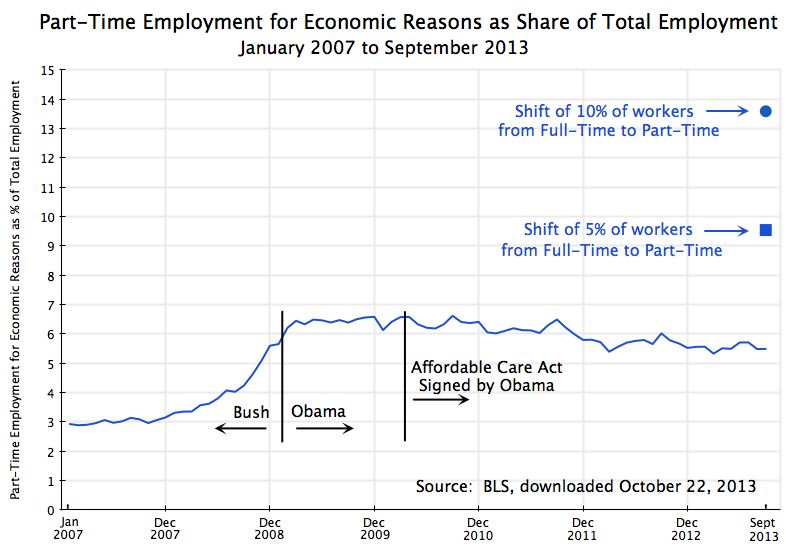
Notwithstanding these issues, the conservative media and Republican politicians continue to assert that ObamaCare is leading to a large substitution of part-time for full-time workers.  But as Jason Furman, the Chairman of the Council of Economic Advisors in the White House has recently noted, this is not seen in the data.  The graph at the top of this blog post is one way to look at this data.

The graph shows the share of part-time workers (part time for economic reasons and not part time by choice) in all workers, by month, for the period from January 2007 to September 2013.  The data come from the Bureau of Labor Statistics.  If ObamaCare is leading to a large shift of workers from full-time to part-time status, then this ratio would be rising since ObamaCare was passed or at some more recent date.  But it is not.

The share of part-time workers in all workers rose in the last year of the Bush administration due to the economic crisis, from about 3% before to about 6 1/2% after.  It was rising rapidly as Obama took office, but stabilized soon thereafter as the economy began to stabilize with the passage of Obama’s stimulus package and aggressive actions by the Fed.  Since then the ratio has trended downwards, albeit slowly.  As has been noted previously in this blog, the continued fiscal drag from government expenditure cuts since 2010 has held back the economy and hence the recovery in the job market.  The blog post noted that if government spending had simply been allowed to grow at its long term average rate, we would likely have already returned to full employment (and would have returned to full employment in 2011, if government expenditures had been allowed to rise at the same pace as they had during the Reagan years).

The Affordable Care Act was signed by Obama in March 2010.  As the graph above indicates, there was no sharp change in trend once that act was signed.  If anything, the share of part-time workers in all workers then began to decline from a previous steady level.  Such a response is the opposite of what the conservative media and Republican politicians have asserted has been the result of ObamaCare coming into effect.

To put the figures in perspective, the graph above also shows how high the ratio of part-time workers to all workers would have had to jump, had either just 5% (the square point) or 10% (the round point) of full-time workers been substituted for by an equal number of part-time workers, additional to where the September 2013 ratio in fact was.   An equal number is used between the full-time and part-time workers to be conservative in the estimate.  The argument being made by the critics is in fact that a higher number of part-time workers would have been hired to substitute for the full-time workers let go, to get the same number of working hours.  But even with an equal number being substituted, such a shift of 5% of the workers would have led to rise in the ratio by 74% relative to where it was in September 2013, and a shift of 10% would have led to a rise of 148%.  One does not see anything like this.

It is not known what the paths would have been to reach those 5% or 10% shifts, but the resulting changes in the paths would have been obvious.  Such changes did not occur.  Since one is comparing the figures to what otherwise would have been the case, the conservative critics would need to argue that the ratio of part-time to all workers would have plummeted in the absence of ObamaCare.  There is no reason given on why this would have been so.  Furthermore, for the case of a 10% shift the number of part-time workers would have had to be negative in the absence of ObamaCare, which is of course impossible.

There is simply no evidence to support the assertion in the conservative media that ObamaCare is leading a significant share of firms to shift workers from full-time to part-time status.

A Disappointing March Jobs Report

Employment, Monthly Change, Dec 2005 - March 2013

The Bureau of Labor Statistics released this morning its regular monthly report on employment.  Growth in jobs in March was disappointingly low, at just 88,000 net new jobs created.  The expectation among analysts (averaging across all their forecasts) prior to the report coming out was that 193,000 net new jobs had been created in March.  Private sector job growth in the BLS figures was just 95,000, while government once again brought down job growth with a cut of 7,000 public sector jobs.  While one should not read too much in one month’s report, and it follows a fairly good February report, the slow-down in March appears to indicate that the recent signs of improvement (including that February jobs report) are being undermined by the decisions being made in Washington on government spending.

The worst of the government cut-backs are yet to come.  The sequester, under which $85 billion in spending authority in the remainder of fiscal year 2013 has been cut (roughly 1% of GDP over this seven month period), only entered into effect on March 1.  It appears that most of the cuts will be enforced through mandatory furloughs, where government workers will be forced not to come to work for a certain number of days (varying by agency) and then not be paid for those days.  These furloughs will only start in April, as a 30 day notice is required.  The furloughed workers will not show up directly in the unemployment statistics, but with their resulting lower incomes (about 5% on average it appears) they will have less to spend in this still weak economy, thus depressing demand and private jobs.  We will see how this works out over the coming months.

There are in fact some early signs of the sequester having an adverse impact on the private sector.  For example, in the past week, both Delta Air Lines and then US Airways announced that their March revenues were weak, which they attributed at least in part to the sequester (leading not only to less travel by government workers, but also and more importantly, less travel by government contractors).  But it is still early.  And since the impact on the GDP numbers will not become significant until the second quarter, we will not know until July (when the initial GDP estimate is published) what the impact on GDP growth has been.

The BLS jobs report also reported that the unemployment rate had fallen to 7.6% from the previous 7.7%.  However, this was more than entirely due to the estimate that the number of workers in the labor force had declined by almost a half million.  The unemployment figures are obtained from a survey of households, while the figures on net new jobs created are from a separate survey of business establishments (along with government and non-profit entities).  There is more volatility in the figures from the household survey, as the effective sample size is a good deal less (each household surveyed will generally have only one or two household members in the labor force, while a business establishment can have thousands of workers).

Thus the published figures from the household survey from a single month are viewed with caution.  It is not clear why the estimated population in the labor force would have fallen by a half million in a single month, and analysts will want to see whether this holds up in coming months.  And while also figures from just one month, it is still disconcerting that the household survey estimated that the number of people with jobs actually fell by 290,000 in the month (while the number of unemployed fell by close to 210,000, with these two numbers together adding up to the half million fewer household members in the labor force).

The March jobs report was not a good one.  And with government cutbacks due to the sequester now becoming greater, there is reason to be concerned that the picture will become even worse in coming months.

The Stagnation Over the Last Half Century of the Real Minimum Wage Is Even Worse Than It Looks: But May Not Be Easy to Solve

Real Min Wage Under Alternative Scenarios, 1950-2012

A.  Introduction

The previous post on this blog looked at whether the periodic increases in the minimum wage since 1950 in the US had led to jumps in unemployment of those workers making the minimum wage.  It concluded that there was no evidence of higher unemployment resulting from the changes of the magnitude observed.  And this was found whether by simply examining what happened to unemployment in the months following those sporadic increases, or in more rigorous econometric studies that have been undertaken over the last two decades.

That blog post noted that despite those sporadic increases in the nominal minimum wage, the minimum wage in real, inflation adjusted, terms had still fallen significantly over the last half century.  The minimum wage, in terms of today’s prices, had averaged about $9 per hour over the 25 years 1956-80 inclusive, and had reached a peak of $10.82 in February 1968.  Yet the minimum wage is only $7.25 today.  President Obama proposed to Congress in his State of the Union address that the minimum wage be raised to $9.00.  This would be a modest goal, as it would bring it back only to a level of a half century ago.  During that half century, US per capita GDP has more than doubled.  Yet even that modest increase has been strongly criticized by Republican leaders and conservatives.

B.  Two Scenarios

Staying flat in real terms is an exceedingly limited goal.  One would expect growth in a growing economy.  And at $9.00 an hour, a full time worker (40 hours a week, 52 weeks a year with no vacation) would still be earning almost 20% less than the poverty line for a family of four.  It is therefore of interest to ask what would the minimum wage be today if it were not simply flat in real terms, but had grown along with the rest of the economy?

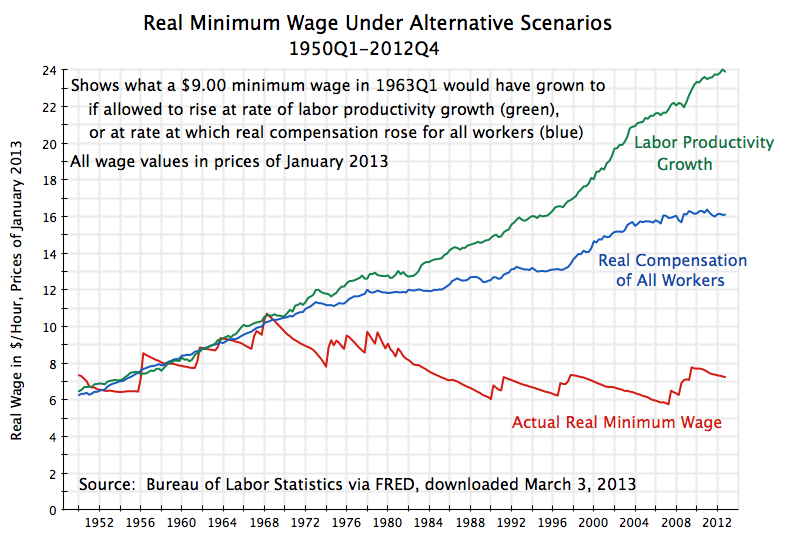
The graph above shows two scenarios.  One is where the minimum wage would have grown at the same pace as overall labor productivity growth, and the other is where the minimum wage would have grown at the same pace as real compensation has for all workers.

There are several points worth noting.  First, it is very interesting that over the period 1950 to 1968, one finds that labor productivity, real compensation of all workers, and (with more jumpiness) the real minimum wage, all tracked basically the same path.  This is as one would expect in a normal growing economy.  Productivity grows, real wages grow at a similar rate (implying that profits will also grow at a similar rate), and similar increases in the real minimum wage will not create difficulties.

But the trends then diverged.  The minimum wage, set by government policy, was not allowed to keep up with inflation, leading to a significant fall in real terms.  The deterioration in the real minimum wage was especially sharp and steady during the presidencies of Richard Nixon (1969-74), Reagan (1981-88, and carrying over into 1989) and George W. Bush (2001-2007).  By June 2007, the minimum wage had reached a low of $5.75 (in terms of today’s prices) – lower than at any other point in time since before 1950 (I did not look at earlier data than this).  The real minimum wage was $7.38 in January 1950, during the presidency of Harry Truman.  It was 22% less in 2007, 57 years later.

C.  The Divergence Since the 1980s Between Growth in Labor Productivity and Growth in Labor Compensation

Labor productivity and real compensation of all workers continued to track each other for a few years after 1968.  But then some divergence started to open up in the mid-1970s, and this divergence began to grow sharply from about 1982/83.  It has continued since.

This divergence between productivity growth and real compensation of workers since the 1980s has been noted and discussed before in this blog.  It was noted there that the changes that occurred during the Reagan presidency, while lauded by conservatives, in fact did not lead to overall faster growth in output or productivity (growth in output and in productivity have in fact been slower since the Reagan presidency than it was before).  But the changes that began during the Reagan term did lead to sharply slower growth in real wages, and led as well to a far worse distribution of income.  The rich, and especially the very rich (the top 1%, and even more so the top 0.1% and 0.01%) have done extremely well since 1980.  But as that blog post showed, the real incomes of the bottom 90% have grown only modestly (and almost solely in the second half of the 1990s, during Clinton’s term).

By 2012, the average real compensation of all workers was fully one-third less than what it would have been had it grown after 1968 at the same pace as labor productivity growth.  This is not a small difference.

The causes for this divergence between labor productivity growth and real compensation of workers, largely since 1982/83, are not all known.  Policy was clearly an important part of it.  One policy was that of allowing the minimum wage to fall in real terms, which pulled down the wages of not only those at the minimum wage, but also the wages of those some distance above the minimum wage as the minimum wage affects the whole lower end of the wage structure.  Reagan’s policies to undermine the ability of labor unions to bargain for higher wages were also a factor.  Government policies to keep down the wages of government workers would also have contributed.

But in addition to such policy factors, there were technological and other economic issues that probably contributed.  As Erik Brynjolfsson and Andrew McAfee argue in their recent book, Race Against the Machine, the high rate of change in computer and communications technology, and the accompanying growth in robotics, not only diminished the demand for many middle class jobs such on the automobile production lines, but also for middle class jobs such as accountants, clerks, and other skilled positions where rules are followed which a computer can be programmed to do.  This same technological change in computers and communications also enabled globalization of production.  And the changes made possible by the new technologies led to the development of more and more “winner-take-all” sectors, where a few winners at the top can supply the whole market, leaving little for the rest.

D.  Could the Minimum Wage be Raised to Match?

As the graph above shows, had the minimum wage continued to grow after 1968 at the same pace as overall labor productivity grew (as it had before 1968), it would have reached $24 an hour by 2012.  Had it grown even at the slower pace that overall compensation of workers had grown, it would have reached $16 an hour.  But I would not advocate increasing the minimum wage today to $24 an hour, or even $16 an hour.  While the previous blog post had noted that changes in the minimum wage of a magnitude seen in the past had not led to higher unemployment, I am not so sure this would hold if the current minimum wage ($7.25 an hour) were more than doubled or tripled.  Without more data, I would indeed be wary of a rise in the minimum wage to more than perhaps $11 or $12 an hour.

One possible approach might therefore be as follows.  To start, one would raise the minimum wage to $9.00 an hour now, as Obama has proposed.  Obama has then also proposed to index this rate to inflation, so that one does not again see the regression in real terms observed repeatedly in the past.  But this would be too modest.  One would raise the rate to $9.00 an hour now, then to $10 a year later, then to $11 a year after that, and so on.  At each step, one would observe what the effects are.  If the impact on employment of minimum wage workers is modest, one would continue.  At some point one would start to observe significant adverse impacts, and at that point one would stop or even move back a step.

The fact that raising the minimum wage to $24 an hour now, or even to $16 an hour, is considered unimaginable, and indeed would likely lead to significant adverse employment impacts, is telling.  Something fundamentally flawed has developed in the economy which the US did not see before the 1980s.  And it does such harm for the working poor that even a full time worker at the minimum wage will still earn well less than the poverty line income.  There is a clear need to understand this better, but that should not keep us from following a more active approach, such as the step by step process suggested above, until we do.