
The Survey of Establishments Say Employment is Rising, But the Survey of Households Say It Is Falling – Why?

A.  Introduction

Those who follow the monthly release of the Employment Situation report of the Bureau of Labor Statistics (with the most recent issue, for April, released on May 3) may have noticed something curious.  While the figures on total employment derived from the BLS survey of establishments reported strong growth, of an estimated 263,000 in April, the BLS survey of households (from which the rate of unemployment is estimated) reported that estimated employment fell by 103,000.  And while there is month-to-month volatility in the figures (they are survey estimates, after all), this has now been happening for several months in a row:  The establishment survey has been reporting strong growth in employment while the household survey has been reporting a fall.  The one exception was for February, where the current estimate from the establishment survey is that employment grew that month by a relatively modest 56,000 (higher than the initial estimate), while the household survey reported strong growth in employment that month of 255,000.

The chart above shows this graphically, with the figures presented in terms of their change relative to where they were in April 2017, two years ago.  For reasons we will discuss below, there is substantially greater volatility in the employment estimates derived from the household survey than one finds in the employment estimates derived from the establishment survey.  But even accounting for this, a significant gap appears to have opened up between the estimated growth in employment derived from the two sources.  Note also that the estimated labor force (derived from the household survey) has also been going down recently.  The unemployment rate came down to just 3.6% in the most recent month not because estimated employment rose – it in fact fell by 103,000 workers.  Rather, the measured unemployment rate came down because the labor force fell by even more (by 490,000 workers).

There are a number of reasons why the estimates from the two surveys differ, and this blog post will discuss what these are.  To start, and as the BLS tries to make clear, the concept of “employment” as estimated in the establishment survey is different from that as measured in the household survey.  They are measuring different, albeit close, things.  But there are other factors as well.

One can, however, work out estimates where the employment concepts are defined almost, but not quite, the same.  What is needed can be found in figures provided as part of the household survey.  We will look at those below and present the results in a chart similar to that above, but with employment figures from the household survey data adjusted (to the extent possible) to match the employment concept of the establishment survey.  But one finds that the gap that has opened up between the employment estimates of the two surveys remains, similar to that in the chart above.

There are residual differences in the two employment estimates.  And they follow a systematic pattern that appear to be correlated with the unemployment rate.  The final section below will look at this, and discuss what might be the cause.

The issues here are fairly technical ones, and this blog post may be of most interest to those interested in digging into the numbers and seeing what lies behind the headline figures that are the normal focus of news reports.  And while a consistent discrepancy appears to have opened up between the two estimates of employment growth, the underlying cause is not clear.  Nor are the implications for policy yet fully clear.  But the numbers may imply that we should be paying more attention to the much slower growth in the estimates of total employment derived from the household survey, than the figures from the establishment survey that we normally focus on.  We will find in coming months whether the inconsistency that has developed signals a change in the employment picture, or simply reflects unusual volatility in the underlying data.

B.  The BLS Surveys of Establishments, and of Households

The monthly BLS employment report is based on findings from two monthly surveys the BLS conducts, one of establishments and a second of households.  As described by the BLS in the Techincal Note that is released as part of each month’s report (and which we will draw upon here), they need both.  And while the surveys cover a good deal of material other than employment and related issues, we will focus here just on the elements relevant to the employment estimates.

The establishment survey covers primarily business establishments, but also includes government agencies, non-profits, and most other entities that employ workers for a wage.  However, the establishment survey does not include those employed in agriculture (for some reason, possibly some historical bureaucratic issue between agencies), as well as certain employment that can not be covered by a survey of establishments.  Thus they do not cover the self-employed (if they work in an unincorporated business), nor unpaid family workers.  Nor do they cover those employed directly by households (e.g. for childcare).

But for the business establishments, government agencies, and other entities that they do cover, they are thorough.  They survey more than 142,000 establishments each month, covering 689,000 individual worksites, and in all cover in this “sample” approximately one-third of all nonfarm employees.  This means they obtain direct figures each month on the employment of about 50 million workers (out of the approximately 150 million employed in the US), with this closer to a census than a normal sample survey.  But the extensive coverage is necessary in order to be able to arrive at statistically valid sample sizes at the detailed individual industries for which they provide figures.  And because of this giant sample size, the monthly employment figures cited publicly are normally taken from the establishment survey.

To arrive at unemployment rates and other figures, one must however survey households.  Businesses will know who they employ, but not who is unemployed.  And while the current sample size used of households is 60,000, this is far smaller relative to the sample size used for establishments (142,000) than it might appear.  A household will in general have just one or two workers, while a business establishment (or a government agency) could employ thousands.

Thus the much greater volatility seen in the employment estimates from the household survey should not be a surprise.  But they need the household survey to determine who is in the labor force.  They define this to be those adults of age 16 or older, who are either employed (even for just one hour, if paid) in the preceding week, or who, if not employed, were available for a job and were actively searching for one at some point in the four week period before the week of the survey.  Only in this way can the BLS determine the share of the labor force that is employed, and the share unemployed.  The survey of establishments by its nature cannot provide such information no matter what its sample size.

For this and other reasons, the definition of what is covered in “employment” between these two surveys will differ.  In particular:

a)  As discussed above, the establishment survey does not cover employment in the agricultural sector.  While they could, in principle, include agriculture, for some reason they do not.  The household survey does include those in agriculture.

b)  The establishment survey also does not include the self-employed (unless they are running an incorporated business).  They only survey businesses (or government agencies and non-profits), and hence cannot capture those who are self-employed.

c)  The establishment survey also does not capture unpaid family workers.  The household survey counts them as part of the labor force and employed if they worked in the family business 15 hours or more in the week preceding the survey.

d)  The establishment survey, since it does not cover households, cannot include private household workers (such as those providing childcare services).  The household survey does.

e)  Each of the above will lead to the count in the household survey of those employed being higher than what is counted in the establishment survey.  Working in the opposite direction, someone holding two or more jobs will be counted in the establishment survey two or more times (once for each job they hold).  The establishment being surveyed will only know who is working for them, and not whether they are also working elsewhere.  The household survey, however, will count such a worker as just one employed person.

f) The household survey also counts as employed those who are on unpaid leave (such as maternity leave).  The establishment survey does not (although it is not clear to me why they couldn’t – it would improve comparability if they would).

g)  The household survey also only includes those aged 16 or older as possibly in the labor force and employed.  The establishment survey covers all its workers, whatever their age.

There are therefore important differences between the two surveys as to who is covered in the figures provided for “total employment”.  And while the BLS tries to make this clear, the differences are often ignored in references by, for example, the news media.  One can, however, adjust for most, but not all, of these differences.  The data required are provided in the BLS monthly report (for recent months), or online (for the complete series).  But how to do so is not made obvious, as the data series required are scattered across several different tables in the report.

I will discuss in more detail in the next section below what I did to adjust the household survey figures to the employment concept as used in the establishment survey.  Adjustments could be made for each of the categories (a) through (e) in the list above, but was not possible for (f) and (g).  However, the latter are relatively small, with the residual difference following an interesting pattern that we will examine.

When those adjustments are made, the number of employed as estimated from the household survey, but reflecting (almost) the concept as estimated in the establishment survey, looks as follows:


While there are some differences between the estimates here and those in the chart at the top of this post of employment made using the household survey (as adjusted), the basic pattern remains.  While employment as estimated from the household survey (and excluding those in agriculture, the self-employed, unpaid family workers, household employees, and adjusted for multiple jobholders) is now growing, it was growing over the last half year at a much slower pace than what the establishment survey suggests.

C.  Adjustments Made to the Employment Estimates So They Will Reflect Similar Concepts

As noted above, adjustments were made to the employment figures to bring the two concepts of the different surveys into line with each other, to the extent possible.  While in principle one could have adjusted either, I chose to adjust the employment concept of the household survey to reflect the more narrow employment concept of the establishment survey.  This was because the underlying data needed to make the adjustments all came from the household survey, and it was better to keep the figures for the adjustments to be made all from the same source.

Adjustments could be made to reflect each of the issues listed above in (a) through (e), but not for (f) or (g).  But there were still some issues among the (a) through (e) adjustments.  Specifically:

1)  I sought to work out the series going back to January 1980, in order to capture several business cycles, but not all of the data required went back that far.  Specifically, the series on those holding multiple jobs started only in January 1994, and the series on household employees only started in January 2000.

2)  I also worked, to the extent possible, with the seasonally adjusted figures (for the establishment survey figures as well as those from the household survey).  However, the figures on unpaid family workers and of household employees were only available without seasonal adjustment.  I was therefore forced to use these.  But since the numbers in these categories are quite small relative to the overall number employed, one does not see a noticeable difference in the graphs.

One can then compare, as a ratio, the figures for total employment as adjusted from the household survey to those from the establishment survey.  The ratio will equal 1.0 when the figures are the same.  This was done in steps (depending on how far back one could go with the data), with the result:
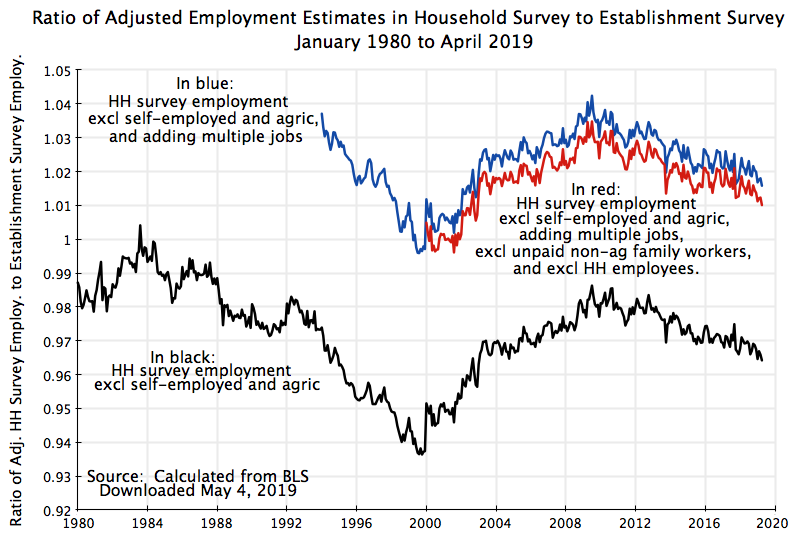
 

The curve in black, which can go back all the way to 1980, shows the ratio when the employment figure in the household survey is adjusted by taking out those who are self-employed (in unincorporated businesses) and those employed in agriculture.  The curve in blue, from 1994 onwards, then adds in one job for each of those holding multiple jobs.  The assumption being made is that those with multiple jobs almost always have two jobs.  The establishment survey would count these as two employees (at two different establishments), while the household survey will only count these as one person (holding more than one job).  Therefore adding a count of one for each person holding multiple jobs will bring the employment concepts used in the two surveys into alignment (and on the basis used in the establishment survey).

Finally, the curve in red subtracts out unpaid family workers in non-agricultural sectors (as those in the agricultural sector will have already been taken out when total employees in agriculture were subtracted), plus subtracts out household employees.  Neither of these series are available in seasonally adjusted form, but they are small relative to total employment, so this makes little difference.

What is interesting is that even with all these adjustments, the ratio of the adjusted figures for employment from the household survey to those from the establishment survey follows a regular pattern.  The ratio is low when unemployment was low (as it was in 2000, at the end of the Clinton administration, and to a lesser extent now).  And it is high when unemployment was high, such as in mid-1980s during the Reagan administration (with a downturn that started in 1982) and again during the downturn of 2008/09 that began at the end of the Bush administration, with unemployment then peaking in 2010 before it started its steady recovery.

Keep in mind that the relative difference in the employment figures between the household survey (as adjusted) and the establishment survey are not large:  about 1% now and a peak of about 3% in 2009/10.  But there is a consistent difference.

Why?  In part there are still two categories of workers where we had no estimates available to adjust the figures from the household survey to align them with the employment concept of the establishment survey:  for those on unpaid leave (who are included as “employed” in the household survey but not in the establishment survey), and for those under age 16 who are working (who are not counted in the household survey but are counted as employees in the establishment survey).

These two categories of workers might account for the difference, but we do not know whether they will fully account for the difference as we have no estimates.  A more interesting question is whether these two categories might account for the correlation observed with unemployment.  We could speculate that during periods of high unemployment (such as 2009/10), those taking unpaid leave might be relatively high (thus bumping up the ratio), and that those under age 16 may find it particularly hard, relative to others, to find jobs when unemployment is high (as employers can easily higher older workers then, with this then also bumping up the ratio relative to times when overall unemployment is low).  But this would just be speculation, and indeed more like an ex-post rationalization of what is observed than an explanation.

Still, despite the statistical noise seen in the chart, the basic pattern is clear.  And that is of a ratio that goes up and down with unemployment.  But it is not large.  Based on the change in the ratio observed from May 2010 to April 2011 (using a 12 month average to smooth out the monthly fluctuations), to the average over May 2018 to April 2019, the monthly divergence in the employment growth figures would only be 23,000 workers.  That is, the unexplained residual difference in recent years between the growth in employment (as estimated by the household survey and as estimated by the establishment survey) would be about 23,000 jobs per month.

But the differences in the estimates for the monthly change in employment between the (adjusted) series from the household survey and that from the establishment survey are much more.  Between October 2018 and April 2019, employment in the adjusted household survey series grew by 65,000 per month on average.  In the establishment survey series the growth was 207,000 per month.  The difference (142,000) is much greater than the 23,000 that can be explained by whatever has been driving down the ratio between the two series since 2010 as unemployment has come down.  Or put another way, the 65,000 figure can be increased by 23,000 per month to 88,000 per month, from adding in the unexplained residual change we observe in the ratio between the two series in recent years.  That 88,000 increase in employment per month from the (adjusted) household survey figures is substantially less than the 207,000 per month figure found in the establishment survey.

D.  Conclusion

Due to the statistical noise in the employment estimates of the household series, one has to be extremely cautious in drawing any conclusions.  While a gap has opened up in the last half year between the growth in the employment estimates of the household survey and those of the establishment survey, it is still early to say whether that gap reflects something significant or not.

The gap is especially large if one just looks at the “employment” figures as published.  Employment as recorded in the household survey has fallen between December 2018 and now, and has been essentially flat since October.  But the total employment concepts between the two surveys differ, so such a direct comparison is not terribly meaningful.  However, if the figures from the household survey are adjusted (to the extent possible) to match the employment concept of the business survey, there is still a large difference.  Employment (under this concept) grew by 207,000 per month in the establishment survey, but by just 88,000 per month in the adjusted household survey figures.

Whether this difference is significant is not yet clear, due to the statistical noise in the household survey figures.  But it might be a sign that employment growth has been less than the headline figures from the establishment survey suggest.  We will see in coming months whether this pattern continues, or whether one series starts tracking the other more closely (and if so, which to which).

The Fed is Not to Blame for the Falling Stock Market

Just a quick note on this Christmas Eve.  The US stock markets are falling.  The bull market that had started in March 2009, two months after Obama took office, and which then continued through to the end of Obama’s two terms, may be close to an end.  A bear market is commonly defined as one where the S&P500 index (a broad stock market index that most professionals use) has fallen by 20% or more from its previous peak.  As of the close of the markets this December 24, the S&P500 index is 19.8% below the peak it had reached on September 20.  The NASDAQ index is already in bear market territory, as it is 23.6% lower than its previous peak.  And the Dow Jones Industrial average is also close, at a fall of 18.8% from its previous peak.

Trump is blaming the Fed for this.  The Fed has indeed been raising interest rates, since 2015.  The Fed had kept interest rates at close to zero since the financial collapse in 2008 at the end of the Bush administration in order to spur a recovery.  And it had to keep interest rates low for an especially long time as fiscal policy turned from expansionary, in 2009/10, to contractionary, as the Republican Congress elected in 2010 forced through cuts in government spending even though employment had not yet then fully recovered.

Employment did eventually recover, so the Fed could start to bring interest rates back to more normal levels.  This began in late 2015 with an increase in the Fed’s target for the federal funds rate from the previous range of 0% to 0.25%, to a target range of 0.25% to 0.50%.  The federal funds rate is the rate at which banks borrow or lend federal funds (funds on deposit at the Fed) to each other, so that the banks can meet their deposit reserve requirements.  And the funds are borrowed and lent for literally just one night (even though the rates are quoted on an annualized basis).  The Fed manages this by buying and selling US Treasury bills on the open market (thus loosening or tightening liquidity), to keep the federal funds rate within the targeted range.

Since the 2015 increase, the Fed has steadily raised its target for the federal funds rate to the current range of 2.25% to 2.50%.  It raised the target range once in 2016, three times in 2017, and four times in 2018, always in increments of 0.25% points.  The market has never been surprised.  With unemployment having fallen to 5.0% in late 2015, and to just 3.7% now, this is exactly one would expect the Fed to do.

The path is shown in blue in the chart at the top of this post.  The path is for the top end of the target range for the rate, which is the figure most analysts focus on.  And the bottom end will always be 0.25% points below it.  The chart then shows in red the path for the S&P500 index.  For ease of comparison to the path for the federal funds rate, I have rescaled the S&P500 index to 1.0 for March 16, 2017 (the day the Fed raised the target federal funds rate to a ceiling of 1.0%), and then rescaled around that March 16, 2017, value to roughly follow the path of the federal funds rate.  (The underlying data were all drawn from FRED, the economic database maintained by the Federal Reserve Bank of St. Louis.  The data points are daily, for each day the markets were open, and the S&P 500 is as of the daily market close.)

Those paths were roughly similar up to September 2018, and only then did they diverge.  That is, the Fed has been raising interest rates for several years now, and the stock market was also steadily rising.  Increases in the federal funds rate by the Fed in those years did not cause the stock market to fall.  It is disingenuous to claim that it has now.

Why is the stock market now falling then?  While only fools claim to know with certainty what the stock market will do, or why it has moved as it has, Trump’s claim that it is all the Fed’s fault has no basis.  The Fed has been raising interest rates since 2015.  Rather, Trump should be looking at his own administration, capped over the last few days with the stunning incompetence of his Treasury Secretary, Steven Mnuchin.  With a perceived need to “do something” (probably at Trump’s instigation), Mnuchin made a big show of calling on Sunday the heads of the six largest US banks asking if they were fine (they were, at least until they got such calls, and might then have been left wondering whether the Treasury Secretary knew something that they didn’t), and then organizing a meeting of the “Plunge Protection Team” on Monday, Christmas Eve. This all created the sense of an administration in panic.

This comes on top of the reports over the weekend that Trump wants to fire the Chairman of the Fed, Jerome Powell.  Trump had appointed Powell just last year.  Nor would it be legal to fire him (and no president ever has), although some may dispute that.  Finally, and adding to the sense of chaos, a major part of the federal government is on shutdown starting from last Friday night, as Trump refused to approve a budget extension unless he could also get funding to build a border wall.  As of today, it does not appear this will end until some time after January 1.

But it is not just these recent events which may have affected the markets.  After all, the S&P500 index peaked on September 20.  Rather, one must look at the overall mismanagement of economic policy under Trump, perhaps most importantly with the massive tax cut to corporations and the wealthy of last December.  While a corporate tax cut will lead to higher after-tax corporate profits, all else being equal, all else will not be equal.  The cuts have also contributed to a large and growing fiscal deficit, to a size that is unprecedented (even as a share of GDP) during a time of full employment (other than during World War II).  A federal deficit which is already high when times are good will be massive when the next downturn comes.  This will then constrain our ability to address that downturn.

Plus there are other issues, such as the trade wars that Trump appears to take personal pride in, and the reversal of the regulatory reforms put in place after the 2008 economic and financial collapse in order not to repeat the mistakes that led to that crisis.

What will happen to the stock market now?  I really do not know.  Perhaps it will recover from these levels.  But with the mismanagement of economic policy seen in this administration, and a president who acts on whim and is unwilling to listen, it would not be a surprise to see a further fall.  Just don’t try to shift the blame to the Fed.

How Low is Unemployment in Historical Perspective? – The Impact of the Changing Composition of the Labor Force

A.  Introduction

The unemployment rate is low, which is certainly good, and many commentators have noted it is now (at 3.7% in September and October, and an average of 3.9% so far this year) at the lowest the US has seen since the 1960s.  The rate hit 3.4% in late 1968 and early 1969, and averaged about 3.5% in each of those years.

But are those rates really comparable to what they are now?  This is important, not simply for “bragging rights” (or, more seriously, for understanding what policies led to such rates), but also for understanding how much pressure such rates are creating in the labor market.  The concern is that if the unemployment rate goes “too low”, labor will be able to demand a higher nominal wage and that this will then lead to higher price inflation.  Thus the Fed monitors closely what is happening with the unemployment rate, and will start to raise interest rates to cool down the economy if it fears the unemployment rate is falling so low that there soon will be inflationary pressures.  And indeed the Fed has, since 2016, started to raise interest rates (although only modestly so far, with the target federal funds rate up only 2.0% points from the exceptionally low rates it had been reduced to in response to the 2008/09 financial and economic collapse).

A puzzle is why the unemployment rate, at just 3.9% this year, has not in fact led to greater pressures on wages and hence inflation.  It is not because the modestly higher interest rates the Fed has set have led to a marked slowing down of the economy – real GDP grew by 3.0% in the most recent quarter over what it was a year before, in line with the pace of recent years.  Nor are wages growing markedly faster now than what they did in recent years.  Indeed, in real terms (after inflation), wages have been basically flat.

What this blog post will explore is that the unemployment rate, at 3.9% this year, is not in fact directly comparable with the levels achieved some decades ago, as the composition of the labor force has changed markedly.  The share of the labor force who have been to college is now much higher than it was in the 1960s.  Also, the share of the labor force who are young is now much less than it was in the 1960s.  And unemployment rates are now, and always have been, substantially less for those who have gone to college than for those who have not.  Similarly, unemployment rates are far higher for the young, who have just entered the labor force, than they are for those of middle age.

Because of these shifts in the shares, a given overall unemployment rate decades ago would only have happened had there been significantly lower unemployment rates for each of the groups (classified by age and education) than what we have now.  The lower unemployment rates for each of the groups, in that period decades ago, would have been necessary to produce some low overall rate of unemployment, as groups who have always had a relatively higher rate of unemployment (the young and the less educated) accounted for a higher share of the labor force then.  This is important, yet I have not seen any mention of the issue in the media.

As we will see, the impact of this changing composition of the labor force on the overall unemployment has been significant.  The chart at the top of this post shows what the overall unemployment rate would have been, had the composition of the labor force remained at what it was in 1970 (in terms of education level achieved for those aged 25 and above, plus for the share of youth in the labor force aged 16 to 24).  For 2018 (through the end of the third quarter), the unemployment rate at the 1970 composition of the labor force would then have been 5.2% – substantially higher than the 3.9% with the current composition of the labor force.  We will discuss below how these figures were derived.

At 5.2%, pressures in the labor market for higher wages will be substantially less than what one might expect at 3.9%.  This may explain the lack of such pressure seen so far in 2018 (and in recent years).  Although commonly done, it is just too simplistic to compare the current unemployment rate to what it was decades ago, without taking into account the significant changes in the composition of the labor force since then.

The rest of this blog post will first review this changing composition of the labor force – changes which have been substantial.  There are some data issues, as the Bureau of Labor Statistics (the source of all the data used here) changed its categorization of the labor force by education level in 1992.  Strictly speaking, this means that compositional shares before and after 1992 are not fully comparable.  However, we will see that in practice the changes were not such as to lead to major differences in the calculation of what the overall unemployment rate would be.

We will also look at what the unemployment rates have been for each of the groups in the labor force relative to the overall average.  They have been remarkably steady and consistent, although with some interesting, but limited, trends.  Finally, putting together the changing shares and the unemployment rates for each of the groups, one can calculate the figures for the chart at the top of this post, showing what the unemployment rates would have been over time, had the labor force composition not changed.

B.  The Changing Composition of the Labor Force

The composition of the labor force has changed markedly in the US in the decades since World War II, as indeed it has around the world.  More people have been going to college, rather than ending their formal education with high school.  Furthermore, the post-war baby boom which first led (in the 1960s and 70s) to a bulge in the share of the adult labor force who were young, later led to a reduction in this share as the baby boomers aged.

The compositional shares since 1965 (for age) and 1970 (for education) are shown in this chart (where the groups classified by education are of age 25 or higher, and thus their shares plus the share of those aged 16 to 24 will sum to 100%):

The changes in labor force composition are indeed large.  The share of the labor force who have completed college (including those with an advanced degree) has more than tripled, from 11% of the labor force in 1970 to 35% in 2018.  Those with some college have more than doubled, from 9% of the labor force to 23%.  At the other end of the education range, those who have not completed high school fell from 28% of the labor force to just 6%, while those completing high school (and no more) fell from 30% of the labor force to 22%.  And the share of youth in the labor force first rose from 19% in 1965 to a peak of  24 1/2% in 1978, and then fell by close to half to 13% in 2018.

As we will see below, each of these groups has very different unemployment rates relative to each other.  Unemployment rates are far less for those who have graduated from college than they are for those who have not completed high school, or for those 25 or older as compared to those younger.  Comparisons over time of the overall unemployment rate which do not take this changing composition of the labor force into account can therefore be quite misleading.

But first some explanatory notes on the data.  (Those not interested in data issues can skip this and go directly to the next section below.)  The figures were all calculated from data collected and published by the Bureau of Labor Statistics (BLS).  The BLS asks, as part of its regular monthly survey of households, questions on who in the household is participating in the labor force, whether they are employed or unemployed, and what their formal education has been (as well as much else).  From this one can calculate, both overall and for each group identified (such as by age or education) the figures on labor force shares and unemployment rates.

A few definitions to keep in mind:  Adults are considered to be those age 16 and above; to be employed means you worked the previous week (from when you were being surveyed) for at least one hour in a paying job; and to be unemployed means you were not employed but were actively searching for a job.  The labor force would thus be the sum of those employed or unemployed, and the unemployment rate would be the number of unemployed in whatever group as a share of all those in the labor force in that group.  Note also that full-time students, who are not also working in some part-time job, are not part of the labor force.  Nor are those, of whatever age, who are not in a job nor seeking one.

The education question in the survey asks, for each household member in the labor force, what was the “highest level of school” completed, or the “highest degree” received.  However, the question has been worded this way only since 1992.  Prior to 1992, going back to 1940 when they first started to ask about education, the question was phrased as the “highest grade or year of school” completed.  The presumption was that if the person had gone to school for 12 years, that they had completed high school.  And if 13 years that they had completed high school plus had a year at a college level.

However, this presumption was not always correct.  The respondent might only have completed high school after 13 years, having required an extra year.  Thus the BLS (together with the Census Bureau, which asks similar questions in its surveys) changed the way the question was asked in 1992, to focus on the level of schooling completed rather than the number of years of formal schooling enrolled.

For this reason, while all the data here comes from the BLS, the BLS does not make it easy to find the pre-1992 data.  The data series available online all go back only to 1992.  However, for the labor force shares by education category, as shown in the chart above, I was able to find the series under the old definitions in a BLS report on women in the labor force issued in 2015 (see Table 9, with figures that go back to 1970).  But I have not been able to find a similar set of pre-1992 figures for unemployment rates for groups classified by education.  Hence the curve in the chart at the top of this post on the unemployment rate holding constant the composition of the labor force could only start in 1992.

Did the change in education definitions in 1992 make a significant difference for what we are calculating here?  They will matter only to the extent that:  1)  the shifts from one education category to another were large; and 2) the respective unemployment rates where there was a significant shift from one group to another were very different.

As can be seen in the chart above, the only significant shifts in the trends in 1992 was a downward shift (of about 3% points) in the share of the labor force who had completed high school and nothing more, and a similar upward shift (relative to trend) in the share with some college. There are no noticeable shifts in the trends for the other groups.  And as we will see below, the unemployment rates of the two groups with a shift (completed high school, vs. some college) are closer to each other than that for any other pairing of the different groups.  Thus the impact on the calculated unemployment rate of the change in categorization in 1992 should be relatively small.  And we will see below that that in fact is the case.

There was also another, but more minor (in terms of impact), change in 1992.  The BLS always reported the educational composition of the labor force only for those labor force members who were age 25 or above.  However, prior to 1992 it reported the figures only for those up to age 64, while from 1992 onwards it reported the figure at any higher age if still in the labor force, including those who at age 65 or more but not yet retired.  This was done as an increasing share over time of those in the US of age 65 or higher have remained in the labor force rather than retiring.  However, the impact of this change will be small.  First, the share of the labor force of age 65 or more is small.  And second, this will matter only to the extent that the shares by education level differ between those still in the labor force who are age 65 or more, as compared to those in the labor force of ages 25 to 64.  Those differences in education shares are probably not that large.

C.  Differences in Unemployment Rates by Age and Education 

As noted above, unemployment rates differ between groups depending on age and education.  It should not be surprising that those who are young (ages 16 to 24) who are not in school but are seeking a job will experience a high rate of unemployment relative to those who are older (25 and above).  They are just starting out, probably do not have as high an education level (they are not still in school), and lack experience.  And that is indeed what we observe.

At the other extreme we have those who have completed college and perhaps even hold an advanced degree (masters or doctorate).  They are older, have better contacts, normally have skills that have been much in demand, and may have networks that function at a national rather than just local level.  The labor market works much better for them, and one should expect their unemployment rate to be lower.

And this is what we have seen (although unfortunately, for the reasons noted above on the data, the BLS is only making available the unemployment rates by education category for the years since 1992):

The unemployment rates of each group vary substantially over time, in tune with the business cycle, but their position relative to each other is always the same.  That is, the rates move together, where when one is high it will also be high for the others.  This is as one would expect, as movements in unemployment rates are driven primarily by the macroeconomy, with all the rates moving up when aggregate demand falls to spark a recession, and moving down in a recovery.

And there is a clear pattern to these relationships, which can be seen when these unemployment rates are all expressed as a ratio to the overall unemployment rate:

The unemployment rate for those just entering the labor force (ages 16 to 24) has always been about double what the overall unemployment rate was at the time.  And it does not appear to be subject to any major trend, either up or down.  Those in the labor force (and over age 25) with less than a high school degree (the curve in blue) also have experienced a higher rate of unemployment than the overall rate at the time – 40 to 60% higher.  There might be some downward trend, but one cannot yet say whether it is significant.  We need some more years of data.

Those in the labor force with just a high school degree (the curve in green in the chart) have had an unemployment rate very close to the average, with some movement from below the average to just above it in recent years.  Those with some college (in red) have remained below the overall average unemployment rate, although less so now than in the 1990s.  And those with a college degree or more (the curve in purple) have had an unemployment of between 60% below the average in the 1990s to about half now.

There are probably a number of factors behind these trends, and it is not the purpose of this blog post to go into them.  But I would note that these trends are consistent with what a simple supply and demand analysis would suggest.  As seen in the chart in section B of this post, the share of the labor force with a college degree, for example, has risen steadily over time, to 35% of the labor force now from 22% in 1992.  With that much greater supply and share of the labor force, the advantage (in terms of a lower rate of unemployment relative to that of others) can be expected to have diminished.  And we see that.

But what I find surprising is that that impact has been as small as it has.  These ratios have been remarkably steady over the 27 years for which we have data, and those 27 years have included multiple cycles of boom and bust.  And with those ratios markedly different for the different groups, the composition of the labor force will matter a great deal for the overall unemployment rate.

D.  The Unemployment Rate at a Fixed Composition of the Labor Force

As noted above, those in the labor force who are not young, or who have achieved a higher level of formal education, have unemployment rates which are consistently below those who are young or who have less formal education.  Their labor markets differ.  A middle-aged engineer will be considered for jobs across the nation, while someone with who is just a high school graduate likely will not.

Secondly, when we say the economy is at “full employment” there will still be some degree of unemployment.  It will never be at zero, as workers may be in transition between jobs and face varying degrees of difficulty in finding a new job.  But this degree of “frictional unemployment” (as economists call it) will vary, as just noted above, depending on age (prior experience in the labor force) and education.  Hence the “full employment rate of unemployment” (which may sound like an oxymoron, but isn’t) will vary depending on the composition of the labor force.  And more broadly and generally, the interpretation given to any level of unemployment needs to take into account that compositional structure of the labor force, as certain groups will consistently experience a higher or lower rate of unemployment than others, as seen in the chart above.

Thus it is misleading simply to compare overall unemployment rates across long periods of time, as the compositional structure of the labor force has changed greatly over time.  Such simple comparisons of the overall rate may be easy to do, but to understand critical issues (such as how close are we to such a low rate of unemployment that there will be inflationary pressure in the labor market), we should control for labor force composition.

The chart at the top of this post does that, and I repeat it here for convenience (with the addition in purple, to be explained below):

The blue line shows the unemployment rate for the labor force since 1965, as conventionally presented.  The red line shows, in contrast, what the unemployment rate would have been had the unemployment rate for each identified group been whatever it was in each year, but with the labor force composition remaining at what it was in 1970.  The red line is a simple weighted average of the unemployment rates of each group, using as weights what their shares would have been had they remained at the shares of 1970.

The labor force structure of 1970 was taken for this exercise both because it is the earliest year for which I could find the necessary data, and because 1970 is close to 1968 and 1969, when the unemployment rate was at the lowest it has been in the last 60 years.  And the red curve can only start in 1992 because that is the earliest year for which I could find unemployment rates by education category.

The difference is significant.  And while perhaps difficult to tell from just looking at the chart, the difference has grown over time.  In 1992, the overall unemployment rate (with all else equal) at the 1970 compositional shares, would have been 23% higher.  By 2018, it would have grown to 33% higher.  Note also that, had we had the data going back to 1970 for the unemployment rates by education category, the blue and red curves would have met at that point and then started to diverge as the labor force composition changed.

Also, the change in 1992 in the definitions used by the BLS for classifying the labor force by education did not have a significant effect.  For 1992, we can calculate what the unemployment rate would have been using what the compositional shares were in 1991 under the old classification system.  The 1991 shares for the labor force composition would have been very close to what they would have been in 1992, had the BLS kept the old system, as labor force shares change only gradually over time.  That unemployment rate, using the former system of compositional shares but at the 1992 unemployment rates for each of the groups as defined under the then new BLS system of education categories, was almost identical to the unemployment rate in that year:  7.6% instead of 7.5%.  It made almost no difference.  The point is shown in purple on the chart, and is almost indistinguishable from the point on the blue curve.  And both are far from what the unemployment rate would have been in that year at the 1970 compositional weights (9.2%).

E.  Conclusion

The structure of the labor force has changed markedly in the post-World War II period in the US, with a far greater share of the labor force now enjoying a higher level of formal education than we had decades ago, and also a significantly lower share who are young and just starting in the labor force.  Since unemployment rates vary systematically by such groups relative to each other, one needs to take into account the changing composition of the labor force when making comparisons over time.

This is not commonly done.  The unemployment rate has come down in 2018, averaging 3.9% so far and reaching 3.7% in September and October.  It is now below the 3.8% rate it hit in 2000, and is at the lowest seen since 1969, when it hit 3.4% for several months.

But it is misleading to make such simple comparisons as the composition of the labor force has changed markedly over time.  At the 1970 labor force shares, the unemployment rate in 2018 would have been 5.2%, not 3.9%.  And at a 5.2% rate, the inflationary pressures expected with an exceptionally low unemployment rate will not be as strong.  This may, at least in part, explain why we have not seen such inflationary pressures grow this past year.