Why Wages Have Stagnated While GDP Has Grown: The Proximate Factors

Real GDP per Capita & Median Weekly Earnings, 1980-2013

A.  Introduction

A healthy debate appears to be developing in the run up to the 2016 elections, with politicians of all parties raising the issue of stagnant wages.  Republicans have charged that this is a recent development, and the fault of Obama, but that is certainly not the case.  As the diagram above shows, real median wages have been stagnant since at least 1980, despite real GDP per capita which is 78% higher now than then.  Real median wages are only 5% higher (and in fact unchanged from 1979).  In a normally developing economy, one would expect real GDP per capita and real wages to move together, growing at similar rates and certainly not diverging.  But that has not been the case in the US since at least the early 1980s.

Why has such a large wedge opened up between worker earnings and GDP per capita?  This blog post will look at the immediate factors that lead from one curve to the other.  This will all be data and arithmetic, but will allow one to decompose the separation into several key underlying factors.  A future blog post will look at policies that would address those factors.

B.  Moving from Growth in GDP per Capita to Stagnant Real Wages

The progression from GDP per capita to real wages, with intermediate steps shown, looks as follows:

Going from GDP per Capita to Median Wage, 1947 to 2013:14

The chart here goes back further, to 1947, to show the divergence in recent decades in a longer term perspective.  The data come from the Bureau of Economic Analysis (BEA) or the Bureau of Labor Statistics (BLS).  As one sees, the curves moved together until around the mid-1970s, after which they began to diverge.

1)  Real GDP per Capita

Starting at the top, real GDP per capita (the curve in blue) measures the progression, in real terms, of GDP per person in the US.  GDP captures the value of all goods and services produced in the economy.  Its price index, the GDP deflator, is a price index for all those goods and services.  Although there have been temporary dips with periodic recessions, real GDP per capita has in fact grown at a remarkably stable long term rate of about 1.9% per annum going back all the way to 1870.  The growth rate was in fact a bit higher, at 2.0%, from 1947 to 2014, as the 1947 starting point was somewhat below the long term trend.  With this growth, real GDP per person was 3.75 times higher in 2014 than what it was in 1947.

2)  Real GDP per FTE Worker

But wages are paid to individual workers, and the share of workers in the population can change over time.  The share has in fact grown significantly over the post-war period, and in particular since about the mid-1960s, principally due to women entering the labor force.  There will also be demographic effects leading to changes in the shares of the very young and of retirees.

With a growing share of the population in the labor force, real GDP per full time equivalent (FTE) worker (the measure of the labor force used by the BEA) will grow by less than it will per person in the population.  The path of real GDP per FTE worker (the curve in green in the chart above), will rise more slowly than the path for real GDP per capita.  The curves start to diverge in the mid-1960s, when large numbers of women began to enter the labor force.

It should also be noted that the divergence in the two paths will not necessarily continue forever.  Indeed, the paths have in fact grown broadly in parallel from around 1997 until 2008 (when GDP per capita dipped in the downturn that began in the last year of the Bush administration).  The number of women entering the labor force reached a peak as a share of the labor force around 1997, and a decade later the first of the baby boomers started to retire.

Thus while such demographic factors and labor force participation decisions led to a significant divergence in the two paths (between GDP per capita and GDP per FTE worker) from the mid-1960s to the late-1990s, the impact since then has been broadly neutral, and might in fact go the other way going forward.

3)  Average Real Wages using the GDP Deflator

Next, workers are paid wages, not units of GDP.  Wages and salaries made up roughly half of GDP in 1947, with most of the rest accounted for by profits to capital.  And it stayed in the narrow range of 49 to 51% of GDP continuously until 1974.  The share then fell to 48%, where it held until 1981, and then began to deteriorate much more sharply, to just 42% as of 2013 (the most recent year with this data).

If the share of wages in GDP had remained constant, then the growth of wages per FTE worker would have exactly matched the growth of GDP per FTE worker.  But with a declining share of wages in GDP (with a growing share of profits as the mirror image), the curve (shown in brown in the chart above) of wages per FTE worker will rise by less than the curve of real GDP per FTE worker.

4)  Average Real Wages using the Consumer Price Index

The curves so far have been measured in real terms based on the GDP deflator.  The GDP deflator is a price index that takes into account all goods and services produced in the economy, and the weights in the price index will be in accordance with the shares of each of the goods or services in the overall economy.  But to an individual, what matters is the prices of goods and services that he or she buys.  This is measured by the consumer price index (cpi), where the weights used are in accordance with the expenditures shares of households on each of the items.  These weights can be significantly different than the weights of the items in GDP, as GDP includes more than simply what households consume.

The curve in orange in the chart above is then the average real wage but with the cpi rather than the GDP deflator used to account for inflation.  From 1978 onwards, the average real wage based on the cpi grew by significantly less than the average real wage measured in terms of the GDP deflator.  That is, inflation as measured by the items that make up the cpi grew at a faster rate, from 1978 onwards, than inflation as measured by the items (and their weights) that go into the GDP deflator.  Up until 1978, the cpi and the GDP deflator grew at remarkably similar rates, so the two curves (brown and orange in the chart) follow each other closely up to that year.

What happened after 1978?  The prices of several items whose weight in the cpi is greater than their weight in the GDP deflator began to rise more rapidly than other prices.  Especially important was the rise in medical costs in recent decades, but also important was the rise in housing costs as well as energy (with energy increases already from 1974).

Thus wages expressed in terms of what households buy (the cpi) rose by less, from 1978 onwards, than when expressed in terms of what the economy produces overall (the GDP deflator).

5)  Median Real Wages using the Consumer Price Index

The final step is to note that average wages can be misleading when the distribution of wages becomes more skewed.  If the wages of a few relatively well off wage earners (lawyers, say) rise sharply, the average wage can go up even though the median wage (the wage at which 50% of the workers are earning more and 50% are earning less) has been flat.  And that median wage is what is shown as the red curve in the chart.

[Technical Note:  The median wage series used here is the median weekly earnings of full time workers, adjusted for inflation using the cpi.  The series unfortunately only starts in 1979, but is the only series on the median, as opposed to average, wage I could find that the BLS publishes which goes back even as far as that.  The source comes from the Current Population Survey, which is the same survey of households used to estimate the nation’s unemployment rate, among other statistics.]

Since 1980 (and indeed since 1979, when the series starts), the median real wage has been flat.  This is not a new phenomenon, that only began recently.  But it is a problem nonetheless, and more so because it has persisted over decades.

C.  The Astounding Deterioration in the Distribution of Income Since 1980

Aside from demographic effects (including the impact of women entering the labor force), and the differential impact of certain price increases (medical costs, as well as others), the reason median real wages have been flat since around 1980 despite an increase of real GDP per capita of close to 80% over this period, is distributional.  The share of wages in GDP has been reduced while the share of profits has increased, and the distribution within wages has favored the better off compared to the less well off (leading to a rise in the average wage even though the median wage has been flat).

That is, the US has a distribution problem.  Wages have lost relative to profits (and profits largely accrue to the rich and wealthy), and the wages of lower paid workers have fallen even while the wages of higher paid workers have risen.

There are therefore two reasons for the distribution of income at the household level to have deteriorated since 1980.  And one sees this in the data:

Piketty - Saez 1945 to 2012, Feb 2015

This is an update of a chart presented in an earlier post, with data now available through 2012, and with the period from 1945 to 1980 included on the same chart as well.  The data came from the World Top Incomes Database (now part of the World Inequality Database), which is maintained by Thomas Piketty, Emmanuel Saez, and others.  The data is drawn from individual income tax return filings, and thus the distribution is formally by tax reporting unit (which will normally be households).  The incomes reported are total taxable incomes, whether from wages or from capital.

Over the 33 years from 1947 to 1980, average reported taxable incomes rose in real terms (using the cpi price index to adjust for inflation) by 87%.  The incomes of the bottom 90%, the top 10%, and the top 0.01%, rose by almost exactly the same amount, while the incomes of the top 1% and top 0.1% also rose substantially (by 57% and 63% respectively).  It is amazing how close together all these figures are.

This changed dramatically from 1980.  As the chart above shows, the curves then started to diverge sharply.  Furthermore, the average reported income rose only by 24% over 1980 to 2012, even though real GDP per capita rose by 73% over this period.  The 24% average increase can be compared to the 28% increase over the same years in the average real wage (based on the cpi).  While from two totally different sources of data (income tax returns vs. the national income accounts of the BEA) and measuring somewhat different concepts, these are surprisingly close.

But while average real incomes per household rose by 24%, the bottom 90% saw their real incomes fall by 6%.  Instead, the rich gained tremendously:  by 80% for the top 10%, by 178% for the top 1%, by 312% for the top 0.1%, and by an astounding 431% for the top 0.01%.

The US really does have a distribution problem, and this deterioration in distribution largely explains why real median wages have stagnated since 1980, while real GDP per capita grew at a similar rate to what it had before.

D.  Summary

To summarize, in the post-war period from 1947 to about the mid-1970s, measures of real income per person grew substantially and at similar rates.  Since then, real GDP per capita continued to grow at about the same pace as it had before, but others fell back.  The median real wage has been stagnant.

One can attribute this to four effects, each of which has been broadly similar in terms of the magnitude of the impact:

a)  Real GDP per worker has grown by less than real GDP per capita, as the share of those working the population (primarily women) has grown, with this becoming important from around the mid-1960s.  However, there has been no further impact from this since around 1997 (i.e. the curves then moved in parallel).  It may be close to neutral going forward, but was an important factor in explaining the divergence in the period from the mid-1960s to the late-1990s.

b)  The average real wage (in terms of the GDP deflator) has grown by less than real GDP per worker, as the share of GDP going to wages has gone down while the share going to profits (the mirror image) has gone up, especially since about 1982.

c)  The average real wage measured in terms of the cpi has grown by less than the average real wage measured in terms of the GDP deflator, because of the rising relative price since 1978 of items important in the household consumption basket, including in particular medical costs, but also housing and energy.

d)  The median real wage has grown by less than the average real wage (and indeed has not grown at all since the data series began in 1979), because of increasing dispersion in wage earnings between the relatively highly paid and the rest.

The implication of all this is that if one wants to attack the problem of stagnant wages, one needs to address the sharp deterioration in distribution that has been observed since 1980, and secondly address issues like medical costs.  Medical costs have in fact stabilized under Obama, as was discussed in a recent post on this blog.  But while several of the measures passed as part of the Affordable Care Act (aka ObamaCare) have served to hold down costs, it is too early to say that the previous relentless upward pressure of medical costs has ended.  More needs to be done.

Future blog posts will discuss what policy measures could be taken to address the problem of stagnant real wages and the deterioration in the distribution of income, as well as what can be done to address medical costs.

The Strong Recovery in Employment Under Obama

Unemployment Rates - Obama vs Reagan

A.  The December Jobs Report

The Bureau of Labor Statistics released on Friday its regular monthly report on employment.  Job growth was once again strong.  Total jobs (nonfarm payroll employment, to be precise) rose by a solid 252,000 in December, and the unemployment rate came down to 5.6%.  Total jobs rose by an even higher (and upwardly revised) 353,000 in November and by an also upwardly revised 243,000 in October (the two most recent monthly figures are always preliminary and subject to revision).  These are all good numbers.  The 353,000 figure for job gains in November was the highest monthly figure in over nine years.

The overall job gain in 2014 came to 2.95 million.  This was the highest annual total since 1999.  Private sector jobs rose by 2.86 million in 2014.  This was the highest annual gain in private jobs since 1997.  Government jobs (federal, state, and local) also grew, although only by 91,000 and equal to just 3% of the overall growth in jobs of 2.95 million.  But at least it was positive and stopped being the drag on growth it had been before through repeated cuts.  Government jobs had been cut each and every year since 2009, reducing American jobs by 702,000 between 2009 and 2013.

B.  Obama’s Performance on Unemployment, Compared to Reagan’s

While the pace of improvement has accelerated in the past year, the Obama record on jobs has in fact been a good deal better for some time than he has been given credit for.  Critics said that Obama’s policies, both as a consequence of the passage of the Obamacare health reforms and from his use of government regulatory powers, would (they asserted) constrain job growth and keep unemployment high.  These critics look to the Reagan presidency as a model, with the belief that there was a rapid fall in unemployment following his tax cuts, attacks on unions, and aggressive deregulatory actions.  This adulation continues.  A recent example was a column by Stephen Moore (Chief Economist of the Heritage Foundation) published in the Washington Post just two weeks ago (and which a number of commentators, including Paul Krugman, noted was full of errors).

But how do the Obama and Reagan records in fact compare?  The graph at the top of this post shows the path the rate of unemployment has taken during Obama’s presidency, and for the same period during Reagan’s presidency.  Both curves start from their respective inaugurations.

Unemployment under Reagan was high when he took office (at 7.5%), although on a downward trend.  But it then rose quickly (peaking at 10.8%) followed by a fall at a similar pace, before leveling off at a still high 7 to 7 1/2%.  It then fell only slowly for the next two and a half years, by a total of just 0.6% points.  The recovery in terms of the unemployment rate lacked strong staying power.

The pattern was different under Obama.  While unemployment was also high when he took office (7.8%), it was rising rapidly as the economy was losing 800,000 jobs a month.  It rose to a peak of 10.0% nine months later, before starting a fall that has continued to today.  The pace of the reduction was relatively steady over the years, but accelerated in 2014.  Over the last two and a half years, the unemployment rate has been reduced by 2.6% points, far better than the 0.6% reduction for the comparable period under Reagan.

As a result, the unemployment rate is now 5.6% under Obama, versus 6.6% at the same point in Reagan’s tenure.  By this measure, performance has been better under Obama than it was under Reagan.  The 5.6% rate under Obama can also be compared to Mitt Romney’s statement in 2012, during his presidential campaign, that adoption of his policies would bring the unemployment rate down to 6% by January 2017.  Romney viewed this as an ambitious goal, but achievable if one would follow the policies he advocated.  It was achieved under Obama already by September 2014.  One did not hear, however, any words of congratulations from Romney or others in the Republican Party to mark that success.

Of possibly more interest in the debate about the response to the respective policy regimes of Obama vs. Reagan, was the flattening out of unemployment under Reagan at the still high level of 7.5% or close to it in mid-1984.  If his “supply-side” policies were going to be effective in bringing down unemployment, this was the period when they should have been working.  The tax cuts had been passed, and the regulatory and other policies of the Reagan administration were being implemented and enforced.  But unemployment was trending down only slowly.  In contrast, unemployment was falling rapidly for the same period in the Obama presidency, with the pace of reduction indeed accelerating in 2014.  There is absolutely no evidence that Obamacare, actions to protect the consumer or the environment, the application of government regulations under Obama, or even “policy uncertainty” (a new criticism of Obama that was given prominence during the 2012 campaign), have acted to slow job growth.

C.  A Few More Points

1)  Why did unemployment rise rapidly from mid-1981 to late-1982 (to 10.8%), and then fall at almost the same rapid rate from that peak to mid-1984?  This had less to do with the policies of Reagan than of those of Paul Volcker, then Chairman of the Federal Reserve Board (and a Jimmy Carter appointee).  Volcker and the Fed raised interest rates sharply to bring down inflation, with the federal funds rate (the interest rate at which banks lend funds on deposit at the Fed to each other; it is the main policy target of the Fed) reaching over 19% at its peak.  Inflation came down, the Fed then reduced interest rates, and the economic downturn that the Fed policy had induced was then reversed.  Unemployment thus rose fast, and then fell fast.

2)  Has the fall in the unemployment rate under Obama been more a reflection of people dropping out of the labor force than a recovery in jobs?  No.  A previous post on this blog looked at this issue, and found that labor force participation rates have been following their long term trends.  There is no evidence that labor force participation rates have made a sudden shift in recent years.

3)  Why has the pace of improvement in the unemployment rate accelerated in 2014?  As earlier posts on this blog have noted,  Obama is the only president in recent history where government spending has been cut in a downturn.  The resulting fiscal drag pulled back the economy from the growth it would have achieved had government spending, and its resulting demand for goods and services and hence jobs to produce those goods and services, not been cut.

But this finally turned around in 2014.  Congress finally agreed to a budget deal with Obama, and state and local governments saw spending stabilize and then start to rise as the recovery got underway and boosted tax revenues.  The result is shown in this chart, copied from an earlier post whose focus was on austerity policies in Europe:

Govt Expenditures, Real Terms - Eurozone and US, 2006Q1 to 2014 Q2 or Q3

Total US government expenditures (federal, state, and local; in real terms; and for all purposes, including both direct purchases of goods and services and for transfers to households such as for Social Security and Medicare), turned around in the first quarter of 2014 and began to rise.  Government spending had previously been falling from mid-2010.  With that turnaround in government spending, GDP rose by 4.6% (at an annualized rate) in the second quarter of 2014 and by 5.0% in the third quarter.  Much more was going on, of course, and one cannot attribute all moves in GDP growth to what has happened to government spending.  But the turnaround in government spending meant that this component of GDP stopped acting as the drag on growth that it had been before.

Jobs then grew in 2014 at the most rapid rate since 1999, and unemployment fell.  The unemployment rate of 5.6% is the lowest since 2008, the year the economy entered into the economic collapse that marked the end of the Bush administration.

D.  How Much Further Does Unemployment Need to Fall to Reach Full Employment?

The 5.6% rate is not yet full employment.  While it might appear to some to be a contradiction in terms, there will always be some unemployment in an economy, even at “full employment”.  There will be frictions as workers enter and leave jobs, mismatches in skills and in geographic location, and so on.  But the 5.6% rate is still well above this.

Historically, the US economy was often able to achieve far lower rates of unemployment and not see excessive upward pressure on wages and prices.  The unemployment rate was at 4.4% in 2006/07, at 3.9% in 2000, and at 4.0% or below continuously from late 1965 through to early 1970 (and reached 3.5% or below for a full year from mid-1968 to mid-1969).  It even dipped to a post-war low of 2.5% in 1953, although few would say that the conditions then would apply to now.

Based on such historical measures, the unemployment rate could still be reduced substantially from where it is now before the labor market would be so tight as to cause problems.  Economists debate what that rate might be at any given time, but personally I would say that a reasonable target would be no higher than 4 1/2%, and perhaps as low as 4%.

But rather than try to predict what the full employment rate of unemployment might be, one can follow a more operational approach of continuing to push down the rate of unemployment until one sees whether upward wage and price pressures have developed and become excessive.  That is how the Fed operates and determines what policy stance to take on interest rates.  And there is absolutely no sign whatsoever that there is such upward wage or price pressure currently, with the unemployment rate of 5.6%.

As a number of the news reports on the December BLS employment report noted, while unemployment has come down, estimated hourly earnings in December also fell by 5 cents from the previous month (to $24.57 for all private non-farm jobs, from $24.62 the previous month).  Such a one-month change is not really significant, and could be due to statistical fluctuations (as the data comes from a survey of business establishments).  But what is significant is that average hourly earnings in recent years have only kept pace with low inflation of less than 2% a year.  In real terms, wages today are almost exactly the same as they were in late 2008.  This has been the case even though labor productivity is about 10% higher now than in late 2008 (this figure is an estimate, as the GDP figures for the fourth quarter of 2014 have not yet been reported).  In a properly functioning labor market, real wage growth will be similar to labor productivity growth.  But high unemployment since the 2008 downturn has weakened labor’s bargaining position, leaving real wages flat.

Government policy, including actions by the Fed, should be to keep the expansion going at as fast a pace as possible until unemployment has fallen so low that one sees upward pressures on wages and hence prices.  As I noted above, I would not expect to see that until the unemployment rate falls below 4 1/2%, and quite possibly below 4%.

An Update on the Impact of the Austerity Programs in Europe and a Higher Tax on Consumption in Japan: Still No Growth


GDP Growth in Eurozone, Japan, and US, 2008Q1 to 2014Q3

A.  Introduction

With the release last Friday by Eurostat of the initial GDP growth estimates for most of Europe for the third quarter of 2014, and the release on Monday of the initial estimate for Japan, it is a good time to provide an update on how successful austerity strategies have been.

B.  Europe

As was discussed in earlier posts in this blog on Europe (here and here), Europe moved from expansionary fiscal policies in its initial response to the 2008 downturn, to austerity programs with fiscal cutbacks starting in 2010/11.  The initial expansionary policies did succeed in stopping the sharp downturn in output that followed the financial collapse of 2008/2009.  European economies began to grow again in mid-2009, and by late 2010 had recovered approximately two-thirds of the output that had been lost in the downturn.

But then a number of European leaders, and in particular the leaders of Germany (Chancellor Angela Merkel and others) plus the then-leader of the European Central Bank (Jean-Claude Trichet), called for fiscal cuts.  They expressed alarm over the fiscal deficits that had developed in the downturn, and argued that financial instability would result if they were not quickly addressed.  And they asserted that austerity policies would not be contractionary under those circumstances but rather expansionary.  Trichet, for example, said in a June 2010 interview with La Repubblica (the largest circulation newspaper in Italy):

Trichet:  … As regards the economy, the idea that austerity measures could trigger stagnation is incorrect.

La Republicca:  Incorrect?

Trichet:  Yes. In fact, in these circumstances, everything that helps to increase the confidence of households, firms and investors in the sustainability of public finances is good for the consolidation of growth and job creation.  I firmly believe that in the current circumstances confidence-inspiring policies will foster and not hamper economic recovery, because confidence is the key factor today.

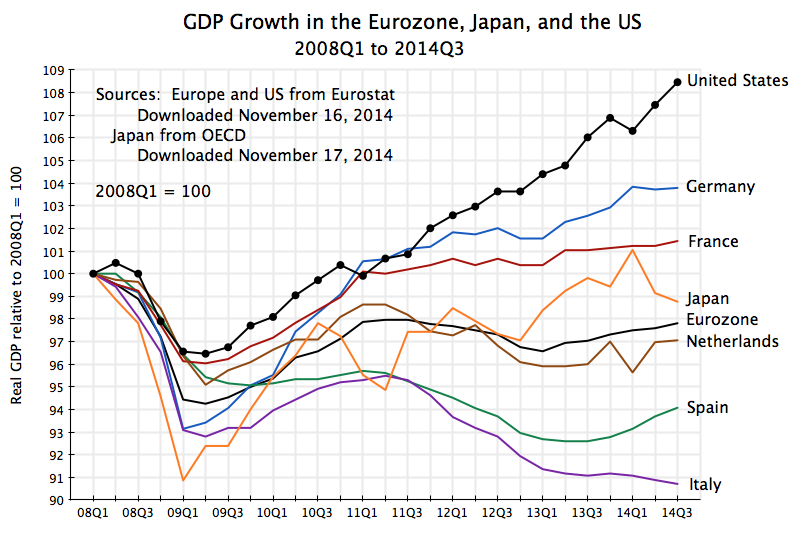
So what has actually happened since the austerity programs were imposed in Europe?  The chart at the top of this post shows the path of real GDP for the larger Eurozone economies as well as for the Eurozone as a whole, plus Japan and the US for comparison.  The data for Europe (as well as the US) comes from Eurostat, with figures for 2014Q3 from the November 14 Eurostat press release, while the data for Japan came most conveniently from the OECD.  Real GDP is shown relative to where it was in the first quarter of 2008, which was the peak for most of Europe before the 2008/09 collapse.

In a word, the results in Europe have been terrible.  Real GDP in the Eurozone as a whole is basically the same as (in fact slightly less than) what it was in early 2011, three and a half years ago.  To be more precise, real GDP in the Eurozone fell by a bit more than 1% between early 2011 and early 2013, and since then rose by a bit over 1%, but it has basically been dead.  There has been no growth in the three and a half years since austerity programs took over.  And Eurozone output is still more than 2% below where it had been in early 2008, six and a half years ago.

Since early 2011, in contrast, the US economy grew by 8.6% in real terms.  Annualized, this comes to 2.4% a year.  While not great (fiscal drag has been a problem in the US as well), and not sufficient for a recovery from a downturn, the US result was at least far better than the zero growth in the Eurozone.

There was, not surprisingly, a good deal of variation across the European economies.  The chart shows the growth results for several of the larger economies in the Eurozone.  Germany has done best, but its growth flattened out as well since early 2011.  As was discussed in an earlier post, Germany (despite its rhetoric) in fact followed fairly expansionary fiscal policies in 2009, with further increases in 2010 and 2011 (when others, including the US, started to cut back).  And as the chart above shows, the recovery in Germany was fairly solid in 2009 and 2010, with this continuing into 2011.  But it then slowed.  Growth since early 2011 has averaged only 0.9% a year.

Other countries have done worse.  There has been very little growth in France since early 2011, and declines in the Netherlands, Spain, and Italy.  Spain was forced (as a condition of European aid) to implement a very tight austerity program following the collapse of its banking system in 2008/09 as a consequence of its own housing bubble, but has loosened this in the last year.  Only in France is real GDP higher now than where it was in early 2008, and only by 1.4% total over those six and a half years.  But France has also seen almost no growth (just 0.4% a year) since early 2011.

C.  Japan

The new figures for Japan were also bad, and many would say horrible.  After falling at a 7.3% annualized rate in the second quarter of this year, real GDP is estimated to have fallen by a further 1.6% rate in the third quarter.  The primary cause for these falls was the decision to go ahead with a planned increase in the consumption tax rate on April 1 (the start of the second quarter) from the previous 5% to a new 8% rate, an increase of 60%.

The Japanese consumption tax is often referred to in the US as a sales tax, but it is actually more like a value added tax (such as is common in Europe).  It is a tax on sales of goods and services to final consumers such as households, with offsets being provided for such taxes paid at earlier stages in production (which makes it more like a value-added tax).  As a tax on consumption, it is the worst possible tax Japan could have chosen to increase at this time, when the economy remains weak.  There is insufficient demand, and this is a straight tax on consumption demand.  It is also regressive, as poor and middle class households will pay a higher share of their incomes on such a tax, than will a richer household.  With its still weak economy, Japan should not now be increasing any such taxes, and increasing the tax on consumption is the worst one they could have chosen.

With recessions conventionally defined as declines in real GDP in two consecutive quarters, Japan is now suffering its fourth recessionary contraction (a “quadruple-dip” recession) since 2008.  This may be unprecedented.  Japan’s output is still a bit better, relative to early 2008, than it is for the Eurozone as a whole, but it has been much more volatile.

Prime Minister Shinzo Abe was elected in December 2012 and almost immediately announced a bold program to end deflation and get the economy growing again.  It was quickly dubbed “Abenomics”, and was built on three pillars (or “arrows” as Abe described it).  The first was a much more aggressive monetary policy by the Central Bank, with use of “quantitative easing” (such as the US had followed) where central bank funds are used to purchase long term bonds, and hence increase liquidity in the market.  The second arrow was further short-term fiscal stimulus.  And the third arrow was structural reforms.

In practice, however, the impacts have been mixed.  Expansionary monetary policy has been perhaps most seriously implemented, and it has succeeded in devaluing the exchange rate from what had been extremely appreciated levels.  This helped exporters, and the stock market also boomed for a period.  The Nikkei stock market average is now almost double where it was in early November 2012 (when it was already clear to most that Abe would win in a landslide, which he then did).  But the impact of such monetary policy on output can only be limited when interest rates are already close to zero, as they have been in Japan for some time.

The second “arrow” of fiscal stimulus centered on a package of measures announced and then approved by the Japanese Diet in January 2013.  But when looked at more closely, it was more limited than the headline figures suggest.  In gross terms, the headline expenditure figure amounted to a bit less than 2% of one year’s GDP, but the spending would be spread over more than one year.  It also included expenditures which were already planned.  It therefore needs to be looked at in the context of overall fiscal measures, including the then planned and ultimately implemented decision to raise the consumption tax rate on April 1, 2014.  The IMF, in its October 2013 World Economic Outlook, estimated that the net impact of all the fiscal measures (including not only the announced stimulus programs, but also the tax hike and all other fiscal measures) would be a neutral fiscal stance in 2013 (neither tightening nor loosening) and a tightening in the fiscal stance of 2.5% of GDP in 2014.  The fall in GDP this year should therefore not be a surprise.

Finally, very little has been done on Abe’s third “arrow” of structural reforms.

On balance, Abe’s program supported reasonably good growth of 2.4% for real GDP in 2013 (see the chart above).  There was then a spike up in the first quarter of 2014.  However, this was largely due to consumers pulling forward into the first quarter significant purchases (such as of cars) from the second quarter, due to the planned April 1 consumption tax hike.  Some fall in the second quarter was then not seen as a surprise, but the fall turned out to be a good deal sharper than anticipated.  And the further fall in the third quarter was a shock.

As a result of these developments, Abe has announced that he will dissolve the Diet, hold new elections in mid-December with the aim of renewing his mandate (he is expected to win easily, due to disorder in the opposition), and will postpone the planned next increase in the consumption tax (from its current 8% to a 10% rate) from the scheduled October 2015 date to April 2017.  Whether the economy will be strong enough to take this further increase in a tax on consumption by that date remains to be seen.  The government has no announced plans to reverse the increase of 5% to 8% last April.

Japan’s public debt is high, at 243% of GDP in gross terms as of the end of 2013.  Net debt is a good deal lower at 134% (debt figures from IMF WEO, October 2014), but still high.  The comparable net debt figure for the US was 80% at the end of 2013 (using the IMF definitions for comparability; note this covers all levels of government, not just federal).  Japan will eventually need to raise taxes.  But when it does, with an economy just then emerging from a recession due to inadequate demand, one should not raise a tax on consumption.  A hike in income tax rates, particularly on those of higher income, would be far less of a drag on the economy.