Recent Data on Home Prices and New Home Sales: Still Far To Go

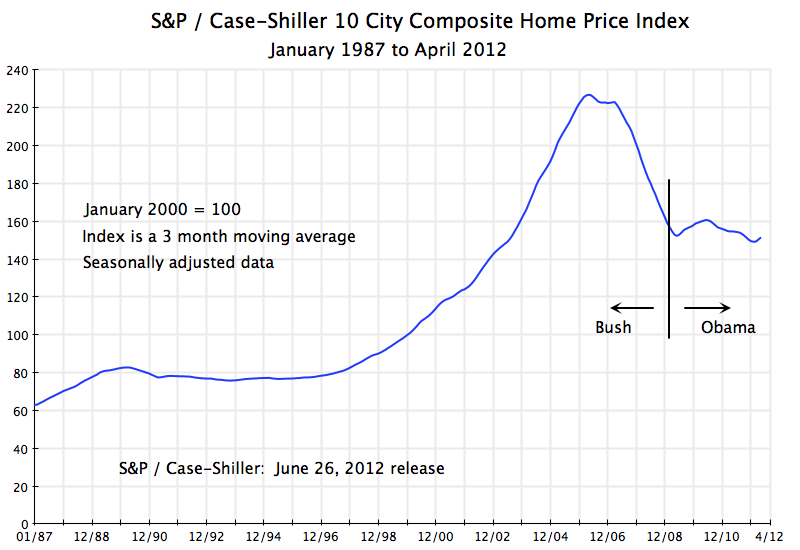
Case - Shiller Home Price Index, 10-city composite, January 1987 to April 2012

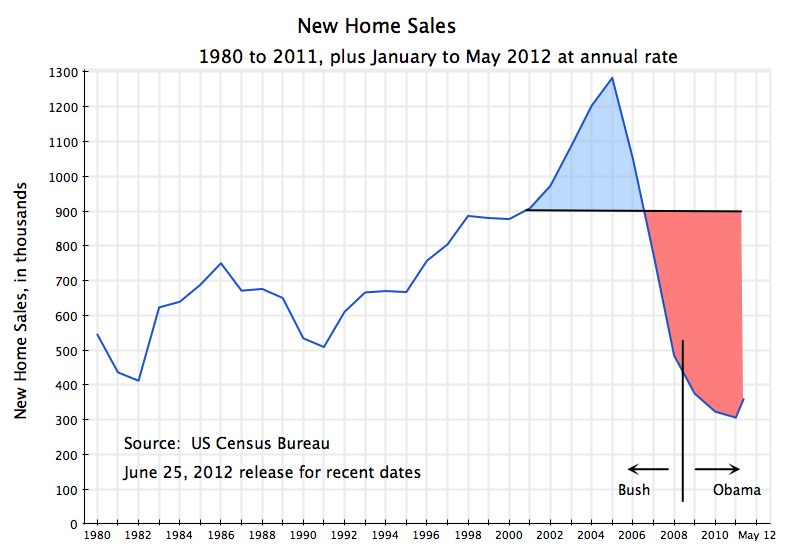
US new home sales, 1980 to May 2012, annual data

A pair of new reports on housing released yesterday and today have sparked positive reports on conditions in the housing market.  Both indicate that conditions have improved.  But comparisons to the recent past can be misleading as conditions have been so miserable.  It is important to look at the data also in a long-term context.  This blog post updates two which were posted on this site last December (here and here).

Yes, compared to the recent past, conditions have improved.  But viewed over a longer term context, one cannot yet say that the changes are significant.  The recent data might ultimately turn out to have marked a turning point.  But it is too early to say that.  Plus there is far to go before one can say there has been a meaningful recovery from the downturn in US housing that started in early 2006 when the housing bubble burst.

The top graph shows the Case-Shiller 10-City Composite home price index for the period from 1980 to April 2012, where the April figures were released this morning.  The Case-Shiller numbers are three month moving averages (so the “April” numbers represent an average over February, March, and April in their raw data).  The index is calculated by looking at changes over time of individual home prices, comparing the price of the home when it was sold to the price when it was purchased.  There is also a broader 20-City Composite Index, but this index only goes back to 2000.

The Case-Shiller numbers indicate an uptick in prices in recent months.  But the upticks are small, with monthly increases of just 0.7% in April and also in March, no change in February, and negative before.  Compared to a year ago, the index was 2.2% lower.

But all these changes are small compared to the fall of one-third in prices from the peak of the housing bubble in early 2006 to now.  Prices were plummeting in 2007 and 2008, and then finally stabilized within a few months of Obama taking office.  But there has not been a significant change since then.  Nor is it necessarily likely that there will be a significant change anytime soon.  As one can see in the diagram, average home prices were fairly flat for almost a decade, from late 1988 to late 1997.

The New Home Sales figures, released yesterday by the Census Bureau, were somewhat more positive.  Estimated new home sales in May reached 369,000 at an annualized rate.  This was almost 20% higher than the 308,000 figure for May 2011.  The January to May, 2012, average pace of new home sales was 352,800, which was 17% above the 300,400 pace of new home sales over January to May 2011 (with all figures at annual rates).

These increases are more encouraging.  But they are still small compared to the pace of new home sales that reached close to 1.3 million in 2005 at the peak of the housing bubble, as seen in the graph above.  The high rate of new home construction and sales during the bubble was clearly excessive.  As was discussed in the earlier blog post, annual sales of about 900,000 a year in the US right now might be considered roughly what is needed, on average, given the US population and its growth.  Sales at a pace of 369,000 units a year is still far below this.  An increase of 17% over the pace of 300,400 in the January to May 2011 period is good, but sales would need to almost triple (an increase of 200%) to reach 900,000 a year.

Over time, one should expect home building to recover to this roughly 900,000 level.  When this happens, it will serve as a significant spur to the economy.  And it might well start soon.  Taking the 900,000 figure as a rough benchmark, there was excess home construction during the bubble years of the Bush administration from 2002 to 2006.  This is shown as the area in blue in the figure above.  The excess during this period (i.e. the excess over the 900,000 benchmark) totaled 1.1 million housing units between 2002 and 2006.  Construction and sales then plummeted as the bubble burst.  With the continued depressed state of the economy, new home demand has remained low, and the cumulative shortfall from 2007 to now (calculated again relative to a 900,000 home unit per year pace as the “normal” demand) has come to 2.5 million units as of May 2012.  There is therefore now a net shortfall in housing units of 2.5 million minus the 1.1 million previous excess, for a net of 1.4 million units.  And at the current rate of 369,000 units per year (at annualized rates), the net shortfall is growing at a rate of 900,000 – 369,000 = 531,000 units per year, or about 44,000 units per month.

All this is consistent with recent published reports (see this Census Bureau report, or this Washington Post article based on it, from June 20) on how households are “doubling up” in record numbers, particularly with adult children in their 20s continuing to live with their parents.  The Census Bureau estimates that the number of doubled up households increased by 2.0 million between 2007 and 2010, with the number of “additional” adults (over and above the household head and his or her spouse or partner, and excluding students) in such households increasing by 3.8 million over this period.

Many of these additional adults will seek their own homes as soon as they can.  This will happen when the economy improves, and the home purchases will then in turn serve to spur further improvement in the economy.  When this happens, the impact on growth will be significant.  A rough calculation in the previous blog post suggested that new home construction and sales returning to a pace of 900,000 per year would add about 1% of GDP, or 2% of GDP assuming a multiplier of two.  The Congressional Budget Office estimates that GDP is about 5% below potential, so such growth in new housing construction could act to make up a significant share of the gap.

This pent up housing demand could therefore act as a significant spur to the economy once the process starts.  This serves to underscore again how important it is to end the fiscal drag that is holding back the economy, and instead allow fiscal growth such as that which acted as a significant spur to the economy during the Reagan years (as was discussed in this earlier post on this blog).  Once growth starts, the recovery of housing construction and sales to a more normal level will act to reinforce the recovery.

It is, however, premature to claim that the recent housing data provides an indication that this recovery is underway.  While positive, the changes are still too small, when seen in the longer term context, to bear much weight in drawing such a conclusion.

Government Jobs Have Been Cut in This Recession: This Has Hurt, Not Helped, the Recovery

I.  Introduction

A Republican theme in this Presidential campaign, asserted repeatedly by Mitt Romney and other Republican leaders, is that a sharp expansion of government under Barack Obama is the cause of the weak job growth in the recovery from the 2008 collapse.  Romney laid out this theme most clearly in his policy address on economic issues last March (see here for a transcript).  I noted in this blog entry that the address was confused and full of factual errors, but it does represent what Romney said he believes.  More recently, in remarks in Iowa earlier this month, Romney said of Obama that, “he wants another stimulus, he wants to hire more government workers.  He says we need more fireman, more policeman, more teachers.  Did he not get the message of Wisconsin?  The American people did.  It’s time for us to cut back on government and help the American people.”

As I have noted in a number of entries in this blog, government has in fact been contracting rather than expanding during this economic recovery, and that indeed the resulting fiscal drag can account for the weakness of the recovery.  See, for example, the posts on fiscal drag during the recession (here and here); the reduction in total government employment (including state and local) during the period Obama has been in office (here and here), with federal government employment flat and non-defense federal employment falling (here); and on federal government spending that has in fact been close to flat during the Obama term, in contrast to the sharp increases under recent Republicans (here).

Given the importance and centrality of this issue in the weak recovery, it is important to get the facts right.  While the previous blogs have looked at the relationship of government spending in recent US economic downturns to the pace of recovery of GDP, they have not explicitly examined the assertion Romney and his Republican colleagues have now raised that higher government employment accounts for the slow recovery in jobs.

This can be done quickly, through a series of graphs.  The analysis here complements and extends the earlier blog post on fiscal drag as the principal cause of the weak recovery from the 2008 collapse, and the blog post on the path of employment during these downturns.

II.  The Data

First, total employment (both public and private) has fallen more in the current downturn than in any other in the US over the last four decades, and the recovery once it bottomed out has been relatively weak:

Recessions, index of total employment before and after peaks, US, 1970s until 2012

Total employment was falling at a rapid rate when Obama took office (and at that point, had fallen by more than had been the case in any other US downturn of the last four decades).  Actions taken by Obama at the start of his administration (as well as aggressive actions by the Fed) started right away to bend this curve, and within a year it had bottomed out.  Since then there has been positive and remarkably steady employment growth, but at too slow a pace given the depth to which employment had fallen to make up for the initial decline.  The path has been the weakest seen in any of the recoveries from the downturns the US has faced over the last four decades.

(Note:  The figure above, and the ones below on employment, go out for 18 quarters.  This carries the data to the second quarter for 2012 for the downturn that began in December 2007.  The employment figures are the averages for the periods, and the June 2012 figure, not yet published by the BLS, was estimated based on the April and May figures.)

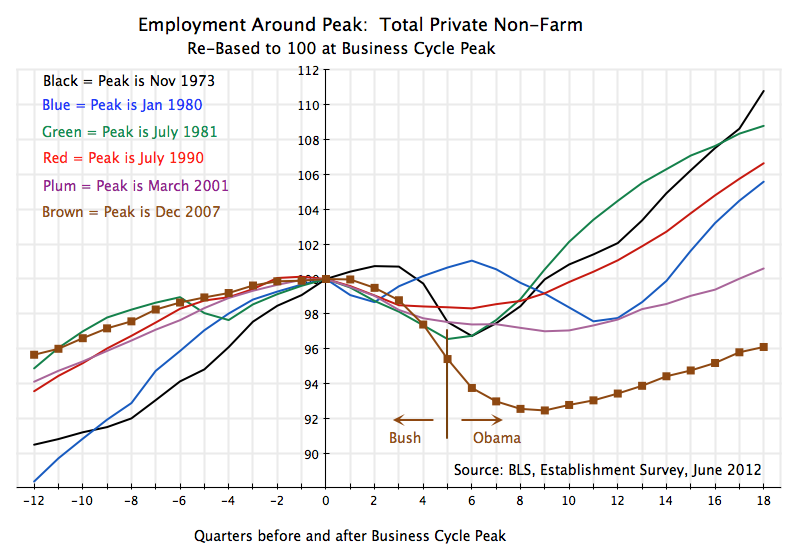
The graph for total private employment is similar, although with a somewhat stronger fall initially, until it bottoms out following the measures early in Obama’s term, and then a somewhat stronger recovery.  Private employment is now above where it was when Obama took office, but it still has not made up for the sharp fall in the last year of the Bush administration:

Recessions, index of total private employment before and after peaks, US, 1970s until 2012

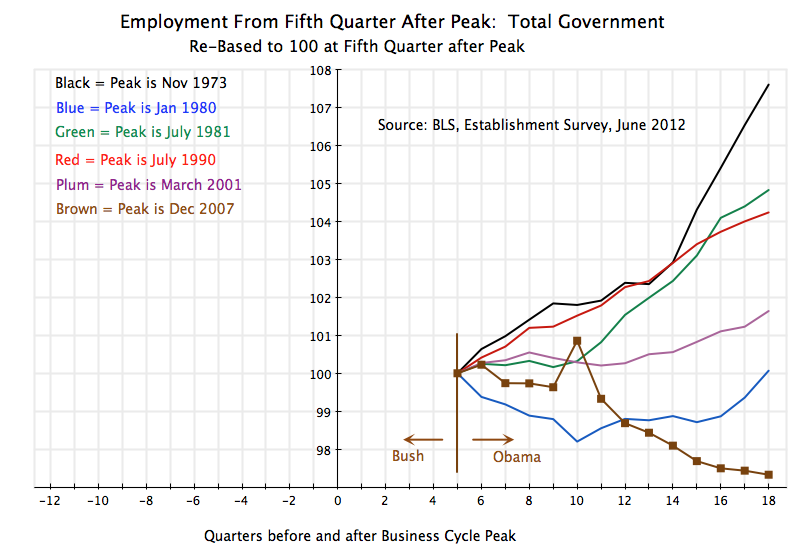
In contrast, total government employment (including state and local, as well as federal) has followed a different pattern.  In contrast to private employment, it did not fall initially (during the last year of the Bush administration).  But once Obama took office, it has fallen steadily except for the temporary blip seen in the 10th quarter after the onset of the downturn, due to the temporary hiring for the decennial census in the Spring of 2010:

Recessions, index of total government employment before and after peaks, US, 1970s until 2012

The fall in government employment was particularly sharp once Obama took office, as can be seen more clearly in a graph which re-bases the data to equal 100 in the fifth quarter following the business cycle peak:

Recessions, index of total government employment starting fifth quarter after peaks, US, 1970s until 2012

In no other downturn has the US had such a cut-back in government employment.  Yet Romney and his Republican colleagues are arguing for even greater cut-backs, including for firemen, policemen, and teachers, as Romney stated in the quotation copied above.

Looking closely at the two graphs above on government employment, one might note that while the reductions in government employment were greater under Obama and in the most recent downturn than in any other, the second smallest was in the recovery following the January 1980 downturn.  This period was initially under Carter (for four quarters) and then under Reagan.  Since I have noted before in this blog that had government grown under Obama at the pace seen under Reagan, the economy would now be at close to full employment, is there a contradiction here?

The answer is no.  First, one should note that the “recovery” from the January 1980 downturn merges into that from the July 1981 downturn (but leading by six quarters), as the economy went into a new recession a half year after Reagan took office.  Reagan did cut back on government employment initially, before allowing it to grow.  Hence the paths followed by the green (July 1981) lines in the graphs above are more directly related to Reagan’s policies than those indicated by the blue (January 1980) lines.

Second and more fundamentally, the importance of the government sector to the economy and its recovery is more related to overall government expenditures than to simply the number of government employees.  Romney and his Republican colleagues are simply missing this point when they focus their criticisms on the number of government workers.  Reagan expanded government spending, but the focus was on things like defense expenditures rather than the number of school teachers.  Defense expenditures are done under contract to private companies (much of it to a few giant companies such as Boeing and Lockheed).  Building modern jet fighters and naval ships can be very labor intensive, but these are employees of private contractors, and are not directly classified as government workers.

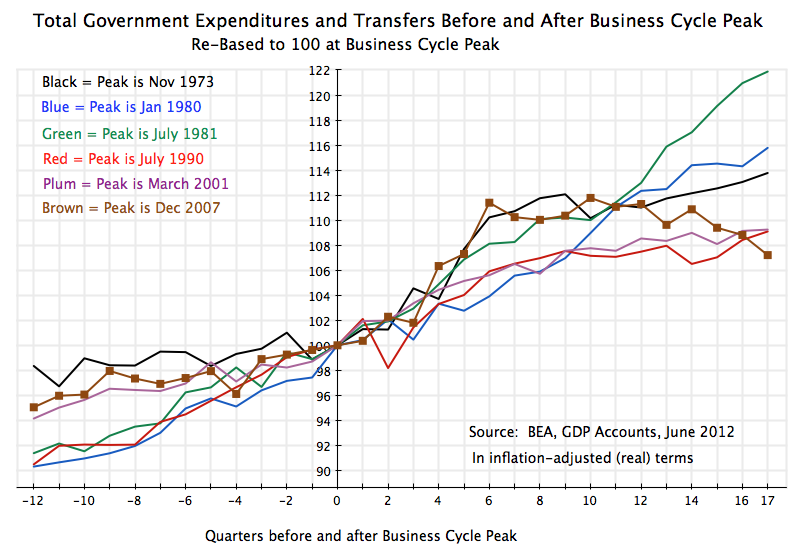
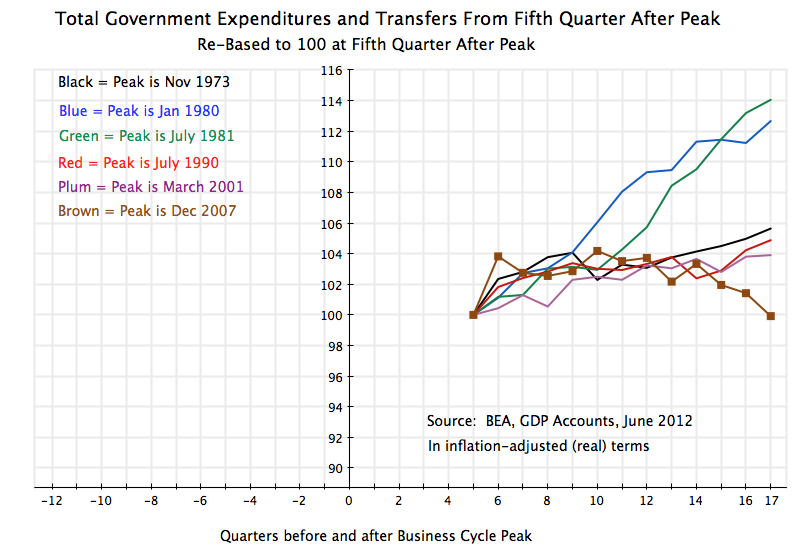
The paths can be seen in the following graphs, similar to ones presented in the earlier blog, but now with 17 quarters shown rather than 16 (as there is now one quarter of additional GDP data available):

US recessions 1970-2012, total government expenditures before and after business cycle peaks

US recessions 1970-2012, total government expenditures from fifth quarter after business cycle peaks

Growth in government spending during the Reagan periods (the blue and green paths) is the highest of all, especially when one starts five quarters from the cyclical peaks (when Obama took office).

III.  Conclusion

In summary, if there was any basis for the belief of Romney and his Republican colleagues that cut-backs in government employment and spending would lead to strong growth, then the economy would be booming right now.  Government employment and spending in the current downturn, especially once Obama took office in January 2009, have been below the paths followed in each of the other downturns the US has faced over the last four decades.

The recovery has been weak because there has been weak demand for the goods and services that business could produce.  There is no point in hiring a worker to make something if you cannot then sell it.  Government demand has been weak, as seen in the graphs above, due to strong Republican opposition.  Investment demand has been weak, despite record low interest rates and high cash balances on corporate balance sheets, since there is surplus production capacity.  There is little point in investing to build even more capacity when what you have is not being fully utilized.  Consumer demand has been weak, both because of weak incomes (the high unemployment and depressed wages for those who are employed) and because of the collapse of the housing bubble, which wrecked household wealth.  And global demand has been weak, due to crises in Europe (with its own mis-guided policies focussed on austerity) and elsewhere.

The cause of this weak recovery is not that government has grown rapidly, but rather that is hasn’t.

Employment is Deteriorating

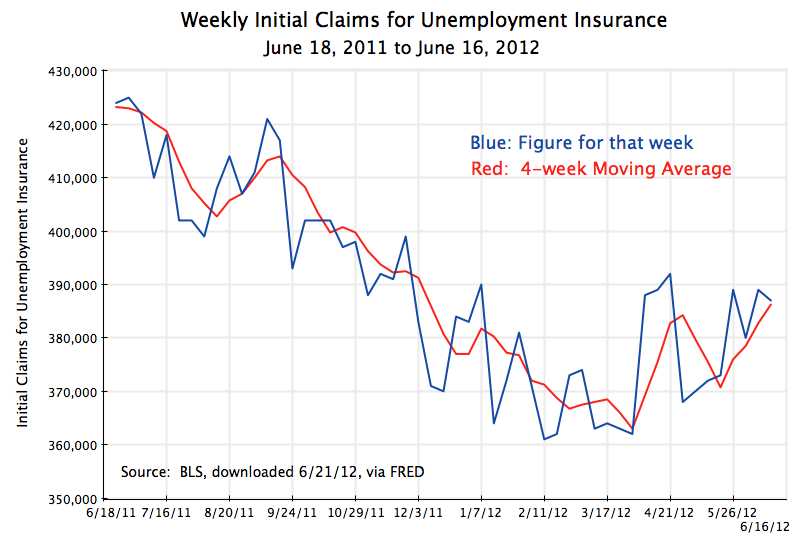
US weekly initial claims for unemployment insurance, June 18, 2011, to June 16, 2012

The Bureau of Labor Statistics released this morning its regular weekly report on the number of American workers who had filed initial claims for unemployment insurance.  Although there is a good deal of noise in this weekly data (so some analysts focus on the four-week moving average rather than on the weekly figures themselves), the report provides a useful early indication of developments in the labor market.

It is now clear that the labor market situation is deteriorating.  The graph above shows the figures (for both the weekly initial claims and for the four-week moving average) for the last year.  The trend was improving (weekly initial claims were falling) until mid to late March of this year.  But it is now clear that there was a turn at that point, with the employment situation since then worsening.  Using the four-week moving average, initial claims for unemployment insurance rose from 363,000 in late March, to 386,250 in the most recent figure.

Keep in mind that with normal churn in the labor market, there will always be initial claims for unemployment insurance.  Even with the economy at full employment, weekly initial claims will be at about 310,000 to 320,000 given the size of and extent of turnover in the US labor force (see the figure below for the numbers in 2006 and early 2007, before the downturn).  And the rise in the weekly rate of initial claims for unemployment insurance could still be consistent with positive net job growth each month.  The labor force is growing over time, although with significant month to month fluctuation in the number of people entering and leaving the labor force.

Nevertheless, the turnaround and sustained increase in the weekly figure on initial claims for unemployment insurance is likely to be a signal that the unemployment rate may now start to rise for a period.  This can be seen by looking at the initial claims figure in a longer term context, and correlating that with the overall unemployment rate.

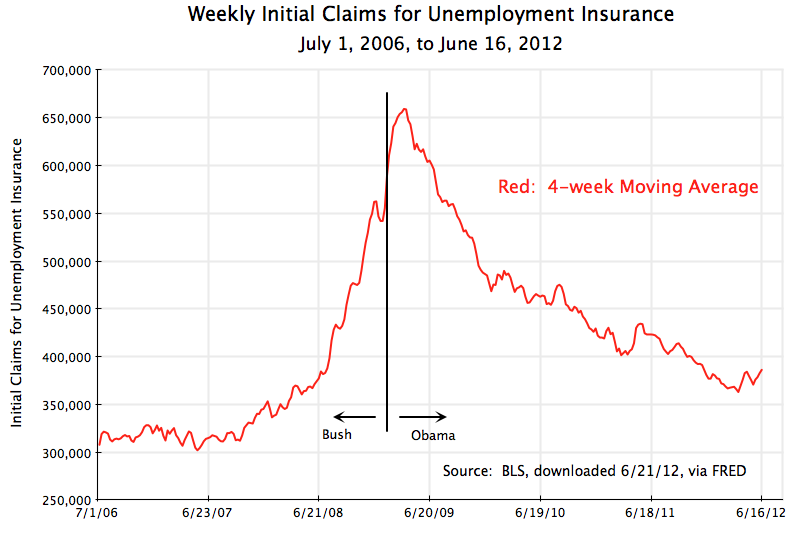
US weekly initial claims for unemployment insurance, July 1, 2006, to June 16, 2012

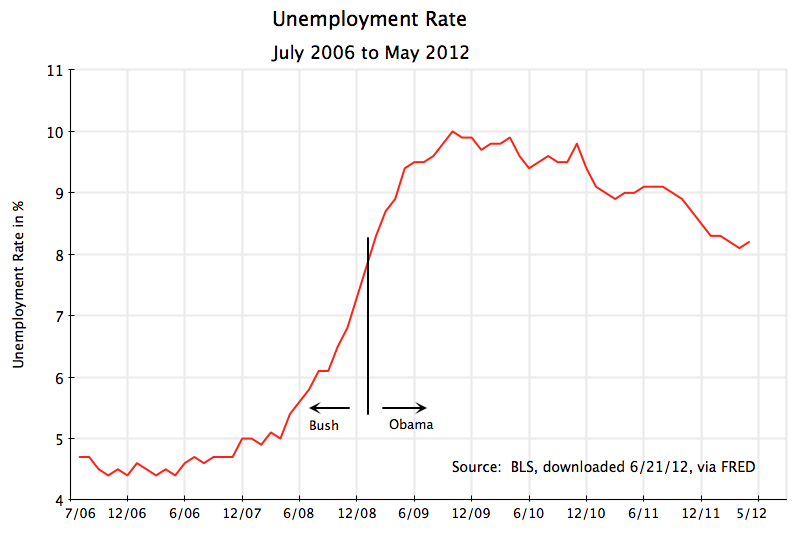
US unemployment rate, July 2006 to May 2012

The first figure shows the weekly initial claims figure (four-week moving average) for the period from July 1, 2006, to now.  The second shows the unemployment rate.  The sharp rise in the initial claims figure in the last year of the Bush Administration is clear, with a peak reached just after Obama took office.  With new measures such as the Stimulus Bill (passed in February 2009) and other actions (such as continued aggressive measures by the US Federal Reserve Board), the economy started to turn around, and new claims for unemployment insurance began to diminish.  But while the weekly pace was reduced, it was still high, and the overall rate of unemployment continued to rise for a period before starting to fall.

The recovery has been weak, however.  As noted previously in this blog (such as here, and here), fiscal drag from falling government expenditures (mainly at the state and local level, but also weakness at the federal level) can by itself account for this slow and weak recovery.  And as seen in the figure above, in this weak recovery there have been two periods (between May and August 2010, and between March and June 2011) when initial claims reversed its downward path and began to rise for a period.  In each of these times, the unemployment rate also then started to rise for about half a year (from June to November 2010, and from March to June/July/August 2011).

The blip upwards of the unemployment rate last month to 8.2% from the earlier 8.1%, might therefore not be a fluke, but rather a signal of further weakness to come.  Such a rise in the unemployment rate in the half year before an election should be particularly worrisome to any incumbent seeking re-election.  And all this is unfortunately also consistent with the prediction made in this blog in January (see posting here), that despite what looked like an acceleration of growth in the second half of 2011, growth in 2012 could be weak.  It appears that is what is happening.