Failure to Keep Up Gasoline Taxes Has Crippled Highway Construction

US federal gasoline tax, 1959 to 2011, in nominal terms, constant real terms, and as a constant share of gasoline price, in dollars per gallon

As I write this in late June, 2012, Congress is once again in a crisis mode over extension of the Highway Trust Fund Reauthorization bill.  The last long term authorization expired in September 2009.  Since then, there have been nine temporary extensions, usually for three months each.  If no extension is passed by Congress and signed by Obama by June 30, the Federal government will no longer be able to reimburse State governments for its share of highway projects underway, no new construction or maintenance projects would start, and 3,500 federal workers (mostly in the Federal Highways Administration) would be furloughed.

Right now (on June 28) it appears Congress will pass legislation tomorrow to reauthorize the highway spending for a little over two years (to the end of FY2014).  A compromise was reached among the key negotiators yesterday, which resolved the immediate stumbling blocks.  For example, the Republican House had tried to attach controversial and unrelated additional measures to this high priority bill to require approval of the Keystone XL oil pipeline (even though the environmental review of the recently revised route has not been done), and to declare that coal ash should not be treated as hazardous waste (despite what scientists might say on it being hazardous).  But these additional provisions were dropped.  In the bill as now drafted, federal expenditures would continue at the current rate of $54 billion a year in nominal terms.  But the compromise legislation still provides no long term solutions to the key issues.

The fundamental issue is money.  The basic problem is that while everyone recognizes the critical need to build up and maintain our highway and other transport infrastructure, there has been an unwillingness to raise the taxes needed to pay for it.  Republican leaders today repeatedly cite Eisenhower and the Interstate Highway System that was launched under Eisenhower as exemplars of what America should do.  But the Republican leaders have been completely unwilling to consider setting gasoline tax rates at the levels they were in real terms under Eisenhower when the Interstate Highway system was launched.

The problem is that while the system of funding centers on use of taxes on gasoline (and other fuels, such as diesel) to pay for the highway improvements, the fuel taxes are structured to fall steadily over time in real terms.  The fuel taxes have been set in terms of some fee per gallon sold (currently 18.4 cents per gallon for gasoline), but these taxes are not then adjusted for inflation.  The current 18.4 cents per gallon rate was set in 1993, but general prices are now more than 50% higher than they were then.  Hence general construction costs will be higher by about this much, and the money raised will not go as far as it did back then.  Hence needed projects do not get funded, congestion increases, maintenance is neglected, and our highways and bridges deteriorate and fall apart (sometimes dangerously so, with bridges collapsing).  Highways in America were once the best in the world, but no more.

The graph above shows what federal gasoline taxes have been since 1959, in dollars per gallon.  The data is from the Energy Information Agency of the US Department of Energy and from this special report of the US Department of Energy, coupled with a history of gasoline taxes from the Federal Highway Administration, and inflation data from the Bureau of Labor Statistics.  There are also fuel taxes at the state and sometimes local level, which will be in addition to the federal taxes, and these taxes are significant.  But the focus here is on the federal tax, as it is the federal tax which funds the federal government payments for highway construction and maintenance.

Federal gasoline taxes were in fact originally imposed in June 1932 by President Herbert Hoover, at a rate of 1.0 cents per gallon (equivalent to 16.2 cents in prices of 2011) which was raised to 1.5 cents in June 1933 (equivalent to 25.4 cents in current prices) and then reduced to 1.0 cents again in 1934.  But these taxes were considered part of general government revenues, and were not earmarked to be used solely for highway construction and maintenance.

This changed during the Eisenhower Administration, with the approval in 1956 to build the new Interstate Highway system.  Gasoline taxes were raised to 3.0 cents per gallon (they were at 2.0 cents at that point), with these taxes and other taxes (on other fuels as well as on rubber for tires and on sales of new trucks) allocated to a new Highway Trust Fund.  The Highway Trust Fund would be used to fund the federal share of the new Interstate highways and other federal highway projects (and later, under Reagan starting in 1983, a share would be used for mass transit projects).  As construction ramped up, the tax was raised to 4.0 cents per gallon in 1959.

A tax of 4.0 cents per gallon in 1959 would be equivalent to a tax of 30.2 cents per gallon today, in current (2011) prices.  But while there were several increases in the fuel tax (to 9.0 cents in 1983 under Reagan, to 14.1 cents in 1990 under the first Bush, and to 18.4 cents in 1993 under Clinton), the increases did not suffice to make up for inflation.  And since 1993, the tax has not been changed, and hence has diminished in real terms because of inflation.

The graph above shows in the green line what the fuel tax would have needed to have been (in terms of the current prices of the year) to have kept it steady in real terms at the level of 1959 under Eisenhower.  The actual fuel tax (the red line) is always below that, and sometimes far below, as it is now.  With such a gap, it should not be surprising that there is a shortage of funds to pay for highways, and their now decrepit state not a surprise.

Another way to structure the tax would have the tax as a constant percentage of the price of gasoline.  Regular sales taxes are always set as a percentage share of the value of what is bought, and there is no reason in principle why fuel taxes could not be also.

The graph above shows in the blue line what the tax on gasoline would have been had it been set at the percentage share that 4.0 cents per gallon represented in 1959.  That share was 12.9% (based on the average retail gasoline price of the year).  There is more volatility in this line, as gasoline prices have been volatile, especially in recent years.  For 2011, the tax would have averaged 45.5 cents per gallon.  This is well above the actual 18.4 cents rate.  However, the tax rate would have been lower between 1993 and 2000 and again in 2002.

While there is some logic to structuring the fuel tax as a constant percentage share of the price of gasoline, a major drawback is that fuel tax revenues are needed for highway construction and maintenance, and the costs of building or maintaining highways is not closely linked to the price of gasoline, but rather to general prices.  Adjusting the fuel tax rate for general inflation rather than for the price of gasoline (as is implicitly being done with the tax at a constant share of the price of gasoline) will be more likely to produce revenues linked to the cost of construction.  One can see from the diagram at the top that had the fuel tax been set at a constant share of gasoline prices, the rate would have been almost the same in 2002 as in 1980, over two decades earlier.  Yet the general price level was more than double (117% higher to be more precise) in 2002 than in 1980.

In FY2011, the Highway Trust Fund received $36.9 billion in revenues (from all sources).  Had gasoline taxes been adjusted for inflation so that they represented in 2011 what they were under Eisenhower in 1959 (and assuming similar adjustments in the taxes on other fuels and other items such as tires), the Trust Fund would have received $60.5 billion in revenues.  This would have been an increase of $23.6 billion, or 64%.  (I am assuming for simplicity that the higher tax rates would not have led to a lower volume of fuels purchased.  The volumes purchased would probably have been reduced some, but in general in the US, gasoline and other fuel use is fairly insensitive in the short run to such price changes.)

Highway Trust Fund revenues of $60 billion would have more than fully funded the $54 billion per year that is currently being spent, and would continue to be spent under the draft reauthorization bill that might pass tomorrow.  But everyone agrees that the $54 billion level of spending is far below what is needed.  A 2009 report by the commission established by Congress to examine the issue, the National Surface Transportation Infrastructure Financing Commission, estimated that federal government spending on what is now being covered by the Highway Trust Fund would need to total between $92 billion and $119 billion per year (over the period 2008 to 2035, in 2008 constant dollars), simply to maintain the system as it is now.  For the system to improve, federal spending would need to total between $118 billion and $150 billion per year.

Hence even $60 billion per year would not suffice, even though this is far higher than the $36.9 billion collected in FY2011.  A case could be made that the tax per gallon should be higher than what it was in 1959 in real terms during Eisenhower’s Presidency.  Many would argue the tax should be a dollar per gallon or even more, both to fund the needed highway improvements, and to cover the pollution and congestion costs that result from gas users not paying to cover the costs they impose on others.  A tax of a dollar per gallon would raise $200 billion per year at current (2011) usage rates, but presumably (and hopefully) usage would be reduced somewhat with a tax on use at this level.  But even if usage fell 25% (the fall would likely be less), revenues would still total $150 billion per year, or enough to cover fully even the high end of the estimated $118 to $150 billion range cited above on how much needs to be spent for the highway system to improve.

But touching the current 18.4 cents per gallon gasoline tax rate is considered politically impossible, and that may well be correct.  Hence dedicated revenues for highways falls each year in real terms, and what is spent to maintain and improve highways is kept well below what is needed.  It was noted above that the current reauthorization bill constrains spending to just $54 billion a year.  With revenues from the gasoline (and related fuels, tires, and new truck sales) coming to less than this ($36.9 billion in FY2011), the difference has to be found from other sources.

The current reauthorization bill illustrates the types of tricks that are used.  Some funds will come from the Leaking Underground Storage Tank Trust Fund.  I know nothing about that fund, but suspect it does not have an excess of money.  A bigger part will come via a change in accounting rules that corporations would now be able to use for their pension obligations for their workers.  The easier rules would allow underfunded pension obligations to become even more underfunded.  The result is that the corporations would then be able to show a higher near term profit, as they would not need to record the same level of transfers to the pension funds.  The corporations want this.  And with the higher profits, there would be higher corporate profit taxes paid to the government, and the government would then count this as revenues to cover the highway expenditures.

This is of course short-sighted.  The pension obligations will remain, and will simply become even more underfunded than they are now.  Eventually this will need to be covered, unless the corporation goes bankrupt and reneges on its pension obligations.  If it does, the Pension Benefit Guarantee Corporation (PBGC) would be responsible for covering at least part of these pensions.   But the PBGC already has greater obligations than it has funds to cover them.  While the highway reauthorization bill will also authorize a rise in PBGC fees, it will also count these fees as part of the “additional” revenues to fund the highway construction.

As the saying goes, “this is no way to run a railroad”.  Or fund building of highways.

Government Jobs Have Been Cut in This Recession: This Has Hurt, Not Helped, the Recovery

I.  Introduction

A Republican theme in this Presidential campaign, asserted repeatedly by Mitt Romney and other Republican leaders, is that a sharp expansion of government under Barack Obama is the cause of the weak job growth in the recovery from the 2008 collapse.  Romney laid out this theme most clearly in his policy address on economic issues last March (see here for a transcript).  I noted in this blog entry that the address was confused and full of factual errors, but it does represent what Romney said he believes.  More recently, in remarks in Iowa earlier this month, Romney said of Obama that, “he wants another stimulus, he wants to hire more government workers.  He says we need more fireman, more policeman, more teachers.  Did he not get the message of Wisconsin?  The American people did.  It’s time for us to cut back on government and help the American people.”

As I have noted in a number of entries in this blog, government has in fact been contracting rather than expanding during this economic recovery, and that indeed the resulting fiscal drag can account for the weakness of the recovery.  See, for example, the posts on fiscal drag during the recession (here and here); the reduction in total government employment (including state and local) during the period Obama has been in office (here and here), with federal government employment flat and non-defense federal employment falling (here); and on federal government spending that has in fact been close to flat during the Obama term, in contrast to the sharp increases under recent Republicans (here).

Given the importance and centrality of this issue in the weak recovery, it is important to get the facts right.  While the previous blogs have looked at the relationship of government spending in recent US economic downturns to the pace of recovery of GDP, they have not explicitly examined the assertion Romney and his Republican colleagues have now raised that higher government employment accounts for the slow recovery in jobs.

This can be done quickly, through a series of graphs.  The analysis here complements and extends the earlier blog post on fiscal drag as the principal cause of the weak recovery from the 2008 collapse, and the blog post on the path of employment during these downturns.

II.  The Data

First, total employment (both public and private) has fallen more in the current downturn than in any other in the US over the last four decades, and the recovery once it bottomed out has been relatively weak:

Recessions, index of total employment before and after peaks, US, 1970s until 2012

Total employment was falling at a rapid rate when Obama took office (and at that point, had fallen by more than had been the case in any other US downturn of the last four decades).  Actions taken by Obama at the start of his administration (as well as aggressive actions by the Fed) started right away to bend this curve, and within a year it had bottomed out.  Since then there has been positive and remarkably steady employment growth, but at too slow a pace given the depth to which employment had fallen to make up for the initial decline.  The path has been the weakest seen in any of the recoveries from the downturns the US has faced over the last four decades.

(Note:  The figure above, and the ones below on employment, go out for 18 quarters.  This carries the data to the second quarter for 2012 for the downturn that began in December 2007.  The employment figures are the averages for the periods, and the June 2012 figure, not yet published by the BLS, was estimated based on the April and May figures.)

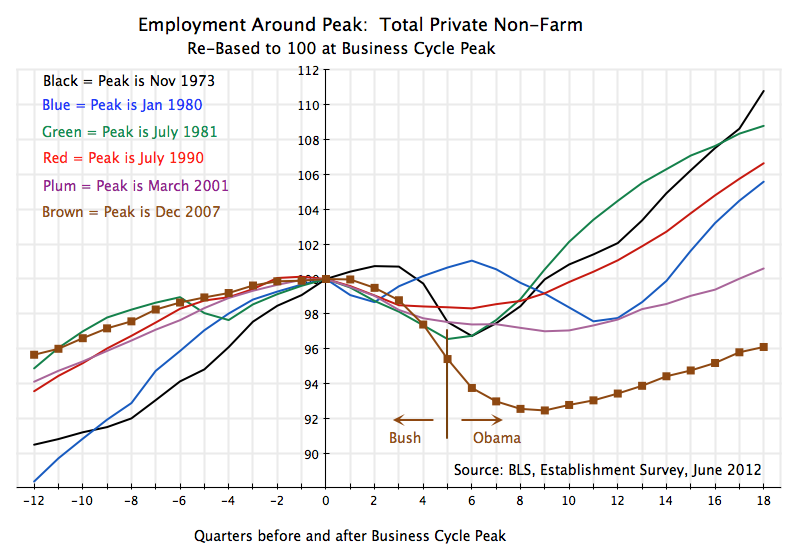
The graph for total private employment is similar, although with a somewhat stronger fall initially, until it bottoms out following the measures early in Obama’s term, and then a somewhat stronger recovery.  Private employment is now above where it was when Obama took office, but it still has not made up for the sharp fall in the last year of the Bush administration:

Recessions, index of total private employment before and after peaks, US, 1970s until 2012

In contrast, total government employment (including state and local, as well as federal) has followed a different pattern.  In contrast to private employment, it did not fall initially (during the last year of the Bush administration).  But once Obama took office, it has fallen steadily except for the temporary blip seen in the 10th quarter after the onset of the downturn, due to the temporary hiring for the decennial census in the Spring of 2010:

Recessions, index of total government employment before and after peaks, US, 1970s until 2012

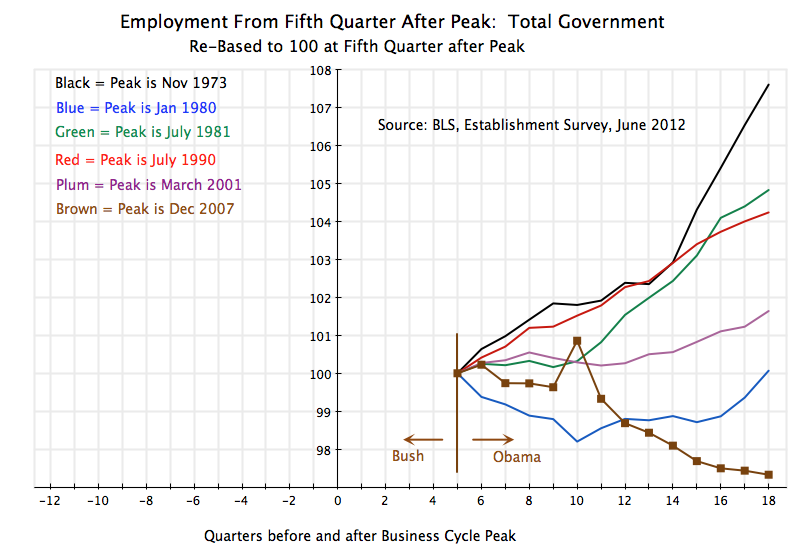
The fall in government employment was particularly sharp once Obama took office, as can be seen more clearly in a graph which re-bases the data to equal 100 in the fifth quarter following the business cycle peak:

Recessions, index of total government employment starting fifth quarter after peaks, US, 1970s until 2012

In no other downturn has the US had such a cut-back in government employment.  Yet Romney and his Republican colleagues are arguing for even greater cut-backs, including for firemen, policemen, and teachers, as Romney stated in the quotation copied above.

Looking closely at the two graphs above on government employment, one might note that while the reductions in government employment were greater under Obama and in the most recent downturn than in any other, the second smallest was in the recovery following the January 1980 downturn.  This period was initially under Carter (for four quarters) and then under Reagan.  Since I have noted before in this blog that had government grown under Obama at the pace seen under Reagan, the economy would now be at close to full employment, is there a contradiction here?

The answer is no.  First, one should note that the “recovery” from the January 1980 downturn merges into that from the July 1981 downturn (but leading by six quarters), as the economy went into a new recession a half year after Reagan took office.  Reagan did cut back on government employment initially, before allowing it to grow.  Hence the paths followed by the green (July 1981) lines in the graphs above are more directly related to Reagan’s policies than those indicated by the blue (January 1980) lines.

Second and more fundamentally, the importance of the government sector to the economy and its recovery is more related to overall government expenditures than to simply the number of government employees.  Romney and his Republican colleagues are simply missing this point when they focus their criticisms on the number of government workers.  Reagan expanded government spending, but the focus was on things like defense expenditures rather than the number of school teachers.  Defense expenditures are done under contract to private companies (much of it to a few giant companies such as Boeing and Lockheed).  Building modern jet fighters and naval ships can be very labor intensive, but these are employees of private contractors, and are not directly classified as government workers.

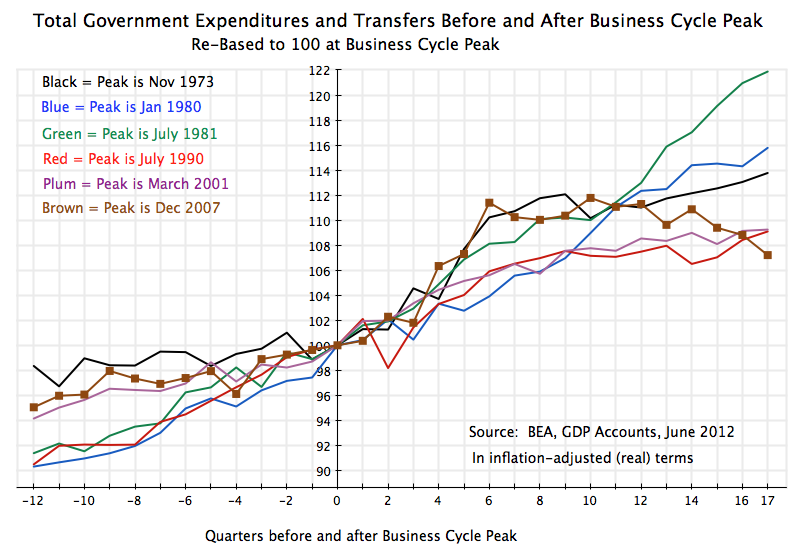
The paths can be seen in the following graphs, similar to ones presented in the earlier blog, but now with 17 quarters shown rather than 16 (as there is now one quarter of additional GDP data available):

US recessions 1970-2012, total government expenditures before and after business cycle peaks

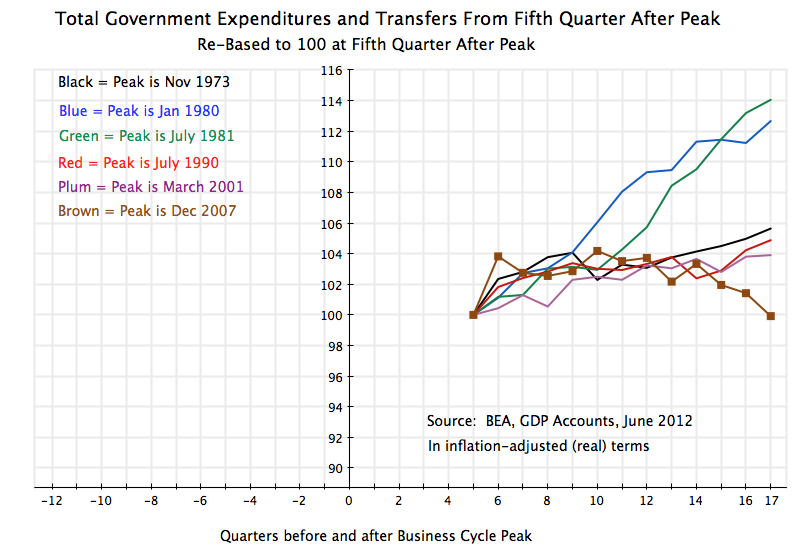
US recessions 1970-2012, total government expenditures from fifth quarter after business cycle peaks

Growth in government spending during the Reagan periods (the blue and green paths) is the highest of all, especially when one starts five quarters from the cyclical peaks (when Obama took office).

III.  Conclusion

In summary, if there was any basis for the belief of Romney and his Republican colleagues that cut-backs in government employment and spending would lead to strong growth, then the economy would be booming right now.  Government employment and spending in the current downturn, especially once Obama took office in January 2009, have been below the paths followed in each of the other downturns the US has faced over the last four decades.

The recovery has been weak because there has been weak demand for the goods and services that business could produce.  There is no point in hiring a worker to make something if you cannot then sell it.  Government demand has been weak, as seen in the graphs above, due to strong Republican opposition.  Investment demand has been weak, despite record low interest rates and high cash balances on corporate balance sheets, since there is surplus production capacity.  There is little point in investing to build even more capacity when what you have is not being fully utilized.  Consumer demand has been weak, both because of weak incomes (the high unemployment and depressed wages for those who are employed) and because of the collapse of the housing bubble, which wrecked household wealth.  And global demand has been weak, due to crises in Europe (with its own mis-guided policies focussed on austerity) and elsewhere.

The cause of this weak recovery is not that government has grown rapidly, but rather that is hasn’t.

The Long-Term Rise in Federal Debt is Due to the Bush Tax Cuts

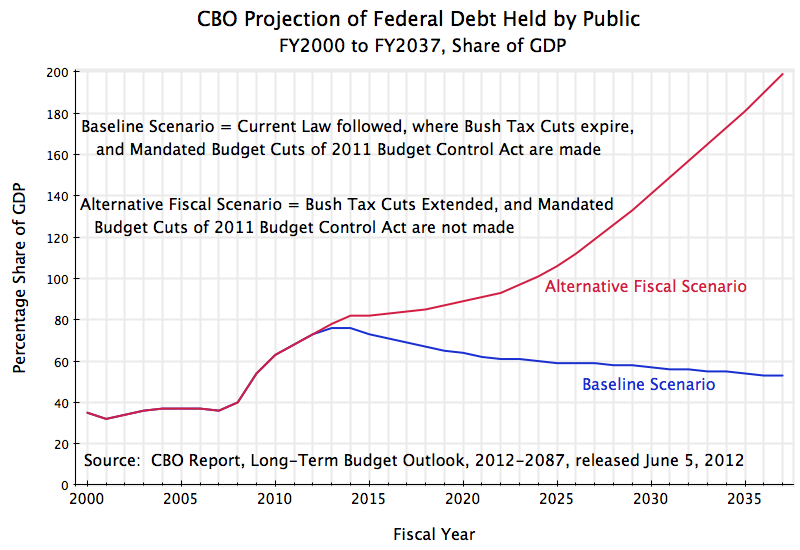
US Federal Government Debt to GDP ratio, CBO long-term projection, 2000 to 2037The Congressional Budget Office released yesterday its regular annual report on the long-term budget outlook for the federal government.  Surprisingly, it did not receive much attention in the press (at least not yet).  But the implications of the projections it has made are important:  They basically indicate that were it not for the Bush Tax Cuts passed in 2001 and 2003, we would not be facing a long-term fiscal problem.  That is, if tax rates were allowed to return to those we had during the Clinton years, along with some near term control on spending, federal government debt as a share of GDP would stabilize and then fall.  And since the economy prospered during the Clinton years, there is no support for the argument that such tax rates would stifle long run growth.

The results are consistent with projections made in a posting on this blog on February 11, 2012.  In that blog, results are shown from calculations (based on underlying CBO numbers) which demonstrated that phasing out the Bush Tax Cuts would lead the federal government debt to GDP ratio to start to fall.  The new CBO numbers, with calculations by their staff rather than myself, back this up.

The figure above shows the CBO projections of federal debt (held by the public) as a share of GDP, for the period FY2000 to FY2037, under two scenarios.  Under CBO’s Baseline Scenario, current law is followed in all respects.  This includes that the Bush Tax Cuts would be allowed to expire (as currently provided by law) at the end of 2012, and that the budget cuts mandated by the 2011 Budget Control Act for the period 2013 to 2022 (if Congress failed to make similar cuts before then) would be implemented.  Medical payments to doctors made by Medicare would also be cut (as per a law passed by the then Republican Congress in 1997, but then over-ridden annually since then), while over the longer term, the growth in medical costs would be moderated through the implementation of measures passed in the “ObamaCare” reforms.

Under the Alternative Fiscal Scenario, the Bush Tax Cuts would all be extended permanently, the 2013 to 2022 mandated budget cuts would not be made, after 2022 budget expenditures would be raised further to historical levels (as a share of GDP), medical payments to doctors would not be cut but rather kept at current levels, and the ObamaCare medical cost reforms would not be implemented, so medical costs would rise compared to the costs in the Baseline Scenario.

The CBO also mechanically extrapolated the underlying numbers under the two scenarios all the way to 2087, but wisely focussed on the period to 2037 (the next twenty-five years).  The longer term numbers are subject to much uncertainty.  The diagram above presents the CBO numbers to 2037.

What is striking is that the figure above shows that under the Baseline Scenario, where current law is followed and in particular the Bush Tax Cuts are allowed to expire, the federal government debt to GDP ratio peaks in 2013 and then immediately starts to fall.  Indeed, the long-term numbers extended mechanically to 2085 indicate that the federal government debt would fall to zero in 2069.  In contrast, the debt to GDP ratio grows explosively upwards under the Alternative Fiscal Scenario.

It was noted above that a number of changes are made in the Alternative Fiscal Scenario compared to the Baseline Scenario, affecting both tax revenues and spending.  However, one can calculate from the underlying data released by the CBO along with its report (in spreadsheet form at the CBO site), that 76% of the higher deficits in the Alternative Scenario over the key period 2013 to 2022 would be due to the lower revenues following from the Bush Tax Cuts.  Higher government spending other than on medical expenditures accounted for 18% of the higher deficits, while higher spending on medical costs (principally for doctors over this period) accounted for only 6% of the higher deficits.

That is, lower revenues due to the Bush Tax Cuts account for three-quarters of the difference in the deficits between what one would have under the Baseline Scenario and what one would have under the Alternative Fiscal Scenario.  Given the extent of the decline in the debt to GDP ratio that one sees under the Baseline Scenario, it is likely that allowing the Bush Tax Cuts to expire would alone suffice to lead that ratio to start to fall in these new CBO scenarios.  My February 11 posting on this blog did find this.  But it should be noted that the new CBO scenarios included other factors as well in its projections, which accounted for one-quarter of the reduction in deficits.  The report does not show a scenario focused exclusively on the impact of the Tax Cuts.

It should be emphasized that no one, and certainly not myself, is arguing that the Baseline Scenario should be followed in all respects.  Doctor payments under Medicare should certainly not be allowed to be cut sharply as they would if the annual “Medicare doc fix” were not extended.  Nor, I would strongly stress, should all the crude and across-the-board spending cuts mandated by the 2011 Budget Control Act  be allowed to go through.

The basic point, rather, is that drastic cuts in entitlement programs such as Social Security and Medicare are not absolutely necessary for the US to achieve budget balance, despite what Mitt Romney, Congressman Paul Ryan, and other Republicans have asserted.  What the CBO scenarios show is that the Bush Tax Cuts have led to the US fiscal debt problem, and that simply allowing these Tax Cuts to expire would likely suffice to fix that problem.  The US debt spirals out of control due to the Bush Tax Cuts.

To fix a problem, it is important to know the source.  The CBO scenarios make clear that the primary source of the exploding federal government debt is the Bush Tax Cuts.  And while I would not advocate an immediate re-instatement of tax rates to their previous levels, since the economy remains weak, phasing out the Bush Tax Cuts over the next few years would suffice to resolve the fiscal problems we face.