Bringing Democracy to America: The Popular Vote Should Determine Who Wins the Presidency

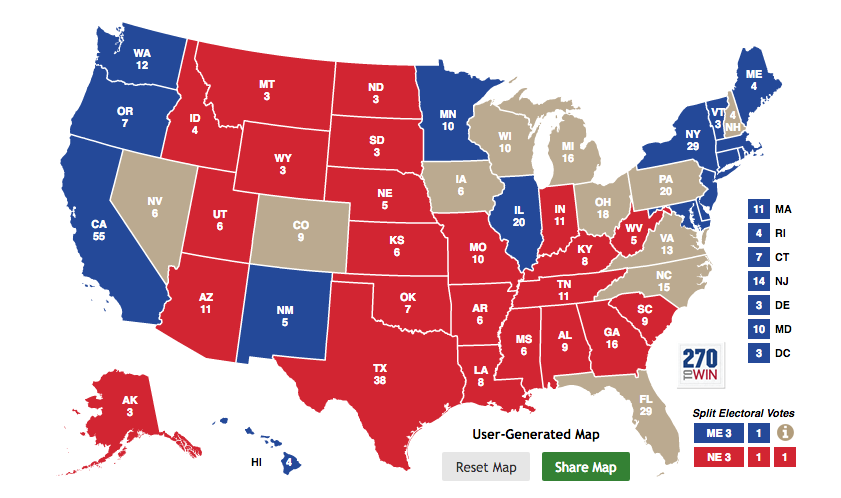
Map of Battleground States in 2012

A.  Introduction

The US is once again in the middle of a presidential election, with possible consequences this time that are more worrying than ever.  And once again it is an election where the candidates focus their attention on a limited sub-set of US states – those states where the result is expected to be relatively close and winnable by a candidate if given sufficient attention. This is a consequence of the unique US system where presidents are selected not by who receives the most votes in the nation, but rather by who wins a plurality of votes in individual states whose electoral college votes sum to 270 or more (i.e. more than half of the total 538 electoral votes allocated across the nation).  It does not matter if the candidate wins the state by a little or a lot; they receive the same number of electoral votes from the state regardless.

Hence if a candidate is almost certain to win a state, as well as if they are almost certain to lose a state, it makes no sense to campaign there.  They gain nothing by winning by somewhat more, or by losing by somewhat less.  Total votes in the nation by the population do not count; only electoral votes count, and these are won at the state level.

This is not a democratic system, and no other democratic country in the world with a president with substantial real powers selects their president this way.  There are systems in some countries with a parliamentary form of government (where the party with a majority of seats in the parliament selects the prime minister) that might be seen as somewhat similar to an electoral college.  But in such situations, the president is largely or totally a figurehead.  In no other democratic country where the president is the head of the executive branch, other than the US, does one select that president other than through a popular vote of the entire nation.

Until recently, I had thought there was nothing one could do about this in the US other than through a constitutional amendment.  And a constitutional amendment on such an issue with divided interests, especially in the current political environment, is a non-starter. But there is in fact an initiative, already well underway, that would resolve this problem through a compact being reached across states that have at least 270 electoral votes between them.  It is actually pretty ingenious, and might well pass.  It is certainly in the interest of the three-quarters of the states that are not swing states to see it approved.

This blog post will first review some of the problems that come out of the current electoral college system.  It will then describe the National Popular Vote Interstate Compact, where an agreement would be reached to ensure electoral votes are cast for the candidate receiving the most votes nationally, and not necessarily the most votes in the individual state.  The benefits of such a system will then be examined, as well as the politics of whether or not it will ultimately be approved.

B.  The Problems With the Current Electoral College System

a)  It is Not Democracy

To start, the current system is not democratic.  Electoral votes are allocated by state to be equal to the number of congressmen from that state plus two (equal to the number of senators from each state).  There are 538 electoral votes, the sum of 435 Congressmen, 100 Senators, and 3 electoral votes granted to Washington, DC, by the 23rd amendment to the Constitution (ratified in 1961).

The result is that voters in a state like Wyoming, a small state with fewer voters even than Washington, DC, have a disproportionate share of influence in the electoral college and hence in the selection of the president.  In 2012, the voting-eligible population (VEP, equal to the voting age population of the state, less non-citizens and felons ineligible to vote) of Wyoming was 425,142.  With 3 electoral votes, Wyoming had 141,714 voters per electoral vote.

In contrast, the voting-eligible population of California in 2012 was 23,681,837 for 55 electoral votes.  Thus there were 430,579 voters in California for each of its electoral votes. That is, there were almost exactly 3 times as many voters in California per electoral vote as there were in Wyoming.  Each vote in California counted only one-third as much.  This is not democracy.  In a democracy, each vote counts the same.

It should be noted that the framers of the Constitution in 1787 never presented the selection of the US President via the electoral college as being democratic.  Congressmen were selected democratically, by popular vote.  But senators were appointed by state legislatures not by popular vote (until the 17th amendment to the Constitution was ratified in 1913) and presidents were chosen through the electoral college process.  There was an open and explicit decision to by-pass a popular vote for the president as a requirement (although that remained as an option within each state), where it was left up to each state to decide how the electors representing that state would be chosen.  Article II, Section 1, Paragraph 2, of the Constitution reads:

“Each State shall appoint, in such Manner as the Legislature thereof may direct, a Number of Electors, equal to the whole Number of Senators and Representatives to which the State may be entitled in the Congress: but no Senator or Representative, or Person holding an Office of Trust or Profit under the United States, shall be appointed an Elector.”

That is, it leaves the method to be used in a state up to the legislature of that state, with the only constraint being that the electors may not be a US Senator, a US Congressman, or a federal government official.

Not surprisingly, the states used a variety of ways initially to choose their electors.  In 1789 (when George Washington was ultimately chosen as president), there were direct popular at-large votes within a state to choose the electors in only two of the states (Maryland and Pennsylvania), and popular votes but by specially drawn districts within the states in two more (Delaware and Virginia).  The electors were simply chosen directly by the state legislatures in four of the states, and two states had hybrid systems where the voters chose a list of possible electors and the state legislatures then chose the specific electors from those lists.  Finally, one state (New York) could not decide in time what to do, and hence did nothing.  Two more (North Carolina and Rhode Island), did not accede to the Constitution until after the process was over.

In the early years of the republic, states frequently changed their system of choosing electors.  But over time, states shifted to systems where their state population would vote for their electors, as is now the case in all states (with Maine and Nebraska choosing them by votes in individual congressional districts, plus two for the winner of the state-wide vote).  The election of 1824 is generally taken as the first election where the popular vote totals were meaningful (even though in that year, 6 of the then 24 states still had their electors chosen by their legislatures).  Indeed, it appears that there is not even any record of what the vote totals were (in the states where votes were used) in the elections before 1824.

As noted, the framers of the Constitution never viewed this system as democratic.  It was only later that the myth grew that the US is a great democracy, including in how it elects the most important official in the land.  We don’t, and this should be recognized.

b)  A Candidate Can Be Elected President Even Though He or She Received Fewer Votes

Directly following from the fact the current system is not democratic, is the possible consequence that whomever receives the most votes might not win the presidency.  It is worth flagging this separately only because many believe that while this is theoretically possible, in practice it has been and would be so rare that we should not worry about it.

The results of the 2000 election between George Bush and Al Gore did serve to wake people up that this result is indeed possible in modern times.  Al Gore won the nation-wide popular vote over Bush by a not so small 0.5% points (544,000 votes), but lost due to a loss in Florida.

Furthermore, the loss in Florida was by just 537 votes, or 0.01% of the votes cast in that state.  But this loss was due to the use of the terribly designed and now infamous “butterfly ballot” in Palm Beach County (and only that county), where to vote for Al Gore, whose name appeared second on the ballot, one had to punch the third hole in the column to the right of his name.  Punching the second hole would be a vote for Pat Buchanan, a minor third party candidate who received only 0.4% of the votes in the country.  A careful statistical analysis of the Palm Beach County results indicate that at least 2,000 votes intended for Al Gore mistakenly went to Buchanan.  This was far more than the 537 vote state-wide margin.  Without this confusing ballot in just one county, Al Gore would have won Florida and the presidency.

The impact of the Florida result on the 2000 election is well known.  And if it were not for the electoral college system, where electoral votes are allocated by state and with winner-take-all in each individual state or district, there would not have been such an impact from one poorly designed ballot in one county of one state.  Al Gore won the popular vote in the country by over a half million votes, and a badly designed ballot in one jurisdiction would not have mattered.

And it is in fact not so rare that there might be an election where the winner of the electoral vote lost the popular vote.  Aside from the 2000 election, there were three other such cases in American history (although all were in the 1800s).  Thus in the 48 presidential elections since 1824 (the first election where, as discussed above, the popular vote at the state level was meaningful), there have been four cases where the person elected president received fewer votes than his opponent.  That is, in one of 12 cases (4 in 48) the loser of the popular vote still became president.  One in 12 cases means, on average, that one might expect there to be such a case every 48 years or so, given the four-year presidential terms.  That is, each voter should expect this to happen about once in their voting lifetimes.  That is not uncommon.

c)  Focus Only on the Swing States

Beyond any statement of principle, there are also other, and highly important, problems stemming from the current system.  As a direct consequence of the current system, presidential candidates and their campaigns will focus their efforts and policy commitments not on the nation as a whole, but only on the limited number of swing states (also referred to as battleground states) where the race is so tight that the victor is not clear.

While most are aware of this focus, the extent of the focus may be surprising.  While the definition of precisely which states might be considered swing states will differ a bit between analysts, and especially for those states near the margin between being considered a swing state or not, there is actually a surprising degree of consensus.  For the 2012 presidential election, 11 states were considered by most as swing states.  They are shown in brown in the map at the top of this post.  The only real debate is whether Michigan should be included, thus leading to 10 swing states.  And some might have substituted Minnesota for Michigan.

These 11 states made up 22% of the voting jurisdictions (50 states plus DC) in the nation, 27% of the voting eligible population, and also 27% of the electoral votes:

11 Swing States

Shares in Nation in 2012:

% Share

Number of States (and DC)

22%

Voting Eligible Population

27%

Electoral Votes

27%

Campaign Events

99.6%

TV Ad Spending

99.8%

But these 11 states accounted for 99.6% of the campaign events held in the presidential campaigns in 2012, and 99.8% of the TV ad spending!  The rest of the country simply did not matter, and was ignored.

This also had consequences for voter turnout.  For the largely same set of 10 swing states considered to be battlegrounds in 2012 (the list of 11 above less Michigan), voter turnout has increased steadily over time relative to turnout in the non-swing 40 states plus DC:

10 Swing States of 2012 vs. Rest:

Difference in Turnout in % Points

1996

0.1%

2000

1.2%

2004

4.4%

2008

5.2%

2012

7.4%

In 1996, when a number of the states considered to be battlegrounds in 2012 were not so before (as the list evolves, but slowly, over time), voter turnout was essentially the same as in the rest of the country (51.5% in this set of 10 states vs. 51.4%).  But as these states became increasingly seen as competitive, with increased attention then afforded to them and with voters increasingly recognizing that their votes there could indeed matter, the turnout differential grew steadily, reaching a difference of 7.4% points in 2012.  This is a big difference.

A different study made use of the fact that the states considered to be swing or battleground states do evolve over time, and looked at how much voter turnout then shifted based on whether the states gained or lost battleground status:

Difference in % Points

Shifts in Voter Turnout:

2004 to 2008

2008 to 2012

Gained Battleground Status

+5.2%

no cases

Lost Battleground Status

-2.0%

-4.9%

Stayed Battleground

+1.0%

-1.0%

Stayed Spectator

+1.0%

-3.7%

Nation as a Whole

+1.5%

-3.6%

States that gained battleground status in the 2008 election saw their turnout jump by 5.2% points, when national turnout rose by only 1.5% points.  There were no such cases in 2012.  States that lost battleground status saw their turnout drop by 2% points in 2008 and by 4.9% points in 2012.  Other states had smaller changes.

It should not be surprising that fewer people vote if they believe their vote does not count. And for a presidential election, if you do not live in a battleground state, it most certainly does not matter:  One candidate or the other is certain to win that state.  But while this is a problem in itself, there are important implications for the other offices up for election in that year.  Fewer people will vote in the non-battleground states in the congressional and senate races, and for the various state and local offices and referenda that might also be on the ballot.

d)  People Want the President to be Selected by Popular Vote

Finally, doing away with the electoral college and selecting the president by popular vote is overwhelmingly favored by the population.  For example, a Gallup Poll from January 2013 found that 63% are in favor of such a reform:

Gallup Poll, January 2013

Do Away With Electoral College

In Favor

Opposed

No Opinion

All

63%

29%

8%

Republicans

61%

30%

9%

Independents

63%

29%

8%

Democrats

66%

30%

4%

What is perhaps surprising is that such support is basically identical between Republicans, Independents, and Democrats.  This is not a partisan issue.

Other polls have found similar results (see for example this poll, specifically question # 22).

C.  The National Popular Vote Interstate Compact

While the problems with the electoral college system have long been recognized, most (including myself) thought until recently that a constitutional amendment would be required to change it.  But in fact that is not so.  Following the 2000 election debacle, Professor Roger Bennett of Northwestern University Law School pointed out that the US Constitution (in its Article II, Section 1, Paragraph 2, quoted above) gives state legislatures the power to decide how electors will be chosen in their state.  States could use this power to choose a slate of electors pledged not to the presidential candidate who received the most votes within their own state, but rather pledged to the presidential candidate who received the most votes in the nation.

This is simple and clear, and provided states with electoral votes that sum to 270 or more agree, we could have the democratic election of the president where the candidate who gets most votes nationally, will win.  The mechanism is the approval in each state of legislation that would commit that state, provided other states holding 270 or more electoral votes also agree, to select electors from the slate committed to the candidate that wins the most votes nationally.  So far ten states plus Washington, DC, have approved and signed such legislation.  They hold 165 electoral votes between them, and approvals include from such large states as California and New York.

Not only does this approach by-pass the need for a new constitutional amendment, but it also does not give a veto right to the small number of states who benefit from the current system.  For a swing state, and particularly for a small swing state, the current system has its advantages.  Presidential candidates are forced to pay special attention to you, and to grant you special favors that others may not enjoy and which could indeed cost others. But the system effectively ignores the voters in more than three-quarters of the states, and the National Popular Vote initiative is a mechanism to restore their democratic rights.  One should not want to grant a veto right to this to a small number of swing states who benefit from the current system.

D.  The Benefits of a Selecting the President by National Popular Vote

The benefits of selecting the president by a national popular vote are clear, and include:

  1. It is democratic.
  2. Votes would count the same across the nation.  Currently, a vote in California counts only one-third as much as a vote in Wyoming in terms of electoral votes.
  3. It would end the possibility that a candidate receiving more votes than another would nonetheless lose the election, as happened in Bush vs. Gore in 2000 and three other times in US history.
  4. There would be less incentive than now for states like North Carolina, Florida, and Pennsylvania to try to introduce measures to selectively disenfranchise targeted voters (such as the poor or from minority groups) through voter ID and similar restrictions.  Such voter disenfranchisement measures can be effective at the margin, where by shifting voting shares by a few percentage points in the state the favored candidate might win that state.  But if what now matters is the total votes cast in the nation, a swing of a few percentage points in a few states such as Florida are less likely to decide the outcome.  I should add, however, that while there would be less of an incentive to introduce such voting measures for elections for the president, the incentive would remain for state and local offices.

But perhaps the biggest concrete impact would be the impact of such a reform on how candidates run for office.  Instead of focusing almost all of their attention on a limited number of swing states, they would now have a reason to campaign across the entire nation.  Their aim would be to pick up votes wherever they can.  Thus a Republican would want to campaign in states like California, New York, and Massachusetts.  While he might not expect to win a majority in such a state, there are a large number of potential Republican voters in such states whom he would want to encourage to go out and vote. Similarly, a Democrat would have an incentive to campaign in states like Texas and Alabama.  Their aim would be to campaign wherever they might gain a significant number of votes, including in states where they might well still expect not to receive a majority overall.

This would change the dynamics of US presidential campaigns, and in a good way. Three-quarters of the nation would not be neglected.

E.  The Politics of the Proposal

As noted above the National Popular Vote Interstate Compact has now seen legislation passed and signed in ten states plus Washington, DC, who between them have 165 electoral votes. Maryland was the first (in 2007) and New York the most recent (in 2014).   Unfortunately for the politics of this, all the states (including DC) who have passed this are strong “blue” (Democratic leaning) states.  No red states have as yet passed it, although such legislation has been passed in one but not both of the legislative chambers in red states such as Arizona, Arkansas, and Oklahoma.

Many Republicans appear to believe that selection of the president by popular vote would not be of benefit to them.  But this is not at all clear.  First, it is quite possible that more Republican votes would be gained on a net basis in states like California, New York, Illinois, and others, than would be gained on a net basis by Democrats in states like Texas. It is very difficult to predict what the net impact on votes will be because, as noted above, the focus of attention of the election campaigns would then be totally different than what it is now.  While one could safely predict that voter turnout will rise (it is abysmally poor in the US), whether the fact that all votes would count (and count equally) would favor one party or the other is not at all clear.

But what is clear is that under the current electoral college system, many observers have concluded that the Democrats have a clear electoral vote advantage over the Republicans. While there are various ways that they have come to this conclusion, one example is based on an examination of which states have voted for the Democrat in every one of the six presidential elections since 1992, in comparison to the states that have every time voted for the Republican.  The Democrats have a huge electoral college advantage by this measure, with 19 states plus Washington, DC, having always voted for the Democratic candidate since 1992, with 242 electoral votes between them.  This has been called the “Blue Wall”.  Starting from this as a base, a win just in also Florida (with its 29 electoral votes) will hand the election to the Democrat (with a minimum of 271 electoral votes, even if no other state is won).  The Republicans, in contrast, have consistently won only 13 states since 1992, with just 102 electoral votes.  It is a far bigger reach for them to get to 271 electoral  votes from this base.

While there are also critics of this specific measure of the Blue Wall, most commentators agree the Democrats do have a major electoral college advantage.  It is then not at all clear that Republicans should oppose a reform where the president would be chosen by a nation-wide popular vote instead.  Presidential elections have generally been won or lost by only a few percentage points when measured in terms of the popular vote (in years other than when there was a major third party candidate, such as Ross Perot in 1992).

Tellingly, even Newt Gingrich, the former Speaker of the House, former presidential candidate, and close advisor to Donald Trump, has endorsed the National Popular Vote initiative.  Newt Gingrich is highly political.  One would not expect him to do this if he saw it to be other than an advantage for the Republicans.

F.  Conclusion

The electoral college system might well have made sense in 1788, when the US Constitution was ratified.  But that does not mean it makes sense now.  While a formal constitutional amendment might well be a preferable solution, the current politics in Washington means that any amendment process would not go far.

But the US Constitution does specifically provide the state legislatures the flexibility to decide how their electors are to be chosen.  States can use that flexibility to direct that the slate of electors for that state will be the slate committed to the candidate who receives the most votes in the nation, rather than in the individual state.  And the states can agree that they will begin to abide by this process when, and only when, states with a minimum of 270 electoral college votes have agreed.

This is thus eminently doable.  However, while states with 165 electoral votes have already approved this initiative, there is a need for states with a further 105 electoral votes also to agree.  This will not happen until Republican controlled states recognize that this reform is as much in their interest as it is for others.

Productivity: Do Low Real Wages Explain the Slowdown?

GDP per Worker, 1947Q1 to 2016Q2,rev

A.  Introduction, and the Record on Productivity Growth

There is nothing more important to long term economic growth than the growth in productivity.  And as shown in the chart above, productivity (measured here by real GDP in 2009 dollars per worker employed) is now over $115,000.  This is 2.6 times what it was in 1947 (when it was $44,400 per worker), and largely explains why living standards are higher now than then.  But productivity growth in recent decades has not matched what was achieved between 1947 and the mid-1960s, and there has been an especially sharp slowdown since late 2010.  The question is why?

Productivity is not the whole story; distribution also matters.  And as this blog has discussed before, while all income groups enjoyed similar improvements in their incomes between 1947 and 1980 (with those improvements also similar to the growth in productivity over that period), since then the fruits of economic growth have gone only to the higher income groups, while the real incomes of the bottom 90% have stagnated.  The importance of this will be discussed further below.  But for the moment, we will concentrate on overall productivity, and what has happened to it especially in recent years.

As noted, the overall growth in productivity since 1947 has been huge.  The chart above is calculated from data reported by the BEA (for GDP) and the BLS (for employment).  It is productivity at its most basic:  Output per person employed.  Note that there are other, more elaborate, measures of productivity one might often see, which seek to control, for example, for the level of capital or for the education structure of the labor force.  But for this post, we will focus simply on output per person employed.

(Technical Note on the Data: The most reliable data on employment comes from the CES survey of employers of the BLS, but this survey excludes farm employment.  However, this exclusion is small and will not have a significant impact on the growth rates.  Total employment in agriculture, forestry, fishing, and hunting, which is broader than farm employment only, accounts for only 1.4% of total employment, and this sector is 1.2% of GDP.)

While the overall rise in productivity since 1947 has been huge, the pace of productivity growth was not always the same.  There have been year-to-year fluctuations, not surprisingly, but these even out over time and are not significant. There are also somewhat longer term fluctuations tied to the business cycle, and these can be significant on time scales of a decade or so.  Productivity growth slows in the later phases of a business expansion, and may well fall as an economic downturn starts to develop.  But once well into a downturn, with businesses laying off workers rapidly (with the least productive workers the most likely to be laid off first), one will often see productivity (of those still employed) rise.  And it will then rise further in the early stages of an expansion as output grows while new hiring lags.

Setting aside these shorter-term patterns, one can break down productivity growth over the close to 70 year period here into three major sub-periods.  Between the first quarter of 1947 and the first quarter of 1966, productivity rose at a 2.2% annual pace.  There was then a slowdown, for reasons that are not fully clear and which economists still debate, to just a 0.4% pace between the first quarter of 1966 and the first quarter of 1982.  The pace of productivity growth then rose again, to 1.4% a year between the first quarter of 1982 and the second quarter of 2016.  But this was well less than the 2.2% pace the US enjoyed before.

An important question is why did productivity growth slow from a 2.2% pace between the late 1940s and mid-1960s, to a 1.4% pace since 1982.  Such a slowdown, if sustained, might not appear like much, but the impact would in fact be significant.  Over a 50 year period, for example, real output per worker would be 50% higher with growth at a 2.2% than it would be with growth at a 1.4% pace.

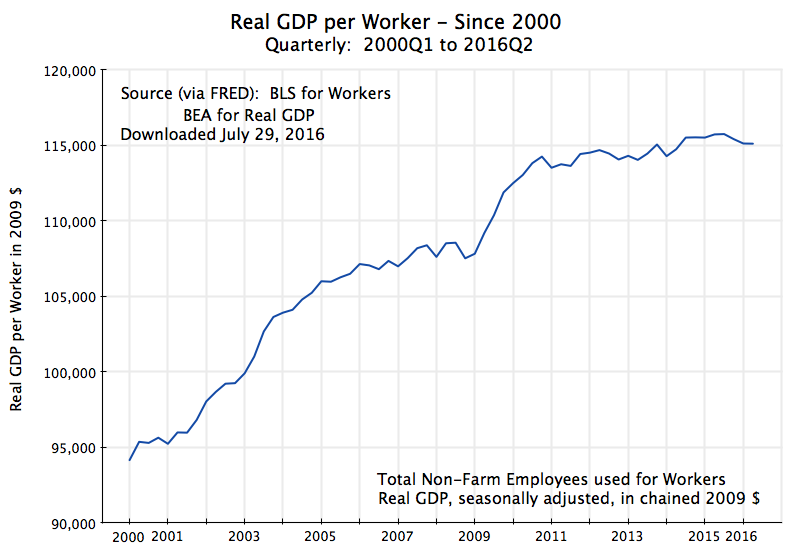
There is also an important question of whether productivity growth has slowed even further in recent years.  This might well still be a business cycle effect, as the economy has recovered from the 2008/09 downturn but only slowly (due to the fiscal drag from cuts in government spending).  The pace of productivity growth has been especially slow since late 2010, as is clear by blowing up the chart from above to focus on the period since 2000:

GDP per Worker, 2000Q1 to 2016Q2,rev

Productivity has increased at a rate of just 0.13% a year since late 2010.  This is slow, and a real problem if it continues.  I would hasten to add that the period here (5 1/2 years) is still too short to say with any certainty whether this will remain an issue.  There have been similar multi-year periods since 1947 when the pace of productivity growth appeared to slow, and then bounced back.  Indeed, as seen in the chart above, one would have found a similar pattern had one looked back in early 2009, with a slow pace of productivity growth observed from about 2005.

There has been a good deal of work done by excellent economists on why productivity growth has been what it was, and what it might be in the future.  But there is no consensus.  Robert J. Gordon of Northwestern University, considered by many to be the “dean in the field”, takes a pessimistic view on the prospects in his recently published magnum opus “The Rise and Fall of American Growth”.  Erik Brynjolfsson and Andrew McAfee of MIT, in contrast, argue for a more optimistic view in their recent work “The Second Machine Age” (although “optimistic” might not be the right word because of their concern for the implication of this for jobs).  They see productivity growth progressing rapidly, if not accelerating.

But such explanations are focused on possible productivity growth as dictated by what is possible technologically.  A separate factor, I would argue, is whether investment in fact takes place that makes use of the technology that is available.  And this may well be a dominant consideration when examining the change in productivity over the short and medium terms.  A technology is irrelevant if it is not incorporated into the actual production process.  And it is only incorporated into the production process via investment.

To understand productivity growth, and why it has fallen in recent decades and perhaps especially so in recent years, one must therefore also look at the investment taking place, and why it is what it is.  The rest of this blog post will do that.

B.  The Slowdown in the Pace of Investment

The first point to note is that net investment (i.e. after depreciation) has been falling in recent decades when expressed as a share of GDP, with this true for both private and public investment:

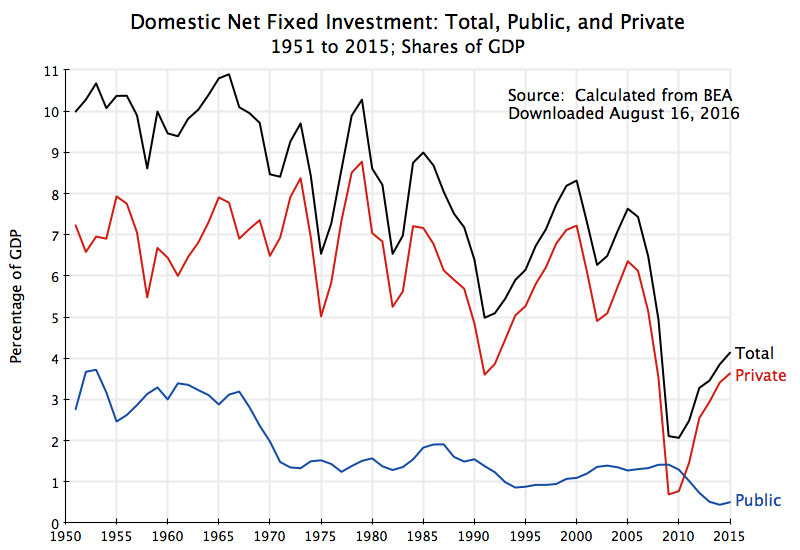
Domestic Fixed Investment, Total, Public, and Private, Net, percentage of GDP, 1951 to 2015, updated Aug 16, 2016

Total net investment has been on a clear downward trend since the mid-1960s.  Private net investment has been volatile, falling sharply with the onset of an economic downturn and then recovering.  But since the late 1970s its trend has also clearly been downward. Net private investment has been less than 3 1/2% of GDP in recent years, or less than half what it averaged between 1951 and 1980 (of over 7% of GDP).  And net public investment, while less volatile, has plummeted over time.  It averaged 3.1% of GDP between 1951 and 1968, but is only 0.5% of GDP now (as of 2015), or less than one-sixth of what it was before.

With falling net investment, the rates of growth of public and private capital stocks (fixed assets) have fallen (where 2014 is the most recent year for which the BEA has released such data):

Rate of Growth In Per Capita Net Stock of Private and Government Fixed Assets, edited, 1951 to 2014

Indeed, expressed in per capita terms, the stock of public capital is now falling.  The decrepit state of our highways, bridges, and other public infrastructure should not be a surprise.  And the stock of private capital fell each year between 2009 and 2011, with some recovery since but still at almost record low growth.

Even setting aside the recent low (or even negative) figures, the trend in the pace of growth for both public and private capital has declined since the mid-1960s.  Why might this be?

C.  Why Has Investment Slowed?

The answer is simple and clear for pubic capital.  Conservative politicians, in both the US Congress and in many states, have forced cuts in public investment over the years to the current low levels.  For whatever reasons, whether ideological or something else, conservative politicians have insisted on cutting or even blocking much of what the United States used to invest in publicly.

Yet public, like private, investment is important to productivity.  It is not only commuters trying to get to work who spend time in traffic jams from inadequate roads, and hence face work days of not 8 1/2 hours, but rather 10 or 11 or even 12 hours (with consequent adverse impacts on their productivity).  It affects also truck drivers and repairmen, who can accomplish less on their jobs due to time spent in jams.  Or, as a consequence of inadequate public investment in computer technology, a greater number of public sector workers are required than otherwise, in jobs ranging from issuing driver’s licenses to enrolling people in Medicare.  Inadequate public investment can hold back economic productivity in many ways.

The reasons behind the fall in private investment are less obvious, but more interesting. An obvious possible cause to check is whether private profitability has fallen.  If it has, then a reduction in private investment relative to output would not be a surprise.  But this has in fact not been the case:

Rate of Return on Produced Assets, 1951 to 2015, updated

The nominal rate of return on private investment has not only been high, but also surprisingly steady over the years.  Profits are defined here as the net operating surplus of all private entities, and is taken from the national account figures of the BEA.  They are then taken as a ratio to the stock of private produced assets (fixed assets plus inventories) as of the beginning of the year.  This rate of return has varied only between 8 and 13% over the period since at least 1951, and over the last several years has been around 11%.

Many might be surprised by both this high level of profitability and its lack of volatility.  I was.  But it should be noted that the measure of profitability here, net operating surplus, is a broad measure of all the returns to capital.  It includes not only corporate profitability, but also profits of unincorporated businesses, payments of interest (on borrowed capital), and payments of rents (as on buildings). That is, this is the return on all forms of private productive capital in the economy.

The real rates of return have been more volatile, and were especially low between 1974 and 1983, when inflation was high.  They are measured here by adjusting the nominal returns for inflation, using the GDP deflator as the measure for inflation.  But this real rate of return was a good 9.6% in 2015.  That is high for a real rate of return.  It was higher than that only for one year late in the Clinton administration, and for several years between the early 1950s and the mid-1960s.  But it was never higher than 11%.  The current real rate of return on private capital is far from low.

Why then has private investment slowed, in relation to output, if profitability is as high now as it has ever been since the 1950s?  One could conceive of several possible reasons. They include:

a)  Along the lines of what Robert Gordon has argued, perhaps the underlying pace of technological progress has slowed, and thus there is less of an incentive to undertake new investments (since the returns to replacing old capital with new capital will be less).  The rate of growth of capital then slows, and this keeps up profitability (as the capital becomes more scarce relative to output) even as the attractiveness of new investment diminishes.

b)  Conservatives might argue that the reduced pace of investment could be due to increased governmental regulations, which makes investment more difficult and raises its cost.  This might be difficult to reconcile with the rate of return on capital nonetheless remaining high, but in principle could be if one argues that the slower pace of new investment keeps up profitability as capital then becomes more scarce relative to output. But note that this argument would require that the increased burden of regulation began during the Reagan years in the early 1980s (when the share of private investment in GDP first started to slow – see the chart above), and built up steadily since then through both Republican and Democratic administrations.  It would not be something that started only recently under Obama.

c)  One could also argue that the reduced investment might be a consequence of “Baumol’s Cost Disease”.  This was discussed in earlier posts on this blog, both for overall government spending and for government investment in infrastructure specifically.  As discussed in those posts, Baumol’s Cost Disease explains why activities where productivity growth may be relatively more difficult to achieve than in other activities, will see their relative costs increase over time.  Construction is an example, where productivity growth has been historically more difficult to achieve than has been the case in manufacturing.  Thus the cost of investing, both public and private, relative to the cost of other items will increase over time.  This can then also be a possible explanation of slowing new investment, with that slower investment then keeping profitability up due to increasing scarcity of capital.

One problem with each of the possible explanations described above is that they all depend on capital investments becoming less attractive than before, either due to higher costs or due to reduced prospective return.  If such factors were indeed critical, one would need to take into account also the effect of taxes on investment returns.  And such taxes have been cut sharply over this same period.  As discussed in an earlier blog post, taxes on corporate profits, for example, are taxed now at an effective rate of less than 20%, based on what is actually paid after all the legal deductions and credits are included.  And this tax rate has fallen steadily over time.  The current 20% rate is less than half the effective rate that applied in the 1950s and 1960s, when the effective rate averaged almost 45%.  And the tax rate on long-term capital gains, as would apply to returns on capital to individuals, fell from a peak of just below 40% in the mid-1970s to just 15% following the Bush II tax cuts and to 20% since 2013.

Such sharp cuts in taxes on profits implies that the after-tax rate of return on assets has risen sharply (the before-tax rate of return, shown on the chart above, has been flat).  Yet despite this, private investment has fallen steadily since the early 1980s as a share of GDP.

Such explanations for the reason behind the fall in private investment since the early 1980s are therefore questionable.  However, the purpose of this blog post is not to debate this. Economists are good at coming up with models, possibly convoluted, which can explain things ex post.  Several could apply here.

Rather, I would suggest that there might be an alternative explanation for why private investment has been declining.  While consistent with basic economics, I have not seen it before.  This explanation focuses on the stagnant real wages seen since the early 1980s, and the impact this would have on whether or not to invest.

D.  The Impact of Low Real Wages

Real wages have stagnated in the US since the early 1980s, as has been discussed in earlier posts on this blog (see in particular this post).  The chart below, updated to the most recent figures available, compares the real median wage since 1979 (the earliest year available for this data series) to real GDP per worker employed:

Real GDP per Worker versus Real Median Wage, 1979Q1 to 2016Q2, rev

Real median wages have been flat overall:  Just 3% higher in 2016 than what they were 37 years before.  But real GDP per worker is almost 60% higher over this same period.  This has critically important implications for both private investment and for productivity growth. To sum up in one line the discussion that will follow below, there is less and less reason to invest in new, productivity enhancing, capital, if labor is available at a stagnant real wage that has changed little in 37 years.

Traditional economics, as commonly taught, would find it difficult to explain the observed stagnation in real wages while productivity has risen (even if at a slower pace than before). A core result taught in microeconomics is that in “perfectly competitive” markets, labor will be paid the value of its marginal product.  One would not then see a divergence such as that seen in this chart between growth in productivity and a lack of growth in the real wage.

(The more careful observers among the readers of this post might note that the productivity curve shown here is for average productivity, and not the marginal productivity of an extra worker.  This is true.  Marginal productivity for the economy as a whole cannot be easily observed, nor indeed even be well defined.  However, one should note that the average productivity curve, as shown here, is rising over time.  This can only happen if marginal productivity on new investments are above average productivity at any point in time.  For other reasons, the real average wage would not rise permanently above average productivity (there would be an “adding-up” problem otherwise), but the theory would still predict a rise in the real wage with the increase in observed productivity.)

There are, however, clear reasons why workers might not be paid the value of their marginal product in the real world.  As noted, the theory applies in markets that are assumed to be perfectly competitive, and there are many reasons why this is not the case in the world we live in.  Perfect competition assumes that both parties to the transaction (the workers and employers) have complete information on not only the opportunities available in the market and on the abilities of the individual worker, but also that there are no costs to switching to an alternative worker or employer.  If there is a job on the other side of the country that would pay the individual worker a bit more, then the theory assumes the worker will switch to it.  But there are, of course, significant costs to moving to the other side of the country.  Furthermore, there will be uncertainty on what the abilities of any individual worker will be, so employers will normally seek to keep the workers they already have to fill their needs (as they know what these workers can do), than take a risk on a largely unknown new worker who might be willing to work for a lower wage.

For these and other reasons, labor markets are not perfectly competitive, and one should not then be surprised to find workers are not being paid the value of their marginal product.  But there is also an important factor coming from the macroeconomy. Microeconomics assumes that all resources, including labor resources, are being fully employed.  But unemployment exists and is often substantial.  Additional workers can then be hired at the current wage, without a need for the firm to raise that wage.  And that will hold whether or not the productivity of those workers has risen.

In such an environment, when unemployment is substantial one should not be surprised to find a divergence between growth in productivity and growth in the real wage.  And while there have of course been sharp fluctuations arising from the business cycle in the rate of unemployment from year to year, the simple average in the rate since 1979 has been 6.4%.  This is well in excess of what is normally considered the full employment rate of unemployment (of 5% or less).  Macro policy (both fiscal and monetary) has not done a very good job in most of the years since 1979 in ensuring there is sufficient demand in the aggregate in the economy to allow all workers who want to be employed in fact to be employed.

In such an environment, of workers being available for hire at a stagnant real wage which over time diverges more and more from their productivity, consider the investment decision a private firm faces.  Suppose they see a market opportunity and can sell more. To produce more, they have two options.  They can hire more labor to work with their existing plant and equipment to produce more, or they can invest in new plant and equipment.  If they choose the latter, they can produce more with fewer workers than they would otherwise need at the new level of production.  There will be more output per unit of labor input, or put another way, productivity will rise if the latter option is chosen.

But in an economy where labor is available at a flat real wage that has not changed in decades, the best choice will often simply be to hire more labor.  The labor is cheap.  New investment has a cost, and if the cost of the alternative (hire more labor) is low enough, then it is more profitable for the firm simply to hire more labor.  Productivity in such a case will then not go up, and may indeed even go down.  But this could be the economically wise choice, if labor is cheap enough.

Viewed in this way, one can see that the interpretation of many conservatives on the relationship between productivity growth and the real wage has it backwards.  Real wages have not been stagnant because productivity growth has been slow.  Labor productivity since 1979 has grown by a cumulative 60%, while real median wages have been basically flat.

Rather, the causation may well be going the other way.  Stagnant and low real wages have led to less and less of an incentive for private firms to invest.  And such a cut-back is precisely what we saw in the chart above on private (as well as public) investment as a share of GDP.  With less investment, the pace of productivity growth has then slowed.

As a reflection of this confusion, conservatives have denounced any effort to raise wages, asserting that if this is done, jobs will be lost as firms choose instead to invest and automate.  They assert that raising the minimum wage, which is currently lower in real terms than what it was when Harry Truman was president, would lead to minimum wage workers losing their jobs.  As a former CEO of McDonalds put it in a widely cited news report from last May, a $15 minimum wage would lead to “a job loss like you can’t believe.”   Fast food outlets like McDonalds would then find it better to invest in robotic arms to bag the french fries, he said, rather than hire workers to do this.

This is true.  The confusion comes from the widespread presumption that this is necessarily bad.  Outlets like McDonalds would then require fewer workers, but they would still need workers (including to operate the robotic arms), and those workers would be more productive.  They could be paid more, and would be if the minimum wage is raised.

The error in the argument comes from the presumption that the workers being employed at the current minimum wage of $7.25 an hour do not and can not possess the skills needed to be employed in some other job.  There is no reason to believe this to be the case.  There was no problem with ensuring workers could be fully employed at a minimum wage which in real terms was higher in 1950, when Harry Truman was president, than what it is now.  And average worker productivity is 2.4 times higher now than what it was then.

Ensuring full employment in the economy as a whole is not a responsibility of private business.  Rather, it is a government responsibility.  Fiscal and monetary policy need to be managed so that labor markets are tight enough to ensure all workers who want a job can get a job, while not so tight at to lead to inflation.

Following the economic collapse at the end of the Bush administration in 2008, monetary policy did all it could to try to ensure sufficient aggregate demand in the economy (interest rates were held at or close to zero).  But monetary policy alone will not be enough when the economy collapsed as far as it did in 2008.  It needs to be complemented by supportive fiscal policy.  While there was the initial stimulus package of Obama which was critical to stabilizing the economy, it did not go far enough and was allowed to run out. And government spending from 2010 was then cut, acting as a drag which kept the pace of recovery slow.  The economy has only in the past year returned to close to full employment.  It is not a coincidence that real wages are finally starting to rise (as seen in the chart above).

E.  Conclusion

Productivity growth is key in any economy.  Over the long run, living standards can only improve if productivity does.  Hence there is reason to be concerned with the slower pace of productivity growth seen since the early 1980s, and especially in recent years.

Investment, both public and private, is what leads to productivity growth, but the pace of investment has slowed since the levels seen in the 1950s and 60s.  The cause of the decline in public investment is clear:  Conservative politicians have slowed or even blocked public investment.  The result is obvious in our public infrastructure:  It is overused, under-maintained, and often an embarrassment.

The cause of the slowdown in private investment is less obvious, but equally important. First, one cannot blame a decline in private investment on a fall in profitability:  Profitability is higher now than it has been in all but one year since the mid-1960s.

Rather, one needs to recognize that the incentive to invest in productivity enhancing tools will not be there (or not there to the same extent) if labor can be hired at a wage that has stagnated for decades, and which over time became lower and lower relative to existing productivity.  It then makes more sense for firms to hire more workers with their existing stock of capital and other equipment, rather than invest in new, productivity enhancing, capital.  And this is what we have observed:  Workers are being hired, but productivity is not growing.

An argument is often made that if firms did indeed invest in capital and equipment that would raise productivity, that workers would then lose their jobs.  This is actually true by definition:  If productivity is higher, then the firm needs fewer workers per unit of output than they would otherwise.  But whether more workers would be employed in the economy as a whole does not depend on the actions of any individual firm, but rather on whether fiscal and monetary policy is managed to ensure full employment.

That is, it is the investment decisions of private firms which determine whether productivity will grow or not.  It is the macro management decisions of government which determine whether workers will be fully employed or not.

To put this bluntly, and in simplistic “bumper sticker” type terms, one could say that private businesses are not job creators, but rather job destroyers.  And that is fine.  Higher productivity means that a firm needs fewer workers to produce what they make than would otherwise have been needed, and this is important for ensuring efficiency.  As a necessary complement to this, however, it is the actions of government, through its fiscal and monetary policies, which “creates” jobs by managing aggregate demand to ensure all workers who want to be employed, are employed.

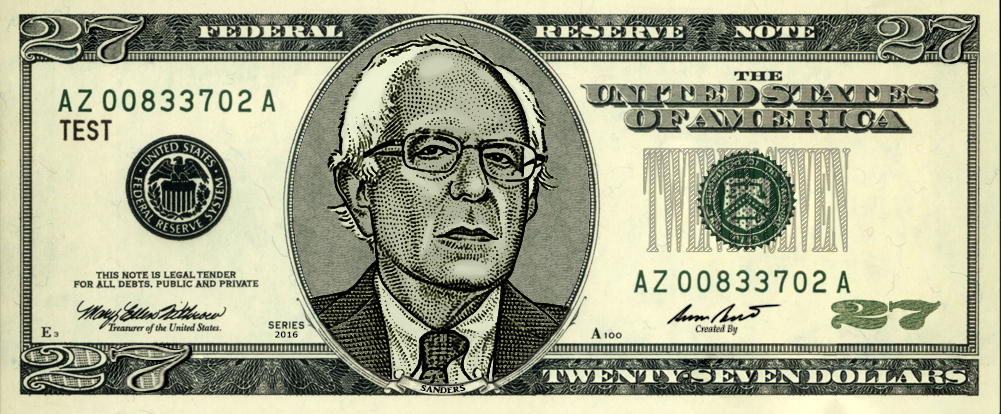
Bernie Sanders and His $27 Average Campaign Donation

Sanders $27 Money

Bernie Sanders is certainly to be commended for leading a modern US political campaign funded almost in its entirety by campaign contributions from individuals.  According to the Center for Responsive Politics, the Sanders campaign (through June 30) raised $226 million in individual contributions, with this accounting for 99% of the total money raised by or for the campaign (including outside groups).  This is impressive, and hopefully will serve as a model for future political campaigns.

Famously, the Sanders campaign touted that the average contribution came out to just $27, thus highlighting the grass roots nature of his support.  And this has been widely quoted.  Even President Obama got in on this.  In his remarks at this year’s White House Correspondents’ Dinner, he noted:

“What an election season.  For example, we’ve got the bright new face of the Democratic Party here tonight  –-  Mr. Bernie Sanders!   There he is  —  Bernie! Bernie, you look like a million bucks.  Or to put it in terms you’ll understand, you look like 37,000 donations of 27 dollars each!”

But listening to Sanders’ speech to the Democratic Convention on Monday, a point bothered me.  And being a numbers person, I had to look it up.  Sanders noted right at the beginning of his remarks that he wanted to:

“thank the 2 1/2 million Americans who helped fund our campaign with an unprecedented 8 million individual campaign contributions – averaging $27 a piece.”

This was the first time I realized that the $27 individual contribution may not be referring to what an average person contributed, but rather to what the average donation was, where they are counting separately each donation from an individual contributor making multiple donations.

And it does appear that this is the case.  The $226 million figure noted above for total contributions divided by 8 million individual campaign contributions comes to a bit over $28 per contribution – close enough to the $27 number; it is within round-off.  But per individual, it comes to over $90 per person over the 2 1/2 million individuals who contributed to the Sanders campaign.  On average, each donor contributed 3.2 times.

This is a quibble, to be sure.  But an average contribution of $90 (per donor) does not sound as democratic as $27 (per donation).