Employment Growth: Still Sluggish

Employment, Monthly Change, Dec 2005 - Jan 2013

The Bureau of Labor Statistics released its regular monthly report on employment this morning.  The report indicates that the trends seen since late 2010 have continued, with steady but modest growth in private employment, falling government employment, and a resulting growth in total employment that brings down the unemployment rate only slowly and with month to month fluctuations.  Total non-farm employment (from the Business Establishment Survey) rose by an estimated 157,000 in January, with private non-farm employment rising by 166,000 while government employment was cut by 9,000.

The figures in this report also reflect the impact of the regular annual re-benchmarking of the employment statistics.   As was discussed in an earlier posting on this blog, this re-benchmarking was expected to raise the estimates for employment in 2012, and it did.  But with revisions in the seasonally adjusted data going all the way back to 2008 (as is normal), the changes in 2012 itself were relatively modest as the base rose.  Under the earlier estimates, total non-farm employment growth in 2012 was estimated to have averaged 153,000 per month.  Under the revised figures, employment is estimated to have grown at about 181,000 per month, for an increase of 28,000 per month.  While an improvement, this still leaves monthly employment growth at less than the 200 to 250,000 per month that I had earlier noted in this blog would be needed to produce a steady and reasonably strong reduction in the unemployment rate.  But it is at least closer to what is needed.

And indeed, the unemployment rate from the separate Household Survey went up one notch to an estimated 7.9%, from 7.8% in December and November as well as September (it was an estimated 7.9% in October).  While such a small increase in the January rate is not statistically significant in itself (the numbers are all based on surveys), one can certainly say that the unemployment rate has not improved since September.

Like the Establishment Survey, the Household Survey that is used to calculate the unemployment rate (as well as labor participation and other figures) was revised to reflect new benchmarks and weights.  But unlike the Establishment Survey numbers (used for the employment estimates), the Bureau of Labor Statistics does not then go back and revise the previous estimates stemming from the Household Survey.  I do not know why.  One cannot then directly compare the January figures to those of December and earlier, to see what the changes were.

The BLS does, however, provide in a note the impact of the re-weighting on a few of the main estimates, including on the total number in the labor force, on those employed, and on those unemployed.  Taking this impact into account, the figures indicate that the number in the labor force was about unchanged in the month, while those employed (based on the Household Survey) fell by 110,000, and those unemployed rose by 117,000.  This is not good, and suggests that the unemployment rate rose (slightly) not because workers re-entered the labor force, but because workers lost jobs.  But too much should not be read into one month’s figures, particularly when the figures suggested by the Household Survey (that employment declined) contradict the figures indicated in the Establishment Survey (that employment rose).  Such contradictory moves in the month to month changes are not unusual between these two surveys, and the figures in the Establishment Survey are generally seen as more reliable for the total employment estimates.

Private employment growth is therefore continuing, and is indeed continuing at a rate that is somewhat higher than had been estimated before.  But total employment growth is being pulled down by continued cuts in government employment, and the overall rate of employment growth is not at what is needed to produce a steady and consistent decline in the rate of unemployment.  Perhaps the best that can be said is that the estimated fall in GDP in the fourth quarter of 2012 (discussed in a post on this blog yesterday) does not appear to have led to a sharp reduction in employment growth — at least not yet.
GDP Growth in the Fourth Quarter of 2012: Cuts in Government Spending Drove GDP Down

Growth of GDP and Contri of Govt, 2007Q1 to 2012Q4

BEA release of 1/30/13; Seasonally adjusted annualized rates       Percent Growth Contribution to GDP      Growth (% points)
2012Q2 2012Q3 2012Q4 2012Q2 2012Q3 2012Q4
Total GDP 1.3 3.1 -0.1 1.3 3.1 -0.1
A.  Personal Consumption Expenditure 1.5 1.6 2.2 1.06 1.12 1.52
B.  Gross Private Fixed Investment 4.5 0.9 9.7 0.56 0.12 1.19
 1.  Non-Residential Fixed Investment 3.6 -1.8 8.4 0.36 -0.19 0.83
 2.  Residential Fixed Investment 8.5 13.5 15.3 0.19 0.31 0.36
C.  Change in Private Inventories nm* nm* nm* -0.46 0.73 -1.27
D.  Net Exports nm* nm* nm* 0.23 0.38 -0.25
E.  Government -0.7 3.9 -6.6 -0.14 0.75 -1.33
Memo:  Final Sales 1.7 2.4 1.1 1.71 2.37 1.13
    nm* = not meaningful
$ Value of Change in Private Inventories (2005 prices) $41.4b $60.3b $20.0b

The Bureau of Economic Analysis of the US Department of Commerce released on January 30 its initial estimate (what it formally calls its “advance” estimate) of US GDP growth in the fourth quarter of 2012.  The result was terrible:  GDP is estimated to have declined by a slight amount (0.1% at an annual rate).  While it is possible that this estimate will be revised upwards as the second and third revisions are released next month and the month after (there has historically been an upward revision on average of 0.3% points from the advance estimate to the third, and there was a particularly large upward revision in the 2012Q3 figures between the advance and third estimates), fourth quarter growth will still likely be disappointingly low.

The primary cause of the stagnation of GDP in the fourth quarter was a sharp cut in government spending.  As shown in the table above, total government spending on goods and services (federal, state, and local) fell at an annualized 6.6% rate in the quarter.  This had the direct impact of subtracting 1.33% points from what GDP growth would otherwise have been.  But there will also be an indirect impact, as workers who would have been employed producing goods and services for government would in turn buy goods and services themselves with the salaries they would have received.  With a multiplier of just two, the impact of the cut in government spending in the fourth quarter was a subtraction of 2.66% points (2 x 1.33% points) from what growth would have been.

Most of the decline in government spending was due to a large fall in spending at the federal level, although state and local spending fell some as well.  Federal government spending fell at an annualized rate of 15%, all due to a fall in defense spending at an annualized rate of 22%.  These declines more than offset increases of an estimated 9.5% and 13% in total federal and in defense spending respectively in the third quarter, which had contributed to the relatively good GDP growth of 3.1% in that quarter.  The swings were likely due to end of the fiscal year spending (the federal fiscal year ends September 30) which was particularly sharp last year and therefore not picked up in the normal seasonal adjustment calculations.  The fall in the fourth quarter of 2012 (the first quarter of the fiscal year) reflected the continued budget uncertainty, as Congress threatens to slash the current budget drastically, either by design or through the automatic sequester cut-backs dictated as part of the agreement to get out of the debt ceiling debacle in 2011, that might be instituted soon (see below).

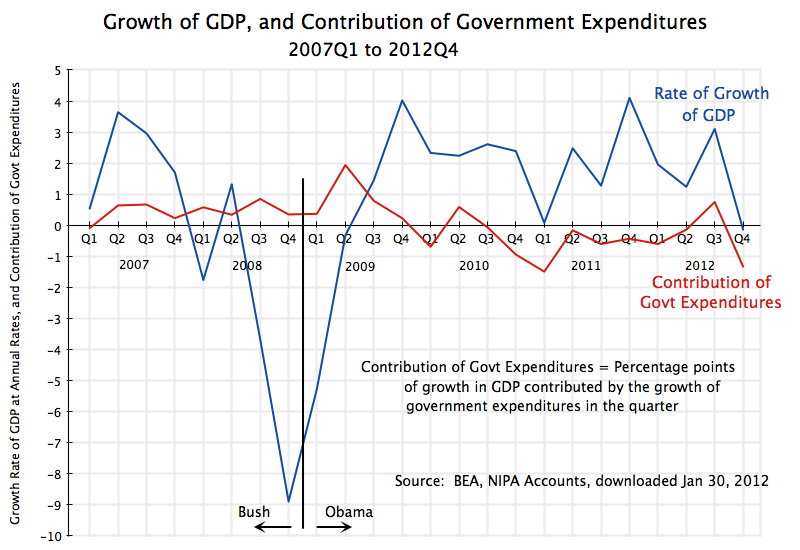
The fall in government spending in the fourth quarter was particularly sharp, but government spending has been falling in each quarter but two since the beginning of 2010.  The resulting fiscal drag has held back growth.  The figures are shown in the graph at the top of this blog.  The graph shows the rate of growth of GDP each quarter (in blue, at annualized rates) since the beginning of 2007, plus the direct contribution to this growth each quarter from government expenditures (in red).

Government spending rose each quarter in 2007 and 2008, the last two years of the Bush Administration, and this continued into 2009 after Obama was inaugurated.  The growth in government expenditures was particularly sharp in the second quarter of 2009 as the stimulus measures started, and this succeeded in turning around GDP.  GDP was falling at an annualized rate of 8.9% in the fourth quarter of 2008, and this carried over into the first quarter of 2009 with an annualized fall of 5.3%.  But then GDP stabilized and began to grow in the third quarter of 2009, and it has grown each quarter since until the fourth quarter of 2012.

But GDP growth since 2010 has been disappointingly modest, at rates of just 2 to 3% a year on average (with some quarterly fluctuation), as it has been dragged down by the falling government expenditures over this period.  As has been noted in earlier postings on this blog (for example here and here), the resulting fiscal drag can explain fully why this recovery has been modest in comparison to the recoveries seen in previous downturns in the US economy over the past four decades.

The other major factor explaining the stagnation of GDP in the fourth quarter was the negative contribution from inventory accumulation.  The change in private inventories led to 1.27% points being subtracted from what GDP growth otherwise would have been.  But as was explained in an Econ 101 posting on this blog, it is the change in the change in private inventory accumulation which acts to contribute to (or subtract from) GDP growth in any given period.

One sees news reports that still get this wrong, with statements such as that inventories fell by $40 billion in the fourth quarter.  This is not correct.  As noted in the table above, inventories actually grew by $20 billion in the fourth quarter.  But they grew by more (by $60 billion) in the third quarter.  That is, the change (the growth) in inventories was $60 billion in the third quarter, while the change (the growth) in inventories was again positive at $20 billion in the fourth quarter.  But while they continued to grow, they did not grow as fast as before, and the change in the change in inventories was a negative $40 billion.  This subtracted 1.27% points from GDP growth.

As was noted a year ago on this blog when the figures for GDP growth in the fourth quarter of 2011 were released, an increase in private inventory accumulation in that quarter largely explained the relatively good growth rate of that quarter.  But I argued this would then likely be reversed, with inventories not growing as fast and perhaps even declining, which would act as a drag on growth in 2012.  The 2012 figures now out show that this in fact happened, with a negative contribution of private inventory accumulation to GDP growth in the first, second, and fourth quarters.

Other than the drag from cuts in government spending and the deceleration of inventory accumulation, the other components of GDP growth in the fourth quarter of 2012 were generally quite good.  Residential fixed investment grew at an annualized rate of 15.3%, continuing the strong growth seen already in the second and third quarters.  But residential fixed investment was only 2.6% of GDP in the fourth quarter, so the rapid growth on this small base only made a contribution of 0.36% points to GDP growth in the quarter.  In contrast, government spending in the fourth quarter was 19.3% of GDP (down from 19.6% of GDP in the third quarter).  [Figures on GDP shares directly from BEA on-line GDP tables.]

Non-residential fixed investment (basically private business investment in capital and structures) also grew at a good rate in the fourth quarter, at 8.4% annualized, reversing a small decline seen in the third quarter.  And personal consumption expenditure rose at a 2.2% rate.  Since personal consumption accounts for 71% of GDP spending, this 2.2% increase contributed 1.52% points to what GDP growth would have been.

The fourth quarter GDP report therefore would have been solid, had it not been for the sharp cuts in government spending in the quarter.  Accumulation of private inventories then responds, as businesses do not want to see inventories mounting up on the shelves when they cannot be sold and scale back production (or in the fourth quarter, still increase their inventories, but not by as much as before).

The danger to the economy now is that government spending will be scaled back even further, as a Republican controlled Congress insists on slashing public expenditures.  If nothing is agreed to, then the sequesters that Congress required in August 2011 as a condition for the debt ceiling increase (so that the US would not then be forced to default) will mandate a sharp scaling back in federal government expenditures.  While the deadline for this was pushed back to March 1 from January 1 as part of the fiscal cliff agreement at the end of 2012, there is still a deadline.  The nonpartisan Center on Budget and Policy Priorities has estimated in a recent report that should the sequester enter into effect on March 1, defense spending would be cut by $42.7 billion, or 7.3%, while non-defense spending would be cut by also $42.7 billion, or 5.1% for programs included other than Medicare (Medicare would be cut by 2.0%).

Such cuts, especially if they suddenly enter into effect on March 1, would be devastating to  the economy.  Note that while federal spending already fell by 15% at an annualized rate in the fourth quarter, this fall at a quarterly rate is just 3.6%.  The sudden cuts under the sequester would be far larger.

Almost all of the participants in this budget process, both Democrat and Republican, agree that the sequester is something to be avoided.  The sequester requirement was in fact set up precisely as something both sides would want to avoid, so that agreement would be reached on some other budget plan.  But Republicans are insisting on similarly large cuts in any budget.  They simply wish that the cuts would fall more on domestic programs affecting the poor and middle classes, and less on the military.  But economically the problem for GDP growth would remain if similarly sized cuts are forced through, and would indeed be worse (in terms of the impact on GDP, even ignoring the distributional consequences) if they are re-focused on programs for the poor and middle classes.

Finally, it is worth noting that the price index figures also released by the BEA on January 30 as part of the GDP accounts still show no indication that inflation is any issue.  While conservatives have been asserting since Obama took office four years ago that high deficits resulting from his policies would lead to high inflation, that has not occurred.  The price deflator for GDP, the most broad-based index measuring inflation, grew by only 1.8% in 2012.  The price deflator for the personal consumption expenditures component of GDP (the price deflator that Alan Greenspan reportedly favored for tracking inflation) grew by a similar 1.7% in 2012.  These are both just below the target of 2% for inflation that the Federal Reserve Board favors.  (Inflation of zero is not desired by the Fed or others as it is then easy for the economy to slip into deflation, which makes management of the economy even more difficult.)

And inflation in the fourth quarter of 2012 was even less, at just 0.6% for the GDP deflator and 1.2% for the personal consumption expenditures deflator.  The prediction of both conservative economists and politicians that high deficits under Obama would lead to high inflation unless government expenditures were slashed drastically, could not have been more wrong.

Homicides by Firearms in the US: An International Comparison of Homicides and Criminality Rates

Homicides by Firearms Across Countries

Introduction

It is well known that the rate of homicides due to firearms is higher in the US than in other developed countries.  What some might not realize is how much higher.  But some then argue that while the US rate of homicides by firearms might be high, homicides can be carried out by other weapons, such as knives and clubs, and that when one takes these into account, the overall homicide rates are similar.  This is simply not true.  Some also argue that the US suffers from especially high criminality for social, cultural, economic, or whatever reasons, and that homicide rates in the US are just similarly high.  This is also simply not true.

This blog post will examine these assertions through a series of simple charts.

Homicides by Firearms

First, the chart above shows the rate of homicides due to firearms in the US as compared to Japan, the UK, France, Germany, Ireland, New Zealand, and Iceland.  The data comes from the UN Office of Drugs and Crime, as part of its 2011 Global Study on Homicide.  The figures are for 2008, the most recent year for which data were available for most of the countries on the list (2007 for France)

Japan, the UK, France, and Germany were chosen as other large, developed, countries with per capita incomes comparable to that of the US.  All are members of the OECD, the “club” of developed countries that, among other activities, share data and analyses.  Ireland, New Zealand, and Iceland (also OECD members) were added for reasons that will become clear below.  Briefly, these three countries plus the UK had the highest rates of overall criminality among the 26 OECD members, which make them interesting comparators.

As the chart above shows, homicides by firearms are tiny in the comparator countries relative to what they are in the US.  The US rate in 2008 was over 3.6 homicides per 100,000 population.  As was noted in a previous posting on this blog, this rate had come down by almost half during the 1990s.   But a 3.6 rate pales in comparison to rates of only 0.009 in Japan, 0.06 in the UK and France, 0.2 in Germany, 0.5 in Ireland, 0.2 in New Zealand, and exactly zero in Iceland (where there no homicides at all in 2008).  Put another way, the rate in the US was 424 times higher than it was in Japan, and about 60 times higher than in the UK and France.

Homicides by Any Method

But perhaps a higher rate of homicides by firearms in the US is being offset by higher rates of homicide by other means in the other countries?  If so, then all the overall homicide rates would be comparable across the countries.  But no, this is not happening:

Homicides by All Methods Across Countries

The overall US homicide rate of about 5.5 still remains far above the rates of between 0.5 and 1.3 in the other countries (and of exactly zero in Iceland).

Homicides by Means Other Than Firearms

Looking at the rate of homicides by means other than firearms:

Homicides by non-Firearms Across Countries

Here the rates are at least comparable to each other.  While the US rate remains the highest, at a rate of 1.8 per 100,000, the rates for the others are between 0.5 and about 1.25 (other than the rate of zero for Iceland).  But there is no basis for the argument made by some gun advocates in the US that if one restricted access to guns, that the homicides would take place anyway, but by means of knives and clubs and other weapons.  One does not see this in the other countries.  Firearms are not substituting for other weapons in the homicide rate.  The data rather are consistent with firearms adding to the rate of homicides by other methods, leading to a very high overall rate for the US.

Victims of All Crime

But perhaps the US is a country with a particularly high rate of criminality?  If so, the high homicide rate might be explained by an also high rate of overall crime.  But this is not the case:

Crime Victimization - All Crimes, Across Countries

The number of victims of crimes in the US (as a share of the population) is in the middle of the range for this set of comparator countries.  In the US, about 17.5% of the population had been the victim of a crime (burglary, theft, robbery, sexual assault, other assault or threatened assault) over the preceding 12 months.  The rates were between 10 and 13% in Japan, France, and Germany, but between 21 and 22% in the UK, Ireland, New Zealand, and Iceland.  These latter four countries had the highest rates of any countries in the sample of 26 OECD countries with data.  The overall OECD average was 15.5%.  The US rate ranked #17 of the 26 countries.

[These data come from an international sample survey undertaken periodically with UN support, that covered 30 countries in 2004/2005 (the most recent available).  This International Crime Victims Survey asked a statistically valid sample of individuals in each country a range of questions on whether they had been a victim of a crime (broken into a number of categories) over the previous 12 months.  The data here comes through the OECD, which posted it in convenient spreadsheet form.]

Criminality in the US, in terms of the number of victims as a share of the population, is therefore somewhat above the OECD average, but is by no means the highest.  Nine of the 26 OECD countries were worse.  The four worst countries were the UK, Ireland, New Zealand, and Iceland.  But as seen in the chart at the top of this post, their rates of homicide by firearms are tiny compared to the rate in the US.  Relatively higher rates of criminality are not associated with higher rates of homicides by firearms.  The same holds true for homicides by any method.

Victims of Assault

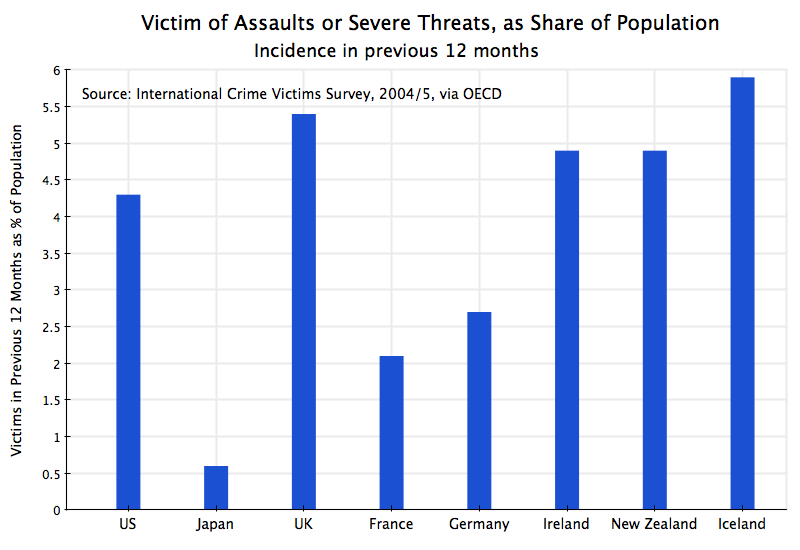
It might also be argued by some that it is not the overall rate of criminality that matters to homicides, as this includes crimes such as burglary where the victim is not present.  Rather, they might argue, it is the rate of assault or the threat of assault that matters, as it is here where homicides might occur.  But there is no evidence to support this either:

Crime Victimization - Assaults & Threats, Across Countries

The US rate of 4.3% is again by no means the highest rate among the OECD members.  The UK, Ireland, New Zealand, and Iceland again all have higher rates (of 4.9 to 5.9%).  These latter four countries are again the worst four among the 26 OECD members.  The US rate of assault is well within the range for the OECD countries, yet its homicide rate by firearms is far higher.  And countries with higher rates of assault have far lower rates of homicide.

Conclusion

To conclude, the rate of homicides in the US by firearms is incredibly higher than the rate seen in other OECD countries.  This cannot be explained by a substitution of firearms for other weapons which would have been used anyway to commit the homicide, nor can it be explained by an especially high rate of criminality in the US.  There are more victims of crimes as a share of the population in other OECD countries, who nevertheless have far lower homicide rates.

The easy availability of firearms in the US, instead of the tight controls seen in other developed countries, certainly has something to do with this.