GDP Growth in the First Quarter of 2012: A Slow Economy Going Slower

BEA release of 4/27/12 2011 Q3 %growth 2011 Q4 %growth 2012 Q1 %growth Contribution to GDP growth in 2011 Q4 Contribution to GDP growth in 2012 Q1
Total GDP 1.8 3.0 2.2 3.0 2.2
A.  Personal Consumption Expenditure 1.7 2.1 2.9 1.47 2.04
B.  Gross Private Fixed Investment 13.0 6.3 1.4 0.78 0.18
   1.  Non-Residential Fixed Investment 15.7 5.2 -2.1 0.53 -0.22
   2.  Residential Fixed Investment 1.3 11.6 19.1 0.25 0.40
C.  Change in Private Inventories nm* nm* nm* 1.81 0.59
D.  Net Exports nm* nm* nm* -0.26 -0.01
E.  Government -0.1 -4.2 -3.0 -0.84 -0.60
   1.  Federal Government 2.1 -6.9 -5.6 -0.58 -0.46
   2.  State and Local Government -1.6 -2.2 -1.2 -0.26 -0.14
Memo:  Final Sales 3.2 1.1 1.6 1.15 1.61
        nm* = not meaningful
$ Value of Change in Private Inventories (2005 prices) -$2.0b $52.2b $69.5b

A.  Introduction

The Bureau of Economic Analysis (BEA) of the Department of Commerce released this morning its first estimate of GDP growth in the first quarter of 2012.  The table above summarizes the key figures.  Overall, the report is disappointing.  Many observers were expecting GDP growth to accelerate, continuing the path of quarter by quarter increases seen during the course of 2011 (with growth rates of 0.4%, 1.3%, 1.8%, and 3.0%, in the first through the fourth quarters, respectively).  But readers of this blog may recall that I had warned of a real possibility of deceleration in a posting on January 27, when the BEA released its first estimate of growth in the fourth quarter of 2011.  That slowdown has happened.  So far the slowdown has been modest, and one should not put too much emphasis on one quarter’s figures.  But a deeper assessment of the numbers contained in the report suggests that growth could slow further in the next few quarters, in the period just before the Presidential election.  This is not good for Obama.

The table has a lot of numbers to give the full picture, but we will focus on a few.  The table is similar to the one I used in the January 27 posting noted above, although this time I have split out the Change in Private Inventories from other investment (i.e. from Fixed Investment), to give a clearer picture of the trends.  Note also that the figures for the fourth quarter of 2011 differ somewhat from those shown in the January 27 posting.  This is because the January figures were the initial estimates (the BEA calls them the “advance estimates”), which are then revised twice (and released in late February and then in late March).  The initial estimate for the fourth quarter of 2011 was that GDP rose by 2.8%.  Following the revised second and then third estimates (as more complete data became available), the GDP growth rate for the period is now estimated to have been 3.0%.  And there are small changes in a number of the other figures as well.  Similarly, the release today was the initial estimate for the first quarter of 2012, and revised estimates will be released in late May and then in late June, before the release in late July of the initial estimates for the second quarter.

B.  The Change in the Change in Private Inventories

It is best first to focus on what has happened to the Change in Private Inventories, as this can drive the short term dynamics of quarter to quarter GDP growth.  As was described in a posting in the Econ 101 section of this blog, it is the change in the change in private inventories which leads to a change in GDP (i.e. to GDP growth).  In the last line of the table above, I have shown what the actual (estimated) dollar value was of inventory accumulation (the change in private inventories), going back to the third quarter of 2011.  In that third quarter, the stock of inventories in fact fell a small amount, by $2.0 billion (in 2005 prices).  Inventories are then estimated to have grown by $52.2 billion in the fourth quarter, for a change in the change in private inventories of $54.4 billion.  This contributed 1.81% points of the 3.0% growth in GDP.  That is, fully 60% ( = 1.81 / 3.0 ) of the growth in the fourth quarter (based on the revised figures) is now estimated to have come from inventory accumulation.

In the first quarter of 2012, private inventories are estimated to have grown by even more than they did in the fourth quarter:  by $69.5 billion.  But even though inventory accumulation is now estimated to have been higher, the change in the change in inventories was only $17.3 billion ( = $69.5b – $52.2b).  Thus even though inventory accumulation was greater than in the fourth quarter of 2011, the contribution to the growth of GDP in the first quarter of 2012 was an estimated 0.59% points (vs. the 1.81% of the previous quarter) of the 2.2% growth, or about 27% ( = 0.59 / 2.2 ) of the growth in GDP.

Inventory accumulation thus continued to add to, rather than subtract from, overall GDP growth in the first quarter, but at a slower pace than in the fourth quarter.  Looking forward, inventory accumulation would need to grow further to $86.8 billion ( = $69.5b + $17.3b) for the change in the change in private inventories to continue at the same pace, and contribute approximately 0.6% points to growth.

But with high positive inventory growth for two quarters now, there is a good chance that producers will cut back on production so as not to add so much to inventories sitting on shelves.  If inventory accumulation even simply continues at the $69.5 billion pace of the first quarter, the change in the change in inventories will then be zero.  If all else in the economy continues to grow as it did in the first quarter (it won’t, but if it did), then the growth rate in the second quarter would be 2.2% – 0.6% points = 1.6% (which is the rate of final sales growth in the quarter; see the table above).

But inventory accumulation could be a good deal less than that.  A fall in the stock of inventories is not unusual.  From 2001Q1 through 2012Q1, for example (a period of 45 quarters), the change in private inventories was negative in 15 of the quarters (i.e. one-third of the time) and positive in 30.  Even if the change in private inventories was just zero, and not even negative, the change in the change in private inventories would then be a negative $69.5 billion from the pace in the first quarter.  This would subtract 2.4% points from GDP growth, and if all else grew at the pace it did in the first quarter, then GDP growth would be a negative 0.8% ( = 1.6% growth of final sales minus the 2.4% points).

There is a good chance, but no certainty, the pace of inventory accumulation will slow down.  If so, overall GDP growth would slow, and even possibly turn negative.  The economy remains weak.

C.  Personal Consumption and Fixed Investment

A positive in the figures is that household expenditures, for both personal consumption and for residential investment, continued to strengthen.  Personal consumption (which accounts for 71% of GDP), grew by 2.9% and accounted for 2.04% points of the 2.2% growth.  And residential fixed investment (mainly housing) grew at a very fast 19.1% pace, following the 11.6% growth of the fourth quarter.  These are strong figures, and suggest housing may be starting to recover.  However, as had been noted in the January 27 blog posting, residential fixed investment has fallen by so much in the crash of the housing bubble (to just 2.3% of GDP now, from a high of over 6% during the bubble, and a more normal 4% of GDP or so), that such investment would need to double to return to normal levels, or triple to get back to where it was before.  And with its current small share of GDP, the 19.1% growth of residential fixed investment only accounted for 0.40% points of the 2.2% GDP growth in the first quarter.

Offsetting this positive news on household consumption and investment, there was a decline in business (i.e. non-residential) fixed investment.  Business fixed investment had been strong earlier in the recovery, from early 2010 through to late 2011, but is estimated to have contracted by 2.1% in the first quarter.  This subtracted from GDP growth.  And with business fixed investment (at 10.3% of GDP currently) much larger than residential fixed investment, the declining growth of business fixed investment has pulled down overall fixed investment from a 13.0% rate of growth in the third quarter of 2011, to 6.3% in the fourth quarter, and to just 1.4% in the first quarter.

D.  Fiscal Drag Continues

Finally, and most stupidly in a still depressed economy with high unemployment, government expenditures are falling, acting as a drag bringing down the overall economy.  And while earlier this fiscal drag was mostly due to cuts in government expenditures at the state and local level, cuts in federal expenditures are now also pulling down the economy. Federal government expenditures on goods and services fell by 5.6% in the first quarter, following a fall now estimated at 6.9% in the fourth quarter.  State and local government expenditures continued to fall (as they have in 11 of the 13 quarters since the first quarter of 2009), but now federal expenditures are falling even faster.

The direct impact of the decline in government expenditures subtracted 0.6% points from what growth would otherwise have been in the first quarter.  That is, had government expenditures simply remained flat rather than fallen by 3.0% (for federal combined with state and local), GDP growth would have been 2.2% + 0.6% = 2.8%.  With a modest 3.0% growth (instead of a 3.0% cut) in government expenditures, growth in the first quarter would have been a more respectable 2.2% + 1.2% = 3.4%.  And assuming a multiplier of just 1.5, the growth rate would have been 2.2% + 1.5×1.2% = 4.0%.  While still modest, this would bring GDP growth closer to the rate needed for a sustained reduction in unemployment.  And as was noted in a previous posting on this blog, had government expenditures been allowed to grow at the pace it had during the economic downturn after 1981 during the Reagan years, the economy would now be at full employment.

Cutting government expenditures when the economy is so weak and unemployment so high only serves to further weaken the economy.  The consequences of an even more severe austerity program can be seen in the UK.  The Conservative Government in the UK has adopted an austerity program similar to what Republicans have pushed to be adopted here.  The new GDP report for the UK issued two days ago indicates that growth in the UK was negative in the first quarter of 2012, as it was in the fourth quarter of 2011.  The two quarters of negative growth meets the criterion normally used to define a recession, and hence the UK has now dropped back into recession for the second time since the 2008 crisis.

The US has fortunately not adopted an austerity program as severe as that adopted by the UK.  However, Republicans are pushing strongly for the US to do so.  If Obama did, the results would be similar to that seen in the UK.  If you are running for re-election, that is not a good place to be.  And that may explain why the Republicans have been pushing for it.

Private Job Growth Under Obama: Recovery, in Contrast to the Fall Under Bush

Cumulative Private sector employment growth by months from inaugurations, Obama, Bush II, Clinton, Bush I

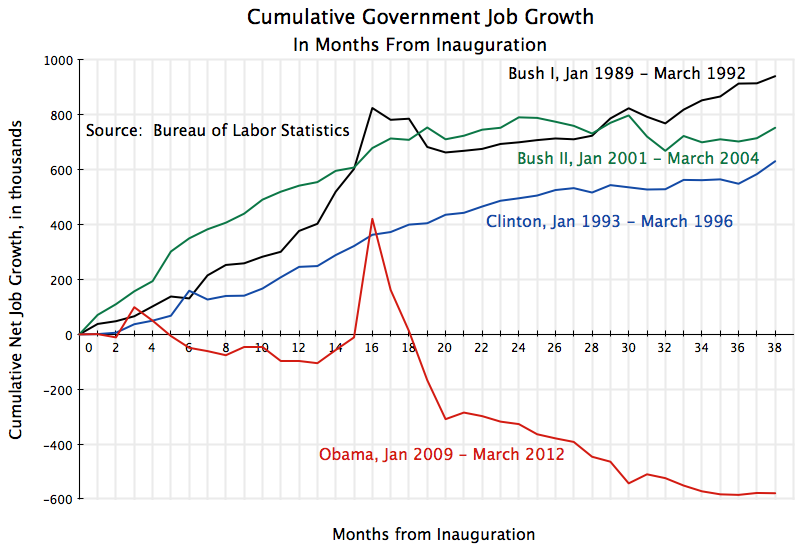
Cumulative Government sector employment growth by months from inaugurations, Obama, Bush II, Clinton, Bush I

[Update on February 2, 2013:  A more recent analysis of these issues, with these charts now covering the full first term of Obama, is available here.]

A.  Introduction

Mitt Romney and Republican Party leaders have repeatedly and emphatically asserted that Obama and the policies of his administration have been terrible for private sector job growth, and that voters should therefore bring back the Republicans and their policies.  Indeed, Romney has said his campaign is all about jobs.  At the same time, they’ve asserted that government and its bureaucrats have exploded during the Obama years, with this holding back private sector job growth.

But as the figures above show, private sector jobs have recovered under Obama, reversing the freefall that was underway as he was taking the oath of office, while government employment has contracted sharply.  In contrast, private jobs were stable when George W. Bush took office, but then started to fall and fall sharply, while government jobs rose.  By 38 months into his first term, there were 2.4 million fewer private sector jobs in the US economy than on the day Bush was inaugurated.  Yet Romney repeatedly lambasts Obama for his jobs record, while he argues for bringing back the policies of Bush.

They figures show the cumulative change in private and in government jobs between January of the year the Presidents were inaugurated, to the March that was 38 months (a little over three years) later.  The March date 38 months later was chosen as that is the most recent date for which data is available for Obama.  The data all come from the Bureau of Labor Statistics.  The graph on government jobs is similar in presentation to that used by Paul Krugman in a posting on his blog yesterday.  The government jobs issue was also reviewed in a posting on this blog site over four months ago, which noted the collapse in government jobs during the Obama years (while they grew under Bush), and discussed how this has hurt overall job growth in the economy.

B.  Private Sector Jobs

Private sector jobs were falling rapidly in the period leading up to Obama’s inauguration in January 2009, as has been discussed before in this blog (see in particular the figure at this posting).  While the pace of decline was turned around almost immediately (within three months of Obama taking office), the number of private sector jobs continued to decline in Obama’s first year.  But jobs in the private sector then began to grow, and by March 2012 (the most recent figure available) they are almost back to where they were when he took office.  While this represents a growth of over 4 million private jobs over the past two years, the hole was a deep one.  The economy was hemorrhaging 800,000 jobs per month at the end of the Bush administration.  One would have of course wanted a more rapid recovery from this deep hole, but Republican opposition in Congress has blocked the measures that would have been needed to get this done (such as further stimulus).

But while one would have wanted a more rapid recovery from the 2008 economic collapse, contrast the record of Obama with that of George W. Bush in the first term of his administration.  Private jobs were growing in the final months of the Clinton administration, and were flat in the first two months of the Bush administration.   But they then began to fall (with the fall well underway before the September 11 attacks, so one cannot blame them).  The steady decline in private sector jobs continued for two and a half years, and at the trough there were 3.4 million fewer private jobs than when Bush took office.  They then began a slow recovery, but by 38 months into his term there were still 2.4 million fewer private jobs than when Bush took the oath of office.   Yet Romney and his economic advisors (most of whom held high positions in the Bush administration) advocate bringing back the policies of Bush.

The graph also shows private job growth for similar periods in the Clinton administration and in the administration of the elder George Bush.  Under the Democratic administration of Clinton, there was steady and strong private sector job growth throughout the period being followed here (and indeed throughout his two terms).  Under the Republican administration of the elder George Bush, there was some, but weak, private job growth in his first year and a half in office, but then private jobs fell, so that by 38 months into his term they were close to where they had been when he started.  Put another way, after one year in office up to the point 38 months into their respective terms, private jobs rose by over 4 million under Obama, but fell by 1.4 million under the elder Bush.

C.  Government Jobs

The story commonly told about growth in government jobs under the different Democratic and Republican administrations is also a false one.  Total government jobs have fallen during the Obama term, but grew sharply during the terms of both Bush administrations.  They also grew during the Clinton period, although by less than in either of the two Bush terms.  (Note that the sharp spike, and then after a few months a reversion to the previous trend, at a little over a year into both the Obama and first Bush administrations, is due to temporary hiring for the decennial census.)  Keep in mind that government employment in the US is mostly state and local government employment, with federal employment only a small share (13% currently).  But under Obama, non-defense federal employment has fallen as well (discussed in this blog posting).

Positive government job growth during the Obama period, similar to that seen during the two Bush administrations, would have helped spur the recovery.  But federal support which would have saved the jobs of teachers, police, and others has been blocked by Republican opposition, while cuts at the state and local level have been driven not only by deficit concerns but also by ideology.  Indeed, prominent Republican governors such as Scott Walker in Wisconsin, Chris Christie in New Jersey, John Kasich of Ohio, Rick Perry of Texas, Rick Scott of Florida, and others, have celebrated their slashing of state and local government employment, often while cutting taxes at the same time.  The job cuts have been unprecedented.

D.  Conclusion

The Republican stories on jobs are myths, and not consistent with the facts.  Private sector jobs have recovered under Obama, and have grown by over 4 million jobs once the downturn Obama inherited was stopped.  One would have hoped for a faster recovery, but further efforts to spur the recovery have been blocked by Republican opposition in Congress.  And the story should be compared to that in the first term of George W. Bush, where there were 2.4 million fewer private sector jobs than when he took office, at the comparable point in his term.

The story told about government job growth under the different administrations is also false.  Government jobs have been slashed sharply (mostly at the state and local level) during the Obama period, which has hurt the economic recovery.  In contrast, government jobs grew significantly under both Bush administrations, and grew but by somewhat less during the comparable Clinton period.  Positive government job growth during the Obama period, had it happened, would have helped spur the economic recovery.

Taxes are the Lowest in Over a Half Century: But Low Taxes Have Spurred Neither Growth nor Jobs

US Federal Government Revenues as Share of GDP, 1960-2011, Federal Taxes, Federal Receipts

A.  Introduction

Personal income tax returns in the US were due last week.  With taxes on most people’s mind, blog postings on taxes in the US are perhaps timely.  This initial post will focus on how much has been paid in taxes in recent years, and whether there is any evidence for the assertion that high taxes have slowed economic growth and job creation.  Although it may not feel like it to those have just paid their taxes, the share of taxes in GDP has been at record lows during the Obama administration.  Subsequent posts will look at some of the idiocies in the tax code that we as filers face each year, and then at reforms to the tax code, both relatively straightforward (within the current basic structure) and more fundamental.

B.  Taxes Have Been at Historic Lows

As noted in a recent posting on this blog, Mitt Romney has repeatedly asserted that high taxes under Obama, due to tax increases under Obama, have led to the disappointing recovery from the 2008 economic collapse.  Mitch McConnell, the Republican leader in the Senate, has stated repeatedly in recent years (here is one example) that the US fiscal problem is “because we spend too much, not because we tax too little”.  And the new Republican term for the super-rich is that they are the “job creators”, and that therefore taxes on them need to be kept low and cut even further so that they will then “create” new jobs through some kind of trickle-down process.

Yet taxes as a share of GDP are the lowest in over a half century in the US (and in fact since 1950).  The graph at the top above shows total federal government revenues as a share of GDP, going back a half century to 1960.  Taxes (from all sources, not just individual income taxes) averaged almost 18% of GDP over this period, but began a clear downward trend from 2001.  The data is from the historical tables made available by the Office of Management and Budget, with data that goes all the way back to the founding of the republic in 1789.

The Bush tax cuts of 2001 and 2003 account for the change in trend.  With this change in trend, coupled with the effects of the 2008 economic collapse and then the further tax cuts (not tax increases) signed into law by Obama (discussed below), taxes as a share of GDP reached a low of just 15.1% of GDP in FY2009.  And with the tax cuts under Obama, taxes as a share of GDP remained at just 15.1% in FY2010, at 15.4% in FY2011, and are projected to be just 15.8% of GDP in FY2012.

Such a low tax take is unprecedented in the post-World War II United States.  Since 1950, taxes were never below 16% of GDP for any individual yearn prior to 2009, despite a number of economic downturns, much less so low for four years straight.  It is hard to see how our problems are from taxing “too much” when taxes are the lowest they have been in over 60 years.

Taxes collected in FY09 were low in part due to the 2008 economic collapse.  But the economy has been in recovery since the middle of CY2009, albeit weakly.  Despite this recovery, and in contrast to the experience in previous cyclical downturns, fiscal revenues have remained at record lows.  Average fiscal revenues over the three year period of the year of the economic trough plus the following two years were only 15.2% of GDP in the current downturn.  The similar average fiscal revenues over such three year periods in the other five economic downturns of the past four decades were 17.9% of GDP.  Cyclical factors cannot explain the current extremely low levels of taxes as a share of GDP.  Rather, taxes have been so low due to the downward structural trend that began with the Bush tax cuts, compounded then by further tax cuts signed by Obama.

As was noted in the earlier posting on this blog on Romney’s economic policy address, between February 2009 and February 2012 Obama signed into law almost $1.5 trillion of tax cuts.  For convenience, here is the table shown in that post, although with the Payroll Tax cuts now consolidated into one line:


Tax Cuts Signed Into Law by Obama    
  Date Signed Amount ($b)
A.  Tax Provisions in 2009 Stimulus Package 2/17/09 $420.0
B.  2010 Tax Cut Package, excl Payroll Tax Cut 12/17/10 $769.3
C.  2011 and 2012 Payroll Tax Cuts 12/17/10, 12/23/11, and 2/22/12 $227.1
D.  Other – Various Dates in 2009 and 2010 various $64.2
TOTAL   $1,480.6

The $1.5 trillion cost estimate is from figures posted by the bipartisan Committee for a Responsible Federal Budget, which in turn came from estimates obtained from either the Congressional Budget Office or the Joint Committee on Taxation of the US Congress.  One can also obtain from these sources estimates of how much of the tax cuts would occur by fiscal year, and the estimate, when added up, is that $1.4 of the $1.5 trillion in cuts were in fiscal years 2009 to 2012.  These are estimates, made before the fact and subject to uncertainty, but suffice for the basic point here.

Taking these tax cuts as estimated by fiscal year, expressed as a share of GDP, one finds:

      Impact of 2009-2012 Obama Tax Cuts
Taxes/GDP:  Actual 2009-2012 Tax Cuts Enacted Taxes/GDP If No Tax Cuts
FY09 15.1% 0.8% 15.8%
FY10 15.1% 2.1% 17.2%
FY11 15.4% 2.9% 18.3%
FY12 proj. 15.8% 3.2% 19.1%

The tax cuts were large, especially from FY2010 onwards.  While taxes as a share of GDP would still have been a relatively low 15.8% of GDP in FY2009 (reflecting the downturn which reached its trough that year), taxes in the subsequent years would have been close to what they have normally been since 1960 (an average of almost 18% of GDP).  That is, while taxes as a share of GDP were low in FY2009 largely due to the downturn, they have since remained at historically low levels largely due to the tax cuts signed by Obama.

Critics will of course state immediately that without the tax cuts signed by Obama, GDP recovery would have been even slower.  This is true, given the recession.  But a reduction of GDP of two or three percent or more, while of course not to be welcomed, would not have had a major impact on these figures on GDP shares of taxes.  The denominator would have just been reduced from 100% to 98 or 97%.  Furthermore, a reduction in the denominator would (by simple arithmetic) have raised, not lowered, the GDP shares of taxes.

While a more complete modeling exercise would have been desirable, it would still have been a model and subject to all the limitations and criticisms any model will have.  The point being made here is just the simple one that the tax cuts signed by Obama were big, and that they were the primary factor leading to the historically record low shares of taxes in GDP during Obama’s term, especially from FY2010 onwards.

C.  Do Lower Taxes Lead to Faster Growth in GDP or Jobs?

Mitt Romney and the Republican Party leaders also repeatedly assert that cuts in taxes, including on the rich, will lead to faster growth in both output (GDP) and jobs.  The super-rich now have the new name of “job creators”.  But is there any historical evidence to support this?

The following table shows for the US by decade, since the 1960s, the average collection of taxes as a share of GDP, growth in GDP and in jobs over the decade, and the average highest tax bracket on ordinary income in the tax code (the rate the super-rich will pay on ordinary income) in the decade:

Taxes/GDP Period Avg GDP Growth Rate Jobs Growth Rate Highest Tax Bracket – Period Avg
1961-1970 18.0% 4.3% 2.8% 78.4%
1971-1980 17.9% 3.2% 2.5% 70.0%
1981-1990 18.2% 3.2% 1.8% 44.2%
1991-2000 18.8% 3.3% 2.0% 37.9%
2001-2010 17.1% 1.6% -0.2% 35.8%
Bush term:
2001-08 17.6% 2.2% 0.2% 36.0%

Sources:  Taxes/GDP and GDP growth calculated from OMB Historical Tables; Job growth from Bureau of Labor Statistics; and Highest tax bracket from Tax Policy Center.

Taxes as a share of GDP did come down, and were at their lowest of any decade, in the 2001-2010 period.  The decade average for the highest tax bracket was also the lowest.  But while GDP grew by between 3.2% and 4.3% a year in the preceding four decades, growth fell to just 1.6% a year in the decade with the lowest taxes.  Job growth was between 1.8% and 2.8% a year in the preceding four decades, but fell to a negative 0.2% when taxes on the “job creators” were at their lowest.  The bottom line of the table also shows the figures for just the Bush term of 2001 to 2008, before the full effects of the 2008 downturn were felt, to show that these results are not simply a consequence of the downturn in the final years of the decade, weighing down the decade long results.

Such a comparison across periods is simplistic, of course.  There is much else going on.  But there is no evidence here that the Bush tax cuts, and the recent tax cuts keeping taxes low, have led to a long-term structural rise in the growth rate of the economy, or of the jobs being generated.  The evidence that exists is completely inconsistent with this, and indeed by itself it consistent with the opposite.

D.  Conclusion

To summarize:

1)  Taxes as a share of GDP are now at record lows, and have been since Obama took office.

2)  Other than in FY2009, when the economy was at its trough following the 2008 collapse, the record low share of taxes as a share of GDP has been largely due to a series of very large tax cuts signed by Obama.  That is, the shares of taxes have remained at record lows largely due to policy, and not due to the weak economy.

3)  There is no evidence from US history of the past half century which would suggest that lower tax collections or a lower tax bracket for the super-rich will lead to a higher growth rate for the economy or for jobs.  In fact, the downward trend in taxes since the Bush tax cuts of 2001 and 2003 has been associated with the lowest decade long growth rates of GDP or jobs of the past half century.

A previous posting on this blog showed that the US public debt problem (with a rising public debt to GDP ratio) is fully due to the impact of the Bush tax cuts.  That blog posting showed that simply be phasing out the Bush tax cuts from 2014 onwards, the public debt to GDP ratio would be brought back down over time, rather than grow explosively (if there is no change to current policy).  The Bush tax cuts by themselves account for the US fiscal problems of at least the next decade.

With record low tax collection as a share of GDP, with the downward trend in tax collection a consequence of the Bush tax cuts of 2001 and 2003, with subsequent extensions of these tax cuts signed by Obama along with other major tax cuts passed as part of the stimulus package and in payroll taxes leading to record low tax collections in the US as a share of GDP, and with no evidence that the lower taxes of the past decade have led to higher long term growth rates of the economy or of jobs, it is difficult to see how the current economic difficulties are due to taxes that are too high.  To deal with a problem, one must first recognize its origins.  The Bush tax cuts were a disaster for the economy, and restoring tax rates (over time, once the economy is in a more solid recovery) to what they were in the 1990s would solve America’s fiscal problems.