There is No Reason to Expect Increased Labor Force Participation Rates to be a Source of Spectacular Growth

Labor Force Participation Rate, Ages 25 to 54, All, Male, Female, Jan 1948 to Feb 2016

A.  Introduction

An important issue in the current presidential campaign, although somewhat technical, is whether one should expect that employment could jump to substantially higher levels than where it is now, if only economic policy were better.  The argument is that while the unemployment rate as officially measured (4.9% currently) might appear to be relatively low and within the range normally considered “full employment”, this masks that many people (it is asserted) have given up looking for jobs and make up a large reservoir of “hidden unemployed”.  If only the economy were functioning better, it is said, more jobs would be created and taken up by these hidden unemployed, the economy would then be producing more, and everyone would be better off.

This is important for the Republicans, not only as part of their criticism of Obama, but also as a basis for their tax plans.  As discussed in the previous post on this blog, the Republican tax plans would all cut tax rates sharply, leading to such revenue losses that deficits would rise dramatically even if non-defense discretionary budget expenditures were cut all the way to zero.  The Republican candidates have asserted that deficits would not rise (even with sharply higher spending for defense, which they also want), because the tax cuts would spur such a large increase in growth of GDP that the tax revenues from the higher output would offset the reductions from lower tax rates.  Aside from the fact that there is no evidence to support the theory that such tax cuts would spur growth by any amount, much less the jump they are postulating (see the earlier blog post for a discussion), any rise in GDP of such magnitude would also depend on there being unemployed labor to take on such jobs.  With the economy now at close to full employment (with the unemployment rate of 4.9%), this could only be achieved if a large pool of hidden unemployed exists to enter (or re-enter) the labor force.

Given the huge magnitudes involved, few economists see these Republican tax plans as serious.  One cannot have such massive tax cuts and expect deficits not to rise.  And Democrats have long criticized such Republican plans for being unrealistic (there were similar, although not as extreme, Republican tax plans in the 2012 campaign, and Paul Ryan’s budget plans also relied on completely unrealistic assumptions).

Unfortunately, the Bernie Sanders campaign this year on the Democratic side has similarly set out proposals that are economically unrealistic.  A detailed assessment of the Bernie Sanders economic program by Professor Gerald Friedman of the University of Massachusetts at Amherst concluded that the Sanders program would raise GDP growth rates by more than even the Republicans are claiming.  But even left-wing commentators have criticized it heavily.  Kevin Drum at Mother Jones, for example, said the Sanders campaign had “crossed into neverland”.

A more detailed and technical evaluation from Professors Christina Romer and David Romer of UC Berkeley (with Christina Romer also the first Chair of the Council of Economic Advisers in the Obama Administration), concluded Friedman’s work was “highly deficient”, as they more politely put it.  And an open letter issued by four former Chairs of the Council of Economic Advisers under Obama and Bill Clinton (including Christina Romer) said “the economic facts do not support these fantastical claims”.

This is important.  In recent decades, it was the Republican candidates who have set out economic programs which did not add up or which depended on completely unrealistic assumptions of how the economy would respond.  The analysis by Professor Friedman of the Sanders program is similarly unrealistic.  As the four former Chairs of the CEA put it in their open letter:

“As much as we wish it were so, no credible economic research supports economic impacts of these magnitudes. Making such promises runs against our [Democratic] party’s best traditions of evidence-based policy making and undermines our reputation as the party of responsible arithmetic. These claims undermine the credibility of the progressive economic agenda and make it that much more difficult to challenge the unrealistic claims made by Republican candidates.”

To be fair, the relationship of the Friedman work to the Sanders campaign is not fully clear. At least one news report said the analysis was prepared at the request of Sanders, while others said not.  But upon its release, the Sanders campaign did explicitly say it was “outstanding work” which should receive more attention.  And when the work began to be criticized by economists such as the former chairs of the CEA, the response of the Sanders campaign was that their criticism should be dismissed, as they were of “the establishment of the establishment”.  Rather than engage on the real issues raised, the Sanders campaign simply dismissed the criticisms.  This does not help.

Both the Republican plans and the Sanders program depend on the assumption that so many workers would enter or re-enter the labor force that GDP could take a quantum leap up from what current projections consider to be possible.  (Both depend on other assumptions as well, such as unrealistically high assumptions on what would happen to productivity growth.  But it is not the purpose of this blog post to go into all such issues. Rather, it is to address the single issue of labor force participation.)  Their plans depend on a higher share of the population participating in the labor force than currently choose to do so, leading to an employment to population ratio that would thus rise sharply.  We will look in this post at whether this is possible.  An earlier post on this blog examined similar issues.  This post will come at it from a slightly different direction, and will update the figures to reflect the most recent numbers.

The key chart will be the one shown at the top of this post.  But to get to it, we will first go through a series of charts that set the story.  The data all come from the Bureau of Labor Statistics (BLS), either directly, or via the data set maintained by the Federal Reserve Bank of St. Louis (FRED).

B.  Recent Behavior of the Employment to Population Ratio

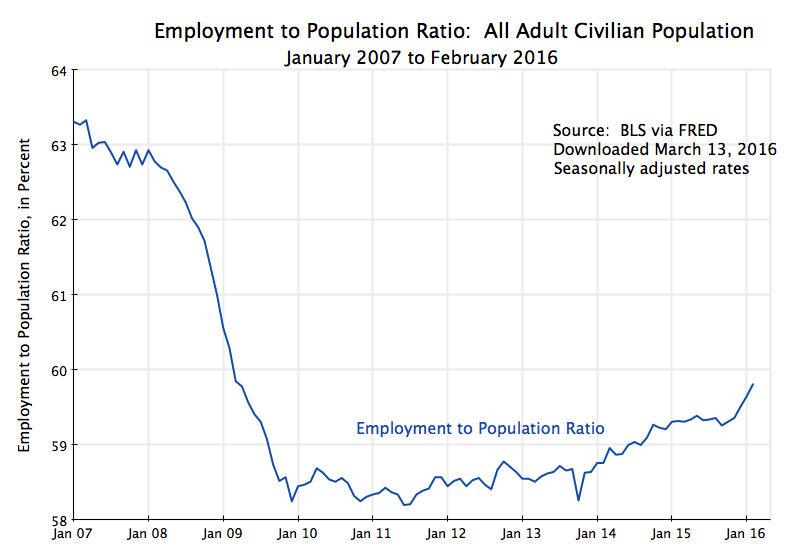
Many observers, from both the left and the right of the political spectrum, have looked at how the employment to population ratio has moved in the recent downturn, and concluded that there must be a significant reservoir of hidden unemployed.  Specifically, they have looked at charts such as the following:

Employment to Popul only, Jan 2007 to Feb 2016

Employment as a share of the population fell rapidly and sharply with the onset of the economic downturn in 2008, in the last year of the Bush Administration, and reached a low point in late 2009.  From about 63% in 2007 to around 58 1/2% in late 2009, it fell by over 7%.  It then remained at such low levels until 2013, rising only slowly, and since then has risen somewhat faster.

But at the current reading of 59.8%, it remains well below the 63% levels of 2007.  And it remains even more below the peak it reached in the history of the series of 64.7% in April 2000.  If this does, in fact, reflect a pool of hidden unemployed, then GDP could be significantly higher than it is now.  Assuming for simplicity that GDP would rise in proportion to the increase in workers employed, annual GDP would be close to a trillion dollars higher if the employment to population ratio rose from the current 59.8% to the 63% that prevailed in 2007.  And annual GDP would be close to $1.5 trillion higher if the ratio could revert to where it was in April 2000.  With a share of about 25% of this accruing in taxes, this would be a significant pot of money, which could be used for many things.

But is this realistic?  The short answer is no.  The population has moved on, with important demographic as well as social changes that cannot be ignored.

C.  Adding the Labor Force Participation Rate

A problem with the employment to population measure is that people will not be employed not just due to unemployment (are looking but cannot find a job), but also because they might not want to be working at the moment.  If older, they might be retired, and happily so.  If younger (the figures are for all adults in the civilian population, defined as age 16 or older), they might be students in high school or college.  And not all those in middle age will want to be working:  Until recent decades, a large share of adult women did not participate in the formal labor force.  Women’s participation in the formal labor force has, however, changed significantly over time, and is one of the key factors underlying the rise seen in the overall labor force participation rate over time.  Such factors should not be ignored, but are being ignored when one looks solely at the employment to population ratio.

The first step is to take into account unemployment.  Unemployment accounts for the difference between the employment to population ratio and the labor force participation rate (which is, stated another way, the labor force to population ratio).  Adding the labor force participation rate to the diagram yields:

Employment to Popul and Labor Force Participation Rate, Jan 2007 to Feb 2016

Note the unemployment rate as traditionally referred to (currently 4.9%) is not the simple difference, in percentage points, between the labor force participation rate (62.9% in February 2016) and the employment to population ratio (59.8% in February 2016).  The unemployment rate is traditionally defined as a ratio to the labor force, not to population, while the two measures of labor force participation rate and employment to population ratio are both defined as shares of the population.  Note that if you take the difference here (62.9% – 59.8% = 3.1% points in February 2016), and divide it by the labor force participation rate (62.9%), one will get the unemployment rate of 4.9% of the labor force. But all this is just arithmetic.

The key point to note for the chart above is that while the employment to population ratio fell sharply in the 2008-2009 downturn, and then recovered only slowly, the labor force participation rate has been moving fairly steadily downward throughout the period.  There is month to month variation for various reasons, including that all these figures are based on surveys of households.  There will therefore be statistical noise.  But the downward trend over the period is clear.  The question is why.  Does it perhaps reflect people dropping out of the labor force due to an inability to find jobs when the labor market is slack with high unemployment (the “discouraged worker” effect)?  Some commentators have indeed noted that the upward bump seen in the figures in the last few months (since last November), with the unemployment rate now low and hence jobs perhaps easier to find, might reflect this.  Or is it something else?

D.  The Longer Term Trend

A first step, then, is to step back and look at how the labor force participation rate has moved over a longer period of time.  Going back to 1948, when the data series starts:

Labor Force Participation Rate, Overall, All Ages, Jan 1948 to Feb 2016

The series peaked in early 2000, at a rate of 67.3%, and has moved mostly downward since.  It was already in 2007 well below where it had been in 2000, and the decline since then continues along largely the same downward path (where the flattening out between 2004 and 2007 was temporary).  Prior to 2000, it had risen strongly since the mid-1960s.

One does see some downward deviation from the trend whenever there was an economic downturn, but then that the series soon returned to trend.  Thus, for example, the labor force participation rate rose rapidly during the years of Jimmy Carter’s presidency in the late 1970s, but then leveled off in the economic downturn of the early 1980s during the Reagan years.  The unemployment rate peaked at 10.8% in late 1982 under Reagan (significantly more than the 10.0% it peaked at in 2009 under Obama), and one can see that the labor force participation rate leveled off in those years rather than continued the rise seen in the years before.  But these are relatively mild “bumps” in the broader long-term story of a rise to 2000 and then a fall.

The long term trend has therefore been a fairly consistent rise over the 35 years from the mid-1960s to 2000, and then a fairly consistent fall in the 16 years since then.  The question to address next is why has it behaved this way.

E.  Taking Account of an Aging Society, Students in School, and Male / Female Differences

As people age, they seek to retire.  Normal retirement age in the US has been around age 65, but there is no rigid rule that it has to be at that precisely that age.  Some retire a few years earlier and some a few years later.  But as one gets older, the share that will be retired (and hence not in the formal labor force) will increase.  And with the demographic dynamics where an increasing share of the US population has been getting older over time (due in part to the baby boom generation, but not just that), one would expect the labor force participation rate to decline over time, and especially so in recent years as the baby boom generation has reached its retirement years.

At the other end of the age distribution, an increasing share of the adult population (defined as those of age 16 or more) in school in their late teens and 20s will have a similar impact.  Over this period, the share of the population (of age 16 or more) in school or college has been increasing.

The other key factor to take into account is male and female differences in labor force participation.  A half century ago, most women did not participate in the formal labor force, and hence were not counted in the labor force participation rate.  Now they do.  This has had a major impact on the overall (male plus female) labor force participation rate, and this change over time has to be taken into account.

The impact of these factors can be seen in the key chart shown at the top of this blog. Male and female rates are shown separately, and to take into account the increasing share of the population in their retirement years or in school, the figures presented are for those in the prime working age span of 25 to 54.  The trends now come out clearly.

The most important trend is the sharp rise in female participation in the formal labor force, from just 34% (of those aged 25 to 54) at the start of 1948 to a peak of over 77% in early 2000.  The male rate for this age group, in contrast, has followed a fairly steady but slow downward trend from 97 to 98% in the early 1950s to about 88% in recent years.  As a result, the combination of the male and female rates rose (for this age group) from 65% in 1948 to a peak of 84% in 2000, and then declined slowly to 81% now.

Seen in this way, the recent movement in the labor force participation rate does not appear to be unusual at all.  Rather, it is simply the continuation of the trends observed over the last 68 years.  The male rate fell slowly but steadily, and the female rate at first rose until 2000, and then followed a path similar to the male rate.  The overall rate reflected the average between these two, and was driven mostly by the rise in the female rate before 2000, and then the similar declines in the male and female rates since then.

F.  The Female Labor Force Participation Rate as a Ratio to the Male Rate

Finally, it is of interest to look at the ratio of the female labor force participation rate to the male rate:

Ratio of Female to Male LFPR, Ages 25 to 54 only, Jan 1948 to Feb 2016

This ratio rose steadily until 2000.  But what is perhaps surprising is how steady this ratio has been since then, at around 83 to 84%.  An increasing share of females entered the labor force until 2000, but since then the female behavior has matched almost exactly the male behavior.  For both, the share of those in the age span of 25 to 54 in the labor force declined since 2000, but only slowly and at the same pace.  The male rate continued along the same trend path it had followed since the early 1950s; the female rate first caught up to a share of the male rate, and then followed a similar and parallel downward path.

Why the female and male rates moved at such a similar and parallel pace since 2000, and at a 83 to 84% proportion, would be interesting issues to examine, but is beyond the scope of this blog post.  One hypothesis is that the parallel downward movements since 2000 reflect increasing enrollment in graduate level education of men and women older than age 25 (and hence included in the 25 to 54 age span).  But I do not know whether good data exists for this.  Another hypothesis might be that very early retirement (at age 54 or before), while perhaps small, has become more common.  And the ratio of the female rate to the male rate of a steady 83 to 84% might reflect dropping out of the labor force temporarily for child rearing, which most affects women.

More data would be required to test any of these hypotheses.  But it appears to be clear that long-term factors are at play, whether demographic, social, or cultural.  And the pattern seen since 2000 has been quite steady for 16 years now.  There is no indication that one should expect it to change soon.

G.  Conclusion

The downward movement in the employment to population ratio in 2008 and 2009 reflected the sharp rise in unemployment sparked by the economic and financial collapse of the last year of the Bush administration.  Unemployment then peaked in late 2009, as the economy began to stabilize soon after Obama took office, with Congress passing Obama’s stimulus program and the aggressive actions of the Fed.  From late 2009, the employment to population ratio was at first flat and then rose slowly, as falling unemployment was offset by a steadily falling labor force participation rate.

But the fall since 2007 in the labor force participation rate did not represent something new.  Rather, it reflected a continuation of prior trends.  Once one takes into account the increasing share of the population either in retirement or in school (by focussing on the behavior of those in the prime working ages of 25 to 54), and most importantly by taking into account female and male differences, the trends are quite steady and clear.  The movement since 2007 in the recent downturn has not been something special, inconsistent with what was observed before.

The implications for the economic programs of the Republican presidential candidates as well as Bernie Sanders on the Democratic side, are clear.  While there will be month to month fluctuation in the data, and perhaps some further increase in the labor force participation rate, one should not assume that there is a large reservoir of hidden unemployed who could be brought into gainful employment and allow there to be a large jump in GDP.

Economic performance can certainly be improved.  The rate of growth of GDP should be higher.  But do not expect a quantum leap.  One should not expect miracles.

Initial Claims for Unemployment Insurance Are at Record Lows

Weekly Initial Claims for Unemployment Insurance, January 7, 2006, to November 21, 2015

Weekly Initial Claims for Unemployment Insurance as a Ratio to Employment, January 1967 to October 2015


Initial claims for unemployment insurance are now at their lowest level, in terms of absolute numbers, in forty years, and the lowest ever when measured relative to employment (although the series goes back only to 1967).  There has been a steady improvement in the job market since soon after Barack Obama took office in January 2009, with (as discussed in a recent post on this blog) a steady increase in private sector jobs and an unemployment rate now at just 5.0%.  Yet the general discussion still fails to recognize this.  I will discuss some of the possible reasons for this perception later in this post.

Initial claims for unemployment insurance provides a good measure of the strength of the labor market, as it shows how many workers have been involuntarily laid off from a job and who are then thus eligible for unemployment insurance.  The US Department of Labor reports the figure weekly, where the numbers in the chart above are those updated through the release of November 25, 2015 (with data through November 21).  While there is a good deal of noise in the weekly figures due to various special factors (and hence most of the focus is on the four week moving average), it does provide a high frequency “yardstick” of the state of the labor market.  The charts above are for the four week moving averages.

The measure has been falling steadily (abstracting from the noise) since soon after President Obama took office.  News reports have noted that the weekly figures have been below 300,000 for some time now (close to a year).  This is a good number.  Even in the best year of the Bush administration (2006, at the height of the housing bubble), weekly initial claims for unemployment insurance averaged 312,000.  So far in 2015 (through November 21) it has averaged 279,000, and the lowest figure was just 259,250 for the week of October 24.  Initial claims for unemployment have not been so low in absolute numbers since December 1973.

But the population and labor force have grown over time.  When measured as a ratio to the number of those employed, initial claims for unemployment insurance have never been so low, although the series only begins in January 1967.  It is now well below the lowest points ever reached in the George W. Bush administration, in the Reagan administration, and even in the Clinton administration, under which the economy enjoyed the longest period of economic expansion ever recorded in the US (back to at least 1854, when the recession dating of the NBER begins).

Why then has the job market been seen by many as being especially weak under Obama? It should not be because of the unemployment rate, which has fallen steadily to 5.0% and is now well below where it was at a similar point during the Reagan administration.  Private job creation has also been steady and strong (although government jobs have been cut, for the first time in an economic downturn in at least a half century).  There has also been no increase in the share of part time employment, despite assertions from Republican politicians that Obamacare would have led to this.  And growth in GDP, while it would have been faster without the fiscal drag of government spending cuts seen 2010, has at least been steady.

What has hurt?  While no one can say for sure as the issue is some sense of the general perception of the economy, the steady criticism by Republican officials and pundits has probably been a factor.  The Obama administration has not been good at answering this.

But also important, and substantive, is that wages have remained stagnant.  While this stagnation in wages has been underway since about 1980, increased attention is being paid to it now (which is certainly a good thing).  In part due to this stagnation, the recovery that we have seen in the economy since the trough in mid-2009 has mostly been for the benefit of the very rich.  Professor Emmanuel Saez of UC Berkeley has calculated, based on US tax return data, that the top 1% have captured 58% of US income growth over the period 2009 to 2014.  The top 1% have seen their real incomes rise over this period by a total of 27% in real terms, while the bottom 99% have seen income growth over the period of only 4.3%.  Furthermore, most of this income growth for the bottom 99% only started in 2013.  For the period from 2009 through 2012, the top 1% captured 91% of the growth in national income.  The bottom 99% saw their real incomes rise by only 0.8% total over that period.

The issue then is not really one of jobs or overall growth.  Rather it is primarily a distribution problem.  The recovery has not felt like a recovery not because jobs or growth have been poor (although they would have been better without the fiscal drag), but rather because most of the gains of the growth have accrued to the top 1%.  It has not felt like a recovery for the other 99%, and for an understandable reason.

An Update on Progress in the Labor Market Recovery Under Obama

Cumul Private Job Growth from Inauguration to Oct 2015

Cumul Govt Job Growth from Inauguration to Oct 2015

A)  Introduction

The Bureau of Labor Statistics released on November 6 its most recent report on the state of the job market.  It was a strong report, with net job gains of 271,000 in October and the unemployment rate falling to 5.0%.  One should not, however, put too much weight on the figures in just one month’s report.  Indeed, the report for October followed relatively weaker reports in the two previous months.  Rather, one should put all these reports in the longer term context of how the labor market has moved in recent years.  And what they show is continued, and remarkably steady, improvement.

This post will look at that longer term context by updating several labor market charts that have been discussed in previous posts on this blog.  It will look first at net job growth in the private sector and in the government sector in the period since Obama’s inauguration, with a comparison to the similar period during George W. Bush’s term.  The post will then look at the continued fall in the unemployment rate, with a comparison to the similar period under Reagan, and finally to the share of part time workers in total employment.  The last is to see whether there is any evidence to support the assertion coming from Republican critics that Obamacare has led to a shift by employers to part time workers so that they can avoid providing health insurance in the overall wage compensation package for their staff.  We will find that there is no indication in the data that this has been the case.

B)  Total Job Growth

The charts at the top of this post show total net job growth, in the private sector and in the government sector, in the period since Obama’s inauguration (up to October 2015) and under Bush (for his two full terms).  They update similar charts discussed in several earlier posts on this blog, most recently from June 2014.

Private sector job growth has been strong under Obama, and continues to be.  And the record is clearly far better than that under the George W. Bush administration.  There has been a net increase of 9.3 million new private jobs under Obama since the month he was inaugurated, versus just 4.0 million new private jobs over the similar period in the Bush administration.  Furthermore, this 4.0 million additional private jobs was close to the peak achieved in the Bush years, before it started to fall and then plummet as the housing bubble burst and the economy collapsed in the last year of his second term.  By the end of his presidency there were fewer private jobs than there were on the day he was inaugurated, eight years before.

Obama faced this collapse in the jobs market as he took office.  The economy was losing 800,000 private jobs per month, with the economy contracting at the fastest pace since the Great Depression.  The new administration was able to turn this around with the stimulus package and with aggressive Fed actions, with the fall in employment first slowing and then turning around.  The result has been a net growth of 13.5 million new private jobs from the trough just one year into the new administration until now.

Government jobs, in contrast, have been cut.  This hurt total job growth both directly (government jobs are part of total jobs obviously) as well as indirectly.  Indirectly, the government job cuts (as well as the fiscal austerity that began in 2010) reduced demand for goods and hence production at a time when the economy was still depressed and suffering from insufficient demand to keep production lines going.  As discussed in an earlier post on this blog, without the fiscal austerity introduced from 2010 onwards the economy would have recovered from the economic downturn by 2013 and perhaps even 2012.  The initial stimulus package in 2009 turned things around.  It is unfortunate that the government then moved to cuts from 2010 onwards, which reduced the pace of the recovery.

It should be recognized that government jobs as recorded here include government jobs at all levels (federal, state, and local), with federal government jobs only a relatively small share of the total (12.4%).  But government jobs have fallen at all three levels, federal as well as state and local.

The cuts on government jobs during Obama’s time in office stand in sharp contrast to the growth in government jobs during Bush’s two terms.  Yet Obama is charged with being a big government liberal while the Republicans claim to be small government conservatives.

C)  The Rate of Unemployment

Unemployment Rates - Obama vs Reagan, up to Oct 2015After peaking at 10.0% in October 2009, the rate of unemployment has fallen at a remarkably steady pace under Obama (aside from the monthly fluctuations in the reported figures, which will in part be statistical noise as unemployment estimates come from household surveys).  This was discussed in this earlier post on this blog.  The record is certainly better than that under Reagan.  The unemployment rate is now 5.0%, while it was still 6.0% at the same point in the Reagan presidency.

Furthermore, Reagan was not confronted, as Obama was, with an economy in collapse as he took office.  Rather, unemployment began to rise only about a half year after Reagan took office, as he began to implement his new budgetary and other policies.  The unemployment rate then rose to a peak of 10.8% in late 1982 before starting to fall.  And while the recovery was then rapid for a period, supported by rising government spending, it stalled by mid-1984 with unemployment then fluctuating in the range of 7.0% to 7.5% for most of the next two years.  One does not see the steady improvement as one has had under Obama.

With the unemployment rate now at 5.0%, it is expected that the Fed will soon start to raise interest rates.  This would be unfortunate in my view (as well as that of many others, such as Paul Krugman).  Inflation remains low (only 0.2% over the past year for personal consumption expenditures for all goods, or 1.3% over the past year if one excludes the often volatile food and energy costs).  And while wages ticked up by 2.5% over the year before in the most recent BLS labor market report, this is still below the roughly 3 1/2% increases that would be consistent (after expected productivity gains in a normally functioning job market) with the Fed’s 2.0% inflation target.  And if wages are not allowed to rise faster than inflation, then by definition there will be no increase in real wages.

It is of course recognized that the rate of unemployment cannot fall forever.  There will always be some slack in the labor market as workers transition between jobs, and if the unemployment rate is too low, there will be excessive upward pressure on wages, and inflation can become a problem.  But where that “full employment rate of unemployment” is, is not clear.  Different economists have different views.  It does not appear to be at 5.0% under current conditions, as the rate of inflation remains low.  But whether it is at 4.5% or 4.0% is not clear.  At some point, it would be reached.

When it is, the pace of job creation will need to fall to match the pace of labor force growth (from population growth).  Otherwise, by simple arithmetic, the rate of unemployment would continue to fall.  And this cut in employment growth would be the objective of the Fed in raising interest rates:  It would be to slow down the pace of job growth to the rate that matches labor force growth.

Once the Fed does start to raise interest rates, one should then not be surprised, nor criticize, that the pace of job growth has slowed.  That is the aim.  And it will need to slow sharply from what the pace of job growth has been in recent years under Obama.  Over the past two years, for example, employment growth has averaged 236,000 per month. The labor force has grown at a pace of 101,000 per month over this period.  As a result, unemployment has fallen at a pace of 135,000 per month (= 236,000 – 101,000), with this leading the unemployment rate to fall to 5.0% now from 7.2% two years ago.  If unemployment is now to be kept constant rather than falling, the pace of job growth will need to fall by more than half, from 236,000 per month to just 101,000 per month (or slightly more, to be precise, taking into account the arithmetic of a constant unemployment rate).

I have no doubt that when this happens, and the pace of job growth slows, that Obama will be criticized by his Republican critics.  But this will reflect a fundamental confusion of what full employment implies for the labor market.

D)  Part-Time Employment as a Share of Total Employment

Part-Time Employment #2 as Share of Total Employment, Jan 2007 to Oct 2015

Finally, it is of interest to update the graph in an earlier post to see whether there is now any evidence that the Affordable Care Act (Obamacare) has led employers to fire their regular full time workers and replace them with part-timers, in order to avoid the mandate of including health insurance coverage in the wage compensation package they pay to their workers.  Conservative politicians and media asserted this as a fact (see the earlier blog post cited for several references).  But as discussed before, and as confirmed with the more recent data, there is no indication in the data that this has been the case. Indeed, the share of part time workers in the total has been falling at an accelerated pace in the most recent two years, at a time when the Obamacare insurance mandate provisions have come into effect.

The acceleration in the pace of this improvement is consistent with the improvement seen in the overall labor market over the past several years, as discussed above.  As the economy approaches full employment, those who are working part time (not by choice, but because they have no alternative) are able to find full time jobs.  The share of part-time workers in total employment is still somewhat above (at about 4%) what would be normal when the economy is at full employment (at about 3%), lending support to those arguing that while the labor market is improving, we are not yet at full employment (and the Fed should thus wait longer before it starts to raise interest rates).  But it is getting better.

I have also added to the graph a line (in red) showing what the share of part-time employment workers were in total employment during the Reagan years.  At the comparable time in his presidency, the share was higher than what it is now under Obama.  Furthermore, it had improved only slowly under Reagan over the three years leading up to that point.  Yet Reagan is praised by conservatives for his purportedly strong labor market.

E)  Conclusion

The labor market has improved considerably in recent years under Obama.  It could have been better had the government not turned to austerity in 2010, but even with the government cuts, job growth has been reasonably good.  The unemployment rate has now fallen to 5%, and it is expected the Fed will soon begin to raise interest rates in order to slow the pace of job creation.  One should not then be surprised if fewer net new jobs are created each month, nor criticize Obama when it does.  That will be precisely the aim of the policy.  But I strongly suspect that we will nonetheless hear such criticisms.