Regulations Under Obama Cannot Be Blamed: Productivity and Profits Have Gone Up


The Republican Presidential candidates, and especially Mitt Romney, have repeatedly asserted that burdensome regulations imposed by the Obama Administration are to blame for the disappointing performance of the economy during the recovery, and especially the disappointing job performance.  The evidence points to the opposite:  productivity has in fact performed quite well and profitability has sky-rocketed.  If regulations were a problem, one would have expected productivity to have declined and profitability to have suffered, and they haven’t.

The disappointing performance of the economy in recent years can rather be attributed to slow growth in aggregate demand.  Households have had to scale back consumption after the housing bubble burst, while conservative fiscal policies forced by a Republican Congress have not allowed government expenditures to fill in the resulting gap.

The chart above shows how labor productivity, unit labor costs, and unit profits have performed in recent years (for non-financial corporations), each indexed so that the 2005 average equals 100.  Labor productivity (in green in the chart) is the amount of output produced per unit of labor.  It was basically flat prior to Obama taking office, rising by just 2.2% total in those four years, but then jumped by 8.6% total in the subsequent 2 1/2 years.  If regulations imposed by Obama were a major hindrance, productivity would not have gone up like this.

But while labor productivity improved, labor compensation (not shown in the chart to reduce clutter) was basically flat.  Indeed, hourly wages in real terms have declined slightly since Obama took office (by 0.8% total).  This is consistent with a slack labor market, with high unemployment depressing wages.  With higher productivity and wages not increasing, the result was falling unit labor costs (labor costs per unit of output), as shown in blue in the chart.

What did shoot up after Obama took office was unit profits (profits per unit of output, in red in the chart).  This is much more volatile, but it is interesting to note that it peaked in the third quarter of 2006 and then fell sharply well before Obama took office.  If someone is to be “blamed” for this, it would have to be Bush.  Unit profits then reached its low point in the second quarter of 2009, as the recession came to an end, and then skyrocketed by over 75% up to the third quarter of 2011 (the most recent data available).  This is of course all consistent with what has been observed at the level of the aggregate National Income accounts, which was reviewed in an earlier post (see here) on this blog.

Mitt Romney and the other Republican candidates assert that burdensome regulations under Obama have stifled the ability of business to make a profit, and with that, businesses have been unwilling to employ more workers.  But productivity has improved and profitability has soared.  The evidence simply does not support their assertions.
Contracting Government Has Hurt Job Growth

(change, in thousands of jobs) Jan 2001 to Jan 2005 Jan 2005 to Jan 2009 Jan 2001 to Jan 2009 Jan 2009 to Nov 2011
Total Employment -16 +1,110 +1,094 -1,855
Private Sector -916 +263 -653 -1,262
Government Sector +900 +847 +1,747 -593

Obama has repeatedly and emphatically been charged by Republican politicians as fostering  a huge expansion in government job growth, with this a major cause for the weak recovery in private job growth.  The facts do not support this.  The government sector has in fact been contracting sharply during the Obama period, in distinct contrast to the expansion during the Bush presidency, and it is this contraction which indeed can explain a significant share of the drop in overall jobs in the economy.

The table above, drawn from Bureau of Labor Statistics (US Department of Labor) figures on employment levels by the major sectors, shows the change in the number of those employed, for the periods between January 2001 and January 2005 (the first Bush term), between January 2005 and January 2009 (the second Bush term), between January 2001 and January 2009 (the two Bush terms together), and between January 2009 and November 2011 (the most recent figures, for the Obama term so far).

In the first Bush presidential term, overall job growth was basically zero.  But it is striking that it only comes to zero because a decline of 916,000 private jobs is almost fully offset by a nearly identical rise in government jobs of 900,000.  Note that while the time periods we are examining are the presidential terms, government job growth is largely affected by changes at the state and local level, as these account for about 87% of government jobs.

During the second Bush term, private sector job growth became positive, by a modest 263,000 for the period (with growth early on offset by the downturn in his final year), while government job growth continued at a roughly similar positive rate as during his first term.  With both positive, total job growth was then about 1.1 million.

For the Bush presidency as a whole, it is then interesting to note the overall job growth of about 1.1 million (all in his second term), only came about due to a growth in government jobs of about 1.75 million:  Private jobs in fact fell by about 650,000.

During the Obama presidency so far, government job growth went into reverse, with a decline of almost 600,000 jobs.  It is interesting that the pace of the decline for the first 34 months of Obama’s 48 month term (that is, through November 2011), matches almost exactly the pace of the increase during either of the Bush terms.

Suppose government job growth had increased during the Obama period at the pace it had during the Bush terms.  There would then have been a growth in government employment of over 600,000, rather than a decline of almost that amount, for a swing of 1.2 million jobs.  Assuming the same decline as now of over 1.2 million private jobs, overall jobs would have still fallen, but by only about 600,000 rather than over 1.8 million.

Of course, with such a different policy on government job growth, one would not expect private job growth to be the same.  Conservatives might argue that the government job growth would “crowd out” the private sector, leading to even an even larger fall in private jobs.  But there is no evidence to support this, in an environment where unemployment is high and interest rates on government borrowing are close to zero as the economy suffers from a liquidity trap.

Indeed, the basic insight of John Maynard Keynes is that in such a situation, government job growth (and its accompanying spending) will not only not displace private job growth, but will add to it at a multiple of what is spent directly, as the newly employed by the government will add to demand for privately produced goods and services as they spend their wages.  A reasonable estimate of this government employment multiplier would be at least two, and many would argue higher.  At a multiplier of two (that is, each additional government job leads to one additional private job, for two total), the swing in government employment of 1.2 million (that is, a rise of 600,000 rather than a decline of about 600,000), would have led to 1.2 million additional private jobs, and total employment growth would then have been a positive of 600,000 rather than a negative of over 1.8 million.  This is a swing of 2.4 million jobs.  With current unemployment in the US of 13.3 million, and a civilian labor force of 153.9 million, the unemployment rate would then be 7.1% rather than the current 8.6%.  It was 7.8% when Obama took office.

One can quibble with the specific figures, and what multiplier to assume.  But the basic point is that the contraction in government employment in recent years (primarily at the state and local levels) is a major reason why the overall job picture is still so bad.  If government employment had continued to expand at the pace it had during either of the Bush terms, rather than contract at a similar pace, then under quite plausible estimates, unemployment would be less now than when Obama took office.

Unemployment Rate Drops, but How Significant?

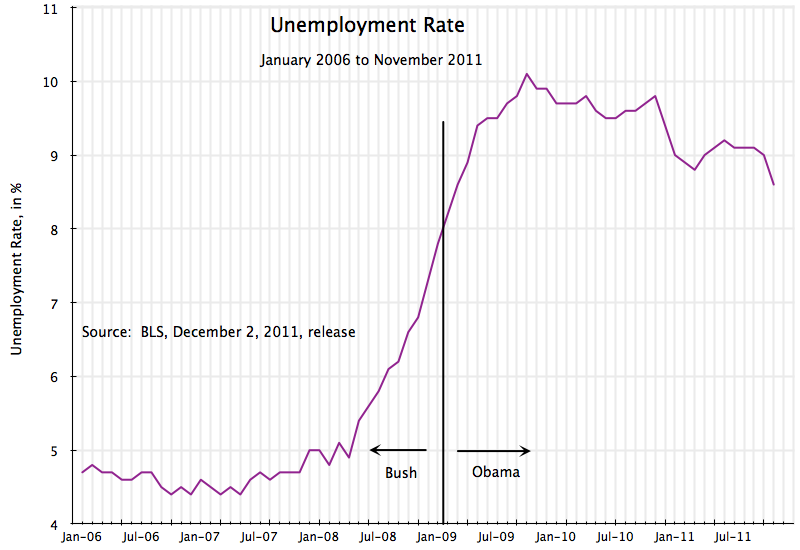
The US unemployment rate dropped by a quite large 0.4% points in November, from the previous 9.0% to 8.6%, according to the December 2 release of the US Bureau of Labor Statistics.   But the drop did not generate much excitement among analysts.  Why?

While at first glance, such a drop would generally be viewed as quite positive, an analysis of the underlying numbers suggests caution.  The estimated number of unemployed fell by 594,000, to a total of 13,303,000.  A fall of 594,000 is major.  However, the estimated increase in the number of employed was only 278,000.  Why the difference?  The reason was an estimated reduction in the size of the civilian labor force of 315,000.  Hence only a bit less than half (47%) of the fall in unemployment came from more workers being employed.  A bit more than half (53%) came from workers leaving the labor force.

Workers may leave the labor force for many reasons, including retirement, but also because they may be unemployed and see little prospect in getting a reasonable job.  Furthermore, the labor force will normally grow (rather than contract) over time as the population grows, but month to month it can vary.  In recent years it has been unusually flat or even falling in the face of high unemployment and hence poor job prospects for many.  Older baby boomers may also be dropping out of the labor force and taking early retirement.

In addition, it is not clear that the estimated increase in the number of employed, of 278,000 in the month, is accurate.  In the same December 2 release, the BLS stated that the number of employed in the month was only 120,000.  Why the difference?  The reason is that both are estimates obtained from surveys, and the figures come from two different surveys.  The 278,000 figure that accompanied the unemployment estimates comes from a survey of households.  The 120,000 figure comes from a survey of establishments (generally firms, but including governmental entities and other employers).

Over time the figures will on average be close to each other, but they can differ in any given month.  Coming from surveys, they are both subject to sampling errors, where it should be kept in mind that both of these figures are the relatively small differences between two estimates (for October and November) of the much larger number of total workers employed in that period.  Furthermore, the timing of the surveys within the month will differ.  Finally, there are some definitional differences, although such differences probably do not affect too much the estimates of the change in employment levels between the two periods.  The household survey asks whether the person has been employed in any occupation during the period.  The establishment survey surveys employers of non-farm workers.  Hence the household survey will include (and the establishment survey will not) those employed on farms, the self-employed, unpaid family workers, private household workers, and those on unpaid leave from work.  The establishment survey, on the other hand, will count each worker, and hence a worker with two jobs will be counted twice.  There are some other small differences as well.

The difference between the two estimates, of 278,000 more employed vs. 120,000 more employed, is large.  The estimates are also preliminary and hence subject to change.  Observers will therefore be looking at the trends over the next few months to see which estimate was likely the more accurate.