Taxes on Corporate Profits Have Collapsed

A.  Introduction:  The Plunge in Corporate Profit Tax Revenues

Corporate profit tax revenues have collapsed following the passage by Congress last December of the Trump-endorsed Republican tax plan.  And this is not because corporate profits have decreased:  They have kept going up.  The initial figures, for the first half of 2018, show federal corporate profit taxes (also referred to as corporate income taxes) collected have fallen to an annual rate of roughly just $150 billion.  This is only half, or less, of the $300 to $350 billion collected (at annual rates) over the past several years.  See the chart above.

The estimates on corporate profit taxes actually being paid through the first half of 2018 come from the National Income and Product Accounts (NIPA, and commonly also referred to as the GDP accounts) produced by the Bureau of Economic Analysis.  The figures are collected as part of the process of producing the GDP accounts, but for various reasons the figures on corporate profit taxes are not released with the initial GDP estimates (which come out at the end of the month that follows the end of each quarter), but rather one month later (i.e. on August 29 this time, for the estimates for the April to June quarter).  The quarterly estimates are seasonally adjusted (which is important, as tax payments have a strong seasonality to them), and are then shown at annual rates.  While we already saw such a collapse in corporate tax revenues in the figures for the first quarter of 2018 (first published in May), it is always best with the estimates of GDP and its components to wait until a second quarter’s figures are available to see whether any change is confirmed.  And it was.

This initial data on what is actually now being collected in taxes following the passage of the Republican tax plan last December suggests that the revenue losses will be substantially higher than the $1.5 trillion over ten years that the staff at the Joint Committee on Taxation (the official arbiters for Congress on such matters) forecast.  Indeed, the plunge in corporate profit tax collections alone looks likely to well exceed this.  On top of this, there were also sharp cuts in non-corporate business taxes and in income taxes for those in higher income groups.

This blog post will look at what the initial figures are revealing on the tax revenues being collected, as estimated in the GDP accounts.  The focus will be on corporate income taxes, although in looking at the total tax revenue losses we will also look briefly at what the initial data is indicating on reductions in individual income taxes being paid.

The chart above shows what the reduction has been in corporate profit taxes in dollar terms.  In the next section below we will look at this in terms of the taxes as a share of corporate profits.  That implicit average actual tax rate is more meaningful for comparisons over time, and it has also plunged.  And the implicit actual rate now being paid, of only about 7% for the taxes at the federal government level, shows how misleading it is to focus on the headline rate of tax on corporate profits of 21% (down from 35% before the new law).  The actual rate being paid is only one-third of this, as a consequence of the numerous loopholes built into the law.  The Republican proponents of the bill had argued that while they were cutting the headline rate from 35% to 21%, they were also (they asserted) ending many of the loopholes which allowed corporations to pay less.  But in fact numerous loopholes were added or expanded.

The next section of the post will then look at this in the longer term context, with figures on the implicit corporate profit tax rate going back to 1950.  The implicit rate has fallen steadily over time, from a rate that reached over 50% in the early 1950s, to just 7% now.  While Trump and his Republican colleagues argued the cut in corporate taxes was necessary in order for the economy to grow, the economy in fact grew at a faster pace in the 1950s and 1960s, when the rate paid varied between 30 and 50%, than it has in recent decades despite the now far lower rates corporations face.

But this is for the federal tax on corporate profits alone.  There are also taxes on corporate profits imposed at the state and local level, as well as by foreign governments (although such foreign taxes are then generally deductible from the taxes due domestically).  This overall tax burden is more meaningful for understanding whether the overall burden is too high.  But, as we shall see below, that rate has also fallen steadily over time.  There is again no evidence that lower rates lead to higher growth.

The final substantive section of the post will then look more closely at the magnitude of the revenue losses from the December bill.  They are massive, and based on the initial evidence could very well total over $2 trillion over ten years for the losses on the corporate profit tax alone.  The losses from the other tax cuts in the new law, primarily for the wealthy and for non-corporate business, will add to this.  A very rough estimate is that the losses in individual income tax revenues may total an additional $1 trillion, bringing the total to over $3 trillion.  This is double the $1.5 trillion loss in revenues originally forecast.

But first, an analysis of what we see from the initial evidence on what is being paid.

B.  Profit Taxes as a Share of Corporate Profits

The chart at the top of this post shows what has been collected, by quarter (but shown at an annual rate), by the federal tax on corporate profits over the last several years.  Those figures are in dollars, and show a fall in the first half of 2018 of a half or more compared to what was collected in recent years.  But for comparisons over time, it is more meaningful to look at the implicit corporate tax rate, as corporate profits change over time (and generally grow over time).  And this can be done as the National Income and Product Accounts include an estimate of what corporate profits have been, as part of its assessment of how national income is distributed among the major functional groups.

That share since 2013 has been:

Between 2013 and 2016, the implicit rate (quarter by quarter) varied between about 15 and 17%.  It came down to about 14% for most of 2017 for some reason (possibly tied to the change in administration in Washington, with its new interpretation of regulatory and tax rules), but one cannot know from the aggregate figures alone.  But the rate then fell sharply, by half, to just 7% after the new tax law entered into effect.

A point to note is that the corporate profit figures provided here are corporate profits as estimated in the National Income and Product Accounts.  They are a measure of what corporate profits actually are, in an economic sense, and will in general differ from what corporate profits are as defined for tax purposes.  Thus, for example, accelerated depreciation allowed for tax purposes will reduce taxable corporate profits.  But the BEA estimates for the NIPA accounts will reflect not the accelerated depreciation allowed for tax purposes, but rather an estimate of what depreciation actually was.  Thus the figures as shown in the chart above will be a measure of what the true average corporate tax rate actually was, before the adjustments made (as permitted under tax law) to arrive at taxable corporate profits.

That average rate is now just 7%.  That is only one-third of the headline rate under the new law of 21%.  Provisions in the tax code allow corporations to pay far less in tax than what the headline rate would suggest.  This is not new (the headline rate previously was 35%, but the actual average rate paid was just 15 to 17% between 2013 and 2016, and 14% in most of 2017).  But Trump administration officials had asserted that many of the loopholes allowing for lower taxes would be ended under the new tax law, so that the actual rate paid would be closer to the headline rate.  But this clearly did not happen.  As many independent analysts pointed out before the bill was passed, the new tax law had numerous provisions which would allow the system to be gamed.  And we now see the result of that in the figures.

C.  Corporate Taxes in a Longer Term Context

The cuts in corporate profit taxes are not new.  Taxes on corporate profits in the US used to be far higher:

In the early 1950s, the federal tax on corporate profits (actually paid, not the headline rate) reached over 50%.  While it then fell, it kept to a rate of between about 30% and 50% through the 1950s and 60s.  And this was a period of good economic growth in the US – substantially faster than it has been since.  A high tax rate on corporate profits did not block growth.  Indeed, if one looked just at the simple correlation, one might conclude that a higher tax on corporate profits acts as a spur to growth.  But this would be too simplistic, and I would not argue that.  But what one can safely conclude is that a high rate of tax on corporate profits does not act as a block to more rapid growth.

There have also been important distributional consequences, however.  Corporate wealth is primarily owned by the wealthy (duh), and the sharp decline in taxes paid on corporate profits means that a larger share of the overall tax burden has been shifted to taxes on individual incomes, which are primarily borne by the middle classes.  Based on figures in the NIPA accounts, in 1950 taxes on individual incomes (including Social Security taxes) accounted for 47% of total federal taxes, while taxes on corporate profits accounted for 35% (with the rest primarily various excise taxes such as on fuels, liquor, tobacco, etc., plus import duties).  By 2017, however, the share of taxes on individual incomes had grown to 87.4%, while the share on corporate profits had declined to just 8.6%.  There was a gigantic shift away from taxes on wealth to taxes on individual incomes – taxes that are borne primarily by the middle class.  And that share will now fall further in 2018, by about half.

The chart above is for federal corporate profit taxes alone.  It could be argued that what matters to growth is not just the corporate profit taxes paid at the federal level, but all such taxes, including those paid at the state and local level, as well as to foreign governments (although the taxes paid abroad are generally deductible on their domestic taxes, so that will be a wash).

That chart looks like:

This follows the same path as the chart for federal corporate profit taxes alone, with a similar decline.  With the federal share of such taxes averaging 84% over the period (up to 2017), this is not surprising.  The federal share will now fall sharply in 2018, due to the new tax law.  But over the 1950 to 2017 period, the chart covering all taxes on corporate profits is basically a close to proportionate increase over what the tax has been at the federal level alone.

So the same pattern holds, and the total of the taxes on corporate profits varied between 33% to over 50% in the 1950s and 60s, to between 15 and 20% in recent years before the plunge in the first half of 2018 to just 10%.  But the relatively high taxes in the 1950s and 60s did not lead to slow growth in those years, nor did the low taxes in recent decades lead to more rapid growth.  Rather, one had the reverse.

D.  An Estimate of the Revenue Losses Due to the Tax Bill

These initial figures on the taxes actually being paid following the passage of the Republican tax bill allow us to make an estimate of what the revenue losses will turn out to be.  These will be very rough estimates, as we only have data for half a year, and one should be cautious in extrapolating this to what the losses will be over a decade.  But they can give us a sense of the magnitude.  And it is large.  As we will see below, based on the evidence so far the revenue losses (from the cuts in both corporate taxes and in personal income taxes) might be over $3 trillion over ten years, or about double the $1.5 trillion loss estimate originally forecast.

First, for the federal taxes on corporate profits, as the largest changes are there:  As was discussed before (and seen in the charts above), corporate profit taxes paid as a share of corporate profits were relatively flat between 2013 and 2016, varying between 15 and 17% each quarter, before falling to 14% for most of 2017.  For the full 2013 to 2017 period, the simple average was 15.3%.  The implicit rate then fell to just 7.0% in the first half of 2018.  Had the rate instead remained at 15.3%, corporate profit taxes collected in 2018 would have been $184 billion higher (on an annual basis).

This is not small, and is twice as high as the estimate of the staff of the Joint Committee on Taxation of revenue losses of $91 billion in FY2019 (the first full year under the new tax regime) from all the tax measures affecting businesses (including non-corporate businesses, and covering both domestic business and overseas business).  It is three times as high as the estimated loss of $60 billion in FY18, but the new tax law did not affect the first quarter of FY2018 (October to December).

One should be cautious with any extrapolation of this loss estimate going forward, as not only is the time period of actual experience under the new tax regime short (only a half year), but the law is also a complicated one, with certain provisions changing over time.  But a simple extrapolation over ten years, based on the assumption that corporate profits grow at just a modest 3% a year in nominal terms (meaning 1% a year in real terms if inflation is 2% a year), and that the tax rate on corporate profits will be 7.0% a year (as seen so far in 2018) rather than the 15.3% of recent years, implies that the reduction in corporate profit tax revenues will sum to about $2.1 trillion.

Note that the losses would be greater (everything else equal) if the assumed growth rate of corporate profits is higher.  But the results are not very sensitive to this.  The total losses over ten years would be $2.2 trillion, for example, at an assumed nominal growth rate of 4% (i.e. with inflation still at 2%, then with corporate profits growing at 2% a year in real terms, or double the 1% rate of the base scenario).  Note this also counters the argument of some that such tax cuts will lead to such a large spurt in growth that total tax collections will rise despite the cut in the rates.  As will be discussed below, there is no evidence that this has ever been the case in the US.  But even assuming there were, the argument is undermined by the basic arithmetic.  In the example here, a doubling of the assumed growth rate of profits (from 1% in real terms to 2%) would imply taxes on corporate profits would still fall by $2.0 trillion over the next ten years.  This is not far from the $2.1 trillion loss if there is no rise at all in the growth of corporate profits.  And a doubling of the real growth rate is far above what anyone would reasonably assume could follow from such a cut in the tax rate.

Second, there were also substantial cuts in individual income taxes, although primarily for the wealthy.  While far less in proportional terms, the substantially higher taxes that are now paid by individuals than by corporations means that this is also significant for the totals.

Specifically, individual (federal) income taxes as a share of GDP in the NIPA accounts were quite steady in the quarterly GDP accounts for the period from 2015Q1 to 2017Q4, varying only between 8.22% and 8.44%.  The average was 8.31%.  But then this fell to an average of 7.89% in the first half of 2018 (7.90% in the first quarter, and 7.87% in the second quarter).  Had the rate remained at 8.31%, then $86 billion more in revenues (at an annual rate) would have been collected.

Extrapolating this out for ten years, assuming again just a modest rate of growth for GDP of 3% a year in nominal terms (i.e. just 1% a year in real terms if inflation is 2% a year), the total loss would be $1.0 trillion.  With a higher rate of growth, and everything else the same, the losses would again be larger.  This extrapolation is, however, particularly fraught, as the Republicans wrote into their bill that the cuts in individual taxes would be reversed in 2026.  They did this to keep the forecast cost of the tax bill to the $1.5 trillion envelope they had set, and an effort is already underway to make this permanent (Speaker Paul Ryan has said he will schedule a vote on this in September).  But even if we left out the tax revenue losses in the final two years of the period, the losses in individual taxes would still reach about $0.8 trillion.

Adding the lower revenues from the taxes on corporate profits and the taxes on individual incomes, the total revenue losses would come, over the ten years, to about $3 trillion.  This is double the $1.5 trillion loss that had been forecast.  It is not a small difference.

To give a sense of the magnitude, the loss in 2018 alone (a total of $270 billion) would allow a doubling of the entire budgets (based on FY2017 actual outlays) of the Departments of Education, Housing and Urban Development, and Labor; the Environmental Protection Agency; all international assistance programs (foreign aid); NASA; the National Science Foundation; the Army Corps of Engineers (civil works); and the Small Business Administration.  Note I am not arguing that all of their budgets should necessarily be doubled (although many should, indeed, be significantly increased).  Rather, the point is simply to give readers a sense of the size of the revenues lost as a consequence of the tax cut bill.

As another comparison to give a sense of the magnitude, just half of the lost revenue (now and into the future) would suffice to fund fully the Social Security Trust Fund for the foreseeable future.  If nothing is done, the Social Security Trust Fund will run out at some point around 2034.  Republicans have asserted that nothing can be done for Social Security except to scale back (already low) Social Security pensions.  This is not true.  Just half of the revenues that will be lost under the tax cut bill would suffice to ensure the pensions can be paid in full for at least 75 years (the forecast period used by the Social Security trustees).

But as noted above, proponents of the tax cuts argue that the lower taxes will spur growth.  This has been discussed in earlier posts on this blog, where we have seen that there is no evidence that this will follow.  There are not only basic conceptual problems with this argument (a misreading of basic economics), but also no indication in what we have in fact observed for the economy that this has ever been the case (whether in the years immediately following the major tax cuts of Reagan or Bush, nor if one focuses on the longer term).

Administration officials have not surprisingly argued that the relatively rapid pace of growth in the second quarter of 2018 (of 4.2% at an annual rate in the end-August BEA estimates) is evidence of the tax cut working as intended.  But it is not.  Not only should one not place much weight on one quarter’s figures (the quarterly figures bounce around), but this followed first-quarter figures which were modest at best (with GDP growth of an estimated 2.2% at an annual rate).

But more fundamentally, one should dig into the GDP figures to see what is going on.  The argument that tax cuts (especially cuts in corporate profit taxes) will spur growth is based on the presumption that such cuts will spur business investment.  More such investment, especially in equipment, could lead to higher productivity and hence higher growth.  But growth in business investment in equipment has slowed in the first half of 2018.  Such investment grew at the rates of 9.1%, 9.7%, 9.8%, and 9.9% through the four quarters of 2017 (all at annual rates).  It then decelerated to a pace of 8.5% in the first quarter of 2018 and to a pace of 4.4% in the second quarter.  While still early (these figures too bounce around a good deal), the evidence so far is the exact opposite of what proponents have argued the tax cut bill would do.

So what might be going on?  As noted before, there is first of all a good deal of volatility in the quarterly figures for GDP growth.  But to the extent growth has accelerated this year, a more likely explanation is simple Keynesian stimulus.  Taxes were cut, and while most of the cuts went to the rich, some did go to the lower and middle classes.  In addition, government spending is now rising, while it been kept flat or falling for most of the Obama years (since 2010).  It is not surprising that such stimulus would spur growth in the short run.

The problem is that with the economy now running at or close to full capacity, such stimulus will not last for long.  And when it was needed, in the years from 2010 until 2016, as the economy recovered from the 2008/09 downturn (but slowly), such stimulus measures were repeatedly blocked by a Republican-controlled Congress.  This sequence for fiscal policy is the exact opposite of the path that should have been followed.  Contractionary policies were followed after 2010 when unemployment was still high, while expansionary fiscal policies are being followed now, when unemployment is low.  The result is that the fiscal deficit is rising soon to exceed $1 trillion in a year (5% of GDP), which is unprecedented for a period with the economy at full employment.

E.  Conclusion

We now have initial figures on what is being collected in taxes following the tax cut bill of last December.  While still early, the figures for the first two quarters of 2018 are nonetheless clear for corporate profit taxes:  They have fallen by half.  Corporate profit taxes paid would be an estimated $184 billion higher in 2018 had the tax rate remained at the level it had been over the last several years.

While this post has not focused on personal income taxes, they too were cut.  The reduction here was more modest – only by about 5% overall (although certain groups got far more, while others less).  But with their greater importance in overall federal tax collections, this 5% reduction is leading to an estimated $86 billion reduction in revenues (in 2018) from this source.

Based on what has been observed in the first two quarters of 2018, the two taxes together (corporate and individual) will see a combined reduction in taxes paid of about $270 billion in 2018.  Extrapolating over ten years, the combined losses may be on the order of $3 trillion.

These losses are huge.  And they are double what had been earlier forecast for the tax bill.  Just half of what is being lost would suffice to ensure Social Security would be fully funded for the foreseeable future.  And the rest could fund programs to rebuild and strengthen the physical infrastructure and human capital on which growth ultimately depends.  Or some could be used to reduce the deficit and pay down the public debt.  But instead, massive tax cuts are going to the rich.

The Simple Economics of What Determines the Foreign Trade Balance: Econ 101

“There’s no reason that we should have big trade deficits with virtually every country in the world.”

“We’re like the piggybank that everybody is robbing.”

“the United States has been taken advantage of for decades and decades”

“Last year,… [the US] lost  … $817 billion on trade.  That’s ridiculous and it’s unacceptable.”

“Well, if they retaliate, they’re making a mistake.  Because, you see, we have a tremendous trade imbalance. … we can’t lose”

Statements made by President Trump at the press conference held as he left the G-7 meetings in, Québec, Canada, June 9, 2018.


A.  Introduction

President Trump does not understand basic economics.  While that is not a surprise, nor something necessarily required or expected of a president, one should expect that a president would appoint advisors who do understand, and who would tell him when he is wrong.  Unfortunately, this president has been singularly unwilling to do so.  This is dangerous.

Trump is threatening a trade war.  Not only by his words at the G-7 meetings and elsewhere, but also by a number of his actions on trade and tariffs in recent months, Trump has made clear that he believes that a trade deficit is a “loss” to the nation, that countries with trade surpluses are somehow robbing those (such as the US) with a deficit, that raising tariffs can and will lead to reductions in trade deficits, and that if others then also raise their tariffs, the US will in the end necessarily “win” simply because the US has a trade deficit to start.

This is confused on many levels.  But it does raise the questions of what determines a country’s trade balance; whether a country “loses” if it has a trade deficit; and what is the role of tariffs.  This Econ 101 blog post will first look at the simple economics of what determines a nation’s trade deficit (hint:  it is not tariffs); will then discuss what tariffs do and where do they indeed matter; and will then consider the role played by foreign investment (into the US) and whether a trade deficit can be considered a “loss” for the nation (a piggybank being robbed).

B.  What Determines the Overall Trade Deficit?

Let’s start with a very simple case, where government accounts are aggregated together with the rest of the economy.  We will later then separate out government.

The goods and services available in an economy can come either from what is produced domestically (which is GDP, or Gross Domestic Product) or from what is imported.  One can call this the supply of product.  These goods and services can then be used for immediate consumption, or for investment, or for export.  One can call this the demand for product.  And since investment includes any net change in inventories, the goods and services made available will always add up to the goods and services used.  Supply equals demand.

One can put this in a simple equation:

GDP + Imports = Domestic Consumption + Domestic Investment + Exports

Re-arranging:

(GDP – Domestic Consumption) – Domestic Investment = Exports – Imports

The first component on the left is Domestic Savings (what is produced domestically less what is consumed domestically).  And Exports minus Imports is the Trade Balance.  Hence one has:

Domestic Savings – Domestic Investment = Trade Balance

As one can see from the way this was derived, this is simply an identity – it always has to hold.  And what it says is that the Trade Balance will always be equal to the difference between Domestic Savings and Domestic Investment.  If Domestic Savings is less than Domestic Investment, then the Trade Balance (Exports less Imports) will be negative, and there will be a trade deficit.  To reduce the trade deficit, one therefore has to either raise Domestic Savings or reduce Domestic Investment.  It really is as straightforward as that.

Where this becomes more interesting is in determining how the simple identity is brought about.  But here again, this is relatively straightforward in an economy which, like now, is at full employment.  Hence GDP is essentially fixed:  It cannot immediately rise by either employing more labor (as all the workers who want a job have one), nor by each of those laborers suddenly becoming more productive (as productivity changes only gradually through time by means of either better education or by investment in capital).  And GDP is equal to labor employed times the productivity of each of those workers.

In such a situation, with GDP at its full employment level, Domestic Savings can only rise if Domestic Consumption goes down, as Domestic Savings equals GDP minus Domestic Consumption.  But households want to consume, and saving more will mean less for consumption.  There is a tradeoff.

The only other way to reduce the trade deficit would then be to reduce Domestic Investment.  But one generally does not want to reduce investment.  One needs investment in order to become more productive, and it is only through higher productivity that incomes can rise.

Reducing the trade deficit, if desirable (and whether it is desirable will be discussed below), will therefore not be easy.  There will be tradeoffs.  And note that tariffs do not enter directly in anything here.  Raising tariffs can only have an impact on the trade balance if they have a significant impact for some reason on either Domestic Savings or Domestic Investment, and tariffs are not a direct factor in either.  There may be indirect impacts of tariffs, which will be discussed below, but we will see that the indirect effects actually could act in the direction of increasing, not decreasing, the trade deficit.  However, whichever direction they act in, those indirect effects are likely to be small.  Tariffs will not have a significant effect on the trade balance.

But first, it is helpful to expand the simple analysis of the above to include Government as a separate set of accounts.  In the above we simply had the Domestic sector.  We will now divide that into the Domestic Private and the Domestic Public (or Government) sectors.  Note that Government includes government spending and revenues at all levels of government (state and local as well as federal).  But the government deficit is primarily a federal government issue.  State and local government entities are constrained in how much of a deficit they can run over time, and the overall balance they run (whether deficit or surplus) is relatively minor from the perspective of the country as a whole.

It will now also be convenient to write out the equations in symbols rather than words, and we will use:

GDP = Gross Domestic Product

C = Domestic Private Consumption

I = Domestic Private Investment

G = Government Spending (whether for Consumption or for Investment)

X = Exports

M = Imports

T = Taxes net of Transfers

Note that T (Taxes net of Transfers) will be the sum total of all taxes paid by the private sector to government, minus all transfers received by the private sector from government (such as for Social Security or Medicare).  I will refer to this as simply net Taxes (T).

The basic balance of goods or services available (supplied) and goods or services used (demanded) will then be:

GDP + M = C + I + G + X

We will then add and subtract net Taxes (T) on the right-hand side:

GDP + M = (C + T) + I + (G – T) + X

Rearranging:

GDP – (C + T) – (G – T) – I = X – M

(GDP – C – T) – I + (T – G) = X – M

Or in (abbreviated) words:

Dom. Priv. Savings – Dom. Priv. Investment + Govt Budget Balance = Trade Balance

Domestic Private Savings (savings by households and private businesses) is equal to what is produced in the economy (GDP), less what is privately consumed (C), less what is paid in net Taxes (T) by the private sector to the public sector.  Domestic Private Investment is simply I, and includes investment both by private businesses and by households (primarily in homes).  And the Government Budget Balance is equal to what government receives in net Taxes (T), less what Government spends (on either consumption items or on public investment).  Note that government spending on transfers (e.g. Social Security) is already accounted for in net Taxes (T).

This equation is very much like what we had before.  The overall Trade Balance will equal Domestic Private Savings less Domestic Private Investment plus the Government Budget Balance (which will be negative when a deficit, as has normally been the case except for a few years at the end of the Clinton administration).  If desired, one could break down the Government Budget Balance into Public Savings (equal to net Taxes minus government spending on consumption goods and services) less Public Investment (equal to government spending on investment goods and services), to see the parallel with Domestic Private Savings and Domestic Private Investment.  The equation would then read that the Trade Balance will equal Domestic Private Savings less Domestic Private Investment, plus Government Savings less Government Investment.  But there is no need.  The budget deficit, as commonly discussed, includes public spending not only on consumption items but also on investment items.

This is still an identity.  The balance will always hold.  And it says that to reduce the trade deficit (make it less negative) one has to either increase Domestic Private Savings, or reduce Domestic Private Investment, or increase the Government Budget Balance (i.e. reduce the budget deficit).  Raising Domestic Private Savings implies reducing consumption (when the economy is at full employment, as now).  Few want this.  And as discussed above, a reduction in investment is not desirable as investment is needed to increase productivity over time.

This leaves the budget deficit, and most agree that it really does need to be reduced in an economy that is now at full employment.  Unfortunately, Trump and the Republican Congress have moved the budget in the exact opposite direction, primarily due to the huge tax cut passed last December, and to a lesser extent due to increases in certain spending (primarily for the military).  As discussed in an earlier post on this blog, an increase in the budget deficit to a forecast 5% of GDP at a time when the economy is at full employment is unprecedented in peacetime.

What this implies for the trade balance is clear from the basic identity derived above.  An increase in the budget deficit (a reduction in the budget balance) will lead, all else being equal, to an increase in the trade deficit (a reduction in the trade balance).  And it might indeed be worse, as all else is not equal.  The stated objective of slashing corporate taxes is to spur an increase in corporate investment.  But if private investment were indeed to rise (there is in fact little evidence that it has moved beyond previous trends, at least so far), this would further worsen the trade balance (increase the trade deficit).

Would raising tariffs have an impact?  One might argue that this would raise net Taxes paid, as tariffs on imports are a tax, which (if government spending is not then also changed) would reduce the budget deficit.  While true, the extent of the impact would be trivially small.  The federal government collected $35.6 billion in all customs duties and fees (tariffs and more) in FY2017 (see the OMB Historical Tables).  This was less than 0.2% of FY2017 GDP.  Even if all tariffs (and other fees on imports) were doubled, and the level of imports remained unchanged, this would only raise 0.2% of GDP.  But the trade deficit was 2.9% of GDP in FY2017.  It would not make much of a difference, even in such an extreme case.  Furthermore, new tariffs are not being pushed by Trump on all imports, but only a limited share (and a very limited share so far).  Finally, if Trump’s tariffs in fact lead to lower imports of the items being newly taxed, as he hopes, then tariffs collected can fall.  In the extreme, if the imports of such items go to zero, then the tariffs collected will go to zero.

Thus, for several reasons, any impact on government revenues from the new Trump tariffs will be minor.

The notion that raising tariffs would be a way to eliminate the trade deficit is therefore confused.  The trade balance will equal the difference between Domestic Savings and Domestic Investment.  Adding in government, the trade balance will equal the difference between Domestic Private Savings and Domestic Private Investment, plus the equivalent for government (the Government Budget Balance, where a budget deficit will be a negative).  Tariffs have little to no effect on these balances.

C.  What Role Do Tariffs Play, Then?

Do tariffs then matter?  They do, although not in the determination of the overall trade deficit.  Rather, tariffs, which are a tax, will change the price of the particular import relative to the price of other products.  If applied only to imports from some countries and not from others, one can expect to see a shift in imports towards those countries where the tariffs have not been imposed.  And in the case when they are applied globally, on imports of the product from any country, one should expect that prices for similar products made in the US will then also rise.  To the extent there are alternatives, purchases of the now more costly products (whether imported or produced domestically) will be reduced, while purchases of alternatives will increase.  And there will be important distributional changes.  Profits of firms producing the now higher priced products will increase, while the profits of firms using such products as an input will fall.  And the real incomes of households buying any of these products will fall due to the higher prices.

Who wins and who loses can rapidly become turn into something very complicated.  Take, for example, the new 25% tariff being imposed by the Trump administration on steel (and 10% on aluminum).  The tariffs were announced on March 8, to take effect on March 23.  Steel imports from Canada and Mexico were at first exempted, but later the Trump administration said those exemptions were only temporary.  On March 22 they then expanded the list of countries with temporary exemptions to also the EU, Australia, South Korea, Brazil, and Argentina, but only to May 1.  Then, on March 28, they said imports from South Korea would receive a permanent exemption, and Australia, Brazil, and Argentina were granted permanent exemptions on May 2.  After a short extension, tariffs were then imposed on steel imports from Canada, Mexico, and the EU, on May 31.  And while this is how it stands as I write this, no one knows what further changes might be announced tomorrow.

With this uneven application of the tariffs by country, one should expect to see shifts in the imports by country.  What this achieves is not clear.  But there are also further complications.  There are hundreds if not thousands of different types of steel that are imported – both of different categories and of different grades within each category – and a company using steel in their production process in the US will need a specific type and grade of steel.  Many of these are not even available from a US producer of steel.  There is thus a system where US users of steel can apply for a waiver from the tariff.  As of June 19, there have been more than 21,000 petitions for a waiver.  But there were only 30 evaluators in the US Department of Commerce who will be deciding which petitions will be granted, and their training started only in the second week of June.  They will be swamped, and one senior Commerce Department official quoted in the Washington Post noted that “It’s going to be so unbelievably random, and some companies are going to get screwed”.  It would not be surprising to find political considerations (based on the interests of the Trump administration) playing a major role.

So far, we have only looked at the effects of one tariff (with steel as the example).  But multiple tariffs on various goods will interact, with difficult to predict consequences.  Take for example the tariff imposed on the imports of washing machines announced in late January, 2018, at a rate of 20% in the first year and at 50% should imports exceed 1.2 million units in the year.  This afforded US producers of washing machines a certain degree of protection from competition, and they then raised their prices by 17% over the next three months (February to May).

But steel is a major input used to make washing machines, and steel prices have risen with the new 25% tariff.  This will partially offset the gains the washing machine producers received from the tariff imposed on their product.  Will the Trump administration now impose an even higher tariff on washing machines to offset this?

More generally, the degree to which any given producer will gain or lose from such multiple tariffs will depend on multiple factors – the tariff rates applied (both for what they produce and for what they use as inputs), the degree to which they can find substitutes for the inputs they need, and the degree to which those using the product (the output) will be able to substitute some alternative for the product, and more.  Individual firms can end up ahead, or behind.  Economists call the net effect the degree of “net effective protection” afforded the industry, and it can be difficult to figure out.  Indeed, government officials who had thought they were providing positive protection to some industry often found out later that they were in fact doing the opposite.

Finally, imposing such tariffs on imports will lead to responses from the countries that had been providing the goods.  Under the agreed rules of international trade, those countries can then impose commensurate tariffs of their own on products they had been importing from the US.  This will harm industries that may otherwise have been totally innocent in whatever was behind the dispute.

An example of what can then happen has been the impact on Harley-Davidson, the American manufacturer of heavy motorcycles (affectionately referred to as “hogs”).  Harley-Davidson is facing what has been described as a “triple whammy” from Trump’s trade decisions.  First, they are facing higher steel (and aluminum) prices for their production in the US, due to the Trump steel and aluminum tariffs.  Harley estimates this will add $20 million to their costs in their US plants.  For a medium-sized company, this is significant.  As of the end of 2017, Harley-Davidson had 5,200 employees in the US (see page 7 of this SEC filing).  With $20 million, they could pay each of their workers $3,850 more.  This is not a small amount.  Instead, the funds will go to bolster the profits of steel and aluminum firms.

Second, the EU has responded to the Trump tariffs on their steel and aluminum by imposing tariffs of their own on US motorcycle imports.  This would add $45 million in costs (or $2,200 per motorcycle) should Harley-Davidson continue to export motorcycles from the US to the EU.  Quite rationally, Harley-Davidson responded that they will now need to shift what had been US production to one of their plants located abroad, to avoid both the higher costs resulting from the new steel and aluminum tariffs, and from the EU tariffs imposed in response.

And one can add thirdly and from earlier, that Trump pulled the US out of the already negotiated (but still to be signed) Trans-Pacific Partnership agreement.  This agreement would have allowed Harley-Davidson to export their US built motorcycles to much of Asia duty-free.  They will now instead be facing high tariffs to sell to those markets.  As a result, Harley-Davidson has had to set up a new plant in Asia (in Thailand), shifting there what had been US jobs.

Trump reacted angrily to Harley-Davidson’s response to his trade policies.  He threatened that “they will be taxed like never before!”.  Yet what Harley-Davidson is doing should not have been a surprise, had any thought been given to what would happen once Trump started imposing tariffs on essential inputs needed in the manufacture of motorcycles (steel and aluminum), coming from our major trade partners (and often closest allies).  And it is positively scary that a president should even think that he should use the powers of the state to threaten an individual private company in this way.  Today it is Harley-Davidson.  Who will it be tomorrow?

There are many other examples of the problems that have already been created by Trump’s new tariffs.  To cite a few, and just briefly:

a)  The National Association of Home Builders estimated that the 20% tariff imposed in 2017 on imports of softwood lumber from Canada added nearly $3,600 to the cost of building an average single-family home in the US and would, over the course of a year, reduce wages of US workers by $500 million and cost 8,200 full-time US jobs.

b)  The largest nail manufacturer in the US said in late June that it has already had to lay off 12% of its workforce due to the new steel tariffs, and that unless it is granted a waiver, it would either have to relocate to Mexico or shut down by September.

c)  As of early June, Reuters estimated that at least $2.5 billion worth of investments in new utility-scale solar installation projects had been canceled or frozen due to the tariffs Trump imposed on the import of solar panel assemblies.  This is far greater than new investments planned for the assembly of such panels in the US.  Furthermore, the jobs involved in such assembly work are generally low-skill and repetitive, and can be automated should wages rise.

So there are consequences from such tariffs.  They might be unintended, and possibly not foreseen, but they are real.

But would the imposition of tariffs necessarily reduce the trade deficit, as Trump evidently believes?  No.  As noted above, the trade deficit would only fall if the tariffs would, for some reason, increase domestic savings or reduce domestic investment.  But tariffs do not enter directly into those factors.  Indirectly, one could map out some chains of possible causation, but these changes in some set of tariffs (even if broadly applied to a wide range of imports) would not have a major effect on overall domestic savings or investment.  They could indeed even act in the opposite direction.

Households, to start, will face higher prices from the new tariffs.  To try to maintain their previous standard of living (in real terms) they would then need to spend more on what they consume and hence would save less.  This, by itself, would reduce domestic savings and hence would increase the trade deficit to the extent there was any impact.

The impacts on firms are more various, and depend on whether the firm will be a net winner or loser from the government actions and how they might then respond.  If a net winner, they have been able to raise their prices and hence increase their profits.  If they then save the extra profits (retained earnings), domestic savings would rise and the trade deficit would fall.  But if they increase their investments in what has now become a more profitable activity (and that is indeed the stated intention behind imposing the tariffs), that response would lead to an increase in the trade deficit.  The net effect will depend on whether their savings or their investment increases by more, and one does not know what that net change might be.  Different firms will likely respond differently.

One also has to examine the responses of the firms who will be the net losers from the newly imposed tariffs.  They will be paying more on their inputs and will see a reduction in their profits.  They will then save less and will likely invest less.  Again, the net impact on the trade deficit is not clear.

The overall impact on the trade deficit from these indirect effects is therefore uncertain, as one has effects that will act in opposing directions.  In part for this reason, but also because the tariffs will affect only certain industries and with responses that are likely to be limited (as a tariff increase today can be just as easily reversed tomorrow), the overall impact on the trade balance from such indirect effects are likely to be minor.

Increases in individual tariffs, such as those being imposed now by Trump, will not then have a significant impact on the overall trade balance.  But tariffs still do matter.  They change the mix of what is produced, from where items will be imported, and from where items will be produced for export (as the Harley-Davidson case shows).  They will create individual winners and losers, and hence it is not surprising to see the political lobbying as has grown in Washington under Trump.  Far from “draining the swamp”, Trump’s trade policy has made it critical for firms to step up their lobbying activities.

But such tariffs do not determine what the overall trade balance will be.

D.  What Role Does Foreign Investment Play in the Determination of the Trade Balance?

While tariffs will not have a significant effect on the overall trade balance, foreign investment (into the US) will.  To see this, we need to return to the basic macro balance derived in Section B above, but generalize it a bit to include all foreign financial flows.

The trade balance is the balance between exports and imports.  It is useful to generalize this to take into account two other sources of current flows in the national income and product accounts which add to (or reduce) the net demand for foreign exchange.  Specifically, there will be foreign exchange earned by US nationals working abroad plus that earned by US nationals on investments they have made abroad.  Economists call this “factor services income”, or simply factor income, as labor and capital are referred to as factors of production.  This is then netted against such income earned in the US by foreign nationals either working here or on their investments here.  Second, there will be unrequited transfers of funds, such as by households to their relatives abroad, or by charities, or under government aid programs.  Again, this will be netted against the similar transfers to the US.

Adding the net flows from these to the trade balance will yield what economists call the “current account balance”.  It is a measure of the net demand for dollars (if positive) or for foreign exchange (if a deficit) from current flows.  To put some numbers on this, the US had a foreign trade deficit of $571.6 billion in 2017.  This was the balance between the exports and imports of goods and services (what economists call non-factor services to be more precise, now that we are distinguishing factor services from non-factor services).  It was negative – a deficit.  But the US also had a surplus in 2017 from net factor services income flows of $216.8 billion, and a deficit of $130.2 billion on net transfers (mostly from households sending funds abroad).  The balance on current account is the sum of these (with deficits as negatives and surpluses as positives) and came to a deficit of $485.0 billion in 2017, or 2.5% of GDP.  As a share of GDP, this deficit is significant but not huge.  The UK had a current account deficit of 4.1% of GDP in 2017 for example, while Canada had a deficit of 3.0%.

The current account for foreign transactions, basically a generalization of the trade balance, is significant as it will be the mirror image of the capital account for foreign transactions.  That is, when the US had a current account deficit of $485.0 billion (as in 2017), there had to be a capital account surplus of $485.0 billion to match this, as the overall purchases and sales of dollars in foreign exchange transactions will have to balance out, i.e. sum to zero.  The capital account incorporates all transactions for the purchase or sale of capital assets (investments) by foreign entities into the US, net of the similar purchase or sale of capital assets by US entities abroad.  When the capital account is a net positive (as has been the case for the US in recent decades), there is more such investment going into the US than is going out.  The investments can be into any capital assets, including equity shares in companies, or real estate, or US Treasury or other bonds, and so on.

But while the two (the current account and the capital account) have to balance out, there is an open question of what drives what.  Look at this from the perspective of a foreigner, wishing to invest in some US asset.  They need to get the dollars for this from somewhere.  While this would be done by means of the foreign exchange markets, which are extremely active (with trillions of dollars worth of currencies being exchanged daily), a capital account surplus of $485 billion (as in 2017) means that foreign entities had to obtain, over the course of the year, a net of $485 billion in dollars for their investments into the US.  The only way this could be done is by the US importing that much more than it exported over the course of the year.  That is, the US would need to run a current account deficit of that amount for the US to have received such investment.

If there is an imbalance between the two (the current account and the capital account), one should expect that the excess supply or demand for dollars will lead to changes in a number of prices, most directly foreign exchange rates, but also interest rates and other asset prices.  These will be complex and we will not go into here all the interactions one might then have.  Rather, the point to note is that a current account deficit, even if seemingly large, is not a sign of disequilibrium when there is a desire on the part of foreign investors to invest a similar amount in US markets.  And US markets have traditionally been a good place to invest.  The US is a large economy, with markets for assets that are deep and active, and these markets have normally been (with a few exceptions) relatively well regulated.

Foreign nationals and firms thus have good reason to invest a share of their assets in the US markets.  And the US has welcomed this, as all countries do.  But the only way they can obtain the dollars to make these investments is for the US to run a current account deficit.  Thus a current account deficit should not necessarily be taken as a sign of weakness, as Trump evidently does.  Depending on what governments are doing in their market interventions, a current account deficit might rather be a sign of foreign entities being eager to invest in the country.  And that is a good sign, not a bad one.

E.  An “Exorbitant Privilege”

The dollar (and hence the US) has a further, and important, advantage.  It is the world’s dominant currency, with most trade contracts (between all countries, not simply between some country and the US) denominated in dollars, as are contracts for most internationally traded commodities (such as oil).  And as noted above, investments in the US are particularly advantageous due to the depth and liquidity of our asset markets.  For these reasons, foreign countries hold most of their international reserves in dollar assets.  And most of these are held in what have been safe, but low yielding, short-term US Treasury bills.

As noted in Section D above, those seeking to make investments in dollar assets can obtain the dollars required only if the US runs a current account deficit.  This is as true for assets held in dollars as part of a country’s international reserves as for any other investments in US dollar assets.  Valéry Giscard d’Estaing in the 1960s, then the Minister of Finance of France, described this as an “exorbitant privilege” for the US (although this is often mistakenly attributed Charles de Gaulle, then his boss as president of France).

And it certainly is a privilege.  With the role of the dollar as the preferred reserve currency for countries around the world, the US is able to run current account deficits indefinitely, obtaining real goods and services from those countries while providing pieces of paper generating only a low yield in return.  Indeed, in recent years the rate of return on short-term US Treasury bills has generally been negative in real terms (i.e. after inflation).  The foreign governments buying these US Treasury bills are helping to cover part of our budget deficits, and are receiving little to nothing in return.

So is the US a “piggybank that everybody is robbing”, as Trump asserted to necessarily be the case when the US is has a current account deficit?  Not at all.  Indeed, it is the precise opposite.  The current account deficit is the mirror image of the foreign investment inflows coming into the US.  To obtain the dollars needed to do this those countries must export more real goods to the US than they import from the US.  The US gains real resources (the net exports), while the foreign entities then invest in US markets.  And for governments obtaining dollars to hold as their international reserves, those investments are primarily in the highly liquid and safe, short-term US Treasury bills, despite those assets earning low or even negative returns.  This truly is an “exorbitant privilege”, not a piggybank being robbed.

Indeed, the real concern is that with the mismanagement of our budget (tax cuts increasing deficits at a time when deficits should be reduced) plus the return to an ideologically driven belief in deregulating banks and other financial markets (such as what led to the financial and then economic collapse of 2008), the dollar may lose its position as the place to hold international reserves.  The British pound had this position in the 1800s and then lost it to the dollar due to the financial stresses of World War I.  The dollar has had the lead position since.  But others would like it, most openly by China and more quietly Europeans hoping for such a role for the euro.  They would very much like to enjoy this “exorbitant privilege”, along with the current account deficits that privilege conveys.

F.  Summary and Conclusion

Trump’s beliefs on the foreign trade deficit, on the impact of hiking tariffs, and on who will “win” in a trade war, are terribly confused.  While one should not necessarily expect a president to understand basic economics, one should expect that a president would appoint and listen to advisors who do.  But Trump has not.

To sum up some of the key points:

a)  The foreign trade balance will always equal the difference between domestic savings and domestic investment.  Or with government accounts split out, the trade balance will equal the difference between domestic private savings and domestic private investment, plus the government budget balance.  The foreign trade balance will only move up or down when there is a change in the balance between domestic savings and domestic investment.

b)  One way to change that balance would be for the government budget balance to increase (i.e. for the government deficit to be reduced).  Yet Trump and the Republican Congress have done the precise opposite.  The massive tax cuts of last December, plus (to a lesser extent) the increase in government spending now budgeted (primarily for the military), will increase the budget deficit to record levels for an economy in peacetime at full employment.  This will lead to a bigger trade deficit, not a smaller one.

c)  One could also reduce the trade deficit by making the US a terrible place to invest in.  This would reduce foreign investment into the US, and hence the current account deficit.  In terms of the basic savings/investment balance, it would reduce domestic investment (whether driven by foreign investors or domestic ones).  If domestic savings was not then also reduced (a big if, and dependant on what was done to make the US a terrible place to invest in), this would lead to a similar reduction in the trade deficit.  This is of course not to be taken seriously, but rather illustrates that there are tradeoffs.  One should not simplistically assume that a lower trade deficit achieved by any means possible is good.

d)  It is also not at all clear that one should be overly concerned about the size of the trade and current account deficits, at where they are today.  The US had a trade deficit of 2.9% of GDP in 2017 and a current account deficit of 2.5% of GDP.  While significant, these are not huge.  Should they become much larger (due, for example, to the forecast increases in government budget deficits to record levels), they might rise to problematic levels.  But at the current levels for the current account deficit, we have seen the markets for foreign exchange and for interest rates functioning pretty well and without overt signs of concern.  The dollars being made available through the current account deficit have been bought up and used for investments in US markets.

e)  Part of the demand for dollars to be invested and held in the US markets comes from the need for international reserves by governments around the world.  The dollar is the dominant currency in the world, and with the depth and liquidity of the US markets (in particular for short-term US Treasury bills) most of these international reserves are held in dollars.  This has given the US what has been called an “exorbitant privilege”, and permits the US to run substantial current account deficits while providing in return what are in essence paper assets yielding just low (or even negative) returns.

f)  The real concern should not be with the consequences of the dollar playing such a role in the system of international trade, but rather with whether the dollar will lose this privileged status.  Other countries have certainly sought this, most openly by China but also more quietly for the euro, but so far the dollar has remained dominant.  But there are increasing concerns that with the mismanagement of the government budget (the recent tax cuts) plus ideologically driven deregulation of banks and the financial markets (as led to the 2008 financial collapse), countries will decide to shift their international reserves out of the dollar towards some alternative.

g)  What will not reduce the overall trade deficit, however, is selective increases in tariff rates, as Trump has started to do.  Such tariff increases will shift around the mix of countries from where the imports will come, and/or the mix of products being imported, but can only reduce the overall trade deficit to the extent such tariffs would lead somehow to either higher domestic savings and/or lower domestic investment.  Tariffs will not have a direct effect on such balances, and indirect effects are going to be small and indeed possibly in the wrong direction (if the aim is to reduce the deficits).

h)  What such tariff policies will do, however, is create a mess.  And they already have, as the Harley-Davidson case illustrates.  Tariffs increase costs for US producers, and they will respond as best they can.  While the higher costs will possibly benefit certain companies, they will harm those using the products unless some government bureaucrat grants them a special exemption.

But what this does lead to is officials in government picking winners and losers.  That is a concern.  And it is positively scary to have a president lashing out and threatening individual firms, such as Harley-Davidson, when the firms respond to the mess created as one should have expected.

Impact of the 1994 Assault Weapons Ban on Mass Shootings: An Update, Plus What To Do For a Meaningful Reform

A.  Introduction

An earlier post on this blog (from January 2013, following the horrific shooting at Sandy Hook Elementary School in Connecticut), looked at the impact of the 1994 Federal Assault Weapons Ban on the number of (and number of deaths from) mass shootings during the 10-year period the law was in effect.  The data at that point only went through 2012, and with that limited time period one could not draw strong conclusions as to whether the assault weapons ban (with the law as written and implemented) had a major effect.  There were fewer mass shootings over most of the years in that 1994 to 2004 period, but 1998 and 1999 were notable exceptions.

There has now been another horrific shooting at a school – this time at Marjory Stoneman Douglas High School in Parkland, Florida.  There are once again calls to limit access to the military-style semiautomatic assault weapons that have been used in most of these mass shootings (including the ones at Sandy Hook and Stoneman Douglas).  And essentially nothing positive had been done following the Sandy Hook shootings.  Indeed, a number of states passed laws which made such weapons even more readily available than before.  And rather than limiting access to such weapons, the NRA response following Sandy Hook was that armed guards should be posted at every school.  There are, indeed, now more armed guards at our schools.  Yet an armed guard at Stoneman Douglas did not prevent this tragedy.

With the passage of time, we now have five more years of data than we had at the time of the Sandy Hook shooting.  With this additional data, can we now determine with more confidence whether the Assault Weapons Ban had an impact, with fewer shootings incidents and fewer deaths from such shootings?

This post will look at this.  With the additional five years of data, it now appears clear that the 1994 to 2004 period did represent a change in the sadly rising trend, with a reduction most clearly in the number of fatalities from and total victims of those mass shootings.  This was true even though the 1994 Assault Weapons Ban was a decidedly weak law, with a number of loopholes that allowed continued access to such weapons for those who wished to obtain them.  Any new law should address those loopholes, and I will discuss at the end of this post a few such measures so that such a ban would be more meaningful.

B.  The Number of Mass Shootings by Year

The Federal Assault Weapons Ban (formally the “Public Safety and Recreational Firearms Use Protection Act”, and part of a broader crime control bill) was passed by Congress and signed into law on September 13, 1994.  The Act banned the sale of any newly manufactured or imported “semiautomatic assault weapon” (as defined by the Act), as well as of newly manufactured or imported large capacity magazines (holding more than 10 rounds of ammunition).  The Act had a sunset provision where it would be in effect for ten years, after which it could be modified or extended.

However, it was a weak ban, with many loopholes.  First of all, there was a grandfather clause that allowed manufacturers and others to sell all of their existing inventory.  Not surprisingly, manufacturers scaled up production sharply while the ban was being debated, as those inventories could later then be sold, and were.  Second and related to this, there was no constraint on shops or individuals on the sale of weapons that had been manufactured before the start date, provided just that they were legally owned at the time the law went into effect.  Third, “semiautomatic assault weapons” (which included handguns and certain shotguns, in addition to rifles such as the AR-15) were defined quite precisely in the Act.  But with that precision, gun manufacturers could make what were essentially cosmetic changes, with the new weapons then not subject to the Act.  And fourth, with the sunset provision after 10 years (i.e. to September 12, 2004), the Republican-controlled Congress of 2004 (and President George W. Bush) simply could allow the Act to expire, with nothing done to replace it.  And they did.

The ban was therefore weak.  But it is still of interest to see whether even such a weak law might have had an impact on the number of, and severity of, mass shootings during the period it was in effect.

The data used for this analysis were assembled by Mother Jones, the investigative newsmagazine and website.  The data are available for download in spreadsheet form, and is the most thorough and comprehensive such dataset publicly available.  Sadly, the US government has not assembled and made available anything similar.  A line in the Mother Jones spreadsheet is provided for each mass shooting incident in the US since 1982, with copious information on each incident (as could be gathered from contemporaneous news reports) including the weapons used when reported.  I would encourage readers to browse through the spreadsheet to get a sense of mass shootings in America, the details of which are all too often soon forgotten.  My analysis here is based on various calculations one can then derive from this raw data.

This dataset (through 2012) was used in my earlier blog post on the impact of the Assault Weapons Ban, and has now been updated with shootings through February 2018 (as I write this).  To be included, a mass shooting incident was defined by Mother Jones as a shooting in a public location (and so excluded incidents such as in a private home, which are normally domestic violence incidents), or in the context of a conventional crime (such as an armed robbery, or from gang violence), and where at least four people were killed (other than the killer himself if he also died, and note it is almost always a he).  While other possible definitions of what constitutes a “mass shooting” could be used, Mother Jones argues (and I would agree) that this definition captures well what most people would consider a “mass shooting”.  It only constitutes a small subset of all those killed by guns each year, but it is a particularly horrific set.

There was, however, one modification in the updated file, which I adjusted for.  Up through 2012, the definition was as above and included all incidents where four or more people died (other than the killer).  In 2013, the federal government started to refer to mass shootings as those events where three or more people were killed (other than the killer), and Mother Jones adopted this new criterion for the mass shootings it recorded for 2013 and later.  But this added a number of incidents that would not have been included under the earlier criterion (of four or more killed), and would bias any analysis of the trend.  Hence I excluded those cases in the charts shown here.  Including incidents with exactly three killed would have added no additional cases in 2013, but one additional in 2014, three additional in 2015, two additional in 2016, and six additional in 2017 (and none through end-February in 2018).  There would have been a total of 36 additional fatalities (three for each of the 12 additional cases), and 80 additional victims (killed and wounded).

What, then, was the impact of the assault weapons ban?  We will first look at this graphically, as trends are often best seen by eye, and then take a look at some of the numbers, as they can provide better precision.

The chart at the top of this post shows the number of mass shooting events each year from 1982 through 2017, plus for the events so far in 2018 (through end-February).  The numbers were low through the 1980s (zero, one, or two a year), but then rose.  The number of incidents per year was then generally less during the period the Assault Weapons Ban was in effect, but with the notable exceptions of 1998 (three incidents) and especially 1999 (five).  The Columbine High School shooting was in 1999, when 13 died and 24 were wounded.

The number of mass shootings then rose in the years after the ban was allowed to expire.  This was not yet fully clear when one only had data through 2012, but the more recent data shows that the trend is, sadly, clearly upward.  The data suggest that the number of mass shooting incidents were low in the 1980s but then began to rise in the early 1990s; that there was then some fallback during the decade the Assault Weapons Ban was in effect (with 1998 and 1999 as exceptions); but with the lifting of the ban the number of mass shooting incidents began to grow again.  (For those statistically minded, a simple linear regression for the full 1982 to 2017 period indicates an upward trend with a t-statistic of a highly significant 4.6 – any t-statistic of greater than 2.0 is generally taken to be statistically significant.)

C.  The Number of Fatalities and Number of Victims in Mass Shooting Incidents 

These trends are even more clear when one examines what happened to the total number of those killed each year, and the total number of victims (killed and wounded).

First, a chart of fatalities from mass shootings over time shows:


Fatalities fluctuated within a relatively narrow band prior to 1994, but then, with the notable exception of 1999, fell while the Assault Weapons Ban was in effect.  And they rose sharply after the ban was allowed to expire.  There is still a great deal of year to year variation, but the increase over the last decade is clear.

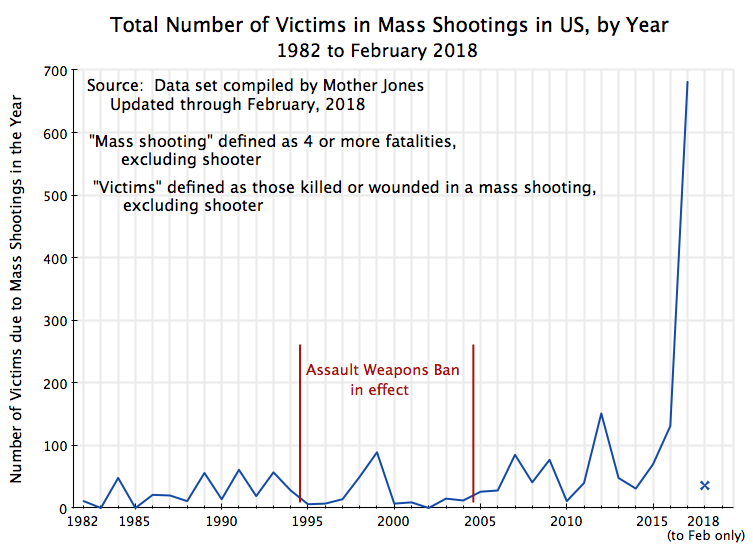
And for the total number of victims:


One again sees a significant reduction during the period the Assault Weapons Ban was in effect (with again the notable exception of 1999, and now 1998 as well).  The number of victims then rose in most years following the end of the ban, and went off the charts in 2017.  This was due largely to the Las Vegas shooting in October, 2017, where there were 604 victims of the shooter.  But even excluding the Las Vegas case, there were still 77 victims in mass shooting events in 2017, more than in any year prior to 2007 (other than 1999).

D.  The Results in Tables

One can also calculate the averages per year for the pre-ban period (13 years, from 1982 to 1994), the period of the ban (September 1994 to September 2004), and then for the post-ban period (again 13 years, from 2005 to 2017):

Number of Mass Shootings and Their Victims – Averages per Year

Avg per Year

Shootings

Fatalities

Injured

Total Victims

1982-1994

1.5

12.4

14.2

26.6

1995-2004

1.5

9.6

10.1

19.7

2005-2017

3.8

38.6

71.5

110.2

Note:  One shooting in December 2004 (following the lifting of the Assault Weapons Ban in September 2004) is combined here with the 2005 numbers.  And the single shooting in 1994 was in June, before the ban went into effect in September.

The average number of fatalities per year, as well as the number injured and hence the total number of victims, all fell during the period of the ban.  They all then jumped sharply once the ban was lifted.  While one should acknowledge that these are all correlations in time, where much else was also going on, these results are consistent with the ban having a positive effect on reducing the number killed or wounded in such mass shootings.

The number of mass shootings events per year also stabilized during the period the ban was in effect (at an average of 1.5 per year).  That is, while the number of mass shooting events was the same (per year) as before, their lethality was less.  Plus the number of mass shooting events did level off, and fell back if one compares it to the previous half-decade rather than the previous 13 year period.  They had been following a rising trend before.  And the number of mass shootings then jumped sharply after the ban was lifted.

The data also allow us to calculate the average number of victims per mass shooting event, broken down by the type of weapon used:

Average Number of Victims per Mass Shooting, by Weapon Used

Number of Shootings

Fatalities

Injured

Total Victims

Semiauto Rifle Used

26

13.0

34.6

47.6

Semiauto Rifle Not Used

59

7.5

5.6

13.1

Semiauto Handgun Used

63

10.0

17.5

27.5

Semiauto Handgun (but Not Semiautomatic Rifle) Used

48

7.7

6.0

13.7

No Semiauto Weapon Used

11

6.6

4.0

10.6

There were 26 cases where the dataset Mother Jones assembled allowed one to identify specifically that a semiautomatic rifle was used.  (Some news reports were not clear, saying only that a rifle was used.  Such cases were not counted here.)  This was out of a total of 85 mass shooting events where four or more were killed.  But the use of semiautomatic rifles proved to be especially deadly.  On average, there were 13 fatalities per mass shooting when one could positively identify that a semiautomatic rifle was used, versus 7.5 per shooting when it was not.  And there were close to 48 total victims per mass shooting on average when a semiautomatic rifle was used, versus 13 per shooting when it was not.

The figures when a semiautomatic handgun was used (from what could be identified in the news reports) are very roughly about half-way between these two.  But note that there is a great deal of overlap between mass shootings where a semiautomatic handgun was used and where a semiautomatic rifle was also used.  Mass shooters typically take multiple weapons with them as they plan out their attacks, including semiautomatic handguns along with their semiautomatic rifles.  The fourth line in the table shows the figures when a semiautomatic handgun was used but not also a semiautomatic rifle.  These figures are similar to the averages in all of the cases where a semiautomatic rifle was not used (the second line in the table).

The fewest number of fatalities and injured are, however, when no semiautomatic weapons are used at all.  Unfortunately, in only 11 of the 85 mass shootings (13%) were neither a semiautomatic rifle nor a semiautomatic handgun used.  And these 11 might include a few cases where the news reports did not permit a positive identification that a semiautomatic weapon had been used.

E.  What Would Be Needed for a Meaningful Ban

It thus appears that the 1994 Assault Weapons Ban, as weak as it was, had a positive effect on saving lives.  But as noted before, it was flawed, with a number of loopholes which meant that the “ban” was far from a true ban.  Some of these might have been oversights, or issues only learned with experience, but I suspect most reflected compromises that were necessary to get anything approved by Congress.  That will certainly remain an issue.

But if one were to draft a law addressing these issues, what are some of the measures one would include?  I will make a few suggestions here, but this list should not be viewed as anything close to comprehensive:

a)  First, there should not be a 10-year (or any period) sunset provision.  A future Congress could amend the law, or even revoke it, as with any legislation, but this would then require specific action by that future Congress.  But with a sunset provision, it is easy simply to do nothing, as the Republican-controlled Congress did in 2004.

b)  Second, with hindsight one can see that the 1994 law made a mistake by defining precisely what was considered a “semiautomatic” weapon.  This made it possible for manufacturers later to make what were essentially cosmetic changes to the weapons, and then make and sell them.  Rather, a semiautomatic weapon should be defined in any such law by its essential feature, which is that one can fire such a weapon repeatedly simply by pulling the trigger once for each shot, with the weapon loading itself.

c)  Third, fully automatic weapons (those which fire continuously as long as the trigger is pulled) have been banned since 1986 (if manufactured after May 19, 1986, the day President Reagan signed this into law).  But “bump stocks” have not been banned.  Bump stocks are devices that effectively convert a semiautomatic weapon into a fully automatic one.  Following the horrific shooting in Las Vegas on October 1, 2017, in which 58 were killed and 546 injured, and where the shooter used a bump stock to convert his semiautomatic rifles (he had many) into what were effectively fully automatic weapons, there have been calls for bump stocks to be banned.  This should be done, and indeed it is now being recognized that a change in existing law is not even necessary.  Attorney General Jeff Sessions said on February 27 that the Department of Justice is re-examining the issue, and implied that there would “soon” be an announcement by the department of regulations that recognize that a semiautomatic weapon equipped with a bump stock meets the definition of a fully automatic weapon.

d)  Fourth, a major problem with the 1994 Assault Weapons Ban, as drafted, was it only banned the sale of newly manufactured (or imported) semiautomatic weapons from the date the act was signed into law – September 13, 1994.  Manufacturers and shops could sell legally any such weapons produced before then.  Not surprisingly, manufacturers ramped up production (and imports) sharply in the months the Act was being debated in Congress, which provided then an ample supply for a substantial period after the law technically went into effect.

But one could set an earlier date of effectiveness, with the ban covering weapons manufactured or imported from that earlier date.  This is commonly done in tax law.  That is, tax laws being debated during some year will often be made effective for transactions starting from the beginning of the year, or from when the new laws were first proposed, so as not to induce negative actions designed to circumvent the purpose of the new law.

e)  Fifth, the 1994 Assault Weapons Ban allowed the sale to the public of any weapons legally owned before the law went into effect on September 13, 1994 (including all those in inventory).  This is related to, but different from, the issue discussed immediately above.  The issue here is that all such weapons, including those manufactured many years before, could then be sold and resold for as long as those weapons existed.  This could continue for decades.  And with millions of such weapons now in the US, it would be many decades before the supply of such weapons would be effectively reduced.

To accelerate this, one could instead create a government-funded program to purchase (and then destroy) any such weapons that the seller wished to dispose of.  And one would couple this with a ban on the sale of any such weapons to anyone other than the government.  There could be no valid legal objection to this as any sales would be voluntary (although I have no doubt the NRA would object), and would be consistent with the ban on the sale of any newly manufactured semiautomatic weapon.  One would also couple this with the government buying the weapons at a generous price – say the original price paid for the weapon (or the list price it then had), without any reduction for depreciation.

Semiautomatic weapons are expensive.  An assault rifle such as the AR-15 can easily cost $1,000.  And one would expect that as those with such weapons in their households grow older and more mature over time, many will recognize that such a weapon does not provide security.  Rather, numerous studies have shown (see, for example, here, here, here, and here) that those most likely to be harmed by weapons in a household are either the owners themselves or their loved ones.  As the gun owners mature, many are likely to see the danger in keeping such weapons at home, and the attractiveness of disposing of them legally at a good price.  Over time, this could lead to a substantial reduction in the type of weapons which have been used in so many of the mass shootings.

F.  Conclusion

Semiautomatic weapons are of no use in a civilian setting other than to massacre innocent people.  They are of no use in self-defense:  One does not walk down the street, or while shopping in the aisles of a Walmart or a Safeway, with an AR-15 strapped to your back.  One does not open the front door to your house each time the doorbell rings aiming an AR-15 at whoever is there.  Nor are such weapons of any use in hunting.  First, they are not terribly accurate.  And second, if one succeeded in hitting the animal with multiple shots, all one would have is a bloody mess.

Such weapons are used in the military precisely because they are good at killing people.  But for precisely the same reason as fully automatic weapons have been banned since 1986 (and tightly regulated since 1934), semiautomatic weapons should be similarly banned.

The 1994 Assault Weapons Ban sought to do this.  However, it was allowed to expire in 2004.  It also had numerous loopholes which lessened the effectiveness it could have had.  Despite this, the number of those killed and injured in mass shootings fell back substantially while that law was in effect, and then jumped after it expired.  And the number of mass shooting events per year leveled off or fell while it was in effect (depending on the period it is being compared to), and then also jumped once it expired.

There are, however, a number of ways a new law banning such weapons could be written to close off those loopholes.  A partial list is discussed above.  I fully recognize, however, that the likelihood of such a law passing in the current political environment, where Republicans control both the Senate and the House as well as the presidency, are close to nil.  One can hope that at some point in the future the political environment will change to the point where an effective ban on semiautomatic weapons can be passed.  After all, President Reagan, the hero of Republican conservatives, did sign into law the 1986 act that banned fully automatic weapons.  Sadly, I expect many more school children will die from such shootings before this will happen.