Maintaining Social Security Benefit Payments Once the Trust Fund is Depleted Will NOT Increase the Government Deficit

A.  Introduction

As many are aware, based on the most recent forecast and if nothing is done, the Social Security Trust Fund is expected to be fully depleted by 2035.  Under current law that sets the operating rules for the Social Security system, benefit payments made to retirees and the disabled would then have to be scaled back to a level that would match the Social Security taxes being paid into the system each year.  This would mean a reduction of about 16% (based on current forecasts) from the payments that retirees and other beneficiaries of the system would have otherwise received in 2035.

That would be catastrophic.  Retirees and others depend on their monthly Social Security checks, and slashing those by 16% would mean a dramatic fall in the living standards of many.  In the aggregate, the cut in payments would amount to about 1% of GDP.  Even if one were to ignore the impact on the retirees who depend on their Social Security checks, a sudden scaling back of those payments by 1% of GDP could very well throw the economy into a recession.

What would happen if Congress were instead to fund that shortfall through the regular federal budget?  The amount is certainly large, at 1% of GDP or, in terms of the GDP forecast for 2035, about $425 billion.  How much would the federal deficit (and federal borrowing needs) then increase relative to what it would have been before the Trust Fund was depleted?

The answer is:  Nothing.  None.  Zero.  Zilch.  Nada.  Not a dime.

There would be no impact on the deficit.  Government borrowing in the financial markets would be exactly the same as before.  It is true that the deficit would fall if Social Security payments were slashed by 16% from one day to the next.  Leaving aside the resulting disruption this would cause for the economy – as a sudden cut in payments of 1% of GDP would certainly depress output and increase unemployment – the fiscal deficit would indeed be smaller if Social Security payments were reduced.  But compared to what it was the day before the Trust Fund was depleted, keeping up the Social Security payments in their promised amounts by covering this through the regular federal budget would have no impact on the deficit nor on federal borrowing needs.

Many may not realize this, and I have not seen a discussion of this point in the media or in other accounts of what might happen when the Social Security Trust Fund is depleted.  To be honest, I had not really thought this through before myself, and had operated on the (incorrect) assumption that maintaining Social Security benefit payments at their scheduled levels once the Trust Funds had been depleted would add to the federal deficit and borrowing requirements.  But it would not.  That is important, but I have not seen any discussion of it nor its policy implications.

This post will examine how the Social Security Trust Fund works, its history over the last half-century and its prospects, and briefly on why it is now expected to be depleted by about 2035.  The mechanics of the Social Security Trust Fund operations will then be examined in the context of the federal fiscal accounts, showing why it is an accounting mechanism but one that does not itself affect the federal fiscal deficit nor the federal government’s borrowing needs in the markets.  It will be seen that maintaining Social Security benefit payments as currently scheduled and promised in 2035 and after would not add to the deficit nor to government borrowing needs.  Some of the policy implications will then be considered.

But before starting, some of the terms should be clarified.  My references to the “Social Security Trust Fund” (or simply “Trust Fund”) are to the combined Old Age Security (OAS) and Disability Insurance (DI) trust funds.  Formally these are two separate trust funds, but they are commonly combined and referred to as the OASDI Trust Fund.  Payments from Social Security taxes have on more than one occasion (most recently in 2016 to 2018) been shifted between the OAS and DI accounts as a short-term fix when one of the funds was getting close to depletion (the DI fund in the 2016 to 2018 case).  In reports, the OAS and DI funds are often aggregated as if there were one OASDI fund, and I will treat them that way here as well.

Also, the more formal name for the taxes that go into the Social Security accounts is FICA (for Federal Insurance Contributions Act) taxes.  FICA taxes are applied on wages (i.e. not on other earnings) at current rates for the worker and the employer together of 10.6% for the OAS and 1.8% for the DI accounts – a total of 12.4%.  While these are formally “paid” half by the worker and half by the employer, all analysts agree that these payments in fact all come out of the worker’s wages.  The tax applies up to a ceiling on wage earnings of $168,600 in 2024, after which the tax rate is zero.  In addition, there are also FICA taxes of 2.9% for Medicare Hospital Insurance (with no ceiling on wage earnings).  The Medicare funding will not be addressed here, and when I refer to “Social Security taxes” I will be referring to the 12.4% for the OAS and DI trust funds (OASDI together).

B.  How the Social Security Trust Fund Works

Each year, there are workers who are paying Social Security taxes on their wages (at the 12.4% rate) and retirees (and other Social Security recipients, such as spouses, dependents, and the disabled) who are receiving benefit payments from Social Security.  The taxes paid go into the Social Security Trust Fund and the benefit payments made are drawn out of it.  When the tax payments going in are greater than the current benefit payments going out, the excess accumulates in the Trust Fund.  And in those years when the tax payments in are less than the current benefit payments out, the Trust Fund redeems a share of its assets to cover the difference.

The Trust Fund is invested in specially issued US Treasury obligations – essentially special US Treasury bonds.  The Trust Fund earns interest on those US Treasury holdings at a rate set by law to equal the weighted average yield observed in the markets as of the last business day of the prior month on US Treasury bonds that are not due or callable for 4 years or more.  That interest is added to the Trust Fund.  The Trust Fund also receives income taxes paid by certain retirees on their Social Security benefits (from retirees with incomes above a certain threshold).  There are also some other, generally minor, transfers to the Trust Fund.

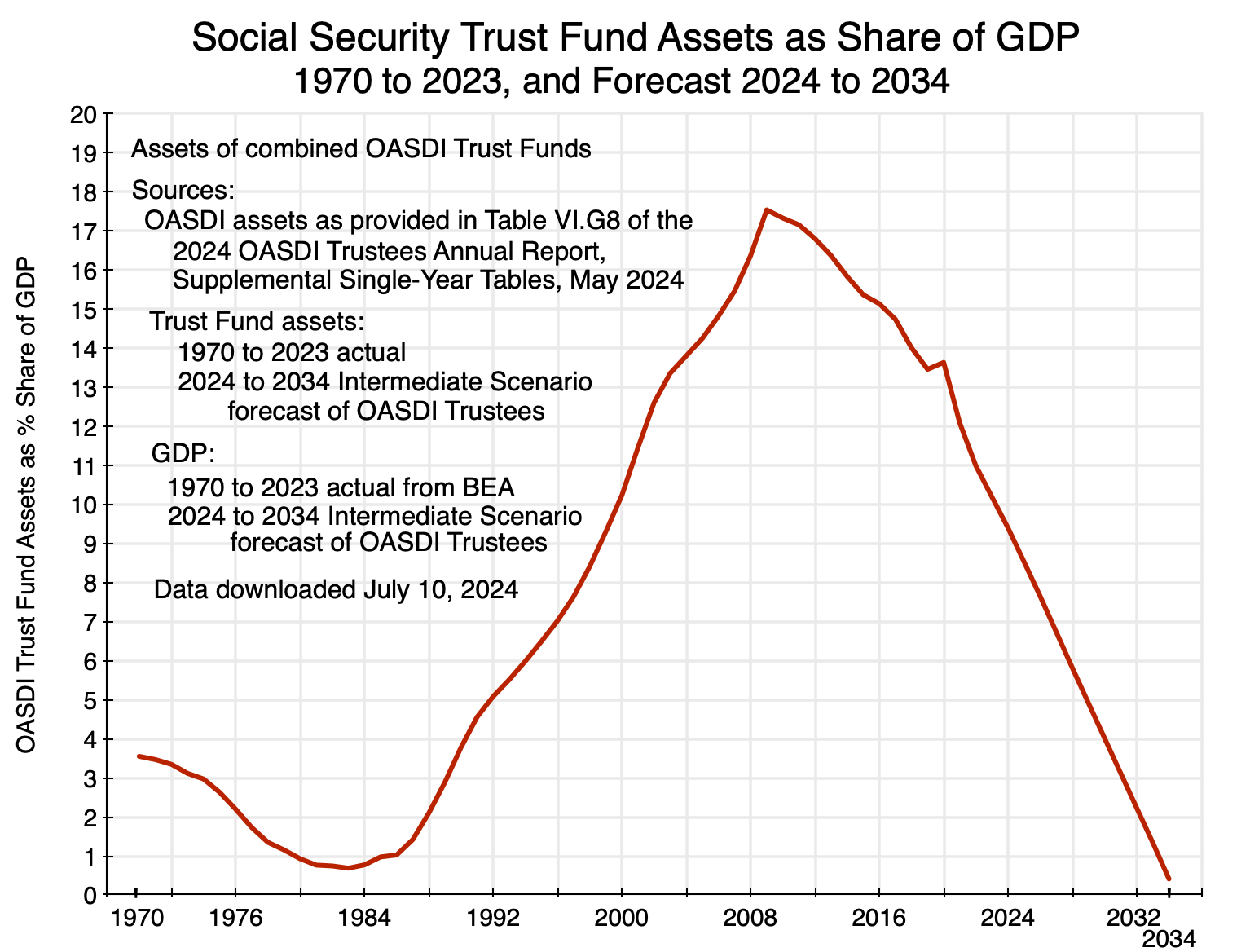
The resulting accumulated balances in the Social Security Trust Fund, as of the end of each year and expressed as a share of GDP of the year, are shown in the chart at the top of this post.  It has varied over time, and one can see that the Trust Fund came close to being depleted before – in the early 1980s.  Before that, the Social Security system had been managed in a more ad hoc way, with benefit levels, eligibility, tax rates, the income ceiling on which Social Security taxes were due, and more frequently adjusted by Congress.  Indexing for inflation was only introduced in the 1970s.

By 1981, the forecast was that the Social Security Trust Fund would be fully depleted by 1983.  In response, President Reagan with Congress appointed a commission in 1981 chaired by Alan Greenspan (and subsequently usually referred to as the Greenspan Commission) to provide recommendations for what would return the system to viability.  The Commission issued its recommendations in early 1983, with a combination of higher tax rates, adjustments to benefit levels, an increase in the retirement age for full eligibility, and numerous more minor changes.  Congress approved these in 1983.

The Greenspan Commission recommendations were based on forecasts of what changes would be needed to lead to the Trust Fund remaining solvent (i.e. not depleted at any point) for at least 75 years.  Starting in 1982, the 75 years would carry the forecasts through to 2057.  This did not mean that the Trust Fund would be brought to zero in the 75th year, but rather that it would still be solvent at that point.  They did not try to look beyond that.

Knowing that the large Baby Boom generation was then in its prime working-age years and that they would be retiring starting around 2010, the changes were designed so that the Trust Fund would be built up in the 1980s, 90s, and 2000s, and then begin to be used to pay out benefits on a net basis as the Baby Boomers retired.  This produced the large “hump” seen in the chart at the top of this post with the Trust Fund growing from less than 1% of GDP to 17 1/2% of GDP in 2009, after which it began to decline.

The decline as a share of GDP was planned.  However, under the forecasts of the Greenspan Commission in 1983, the Trust Fund would not have been fully depleted by 2035.  While it is often stated in the media that this is a consequence of the Baby Boomers reaching retirement age and of longer life expectancies, that is not in fact true.  The Greenspan Commission was well aware of how many Baby Boomers would be reaching retirement age in those years – they had already been born.  And the issue is not whether life expectancies have been rising, but whether life expectancies have been rising by more than what the Greenspan Commission assumed in their forecasts.  And it has not.  Indeed, life expectancy in the US has actually been decreasing since 2014 (and then plummeted in 2020/21/22 due to Covid), is well below that enjoyed in comparable countries, and is well below what the Greenspan Commission forecast.

As was discussed in an earlier post on this blog, the Social Security Trust Fund is now expected to be depleted well before the Greenspan Commission anticipated not because of the Baby Boomers nor because of life expectancies growing longer, but rather because the Greenspan Commission did not anticipate that wage inequality would grow so dramatically following Reagan.  This matters, because it led a higher share of wage earnings to be drawn above the ceiling on which Social Security taxes are paid, where they are not taxed at all.  The Greenspan Commission’s assumption that the share of wages that would be subject to tax would remain where it was (at about 90% of total wages) was not unreasonable at the time, as that share had remained fairly steady in the post-World War II period up to the early 1980s.  But then it deteriorated sharply in the subsequent decades.

Due to that increase in wage income inequality, the Trust Fund is now forecast to be depleted in 2035.  In my earlier post on this issue, I calculated that had the share of wages subject to Social Security taxes remained at the 90% share (and taking into account what this would also mean for higher benefit payments for the high-income wage earners who would then still be paying into the system), the Trust Fund would have been forecast to last until 2056.  The calculations assumed that all else would then be as it was historically when my forecasts were made in 2016, or as the Social Security then forecast in the years from 2016 onwards.

But wage inequality rose in the decades since 1983 and the Social Security Trust Fund is now expected to run out by 2035.  Under the current law that governs the Social Security system, Social Security benefits would then be scaled back to a level that would match amounts being paid into the Trust Fund by the workers in those years.  This would require a scaling back of benefits of about 16% based on current forecasts.  This would be devastating for many.  In a biennial report issued by the Social Security Administration (last issued in 2016 with data for 2014 – it appears the Trump administration stopped it, and it has not been restarted), it was estimated that Social Security benefits accounted for 100% of the income of 20% of the population aged 65 or older, and for 90% or more of the income of a third of the population.  Saying that again, one-third of Americans aged 65 or older depend on Social Security for 90% or more of their income.

Furthermore, not only do a high share of those over 65 depend on their Social Security checks for almost all of their income in their old age, but the checks themselves are not that high.  As of June 2024, the average monthly benefit was only $1,781, or $21,372 on an annual basis.  And most of those who especially depend on their Social Security checks also receive well less than these average payments.

A high share of those aged 65 or older in the US depend critically on Social Security.  A sudden cut of 16% would be devastating.

C.  Federal Borrowing Before and After the Trust Fund is Depleted   

As described above, when the amount being paid into the Social Security Trust Fund in Social Security taxes exceeds what is being paid out in Social Security benefits, the excess is invested in interest-earning US Treasury obligations.  That excess will reduce what the US Treasury will need to borrow from the markets to cover whatever the federal deficit might be from all of its other revenues less expenditures (i.e. everything other than from Social Security revenues and expenditures).  The Social Security Trust Fund will, in such years, be built up as it was from 1983 to 2009.

The opposite happens in years when Social Security tax revenues fall short of what Social Security is paying out in benefits.  In those years, the Social Security system will redeem a portion of the US Treasury obligations it holds and from this receive the cash it needs to pay the scheduled benefits.  When it does this, the US Treasury will then need to borrow in the markets the amount required to cover the US Treasury obligations that the Social Security system has redeemed.  That is, as the Social Security Administration redeems a share of the US Treasury obligations that it holds in the Trust Fund, the Treasury will need to issue new debt to the public to obtain the cash it needs to pay to Social Security for those redemptions.

Now suppose the Trust Fund has been fully depleted, and it no longer holds any balance of US Treasury obligations.  This is the forecast for what will be faced in 2035.  It no longer has US Treasury obligations that it can redeem.  Under the current law for the Social Security system, it would then be required to scale back benefit payments to the amount it is then receiving from Social Security taxes being paid by those then working.  The current forecast is that this would require a scaling back of 16%.  (Note that this is not 100%, as some people appear to believe.  Social Security is not being shut down in some kind of “bankruptcy”.  Rather, Social Security payments would continue – just not at the scheduled benefit levels.)

But what would happen in terms of federal government borrowing requirements if, instead of scaling back benefits by 16%, the government instead funded those payments in full from the general budget?  The amount would be far from small, at a forecast 1% of GDP to cover that 16% shortage.  But what would then happen to what the US Treasury would need to borrow from the public?

The answer is nothing.  There would be no change at all.  As explained above, when the funds come out of the Social Security Trust Fund holdings of US Treasury obligations, the Treasury will need to borrow from the public whatever is redeemed by the Trust Fund.  That is where the cash comes from.  When the Trust Fund no longer has any holdings of the US Treasury obligations, then the cash needed to cover the 16% Social Security payment gap from the general budget will be exactly the same.  That is, the amount the US Treasury will need to borrow from the public will be the same whether it needs the cash to cover redemptions of US Treasury obligations from the Trust Fund, or to cover the 16% gap in what is needed to pay Social Security benefits in full.

The fiscal deficit will also be the same, whether the full Social Security payments are made out of redemptions from the Trust Fund or are made out of transfers from the general government budget.  Social Security taxes (i.e. FICA taxes) are included as revenues going to the government, the same as personal income taxes or other sources of government revenues.  Similarly, payments for Social Security benefits are treated as government expenditures – whether or not they are covered by redemptions from the Social Security Trust Fund.

To illustrate with numbers from FY2023 (and using the recent, June 2024, budget figures from the Congressional Budget Office), and expressed as a share of GDP:  Outlays for the Social Security system (for retirees and their dependents, as well as for the disabled) was 5.0% of GDP.  Payroll taxes for Social Security (the 12..4% on wages) was 4.4% of GDP, leaving 0.6% of GDP to be obtained by drawing down the Social Security Trust Fund.  This accounted for part of the overall fiscal deficit in FY2023 of 6.3% of GDP.  If the 0.6% of GDP gap had been covered by direct fiscal transfers from the general government budget instead of by redemptions from the Social Security Trust Fund, the overall fiscal deficit (6.3% of GDP) as well as government borrowing requirements (whether to fund the deficit or to cover the Trust Fund redemptions) would have been the same.

(Note:  I have left out here the relatively much smaller amounts coming from the transfer of income tax revenues arising from taxation of Social Security benefits in households meeting certain income thresholds, and the interest earned on Trust Fund assets during the year.  These are both covered elsewhere in the fiscal accounts.)

It is in this sense that it is accurate to describe Social Security as a “pay-as-you-go” system.  While it is not always clear what is being referred to when speakers refer to Social Security as pay-as-you-go (different speakers appear to be referring to different things), it would be accurate to say that this is the case from the point of view of the government’s fiscal accounts and of its borrowing requirements in the markets.  What Social Security pays out in benefits in any given year will match what Social Security obtains as revenues in that year (primarily from the Social Security share of the FICA taxes) plus what is provided to the system from the US Treasury.  Whether those amounts transferred from the US Treasury are matched by a drawdown on the Treasury obligations in the Social Security Trust Fund, or come directly from the budget, the overall fiscal deficit as well as the Treasury’s borrowing requirements in the market will be the same.

D.  Policy Implications and Conclusion

Recognizing this, what does it imply for what should be done in 2035 (or whenever the Social Security Trust Fund is fully depleted)?  Under current law, and what is repeatedly stated in the media, is that scheduled Social Security benefit payments would have to be scaled back drastically (by about 16% in the current forecasts).  If that is done, that would indeed be a disaster for many given their dependence on the Social Security checks they receive.

But as explained above, there would be no impact on the deficit, nor on government borrowing requirements, if the scheduled benefit payments were kept in full and not scaled back from the scheduled levels, but rather with the gap covered instead by appropriations from the regular budget.  Congress could approve this if they wished.

Seen in this perspective, the question then becomes how best to fund the Social Security system along with all other government programs in the budget.  One should not restrict consideration only to adjustments in the payroll taxes that are currently tied to the Social Security system, nor to possible reductions in benefit levels by, for example, raising the normal retirement age.  Consideration should thus be given to possible other changes in the overall tax system – for example in personal income taxes and/or corporate income (profit) taxes.  The payroll tax is regressive, with a flat 12.4% on wages (and only wages) and only up to a ceiling ($168,600 in 2024).  Greater reliance on progressive income taxes is an attractive alternative to a regressive payroll tax.

One should therefore take a more holistic view as to what the tax system should be and not treat the issue as one for Social Security taxes in isolation.  While there could very well be political advantages to defining a trust fund for Social Security into which certain taxes are paid and from which benefit payments are then made, one should recognize that fundamentally this is only presentation.  Covering a portion of the Social Security benefit payments through the general budget, and hence through the overall system of income and other taxes, could well be preferred to exclusive reliance on payroll taxes.

Note also there is precedent for this.  Medicare taxes are also paid on wages (at a 2.9% rate, but with no ceiling on the wages subject to tax) and go into a trust fund, plus there are direct monthly premia paid for Medicare coverage.  However this funding does not suffice to cover all of what Medicare now costs.  The difference is made up by direct fiscal transfers.  It is certainly a major government expense, but no one argues Medicare payments should be limited to whatever is paid in Medicare taxes and premia.

As noted, sustaining payments once the Social Security Trust Fund has been fully depleted would require a change in the law that governs the Social Security system.  That law has been changed numerous times in the past, and could certainly be changed on this.  The real problem is that with Congressional gridlock, obtaining approval for such a change may well be difficult.  Republicans have been opposed to Social Security ever since its origin in the Social Security Act of 1935 under Roosevelt.  As Social Security became popular and demonstrated its success in reducing poverty among the elderly, that political criticism became less overt but has remained.  And those opposed to Social Security will likely use the imminent prospect of the Trust Fund being depleted by 2035 as an opportunity to scale the system back.  A reduction in expenditures of 1% of GDP would be huge.

But as examined above, maintaining Social Security benefit payments at scheduled levels once the Trust Fund is depleted would have no fiscal effects in itself.  Government revenues, expenditures, and borrowing requirements would be the same the day after the Trust Fund was depleted as it was the day before.

Raising the Minimum Wage Has Not Led to Higher Unemployment: Evidence from California

A.  Introduction

California has aggressively increased its minimum wage since 2014, starting on July 1 of that year and then with increases on January 1 of each year from 2016 through to 2024.  Critics have argued that this would increase unemployment, saying that firms would no longer be willing to employ minimum-wage workers at the new, higher, minimum wage rates.  They argued that the productivity of these workers was simply too low.  If they were right, then one would have seen increases in the unemployment rate in the months following each of the steps up in the minimum wage.  But there is absolutely no evidence that this happened.

The chart at the top of this post shows this lack of a response graphically.  It may be a bit difficult to see as showing a lack of a response is more difficult than showing the presence of a response.  The chart will be discussed in more detail below, but briefly, it shows the averages in each of the subsequent 12 months following the increases in the California minimum wage (including or excluding 2020 to 2022, as the Covid disruptions dominated in those years), of the change in the unemployment rate in California versus the change in the unemployment rate in the US as a whole.  The changes are defined relative to what the unemployment rates were in the month before the increase in the minimum wage – i.e. the comparison is normally to the rate in December when the new minimum wage became effective on January 1.  The unemployment rate of course goes up and down depending on macro conditions (and was normally going down for most of this period), so to control for this the changes in the unemployment rate in California are defined relative to the changes in the US as a whole.

What was the result?  The chart shows that basically nothing happened.  If anything, what was most common was that the unemployment rate fell slightly in California relative to the rate in the US in the months following increases in the California minimum wage.  These changes were small, however, and are not really significant.  But what is clear and significant is that aggressive increases in the minimum wage in California have not led to increases in unemployment in the state.  The assertion that they would is simply wrong.

As noted above, this chart will be discussed in more detail below.  But the post will first look at the changes in the minimum wage in California since 2014, and how the minimum wage in California compared to the federal minimum wage for the US as a whole as well as to several measures of wages in the US and to the federal poverty line.  Following a look at the (non)-impact on unemployment, we will for completeness also examine what happened to labor force participation rates.  Some might argue that minimum-wage workers who would have lost their jobs might then have left the labor force (in which case they would not have been counted as unemployed).  But we will see that labor force participation rates in California also did not change following increases in the minimum wage.  Finally, the post will discuss possible reasons for why increases in the minimum wage in California did not lead to a rise in unemployment there.  Standard economics under the standard assumptions would have predicted that it would have.  But those standard assumptions do not reflect well what is happening in the real world in labor markets.

B.  The Minimum Wage Rate in California

The federal government sets a minimum wage that applies to the US as a whole.  But due to gridlock in Congress (and opposition by Republicans), the last time the federal minimum wage was raised was in July 2009, when it was set at $7.25 per hour.  As was discussed in a post on this blog from 2013, when adjusted for inflation this minimum wage was below what we had in the Truman administration in 1950, despite labor productivity now being more than three times higher than then.  And from July 2009 to now, inflation has effectively reduced the value of the $7.25 wage of July 2009 to just $4.97 (based on the CPI).  The federal minimum wage has simply become irrelevant.

Due to this lack of action at the federal level. many states have legislated their own minimum wage rules for their respective jurisdictions.  California is one, and has been particularly aggressive.  Over the past decade, the minimum wage in California has been increased to $16 per hour generally and most recently to $20 per hour for fast-food restaurant workers:

California Minimum Wage Recent History

Effective date 25 employees or less 26 employees or more
Jan 1, 2008 $8.00 $8.00
July 1, 2014 $9.00 $9.00
Jan 1, 2016 $10.00 $10.00
Jan 1, 2017 $10.00 $10.50
Jan 1, 2018 $10.50 $11.00
Jan 1, 2019 $11.00 $12.00
Jan 1, 2020 $12.00 $13.00
Jan 1, 2021 $13.00 $14.00
Jan 1, 2022 $14.00 $15.00
Jan 1, 2023 $15.50 $15.50
Jan 1, 2024 $16.00 $16.00
Fast food restaurant employees:
Apr 1, 2024 $20.00 $20.00

Sources:  California Department of Industrial Relations.  See here and here.

The focus of this post is on the series of increases that began on July 1, 2014, with the prior minimum wage set as of January 1, 2008, shown for reference.  That 2008 rate was $8.00 per hour and was raised effective on July 1, 2014, to $9.00 per hour.  California then began to increase the minimum wage annually starting January 1, 2016, with this continuing up to and including on January 1 of this year (2024).  Furthermore, effective January 1, 2017, California began to set separate minimum wage rates for workers employed in businesses with 25 employees or less or with 26 employees or more.   These could differ, although recently they have not.

Finally and most recently, California set a new minimum wage effective on April 1, 2024, of $20 per hour for employees of fast food restaurants (in restaurant chains with 60 or more locations nationwide).  I include this here for completeness, but it is still too early to say whether this has had an impact on unemployment.  So far it has not, but as I write this state-level unemployment data is available only for the months of April and May.  But those figures do not provide any support for the critics:  The unemployment rate in California in fact fell in those two months compared to that in the US.  This will be discussed below.

The general California minimum wage has now doubled – to $16 per hour – from the $8 per hour it was prior to July 1, 2014.  But for a sense of what this means, it is useful to put this in terms of various comparators:

California Minimum Wage:  Selected Comparisons

California minimum wage in firms with 26 employees or more

California Minimum Wage per hour Ratio to US median wage of hourly workers Ratio to US average hourly earnings of all private sector workers Ratio to Poverty Line for family of four Ratio to upper limit of earnings of first decile of US wage & salary workers
2008 $8.00 65% 38% 76% 93%
2014 $9.00 68% 37% 76% 94%
2016 $10.00 71% 39% 83% 102%
2017 $10.50 72% 40% 86% 103%
2018 $11.00 73% 41% 89% 104%
2019 $12.00 78% 43% 94% 109%
2020 $13.00 79% 46% 100% 111%
2021 $14.00 82% 47% 107% 115%
2022 $15.00 83% 47% 109% 113%
2023 $15.50 81% 47% 104% 108%
2024 $16.00 46% 104% 108%
Fast Food:
April 2024 $20.00 58% 129%

The comparisons here are based on the California minimum wage for employees in businesses with 26 or more employees.

The wage measures come from various reports produced by the Bureau of Labor Statistics (BLS).  The first column (following the column with the California minimum wage) shows the ratio of that minimum wage to the BLS estimate of the US median hourly earnings of wage and salary workers paid an hourly wage.  The ultimate source for this is the Current Population Survey (CPS) of the BLS, and this particular series is only provided annually (with 2023 the most recent year).  The California minimum wage rose from 65% of this median wage of hourly workers in 2008 to 83% in 2022 and 81% in 2023).  By this measure of wages – of wage and salary workers paid an hourly wage – the California minimum wage rose significantly in comparison to what a median hourly worker was being paid nationally.

A broader measure of wages is provided in the next column.  The ratios here are for a worker being paid the California minimum wage to the average hourly earnings of all private sector workers – not just workers paid at an hourly rate.  This is also provided by the BLS, but comes from its Current Employment Statistics monthly survey – a survey of business establishments that asks firms how many they employ and what they were paying those workers.  These average wages are higher as they cover all workers and not only those paid at an hourly rate, plus the average will be higher than the median in cases such as this (as the distribution of wages paid is skewed to the right).  By this measure, the California minimum wage rose from 38% of what US private sector workers were being paid on average in 2008 (and 37% in 2014) to 46-47% since 2020.

In terms of the federal poverty line, even full-time workers (40 hours per week for 52 weeks each year) paid the minimum wage in California in 2008 or even 2014 would have been able to earn only 76% of the poverty line income for a family of four.  But with the increases in the minimum wage in the past decade, they would have finally been able to reach that poverty line in 2020, and then 109% of it in 2022.  In 2023 and again in 2024, it would have been 104%.

The final column shows earnings at the California minimum wage compared to the earnings that would place a worker in the first decile (the bottom 10%) of the distribution of earnings of full-time wage and salary workers.  These are also estimates from the BLS, are expressed in terms of usual weekly earnings, and are issued quarterly based on results from the CPS surveys.

With the increases in the California minimum wage over the past decade, full-time workers earning the minimum wage in California had incomes that exceeded the upper limit of the earnings of wage and salary workers in the US as a whole who were in the first decile of the earnings distribution – ranging from 102% of what the bottom 10% earned in 2016 to 115% in 2021 and 108% currently.  Assuming the distribution of earnings in California would be similar to that in the US in the absence of the special California minimum wage laws, this can provide a rough estimate of how many workers were being affected by the California minimum wage laws.

If earnings at the California minimum wage would have matched the earnings at the upper limit of the first decile (i.e. a 100% ratio), the implication would be that the share of workers for which the California minimum wage was applicable would be 10%.  With the ratio above 100% (by varying ratios up to 115%) the share affected would have been somewhat more than 10% – perhaps 11 or 12% of workers as a rough guess.  But the BLS data is not for the entire labor force.  Rather, it is only for wage and salary workers employed full-time.  One has, in addition, part-time workers and those who are self-employed.  The distribution of hourly earnings among those workers is not available, but if it is similar to the hourly earnings of full-time workers, the share affected would be the same 10% (or more).

The purpose here is just to provide a general feel for how many minimum wage workers were being affected by the changes enacted in the California minimum wage over the past decade.  Various factors cannot be accounted for, but they are at least in part offsetting.   For the purposes here, a reasonable estimate would be that at least 10% of the labor force had wages so low that the increases in the minimum wage in California over the last decade had an impact on what they would then be paid.  That is a not insignificant share.

C.  The Impact of Increases in the Minimum Wage on Unemployment

What impact did those increases in the California minimum wage then have on the employment of workers who were being paid the minimum wage? Critics of the minimum wage argue that workers are paid a wage based on their productivity, and if they are being paid at or close to the minimum wage this is only because their productivity is low.  In this view, if the minimum wage that has to be paid is then raised, those workers will be let go and will become unemployed.  Did we see this?

No, we did not.  The evidence from the ten different increases in the minimum wage in California over the past decade (from July 2014 to January 2024) does not show any impact at all on unemployment.  The chart at the top of this post summarizes the results.

The chart is based on calculations using data on the unemployment rate in California and on the unemployment rate in the US as a whole, where I calculated the unemployment rates from underlying data on the number unemployed and the number in the labor force (as published unemployment rates themselves are shown only to the nearest 0.1% point – anything less is not considered significant).

For numerous structural reasons, the unemployment rate in any particular state (including California) will differ from the rate in the nation as a whole.  These structural reasons include the age structure of the population (middle-aged workers are less likely to be unemployed than young workers), the education structure (college-educated workers are less likely to be unemployed than workers with only a high school education), the industrial structure, the racial and ethnic mix of the population, and much more.

But while these structural factors affect the level of the unemployment rate in California relative to the national average, such structural factors change only slowly over time and hence do not have a significant impact on the month-to-month changes in that rate.  The rate of unemployment itself can, however, change significantly from month to month at the national (as well as state) levels due to macroeconomic factors.  In a recession the rate of unemployment goes up, and in a recovery or during periods of rapid growth, the rate of unemployment goes down.  It is just that in the absence of some state-specific event (such as – possibly – a change in its mandated minimum wage), the month-to-month changes in the unemployment rate at the state level will generally be similar to the changes seen at the national level.  They move together, as affected by macroeconomic factors.  The question being examined is thus whether the increases in the minimum wage in California over the past decade led to an increase in the unemployment rate in California in the months following those changes in the minimum wage, as compared to what was observed for the unemployment rate nationally.

This is a simple form of what is called the “difference-in-difference” method.  What is significant is not whether unemployment in California went up or down during the period, but whether it went up or down by more than what was seen at the national level in the same period.  For example, define the changes as relative to the month prior to a change in the minimum wage law (i.e. normally relative to what the rate was in December, as all but one of the changes were effective on January 1 of each year).  The employment and unemployment statistics (gathered by the BLS as part of the CPS household surveys) take place in the middle week of each month, so the mid-January unemployment rate will be treated as month one following the change in the minimum wage.  The mid-February unemployment figures will then be month two, and so on until mid-December of that year will be month twelve.  The minimum wage was then increased again in the next January 1, and the annual cycle was repeated for a second set of observed impacts (or non-impacts).  The changes in the unemployment rate are thus defined as the difference between changes in the California rate for the given number of months following the change in its minimum wage (i.e. in month one, or in month two, and so on to month twelve), relative to what the changes were in the same period for the US as a whole.

As a concrete example using made-up numbers, suppose that in some December the unemployment rate in California was 6.0% while the unemployment rate in the US as a whole was 5.0%.  Suppose then that in, say, month three (March) the observed unemployment rate in the US was 4.5% – a fall of 0.5% point over the period.  If the unemployment rate in California fell to 5.5% in the same period (to March), then the change in California was the same as the change in the US as a whole, and the increase in the minimum wage on January 1 did not appear to have any differential effect.  If, however, the unemployment rate in California fell only by, say, 0.3% points to 5.7%, while the US rate fell by 0.5% in the same period, one would say that it appears the increase in the minimum wage in California led to an increase in its unemployment rate by 0.2% points.  And if the rate in California fell by 0.7% points to 5.3% while the US rate fell by 0.5%, then there was a 0.2% point reduction in the unemployment rate in California following the change in its minimum wage rate.

There will of course be statistical noise, as all the figures are based on household surveys.  And importantly, in any given year there will also be special factors that could enter in that particular year that could affect the results.  More is always happening than just a change in the minimum wage law.  But to address this we have that California changed its minimum wage law on ten separate occasions over this ten-year period.  We therefore have ten separate instances, and we can work out the average over those ten separate episodes.  While special factors may have arisen in any given year, the only common factor in all ten was that California raised its minimum wage ten separate times.

(The exception in the averages is for the January 1, 2024, increase in the minimum wage,  As I write this, we only have data for the five months through May.  Thus the averages over up to the full ten instances can only be calculated for the first five months, while the averages for months six through twelve can only be for the nine cases to 2023.  Also, note that for the July 1, 2014, increase in the minimum wage, the changes were defined relative to the California and US unemployment rates in June, with the subsequent twelve months then covering July 2014 to June 2015.)

Those average impacts were then remarkably small:

Average Changes in the California Unemployment Rate less Changes in the US Unemployment Rate, in the Months Following an Increase in the California Minimum Wage (in percentage points)

Months from Minimum Wage Change July 2014 –   May 2024 July 2014-2019,                   and 2023 – May 2024
0 0.00% 0.00%
1 -0.02% 0.01%
2 -0.06% -0.05%
3 -0.05% -0.04%
4 -0.07% -0.05%
5 0.00% -0.10%
6 -0.00% -0.09%
7 0.03% -0.08%
8 0.04% -0.10%
9 -0.04% -0.05%
10 -0.02% -0.05%
11 -0.02% -0.05%
12 0.02% -0.03%
Overall average -0.02% -0.06%

The chart at the top of this post shows this table graphically.  The two columns are for averages over the full period and with the years 2020 to 2022 excluded.  The Covid disruptions dominated in those years, but the results are basically the same whether those years are included or excluded.

The changes were all essentially zero.  It is not possible to see any increase in the California unemployment rate at all resulting from the increases in the minimum wage in the state over the past decade.  If anything, the increases in the minimum wage were associated in most cases with a small reduction in the unemployment rates.  But these are all small, and are probably simply statistical noise and not significant.

To put this in perspective, recall the discussion above that arrived at the rough estimate that the share of the labor force being paid at or close to the minimum wage might be around 10%, and possibly more.  If – as the critics argue – such workers can be paid only those low wages because their productivity is so low, then they would all lose their jobs if their employers were required to pay them a higher wage.  If true, the unemployment rate would then shoot up by 10% points.  One obviously does not see that.

If we had over-estimated the share employed at the minimum wage by a factor of two, so that it was in fact 5% rather than 10% of the labor force, then the unemployment rate would have shot up by 5% points.  One does not see that either.  One does not even see an increase of 1% point, nor, for that matter, even 0.1%.  The overall average change is in fact generally a small decrease in the rate of unemployment in California relative to the US rate in the months following an increase in the minimum wage, although I suspect this is just statistical noise.

Most recently, California raised the minimum wage for workers at fast food restaurants (at chains with 60 or more locations nationally) to $20 per hour effective April 1, 2024.  We so far only have data for April and May as I write this, but that data provides no support for the belief that this has led to an increase in the unemployment rate.  Fast-food workers are of course only a small share of the labor force:  about 2.2% in California in 2023 based on BLS data for fast-food and counter workers (where fast-food workers make up about 80% of this total in national data).  But in the two months since the April 1 increase to $20 per hour for fast food workers, the California unemployment rate relative to that in the US in fact fell by 0.06% points in April compared to March, and by 0.25% in May compared to March.  It did not go up but rather went down.

Finally, it is possible that critics of the minimum wage may argue that low-wage workers laid off following an increase in the minimum wage will then leave the labor force entirely.  If they did this, they would then not show up in the unemployment statistics and one would not see an increase in the observed unemployment rates.  To be counted as unemployed in the BLS surveys, the unemployed person must have taken some positive action in the prior four weeks to try to find a job (e.g. send out applications, visit an employment center, and similarly) and yet was not employed at the time of the survey.  If they did not take such an action to try to find a job, they would not be counted as “unemployed”.  Rather, they would be counted as not participating in the labor force.

Therefore, for completeness, I calculated what happened to the Labor Force Participation Rate in California compared to the US rate in the months following the increases in the California minimum wage.  The data comes from the BLS (but is most conveniently accessed via FRED, for the US and the California rates respectively):

Average Changes in the California Labor Force Participation Rate less Changes in the US Labor Force Participation Rate, in the Months Following an Increase in the California Minimum Wage (in percentage points)

Months from Minimum Wage Change July 2014 –  May 2024 July 2014-19,                       and 2023 – May 2024
0 0.00% 0.00%
1 -0.01% -0.06%
2 -0.02% -0.10%
3 -0.07% -0.11%
4 0.04% -0.10%
5 0.01% 0.01%
6 0.11% 0.00%
7 0.06% -0.08%
8 -0.02% -0.03%
9 -0.11% -0.10%
10 -0.11% -0.05%
11 -0.04% -0.05%
12 0.02% 0.02%
Overall average -0.01% -0.05%

As with the unemployment rates, there was no significant impact.  Had the 10% of the workers being paid at or close to the minimum wage dropped out of the labor force following the increases in the minimum wage, the figures would have shown a 10% point reduction in the California labor force participation rate.  One does not see anything remotely close to that.  One does not see an impact of even 1.0% point.  There was simply no significant impact on labor force participation rates.

Thus, the data indicates the minimum-wage workers remained in the labor force and did not become unemployed.

D.  The Economics of How Wages are Determined:  In Theory and in the Real World

Economic analysis, when done well, will be clear on what conditions are necessary for certain propositions to hold.  Under those conditions, one might be able to arrive at interesting conclusions.  But a good analyst will examine whether there is reason to believe that those conditions reflect what we should expect in the real world.  Often they do not.  That is, what is of interest is not simply some proposition in isolation, but rather also under what conditions one can expect that proposition to hold.

The economics of how wages are determined is a good example of this approach.  One can show that, under certain conditions, the wages paid to a worker would reflect the value of the marginal product of that worker – that is, the value of the increase in output that was made possible by hiring that worker.  But one should then look at the conditions that are necessary for this to follow.  And in the case of wage determination, they are not at all realistic, particularly for low-wage workers.  The implication is that one should not expect the wages of these workers to reflect necessarily the value of the marginal product of such a worker.

A problem, however, is that some commentators do not follow through and examine the conditions necessary for the theoretical conclusion to hold.  That is, they stop at the proposition that workers will be paid the value of their marginal product, and fail to look at whether the conditions under which that proposition would hold are realistic.  They thus conclude, for example, that increases in the minimum wage will lead to the layoff of all the workers who were being paid the prior minimum wage.  In their world, those workers are being paid a low wage because their productivity is low, and if firms are then required to pay a higher wage then those workers – these analysts conclude – will be laid off and indeed not be employable anywhere.  They assert that their productivity is too low.

Yet as we saw above, we see nothing at all close to this in the data.  California raised its minimum wage repeatedly in the last decade, and in a significant and meaningful way.  We saw that it led to a significant increase in the wages of such workers compared to the overall wage structure in the US.  Yet the unemployment rate in California did not increase at all in the months following those increases.

What, then, are the conditions that are necessary for this theoretical model of wage determination to hold?  And how realistic are they?  This section will provide a brief discussion of that theoretical model, and will then examine some of the conditions necessary for it to hold.  It will not be a comprehensive discussion of all the issues that could arise.  There are others as well.  Rather, the purpose is to show for one set of reasons (there could be others also), the simple notion that wages will be equal to the value of the marginal product of the worker does not reflect the reality of how wages are determined.

a.  The Standard Neoclassical Model of Wage Determination

In the standard model of neoclassical economics, it can be shown that the wages of a worker will equal the value of the marginal product of the worker.  This can be shown to hold under the assumption of “perfectly competitive markets” for both labor (hired as an input) and for firms (hiring the labor).  But for such perfectly competitive markets to exist, one needs:

1.  On the side of the firms, there are many firms within a small geographic zone (small enough that commuting costs to the firms will not differ significantly) that are all competing with each other to hire labor with any given skill set.  That is, the markets are “dense”, with many firms competing for that labor.

2.  On the side of labor, there are many workers with each given skill set who are competing with each other and are seeking to be employed within that geographic zone.

3.  There are no lumpy fixed costs incurred by the firms in hiring or firing a worker, nor are there any lumpy fixed costs for a worker in finding and being hired into a new job.  Economists refer to this as no transaction costs.  That is, that there are no costs incurred (neither on the part of the firm nor the worker) when a worker is fired and replaced with another.

4.  There is full information freely available to all parties on what skills are required for a job, what skills each worker has, and how any worker will perform in any job.  Both the firms and the workers know all this, with no cost to obtain such information.

5.  Production is a smooth, upwardly rising (up to some limit), and always concave function of the hours any individual laborer provides for a job.  Concave means that while the curve is rising, it is rising by less and less as the hours provided by the laborer increases.  That is, there are no “bumps” in the curve.  The slope of that curve at any given number of hours of labor is the marginal product of the laborer at that number of hours.  That is, the slope indicates how much additional output there will be with one additional unit of labor being provided.

If all of the above holds, then one should expect that firms will pay in wages, and workers will receive, the value of the marginal product of what the workers produce.  If workers were paid less than this, they would know the value of what they produce is in fact more and they would immediately move to a nearby competing firm that is willing to pay them up to the value of their marginal product.  And if firms paid more than this, then competing firms could take away business from the firms paying the higher wages.

In this system, workers will thus be paid the value of their marginal product – no more and no less.  And if this were true in the real world, then a mandate from the government to pay a higher minimum wage would mean that all those workers whose productivity was below the new minimum wage rate would be let go.  They would become unemployed and indeed unemployable, as this set of assumptions implies that the productivity of such workers is simply too low for any firm to be willing to pay them the new minimum wage.

b.  But the real world differs

Laying out the assumptions necessary for the neoclassical theory of wage determination allows us then to see whether those assumptions correspond to what we know about the world.  They do not:

1. Markets are rarely dense.  There are usually only a few firms – and often even no other firms hiring workers with similar skills – within a geographic zone so small that a worker is indifferent as to whom they would go to work for.  There may be few or even no firms nearby that a worker could threaten to move to if they are being underpaid.  And the few firms that are there may well follow what they consider to be informal “norms” on what such workers should be paid, rather than compete with each other and bid up the local wages.

2.  There are transaction costs for both a firm considering to fire a worker and then to hire a new worker as a replacement, and for a worker when considering a move to a new employer.  There are major costs incurred by both.  Switching between employers is far from cost-free, so it is rarely done.

3.  There can also be more overt constraints imposed on labor mobility and hence the ability of a worker to threaten to leave for a better-paying job.  Noncompete clauses in many labor contracts – including for low-wage workers – may legally block workers from switching to a new employer in the industry where that worker has the particular skills to do well.  The FTC has estimated that 18% of all US workers are covered by noncompete clauses.  The FTC thus approved on April 23, 2024, new regulations banning their use.  While the rule is scheduled to enter into effect on September 4, 2024, it will undoubtedly be challenged in court, with this leading to delays before it can enter into effect (if it ever does).

There is also the separate practice of antipoaching clauses.  These are common in the fast-food industry as well as in other national chains of franchises.  The antipoaching clauses are not in the labor contracts themselves, but rather in the franchise agreements between the franchise owner and the national firm.  They require that the franchise owner not employ any individual who had worked at another franchisee’s establishment sometime before – typically at some point in the prior six months.  McDonald’s claims it ended requiring those clauses in its franchisee contracts in 2017, and several states have banned the practices within their borders.  But McDonald’s is still being sued in court, and it appears the practice remains common.  The new FTC rule – if upheld in court – may apply to these practices as well.

4.  Information is also far from complete nor is it cost-free.  A firm can never know for sure how a particular worker will perform in a job until they are already on the job (with it then costly to fire and replace them in case the performance is not good).  Nor will the worker easily know what all the job opportunities are out there, and what he or she would be paid at some alternative firm.

The relevant information may also be more readily available to one side of the transaction than to the other – what economists call “asymmetric information”.  The worker may know well his or her skills and abilities, but the prospective hiring firm will not.  Similarly, the hiring firm may know well what is needed to do well in a job, but the prospective worker will not.  Also, doing well in a particular job is more than simply a skill set.  It also requires an ability to work well with colleagues and a willingness to take the work seriously.

Firms will thus be cautious in hiring and may only be willing to pay a relatively low wage to new workers to start.  Alternative firms will act similarly, as those firms are also unsure how well a new employee might work out (information is not complete).  Thus they too will only offer a relatively low wage to start.  Plus there are significant costs in the hiring and firing process itself.  All this serves to lock in workers at the firms where they are now, without a credible threat to move elsewhere if their wages are not raised to reflect their full productivity.

5.  Workers also gain firm-specific skills simply by the time they spend at the job.  This spans the range from skills for the specific tasks that the job entails, to understanding better how the firm approaches what they want from those in these jobs, to getting to know colleagues better and their specific likes, dislikes, and how they do things.  These skills are helpful, and lead to the worker becoming more productive at that particular firm.

But while a worker may see his or her productivity rise over time at some particular firm, they will not necessarily see their wage rise by the same amount.  That is, the workers would be paid less than the value of their marginal product.  While the firm might pay the worker somewhat more simply to help lock them in, this would not necessarily reflect the full amount of their higher productivity at that firm.  The worker would not have a credible threat to leave to go to a competing firm where he or she would be paid more.  Their productivity at an alternative firm – where they would once again be starting out – would not be as high and those firms would not be willing to offer a higher wage.

6.  There is also a more fundamental problem in the ability (or rather inability) to ascertain what the productivity is of an individual worker.  One of the assumptions of the neoclassical economic analysis noted above is that the relationship between the input of individual workers and the output of the firm is strictly concave.  That is, as the input of the worker goes up (more hours) there will be a smooth decline in the extra output of the firm as a result of the increased labor input, with no “bumps” in that curve.

Economists call this diminishing marginal returns.  If one increased labor input by a unit, one would see some increase in output.  Increase the labor input by another unit, one would see an increase in output again, but by less than in the first step.  And when the relationship is strictly convex, the increase in output would be less and less for each unit increase in labor input, up to a point where there would be no further increase in output (and after which it might even decline).

Reality is more complex.  Those working in firms are not working simply as individuals but as part of teams.  Adam Smith in the first few pages of The Wealth of Nations in 1776 already noted how far more productive workers can be when working in teams than when trying to do it all individually – the famous pin factory.  It still applies today, and not simply in factories.  Take, for example, a team working a shift at a fast food restaurant.  There may normally be a team of, say, ten for a particular shift.  Each worker has different responsibilities, but most of the workers have the skills to do most or perhaps all of the individual tasks.

In this made-up example, they arrived at a team of ten as normally best to handle a particular shift based on how the tasks can be divided up and given the number of customers they normally expect.  It would be difficult to do with just nine, and not much gained with an extra worker and thus eleven on that shift.

What then is the marginal product of each of the workers?  They need to know this to determine what wages they could pay in the standard neoclassical theory, but it is not well defined.  Starting with any grouping of nine workers, the marginal product from hiring a tenth worker would be relatively high as they then could organize into the optimal team of ten.  But any one of the workers could be considered to be the tenth one added to the team, and hence responsible for the jump in output in going from what is possible with just nine workers to the more productive team of ten.  And if all of the workers were paid a wage corresponding to that jump in output that is possible when going to a full team of ten, they would together be paid more than the overall value of what is being produced with a team of ten.

While the workers would likely welcome such higher wages, the reality is that fast-food restaurants do not aim to operate at a loss.  And they don’t.  Their workers are simply not paid that much.  There are fundamental conceptual problems in trying to define the marginal product of a worker when work takes place in teams (as it normally is).

E.  Final Points and Conclusion 

California has raised its minimum wage repeatedly in the past decade, but there is no indication in the data that this has led to an increase in unemployment.  While economic theory would predict that in “perfectly competitive markets” the workers being paid below the new minimum wage would be laid off (as wages are set, under these assumptions, based on productivity, and they assert that the productivity of such workers is simply too low), this only holds under unrealistic assumptions.  Wage determination is more complex.  In the real-world conditions under which wages are in fact set, it is not a surprise to find that unemployment did not in fact go up.

This does not mean, however, that any increase in the minimum wage would not lead to higher unemployment.  If the minimum wage was set next year at, say, $100 per hour, one should of course expect issues.  What we see in the data is not that there can be any increase in the minimum wage with then no consequences for unemployment, but rather that the increases in the minimum wage that were mandated in California in the last decade did not lead to an increase in the rate of unemployment.

Increases in the minimum wage may also lead to increases in the prices of certain goods.  If the production of those goods were heavily reliant on minimum wage workers, and the firms would now have to pay a higher wage for those workers, it may well be the case that such goods will now only be available at a higher price.  Fast-food hamburgers may go up in price, but don’t view this as simply affecting “junk food”.  The prices of blueberries and strawberries might go up as well.

Does this mean that the critics of the minimum wage are in fact right?  No, it does not.  First, it remains the case that unemployment did not go up following the major increases in the minimum wage in California over the past decade.  The critics asserted that it would.

Second, while prices of fast-food hamburgers may have gone up following the increases in the minimum wage, those prices did not go up by as much as the minimum wage did.  If wages in fact reflected the value of the marginal product of the worker, the wages of the minimum wage workers would still have gone up relative to that value – just not by as much.  Under this theory of wage determination, they would still have been laid off.  But there is no evidence of this in the data.

Labor markets operate far from what economists would call “perfectly”.  In this reality, minimum wage laws can play a valuable and indeed important role.

GDP Growth is Strong – Perhaps Too Strong

A.  Introduction

On April 25, the Bureau of Economic Analysis released its initial estimates of the GDP accounts for the first quarter of 2024 – what it calls the “Advance Estimate”.  These initial estimates of the growth of GDP and of its components are eagerly awaited by analysts.  While revised and updated in subsequent months as more complete data become available, it provides the first good indication of what recent growth has been.

In the first quarter of 2024, real GDP grew at an estimated annual rate of 1.6%.  This was viewed by many analysts as disappointing, as the average expectation (based on a survey of economists by Dow Jones) was for 2.4% growth.  And it was a deceleration in the rate of growth of GDP from 4.9% in the third quarter of 2023 and 3.4% in the fourth quarter.  The Dow Jones Industrial Average then fell by 720 points in the first half hour of trading (1.9%), with this attributed to the “disappointing” report on GDP growth.  It later recovered about half of this during the day.

One should have some sympathy for the commentators who are called upon by the media to provide an almost instantaneous analysis of what such economic releases imply.  But if they had examined the release more closely, the conclusion should not have been that economic growth was disappointingly slow, but rather that it has been sustained at a surprisingly high level.  After two quarters of extremely fast growth in the second half of 2023, some moderation in the pace should not only have been expected but welcomed.

The economy under Biden has been remarkably strong.  The unemployment rate has been at 4.0% or less for 28 straight months, and has reached as low as 3.4%.  Unemployment has not been this low nor for this long since the 1960s.  And an economy at full employment can only grow at a potential rate dictated by labor force growth and productivity.  The ceiling is not a hard one in any one quarter (labor utilization rates, and hence productivity, can vary in the short term), plus there is statistical noise in the GDP estimates themselves.  But growth in what is called “potential GDP” sets a ceiling on what trend growth might be.  And if the economy is at or close to that ceiling (as it is now), it can only grow over time at the pace that the ceiling itself grows at.

B.  Potential GDP

There are various ways to determine what potential GDP might be.  A respected and widely cited estimate is produced by the Congressional Budget Office (CBO), with figures on potential GDP for both past and future periods (up to 10 years out).  It is based on estimates of what the potential labor force has been or will be, accumulated capital, and technological progress.  In any given year, the CBO estimates reflect what GDP could be with the capital stock that would be available and the production that capital would allow, along with labor utilization at “full employment”.

The chart at the top of this post shows what real GDP per capita has been over the 11 years from the start of Obama’s second term (2013Q1) to now (2024Q1), along with the estimate by the CBO of potential GDP (expressed in per capita terms).  Not only is the economy now close to the potential GDP ceiling, it is a bit beyond it.  This is possible with the CBO estimates of potential GDP as they assume the labor market cannot sustain for long an unemployment rate of below roughly about 4.5% (which can vary some over time, based on the structure of the labor force).  Hence if actual unemployment is below this – as it is now and as it was for a period in 2019 – “potential GDP” as estimated by the CBO can be below actual GDP.  There are other factors as well, but the level of unemployment is the most significant.

This is also why actual GDP was below potential GDP from 2013 to late 2017 in the chart.  Unemployment was still relatively high in 2013 coming out of the 2008/09 economic and financial collapse.  As discussed in earlier posts on this blog (see here and here) limitations on government spending imposed by the Republican-controlled Congress slowed the recovery from that downturn and kept GDP well below potential for far too long.  This was the first time government spending had been cut following a recession since the early 1970s.  Federal government spending on goods and services fell at an average annual rate of 3.2% each year (in real terms) from 2011 to 2014.  In 2015 and 2016 it was finally allowed to grow, but only at a slow 0.3% per year pace on average.  Only after Trump was elected did Congress allow federal government spending to rise at a more significant rate – at 2.6% per year between 2017 and 2019 (and then by much more in 2020 due to the Covid crisis, by which time Democrats controlled Congress).

This lack of a supportive fiscal policy following the 2008/09 economic and financial collapse slowed the pace of recovery.  Unemployment fell only slowly, but did still fall, and reached 4.7% by the end of Obama’s second term.  The gap between actual and potential GDP diminished, and as seen in the chart at the top of this post, actual GDP has been close to potential GDP since 2018 (with the important exception of the 2020 collapse due to Covid).

The economy is now at – or indeed a bit above – the CBO estimate of potential GDP.  Although there may be quarter-to-quarter fluctuations – as noted above – going forward one cannot expect GDP to grow on a sustained basis faster than that ceiling.  And the CBO forecasts that potential GDP is growing at a 2.2% pace currently, with this expected to diminish over time to a 2.0% pace by 2030 and a 1.8% pace by 2034.  This is primarily due to demographics:  Growth in the labor force is slowing.

Real GDP grew at an average annual rate of 4.1% in the second half of 2023 (3.4% in the third quarter and 4.9% in the fourth quarter).  This is well above the CBO’s estimate of potential GDP growing at a 2.2% rate.  Some slowdown should have been expected.  Even with the 1.6% rate for the first quarter of 2024, real GDP has grown at an average annual rate of 3.3% since mid-2023.  It should not be surprising if GDP growth in the second quarter of 2024 comes in at a relatively modest rate, as the economy returns to the trend growth that potential GDP allows.

However, the initial indication from the Atlanta Fed’s GDPNow indicator is that GDP growth in the second quarter of 2024 will in fact be quite high at a 3.9% rate (in its initial estimate made on April 26 – the most recent as I write this).  If that turns out to be the case, it would not be surprising if the Fed becomes concerned with a pace of growth that is excessively fast.

C.  Other Indicators of an Economy Fully Utilizing Its Potential

One wants an economy that is fully utilizing its potential.  With full employment, one is not throwing away goods and services – as well as the corresponding wages and income – that labor and producers would be eager and able to provide.  But once an economy has reached that potential, it can only grow over time at the rate that that potential grows.  This pace is dictated by demographics (growth in the labor force) and growth in productivity.  While this will be a slower pace than what would be possible for an economy with underutilized labor and other resources – where a period of more rapid growth is possible by bringing into employment those underutilized resources – once one is at the ceiling one cannot grow on a sustained basis at a pace higher than that.  Trying to do so leads to inflation.

With this perspective, a number of observations come together from this release on 2024 first-quarter growth in GDP and its components:

a)  The 1.6% growth rate was viewed as “low”.  But as noted above, this followed exceptionally high growth, of 4.9% in the third quarter of 2023 and 3.4% in the fourth quarter.  One should have expected a slowdown.

b)  There is also evidence of the economy reaching its capacity limits in how the particular components of the GDP figures changed.  Keep in mind that GDP, while derived in these accounts from estimates of what was sold for final demand uses (consumption, investment, etc.), is still a measure of production, not just sales.  That is, GDP – Gross Domestic Product – is a measure of what is produced, produced domestically, and in “gross” terms (because investment is counted in gross terms rather than net of depreciation).

The reason this indirect approach to estimating production works is because whatever is produced and not sold will end up as an increase in inventories.  And this change in inventories is treated as if it were a final demand category.  It can be viewed as a form of investment (investment in inventories), and is included in the accounts as part of overall investment (i.e. it is added to fixed investment, which is investment in machinery and structures).

Furthermore, foreign trade is included in net terms:  exports less imports.  Part of what is produced domestically is sold for exports, while imports supply products that can be used to satisfy domestic demands.

When an economy is operating at or close to potential GDP, one can expect final demands to be increasingly met by drawdowns of inventory (or less of an increase in inventories compared to before) plus a decline in the net trade balance (less exports and/or more imports).  Each can supply product to meet final demands when domestic production is constrained because the economy is operating at close to the ceiling.

One sees both of these in the 2024Q1 figures.  While inventories still rose (by $35 billion, in 2017 constant prices), they rose by less than they had in 2023Q4 (when they rose by $55 billion).  Thus, while GDP includes the change in inventories as one of the demand components along with consumption and other investments, the change in GDP will be based on the change in the change in inventories.  (See this earlier post on this blog.)  And that fell in 2024Q1, as inventory accumulation – while still positive – was not as high as it had been in the previous quarter.  That change in the inventories component reduced GDP growth by 0.35% points relative to what it would have been had domestic production been such that inventory accumulation would have matched what it had been in the preceding quarter.  That it did not can be a sign that domestic production is being constrained by capacity.

Similarly and more importantly, the net trade balance fell.  While exports grew slightly (0.1% of GDP) imports rose by much more (1.0% of GDP), and hence the net trade balance fell by 0.9% of GDP.  This is consistent with domestic production being constrained by an economy that was already at full employment and could not immediately produce much more, and hence with demand that was increasingly met by net imports.

The changes in the net trade balance and in net inventory accumulation totaled 1.2% of GDP (before rounding).  That is, production (GDP) would have had to increase by 2.8% rather than 1.6% to supply domestic purchasers of final (i.e. non-inventory) product.  But with production constrained by capacity limits, the economy had to import more and limit inventory accumulation to less than before.

I should emphasize that this is not a bad position to be in.  One wants an economy operating at full capacity.  But when the economy is operating at full capacity, there will be limits on how much can be supplied domestically.  And as noted before, one cannot expect growth going forward – on average and recognizing there will be period-to-period fluctuations – to exceed the rate at which potential GDP can grow.

c)  Another indication of an economy reaching its potential ceiling is what is happening to prices.  This is more disconcerting.  Price deflators are estimated as part of the GDP accounts in order to convert (deflate) the nominal estimates of the various GDP components into estimates of what the real changes were.  While people focus on changes in real GDP and its components – and properly so – some may not fully realize that the data the BEA collects on production and sales are all in nominal money terms.  It is not really possible for producers to report anything else.  The BEA then converts those nominal money figures to changes in real terms by applying price indices to “deflate” the nominal figures – hence the term “deflator”.  The BEA obtains those price indices – tens of thousands of them – separately, primarily from the price surveys carried out by the Bureau of Labor Statistics.

The initial estimates of the GDP accounts released on April 25 indicated that the price deflators for both overall GDP and for the Personal Consumption Expenditures (PCE) component of GDP demand rose at higher rates than in the preceding several quarters.  The GDP deflator rose in the first quarter of 2024 at an estimated annual rate of 3.1% and the PCE deflator at a rate of 3.4%.  The PCE deflator receives special attention as it is the primary measure of inflation that the Fed focuses on as it considers what monetary policy to follow.  The Fed pays attention to much more as well, of course, but the PCE deflator is special.  And the Fed target for the PCE deflator is 2.0%.

The annualized rates for the GDP and PCE deflators were at 1.6% and 1.8%, respectively, in the fourth quarter of 2023.  They had been generally coming down since mid-2022, and had averaged 2.2% and 2.3% respectively in the final three quarters of 2023.  The increase in the first quarter of 2024 was therefore of some concern, especially when coupled with the other indications (discussed above) that the economy is now at or even above the potential GDP ceiling.

But it is also important to keep in mind that – as often said – one period’s figures do not constitute a trend.  There have been, and will be, quarter to quarter fluctuations.  But the increase in the price deflators from below the Fed’s 2.0% target to a level a good deal higher, coupled with the other indications of an economy operating at or close to capacity, is something to watch.  And it suggests that the Fed is likely to remain cautious and not reduce interest rates from where they now are until they find out more about what is happening to prices.

D.  The Federal Fiscal Deficit is Large

Finally, while not part of the report on the GDP accounts, it should be noted that the federal fiscal deficit remains extremely high.  Recent figures on the Federal Government’s fiscal outlays, receipts, and deficit, expressed here as a share of GDP in the periods, are as follows:

Federal Government Fiscal Accounts

GDP shares

Receipts

Outlays

Deficit

FY2023

16.5%

22.7%

6.3%

CY2023

16.5%

23.0%

6.5%

FY2023 H1

15.4%

23.7%

8.3%

FY2023 H2

17.5%

21.8%

4.3%

FY2024 H1

15.6%

23.1%

7.6%

The GDP shares are calculated from the dollar figures reported in the Monthly US Treasury Statement for March 2024, coupled with the GDP estimates of the BEA.  The Monthly Treasury Statements are definitive in that the reported dollar figures up to the current month rarely change later (although forecasts for the full budget year of course may).  Note also that the reported monthly figures are not seasonally adjusted but are rather the actual fiscal receipts and outlays for the period, while the GDP figures are seasonally adjusted.

In a period of full employment, these deficit figures are all high.  As was discussed in an earlier post on this blog, while high fiscal deficits may well be necessary and appropriate when unemployment is high, one should balance this with lower deficits when the economy is at full employment – as it is now.  The fiscal deficits need not be zero, but a good rule of thumb is to aim for a deficit of perhaps 3% of GDP and no more than 4% of GDP in an economy that is at full employment.  At such deficits, the government debt to GDP ratio will be stable or falling over time, which can then balance out the times when the appropriate policy is to allow for a higher deficit in an economic downturn in order to support a recovery.

The math is simple.  As of March 31, 2024, the total federal debt held by the public was $27.5 trillion (as reported in the Monthly Treasury Statement).  Nominal GDP in 2024Q1 was $28.3 trillion (at an annual rate).  The debt to GDP ratio was thus 97.3% (before rounding), or close to 100%.  If, going forward, one should expect trend growth of about 2% per year in real GDP, inflation of 2% (the Fed’s goal), long-term Treasury interest rates of 4% (i.e. 2% inflation and a 2% real rate of interest on longer-term securities), then a debt to GDP ratio of 100% will stay at 100% if the federal fiscal deficit is 4% of GDP.  The debt ratio will fall with a lower deficit and rise with a higher deficit.

But despite being at full employment, the federal fiscal deficit was 7.6% of GDP in the first half of FY2024.  That is well above the 4% level needed to keep the debt to GDP ratio from rising further.  However, It is not clear whether the deficit has been trending higher or lower.  While the 7.6% deficit in the first half of FY2024 was higher than the 6.3% deficit in FY2023 as a whole, and substantially higher than the 4.3% deficit in the second half of FY2023, it is less than the 8.3% deficit in the first half of FY2023.  There is likely a significant degree of seasonality in the fiscal figures.  But under any reasonable scenario, the deficit will be well above 4% of GDP again this fiscal year.

The issue facing the Democrats is that every time over the past more than 40 years that they have cut the fiscal deficit during their term in office, the subsequent Republican administration has then increased it – through a combination of tax cuts and expenditure increases.  Comparing fiscal years (and avoiding recession years given their special nature, and based on data from the CBO), the fiscal deficit under Ford in FY1976 was 4.1% of GDP.  Carter brought that down by FY1979 to just 1.6% of GDP.  Reagan tax cuts and expenditure increases then raised the deficit to 5.9% of GDP in FY1983, and it was 4.5% of GDP under Bush I in FY1992.  The fiscal accounts then moved into a surplus under Clinton following the steady and strong growth in real GDP during his presidency, reaching a surplus of 2.3% of GDP in FY2000.  On taking office, Bush II at first advocated tax cuts because the economy was strong and the fiscal accounts were in surplus, but then after the downturn a few months after taking office, Bush II promoted tax cuts because the economy was weak.  The tax cuts did go through, and with fiscal revenues falling as a share of GDP while expenditures rose, the fiscal deficit reached 3.4% of GDP in FY2004 – a huge shift of 5.7% points of GDP from where it was in Clinton’s last year in office.

With the economic and financial collapse in 2008 in the last year of the Bush II presidency, the deficit rose to 9.8% of GDP in FY2009 in Obama’s first year.  This stabilized an economy that had been in freefall as Obama took office (with the sharpest downturn since the Great Depression), but as noted above, subsequent cuts in government spending then slowed the full recovery.  Eventually the economy did recover, and the fiscal deficit was reduced to 2.4% of GDP in FY2015 and a somewhat higher 3.1% of GDP in FY2016 when federal government spending was finally allowed to grow, albeit modestly.

Taxes were then once again cut under the Republican presidency of Trump, and despite an economy at full employment, the fiscal deficit rose to 4.6% of GDP in FY2019.  It then exploded with the Covid crisis, to 14.7% of GDP in FY2020 and 12.1% in FY2021, before falling under Biden to 5.4% of GDP in FY2022 and 6.3% of GDP in FY2023.

So what should be done?  This is not the place for a full analysis, but broadly, fiscal revenues as a share of GDP are low in the US.  Total tax revenue (including by state and local governments) is lower in the US than in any other high-income member of the OECD with just one exception (Switzerland), with US tax revenues more than 6% points of GDP less than the OECD average (in 2022).  A post on this blog from 2013 – now perhaps out of date – showed that the federal government debt to GDP ratio would have fallen sharply – rather than increase – in the years then following if the Bush II tax cuts had been allowed to expire in full at the end of 2012.  The figures would be different now, but the basic point remains that both compared to other high-income nations and to the historical record, the US suffers from a chronic fiscal revenue problem.

A reasonable target for federal fiscal revenues might be 20% of GDP – the same share of GDP as in FY2000.  That would be an increase of 3.5% of GDP from the 16.5% collected in FY2023.  Taxes collected in the US would still be less – as a share of GDP – of all but two of the higher-income OECD members (Australia and Switzerland), and also far less than the OECD average.

There are also always some fiscal expenditures that could also rationally be cut (but where there is always disagreement on which), but even with no cuts in expenditures, revenues of 20% of GDP in FY2023 would have brought the deficit down from 6.3% of GDP to 2.8%.  And as discussed above, a deficit of 2.8% of GDP would be expected to lead to a downward trend over time in the government debt to GDP ratio.

One option to get fiscal revenues back to around 20% of GDP would be simply to bring back the taxation rules of that year.  They were not excessively burdensome – the economy was performing well at the time with solid GDP growth and low unemployment.  But better would be to introduce true tax reforms, such as ending the disparities in the tax system where different forms of income are taxed differently (as discussed, for example, in this earlier post on this blog).  The most significant such disparity is that income from wealth (which is, not surprisingly, mostly held by the wealthy) is taxed at lower rates than income from wages.  But with Republicans in control of Congress, such a reform would never be passed.

E.  Summary and Conclusion

The economy is at full employment and is producing at or close to the ceiling allowed by its productive potential.  Going forward, one should not expect growth in real GDP to be greater than the pace at which this ceiling grows.  There may well be quarter-to-quarter fluctuations around this, as the ceiling is not absolute (labor utilization can vary) plus there is statistical noise in the GDP estimates themselves, but over time one should expect – and indeed welcome – growth that averages what that ceiling grows at.  The CBO estimates that potential GDP is growing at a rate of about 2.2% per annum currently, and expects this to fall over time to a 2.0% rate by 2030.

The 1.6% rate of growth in the first quarter of 2024 should be seen in this light.  Real GDP had grown at rates of 4.9% in the third quarter of 2023 and 3.4% in the fourth quarter, and a slowdown from such a pace should not only have been expected but welcomed.

Indeed, there may be a concern that GDP growth has been too rapid since mid-2023.  Even with the 1.6% growth of the first quarter of 2024, growth has averaged 3.3% since the middle of last year.  And there are signs in the GDP accounts themselves of an economy producing at capacity.  Inventory accumulation slowed relative to what it was before while the foreign trade balance fell as imports rose substantially.  The deflators for GDP and for Personal Consumption Expenditures also rose – to annualized rates of 3.1% and 3.4% respectively – after following a downward trend since mid-2022.  This is, however, an increase for the deflators for just one period at this point, and one should not assume until there is further evidence whether this marks a change in that previous trend.

For an economy at full employment, the current size of the fiscal deficit is a concern.  At full employment one should be aiming for a deficit of below around 4% of GDP in order at least to stabilize and preferably reduce the government debt to GDP ratio.  But in FY2023, the deficit was 6.3% of GDP.  The US has been facing chronic deficit issues for decades now – a consequence of the tax cut measures pushed through by Reagan, Bush II, and Trump.  A reasonable goal now would be a tax reform that removes the distortions from taxing different types of income differently, with rates then set to obtain fiscal revenues of around 20% of GDP – an increase of 3.5% points of GDP compared to the revenues collected in 2023.  The tax rates on income from wealth would rise from the preferential rates they now enjoy, while the tax rates on income from wages (and other “ordinary income”) might well fall.

Even with such an increase, fiscal revenues collected would still be well below the OECD average, and below that of all but only two of the higher-income OECD members.  In contrast, cuts in expenditures (as was done, as a share of GDP, during the presidencies of Carter, Clinton, and Obama), are likely to be followed in the next Republican administration with another round of tax cuts.