The Historic Impact on Federal Debt of the “One Big Beautiful Bill”

Chart 1

The Senate is now debating, and will likely soon pass, its version of the officially named “One Big Beautiful Bill Act”.  While minor changes are possible, its overall impact on the federal deficit and hence on federal debt is unlikely to differ much from the June 27 version that the Congressional Budget Office (CBO) examined.  The CBO estimated that this bill would increase the federal deficit by a sum of $3.25 trillion over the ten-year period of FY2025 to FY2034 relative to the CBO’s prior (January 2025) baseline forecast.

This is huge.  It will also be highly regressive, based on a CBO analysis of the similar bill passed in the House in May.  Despite the overall cost (and consequent federal borrowing to pay for it), the poorest households – and indeed households in the lowest three deciles of the population (the bottom 30%) – will see an absolute fall in their incomes.  This is historic.  Previous tax cut bills (the primary focus of this bill) saw at least some increase in the after-tax and transfer incomes of the poor.  Just not very much, and far smaller than the tax cuts received by the rich.  But the “One Big Beautiful Bill Act” (and that is, indeed, the official name) will result in the real incomes of the poor being cut in absolute terms, primarily because the Republicans in both the House and the Senate have reduced the overall impact on the federal deficit by slashing Medicaid.

The impact of the bill on federal debt will also be substantially higher than the figures commonly cited in the press.  Those figures come directly from the CBO estimates.  For some reason (possibly a legislated rule the CBO must follow), the ten-year cost estimates made by the CBO of bills such as this are the simple sum of the year-by-year estimates of the impact on the deficit in each year.  But the ten-year cost will be higher than that simple sum.  With the annual deficits higher, the federal debt will be higher, and interest will need to be paid on that higher federal debt starting in year one.  More funds will need to be borrowed to cover those interest payments.  And there will be interest due on those borrowed funds as well.

Thus the increase in the federal debt over the ten-year period (over and above whatever was in the baseline comparator) will not simply be the sum of the higher deficits in each of those ten years.  There will be higher interest costs as well.  I have estimated that the resulting higher interest expense exceeds $0.7 trillion, based on the assumption that the increased borrowing will cost, on average, the CBO forecast of the 10-year US Treasury bond rate.

Including interest, the resulting impact on the federal debt after ten years will not be the $3.25 trillion figure from the CBO often cited in press articles on the Senate bill, but rather substantially higher at just short of $4 trillion:

in billion $

FY2025 to 2029

FY2025 to 2034

CBO Estimated Outlays           -$274.2         -$1,212.7
CBO Estimated Revenues      -$2,271.0       -$4,466.0
Net Effect on the Annual Deficit       $1,996.8        $3,253.3
Increase in interest due          $160.9           $736.9
Net Effect including Interest        $2,157.7        $3,990.2
Change in Debt in 2029 & 2034       $2,157.7        $3,990.2

Focusing on the ten-year (FY2025-34) costs, the CBO estimates that under the Senate bill being considered (as of June 27), overall outlays in the budget would be reduced by $1.2 trillion.  Most of this would come from cuts to Medicaid ($725 billion), with overall health programs cut by $1.15 trillion.  There would also be major cuts to food stamps (SNAP) and similar food programs ($186 billion).

But spending would be higher on certain favored programs, such as for the military ($173 billion including the Coast Guard) and programs to block immigration ($169 billion).  The CBO estimates there would be a net reduction in fiscal outlays of $1.2 trillion.

But the core of the bill is tax cuts, primarily for the benefit of those with high incomes.  Most of the cost will come from extending the tax cuts enacted in late 2017 during the first Trump administration.  In the 2017 bill, those tax cuts were set to end in 2025.  Formally ending the measures in 2025 made it appear that the full cost of the 2017 tax cut measures would (over the standard ten-year time horizon Congress uses) be less than under the real intent of making them permanent.  That cost has now become apparent.

The total cost of the revenue measures in the Senate bill – as included in the CBO estimates (where the CBO figures in fact come from estimates made by the Joint Committee on Taxation of Congress) – are close to $4.5 trillion over the ten-year period.  Netting out the $1.2 trillion of reduced expenditures, the ten-year cost – as often cited in the press – is $3.25 trillion.

But interest will be due on the debt that will be incurred to fund the higher deficits.  When that interest is included, the federal public debt will not be a $3.25 trillion higher after ten years, but $4 trillion higher.

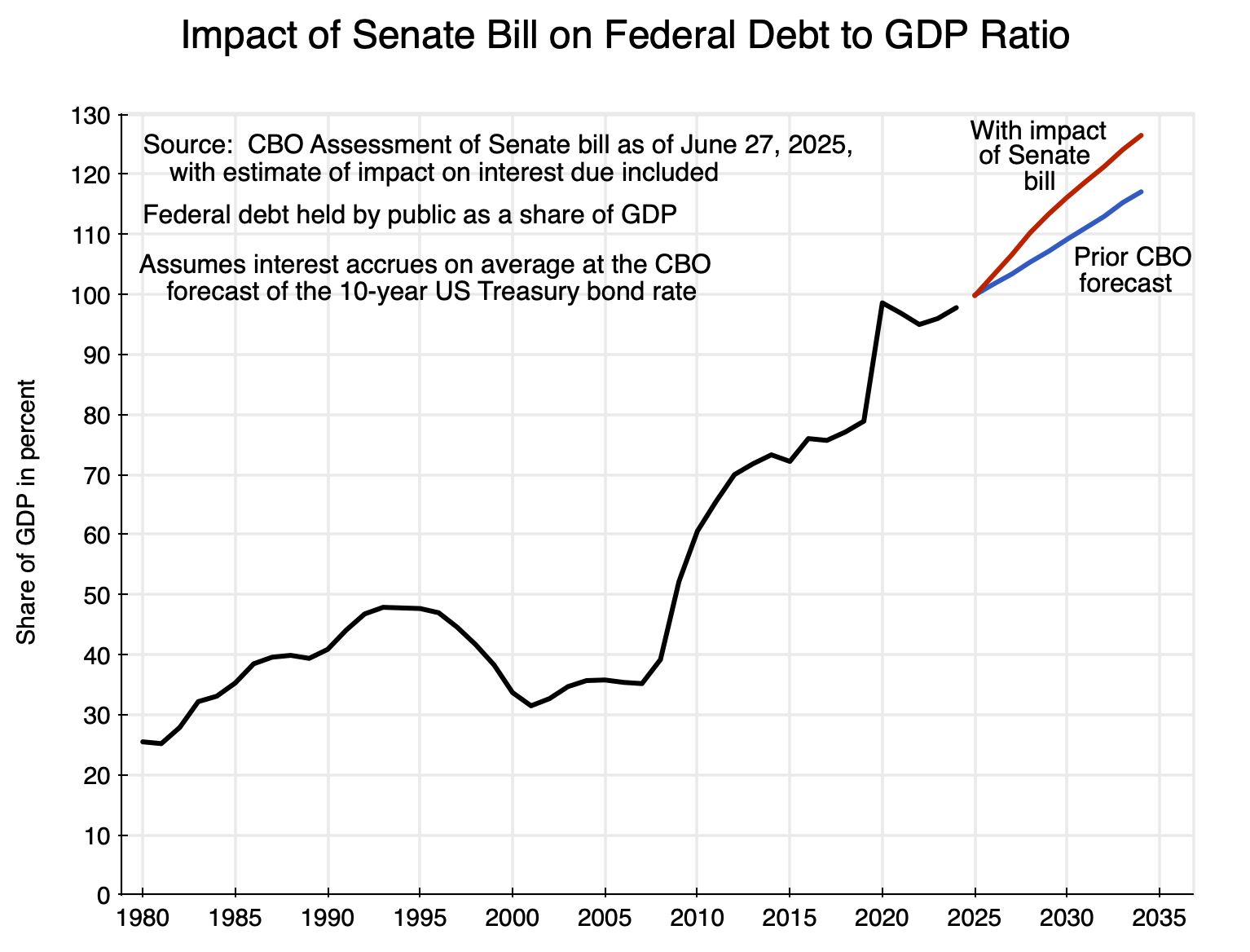
The resulting path for the federal debt to GDP ratio is shown in the chart at the top of this post, with the debt to GDP ratio shown going back to 1980 to provide context.  For the 2025 to 2034 period, the curve in blue shows what it would be under the prior (January 2025) CBO forecast (which assumed current law would be followed), while the curve in red shows what it would be if the Senate bill is passed and then approved also in the House and signed into law by Trump.

The federal debt to GDP ratio (defined as the net federal debt held by the public, where internal trust fund and other accounts – such as for Social Security – are netted out) is now close to 100% of GDP.  It was already on a rising path in the prior (baseline) CBO forecast released in January (a forecast based on budget and tax law as it stood at the time).  With the Senate bill it will now rise even faster.  Fiscal deficits will soon exceed 7% of GDP under Trump – unprecedented in times of full employment other than during World War II – and the federal debt to GDP ratio will soon exceed the record set in 1946 when it hit 106% of GDP.  Under the Senate bill, it is expected to exceed 106% of GDP by 2027, and will reach 126% of GDP by 2034, with no sign of it falling from there.

One should also note that the CBO forecasts of GDP and the federal deficit are long-term, and of necessity the CBO can only forecast some long-run path of steady growth.  In reality, of course, there will be fluctuations around any such path; it is just impossible to know when.  But when there is a downturn (and it is a matter only of when, not whether, with that likelihood especially high due to the chaos of the Trump administration), the fiscal deficit will rise and should rise.  The federal government has an important responsibility to help stabilize the economy.  But that higher fiscal deficit will add to federal debt, and the federal debt to GDP ratio will be higher following any such downturn even when GDP has returned (hopefully) to its previous long-term path.

The CBO forecast of the debt to GDP ratio in the outer years is therefore likely to be an underestimate.  By 2034, it could be a good deal higher than 126% of GDP unless Republicans in Congress finally recognize that their cuts in taxes are irresponsible.

In addition, not only are the measures included in the “One Big Beautiful Bill” tremendously costly, they will only be of benefit to those with higher incomes.  Based on the earlier version of the One Big Beautiful Bill (HR1) passed by the House in May, the CBO estimates that the lowest three deciles of households will see their absolute incomes (post taxes and transfers) reduced.  The CBO issued its estimates for this bill on June 12.  It is not clear whether the CBO will do a similar analysis for the specific Senate bill now being considered, and if so when it would come out.  However, the primary measures in the House and Senate versions of the bill are similar, and the distributional impacts will likely be similar.

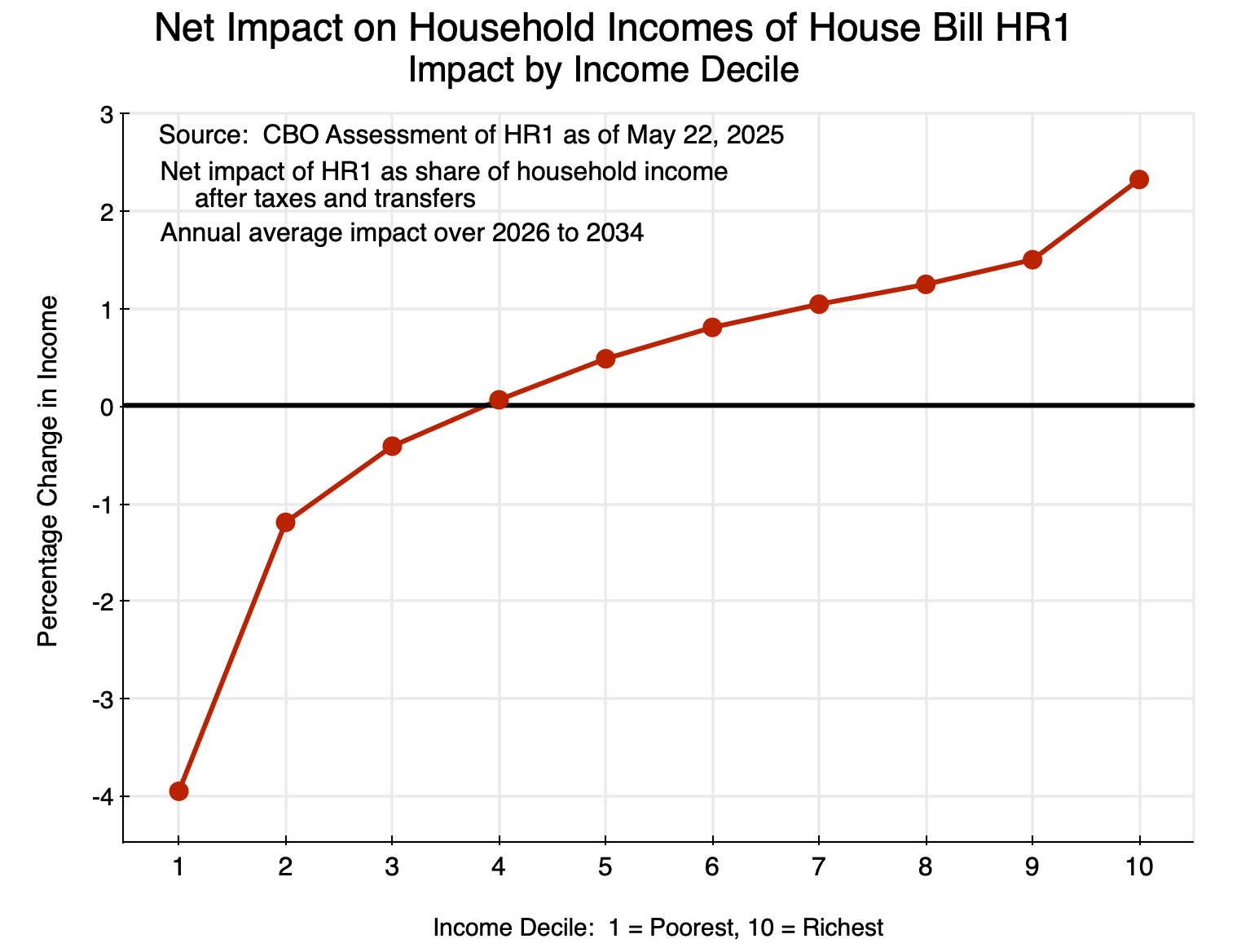
The CBO estimates of the impacts on households by decile of income of the version of the bill passed by the House (as a percent of household incomes) were:

Chart 2

The poorest decile of households would be especially adversely affected.  They would lose 4% of their incomes in absolute terms, with this is in a bill that is being funded primarily by increased federal borrowing.  Households in the second and third deciles would also lose in absolute terms, while those in the fourth decile would see (on average) almost no impact.  Higher income households then gain progressively more, with especially large gains for the richest (highest decile) households.  Note that this is presented as percentages of household incomes, after taxes and transfers.  Since incomes are much higher for the highest income households, the absolute dollar gains are especially high for the richest households.

There has never before been such an expensive and highly regressive measure passed by Congress.  But it appears this bill will soon be passed and signed into law by Trump.

Maintaining Social Security Benefit Payments Once the Trust Fund is Depleted Will NOT Increase the Government Deficit

A.  Introduction

As many are aware, based on the most recent forecast and if nothing is done, the Social Security Trust Fund is expected to be fully depleted by 2035.  Under current law that sets the operating rules for the Social Security system, benefit payments made to retirees and the disabled would then have to be scaled back to a level that would match the Social Security taxes being paid into the system each year.  This would mean a reduction of about 16% (based on current forecasts) from the payments that retirees and other beneficiaries of the system would have otherwise received in 2035.

That would be catastrophic.  Retirees and others depend on their monthly Social Security checks, and slashing those by 16% would mean a dramatic fall in the living standards of many.  In the aggregate, the cut in payments would amount to about 1% of GDP.  Even if one were to ignore the impact on the retirees who depend on their Social Security checks, a sudden scaling back of those payments by 1% of GDP could very well throw the economy into a recession.

What would happen if Congress were instead to fund that shortfall through the regular federal budget?  The amount is certainly large, at 1% of GDP or, in terms of the GDP forecast for 2035, about $425 billion.  How much would the federal deficit (and federal borrowing needs) then increase relative to what it would have been before the Trust Fund was depleted?

The answer is:  Nothing.  None.  Zero.  Zilch.  Nada.  Not a dime.

There would be no impact on the deficit.  Government borrowing in the financial markets would be exactly the same as before.  It is true that the deficit would fall if Social Security payments were slashed by 16% from one day to the next.  Leaving aside the resulting disruption this would cause for the economy – as a sudden cut in payments of 1% of GDP would certainly depress output and increase unemployment – the fiscal deficit would indeed be smaller if Social Security payments were reduced.  But compared to what it was the day before the Trust Fund was depleted, keeping up the Social Security payments in their promised amounts by covering this through the regular federal budget would have no impact on the deficit nor on federal borrowing needs.

Many may not realize this, and I have not seen a discussion of this point in the media or in other accounts of what might happen when the Social Security Trust Fund is depleted.  To be honest, I had not really thought this through before myself, and had operated on the (incorrect) assumption that maintaining Social Security benefit payments at their scheduled levels once the Trust Funds had been depleted would add to the federal deficit and borrowing requirements.  But it would not.  That is important, but I have not seen any discussion of it nor its policy implications.

This post will examine how the Social Security Trust Fund works, its history over the last half-century and its prospects, and briefly on why it is now expected to be depleted by about 2035.  The mechanics of the Social Security Trust Fund operations will then be examined in the context of the federal fiscal accounts, showing why it is an accounting mechanism but one that does not itself affect the federal fiscal deficit nor the federal government’s borrowing needs in the markets.  It will be seen that maintaining Social Security benefit payments as currently scheduled and promised in 2035 and after would not add to the deficit nor to government borrowing needs.  Some of the policy implications will then be considered.

But before starting, some of the terms should be clarified.  My references to the “Social Security Trust Fund” (or simply “Trust Fund”) are to the combined Old Age Security (OAS) and Disability Insurance (DI) trust funds.  Formally these are two separate trust funds, but they are commonly combined and referred to as the OASDI Trust Fund.  Payments from Social Security taxes have on more than one occasion (most recently in 2016 to 2018) been shifted between the OAS and DI accounts as a short-term fix when one of the funds was getting close to depletion (the DI fund in the 2016 to 2018 case).  In reports, the OAS and DI funds are often aggregated as if there were one OASDI fund, and I will treat them that way here as well.

Also, the more formal name for the taxes that go into the Social Security accounts is FICA (for Federal Insurance Contributions Act) taxes.  FICA taxes are applied on wages (i.e. not on other earnings) at current rates for the worker and the employer together of 10.6% for the OAS and 1.8% for the DI accounts – a total of 12.4%.  While these are formally “paid” half by the worker and half by the employer, all analysts agree that these payments in fact all come out of the worker’s wages.  The tax applies up to a ceiling on wage earnings of $168,600 in 2024, after which the tax rate is zero.  In addition, there are also FICA taxes of 2.9% for Medicare Hospital Insurance (with no ceiling on wage earnings).  The Medicare funding will not be addressed here, and when I refer to “Social Security taxes” I will be referring to the 12.4% for the OAS and DI trust funds (OASDI together).

B.  How the Social Security Trust Fund Works

Each year, there are workers who are paying Social Security taxes on their wages (at the 12.4% rate) and retirees (and other Social Security recipients, such as spouses, dependents, and the disabled) who are receiving benefit payments from Social Security.  The taxes paid go into the Social Security Trust Fund and the benefit payments made are drawn out of it.  When the tax payments going in are greater than the current benefit payments going out, the excess accumulates in the Trust Fund.  And in those years when the tax payments in are less than the current benefit payments out, the Trust Fund redeems a share of its assets to cover the difference.

The Trust Fund is invested in specially issued US Treasury obligations – essentially special US Treasury bonds.  The Trust Fund earns interest on those US Treasury holdings at a rate set by law to equal the weighted average yield observed in the markets as of the last business day of the prior month on US Treasury bonds that are not due or callable for 4 years or more.  That interest is added to the Trust Fund.  The Trust Fund also receives income taxes paid by certain retirees on their Social Security benefits (from retirees with incomes above a certain threshold).  There are also some other, generally minor, transfers to the Trust Fund.

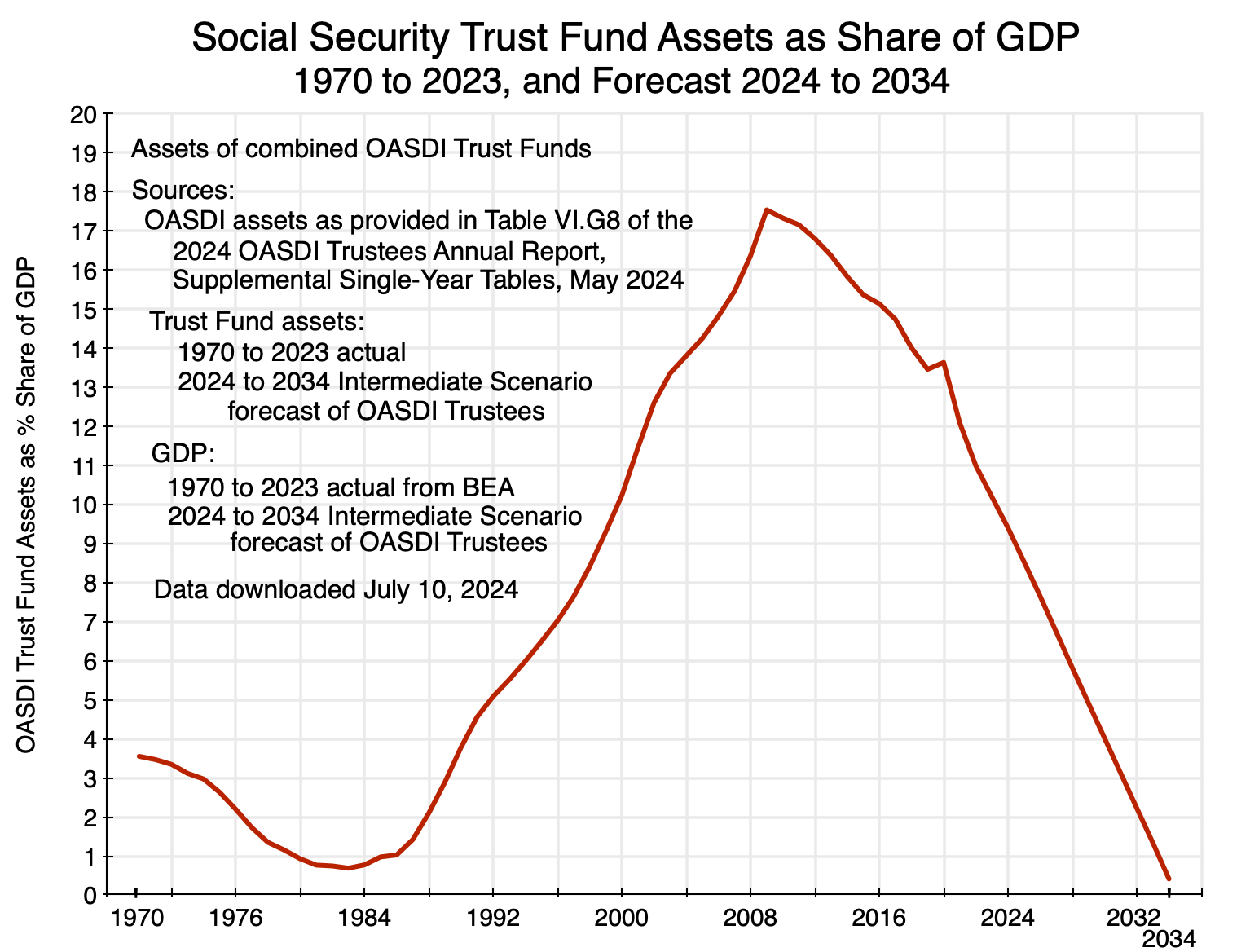
The resulting accumulated balances in the Social Security Trust Fund, as of the end of each year and expressed as a share of GDP of the year, are shown in the chart at the top of this post.  It has varied over time, and one can see that the Trust Fund came close to being depleted before – in the early 1980s.  Before that, the Social Security system had been managed in a more ad hoc way, with benefit levels, eligibility, tax rates, the income ceiling on which Social Security taxes were due, and more frequently adjusted by Congress.  Indexing for inflation was only introduced in the 1970s.

By 1981, the forecast was that the Social Security Trust Fund would be fully depleted by 1983.  In response, President Reagan with Congress appointed a commission in 1981 chaired by Alan Greenspan (and subsequently usually referred to as the Greenspan Commission) to provide recommendations for what would return the system to viability.  The Commission issued its recommendations in early 1983, with a combination of higher tax rates, adjustments to benefit levels, an increase in the retirement age for full eligibility, and numerous more minor changes.  Congress approved these in 1983.

The Greenspan Commission recommendations were based on forecasts of what changes would be needed to lead to the Trust Fund remaining solvent (i.e. not depleted at any point) for at least 75 years.  Starting in 1982, the 75 years would carry the forecasts through to 2057.  This did not mean that the Trust Fund would be brought to zero in the 75th year, but rather that it would still be solvent at that point.  They did not try to look beyond that.

Knowing that the large Baby Boom generation was then in its prime working-age years and that they would be retiring starting around 2010, the changes were designed so that the Trust Fund would be built up in the 1980s, 90s, and 2000s, and then begin to be used to pay out benefits on a net basis as the Baby Boomers retired.  This produced the large “hump” seen in the chart at the top of this post with the Trust Fund growing from less than 1% of GDP to 17 1/2% of GDP in 2009, after which it began to decline.

The decline as a share of GDP was planned.  However, under the forecasts of the Greenspan Commission in 1983, the Trust Fund would not have been fully depleted by 2035.  While it is often stated in the media that this is a consequence of the Baby Boomers reaching retirement age and of longer life expectancies, that is not in fact true.  The Greenspan Commission was well aware of how many Baby Boomers would be reaching retirement age in those years – they had already been born.  And the issue is not whether life expectancies have been rising, but whether life expectancies have been rising by more than what the Greenspan Commission assumed in their forecasts.  And it has not.  Indeed, life expectancy in the US has actually been decreasing since 2014 (and then plummeted in 2020/21/22 due to Covid), is well below that enjoyed in comparable countries, and is well below what the Greenspan Commission forecast.

As was discussed in an earlier post on this blog, the Social Security Trust Fund is now expected to be depleted well before the Greenspan Commission anticipated not because of the Baby Boomers nor because of life expectancies growing longer, but rather because the Greenspan Commission did not anticipate that wage inequality would grow so dramatically following Reagan.  This matters, because it led a higher share of wage earnings to be drawn above the ceiling on which Social Security taxes are paid, where they are not taxed at all.  The Greenspan Commission’s assumption that the share of wages that would be subject to tax would remain where it was (at about 90% of total wages) was not unreasonable at the time, as that share had remained fairly steady in the post-World War II period up to the early 1980s.  But then it deteriorated sharply in the subsequent decades.

Due to that increase in wage income inequality, the Trust Fund is now forecast to be depleted in 2035.  In my earlier post on this issue, I calculated that had the share of wages subject to Social Security taxes remained at the 90% share (and taking into account what this would also mean for higher benefit payments for the high-income wage earners who would then still be paying into the system), the Trust Fund would have been forecast to last until 2056.  The calculations assumed that all else would then be as it was historically when my forecasts were made in 2016, or as the Social Security then forecast in the years from 2016 onwards.

But wage inequality rose in the decades since 1983 and the Social Security Trust Fund is now expected to run out by 2035.  Under the current law that governs the Social Security system, Social Security benefits would then be scaled back to a level that would match amounts being paid into the Trust Fund by the workers in those years.  This would require a scaling back of benefits of about 16% based on current forecasts.  This would be devastating for many.  In a biennial report issued by the Social Security Administration (last issued in 2016 with data for 2014 – it appears the Trump administration stopped it, and it has not been restarted), it was estimated that Social Security benefits accounted for 100% of the income of 20% of the population aged 65 or older, and for 90% or more of the income of a third of the population.  Saying that again, one-third of Americans aged 65 or older depend on Social Security for 90% or more of their income.

Furthermore, not only do a high share of those over 65 depend on their Social Security checks for almost all of their income in their old age, but the checks themselves are not that high.  As of June 2024, the average monthly benefit was only $1,781, or $21,372 on an annual basis.  And most of those who especially depend on their Social Security checks also receive well less than these average payments.

A high share of those aged 65 or older in the US depend critically on Social Security.  A sudden cut of 16% would be devastating.

C.  Federal Borrowing Before and After the Trust Fund is Depleted   

As described above, when the amount being paid into the Social Security Trust Fund in Social Security taxes exceeds what is being paid out in Social Security benefits, the excess is invested in interest-earning US Treasury obligations.  That excess will reduce what the US Treasury will need to borrow from the markets to cover whatever the federal deficit might be from all of its other revenues less expenditures (i.e. everything other than from Social Security revenues and expenditures).  The Social Security Trust Fund will, in such years, be built up as it was from 1983 to 2009.

The opposite happens in years when Social Security tax revenues fall short of what Social Security is paying out in benefits.  In those years, the Social Security system will redeem a portion of the US Treasury obligations it holds and from this receive the cash it needs to pay the scheduled benefits.  When it does this, the US Treasury will then need to borrow in the markets the amount required to cover the US Treasury obligations that the Social Security system has redeemed.  That is, as the Social Security Administration redeems a share of the US Treasury obligations that it holds in the Trust Fund, the Treasury will need to issue new debt to the public to obtain the cash it needs to pay to Social Security for those redemptions.

Now suppose the Trust Fund has been fully depleted, and it no longer holds any balance of US Treasury obligations.  This is the forecast for what will be faced in 2035.  It no longer has US Treasury obligations that it can redeem.  Under the current law for the Social Security system, it would then be required to scale back benefit payments to the amount it is then receiving from Social Security taxes being paid by those then working.  The current forecast is that this would require a scaling back of 16%.  (Note that this is not 100%, as some people appear to believe.  Social Security is not being shut down in some kind of “bankruptcy”.  Rather, Social Security payments would continue – just not at the scheduled benefit levels.)

But what would happen in terms of federal government borrowing requirements if, instead of scaling back benefits by 16%, the government instead funded those payments in full from the general budget?  The amount would be far from small, at a forecast 1% of GDP to cover that 16% shortage.  But what would then happen to what the US Treasury would need to borrow from the public?

The answer is nothing.  There would be no change at all.  As explained above, when the funds come out of the Social Security Trust Fund holdings of US Treasury obligations, the Treasury will need to borrow from the public whatever is redeemed by the Trust Fund.  That is where the cash comes from.  When the Trust Fund no longer has any holdings of the US Treasury obligations, then the cash needed to cover the 16% Social Security payment gap from the general budget will be exactly the same.  That is, the amount the US Treasury will need to borrow from the public will be the same whether it needs the cash to cover redemptions of US Treasury obligations from the Trust Fund, or to cover the 16% gap in what is needed to pay Social Security benefits in full.

The fiscal deficit will also be the same, whether the full Social Security payments are made out of redemptions from the Trust Fund or are made out of transfers from the general government budget.  Social Security taxes (i.e. FICA taxes) are included as revenues going to the government, the same as personal income taxes or other sources of government revenues.  Similarly, payments for Social Security benefits are treated as government expenditures – whether or not they are covered by redemptions from the Social Security Trust Fund.

To illustrate with numbers from FY2023 (and using the recent, June 2024, budget figures from the Congressional Budget Office), and expressed as a share of GDP:  Outlays for the Social Security system (for retirees and their dependents, as well as for the disabled) was 5.0% of GDP.  Payroll taxes for Social Security (the 12..4% on wages) was 4.4% of GDP, leaving 0.6% of GDP to be obtained by drawing down the Social Security Trust Fund.  This accounted for part of the overall fiscal deficit in FY2023 of 6.3% of GDP.  If the 0.6% of GDP gap had been covered by direct fiscal transfers from the general government budget instead of by redemptions from the Social Security Trust Fund, the overall fiscal deficit (6.3% of GDP) as well as government borrowing requirements (whether to fund the deficit or to cover the Trust Fund redemptions) would have been the same.

(Note:  I have left out here the relatively much smaller amounts coming from the transfer of income tax revenues arising from taxation of Social Security benefits in households meeting certain income thresholds, and the interest earned on Trust Fund assets during the year.  These are both covered elsewhere in the fiscal accounts.)

It is in this sense that it is accurate to describe Social Security as a “pay-as-you-go” system.  While it is not always clear what is being referred to when speakers refer to Social Security as pay-as-you-go (different speakers appear to be referring to different things), it would be accurate to say that this is the case from the point of view of the government’s fiscal accounts and of its borrowing requirements in the markets.  What Social Security pays out in benefits in any given year will match what Social Security obtains as revenues in that year (primarily from the Social Security share of the FICA taxes) plus what is provided to the system from the US Treasury.  Whether those amounts transferred from the US Treasury are matched by a drawdown on the Treasury obligations in the Social Security Trust Fund, or come directly from the budget, the overall fiscal deficit as well as the Treasury’s borrowing requirements in the market will be the same.

D.  Policy Implications and Conclusion

Recognizing this, what does it imply for what should be done in 2035 (or whenever the Social Security Trust Fund is fully depleted)?  Under current law, and what is repeatedly stated in the media, is that scheduled Social Security benefit payments would have to be scaled back drastically (by about 16% in the current forecasts).  If that is done, that would indeed be a disaster for many given their dependence on the Social Security checks they receive.

But as explained above, there would be no impact on the deficit, nor on government borrowing requirements, if the scheduled benefit payments were kept in full and not scaled back from the scheduled levels, but rather with the gap covered instead by appropriations from the regular budget.  Congress could approve this if they wished.

Seen in this perspective, the question then becomes how best to fund the Social Security system along with all other government programs in the budget.  One should not restrict consideration only to adjustments in the payroll taxes that are currently tied to the Social Security system, nor to possible reductions in benefit levels by, for example, raising the normal retirement age.  Consideration should thus be given to possible other changes in the overall tax system – for example in personal income taxes and/or corporate income (profit) taxes.  The payroll tax is regressive, with a flat 12.4% on wages (and only wages) and only up to a ceiling ($168,600 in 2024).  Greater reliance on progressive income taxes is an attractive alternative to a regressive payroll tax.

One should therefore take a more holistic view as to what the tax system should be and not treat the issue as one for Social Security taxes in isolation.  While there could very well be political advantages to defining a trust fund for Social Security into which certain taxes are paid and from which benefit payments are then made, one should recognize that fundamentally this is only presentation.  Covering a portion of the Social Security benefit payments through the general budget, and hence through the overall system of income and other taxes, could well be preferred to exclusive reliance on payroll taxes.

Note also there is precedent for this.  Medicare taxes are also paid on wages (at a 2.9% rate, but with no ceiling on the wages subject to tax) and go into a trust fund, plus there are direct monthly premia paid for Medicare coverage.  However this funding does not suffice to cover all of what Medicare now costs.  The difference is made up by direct fiscal transfers.  It is certainly a major government expense, but no one argues Medicare payments should be limited to whatever is paid in Medicare taxes and premia.

As noted, sustaining payments once the Social Security Trust Fund has been fully depleted would require a change in the law that governs the Social Security system.  That law has been changed numerous times in the past, and could certainly be changed on this.  The real problem is that with Congressional gridlock, obtaining approval for such a change may well be difficult.  Republicans have been opposed to Social Security ever since its origin in the Social Security Act of 1935 under Roosevelt.  As Social Security became popular and demonstrated its success in reducing poverty among the elderly, that political criticism became less overt but has remained.  And those opposed to Social Security will likely use the imminent prospect of the Trust Fund being depleted by 2035 as an opportunity to scale the system back.  A reduction in expenditures of 1% of GDP would be huge.

But as examined above, maintaining Social Security benefit payments at scheduled levels once the Trust Fund is depleted would have no fiscal effects in itself.  Government revenues, expenditures, and borrowing requirements would be the same the day after the Trust Fund was depleted as it was the day before.

The Federal Deficit is High, Rising, and Unsustainable at This Level

The federal fiscal deficit fell sharply in Biden’s first year and a half in office.  This was largely due to the expiration of the huge Covid relief programs that had been approved both during Trump’s last year in office and then at the start of Biden’s term (totaling $5.7 trillion, and equivalent to 12.8% of the GDP of 2020 and 2021 together).  The deficit was an astonishing 16.5% of GDP in the last 12 months of the Trump administration, and peaked at 19.2% of GDP in the 12 months leading up to March 2021.  It then came down rapidly, reaching a trough of 3.9% of GDP in the 12 months leading up to July 2022.  But it then turned upward, and is now at about 8.5% of GDP.

The figures are shown in the chart above.  They were calculated from the regular Monthly Treasury Statement released by the US Treasury, which has monthly figures on federal government receipts (revenues collected), outlays (expenditures in a broad sense), and the resulting deficit.  The most recent such statement (the one used here) was released in mid-August with figures through July.  The figures once published are rarely changed, and thus appear to be actual revenue and expenditure numbers and not estimates of what they were in any given month.

The figures will always bounce around substantially from month to month, due to factors such as when major payments on income taxes are due (e.g. each April), when expenditures are bunched (due to the fiscal year cycle), and other such seasonal factors.  Thus for the chart here I have calculated 12-month rolling totals for the figures, ending on the dates shown.  And I have expressed them as a share of average GDP over the period.  Since GDP figures are only available on a quarterly basis, I estimated month-to-month GDP figures based on an assumed constant rate of growth over the three months within each quarter.  The GDP figures were downloaded from FRED.

I also extrapolated the figures to the end of fiscal year 2023 – i.e. through to September 2023.  I suspect there will be a good deal of discussion on the sharp growth in the federal fiscal deficit in FY2023 when the full fiscal year figures are released in early October.  This post can be considered a preview, where while the final numbers will not be exactly the same as those estimated here, they will likely be close.

For the extrapolation, I assumed that federal outlays, receipts, and resulting deficits in August and September 2023 will be the same as they were in August and September 2022.  This was more reasonable than extrapolating the recent trend as the monthly figures fluctuate sharply due to seasonal factors, as noted above.  But it may well underestimate what the deficits will be in August and September 2023 due to the underlying upward trend of the past year.

For GDP for the third quarter of 2023 (where the preliminary estimate will not be released until near the end of October), I used the most recent forecast of third-quarter GDP growth produced by the Atlanta Fed.   The Atlanta Fed’s “GDPNow” forecasts have generally been quite good (far better than various consensus forecasts of panels of economists), and are based on a mechanical method where the forecast is first produced and then updated in real-time when key data are released – during the course of the quarter – on elements of what goes into GDP.  Correlations were worked out based on historical data, with those correlations then used – every time new data is released – to update the forecast of what GDP will be when an estimate is ultimately provided by the BEA at the Department of Commerce.

I have gone into a bit of detail on the Atlanta Fed’s GDPNow forecasting process as its most recent forecast (as I write this) is for GDP growth in the third quarter of 2023 to be quite high – at an annualized real growth rate of 5.9%.  This is a good deal higher than the most recent official (BEA) estimates of GDP growth of 2.4% in the second quarter of 2023 and 2.0% in the first quarter.  It is also substantially higher than the “Blue Chip” consensus forecast of a panel of economists of just 1.6%.  We will see who ends up being closer to the final figure on GDP growth, but for the chart above I used the 5.9% rate.  With this relatively high rate of growth for GDP, the federal deficit and other figures as a share of GDP will be biased in the downward direction.  Despite this bias (as well as that following from the use of 2022 figures for August and September, despite the upward trend in the deficit this year), the resulting federal fiscal deficit for FY2023 (which ends in September 2023) is conservatively estimated to be 8.5% of GDP.

A fiscal deficit of 8.5% of GDP in a period when unemployment is low is huge.  The unemployment rate has been at 3.7% or less (and as low as 3.4% – with this all within the range of statistical uncertainty) since March 2022.  It has not been at a level so low for such an extended period since 1968/69 – more than a half-century ago.  The increase in federal expenditures certainly in part accounts for this (Keynes is once again shown to have been right), but a fiscal deficit of 8.5% of GDP is not sustainable.

The gross federal debt held by the public (the relevant concept, as intragovernmental holdings of public debt will net out) was 95% of GDP as of 2022.  Round this up to 100% of GDP.  It is then easy to see that if one assumes, going forward, that real GDP growth will average 2.0% per year, say (it averaged 1.93% per year from 2000 to 2023), and if the inflation rate (the GDP deflator) matches the 2.0% Fed target for general consumer inflation, then the public debt to GDP ratio will remain flat if the fiscal deficit equals 4.04% per year (as that equals the compounded effect of 2.0% real growth and 2.0% inflation).  A fiscal deficit of 8.5% of GDP is far above this.  At such a deficit, the debt to GDP ratio will grow.  At a deficit of 4% of GDP or less, then with 2% growth and 2% inflation the debt to GDP ratio will fall from where it is now.

Why has the fiscal deficit grown by so much since the trough at 3.9% of GDP in July 2022?  I do not know enough about the fiscal accounts to say, but a few points can be made.  First, it was not due to rising interest rates.  While the US Treasury will need to pay higher interest rates on newly issued debt as the Fed has been raising interest rates, most Treasury debt is longer term and only comes up for renewal slowly over time.  According to the July 2023 Monthly Treasury Report, gross interest payments rose by $136 billion in the fiscal year to date (i.e. from October 2022 through to July 2023) compared to the same period in the prior fiscal year.  This is just 0.6% of GDP if one extrapolates it out to a full 12-month period,

In terms of the broad categories shown on the chart above, what was far more important was a fall in federal receipts (revenues) over the last year.  Federal receipts came to 19.6% of GDP in the 12 months leading up to July 2022, and fell to 16.8% of GDP in the (forecast) 12 months leading up to September 2023.  This was a reduction in receipts of 2.8% of GDP, and accounts for about 60% of the increase in the deficit during this period (which went from 3.9% of GDP to a forecast 8.5%, an increase of 4.6% of GDP).  An increase in federal outlays, rising from 23.5% of GDP in the 12 months leading up to July 2022 to 25.3% in the 12 months leading up to September 2023 (an increase of 1.8% of GDP), accounts for the other 40%.

I am not sure why federal receipts fell over the last year, but a guess would be that they rose in the period from early 2021 to mid-2022 (keeping in mind that these will always be for trailing 12-month periods) due to rebound effects from the Covid relief programs.  Those programs included deferral of when taxes would be due, and also provided for higher government expenditures on a variety of Covid-related activities.  These would translate into higher incomes, with this then leading to higher taxes later becoming due.  There was also major direct income support, although most of this was not taxable.

But for whatever reason, federal government receipts as a share of GDP have fallen substantially since mid-2022 and account for the major share (60%) of the increase in the deficit.  However, it is also important to note that while federal receipts have fallen relative to mid-2022, they are now (as a share of GDP) roughly where they were in early 2020, prior to the onset of the Covid crisis.  In fact, they are a bit higher, at 16.8% of GDP now compared to 16.5% in the 12 months leading up to early 2020.

Federal outlays are, however, substantially higher than where they were in early 2020.  They are now at 25.3% of GDP, versus 21.4% of GDP in early 2020, an increase of 3.9% of GDP.  This more than accounts for the increase in the fiscal deficit since then – rising from 5.0% of GDP in early 2020 (during the Trump administration but pre-Covid) to 8.5% now.  I have discussed before why the deficit of 5% of GDP during the Trump years (pre-Covid) was unwise, exceptional for a period when the economy was at full employment, and not sustainable.  The same is true with a deficit of 8.5% of GDP during a period when the economy is also at full employment.

Much of the new expenditures of the Biden administration are certainly high priority.  Climate change needs to be addressed, for example, and the US has long neglected its public infrastructure and there is an urgent need to repair it.  But I do not have a detailed breakdown of the expenditures, how they compare to expenditures before, and the needs being addressed.  But regardless, the now Republican-controlled House of Representatives will certainly force major cuts in federal expenditures, just as the Republican-controlled House elected in 2010 forced through major expenditure cuts during the Obama presidency.  Fortunately, the economy is now at full employment, while unemployment was still high in 2011 when the Republicans started to force major expenditure cuts on the Obama administration.  There had not been such cuts in fiscal expenditures with unemployment still high in periods recovering from a recession since before World War II.  The result was the exceptionally slow pace of employment growth following the financial and economic collapse of 2008/2009.

Attention should also be given to increasing fiscal revenues as part of a program to reduce the fiscal deficit.  A return of federal receipts to the approximately 18% of GDP share towards the end of the Obama presidency in 2016 would help in reducing the deficit to a sustainable level.  A good start would be to reverse the Trump tax cuts rammed through the Republican-controlled Congress in late 2017 on party-line votes – tax cuts that led to corporate income taxes being reduced by half and which introduced numerous new tax loopholes and other measures favoring the rich.  But with Republicans now in control of the House, that will of course not happen.

A deficit of 8.5% of GDP is not sustainable.  It will need to come down, with a deficit of 4% of GDP or less a reasonable goal.  There is a need for a constructive debate on how best to do this.  Unfortunately, given the state of American politics, it is unlikely that any debate will be constructive.

=========================================================

Update:  October 31, 2023

Final figures have now been released for FY2023 federal government outlays and revenues, with the release of the September 2023 Monthly Treasury Statement. The initial estimate of GDP in the third quarter of 2023 has also now been provided.  From these, we can calculate what the federal fiscal deficit was as a share of GDP in FY2023, and compare that to the estimates made when only data through July 2023 were available.

The FY2023 fiscal deficit came in at 6.3% of GDP.  This deficit figure is still high – it is well above the 5% of GDP rule of thumb on when one should be concerned (in an economy at full employment), and above the figure of around 4% of GDP where the government debt to GDP ratio would be flat.

But the 6.3% of GDP deficit is substantially better than the 8.5% estimate provided in the post above.  That figure was based on extrapolations from data that, at the time, were only available through July 2023.  Why the difference?  It turns out to be due almost entirely due to substantially lower than expected fiscal outlays in the final two months of the fiscal year (i.e. August and September).  The estimates made in the post assumed that the fiscal deficit in August and September 2023 would be the same as the deficit in those two months in 2022.  But the deficit turned out to be 2.1% of annual GDP lower in 2023 than it was in those same two months in 2022.  Within round-off, this is the same as the 2.2% of GDP difference between the 8.5% of GDP forecast, and the 6.3% of GDP realization.

This was basically entirely due to lower federal expenditures (outlays).  Those expenditures were 2.3% less, in terms of annual GDP, in August and September 2023 than they were in those two months in 2022.  Federal revenues were also a bit less, but only by 0.2% of annual GDP.

Note that all these figures have been presented in terms of annual GDP for the fiscal years 2022 or 2023.  But GDP is a flow, and GDP in just the two months being considered will of course be far less.  Based on the advance estimate of GDP in the third quarter of 2023, and assuming GDP in the two months will be two-thirds of that in the three months in the quarter (and also taking GDP at the quarterly, not annual, rate), the reduction in the deficit in those two months relative to the same two months in 2022 comes to 12.3% of the GDP of those two months.  That is gigantic!  While there is substantial volatility in the monthly figures, it is surprising that fiscal expenditures would change by so much in that period compared to what it was in the same period of the prior year.