We Have a Revenue Problem: The Fiscal Accounts Would be Sustainable with a Modest Increase in Taxes

Chart 1

A.  Introduction

The previous post on this blog showed how far federal government debt will rise as a share of GDP as a consequence of the “One Big Beautiful Bill Act” (OBBBA).  The Senate version of the bill was accepted in full by the House and was signed into law by Trump on July 4.  The bill will add $4.0 trillion to public debt in the decade to FY2034, increasing that debt from 98% of GDP as of the end of FY2024 to 126% of GDP by the end of FY2034 (up from the 117% of GDP if the bill had not been passed).

Such numbers on the debt (which would have been astounding just a few years ago, before Trump’s first term in office) might lead some to conclude that rising public debt is now inevitable – that nothing can be done to avoid it.  And some might conclude they should therefore get what they can as fast as they can from bills such as the OBBBA.  The result was a bill laden with numerous special interest provisions for a favored few, and with tax cuts principally of benefit to those with high incomes.

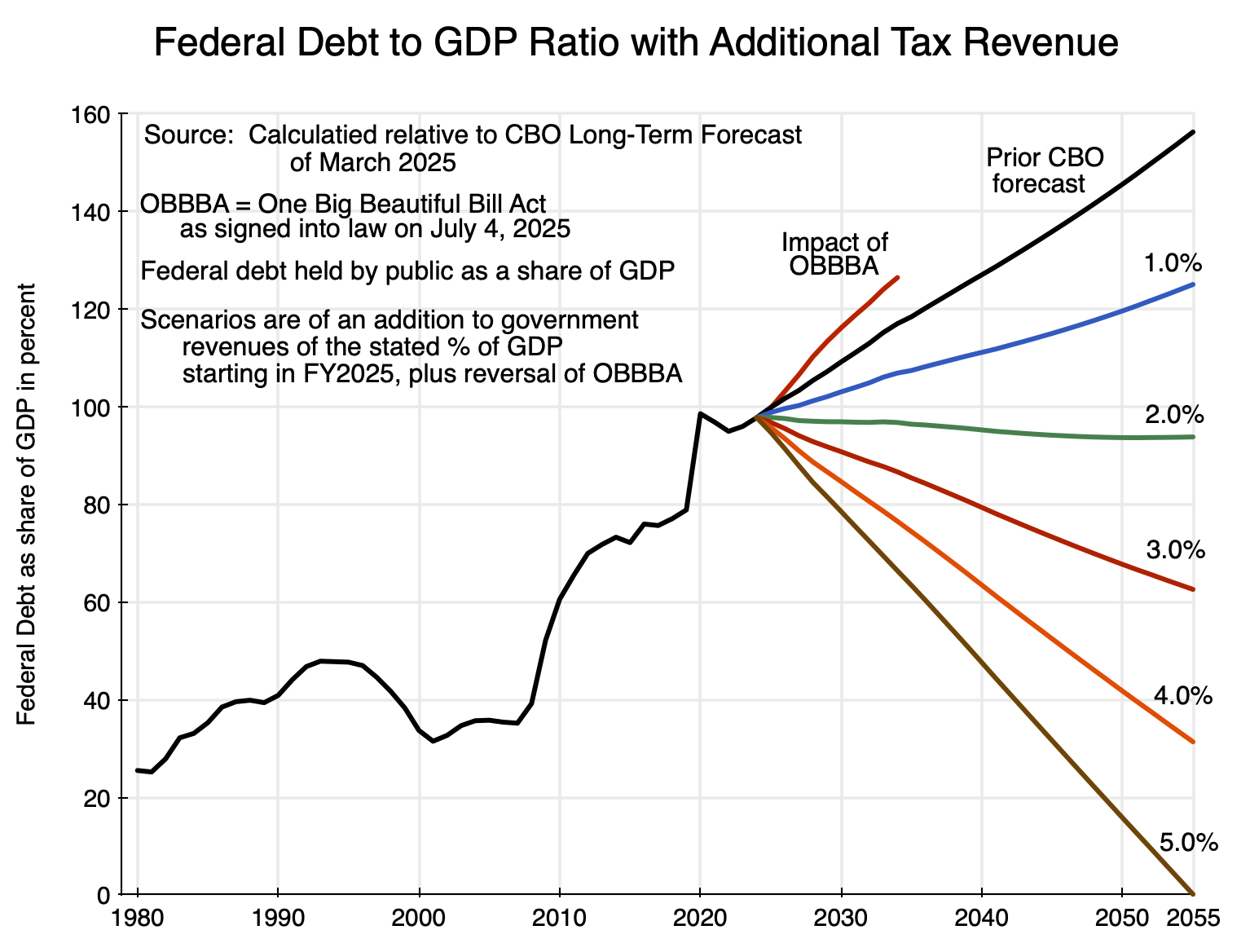
The path is unsustainable and would eventually lead to financial collapse.  But a rising path for the debt ratio is also not inevitable.  A modest increase in federal revenues (2% of GDP or more) along with reversal of the OBBBA would lead to that ratio not just stabilizing, but falling in the decades to come.  The chart at the top of this post shows what the impact would be of a given increase in federal revenues, expressed as a share of GDP, above that in the baseline in the most recent (March 2025) Long-Term Budget Projections of the Congressional Budget Office (the CBO).  This CBO forecast was made prior to the OBBBA being passed, so a first step would be reversal of that act in order to return to that earlier baseline for revenues.

The paths are smooth as they follow the trends under the specified assumptions.  In reality they will of course fluctuate along with the business cycle of economic downturns and upturns.  Right now we do not know when those will occur, but the objective here is simply to illustrate what the longer-term trends would be.

A 3% of GDP revenue increase (plus reversal of the OBBBA) would be a modest target to meet.  To put this in perspective, an extra 3% of GDP of federal revenues in FY2025 would have brought federal revenues (as a share of GDP) back to where they were in FY2000.  This was the last year of the Clinton Administration, and growth was strong, the unemployment rate was the lowest since the 1960s, and the fiscal accounts were in surplus.  But then revenues were cut (as a share of GDP) following the tax cuts of Bush (in 2001 and 2003) and Trump (in 2017).

One can also compare government revenues as a share of GDP of the US to what it is in comparator countries in Europe and elsewhere.  The US is an extreme outlier, with far lower fiscal revenues than what other countries raise – countries with living standards for the general population that many in the US envy.  If other countries can raise such fiscal revenues, one has to wonder why opponents assert it would be devastating for the US economy.

This post will first examine the impact higher federal revenues would have on the path of the federal debt to GDP ratio over the coming decades.  It would not take much. To provide a better understanding of why that is so, it will also look at the basic math behind it.  The section that follows will then look at what government revenues (as a share of GDP) are in the US compared to the share in comparator countries.  A higher (and indeed always far higher) government revenue share in those countries has not meant a reduction in their standard of living.  In many – perhaps all – cases, those living standards for the general population are in fact seen as superior.  Those countries typically also enjoy public infrastructure that is not the embarrassment seen in much of the US.  The section will also look at the economic conditions in the US in 2000, when government revenues were 3% of GDP higher than what they are now.  The economy was performing well in 2000 (and better than it ever has since), and there is no reason why the US could not return to such a level of tax revenue collection.

The section that follows will then discuss some of the criticisms made against raising more in government revenue.  Those arguments (such as that higher tax rates will lead workers to drop out of the labor force, that corporations would invest less, and hence that tax cuts will pay for themselves) are not supported by the evidence.  Nor do the theoretical arguments made in favor of tax cuts stand up.

Mathematically, an alternative to increasing federal revenues would be to reduce federal expenditures.  All else equal, that would also reduce the deficit.  But we can thank Trump for demonstrating that that will not work.  We have seen via the OBBBA that cuts in federal expenditures are not easy to find.  The most severe cuts will be to the Medicaid program – with an expected reduction in expenditures of $1.04 trillion over ten years.  The CBO estimates that those cuts will lead to 11.8 million losing their Medicaid coverage.

Yet the just over $1.0 trillion reduction in federal government expenditures on Medicaid will amount to less than 0.3% of GDP over the period.  With cuts to other programs (such as food stamps), the total cuts were still just 0.3% of GDP after rounding.  The cuts would have had to have been ten times as high to get to a federal expenditure reduction of 3% of GDP.  The authors of the OBBBA searched desperately for expenditures to cut in order to reduce the impact of the OBBBA on the fiscal deficit, and failed to find enough to suffice to cover even one-tenth of what would be needed to get to 3% of GDP.  And the ones they did make will have severe consequences for the poor.

In addition to the lessons from the search under the OBBBA to try to find cuts in federal expenditures to offset what will be lost in lower tax revenues – and failing – there is also now the failure of the effort by Musk and DOGE.  Despite savage cuts to critically valuable government programs (from medical research to the weather service), the federal government has spent (as of July 10) over $300 billion more since Inauguration Day than it did in the same period in 2024.  DOGE had a stated aim that it would cut federal spending by $2 trillion per year.  It never got remotely close.

But what I will refer to as the Musk/DOGE cuts (totaling $190 billion as of July 13, they claim) have had important consequences.  Funds and government staff positions have been cut from medical research, basic science, overseas aid, and the weather service, along with much more.  These cuts have had consequences, as will be discussed below.

What is needed to stop the upward spiral in federal debt relative to GDP is not complicated.  There is a need for more revenues – revenues that have been repeatedly slashed by the tax cuts of Bush in 2001 and 2003, Trump in 2017, and now Trump again.

But while the answer is simple, that does not mean it will happen.  In the current political environment – and as seen with the OBBBA rammed through Congress with only Republican votes – a return to a more sane fiscal policy cannot be expected anytime soon.

B.  The Increase in Government Revenues Needed to Bring Down the Debt to GDP Ratio

The chart at the top of this post shows what the path of the federal debt to GDP ratio over the next three decades would be (with the path since 1980 included for context), for alternative additions to federal revenues expressed as a share of GDP.  The base path is that calculated by the CBO in its Long-Term Budget Outlook issued last March.  This forecast was made prior to the OBBBA, so a first step in all of the scenarios would be to reverse that costly new law.  And the basic story is clear:  With more federal revenues – and not that much more – the debt to GDP ratio would fall.  Federal revenues include all sources of revenue to the federal government, but more than 99% of these are tax revenues.

Relative to the March 2025 (i.e. pre-OBBBA) estimates of the CBO, additional federal revenues of 2% of GDP would lead to a federal debt to GDP ratio that is broadly stable and in fact declining a bit.  Additional revenues of 3% of GDP would put it on a clear downward path, which would be steeper at 4% of GDP in additional revenues, and would be so steep at 5% of GDP that federal debt would fall to zero by 2055 if sustained.  As noted, all these paths would now also require that the OBBBA be reversed.

The pattern is consistent with each step up in federal revenues as a share of GDP.  But what might be surprising to many is that additional revenues of just 2% of GDP (before the OBBBA) would suffice to stabilize the federal debt to GDP ratio.  The overall fiscal deficit will exceed 6% of GDP this fiscal year (6.2% of GDP in the January 2025 CBO forecast).  But the nation would not need anything close to that in deficit reduction to stabilize the debt to GDP ratio.

To see why, one needs to look at the basic math behind this.  It is not that complex, and there are only a few parameters involved.  One is the growth rate of nominal GDP (in total, not per capita, terms).  This can be split up into the growth rate of real GDP and the rate of inflation (specifically inflation as measured by the GDP deflator, but price indices in general move similarly).  Another is the average nominal rate of interest on government debt (US Treasuries), which also implies some average real rate of interest given the rate of inflation.

A last, and key, variable is what economists call the primary deficit in the fiscal accounts.  While not often mentioned in news reports, it is key to understanding the dynamics of the debt to GDP ratio.  The primary deficit is simply total federal government revenues minus total federal government expenditures, other than expenditures for the payment of interest on public debt.  The overall deficit is then the primary deficit minus interest payments on the public debt.

Currently, the federal debt to GDP ratio is very close to 100%.  The 100% figure is not a factor in the dynamics (as will be discussed below), but provides a starting point.  One can use any units, and for convenience I will assume GDP equals $100 (billions of dollars or whatever) and that therefore federal debt also equals $100.  Assume, then, that the growth in real GDP is 2% per annum, that the rate of inflation is 2% per annum, and that therefore the growth in nominal GDP is basically 4% per annum (ignoring interaction effects; it would be 4.04% if one did not).  Assume also a nominal interest rate of 4%, and hence a real interest rate of 2% (again ignoring the same interaction effects).

The primary deficit is then key.  Suppose that it is equal to zero.  The overall fiscal deficit would then be the nominal interest due.  Nominal interest would be 4% times debt outstanding, or 4% x $100 = $4.  Thus the overall deficit would be $4, which would have to be covered by borrowing.  Debt at the start of the next period would then be $100 + $4 = $104.

Nominal GDP in the denominator of the ratio would also have grown.  With a nominal growth rate of 4% per annum, GDP in the next period would also be $104 = 1.04 x $100.  With debt at $104 and GDP at $104, the debt to GDP ratio would be unchanged in that next period at $104 / $104 = 100% once again.  One can continue with the same calculations for further periods.  With these GDP growth rates, interest rates, and a primary deficit of zero, the debt to GDP ratio would be stable.

It does not matter that the debt to GDP ratio started out at 100%.  Suppose it were 50% instead (e.g. debt of $50 with GDP still at $100), along with a primary deficit of zero.  Interest due would then be $2 ( = 4% of $50), and the overall deficit would be $2.  Debt in the next period would then be $50 + $2 = $52.  GDP would once again have grown to $104 (with the 4% nominal growth), and the debt to GDP ratio would be $52 / $104 = 50% again.  It is unchanged.

More generally, when the rate of growth in GDP matches the rate of interest (both either in real terms or in nominal terms), then with a primary deficit of zero, the debt to GDP ratio will be stable.  The debt to GDP ratio will fall if GDP growth exceeds the rate of interest when the primary deficit is zero, and will rise if the rate of interest exceeds the rate of GDP growth.  Or, as one can see in this simple arithmetic, if the primary deficit is, for example, 1% of GDP, then the debt to GDP ratio will be stable if the rate of growth of GDP is 1% point higher than the rate of interest.  And if the primary balance is in surplus by 1% of GDP, then the debt to GDP ratio will be stable even if the rate of growth of GDP is 1% below the rate of interest.

This is all basically just arithmetic and can be calculated with a simple spreadsheet.  What matters, then, are the actual figures in the CBO forecasts.  In the underlying data for the CBO’s Long-Term Budget Outlook of last March (where all the figures can be found at this CBO page), the CBO forecasts that over the 2025 to 2055 period, real GDP will grow at an average annual rate of 1.6% and nominal GDP at a 3.7% rate.  The GDP deflator grows at a 2.0% average rate.  The average interest rate on all outstanding public debt held by the public is forecast to average 3.6% per annum in nominal terms and 1.5% per annum in real terms.

Thus the growth rate of GDP (1.6% per annum in real terms and 3.7% in nominal terms) is close to the average interest rate on outstanding public debt (1.5% in real terms and 3.6% in nominal terms).  With this, a primary deficit of zero will yield a basically stable public debt to GDP ratio.  In the CBO March 2025 budget outlook, the primary deficit is forecast to average very close to 2.0% of GDP over the period 2025 to 2055 as a whole, coming down from 3.0% of GDP in FY2025 to 2.1% for the remainder of the decade and then 1.8% or 1.9% in the outer decades.

Thus an increase in federal revenues of 2% of GDP (plus reversal of the OBBBA) would bring the primary deficit to zero.  With real GDP growing at close to the same rate as the average interest rate on the debt, the debt to GDP ratio would be stable.  With an increase in federal revenues of more than 2% of GDP, the primary balance would be in surplus, and at these growth rates and interest rates, the debt to GDP ratio will fall.  All that is as shown in the chart at the top of this post.

Some might note that all this assumes the rate of growth of GDP and the level of interest rates are unchanged in each year in the various scenarios.  This is correct.  But whether GDP growth will then be faster or slower, and/or interest rates higher or lower, in the various scenarios is debated.  This will be discussed in section D below.

C.  Comparator Countries Raise Far More in Government Revenues than the US, as the US Itself Also Has in the Past

Would it be impossible to increase government revenues by, say, 3% of GDP?  One might start by looking at what other countries – comparable to the US in income – are able to do:
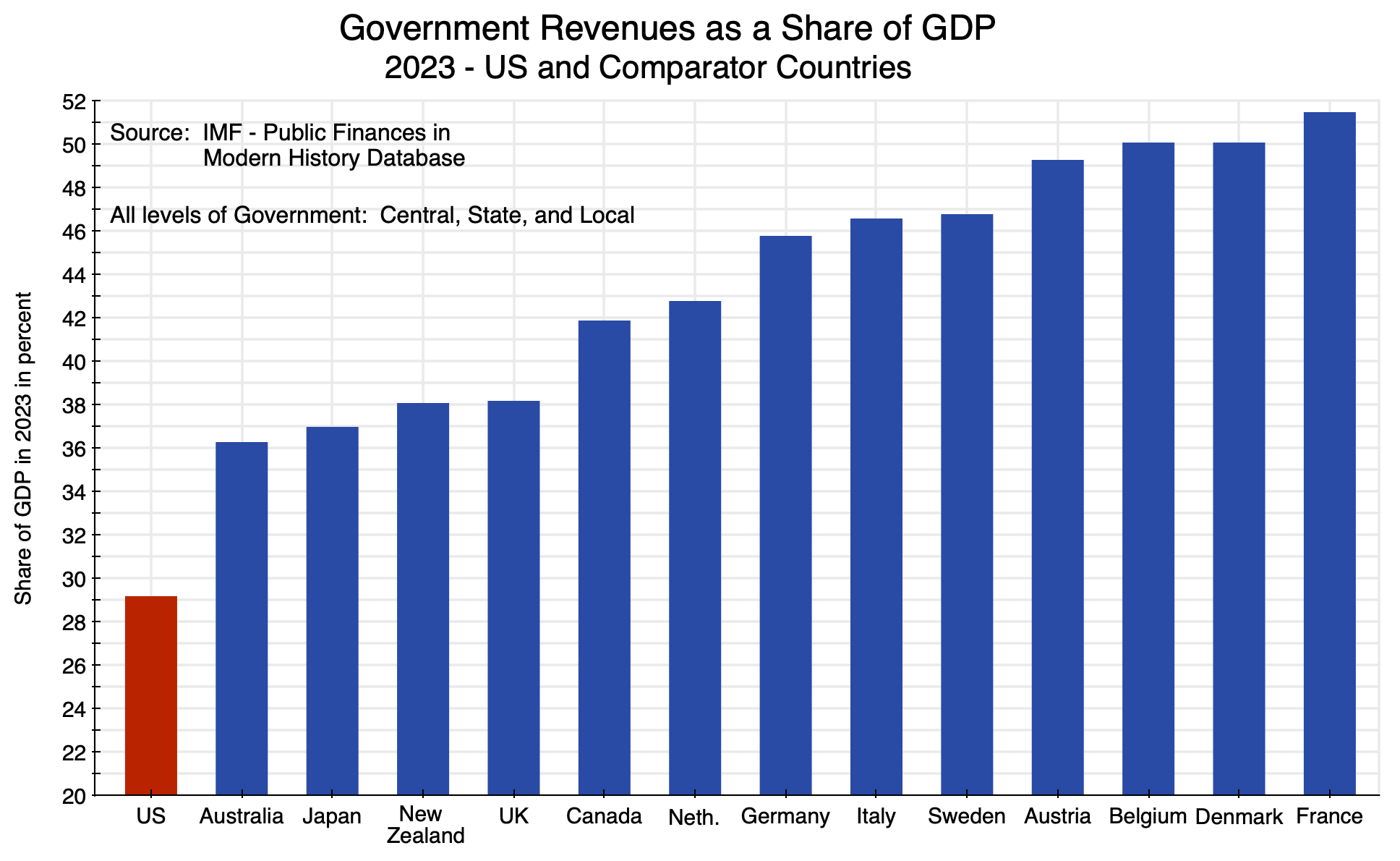
Chart 2

The figures here were assembled by the IMF and are for total government revenues at all levels of government (central/federal, state/provincial, and local) in order for the figures to be comparable across countries.

The US collects far less in government revenues as a share of GDP than do comparator nations.  In 2023, government revenues totaled 29% of GDP in the US.  The closest nation to the US in this list was Australia, at 36% of GDP – 7% points higher.  It was 38% for the UK (9% points higher), an average of 47% for all the European nations on this list (18% points higher), and over 50% of GDP in Belgium, Denmark, and France.

Those other countries have done well.  Living standards are high, and public infrastructure is typically far better than in the US (where it is often an embarrassment).  If all those countries are doing well, it is difficult to see the basis for the assertion that a modest rise in government revenues in the US (of, say, 3% of GDP) would be so problematic.

One can also look at some specific indicators.  Critics of higher taxes assert they would lead to a lower supply of labor (as they claim people would choose to work less when facing a higher tax rate) and a lower supply of capital assets (as they claim corporations and other business entities would invest less when facing higher tax rates).

But neither appears to be a problem in comparator countries.  Labor force participation rates in these comparator countries are – with one exception – all higher than in the US:
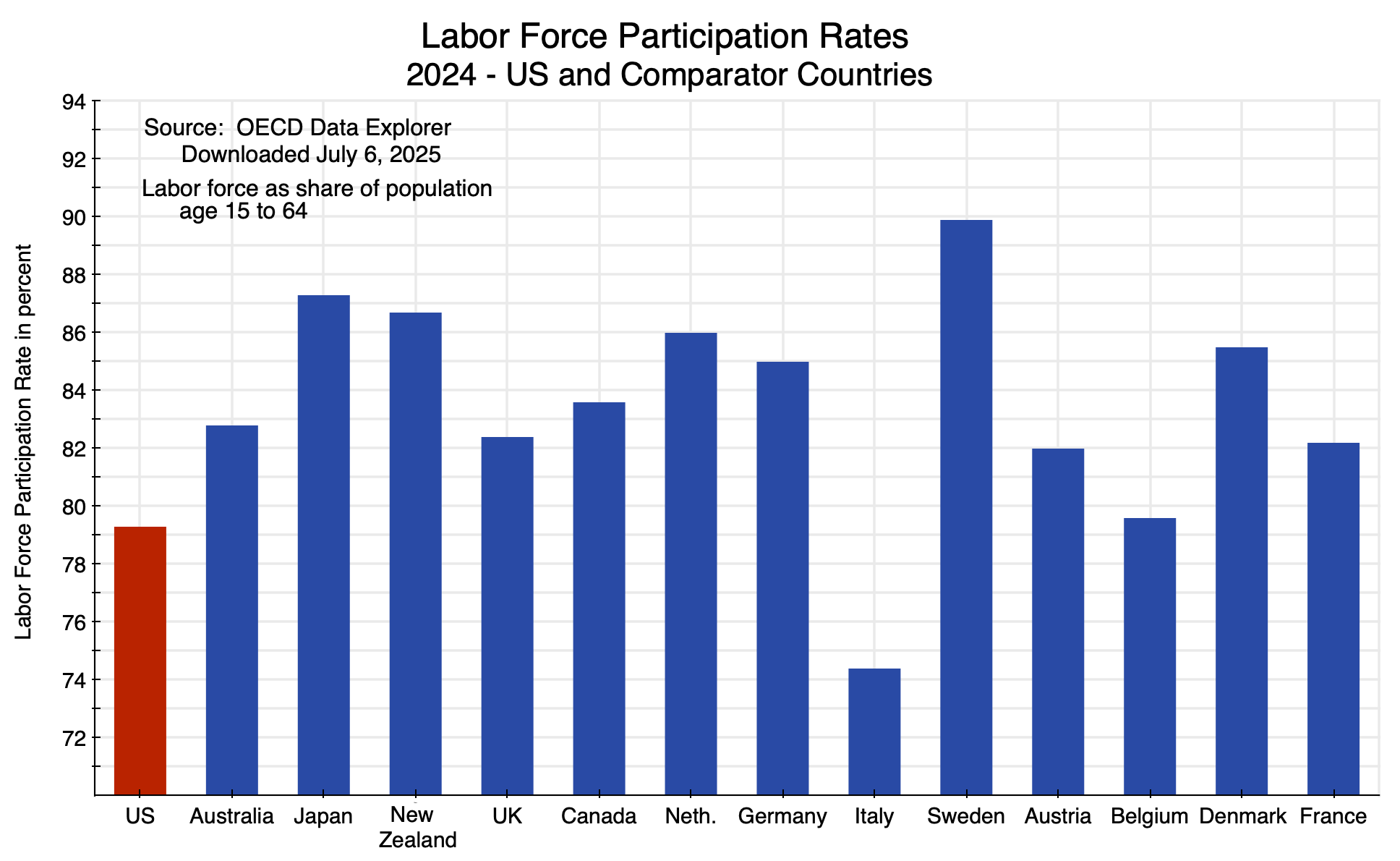
Chart 3

The data are from the OECD (where figures across countries are based on comparable definitions).  The US rate was 79.3%, and the only country with a lower rate than this was Italy (at 74.4%).  The participation rates were higher in all the other countries, and often substantially higher.  The rate was almost 90% in Sweden, despite government revenues 17.6% points of GDP higher than in the US.  Social policy is a far stronger determinant of labor force participation than tax policy.

Higher taxes are also not associated with lower investment.  Investment in the comparator countries are all higher than in the US with two exceptions:
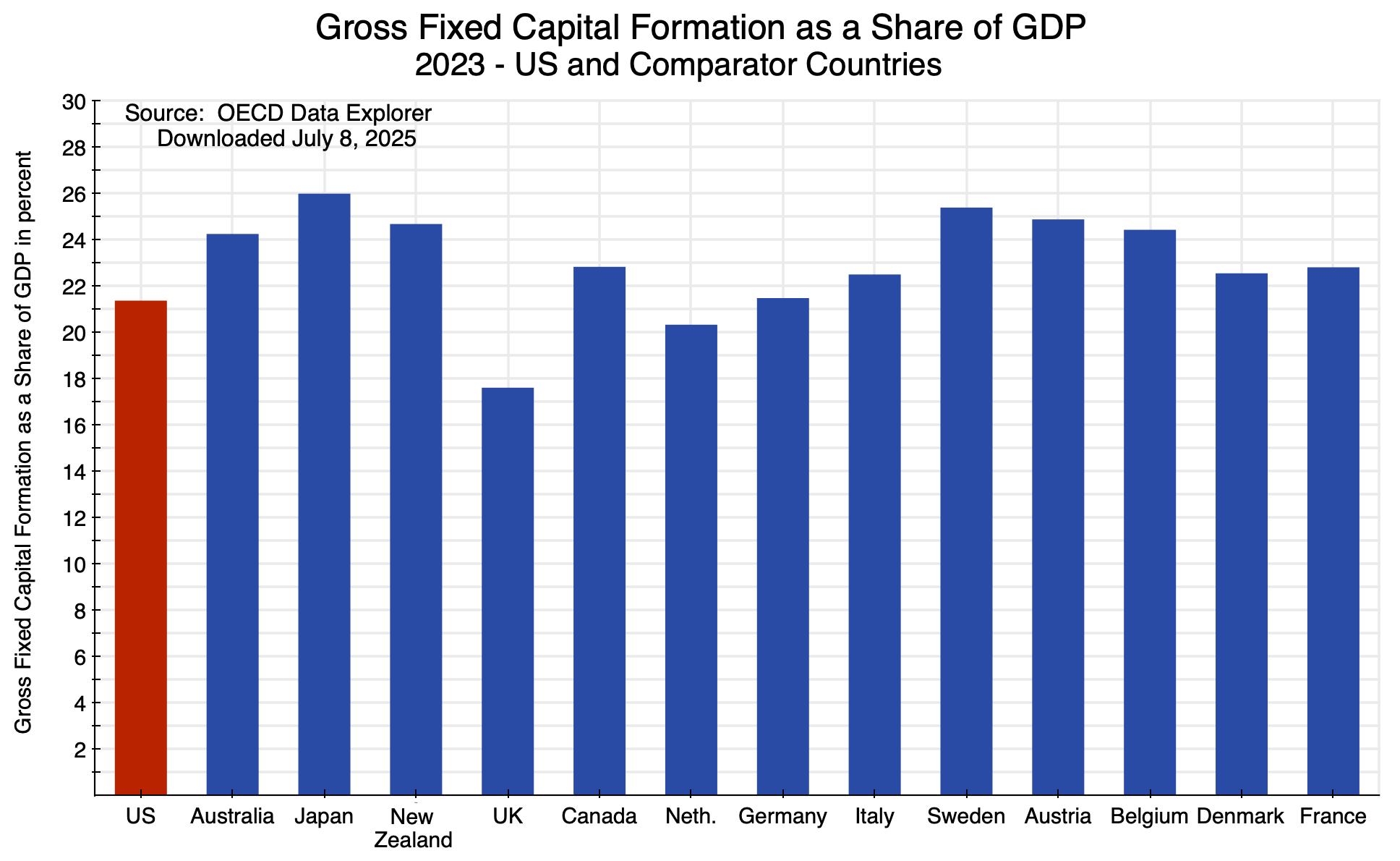
Chart 4

The chart shows gross fixed capital formation (i.e. investment) as a share of GDP in the set of countries in 2023, the most recent year with complete coverage in the OECD data.  The US was at 21.4% of GDP.  The UK was less at 17.6% and the Netherlands marginally less at 20.4%.  The rates were higher in all the other countries, and they were higher despite collecting far higher tax revenues as a share of GDP.

In sum, I would not suggest that the US go to taxes at the level of France, nor even Australia.  But to argue that the US cannot “afford” to raise tax revenues by 2 or 3 or 4% of GDP is belied by the ability of other countries – with comparable incomes and arguably a better standard of living for most of the population – to raise far more than that.  And there is little indication that labor force participation or capital investment are diminished even with government revenue collections that are far greater (as a share of GDP) than what they are in the US.

One can also look at the experience of the US itself.  Government revenues (federal only now) reached 20.0% of GDP in FY2000 – the last year of the Clinton administration.  After repeated tax cuts, it was only 17.1% of GDP in FY2024.  That is, the US was able to raise federal revenues in FY2000 that were almost 3% of GDP higher than what they were in FY2024.

The economy did not suffer when those higher revenues were collected.  Real GDP grew by 4.1% in 2000, and at a 4.5% rate in the four years of Clinton’s second term.  It has not grown faster than that for any four-year period since then, and only once for any individual year since then (in 2021, under Biden with the recovery from the Covid downturn).  This is despite the tax cuts of Bush and Trump.

Nor did the tax cuts help investment.  Real private fixed investment grew at a 8.8% rate in the four years ending in 2000 and real private fixed nonresidential investment (i.e. investment by businesses) grew at a 10.2% rate in the four years ending in 2000.  Neither has grown at such rates in any four-year period since then, despite the repeated tax cuts of Bush and Trump.

The labor market was also strong.  The unemployment rate fell to 3.8% at one point in 2000 (and was 3.9% still at the end of the year) – the lowest unemployment rate for the US up to that time since the 1960s.  Total nonfarm employment grew at a 2.2% rate in 2000 and total private nonfarm employment grew at a 2.1% rate.  Both were faster than in any subsequent year until 2021-23 during the Biden administration.  The four-year growth (in annualized terms) ending in 2000 was 2.5% for total employment and 2.6% for private employment.  Both were faster than in any subsequent four-year period until the four years ending in 2024 in the Biden administration.

So can the US do well with taxes set to raise an extra 3% of GDP?  Certainly.  Other countries do not suffer despite raising far higher government revenues as a share of GDP, and the US itself raised that much in additional government revenues in 2000.  What is basically needed is a reversal of the repeated tax cuts of Bush in 2001 and 2003, Trump in 2017, and now Trump again in 2025.  The government debt to GDP would not now be at 100% of GDP, rising on a trajectory for it to go ever higher for the foreseeable future (if the financial markets allow it), if government revenues were increased by just a few percentage points of GDP.

D.  Some Critiques

a.  Republican arguments for tax cuts are not supported by historical evidence nor by theory

A standard Republican argument since Reagan is that tax cuts will spur growth, as they claim labor will choose to work longer hours and businesses will invest more.  They have also argued that real wages would rise as a consequence of this higher investment.  Indeed, Republicans have argued repeatedly – starting with the Reagan tax cuts of 1981 – that tax cuts will increase growth by so much that they will “pay for themselves”.  That is, they asserted that GDP and incomes would rise by so much that total tax collected would rise rather than fall.  The arguments were repeated for the Bush tax cuts of 2001 and 2003, for the Trump tax cuts of 2017, and have been made once again for the OBBBA.

However, this never turned out to be true.  See earlier posts on this blog that examined the impact of the Reagan and Bush tax cuts (which found they were not a boost to employment nor to growth, but did increase fiscal deficits); examined whether the Reagan tax cuts led to higher real wages (they did not); examined the record of Trump’s first term compared to that of Obama and Biden (which found that despite the tax cuts of 2017, growth was slower during Trump’s first term than under Obama and Biden even before the 2020 Covid crisis, that employment growth was substantially less, and business investment was no higher); and looked at what happened to corporate profit taxes following the sharp cut in corporate tax rates in 2017 (they fell in half, which should not be surprising but is counter to the argument that they would “pay for themselves”).  Another post showed that if the government revenues lost due to the 2017 tax cuts under Trump were directed instead to the Social Security Trust Fund, Social Security would remain fully funded for the foreseeable future, rather than being depleted by 2034.   What was lost in the 2017 tax cuts alone was huge.

One should also not forget that the highest marginal income tax rates in the US in the 1950s (when Eisenhower was president) were 91 or 92%.  Rates at even those levels did not crush the economy.

History does not, therefore, provide support for the argument that the tax cuts of Reagan, Bush, and Trump led to higher growth, employment, or real wages.

Aside from the empirical evidence of history, the arguments that lower taxes will spur increased work effort and business investment are also mistaken at a theoretical level.  As presented in another earlier post on this blog, the argument on labor supply is flawed as it fails to recognize that there will be income effects (and much more) as well as substitution effects when taxes on wage income change.

The Republican argument is that when one taxes wages, labor will work less as their after-tax return will be less.  This is a substitution effect.  But as is taught in any introductory Econ 101 course, there are income effects as well.  They work in the opposite direction, as people work to achieve a certain standard of living as well as sufficient savings for retirement.  There are also social (e.g. availability of childcare) as well as legal factors (e.g. a standard 40-hour workweek) that are probably as important, if not more important.  And as discussed in Section C above, labor force participation rates in the US are less – in some cases substantially less – than in comparator countries with far higher taxes than in the US.

The argument against profit taxes is also flawed.  The argument is that when profits are taxed at a lower rate, businesses will invest more.  But that is not so clear (in addition to not being seen in the evidence).  Businesses invest in the expectation of making a profit.  A share of those profits are then paid in taxes.  If the tax rate on profits is reduced, that does not mean that an investment that would otherwise be a loss (be unprofitable) will then become profitable.  Rather, the lower tax rate on profits will mean that the businesses will retain a higher share of the profits on investments that are profitable.  Such taxes – when properly structured as a tax on profits – will not turn a profitable investment into a loss.

This is the case when firms choose to invest whenever they expect to earn a profit, including possibly only a small profit.  Mathematically, it will be different if firms will only invest in the expectation that they will earn some minimum rate of return – called the hurdle rate.  The tax rate on profits can then matter as the taxes will reduce the after-tax rate of return to less than what it was before taxes.  For investments on the margin (there may not be many), taxes could then lead to an after-tax rate of return below the hurdle rate.  Investments that are expected to generate a very high before-tax rate of return will not be affected, as the after-tax rate of return would still be above the hurdle rate.  Nor would they affect investments expected to generate a low before-tax rate of return.  Such investments would not be done in any case.

In terms of the numbers, the impact of taxes on profits within the relevant range for the rate of return is not substantial.  While this will depend to some degree on the specific pattern of returns as well as the lifetime of the investment, an increase in the tax rate on corporate profits from the current 21% by 3% points to 24% will generally reduce the after-tax rate of return by only a percentage point or less.  That is, if the hurdle rate is 10.0%, the increase in the tax on corporate profits by 3% points will only matter for investments with an expected rate of return of between 10.0% and 11.0%.  There will not likely be many investments in this narrow relevant range.  Those who make decisions on corporate investments also know that they can rarely predict the rate of return on some investment so accurately that this would matter.

The increase in the tax rate on corporate profits from 21% to 24% would be for the headline rate.  Due to numerous measures in the tax code, what corporations actually pay is much less.  Using BEA figures in the NIPA accounts, corporations only paid an average tax of 12.8% on corporate profits in 2024.  An increase in this to 15.8% would have close to the same impact as an increase from 21% to 24% on the rate of return on potential investments:  It would reduce the return by a percentage point or less.  Hence, it would only matter for investments with an expected rate of return only marginally above the company’s hurdle rate.

As with labor supply, one should also not presume that only narrow economic factors matter.  Social factors can also matter, where businesses look at what others are doing (and do not want to be left behind), “animal spirits” matter, and investment decisions are based on far more relevant considerations than whether the tax rate on any profits that are made (if profits are made) are somewhat higher or somewhat lower.

b.  Interest rates can be expected to be lower than otherwise when the fiscal accounts are on a sustainable path, and GDP growth would then rise not fall

Raising tax revenues by 3% of GDP or more can in fact be expected to lead to an increase – not a decrease – in the rate of growth of GDP.

The US fiscal accounts are on an unsustainable course with the ever-rising public debt to GDP ratio.  The US Treasury needs to borrow the funds necessary to cover the annual deficit (as well as to roll over all the debt coming due in each period), and lenders will become increasingly cautious as debt rises on a path of steadily increasing debt relative to GDP.  As they become increasingly cautious, they will only lend the funds needed if they are given a higher interest rate.

Putting the fiscal accounts on a path with a falling public debt to GDP ratio will avoid this.  Interest rates would then fall to less than what they would have been with an ever-rising debt to GDP ratio.  Lower interest rates can then be expected to spur investment.  The scenarios in the chart at the top of this post all assume fixed values in each year for interest rates as well as GDP (those in the CBO’s baseline scenario of last March).  But a more complete analysis would account for both the lower cost to the US Treasury of the consequent lower interest rates and an increase in the rate of growth in GDP (as a result of increased private investment) when the fiscal accounts are placed on a sustainable path.  Both would then lead to a more rapid fall in the public debt to GDP ratios than presented in the chart at the top of this post.

c.  We now know from OBBBA and Musk/DOGE that cutting federal expenditures by the amount needed to put the fiscal accounts on a sustainable path is not possible

Mathematically, the fiscal deficit would also be reduced and the public debt to GDP ratio would fall if, instead of increasing federal revenues by, say, 3% of GDP, federal expenditures were cut by 3% of GDP.  But while mathematically true (under the assumptions that interest rates, GDP growth, and other such factors are then unchanged), what we have seen with the OBBBA and with the failure of the Musk/DOGE campaign are the high costs of trying to cut government expenditures by even a small fraction of what would be needed.  Their efforts have shown that cutting federal expenditures by the 3% of GDP target considered above is simply not feasible.

To start with the OBBBA:  The CBO estimates that the bill in its final form (as passed by the Senate, then by the House, and signed by Trump) will reduce federal revenues by $4.5 trillion over the ten years of FY2025 to FY2034.  Most of this loss in revenue is from tax cuts primarily of benefit to the rich.  To try to reduce the impact this would have on the federal deficit, Republican leaders in both the House and the Senate strenuously sought to find significant federal expenditures they could cut.  The final bill, as passed, cut expenditures over the ten years by a net of $1.2 trillion.  Planned expenditures were increased for certain Republican priorities – specifically about $150 billion for the military and about $190 billion for anti-immigrant measures (funding for prisons, the border wall, and similar, and including for the Coast Guard) – while targeted programs for the poor were cut severely.

The main program cut was Medicaid, with an expected reduction in federal costs of $1.04 trillion over the ten years.  There were also cuts to the food stamps program (SNAP) and other health care programs with a focus on the poor (such as CHIP – the Children’s Health Insurance Program).  Medicaid expenditures would be cut by making enrollment more bureaucratically difficult as well as by reductions in the federal share of costs covered.

The CBO has estimated that the Medicaid measures alone will lead to 11.8 million fewer people being covered by Medicaid.  (This 11.8 million estimate is hard to find, but is presented in a footnote on the Summary page of the spreadsheet with CBO’s cost estimate of the Senate version of the OBBBA.  The spreadsheet can be found here.  The 11.8 million figure is an update of a 10.9 million estimate for the original House-approved version of the bill, and reflects changes that the Senate added to what became the final version of the OBBBA.)

This cut to Medicaid coverage has been strongly criticized.  The program is only for the poor, and 11.8 million is a massive number.  Much of the “cost savings” will also prove to be a false savings at the national level, as many of those denied health insurance cover can be expected to end up in much more expensive hospital treatment both for routine treatment and for treatment when their health condition has worsened to the point that only a hospital will suffice.  In addition, some of the federal savings will come from shifting costs to the states.

Despite the severe impacts on the poor, the estimated $1.04 trillion reduction in federal expenditures over the ten years only comes to less than 0.3% of GDP over the period.  Cuts would need to be ten times as high to get to 3% of GDP in federal expenditure reductions.  Republicans in the House and the Senate were only able to find a net of $0.2 trillion in other expenditure reductions (after the increases for the military and for anti-immigrant measures), bringing the total cut in expenditures to $1.2 trillion, or 0.34% of GDP over the ten years.

If they could have found more to cut, they would have.  The fact that they could not is telling.

The cuts orchestrated by Elon Musk and the DOGE group he established (all with the strong backing of Trump) also failed.  Musk said they would be able to cut “at least” $2 trillion in federal expenditures out of the $6.5 billion budget of Biden (which was actually $6.75 billion in FY2024).  This was, of course, always nonsense.  On the DOGE website (as of July 13, when I accessed this) they claim on their “wall of receipts” that they have achieved “savings” of $190 billion.  That is less than one-tenth what Musk claimed they would easily do.

And the $190 billion figure itself is certainly wrong.  While the documentation provided was far from adequate for most of the line items they listed, analysts nonetheless found numerous errors in many of the costs DOGE claimed to have saved.  A prominent, and obvious, early example was a claim of saving $8 billion on one canceled contract when it was in fact an $8 million contract (this was later corrected).  But analysts have also found that some contracts were counted twice or even three times, that savings were claimed on contracts that had already expired or been canceled during Biden’s term, that they confused what would be spent on certain contracts with certain caps, that iffy guesses were made on savings on contracts that had not yet been awarded, and more.  The figures were also wrong as they mixed one-time asset sales with expenditure reductions, savings over multiple years as if they had all been saved in this year, and other basic accounting mistakes.

The actions of the Musk/DOGE group have also led to higher costs being incurred.  For example, key government personnel who had been fired (such as a group of nuclear safety experts) then had to be rehired (or alternative personnel hired), and certain contracts that had been canceled had to be renewed (at a higher cost due to the disruption).

The cuts made have also not had a noticeable effect on overall federal government expenditures.  As of July 10 (the most recent date in the data as I write this), federal expenditures in 2025 under the Trump administration have been $300.5 billion higher since Inauguration Day than they were over the same period in 2024 under Biden.

There have been cuts – some of them drastic for individual agencies (such as USAID, which has been completely dismantled) – but even $190 billion in cuts (an inflated figure, as discussed above) would only amount to 0.6% of GDP.  It is also clear that the cuts have not reflected cuts in “waste, fraud, and abuse” despite assertions that they have.  Musk/DOGE never even examined whether waste, fraud, or abuse was present.  Rather, they cut where it was easy to do. An example has been the blanket firing of staff on probation.  Newly hired government staff, and staff who have been promoted, will typically be on probation for their first year (sometimes longer).  They can be readily fired with limited rights to appeal, and thus were easy targets for dismissal by the DOGE team.  But recently promoted staff were promoted because they were good performers, and they are precisely the staff the government should want to keep.

There have also been and will be costs from government work not done.  The clearest will be lower tax revenues collected as a consequence of major cuts in the IRS budget and its staff.  Already as of the end of March, the IRS had lost close to one-third of its auditor staff and 11% of its overall staff, with an objective of going to a cut of half of all staff.  The loss of auditor staff is particularly costly.  A group of researchers – primarily at Harvard – estimated from IRS data that audits on average generate $2.17 in additional revenue for every $1 spent.  The return is much higher for audits of high-income taxpayers, with an average return of $6.3 for every $1 spent on audits of those in the top 0.1% of income.  And if one includes an estimate of the resulting deterrence effect in future years for the individuals involved and for those who see what was done, the return is $36 per $1 spent for the richest 0.1%.  This would be seen by anyone in the private sector as a tremendous return on investment.  But it has been treated as rather something to cut if one wants to make it easier for the top 0.1% to cheat on their taxes.

The IRS cuts, especially of the audit staff, will lead to a major reduction in federal revenues, thus widening – not narrowing – the fiscal deficit.  An estimate by the Yale Budget Lab (a program at Yale University) concluded that if half of the IRS staff are dismissed, the federal government would lose $395 billion in tax revenues in the next ten years and a net of $350 billion once $45 billion in IRS cost “savings” are taken out.

It is also worth noting that due in part to constraints on the IRS limiting its ability to ensure all taxes due are paid, the US lost an estimated $696 billion in tax revenue in 2022.  That was 2.7% of GDP that year.  Just collecting that would have led to an increase in federal revenues of close to the 3% target discussed above.  It will of course never be possible to collect 100% of what is due, but it is clear that much more could be done by properly funding the IRS.  Instead, Musk and his DOGE group have slashed IRS funding and staff.

The Musk/DOGE cuts have also slashed funding for medical research and basic science research, and for agencies such as USAID, the National Oceanic and Atmospheric Administration (NOAA – where the National Weather Service resides), and others.  There will be damage from this, although some will be difficult to assess.  It will be impossible, for example, to point with any certainty to a specific medical cure that will not now be found due to the cuts in medical research.

But we do know that medical research in the past has been critical to cures we now have to forms of cancer, to heart disease, and much more.  Two prominent economists (David Cutler and Ed Glaeser, both Professors of Economics at Harvard) recently arrived at a very rough estimate of what the cost would be to the nation if Trump’s proposed cut in the NIH budget (of 43%, with a resulting cut in NIH supported research of 33%) is approved and sustained.  Based on the past relationship between NIH supported medical research, resulting therapies, and their impact on life expectancy, they estimated that $20 billion proposed cut in the NIH budget (adding up to $500 billion over a 25 year time horizon), would lead (conservatively) to a loss to the nation of $8.2 trillion from the reduced life expectancy.  That is, the loss would be $16 for each $1 reduction in funded medical research.

Or take the case of USAID.  Musk was absolutely gleeful in early February when he announced that he had “spent the weekend feeding USAID into the wood chipper”.  Later in the month he waved around a chainsaw in celebration of the funding that had been slashed as he posed on stage in black clothes and dark sunglasses at the Conservative Political Action Conference.

The end of USAID and its programs will have a brutal impact on many in the countries where it provided assistance.  While the Musk/DOGE did not examine the effectiveness of USAID before feeding it “into the wood chipper”, a recently published peer-reviewed article in the medical journal The Lancet did.  The researchers examined the impact of USAID programs on mortality in the period 2001 to 2021, and concluded that those programs led to 92 million lives being saved (with a two standard deviation uncertainty band of 86 million to 98 million).  They also looked at the resulting reduction in mortality from specific causes such as tuberculosis, HIV/AIDs, maternal mortality, and more.  And based on their findings, they concluded that unless the funding cuts announced for the USAID programs in the first half of 2025 are reversed, deaths will rise in the countries affected by 14 million in the years to 2030 (and then continue).  Of those deaths, 4.5 million will be deaths of children under the age of five.

For a specific example of the impacts in the US itself, we have just seen the tragedy of the flooding in Texas on the night of July 4.  As of July 13, 129 are confirmed dead, including 36 children in Kerr County alone (mostly from Camp Mystic, a Christian camp for girls).  An estimated 170 remain missing.  No one has been found alive since July 4.

Questions have been raised on whether the Musk/DOGE cuts in the staff and budget of the National Weather Service may have played a role in this tragedy being as bad as it has been, and on whether changes at FEMA have delayed its ability to respond on a timely basis to the destruction from the floods.

The National Weather Service (NWS) has lost about 17% of its staff (a loss of about 600 staff members) from the Musk/DOGE cuts.  Five former leaders of the NWS (in both Republican and Democratic administrations) released a public letter in May warning that such cuts could lead to loss of life.  Cuts in the NWS budget have also forced it to cut back on the information it gathers on the weather, such as cuts in the daily number of balloons it launches (previously twice a day at 100 sites) to obtain information on atmospheric temperatures, humidity, and wind speed.

What is not clear is whether those cuts led to a lack of adequate warning of the flooding.  Local officials have stated that more rain came down than was forecast, which led to more severe flooding than expected.  Other observers have stated that the forecasts were as good as one could expect.  The two NWS offices responsible for this region in central Texas (San Antonio and San Angelo) were operating, however, with 10 vacancies out of 33 positions for meteorologists on staff.  Most importantly, the position for the meteorologist responsible for communication with local officials was vacant.  The long-time member of the staff responsible for this took one of the early-retirement buy-out packages offered as part of the Musk/DOGE cuts.

The forecast of a flash flood happening may have been as good as one could expect given the circumstances.  But if the danger was not adequately conveyed to local authorities on a timely basis, a tragedy could still follow.  And the NWS apparently recognizes from experience the need for a position with a professional meteorologist responsible for such communications.

There have also been concerns raised with the slow response of FEMA to the flooding.  FEMA search and rescue teams did not reach the site of the disaster until a week after the disaster, having been told by FEMA to mobilize only five days after the flooding.  In flooding in the Appalachians early this year, the teams reached the sites within 12 hours.  FEMA also did not answer two-thirds of the calls to its disaster assistance line, after having laid off hundreds of contractors who had been responsible for answering such calls at the close of business on July 5 (when their contracts expired).  Secretary of Homeland Security Kristi Noem – the cabinet office responsible for FEMA – asserted this was not true.  But documents reviewed by The New York Times indicate otherwise.

Earlier this year, Trump had said he wanted FEMA to “go away”.  Noem indicated in March that she was going to “eliminate” FEMA.  The cost of degrading FEMA capacity is now becoming clear, however.

E.  Summary and Conclusion

An ever-rising public debt to GDP ratio is not inevitable.  Nor is it sustainable.  And it would not take much to reverse it.  An increase in federal revenues of just 2% of GDP (and reversal of the OBBBA tax cuts) would lead to a debt to GDP ratio that is broadly stable, while a larger increase would lead the ratio to decline.

An increase of 3% of GDP in federal revenues would be modest.  Comparator countries collect far more; the next lowest country (Australia) collects 7% points of GDP more in government revenues than the US does.  And the US itself collected 3% points of GDP more in federal government revenues in FY2000 at the end of the Clinton administration than it did in FY2024.

The arguments that have been made that higher tax rates will lead to slower growth (and lower tax rates to faster growth) are not supported by the historical evidence nor by theory.  Rather, it was the tax cuts of Bush in 2001 and 2003, and of Trump in 2017, that have led to the unsustainable rise in the public debt to GDP ratio.  The just passed OBBBA will make this even worse.

We have seen this story before.  A post on this blog from 12 years ago (with a title that also begins with “We Have a Revenue Problem …”) showed that the federal debt to GDP ratio would have fallen over time had the Bush tax cuts of 2001 and 2003 (then up for renewal) been allowed to expire.  This assumed, of course, that there would also never have been the Trump tax cuts of 2017 and now in 2025.  The analysis of the current post has arrived at a conclusion that is essentially the same.  Our nation is on an unsustainable fiscal path not because too much is being spent, but because of the repeated tax cuts of Bush and Trump.

While government expenditures are not to blame for our unsustainable fiscal condition, cuts in expenditures of a sufficient magnitude (such as 3% of GDP) would mathematically also reduce the debt ratio, taking all else as equal.  But cuts of such a magnitude are simply not possible.  Republicans sought strenuously to find programs to cut as part of the OBBBA to offset some of the impact on the deficit of the tax cuts that were their priority.  In the end, the major program they cut was Medicaid.  But those cuts amounted to less than 0.3% of GDP – only one-tenth of what one would need for 3% of GDP.  Even with the cuts to food stamps and other programs targeted for the poor, the total net reduction in expenditures was still only 0.3% of GDP within round-off.

The Musk/DOGE cuts have also not been anywhere close to the $2 trillion that Musk claimed he could easily do.  The current claim is that $190 billion has been cut, but that figure is itself inflated by dodgy accounting.  And even $190 billion is just 0.6% of GDP.

Important programs have certainly been cut by the Musk/Doge group, and thousands of federal government staff have lost their jobs.  But the costs of those cuts are becoming evident.  The US is losing much of what had made it great.

Reversing the direction of the public debt to GDP ratio is not impossible, nor even complicated.  There is a need for more federal revenues.  But in the current political environment, it is doubtful anything will soon be done.

GDP Growth is Strong – Perhaps Too Strong

A.  Introduction

On April 25, the Bureau of Economic Analysis released its initial estimates of the GDP accounts for the first quarter of 2024 – what it calls the “Advance Estimate”.  These initial estimates of the growth of GDP and of its components are eagerly awaited by analysts.  While revised and updated in subsequent months as more complete data become available, it provides the first good indication of what recent growth has been.

In the first quarter of 2024, real GDP grew at an estimated annual rate of 1.6%.  This was viewed by many analysts as disappointing, as the average expectation (based on a survey of economists by Dow Jones) was for 2.4% growth.  And it was a deceleration in the rate of growth of GDP from 4.9% in the third quarter of 2023 and 3.4% in the fourth quarter.  The Dow Jones Industrial Average then fell by 720 points in the first half hour of trading (1.9%), with this attributed to the “disappointing” report on GDP growth.  It later recovered about half of this during the day.

One should have some sympathy for the commentators who are called upon by the media to provide an almost instantaneous analysis of what such economic releases imply.  But if they had examined the release more closely, the conclusion should not have been that economic growth was disappointingly slow, but rather that it has been sustained at a surprisingly high level.  After two quarters of extremely fast growth in the second half of 2023, some moderation in the pace should not only have been expected but welcomed.

The economy under Biden has been remarkably strong.  The unemployment rate has been at 4.0% or less for 28 straight months, and has reached as low as 3.4%.  Unemployment has not been this low nor for this long since the 1960s.  And an economy at full employment can only grow at a potential rate dictated by labor force growth and productivity.  The ceiling is not a hard one in any one quarter (labor utilization rates, and hence productivity, can vary in the short term), plus there is statistical noise in the GDP estimates themselves.  But growth in what is called “potential GDP” sets a ceiling on what trend growth might be.  And if the economy is at or close to that ceiling (as it is now), it can only grow over time at the pace that the ceiling itself grows at.

B.  Potential GDP

There are various ways to determine what potential GDP might be.  A respected and widely cited estimate is produced by the Congressional Budget Office (CBO), with figures on potential GDP for both past and future periods (up to 10 years out).  It is based on estimates of what the potential labor force has been or will be, accumulated capital, and technological progress.  In any given year, the CBO estimates reflect what GDP could be with the capital stock that would be available and the production that capital would allow, along with labor utilization at “full employment”.

The chart at the top of this post shows what real GDP per capita has been over the 11 years from the start of Obama’s second term (2013Q1) to now (2024Q1), along with the estimate by the CBO of potential GDP (expressed in per capita terms).  Not only is the economy now close to the potential GDP ceiling, it is a bit beyond it.  This is possible with the CBO estimates of potential GDP as they assume the labor market cannot sustain for long an unemployment rate of below roughly about 4.5% (which can vary some over time, based on the structure of the labor force).  Hence if actual unemployment is below this – as it is now and as it was for a period in 2019 – “potential GDP” as estimated by the CBO can be below actual GDP.  There are other factors as well, but the level of unemployment is the most significant.

This is also why actual GDP was below potential GDP from 2013 to late 2017 in the chart.  Unemployment was still relatively high in 2013 coming out of the 2008/09 economic and financial collapse.  As discussed in earlier posts on this blog (see here and here) limitations on government spending imposed by the Republican-controlled Congress slowed the recovery from that downturn and kept GDP well below potential for far too long.  This was the first time government spending had been cut following a recession since the early 1970s.  Federal government spending on goods and services fell at an average annual rate of 3.2% each year (in real terms) from 2011 to 2014.  In 2015 and 2016 it was finally allowed to grow, but only at a slow 0.3% per year pace on average.  Only after Trump was elected did Congress allow federal government spending to rise at a more significant rate – at 2.6% per year between 2017 and 2019 (and then by much more in 2020 due to the Covid crisis, by which time Democrats controlled Congress).

This lack of a supportive fiscal policy following the 2008/09 economic and financial collapse slowed the pace of recovery.  Unemployment fell only slowly, but did still fall, and reached 4.7% by the end of Obama’s second term.  The gap between actual and potential GDP diminished, and as seen in the chart at the top of this post, actual GDP has been close to potential GDP since 2018 (with the important exception of the 2020 collapse due to Covid).

The economy is now at – or indeed a bit above – the CBO estimate of potential GDP.  Although there may be quarter-to-quarter fluctuations – as noted above – going forward one cannot expect GDP to grow on a sustained basis faster than that ceiling.  And the CBO forecasts that potential GDP is growing at a 2.2% pace currently, with this expected to diminish over time to a 2.0% pace by 2030 and a 1.8% pace by 2034.  This is primarily due to demographics:  Growth in the labor force is slowing.

Real GDP grew at an average annual rate of 4.1% in the second half of 2023 (3.4% in the third quarter and 4.9% in the fourth quarter).  This is well above the CBO’s estimate of potential GDP growing at a 2.2% rate.  Some slowdown should have been expected.  Even with the 1.6% rate for the first quarter of 2024, real GDP has grown at an average annual rate of 3.3% since mid-2023.  It should not be surprising if GDP growth in the second quarter of 2024 comes in at a relatively modest rate, as the economy returns to the trend growth that potential GDP allows.

However, the initial indication from the Atlanta Fed’s GDPNow indicator is that GDP growth in the second quarter of 2024 will in fact be quite high at a 3.9% rate (in its initial estimate made on April 26 – the most recent as I write this).  If that turns out to be the case, it would not be surprising if the Fed becomes concerned with a pace of growth that is excessively fast.

C.  Other Indicators of an Economy Fully Utilizing Its Potential

One wants an economy that is fully utilizing its potential.  With full employment, one is not throwing away goods and services – as well as the corresponding wages and income – that labor and producers would be eager and able to provide.  But once an economy has reached that potential, it can only grow over time at the rate that that potential grows.  This pace is dictated by demographics (growth in the labor force) and growth in productivity.  While this will be a slower pace than what would be possible for an economy with underutilized labor and other resources – where a period of more rapid growth is possible by bringing into employment those underutilized resources – once one is at the ceiling one cannot grow on a sustained basis at a pace higher than that.  Trying to do so leads to inflation.

With this perspective, a number of observations come together from this release on 2024 first-quarter growth in GDP and its components:

a)  The 1.6% growth rate was viewed as “low”.  But as noted above, this followed exceptionally high growth, of 4.9% in the third quarter of 2023 and 3.4% in the fourth quarter.  One should have expected a slowdown.

b)  There is also evidence of the economy reaching its capacity limits in how the particular components of the GDP figures changed.  Keep in mind that GDP, while derived in these accounts from estimates of what was sold for final demand uses (consumption, investment, etc.), is still a measure of production, not just sales.  That is, GDP – Gross Domestic Product – is a measure of what is produced, produced domestically, and in “gross” terms (because investment is counted in gross terms rather than net of depreciation).

The reason this indirect approach to estimating production works is because whatever is produced and not sold will end up as an increase in inventories.  And this change in inventories is treated as if it were a final demand category.  It can be viewed as a form of investment (investment in inventories), and is included in the accounts as part of overall investment (i.e. it is added to fixed investment, which is investment in machinery and structures).

Furthermore, foreign trade is included in net terms:  exports less imports.  Part of what is produced domestically is sold for exports, while imports supply products that can be used to satisfy domestic demands.

When an economy is operating at or close to potential GDP, one can expect final demands to be increasingly met by drawdowns of inventory (or less of an increase in inventories compared to before) plus a decline in the net trade balance (less exports and/or more imports).  Each can supply product to meet final demands when domestic production is constrained because the economy is operating at close to the ceiling.

One sees both of these in the 2024Q1 figures.  While inventories still rose (by $35 billion, in 2017 constant prices), they rose by less than they had in 2023Q4 (when they rose by $55 billion).  Thus, while GDP includes the change in inventories as one of the demand components along with consumption and other investments, the change in GDP will be based on the change in the change in inventories.  (See this earlier post on this blog.)  And that fell in 2024Q1, as inventory accumulation – while still positive – was not as high as it had been in the previous quarter.  That change in the inventories component reduced GDP growth by 0.35% points relative to what it would have been had domestic production been such that inventory accumulation would have matched what it had been in the preceding quarter.  That it did not can be a sign that domestic production is being constrained by capacity.

Similarly and more importantly, the net trade balance fell.  While exports grew slightly (0.1% of GDP) imports rose by much more (1.0% of GDP), and hence the net trade balance fell by 0.9% of GDP.  This is consistent with domestic production being constrained by an economy that was already at full employment and could not immediately produce much more, and hence with demand that was increasingly met by net imports.

The changes in the net trade balance and in net inventory accumulation totaled 1.2% of GDP (before rounding).  That is, production (GDP) would have had to increase by 2.8% rather than 1.6% to supply domestic purchasers of final (i.e. non-inventory) product.  But with production constrained by capacity limits, the economy had to import more and limit inventory accumulation to less than before.

I should emphasize that this is not a bad position to be in.  One wants an economy operating at full capacity.  But when the economy is operating at full capacity, there will be limits on how much can be supplied domestically.  And as noted before, one cannot expect growth going forward – on average and recognizing there will be period-to-period fluctuations – to exceed the rate at which potential GDP can grow.

c)  Another indication of an economy reaching its potential ceiling is what is happening to prices.  This is more disconcerting.  Price deflators are estimated as part of the GDP accounts in order to convert (deflate) the nominal estimates of the various GDP components into estimates of what the real changes were.  While people focus on changes in real GDP and its components – and properly so – some may not fully realize that the data the BEA collects on production and sales are all in nominal money terms.  It is not really possible for producers to report anything else.  The BEA then converts those nominal money figures to changes in real terms by applying price indices to “deflate” the nominal figures – hence the term “deflator”.  The BEA obtains those price indices – tens of thousands of them – separately, primarily from the price surveys carried out by the Bureau of Labor Statistics.

The initial estimates of the GDP accounts released on April 25 indicated that the price deflators for both overall GDP and for the Personal Consumption Expenditures (PCE) component of GDP demand rose at higher rates than in the preceding several quarters.  The GDP deflator rose in the first quarter of 2024 at an estimated annual rate of 3.1% and the PCE deflator at a rate of 3.4%.  The PCE deflator receives special attention as it is the primary measure of inflation that the Fed focuses on as it considers what monetary policy to follow.  The Fed pays attention to much more as well, of course, but the PCE deflator is special.  And the Fed target for the PCE deflator is 2.0%.

The annualized rates for the GDP and PCE deflators were at 1.6% and 1.8%, respectively, in the fourth quarter of 2023.  They had been generally coming down since mid-2022, and had averaged 2.2% and 2.3% respectively in the final three quarters of 2023.  The increase in the first quarter of 2024 was therefore of some concern, especially when coupled with the other indications (discussed above) that the economy is now at or even above the potential GDP ceiling.

But it is also important to keep in mind that – as often said – one period’s figures do not constitute a trend.  There have been, and will be, quarter to quarter fluctuations.  But the increase in the price deflators from below the Fed’s 2.0% target to a level a good deal higher, coupled with the other indications of an economy operating at or close to capacity, is something to watch.  And it suggests that the Fed is likely to remain cautious and not reduce interest rates from where they now are until they find out more about what is happening to prices.

D.  The Federal Fiscal Deficit is Large

Finally, while not part of the report on the GDP accounts, it should be noted that the federal fiscal deficit remains extremely high.  Recent figures on the Federal Government’s fiscal outlays, receipts, and deficit, expressed here as a share of GDP in the periods, are as follows:

Federal Government Fiscal Accounts

GDP shares

Receipts

Outlays

Deficit

FY2023

16.5%

22.7%

6.3%

CY2023

16.5%

23.0%

6.5%

FY2023 H1

15.4%

23.7%

8.3%

FY2023 H2

17.5%

21.8%

4.3%

FY2024 H1

15.6%

23.1%

7.6%

The GDP shares are calculated from the dollar figures reported in the Monthly US Treasury Statement for March 2024, coupled with the GDP estimates of the BEA.  The Monthly Treasury Statements are definitive in that the reported dollar figures up to the current month rarely change later (although forecasts for the full budget year of course may).  Note also that the reported monthly figures are not seasonally adjusted but are rather the actual fiscal receipts and outlays for the period, while the GDP figures are seasonally adjusted.

In a period of full employment, these deficit figures are all high.  As was discussed in an earlier post on this blog, while high fiscal deficits may well be necessary and appropriate when unemployment is high, one should balance this with lower deficits when the economy is at full employment – as it is now.  The fiscal deficits need not be zero, but a good rule of thumb is to aim for a deficit of perhaps 3% of GDP and no more than 4% of GDP in an economy that is at full employment.  At such deficits, the government debt to GDP ratio will be stable or falling over time, which can then balance out the times when the appropriate policy is to allow for a higher deficit in an economic downturn in order to support a recovery.

The math is simple.  As of March 31, 2024, the total federal debt held by the public was $27.5 trillion (as reported in the Monthly Treasury Statement).  Nominal GDP in 2024Q1 was $28.3 trillion (at an annual rate).  The debt to GDP ratio was thus 97.3% (before rounding), or close to 100%.  If, going forward, one should expect trend growth of about 2% per year in real GDP, inflation of 2% (the Fed’s goal), long-term Treasury interest rates of 4% (i.e. 2% inflation and a 2% real rate of interest on longer-term securities), then a debt to GDP ratio of 100% will stay at 100% if the federal fiscal deficit is 4% of GDP.  The debt ratio will fall with a lower deficit and rise with a higher deficit.

But despite being at full employment, the federal fiscal deficit was 7.6% of GDP in the first half of FY2024.  That is well above the 4% level needed to keep the debt to GDP ratio from rising further.  However, It is not clear whether the deficit has been trending higher or lower.  While the 7.6% deficit in the first half of FY2024 was higher than the 6.3% deficit in FY2023 as a whole, and substantially higher than the 4.3% deficit in the second half of FY2023, it is less than the 8.3% deficit in the first half of FY2023.  There is likely a significant degree of seasonality in the fiscal figures.  But under any reasonable scenario, the deficit will be well above 4% of GDP again this fiscal year.

The issue facing the Democrats is that every time over the past more than 40 years that they have cut the fiscal deficit during their term in office, the subsequent Republican administration has then increased it – through a combination of tax cuts and expenditure increases.  Comparing fiscal years (and avoiding recession years given their special nature, and based on data from the CBO), the fiscal deficit under Ford in FY1976 was 4.1% of GDP.  Carter brought that down by FY1979 to just 1.6% of GDP.  Reagan tax cuts and expenditure increases then raised the deficit to 5.9% of GDP in FY1983, and it was 4.5% of GDP under Bush I in FY1992.  The fiscal accounts then moved into a surplus under Clinton following the steady and strong growth in real GDP during his presidency, reaching a surplus of 2.3% of GDP in FY2000.  On taking office, Bush II at first advocated tax cuts because the economy was strong and the fiscal accounts were in surplus, but then after the downturn a few months after taking office, Bush II promoted tax cuts because the economy was weak.  The tax cuts did go through, and with fiscal revenues falling as a share of GDP while expenditures rose, the fiscal deficit reached 3.4% of GDP in FY2004 – a huge shift of 5.7% points of GDP from where it was in Clinton’s last year in office.

With the economic and financial collapse in 2008 in the last year of the Bush II presidency, the deficit rose to 9.8% of GDP in FY2009 in Obama’s first year.  This stabilized an economy that had been in freefall as Obama took office (with the sharpest downturn since the Great Depression), but as noted above, subsequent cuts in government spending then slowed the full recovery.  Eventually the economy did recover, and the fiscal deficit was reduced to 2.4% of GDP in FY2015 and a somewhat higher 3.1% of GDP in FY2016 when federal government spending was finally allowed to grow, albeit modestly.

Taxes were then once again cut under the Republican presidency of Trump, and despite an economy at full employment, the fiscal deficit rose to 4.6% of GDP in FY2019.  It then exploded with the Covid crisis, to 14.7% of GDP in FY2020 and 12.1% in FY2021, before falling under Biden to 5.4% of GDP in FY2022 and 6.3% of GDP in FY2023.

So what should be done?  This is not the place for a full analysis, but broadly, fiscal revenues as a share of GDP are low in the US.  Total tax revenue (including by state and local governments) is lower in the US than in any other high-income member of the OECD with just one exception (Switzerland), with US tax revenues more than 6% points of GDP less than the OECD average (in 2022).  A post on this blog from 2013 – now perhaps out of date – showed that the federal government debt to GDP ratio would have fallen sharply – rather than increase – in the years then following if the Bush II tax cuts had been allowed to expire in full at the end of 2012.  The figures would be different now, but the basic point remains that both compared to other high-income nations and to the historical record, the US suffers from a chronic fiscal revenue problem.

A reasonable target for federal fiscal revenues might be 20% of GDP – the same share of GDP as in FY2000.  That would be an increase of 3.5% of GDP from the 16.5% collected in FY2023.  Taxes collected in the US would still be less – as a share of GDP – of all but two of the higher-income OECD members (Australia and Switzerland), and also far less than the OECD average.

There are also always some fiscal expenditures that could also rationally be cut (but where there is always disagreement on which), but even with no cuts in expenditures, revenues of 20% of GDP in FY2023 would have brought the deficit down from 6.3% of GDP to 2.8%.  And as discussed above, a deficit of 2.8% of GDP would be expected to lead to a downward trend over time in the government debt to GDP ratio.

One option to get fiscal revenues back to around 20% of GDP would be simply to bring back the taxation rules of that year.  They were not excessively burdensome – the economy was performing well at the time with solid GDP growth and low unemployment.  But better would be to introduce true tax reforms, such as ending the disparities in the tax system where different forms of income are taxed differently (as discussed, for example, in this earlier post on this blog).  The most significant such disparity is that income from wealth (which is, not surprisingly, mostly held by the wealthy) is taxed at lower rates than income from wages.  But with Republicans in control of Congress, such a reform would never be passed.

E.  Summary and Conclusion

The economy is at full employment and is producing at or close to the ceiling allowed by its productive potential.  Going forward, one should not expect growth in real GDP to be greater than the pace at which this ceiling grows.  There may well be quarter-to-quarter fluctuations around this, as the ceiling is not absolute (labor utilization can vary) plus there is statistical noise in the GDP estimates themselves, but over time one should expect – and indeed welcome – growth that averages what that ceiling grows at.  The CBO estimates that potential GDP is growing at a rate of about 2.2% per annum currently, and expects this to fall over time to a 2.0% rate by 2030.

The 1.6% rate of growth in the first quarter of 2024 should be seen in this light.  Real GDP had grown at rates of 4.9% in the third quarter of 2023 and 3.4% in the fourth quarter, and a slowdown from such a pace should not only have been expected but welcomed.

Indeed, there may be a concern that GDP growth has been too rapid since mid-2023.  Even with the 1.6% growth of the first quarter of 2024, growth has averaged 3.3% since the middle of last year.  And there are signs in the GDP accounts themselves of an economy producing at capacity.  Inventory accumulation slowed relative to what it was before while the foreign trade balance fell as imports rose substantially.  The deflators for GDP and for Personal Consumption Expenditures also rose – to annualized rates of 3.1% and 3.4% respectively – after following a downward trend since mid-2022.  This is, however, an increase for the deflators for just one period at this point, and one should not assume until there is further evidence whether this marks a change in that previous trend.

For an economy at full employment, the current size of the fiscal deficit is a concern.  At full employment one should be aiming for a deficit of below around 4% of GDP in order at least to stabilize and preferably reduce the government debt to GDP ratio.  But in FY2023, the deficit was 6.3% of GDP.  The US has been facing chronic deficit issues for decades now – a consequence of the tax cut measures pushed through by Reagan, Bush II, and Trump.  A reasonable goal now would be a tax reform that removes the distortions from taxing different types of income differently, with rates then set to obtain fiscal revenues of around 20% of GDP – an increase of 3.5% points of GDP compared to the revenues collected in 2023.  The tax rates on income from wealth would rise from the preferential rates they now enjoy, while the tax rates on income from wages (and other “ordinary income”) might well fall.

Even with such an increase, fiscal revenues collected would still be well below the OECD average, and below that of all but only two of the higher-income OECD members.  In contrast, cuts in expenditures (as was done, as a share of GDP, during the presidencies of Carter, Clinton, and Obama), are likely to be followed in the next Republican administration with another round of tax cuts.

Gas Prices are High, But Don’t Blame the Usual Suspects: Implications for Policy

A.  Introduction

Gasoline prices in the US (and indeed elsewhere) are certainly high.  Given that in the US much of the voting population views cheap gas as much of a right as life, liberty, and the pursuit of happiness, this has political implications.  It is thus not surprising that politicians, including those in the Biden administration, are considering a range of policy measures with the hope they will bring these gas prices down.  And while fuel prices have indeed come down some in the last few weeks from their recent peak, they remain high, and their path going forward remains uncertain.

One of the most common such measures, already implemented in six states (as of July 6) and under consideration in many more, has been to reduce or end completely for some period state taxes on fuels.  And President Biden on June 22 called on Congress to approve a three-month suspension of federal gas and diesel taxes.  The political attraction of such proposals is certainly understandable.  A Morning Consult / Politico public opinion poll in March found that 72% of those surveyed would favor “a temporary break from paying state taxes on gasoline”, and 73% would favor a similar “temporary break from paying federal taxes on gasoline”.  It is hard to find anything these days that close to three-quarters of the population agree on.

But would this in fact help to reduce what people are paying at the pump?  The answer is no.  One has to look at what led to the recent run-up in gas and other fuel prices, and only with a proper understanding of that can the appropriate policy response be worked out.  Cutting taxes on fuels should not be expected to lead to a reduction in what people pay at the pump for their gas.  Indeed, what could lower these prices would be to raise fuel taxes, and then use the funds generated to cover measures that would, in the near term, reduce the demand for these fuels.

This post will first examine the recent run-up in fuel prices, putting it in the context of how that market has functioned over the last decade and what is different now.  Based on this, it will then look at what the impact would be of measures such as cutting fuel taxes, releasing crude oil from the nation’s Strategic Petroleum Reserve, encouraging more drilling for oil, and similar.  None of these should be expected, under current conditions, to lead to lower prices at the pump.

Rather, one could raise fuel taxes and use these funds to support measures that would reduce the nation’s usage of gas.  For example, an immediate action that would be effective as well as easy to implement would be to encourage ridership on our public transit systems by simply ending the charging of fares on those systems.  One could stop charging those fares tomorrow – nothing special is needed.  Some share of those driving their cars for commuting or for other trips would then switch to transit, which would lead to a reduction in fuel demand and from this a reduction in fuel prices.  The lower price will benefit all those who buy gas, including those in rural areas who have no transit options.  And as will be discussed, the cost to cover what is being collected in fares would be really quite low.

A note on usage:  All references to “gas” in this post are to gasoline.  They are not to natural gas (methane) nor indeed any other gas.  Fuels will refer to gasoline and diesel together, where statements made with a specific reference to gas will normally apply similarly to diesel.

B.  The Rise in Fuel Prices and the Factors Behind It

Fuel prices have certainly gone up in the first half of 2022.  As shown in the chart at the top of this post, despite the fall in recent weeks fuel prices (the line in red) are still 75% above where they were in early-December (in June they were more than double), with those December 2021 prices double what they had been in October / November 2020.  Crude oil prices (the line in black) have also been going up, and have been since late 2020 (following the dip earlier in 2020 due to the Covid lockdowns).  This rise in the price of crude oil can explain the rise in the retail prices for fuels up through early this year.  But as we will discuss, the factors behind the more recent rise in fuel prices changed in late February 2022 – coinciding with Russia’s invasion of Ukraine.

First, some notes on the data.  The figures all come from the Energy Information Administration (EIA), part of the US Department of Energy, and weekly averages are used.  For reasons to be discussed below, the price of “fuel” is a 2:1 weighted average of the prices of regular unleaded gasoline (unleaded) and diesel (ultra low-sulfur no. 2), both wholesale FOB spot prices and for delivery at the US Gulf Coast.  While it is an average, this does not really matter much in practice as the wholesale prices of gas and diesel have not, at any point in time, differed by all that much from each other.  They move together.  Nor have their average prices over time differed by all that much.  For the period since the start of 2014, the average wholesale cost of gas was $1.81 per gallon while that for diesel was $1.90 – a difference of just 9 cents.  While there can be larger differences at various points in time, for the purposes here the distinction between the two fuels is not central.

The cost of crude oil (the line in black) is for West Texas Intermediate (FOB spot price, for delivery at Cushing, Oklahoma), the benchmark crude most commonly used in the US and also the basis for the main financial contracts used to hedge the price of oil in the US.  It is presented here on a per-gallon basis to make it comparable to the other prices, where one barrel of oil is equivalent to 42 gallons.

A refinery will purchase crude oil and then through various processes refine that oil into gasoline, diesel, and other petroleum products that can then be used as fuels by our cars and trucks as well for other purposes.  The difference in price between what the refinery can sell these finished products for and the cost of the crude it buys as the primary input is called the “crack spread”.  While the crack spread will be unique for each refinery, as it will depend on the technology it has (how modern and efficient it is), what types of crude it has been designed to process most efficiently (as different crudes have different characteristics, such as viscosity and sulfur content), the mix of specific products it produces (the share ending as gas or diesel, but also jet fuel, heating oil, etc.), and the location of the refinery (as the crude oil must be delivered to it, and it then must arrange for the delivery of its products to the ultimate purchasers), a simplified standard spread is often calculated to provide an indication of how market prices are moving.  The most common such standard spread is called the “3-2-1 crack spread”.

The 3-2-1 crack spread is calculated for a refinery that would process 3 barrels of crude oil into 2 barrels of gasoline and 1 barrel of diesel.  For the calculations here, all were expressed on a per-gallon basis, and the specific fuels and delivery locations are as specified above.  The 3-2-1 crack spread is then simply calculated as the value of two gallons of gasoline plus one gallon of diesel, minus the cost of three gallons of crude oil, with that total then divided by three as three gallons of fuel are being produced.  It is a gross spread, as a refinery will of course have other operational costs (including the cost of labor), plus the refinery will need to generate a return on the capital invested for it to be viable in the long term.  But this simple gross spread is often used as an indicator of what is happening in the market.

That calculated 3-2-1 crack spread is presented as the blue line in the chart at the top of this post.  From 2014 through 2021, it rarely moved above $0.50 per gallon, and it averaged just $0.36 per gallon over the period.  In 2021 it was not much higher, averaging $0.42 per gallon over the year.  But from late February 2022, coinciding with the Russian invasion of Ukraine, it has shot upward.  As of the week ending June 24 it had reached $1.46 per gallon, but as of the week ending July 8 it had come down to $1.02.  That is still high – it is still close to three times what it had averaged before.

To understand the factors that led to this jump in the crack spread this year, one should first consider how prices are determined in these markets.  The key is that the crack spread is not itself an independently determined price, but rather a spread between the price of the final product (gasoline and diesel fuels) and the price of crude oil, both of which are determined independently.

Start with the final products – gasoline and diesel:  These are sold in highly competitive markets of numerous gas stations pricing their product to sell at the best prices they can get, but where for the nation as a whole, stocks of the fuels are kept within a narrow range.  One can calculate (again from EIA data), that in recent years (2017 through 2022H1), the nation’s stocks of motor gasoline have averaged 236 million barrels, with no clear upward or downward trend.  While the stocks will vary over the course of the year due to seasonality, at comparable weeks in the year they have been kept in a relatively narrow range, with a standard deviation of just 2.1% of the weekly averages over this period.  This means (assuming a normal distribution, which is reasonable) that in about two-thirds of the weekly cases, the stocks will be within +/- 2.1% of the average for those weeks (one standard deviation), and in 95% of the cases will be within +/-4.2% of the averages (two standard deviations).  That is, the stocks are managed to stay within a relatively narrow range, although at a target level that depends on the season of the year.

In such a market, if producers (either directly or through the gas stations they contract with) price their gasoline at too low a price for the conditions of the time, they will find that their stocks will be running down – soon to unsustainable levels.  They would need to ration what they sell, either by long lines at the pumps or by some direct rationing system.  And if they price their gasoline at too high a price, they will find their stocks accumulating to levels that exceed what they can store.  They sell their gas for the highest price they can get, but that price will be constrained to be such that they will be able to manage their inventories of refined gasoline (and similarly for diesel fuels) to within a certain range.  And as noted above, that range is a narrow one of normally just +/- 2% or so.

Crude oil prices are determined differently.  Here there is a world market, where OPEC producers (as well as a few producers who cooperate with OPEC, where the most prominent is Russia) set production ceilings by OPEC member (and cooperative partner) with the aim of achieving some price target.  They do not always succeed in achieving that target, as global conditions can change suddenly.  Recent examples include conditions triggered by the Covid crisis in 2020, or by the global financial crisis that began in the US in 2008.  OPEC also responds sluggishly to changes in the markets, particularly when crude oil prices are rising – which many OPEC members are rather pleased with – as the production quotas must be negotiated among the members.  But it is correct to say that the market for crude oil is a managed one, although often not a terribly well managed one due to the inherent difficulty in forecasting global demands and then responding on a timely basis to unexpected changes.

With the retail price of the fuels determined on the one side by conditions in the competitive markets for fuels, and the price of crude oil determined on the other side by the actions of OPEC and those who cooperate with it, the crack spread will be a margin that has now been determined.  That is, it is not a price that the refiners themselves will normally be able to set.  There is a lower limit, as a gross crack spread that is too low to cover their other operating costs (and is expected to stay that low for some time), will lead refiners to shut down their operations.  But based on what we observe for the period from 2014 in the chart at the top of this post, it appears that a crack spread of $0.36 per gallon (the average from 2014 through 2021) is sufficient to cover such costs as well as provide a return on the capital invested, as refineries stayed open and continued to produce over this period with such a spread.

This spread then jumped in late February of this year – coinciding with the Russian invasion of Ukraine – to a level that has been between three and four times what it was before.  What happened?  While the Russian invasion was clearly significant, one should look at this in the context of where the market was just prior to the invasion.  It was tight, and the Russian invasion should be seen as a tipping point where refinery supplies of these fuels could no longer meet the demand.

First of all, demand has been growing, both in the US and in the rest of the world, as economies have recovered from the lockdowns that were necessary at the start of the Covid crisis.  The US enjoyed a particularly strong recovery in 2021, with real GDP growing by 5.7% – the fastest such growth in any calendar year in the US in close to 40 years.  And the personal consumption component of GDP rose by 7.9% in 2021 – the fastest such growth in any year since 1946!  But it should be recognized that this was coming after the sharp falls in 2020 due to Covid (of 3.4% for GDP and 3.8% for personal consumption).  The rest of the world recovered similarly in 2021, although at various different rates.

This raised the demand for gas, diesel, and other fuels.  Petroleum refineries could keep up in 2021, as this followed the lower demands they had for their products in 2020.  But the lower demands (and hence lower refinery throughputs) in 2020 due to Covid did have an effect.  It led to decisions to close some of that refinery capacity, leading to a reduction in capacity in 2021 for the first time in decades.  Albeit small, worldwide, refinery capacity fell from 102.3 million barrels per day in 2020 to 101.9 million barrels in 2021 (a fall of 0.4%).  Refinery capacity in the US fell similarly, from 18.1 million barrels per day in 2020 to 17.9 million barrels in 2021 (a fall of 1.1%).  With the recovery in demand for fuel products in 2021, this placed producers at closer to their limits.

But the limit to how much petroleum refineries can produce is pretty rigid.  They normally operate on a continuous, 24-hours a day, basis – at a rate as close as possible to their design capacity.  Thus they cannot increase production by adding an extra work shift or by running processes at a faster rate.  They do need to shut down periodically for preventive maintenance, as their systems are complex and they must deal with flammable liquids that are being processed at often high temperatures and pressures, where a failure of some part can lead to a catastrophic explosion.  They must also shut down on occasion for safety reasons, such as when a hurricane or other major storm threatens (an increasingly frequent occurrence in recent years in the US Gulf Coast, where much of the US refinery capacity is located, due to climate change – such weather-related shutdowns are discussed further below).  In general, then, refinery throughput is highly constrained in the short run by existing available capacity, which is being run continuously at as high a rate as they can.

Over the longer term, refinery capacity will depend on what investments are made to expand that capacity.  But new refineries cost billions of dollars, are rare, and when undertaken take many years to plan and then build.  Significant expansions in existing refineries are also very costly, and also require significant time to plan and then build.  Thus such investments are very carefully considered and are only made when they expect there will be a demand for the products of those refineries for many years to come – at least a decade or more.  It is not something they rush into.  Even if capacity is tight right now, such investments will not be made unless the owners expect those conditions to last for an extended time.  And even if the decision is made to make such an investment to expand capacity, it will normally take years before the added capacity will become available.

Thus in the near term, when one is already operating at close to the design limits of the refineries it will not be possible to supply much more than what the existing available capacity will allow.  Economists call this “inelastic supply”, as the percentage increase in supply of some product for some given percentage increase in the price that would be paid for that product (an “elasticity”) is low.  For refineries that are already operating at close to their technical limits, it will be very low.

The other factor in price determination is demand.  And for fuels such as gas or diesel, many will say the price elasticity of demand for such fuels is also low.  Indeed, a common view in the general population is that the price elasticity of demand for gas is zero – that they will have to buy the same number of gallons each week whatever the price is.  This is not really true (and contradicted by the assertion that they also cannot “afford” to pay more – if true, then at a higher price they will have to buy less).  But studies have found that while not zero, it is low.

For example, the Energy Information Agency in 2014 estimated the price elasticity of demand for gasoline in the US was just -0.02 to -0.04.  That is tiny.  It implies that if the price of gas were to rise by 10% (say from $4.00 to $4.40 per gallon), the demand for gas would decline only by 0.2 to 0.4%.  Other estimates that have been made have often been somewhat higher, although still low.  A widely cited review in 1998 by Molly Esprey, for example, examined 300 published studies, and found that the median estimate of this elasticity across those studies was -0.23.  This is still low.  It implies that a 10% increase in the price will be met by only a 2.3% fall in demand.

With a demand for fuel that does not go down by much when prices rise, and a supply for fuel that does not go up by much when prices rise (i.e. when refineries are already operating at close to their capacity), one should expect prices for fuels to be volatile.  And they are.  Even small shifts in the available supply or in the demand can lead to big changes in prices.

In these already tight markets of early 2022, Russia then invaded Ukraine on February 24.  The crack spread rose from $0.49 per gallon for the week ending February 25, to $0.64 the following week and to $0.74 the week after that.  It reached $0.88 by the end of March and $1.35 by the end of April.  As of the week ending June 24 it had reached $1.46, but then came down to $1.02 two weeks later.

The Russian invasion not only affected production at refineries in Ukraine, but international sanctions on Russia meant a significant share of Russian refineries would also no longer supply global markets.  While refineries in Ukraine are not a significant share of global capacity (just 0.2% in 2021), refineries in Russia are significant, with a 6.7% share of global capacity in 2021.  As a comparison, US refineries account for 17.6% of global capacity.

One should note that this does not mean that global capacity was effectively reduced by 6.7% of what it was.  Russian refineries continued to produce for their own markets, while also supplying others.  But the sanctions have reduced the volume effectively available by a significant amount.

In a market that was already tight, with refineries operating at close to capacity following the strong recovery demand in 2021 in the US and much of the world, such a reduction in effective supply acted as a tipping point.  The 3-2-1 crack spread shot up immediately.

C.  Policy Implications

What, then, can be done to reduce fuel prices?  I will take it as a given that that is the objective.  A case could well be made that to address climate change and the consequent need to reduce the burning of fossil fuels, high prices are good.  But while important, that is a separate issue I am not trying to address in this post.

First, where are gas prices now?:

The figures here are based on data gathered by the Bureau of Labor Statistics (BLS) for its calculations of the monthly CPI.  The figures are a consistent series going back to 1976 (further back than any other consistent series I have been able to find), are available in current price terms per gallon, and are not (here) seasonally adjusted so they reflect the actual prices paid that month.  And like the overall CPI that is commonly cited, it is an estimate of prices in urban areas.

As of June 2022, the average retail price of regular unleaded gasoline in the US was $5.058 per gallon.  For the chart, I have then shown what the historical prices would have been when adjusted for general inflation to the prices of June 2022 (based on the overall CPI).  The June prices are not the highest gas prices have been – they hit $5.51 a gallon in July 2008 – but they are close.  Although declining in recent weeks as I am writing this, it remains to be seen whether gas prices might resume their upward trend sometime soon.  The markets continue to be volatile, and prices could soon set a new record.

Whether that will happen will depend in part on what the policy response now is.  There are measures that can be taken that will reduce prices, but also measures that are being discussed that would likely have little effect, or might even raise prices. In this section, I will first discuss why, given the underlying causes of the price increases this year discussed above, some of the measures being discussed will likely do little and might indeed be counterproductive.  I will then discuss measures that could help lead to a reduction in prices.

1)  What Not To Do

First, some policies that will not lead to lower prices, or might even lead to higher prices:

a)  Perhaps the most widespread assumption is that if OPEC produced more crude oil, gasoline prices would then fall.  But that should not be expected given the current situation.  As seen in the chart at the top of this post, the crack spread widened sharply starting in late February, as a certain share of global refining capacity became not usable.  In the already tight markets refinery capacity became the effective binding constraint, not the price of crude oil.

More crude oil production by OPEC (or indeed by anyone) could well lead to lower crude oil prices – and indeed likely would.  But unless more of that crude oil can be refined into final fuel products such as gasoline, the available supply of gas in the market would not be affected.  Retail prices would remain the same.  What would change is that if crude oil prices decline by some amount with the increased supply of crude, the crack spread would widen.  That is, refiners would gain by this.  Consumers would not.

b)  For the same reason, sale of crude oil out of the Strategic Petroleum Reserve should not be expected to lead to lower retail prices for gas either.  President Biden announced on March 31 that the US would start to sell one million barrels of crude oil per day (an unprecedented amount) out of the US Strategic Petroleum Reserve for at least six months.  This announcement may well have had some effect on crude oil prices:  Crude oil prices had been rising through late March and then fell a bit (before returning to March levels in late May, and then continuing to rise until mid-June).  But this did not affect retail prices for fuels, which continued to rise until the last few weeks.  Rather, the crack spread rose (as seen in the chart at the top of this post) as refiners were able to obtain a larger margin between what they could sell their products for and what they had to pay for their crude oil.

c)  Also popular has been the proposal to reduce or eliminate taxes on the sale of gas and other fuels.  The federal tax is 18.4 cents per gallon on gasoline and 24.4 cents on diesel, while state taxes are of varying amounts.

President Biden on June 24 called on Congress to approve a temporary suspension of federal taxes on gas and diesel for three months.  As of my writing this, Congress had not approved such a suspension (it would complicate infrastructure funding, as such funding is linked to fuel tax revenues), and it does not look likely that it will.  But one never knows.  And as of July 6, six states had suspended their state fuel taxes for varying periods, with many more considering it.

What effect would such a tax cut have?  First, consider the federal tax, as it applies across the entire country.  As discussed above, the supply of fuels such as gas and diesel is constrained by available refinery capacity.  Economists refer to this as operating where the supply curve is “vertical”, in that a higher price for the fuel cannot elicit a significant increase in the supply of the fuel in the near-term, due to the capacity constraint.  A lower tax will not then lead to a lower price, as a lower price (if one saw it) would lead to greater demands for the fuels and refiners cannot supply more.  In such a situation, refiners are earning a rent, and a lower tax to be paid on the fuels will just mean that the refiners will be able to earn an even larger profit than they are already.  The crack spread will go up by the amount the tax on fuels is reduced.

The situation would be different if refiners could supply a higher amount.  Retail prices would fall by some amount due to the reduction in the tax, supplies would rise by some amount, and in the end consumers and refiners would share in the near-term gains from the lower tax.  What those relative shares will be will depend on how responsive the supply of fuels would be from the refiners (the elasticity of supply).  In the extremes, if refiners are able and willing to supply the increase in demand at an unchanged price (the supply curve is flat), then retail prices will fall by the entire amount of the tax cut and consumers will enjoy all of the benefit.  But if refiners are unable to supply more due to capacity constraints, then retail prices will be unchanged by the tax cut and refiners will pocket the full amount of the tax cut.  Currently, we are far closer to the latter set of circumstances than to the former.

The situation is a bit different at the state level.  If one state cuts its taxes while the taxes remain the same elsewhere, refiners will be able to move product to meet the higher sales of fuels in the state where taxes were cut.  This would, however, be at the expense of lower supply in the states that did not cut their taxes.  Fuel prices in the state cutting its taxes (and not matched by others) will fall by some amount due to the now higher availability of fuels in that state.  But with the overall supply constrained by what the refineries can produce, the lower amounts supplied to the rest of the country will lead to higher prices in the rest of the country.

Overall there will be no benefit, and indeed on average prices (net of taxes) will rise.  But there will be some redistribution across the states.  The amount will depend on what share of the states decide to cut their taxes.  At one extreme, if only one state does it and that state does not account for a large share of the overall US market, then the retail price (inclusive of taxes) will fall in that state.  If that state is small, prices elsewhere in the country would only rise by a small amount, but they still would rise.  But if more and more states decide to cut their fuel taxes, then one will approach the situation discussed above with the cut in federal taxes on fuels.  The full benefits of the lower taxes will accrue to the oil refiners, not to any consumers.

Finally, one needs to recognize that there is no free lunch.  The states cutting their fuel taxes will need to make up for the revenues they consequently lose.  To fund the expenditures paid for by the fuel taxes (often investments in road and other infrastructure), those states would need to raise their taxes on something else.

2)  What To Do

So what would lead to lower fuel prices given the current conditions?  The simple fact is that for prices to go down, one will need either to increase the supply of the refined products, or reduce the demand for them.  Taking up each:

a)  As was discussed above, refineries normally operate at close to their maximum capacity, and there is not much margin to respond to unforeseen demands.  Refineries are expensive, hence are not designed with much excess capacity to spare, and when operating are operated on a continuous, 24-hour a day, basis.  They also need to be shut down periodically for scheduled maintenance, as well as when unscheduled maintenance is required or when a strong storm threatens.

Still, there might be some measures that can be taken to push refinery throughput at least a bit higher.  Refiners certainly have an incentive to do so, given how high the crack spread is now (three to four times higher in recent months than what it was on average between 2014 and 2021).  But the crack spread does not need to be anywhere close to that high to provide a strong incentive.  A spread that is double what it would be in more normal times should more than suffice to elicit refiners to do whatever they can to maximize refinery throughputs.

There will also be an element of luck, given the increasingly volatile weather conditions that climate change has brought.  One can see this in a simple snapshot of a chart available on the EIA website, showing idle US refinery capacity (which is more properly measured by and referred to as distillation capacity) by month going back to 1985:

Volatility rose significantly starting in 2005 (the year of Hurricanes Katrina and Rita) and has been high since.  The sharp peaks seen in the chart are all in September or October – the peak months of hurricane season for the US.  Especially prominent peaks in the capacity that had to be idled were in September 2008 (Hurricanes Gustav and Ike), September 2017 (Hurricane Harvey), and September 2021 (Hurricane Ida).  With hurricanes threatening, refineries must be shut down for safety.  How fast they can then reopen depends on how much damage was done, but will require some time even if there was only limited damage.

It is impossible to say what will happen in the upcoming hurricane season.  But with the market so tight, any closures could have a large impact on prices.

b)  The other side to focus on is demand.  This could also be more productive in the near term given that little more may be possible on the supply side (as well as subject to chance, given the uncertainty in what will happen in the upcoming hurricane season).  But progress on demand-side measures will depend on political will, and Americans have been historically averse to measures that would reduce the near-term demand for fuels.

But it is important to recognize that not much would be needed in terms of reduced demand in order to reduce fuel prices by a substantial amount.  This is precisely because the demand for fuels is so price inelastic, as discussed before.  That is, a substantially higher price for gas does not lead to all that much of a reduction in the quantity of it purchased.  What economists call the “demand curve” (the amount purchased at any given price) is close to vertical.  When this is coupled with an also close to vertical supply curve for refined products (as refineries are operating close to their capacity, and cannot produce more no matter what price they can get), small shifts in the amount demanded at any given price will have a major effect.

[An annex at the end of this post uses simple supply and demand curves to examine this graphically.]

Given this lack of sensitivity to price under current conditions for both supply and demand, it would not take all that much to get prices to fall by a substantial amount.  Supply of refined products is constrained by refineries operating at close to their maximum, while on the demand side, purchases of fuels do not adjust by much when prices change.  As was noted above, the EIA in 2014 published an estimate of the price elasticity of demand for gasoline of just -0.02 to -0.04.  That implies that a 10% rise in the price of gas would reduce demand by only 0.2 to 0.4%.  Others have estimated higher elasticities, but all still relatively low.

Suppose, for the sake of illustration, that the price elasticity of demand was -0.10, so that a 10% rise in the price would lead to a reduction in demand of 1%.  This relationship also tells us a good deal about the shape of the demand curve – specifically its slope (locally).  If facing a completely vertical supply curve, then it implies that a 1% reduction in the demand for gasoline at any given price (meaning a shift in that demand curve to the left by 1%) would lead to a new price that is 10% lower than before.  And a 2% shift would lead to a price that is 20% lower.  While extrapolating in this way from what might be true for small changes to something substantially larger is dangerous, a 20% fall in the price of gas that is at $5.00 per gallon would lead to a new price of $4.00 per gallon – all resulting from just a 2% shift in the demand.  This is substantial but depends, as noted above, on how responsive demand is to the price.  If truly not very responsive, as is commonly held by many, then it will not take much of a reduction in demand (at any given price) to lead to a very substantial reduction in the price.

How, then, might one reduce the demand for fuels?  One possibility would be to encourage more work from home.  One saw the effect of this on fuel demands (and hence prices) in 2020, when working from home was required for health reasons at the start of the Covid crisis.  Workers are now returning to the office, but perhaps our political leaders should encourage a delay in this, or at least a slower pace on the return.  But it probably could not be mandated, and indeed probably should not be simply for the sake of cutting the price of gasoline.  And while opinions differ on this, some would say that extending work-from-home even further will reduce worker productivity.

A better way to reduce fuel demands would be to provide a greater incentive to take public transit rather than drive a car for a higher share of the trips one undertakes.  One could do the following:  First, raise tax revenues that could be used for these measures by raising federal taxes on fuels by, say, $0.25 per gallon.  As was noted above, when one is operating with a vertical supply curve, as we are now, increasing taxes on fuels will not lead to higher prices for the consumer.  The crack spread would fall, but with that spread that has varied between $1.00 and $1.50 per gallon in recent months, a higher fuel tax of $0.25 per gallon would still leave that crack spread at two to three times the $0.36 it averaged before.

According to EIA data, the total supply of motor gasoline in the US averaged 9.3 million barrels per day between 2016 and 2019 (taking a four-year average, and excluding 2020 due to Covid), while diesel supply averaged 4.0 million barrels per day.  Mutliplying this sum of 13.3 million barrels per day by 42 gallons per barrel and 365 days per year, the annual supply of these fuels averaged 204 billion gallons.  Rounding this to 200 billion gallons, a tax of $0.25 per gallon would raise $50 billion on an annualized basis.

This could be used to support public transit.  Something that could be done instantly (starting literally the next day) would be simply to stop charging fares on public transit systems – including buses, rail (subways), commuter trains, and whatever.  According to the National Transit Database, in 2019 all these public transit systems generated a total of $16.1 billion in revenues, mostly from fares but including also other locally-generated revenues such as from the sale of advertising.  (Again, 2020 was an unrepresentative year due to Covid so it is better to use 2019 figures.)  The database does not separate out fares from other revenues, but even if one treated it all as fares, the $16 billion needed would be far below the $50 billion that would be generated (on an annualized basis) by increasing the federal tax on gasoline and diesel by $0.25.

Filling empty seats on buses and subways also does not cost anything.  Indeed, operating costs would in fact go down by not having to collect fares.  There are significant direct costs in collecting fares (and to ensure too much is not stolen), but one would also gain operational efficiencies.  Buses now take a relatively long time to cover some route in part because at each stop people have to line up and go one-by-one through the front door to pay their fares in some way.  Not having to take so long at each stop would allow the buses to cover their routes at a faster pace.  This would increase effective capacity or, if capacity were to be kept the same as before, one could provide that capacity with fewer buses and their drivers.

The aim is to shift people from driving their cars to taking public transit for a higher share of the trips they take.  To the extent this simply fills up some of the empty seats, there is then no additional cost.  But if ridership increases by a substantial amount (something to hope for), capacity would need to grow.  This could most easily be accommodated by additional buses.  This would cost something, but according to the National Transit Database figures, the total spent in 2019 from all sources (federal, state, and local), for all modes of public transit, for both operating and capital costs, was $79 billion.  With the $34 billion left after using $16 billion to cover fares (out of the $50 billion that the $0.25 per gallon would collect), one could cover an increase in spending on public transit of more than 40%.  This would be far more than what would be needed even with a huge increase in ridership.  But we are now going beyond the very short-term measures that could be taken to reduce fuel demand.  However, with the long-term need to reduce the burning of fossil fuels, it is good to see that even a relatively modest fee of just $0.25 per gallon of fuel could support such an expansion in public transit.

Such an approach would lead to a reduction in the demand for those fuels.  How much I cannot say with the information I have, but it should be substantial.  And as discussed before, even a small reduction in the demand for these fuels should lead to a substantial fall in their price.  That fall in price would also be of benefit to all those who purchase these fuels, including those in rural areas who are far from any public transit option.  It would be a mistake to presume that stopping the collection of fares on public transit systems would only be of benefit to the users of public transit.

D.  Concluding Remarks

The price of gas is certainly high.  Although not quite a record (when general inflation is accounted for) it is close.  This has led to a number of proposals aimed at reducing those prices.  Particularly popular politically has been to cut fuel taxes for at least some period, with this championed both by President Biden (for federal fuel taxes) and in a number of states (where several have done this already for the state-level fuel taxes).  Many also blame OPEC for managing supplies in order to drive crude oil prices higher.  To address this, there have both been major sales out of the Strategic Petroleum Reserve (of one million barrels of crude a day), as well as diplomacy to try to get others to boost their supply of oil.

Under current market conditions, however, these initiatives should not be expected to reduce prices.  The issue right now is that refineries are the binding constraint.  They are producing as much of the refined products (fuels, etc.) as they can, but limits on their capacity keep them from producing more.  One sees this in the crack spread, which jumped up in late February immediately following the Russian invasion of Ukraine.  A substantial share of Russian refinery capacity became unusable, and this served as a tipping point in an already tight market.

Under such conditions, a lower price for crude oil will not lead to lower retail prices for fuels.  While it would benefit refiners (the crack spread would widen), the prices at the pump would not be affected unless refiners were somehow then able to raise their production.  Similarly, a cut in fuel taxes should not be expected to lead to lower fuel prices at the pump.  Rather, refiners would receive a windfall as they would receive a higher share of the retail price.  Refiners are already doing extremely well, with a crack spread in recent months that has been three to four times what it averaged between 2014 and 2021.  There is no need to make this even more generous.

To reduce retail prices, one should instead reduce demand.  One measure that would do this would be simply to stop charging fares on public transit.  Inducing only some of those now driving to use transit more often could have a significant impact on prices.  This is because the demand for fuels is not terribly responsive to price (consumers in the US do not cut back on their car use all that much when prices are higher), at the same time as the supply of fuels is limited by refinery capacity (so the supply of fuels cannot go up by much despite higher prices).  With both the demand and supply curves close to vertical, a small shift left or right in the curves can have a big impact on prices.

It would not cost all that much to end the collection of transit fares either.  Not only can it be done instantly (simply stop collecting), but the total public transit systems received in 2019 in fares paid (as well as in other revenues, such as from advertising) was only $16 billion.  One could easily cover this by increasing the federal taxes on fuels.  As noted above, a cut in fuel taxes would not lead to lower fuel prices.  For the same reason, an increase in fuel taxes (within limits) would not lead to higher fuel prices.  And just a $0.25 per gallon increase in federal fuel taxes would raise roughly $50 billion on an annualized basis.

It should be kept in mind that all this is based on current market conditions.  Those conditions can change, and change suddenly – as we saw in late February with the launch of the Russian invasion.  Thus, for example, while the crack spread is currently very high, this is in part a function of where crude oil prices are.  As of the week ending July 8, the price of West Texas intermediate was $103 per barrel.  With gas and diesel prices where they were then, the crack spread was $1.02 per gallon – far above the $0.36 per gallon it had averaged between 2014 and 2021.  But at a higher price for crude oil, the crack spread would fall.  At $131 per barrel (and with gas and diesel prices where they were as of the week ending July 8), the crack spread would be back at $0.36 per gallon.  And at $146 per barrel, the crack spread would be zero.  Presumably, if crude prices approached such a level refiners would cut back on production, leading to higher gas and diesel prices.  Crude oil prices would then be the binding factor, and efforts to lower those prices (e.g. by sales out of the Strategic Petroleum Reserve, or more OPEC production) could then matter.

The point of this blog post is that that is not where we are now.  Current conditions call for a different policy response.


=========================================================

Annex:  Supply and Demand Curves to Show the Impacts of the Options

For those of you familiar with simple supply and demand curves, it is easy to see the impacts of the policy options discussed verbally in the text above.

The supply curve of fuels from refineries slopes upward from a curve that is relatively shallow to something increasingly steep and ultimately to vertical.  At relatively low levels of production, where there is a good deal of excess capacity in the refineries, a small rise in prices for the fuels will elicit a strong supply response.  But as production approaches the maximum capacity of what the refineries can produce (in the near term, given existing plant), there can only be little and ultimately no more production no matter how high the price goes.

The demand curve is steep.  That is, if prices rise by some amount, the quantity of fuels demanded does not fall by all that much.  The price elasticity of demand is low.

Retail taxes per gallon of fuel add to the supply cost.  That is, in the figure above, the red curve (marked S2) is what the supplies would be at some lower (possibly zero) retail fuel tax per gallon sold, while the blue curve (marked S1) is what the supply would be at some higher tax rate.  The supply curve will shift upwards.  That is, for any given quantity of supply, a higher price will be needed for that amount to be supplied.

When the supply curve is relatively shallow and upward sloping, as in the lower left of the diagram, then a cut in the tax (from the blue curve to the red), with a demand curve such as D3, will lead to some increase in supply and a significantly lower price.  The price, in the diagram, would fall from P3 to P4.  This is the logic behind the proposals, such as have been made by President Biden, for a temporary cut in federal fuel taxes.

However, this is not where current market conditions are.  Rather, refineries are operating at close to their maximum capacity, and one is in an area where the supply curve is close to vertical.  When the supply curve is vertical, a reduction in fuel taxes will simply shift that vertical curve downwards, but with one vertical curve simply sitting on top of the other vertical curve.  While a reduction in the tax per gallon will increase how much the refiner receives, after taxes, it will not lead to a higher amount being supplied (refiners cannot produce any more) nor will it lead to a lower price for consumers.  The lower taxes will simply be reflected in higher profits for the refiners.

In terms of the supply and demand curves depicted above, one would be in an area such as that depicted with the demand curve D1 with a price of P1.  If the supply curve is shifted downwards due to the tax cut (from the blue curve S1 to the red curve S2), with nothing done to affect the demand curve, then the price remains at P1.

In contrast, if the market conditions are such that the demand curve is at D1 and the supply curve is close to vertical, yielding a price of P1, a relatively modest shift in the demand curve to the left, i.e. from D1 to D2, leads to a sizeable fall in the price – from P1 to P2.  The fall in the price is large because both the demand curve and the supply curve are steep, and indeed close to vertical for the supply curve.  In such conditions, modest changes in demand can have a big impact on the price.

A shift of the demand curve shows how much demand would change (at the given price) due to a change in some underlying factor other than price.  Inducing drivers to shift to public transit by ending the charging of fares on transit systems is one such example.  There are others, such as encouraging more work from home (so no commute at all is needed).  And should the economy fall into a recession (which I see as increasingly likely in 2023), there will also be a reduction in fuel demands.  But the latter is not a cause of lower prices that one should hope for.