Initial Claims for Unemployment Insurance Are at Record Lows

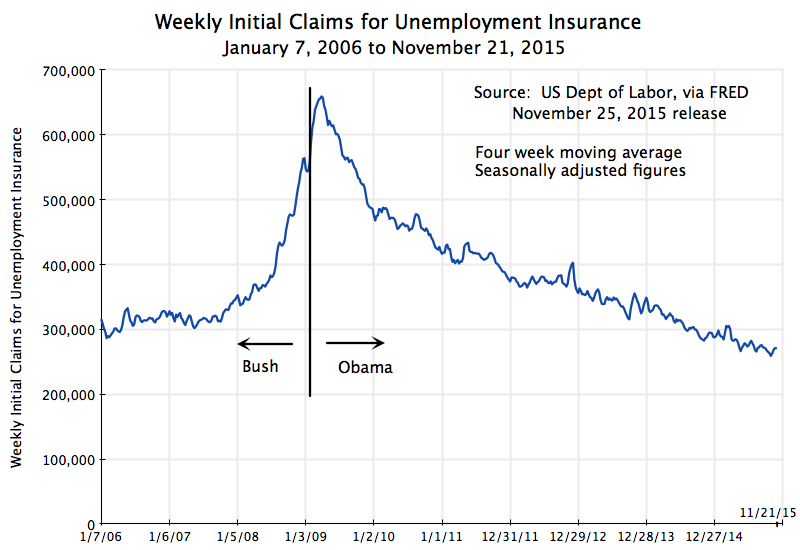
Weekly Initial Claims for Unemployment Insurance, January 7, 2006, to November 21, 2015

Weekly Initial Claims for Unemployment Insurance as a Ratio to Employment, January 1967 to October 2015


Initial claims for unemployment insurance are now at their lowest level, in terms of absolute numbers, in forty years, and the lowest ever when measured relative to employment (although the series goes back only to 1967).  There has been a steady improvement in the job market since soon after Barack Obama took office in January 2009, with (as discussed in a recent post on this blog) a steady increase in private sector jobs and an unemployment rate now at just 5.0%.  Yet the general discussion still fails to recognize this.  I will discuss some of the possible reasons for this perception later in this post.

Initial claims for unemployment insurance provides a good measure of the strength of the labor market, as it shows how many workers have been involuntarily laid off from a job and who are then thus eligible for unemployment insurance.  The US Department of Labor reports the figure weekly, where the numbers in the chart above are those updated through the release of November 25, 2015 (with data through November 21).  While there is a good deal of noise in the weekly figures due to various special factors (and hence most of the focus is on the four week moving average), it does provide a high frequency “yardstick” of the state of the labor market.  The charts above are for the four week moving averages.

The measure has been falling steadily (abstracting from the noise) since soon after President Obama took office.  News reports have noted that the weekly figures have been below 300,000 for some time now (close to a year).  This is a good number.  Even in the best year of the Bush administration (2006, at the height of the housing bubble), weekly initial claims for unemployment insurance averaged 312,000.  So far in 2015 (through November 21) it has averaged 279,000, and the lowest figure was just 259,250 for the week of October 24.  Initial claims for unemployment have not been so low in absolute numbers since December 1973.

But the population and labor force have grown over time.  When measured as a ratio to the number of those employed, initial claims for unemployment insurance have never been so low, although the series only begins in January 1967.  It is now well below the lowest points ever reached in the George W. Bush administration, in the Reagan administration, and even in the Clinton administration, under which the economy enjoyed the longest period of economic expansion ever recorded in the US (back to at least 1854, when the recession dating of the NBER begins).

Why then has the job market been seen by many as being especially weak under Obama? It should not be because of the unemployment rate, which has fallen steadily to 5.0% and is now well below where it was at a similar point during the Reagan administration.  Private job creation has also been steady and strong (although government jobs have been cut, for the first time in an economic downturn in at least a half century).  There has also been no increase in the share of part time employment, despite assertions from Republican politicians that Obamacare would have led to this.  And growth in GDP, while it would have been faster without the fiscal drag of government spending cuts seen 2010, has at least been steady.

What has hurt?  While no one can say for sure as the issue is some sense of the general perception of the economy, the steady criticism by Republican officials and pundits has probably been a factor.  The Obama administration has not been good at answering this.

But also important, and substantive, is that wages have remained stagnant.  While this stagnation in wages has been underway since about 1980, increased attention is being paid to it now (which is certainly a good thing).  In part due to this stagnation, the recovery that we have seen in the economy since the trough in mid-2009 has mostly been for the benefit of the very rich.  Professor Emmanuel Saez of UC Berkeley has calculated, based on US tax return data, that the top 1% have captured 58% of US income growth over the period 2009 to 2014.  The top 1% have seen their real incomes rise over this period by a total of 27% in real terms, while the bottom 99% have seen income growth over the period of only 4.3%.  Furthermore, most of this income growth for the bottom 99% only started in 2013.  For the period from 2009 through 2012, the top 1% captured 91% of the growth in national income.  The bottom 99% saw their real incomes rise by only 0.8% total over that period.

The issue then is not really one of jobs or overall growth.  Rather it is primarily a distribution problem.  The recovery has not felt like a recovery not because jobs or growth have been poor (although they would have been better without the fiscal drag), but rather because most of the gains of the growth have accrued to the top 1%.  It has not felt like a recovery for the other 99%, and for an understandable reason.
More on the High Cost of the Purple Line: A Comparison to BRT on the Silver Spring to Bethesda Segment

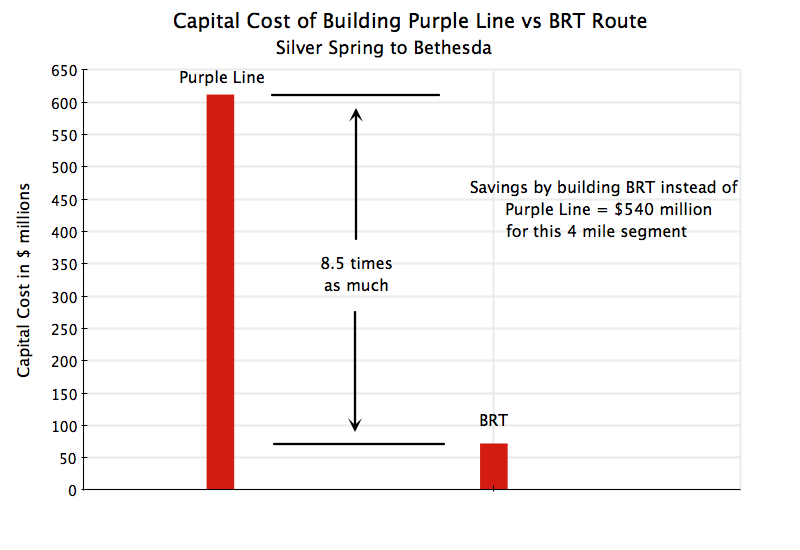
Comparison of Purple Line to BRT Cost, Silver Spring to Bethesda

This is a quick post drawing on a report in today’s Washington Post on the implementation of bus rapid transit (BRT) in Montgomery County, Maryland.  The article notes that one of the early BRT routes planned in the county would run from Burtonsville to Silver Spring down US Highway 29, with an estimated capital cost of $200 million.

This would be a distance of 10.2 miles, so the cost would be $19.6 million per mile on average.  This BRT line is currently slated to stop in Silver Spring, but it would be straightforward to extend it along East-West Highway for a further 3.7 miles to Bethesda. Assuming the same average cost per mile, the capital cost of this addition would be $72 million.

The current plan is for the Purple Line light rail line to cover this same basic route, connecting Silver Spring to Bethesda.  As I have discussed in earlier blog posts, the Purple Line is incredibly expensive, even if one ignores (as the official cost estimates do) the environment costs of building and operating the line (including the value of parkland destroyed, which is implicitly being valued at zero, as well as the environmental costs from storm water run-off, habitat destruction, hazardous waste issues, higher greenhouse gas emissions, and more).  The current capital cost estimate, following the service and other cuts that Governor Hogan has imposed to bring down costs, is $2.25 billion.  This also does not include the costs that Montgomery County will cover directly for building the Bethesda station and well as the cost of a utilitarian path to be built adjacent to the train tracks.  The Purple Line would also cost more to operate per rider than the Montgomery County BRT routes are expected to cost, so there is no cost savings from lower operating costs.

The Purple Line would be 16.2 miles long in total.  Using just the $2.25 billion cost figure, this comes to $139 million per mile.  This is extremely high.  Indeed, the Columbia Pike streetcar line in Arlington County, which was recently cancelled due to its high cost, would have cost “only” $117 million per mile despite it being built through a high density urban corridor for most of its entire route.

The distance from Silver Spring to Bethesda on the Purple Line will be 4.4 miles if it is built. This is longer than the direct route by road since it will follow a more indirect path passing up and around the direct route.  Assuming the cost of this 4.4 miles is the same on average as for the rest of the Purple Line (it might be higher due to the need to build some major bridges, including over Rock Creek), the cost would come to $612 million.

The choice therefore is between spending $612 million to build this segment of the Purple Line from Silver Spring to Bethesda, or spending $72 million by extending the BRT.  The Purple Line cost is 8.5 times as much, and government could save $540 million ( = $612m – $72m) by terminating the Purple Line in Silver Spring and using BRT service instead.

As an earlier blog post argued, new thinking is necessary if we are to resolve the very real transportation issues we face in this region.  This is one more example of what could be done.  A half billion dollar savings is not small.


The Leading Republican Presidential Candidates on Muslims and Syrian War Refugees

Republican Candidates photos.001The lead article on the front page of today’s Washington Post reported on what several of the Republican presidential candidates have said they would do in the face of refugees fleeing the war in Syria, and on Muslims (including US citizens) already resident in the US. David Farenthold and Jose DelReal were the authors.  While I do not normally put up posts on this blog that simply summarize other news reports, this article was especially telling. Those who did not see the article should find it of interest.

The first three paragraphs (where I have inserted the name of the candidate being referred to in parentheses; the article identifies them later) are:

One of the front-runners in the Republican presidential race [Donald Trump] said Thursday he would “absolutely” want a database of Muslims in the country and wouldn’t rule out giving them special ID cards that noted their religion.

Another top candidate [Ben Carson] likened Syrian refugees — who are largely Muslim — to dogs. Some of them might be rabid, he said, which was reason to keep them all out.

And a third [Ted Cruz] stood up in the Senate on Thursday and called for banning refugees from five Middle Eastern countries. He was explicit that the point was to keep Muslim refugees out while letting Christians from the same places in.

Expanding on Trump’s stated views, the article later noted:

Donald Trump, who has suggested closing down mosques and increasing surveillance of Muslims, said in an interview with Yahoo News published online Thursday that “we’re going to have to do certain things that were frankly unthinkable a year ago.”

When pressed on whether such measures might include tracking Muslim Americans in a database or noting their religious affiliations on identification cards, Trump said: “We’re going to have to — we’re going to have to look at a lot of things very closely. We’re going to have to look at the mosques. We’re going to have to look very, very carefully.”

Later Thursday, Trump told NBC News that he would “certainly” and “absolutely” create a database of Muslims in the United States, although it was unclear whether this system would track only newcomers to the country or all Muslims living in the country.

“There should be a lot of systems beyond databases,” Trump said. “I mean, we should have a lot of systems.”

Later in the article:

Sen. Marco Rubio (Fla.) said the attacks were part of a “clash of civilizations” — essentially casting the Paris attackers as products of Muslim society rather than a radical group apart from it.

And finally Jeb Bush (along with Ted Cruz again):

Two other candidates — Sen. Ted Cruz (Tex.) and former Florida governor Jeb Bush — suggested this week that the United States should accept Christian refugees from Syria but not some or all of the Muslim refugees.

According to today’s (November 20) Pollster results on the preferences of Republican voters (Pollster averages out the results from recent individual polls), these five candidates together account for 75% of Republican voter presidential preferences.  Trump is first by a substantial margin, followed by Carson, Rubio, Cruz, and Bush, in that order.  No other candidate seeking the nomination receives more than 3.3% of Republican voter preferences.  It is likely that one of these five candidates will receive the Republican nomination.

This is scary.  Perhaps the statements were not fully thought through.  We will see whether and to what extent the candidates seek to “walk back” the statements in the coming days. But these gut reactions (if that is indeed what they are) to the tragedy in Paris, on the treatment of those whose religion is Islam, and how they see refugees from the Syrian war, should at a minimum make us wonder how they would respond if they were faced by a major crisis as president.