Employment Growth During the Presidencies of Obama and Bush

Cumul Private Job Growth from Inauguration to May 2014

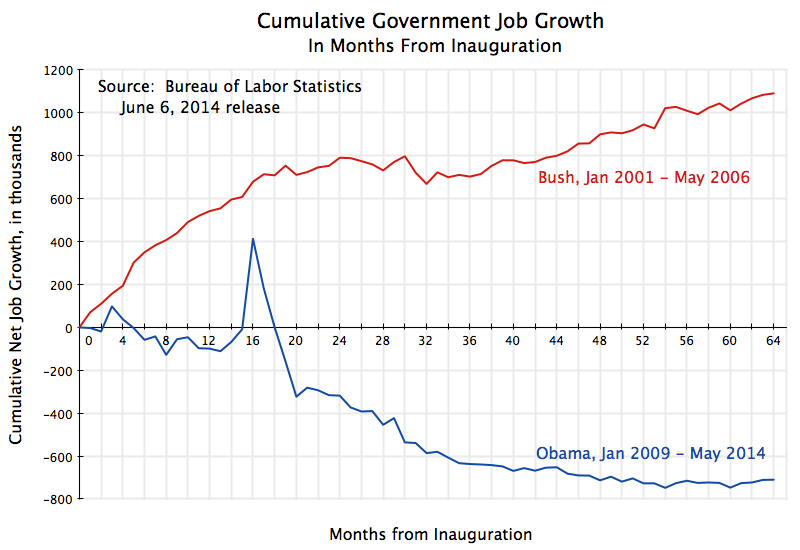
Cumul Govt Job Growth from Inauguration to May 2014

The Bureau of Labor Statistics released its regular monthly jobs report on June 6.  Nonfarm payroll employment rose by 217,000 – a broadly similar pace as in recent months.   But most news reports focussed on noting that total jobs in the US (actually, total nonfarm payroll jobs) have now for the first time exceeded the peak previously reached in January 2008, before the sharp fall that began in the last year of the Bush presidency.  It took the economy six years and four months to get back to the level of employment it had then.

While this is a significant benchmark, it is not all that meaningful by itself.  The labor force has continued to grow over the last six years, so unemployment remains high (at a rate of 6.3% currently).  Conservative critics have charged that the pace of job creation under Obama has been slow, and assert that the slow pace is due to Obama’s anti-business administration (they allege), with high taxes and increased regulation, the negative effects (they assert) of the measures under the Affordable Care Act to make it possible for the uninsured to obtain health insurance coverage, plus an allegation of “increased uncertainty”, as all acting to hold back the private sector from creating new jobs.

To judge such allegations, one might examine the pace of job creation during Obama’s term to the pace during the term of George W. Bush, a conservative Republican who was purportedly pro-business and anti-regulation, and who presided over record tax cuts.  One needs also to separate net job growth in the private sector from net job growth in the public sector to understand the story.

The two charts above do this, and update similar charts in previous posts on the blog that have examined the issue (the most recent from January 2013).  Points to note include:

1)  Net private job growth has been far higher under Obama than under Bush.  As the top chart shows, there were 5.2 million additional private sector jobs in May 2014 compared to when Obama was inaugurated, and an additional 9.4 million private jobs from the trough reached in February 2010, a little over a year after Obama took office.  Private jobs were disappearing at a rate of over 800,000 every month when Obama was taking the oath of office.  This was soon turned around as a result of stimulus measures and the aggressive actions of the Fed, with the rate of decline at first diminishing and then positive job growth appearing a year later.

Under Bush, in contrast, there were only 2.4 million more private jobs at the same point in his presidency relative to when he took office.  A primary reason for this difference is that while the economy was collapsing when Obama took office (which he then turned around within a year), the downturn at the start of the Bush term in 2001 began after he took office.  The economy then began to turn around (in terms of job growth) only two and a half years into Bush’s term in office.  Only then did private jobs begin to grow under Bush.

2)  Once the private job growth began (13 months into Obama’s term, and 30 months into Bush’s term), the pace of that job growth has been remarkably steady in both administrations.  There were month to month variations, of course, particularly in the data as originally announced (but then later revised, in the regular process to incorporate more complete data as it becomes available).  That is, the lines in the chart above for private job growth are both remarkably straight once the turning points were reached.

3)  Not only was the pace of private job growth remarkably steady after the turning points, they are also remarkably similar in terms of that pace for Obama and Bush.  That is, the two lines in the graph above are roughly parallel to each other after the respective troughs.  The pace of private job growth has been 184.5 thousand per month under Obama up to now, and a bit less, at 168.2 thousand per month, under Bush from his trough up to the same point in his presidency.

Thus there is no support in this data for the assertion that private sector job growth has been especially slow under Obama, due to an alleged anti-business administration.  Private sector job growth under Obama has been similar to, and in fact a somewhat higher than, the pace under Bush during the respective recoveries.  And total private job growth is far higher under Obama than it was at the same point in the Bush presidency, as the recovery was earlier under Obama.

4)  Where Obama and Bush do differ, and markedly so, has been in net government job growth.  Government jobs grew strongly under Bush (as they have for all recent presidents other than Obama; see this blog post).  But net government jobs have fallen sharply and consistently under Obama.  Only in the last year or so have they leveled off, but with no recovery in number.  Keep in mind that government jobs include jobs at all levels of government, including state and local government.  It is not just the federal administration that is covered here.  But the impact on the economy is similar whether it is a locally employed school teacher being laid off, or a researcher employed by the National Institutes of Health.

Bush is viewed as the small government conservative.  But government jobs grew by 1.1 million from the month of his inauguration to May 2006.  Government jobs fell by 710,000 over the similar period in Obama’s term.

5)  Thus part of the reason net overall job growth has been disappointing during Obama’s term is not that private job growth has been slow, but rather that government has cut back on those it employs, hence bringing down the overall total.  If government jobs had simply remained flat during Obama’s term in office, rather than fall by 710,000, the direct impact on the unemployment rate would have been to bring that rate down to 5.8% from the current 6.3%.  But that would be the direct impact only.  There would also be indirect impacts.  The now employed school teacher or researcher would spend their newly earned income on what they need, which would lead to increased demand for products and employment of additional workers to make them.  (See this Econ 101 blog post on the multiplier and what it means.)  Assuming a not unreasonable employment multiplier of 2 under current conditions, the impact of simply keeping government employment steady rather than allowing it to fall by 710,000 would have been to bring the unemployment rate down to 5.4%.

Had government employment been allowed to grow under Obama as it had under Bush, the impacts would have been significantly larger.  The direct impact alone (before the multiplier) would have brought the unemployment rate down to 5.1%.  Mechanically applying a multiplier still of 2 would imply an unemployment rate brought down to 4.0%.  But this would have then been at the low end of the range normally taken to represent full employment (of perhaps 4% to 5 1/2%, depending on the assessments of different analysts), and it would no longer be correct to assume a multiplier would have remained at 2.  Rather, and as discussed in the blog post cited above on multipliers, there would have been other reactions, including most likely by the Federal Reserve Board.  With the unemployment rate having been brought down to the full employment range, one would expect that the Fed would have shifted back to a more normal interest rate and monetary policy from its current policy (due to the still high unemployment) of targeting interest rates to as close to zero as possible.

Summary and Conclusion

To conclude,  far more private jobs have been created during the Obama presidential term  than during the same period in the term of George W. Bush.  In part this was due to the more rapid recovery under Obama (due to the stimulus and other measures taken) from the economic collapse he inherited from the last year of the Bush administration, than the recovery under Bush from the downturn that began a few months after he became president in 2001.  But it is interesting to see that once the respective recoveries began, the pace of private job growth was similar during the Obama recovery as under the Bush recovery (and indeed somewhat faster under Obama).  And this is despite the contractionary policies followed by government since 2010.  For the first time since at least the 1970s (I did not look back further in that blog post), government spending has been cut in an economic downturn, rather than allowed to rise to make up for insufficient aggregate demand.

Where the Obama and Bush periods differ, and substantially, is in government employment.  Government employment grew under Bush (as is normal, and as has been the case under every prior president since at least Eisenhower), but has been cut sharply under Obama.  It is because of these cuts that total employment growth under Obama has been disappointing.  Without those cuts, the economy would have returned to full employment some time ago.
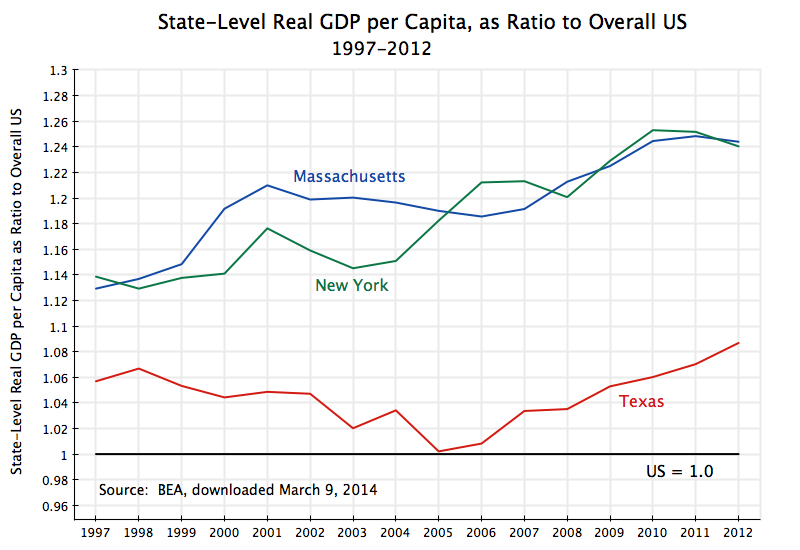
Red States vs. Blue States: Lower Incomes and Less Growth in Texas

State-Level Real GDP per Capita as Ratio to US, 1997-2012

A.  Introduction

Texas Governor Rick Perry’s speech on March 7 to the annual CPAC (Conservative Political Action Conference) meetings was described by various news web sites as “a barn burner address” that wowed the conservatives, as “a rousing speech that was one of the best-received of the conference so far”, as a “fiery speech that ignites CPAC”, as a speech that brought “the audience to its feet and eliciting loud cheers”, and that “received huge applause throughout his rousing speech”.

Rick Perry has been Governor of Texas for more years than any other governor in Texas history.  He was elected Lieutenant Governor in 1998, and became governor in December 2000 when George W. Bush resigned to become President of the US.  Perry was then elected governor in his own right three times (in 2002, 2006, and 2010), the first Texas governor to be elected to three four-year terms.  He is not now running for a further term, and thus will step down following the election later this year.  It is widely assumed he will once again seek the Republican nomination for the Presidency in 2016, and many interpret his CPAC address as confirming this.  He is well known for the failure of his 2012 campaign seeking the Republican nomination, when he quickly went from front-runner to quitting following a series of goofs.  The best known was in one of the debates with the other Republican contenders, when he said he would close three cabinet level departments in the federal government but could only remember two, in his famous “oops” moment.

Perry’s speech at CPAC set forth what will likely be a major theme of his upcoming presidential campaign:  the contrast between the great performance (in his view) of red states (conservative states that generally vote Republican) and the terrible performance of blue states (liberal states that generally vote Democratic).  As the longest-serving governor of the premier red state of Texas, it is not surprising that Perry would say this.  But what has the performance actually been?

B.  Real GDP per Capita

The graph at the top of this post presents one key measure:  real GDP per capita, presented as a ratio to the US average.  Texas is shown (in red), along with two of the top blue states:  Massachusetts (in blue) and New York (in green).  The figures are calculated from data issued as part of the GDP accounts by the Bureau of Economic Analysis (BEA), which provides such data at the state level GDP on an annual basis (with 2012 the most recent available).  The current series goes back only to 1997, before which the state-level figures were calculated on a different basis, and thus are not directly comparable to the later figures.  But 1997 is also the year before Perry was elected Lieutenant Governor, so it provides a suitable starting point.

As the graph shows, real per capita GDP was substantially higher in Massachusetts and New York than in Texas in all of these years.  Indeed, per capita GDP in Texas actually fell relative to that for the US as a whole from 1998 to 2005 (meaning growth in Texas was slower than in all of the US over this period), after which it started to recover.  The oil boom resulting from the sharp escalation in oil prices from the middle of the last decade was certainly a factor helping Texas in recent years.

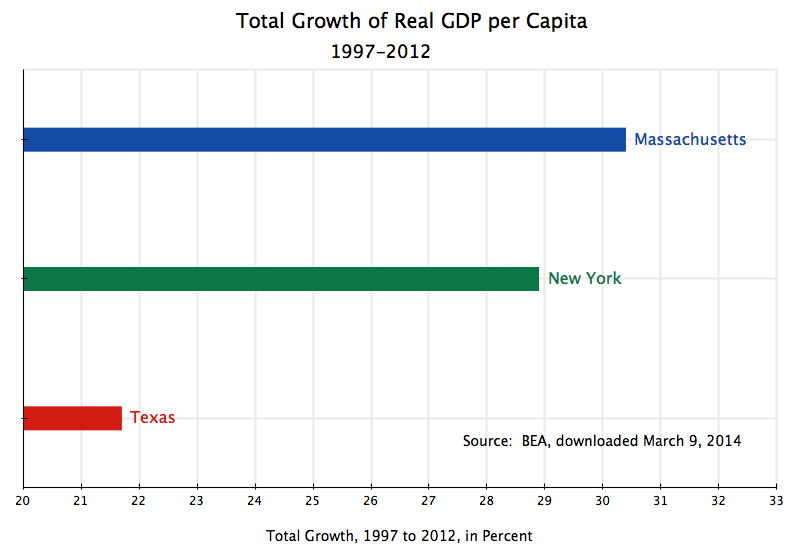
And it is not only in terms of real income levels where Texas has lagged.  Texas has also lagged Massachusetts and New York in terms of overall growth since 1997.  Real per capita GDP rose by 30.4% in Massachusetts over 1997 to 2012 and by 28.9% in New York, but only by 21.7% in Texas:

State-Level Growth of GDP per Capita, 1997 - 2012

C.  Personal Income per Capita

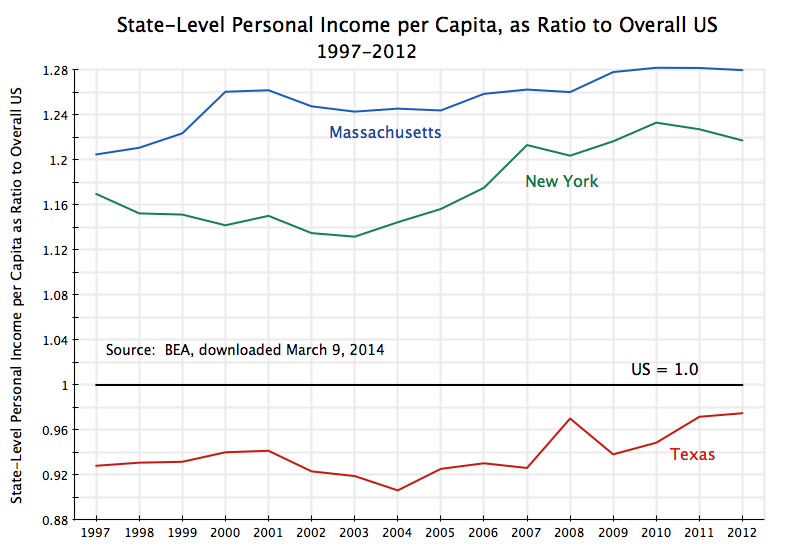
GDP per capita is the broadest measure of income generating activities in a state, but not all of GDP goes to households.  Part will go to corporations (and not distributed to households via dividends).  It therefore is also of interest to look at per capita personal income by state, again relative to that for the US  as a whole:

State-Level Personal Income as Ratio to US, 1997-2012

Once again one finds this measure of income to be far higher in the blue states Massachusetts and New York than in the red state of Texas.  But what is different and interesting is that personal income per capita in Texas is seen to be also below personal income per capita for the US as a whole.  A higher share of GDP generated in Texas goes to corporations than is the case for the US as a whole.  GDP per capita in Texas is somewhat above the US average (although not as much above as in Massachusetts or New York), but personal income per capita, once one subtracts the share going to corporations, is lower in Texas than for the US as a whole.

D.  Conclusion, and Re-Nationalizing the Postal Service

Conservatives, including not surprisingly Governor Perry, hold up Texas as the ideal which they want the nation to emulate.  But GDP per capita is lower in Texas than in the blue states of Massachusetts and New York, and has grown by less in Texas than in Massachusetts or New York over at least the last fifteen years.  In addition, personal income per capita is not only lower in Texas than in Massachusetts or New York (and very much lower), it is even lower than the US average.  Corporations account for a disproportionate share of incomes earned in Texas.

Perry closed his speech to CPAC, to cheers and loud rounds of applause, by declaring that the federal government should “Get out of the health care business, get out of the education business”.  Presumably this means Perry wishes to end Medicare, and that federal government assistance to students and schools up to and including universities should also end.  It is not clear, however, he has thought this far ahead on the implications of what he is calling for.  Calling for the end of Medicare, as conservatives have in the past, is not currently a popular position.

But while Perry said the federal government should “get out” of health and education, one area where he appeared to call for expanded federal responsibility was in the running of the postal system.  The proper federal focus, as established in his reading of the constitution, should be on defense, foreign policy, and to “deliver the mail, preferably on time and on Saturdays”.

The constitution does indeed call on the federal government to ensure postal services are made available.  But while this was done through a cabinet level department under the US President for many years, since 1971 the postal service has been run as a government-owned but independent establishment, run like a private corporation with its own board.  It is not fully clear what Perry means by arguing the federal government should return to its original mission vis-a-vis postal services, but the implication appears to a be reversal of its 1971 conversion from a cabinet level department to an independent agency run along private lines.  That would be an odd position for a conservative.  But I suspect he has not really thought this through.

The Obama Bull Market Rally on Its Fifth Anniversary

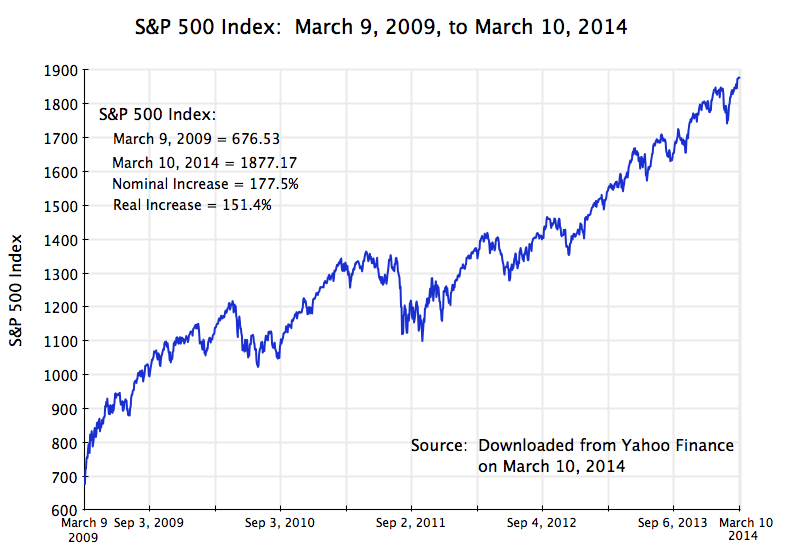
S&P 500 Index, March 9, 2009, to March 10, 2014

Bull Markets, 1940-2014, updated to March 10, 2014

 
   Bull Market Rallies Since 1940
  Ranked by overall growth in real terms
Start Date End   Date Calendar Days Nominal % Change Real % Change Real Rate of Growth
Dec 4, 1987 Mar 24, 2000 4,494 582% 361% 13%
Jun 13, 1949 Aug 2, 1956 2,607 267% 222% 18%
Aug 12, 1982 Aug 25, 1987 1,839 229% 181% 23%
Mar 9, 2009 Mar 10, 2014 1,827 177% 151% 20%
Apr 28, 1942 May 29, 1946 1,492 158% 124% 22%
Oct 22, 1957 Dec 12, 1961 1,512 86% 76% 15%
Oct 9, 2002 Oct 9, 2007 1,826 101% 75% 12%
Jun 26, 1962 Feb 9, 1966 1,324 80% 69% 16%
May 26, 1970 Jan 11, 1973 961 74% 57% 19%
Oct 6, 1966 Nov 29, 1968 785 48% 37% 16%
Oct 3, 1974 Nov 28, 1980 2,248 126% 34% 5%

Today marks the fifth anniversary of the Obama bull market rally.  The rally began on March 9, 2009, just six weeks after Obama was inaugurated.  A reader of this blog suggested that on this anniversary, an update of previous posts on the strong performance of the stock market during Obama’s tenure (see here and here) might therefore be timely and of interest.

Stock market prices have indeed continued to rise, and as the table above shows, stocks during Obama’s term in office have now posted the fourth highest gains of any stock market rally since 1940.  Market rallies are defined as at least a 25% rise in the S&P 500 Index (in real terms), without a 20% fall.  Equity prices (as measured by the S&P 500) have risen by 177% in nominal terms since March 9, 2009, as of the close today.  The increase in real terms (using the CPI inflation index) has been 151%.  And since this rally is on-going, it could move further up in rank.  In addition, in just twelve more days (assuming the rally does not suddenly collapse) this rally will be the third longest in terms of calendar days of all market rallies since 1940.

It is also interesting to see how steady the upward progression has been, especially since September 2011.  This is shown in the graph at the top of this post.  I do not believe anyone had predicted this.

The rally could also end tomorrow.  All rallies eventually come to an end, and this one will as well.  But the rise in prices already achieved, the fourth largest since 1940, needs to be recognized.

Should Obama be given credit for this historic market rally?  Not fully.  I doubt that equity prices in themselves are a primary objective of what Obama has been trying to achieve.   Rather, the objective has been a stronger economy.  Regulatory as well as policy measures have been taken with the aim of strengthening the system, and this ultimately benefits business (as well as the population) as a whole.  This then helps equity prices.  Unfortunately, and as this blog has discussed in earlier posts, fiscal drag from cuts in government spending has held back the pace of the recovery, and this fiscal drag is continuing.  The economy could be doing better.  Nevertheless, there has been a partial recovery.  But it is not yet complete, nor as rapid as one would have had without the fiscal drag.

But what this strong growth in the stock market does clearly indicate is that the charges by Republican politicians that Obama has been bad for business (indeed a disaster for business many of them have said), has no basis.  If there were any truth to the charge, stock market prices would not be up by 177% in nominal terms (and by 151% in real terms) over the last five years, leading to the fourth biggest rally in stock prices in three-quarters of a century.