The Impact on the Employment Numbers of the August 21 Announcement of the Bureau of Labor Statistics

A.  Introduction

The Bureau of Labor Statistics (BLS) issued an announcement on August 21 that said it had made a preliminary estimate that its figure for total employment as of March 2024 will be revised downwards by 818,000.  Some news media articles treated the announcement as if it were something to be alarmed by, and Trump issued a blast on the social media site he owns.  Trump asserted:  “MASSIVE SCANDAL!  The Harris-Biden Administration has been caught fraudulently manipulating Job Statistics to hide the true extent of the Economic Ruin they have inflicted upon America.  New Data from the Bureau of Labor Statistics shows that the Administration PADDED THE NUMBERS with an extra 818,000 Jobs that DO NOT EXIST, AND NEVER DID.  The real Numbers are much worse …” (sic, and capitalization as in the original).

None of this is true, but we know that accuracy has never been a strong point for Trump.  And such derogatory comments about the professionals at the Bureau of Labor Statistics just doing their jobs are also appalling.  There was nothing scandalous in their work.  A few basic points:

a)  Such a “preliminary benchmark revision” is issued every August, as part of an annual process by which the monthly employment estimates of the BLS are updated and anchored to (benchmarked to) more comprehensive estimates of employment.  This is done on a regular and routine basis every year.

b)  The date of the announcement is certainly not a secret, but rather is set well beforehand.  One will find it, for example, highlighted in a box on page 4 of the July jobs report that was released on August 2.  There was no attempt at a cover-up nor a leak.

c)  The 818,000 jobs figure is not some sort of monthly job number that people normally associate with the monthly jobs reports, but rather reflects an estimate of the change in the total number of people employed in March 2024.  The monthly employment estimates are then anchored to this benchmark, which will be updated again next year to an estimate for March 2025.  Employment still grew – and grew strongly – over the period from March 2023 (the previous benchmark) to March 2024 (which, when finalized, will become the new benchmark), but not by as much as was estimated before.  The previous estimate was of job growth of 2.9 million over this March to March period.  The new estimate (if the preliminary benchmark estimate holds – but bear in mind that it is preliminary and may well change) is of job growth of about 2.1 million.  That is still strong job growth.

d)  Many of the news articles highlighted that the 818,000 revision in estimated overall employment is high.  But one should keep in mind that it is equal only to about 0.5% of total employment.  That is, the revised figure (if the preliminary benchmark figure holds) will be 99.5% of what had been estimated earlier.  The 0.5% revision is also certainly not unprecedented.  Such revisions are part of a regular annual process, and figures the BLS provides going back to 1979 show that there have been revisions of 0.7% twice (in 1994 and 2009), 0.6% twice (1991 and 2006), and 0.5% four times (1979, 1986, 1995, and now in 2024).  That is, there have been such revisions to estimated overall employment by 0.5% or more a total of 8 times in 46 years, or 17% of the time.  A 0.5% change is large compared to what the figures normally are, but it is certainly not unprecedented, and in several years the revisions have been greater.

There is no scandal here.  There is no indication of manipulation.  And if there was some kind of politically motivated manipulation possible, doesn’t Trump realize that it would have made much more sense to manipulate the employment figures to be higher rather than lower?  Did he give even a few seconds of thought to his accusations?  The BLS is just doing the professional job it always has.

With all the publicity that has surrounded the BLS announcement, some may find of interest a description of how this annual updating process of the employment estimates works.  We will review that in the next section below.  The section following will then look at the figure itself – the 818,000 change in estimated overall employment – and what it may imply.  While still preliminary, the final estimate is likely to be close.  And the main message is that the basic story on employment growth during the Biden presidency has not changed.  Employment growth under Biden has been, and continues to be, exceptionally strong.

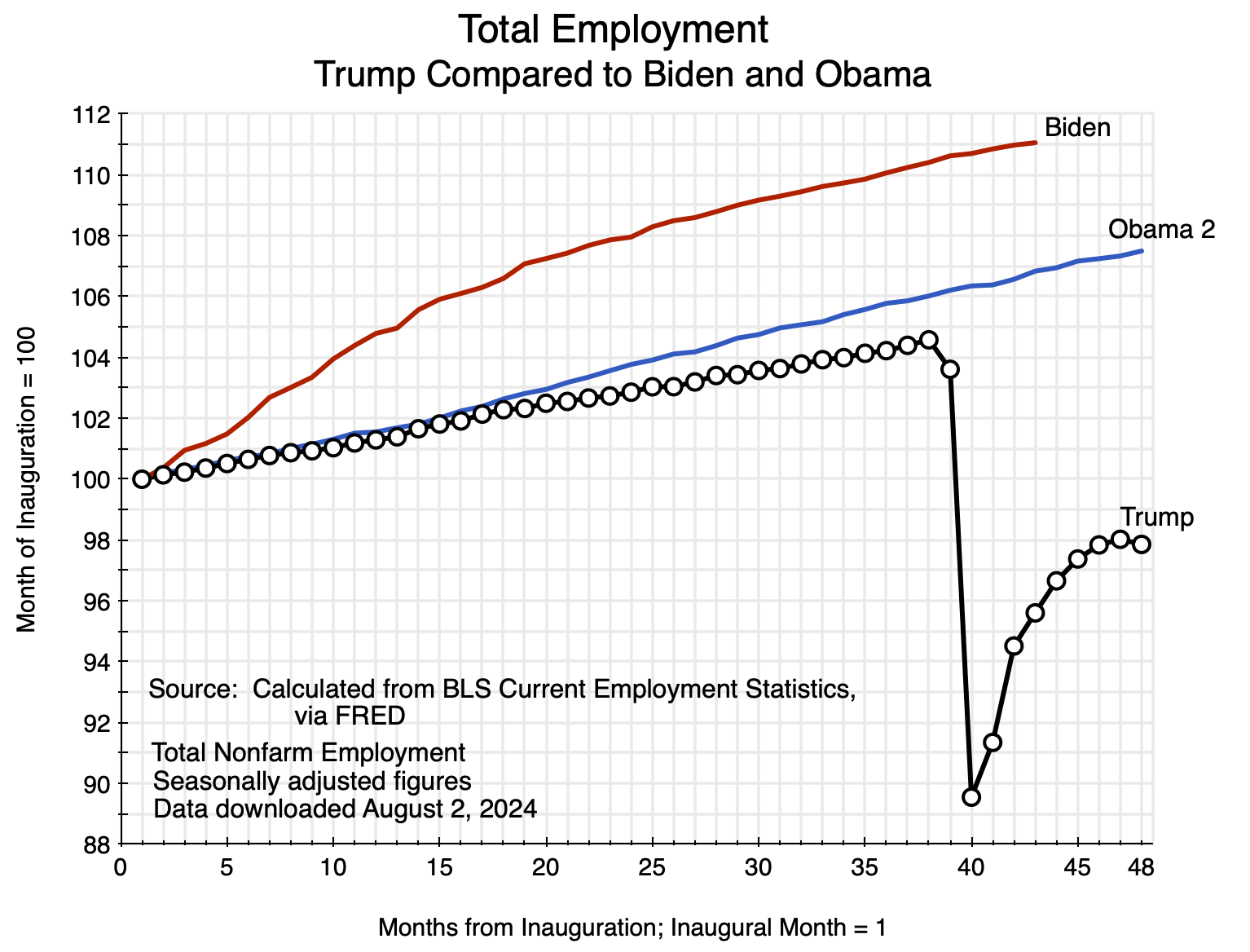
The chart at the top of this post updates a chart I provided in an article on this blog that was posted on August 21 – the day the BLS announcement came out.  I saw that announcement and the reports on it just after I posted that article.  One focus of that post was on the employment record under Biden and how it compared to the record under Trump.  The chart above replicates one in that August 21 post, but with the addition of what the path of estimated employment may now look like once the new benchmark is taken into account for the recent employment estimates.  That revised path is shown in orange.  It is a very rough estimate as the BLS has not yet worked out and released what the monthly employment figures will be with the new benchmark.  They are working on that now, and will release it – as they always do – in early February as part of the January monthly jobs report.

The path in orange is below the original one in red, but follows the same basic course.  It is still rising at a strong pace, and the basic message remains the same.  Job growth under Biden has been far stronger than what it was under Trump.

B.  The Annual Process of the BLS to Update Its Monthly Employment Estimates

The discussion in this section is based on material the BLS provides on its website on the process it follows in updating its monthly employment estimates to tie them (anchor them) to comprehensive employment estimates arrived at once a year from census-like figures.  The summary description provided here is based primarily on the BLS posts here and here.

The monthly jobs report of the BLS (more formally: “The Employment Situation” report) is eagerly awaited by many.  It provides estimates for what happened to the number of “jobs created” during the past month (more accurately, the change in the estimated number of nonfarm employees between the current month and the month before), as well as the unemployment rate along with numerous other measures of the labor market.

The report is produced on a very tight schedule.  The employment statistics come from a sample of establishments (both public and private, and called the Current Employment Statistics, or CES, survey), where the employing entities report to the BLS the number of employees on their payroll in the week of the month which includes the 12th day of the month.  The BLS jobs report is then issued at 8:30am on the Friday three weeks later, which is usually the first Friday of the following month.

(There are also figures in the monthly Employment Situation report on unemployment, the number in the labor force, and other figures that are obtained through the much smaller Current Population Survey (CPS) of households.  Most of what we will discuss here will be for the CES survey of business establishments, but similar modeling issues arise with the CPS survey, where there is also an annual process to update the model parameters.)

The survey of establishments is a rather comprehensive one, where the reporting entities account for about one-third of all nonfarm payroll jobs.  But it is still a sample survey, and the BLS needs to estimate from this survey the overall number of employees in the country (and hence what the change was from the previous month – the growth in the number employed).

For this, what is mainly needed is a large set of weights that the BLS can use to aggregate the reports it receives from firms of various types.  That is, to estimate the overall totals the BLS will need to know what weight to give to what is found in the survey reports for a particular type of firm (such as of a given size), operating in a particular sector, and perhaps categorized in other ways as well.

For example, small firms with up to 99 employees accounted for (in March 2023) 40.0% of all private employment in the country.  But while 70.4% of the number of private firms sampled by the BLS for the CES were in this category of up to 99 employees, those in the CES survey sample accounted for only 4.6% of total private employment.  Those firms are all small.  In contrast, large firms with employment of 1,000 or more were 6.2% of the number of private firms sampled by the BLS.  But those firms accounted for 68.4% of total private employment in the sample (and 28.8% of the total private employment in the country).

The BLS thus needs to know what weights to assign to each of these categories of firms to determine the overall totals.  The annual benchmarking exercise provides this.  A comprehensive census-type of exercise is needed, and for this the BLS uses primarily the March report of the Quarterly Census of Employment and Wages (QCEW) – which the BLS is also responsible for.  The QCEW is a comprehensive accounting of essentially all workers in the US based on the filings (and unemployment insurance tax payments) all firms are required to provide for the unemployment insurance program.

About 97% of the workers counted in the CES reports will be covered by regular unemployment insurance and hence included in the QCEW reports.  About 3% of workers are not, and the BLS uses various methods to arrive at a count for them.  Such “noncovered employment” (as the BLS labels it) includes, for example, certain workers at nonprofits and religious organizations, certain state and local government workers, railroad workers (where unemployment insurance is covered under the Railroad Retirement Board), paid interns and apprentices, and a range of others.

Keep in mind also that “employment” as reported in the monthly jobs report is for the nonfarm payroll, and thus excludes the self-employed as well as those working on farms (whether as self-employed owners or as employees).  But based on CPS data (the survey of households), those employed on farms (whether as employees or self-employed) only account for 1.4% of total employment.  That is so small that changes in on-farm employment do not have a significant impact on overall employment growth.  More potentially significant are the self-employed, who equal 6.1% of total employment according to the CPS data.  Unemployment insurance does not cover the self-employed, but those who are self-employed are also not employees and hence are not included in the CES definition of the nonfarm payroll.

The BLS then uses the detailed census counts from the March QCEW each year (supplemented by various sources of information for the remaining 3% of employees) to work out the weights to use to aggregate to the global estimates.  The March QCEW figures (as supplemented for the remaining 3%) then serve as an anchor on the employment totals.  It is updated on a routine basis annually on a calendar schedule that is set well ahead of time.  The monthly employment estimates are then worked out over the course of the year relative to the annual anchors of every March.

In addition to working out the weights to use to go from the monthly survey results to the overall totals, the BLS must also estimate the changes over time in the number of firms in each category.  That is, it needs to have an estimate for the number of new firms in each category that have begun operations each month (births), plus the number of firms that have ceased operations (deaths).  The QCEW census data will, by its nature, have nothing on the births and only outdated and now wrong information on the deaths.  The BLS updates its model of firm births and deaths each year as well, as part of its annual process of updating the benchmarks.

There has been speculation that the relatively large estimated reduction in estimated total employment of 818,000 in March 2024 may have been due in part to issues in the estimates of firm births and deaths.  There was an especially large jump in the number of new business establishments that opened in 2021 – a jump of 33% over what it was in 2020 or an increase of 37% over what it was in 2019 – to 1.4 million new firms in that year.  And the number of new firms was again at this record high of 1.4 million in 2022.  But small new firms typically struggle after a year or two, and many close even in the best of times.  It is possible that the BLS model for firm births and deaths did not capture well that this large jump in new business creation in 2021 and again in 2022 was followed by a relatively high number then closing in 2023 and 2024.

The BLS work begins once the March QCEW data become available, and each August it announces its preliminary benchmark revision for total employment in the prior March.  This is what the BLS announced on August 21, that Trump attacked.  The BLS will now work out the month-by-month implications of the new benchmark, adjusting the monthly employment figures that it had earlier estimated to reflect the new benchmark.  These revised monthly figures will be announced as part of the release of the January 2025 jobs report on Friday, February 7, 2025.  It does this in every January jobs report each year.

The benchmark figures on total employment are not seasonally adjusted numbers.  The anchors are the figures for each March, and hence the anchors in the upcoming revision will be for March 2023 (which is unchanged from what was determined before) and March 2024 (the new one).  The non-seasonally adjusted employment numbers will then be revised for the 21 months from April 2023 through to December 2024.  From April 2023 to the new March 2024 benchmark, the monthly employment figures will be adjusted in a simple linear fashion based on what the overall change in employment was between the March 2023 and March 2024 anchors.  If the final estimate turns out to be 818,000 (the same as the preliminary estimate), then that means the April 2023 non-seasonally adjusted employment estimate will be reduced by 68,167 (equal to one-twelfth of 818,000), the May 2023 estimate will be reduced by 136,333 (two-twelfths of 818,000), the June 2023 estimate by 204,500, and so on until the March 2024 employment estimate is reduced by 818,000.

The April 2024 to December 2024 figures for non-seasonally adjusted employment will then be re-estimated based on the models the BLS has updated based on the new March 2024 anchor estimates.  Keep in mind that by the time the January 2025 employment estimates are ready to be released (in early February 2025), the BLS will already have issued estimates for the April to December 2024 figures.  The revised estimates for all of the 2024 estimates are then provided in the Employment Situation report along with the employment figures for January.

The seasonally adjusted employment figures are then also updated.  Seasonally adjusted figures are calculated based on a statistical analysis of the regular annual patterns seen in the non-seasonally adjusted figures, using standard statistical programs.  The model parameters for this are re-estimated once the new non-seasonally adjusted employment figures are determined, and the BLS then goes back and revises the seasonally adjusted monthly employment estimates for a full five years.  Hence, once the January jobs report is released (on February 7 next year), one will find that the seasonally adjusted employment figures for the most recent five years (available online) will have also changed.

The January jobs report also has a section, in the interest of full transparency, showing what the new seasonally adjusted employment estimates are for each month of the past year, what the BLS had previously published, the difference, and the month-to-month employment changes (number of “new jobs”) as revised, as published before, and the difference.  All of this is routine.

The process is well-established and has been followed for at least 46 years (I have not looked farther back).  While the methods constantly evolve and are improved over time, there is no basis for Trump’s attack on the integrity of the BLS.

C.  How Much of an Impact?

The BLS was clear in its announcement that the new benchmark estimate for total employment in March 2024 is preliminary.  It is making this initial estimate available to the public in the interest of transparency, even though it has yet to work out the implications for the month-to-month employment figures.

But while preliminary with month-to-month specifics yet to be estimated, it is possible to get a sense of how significant a change this will likely entail to the pattern of employment growth under Biden.  And the answer is not much.  Furthermore, the change is in the direction one should have expected.  As discussed in my recent post on the economic record of Trump compared to that of Biden and Obama, employment growth during Biden’s term has been extremely fast.  This growth (whether based on the prior estimates or the preliminary revised estimates) has continued at a pace over the last year that is well in excess of separate estimates of growth in the labor force.  Over time, and at a constant unemployment rate, employment can only grow as fast as the labor force does.  In the past year the labor force participation rate rose slightly (from 62.6% of the adult population to 62.7%), which led to somewhat faster growth in the labor force than would be the case with a constant participation rate.  But the longer-term trend has been for the participation rate to drift downwards, as an aging population is leading to a higher share of adults in the usual retirement years.

The current estimate for the period of March 2023 to March 2024 – prior to any benchmark change – has been that total employment grew by 2.90 million.  This is based on the seasonally adjusted figures.  Growth over this period in the non-seasonally adjusted figures was a similar 2.96 million.  The preliminary benchmark change in total employment in March 2024 is 818,000, and formally this is the change in the non-seasonally adjusted figure for employment.  But it makes little difference whether one uses this to adjust the seasonally adjusted figures on employment or the non-seasonally adjusted figures.  With either, one ends up with a new figure for total employment in March 2024 of 2.1 million within round-off.

The month-by-month changes in the total employment estimates have yet to be worked out by the BLS, as noted before, but one can make a very rough estimate of what those might be.  The aim here is simply to give a sense of what the magnitudes are so that one can see – as in the chart at the top of this post – what the path of employment under Biden might then look like in comparison to the paths under Trump and Obama.

A number of assumptions are needed.  First, while the 818,000 adjustment in the benchmark employment total is formally a non-seasonally adjusted figure, I will assume the seasonally adjusted estimate will be similar.  The chart at the top of this post uses seasonally adjusted figures throughout, and the adjusted path for employment growth under Biden will be as well.

Second, for the period from April 2023 to March 2024 I adjusted the month-by-month employment estimates linearly, as the BLS does (although the BLS does this with the non-seasonally adjusted figures for the monthly employment estimates; I am assuming the changes in the seasonally adjusted figures will be similar).  That is, the April 2023 employment total was reduced by 68,167 (one-twelfth of 818,000), the May 2023 total by 136,333 (two-twelfths), and so on to March 2024.

Third, adjusting the figures going forward from March 2024 is more difficult as the BLS will use its updated models to make the revisions to the estimates from April.  Note that while the revised BLS estimates – when they are released as part of the January Employment Situation report – will cover the months through to December, all that we need now are estimates for the months of April, May, June, and July.

While very rough, for this I assumed the revisions for these four months will follow a pattern similar to what was found in the 2019 revision.  This was relatively recent but also pre-Covid (with all of the disruptions of patterns associated with that), and in that year the benchmark employment estimate was reduced by 0.3%.  While less than the 0.5% preliminary revision in the 2024 benchmark estimate, it was a still major revision downward (and during the Trump administration, although I do not recall ever seeing a reference by Trump to that reduction in the job totals).  I then used the month-by-month revisions in the seasonally adjusted employment estimates in 2019 for April through July, rescaled the percentage changes of each by the ratio of 0.5%/0.3% (in fact using the more precise figures of 0.517%/0.341%) and then applied those adjusted percentage changes to the current estimates of total employment in those four months.

The new path for total employment for the period of March 2023 to July 2024 is then shown as the orange line in the chart at the top of this post.  While below the current employment estimates (the line in red), the difference is not large.

The basic story remains the same.  Employment growth has been exceptionally strong under Biden, and has continued.  A downward revision in the benchmark total for March 2024 of 818,000 does not change this.

Trump’s Claims on the Economy and the Reality: A Comparison of Trump to Biden and Obama

“We had the greatest economy in the history of the world.  We had never done anything like it. … Nobody had seen anything like it.”

Donald Trump, Republican National Convention, Milwaukee, July 18, 2024

A.  Introduction

Donald Trump is fond of asserting that the US “had the greatest economy in the history of the world” while he was president.  He claimed this when he accepted the nomination at the Republican National Convention (as quoted above); he claimed it when he debated President Biden in June; and it is a standard line repeated at his campaign rallies.  He also asserts that this is all in sharp contrast to the economy he inherited from Obama and to where it is now under Biden.  In a June 22 speech, for example, Trump said “Under Biden, the economy is in ruins.”

These assertions of Trump are not new.  He was already repeatedly making this claim in 2018 – in the second year of his administration – asserting that the US was then enjoying “the greatest economy that we’ve had in our history” (or with similar wording).  And he repeated it.  The Washington Post Fact Checker recorded in their database that Trump made this claim in public fora at least 493 different times (from what they were able to find and verify) by the end of his term in January 2021.

Repetition does not make something true.  And numerous fact-checkers have shown that the assertion is certainly not true (see, for example, here, here, and here, and for the 2018 statements here).  But readers of this blog may nonetheless find a review of the actual data to be of interest, and in charts so that the extent to which Trump is simply making this up is clear.

The post will focus on Trump’s record compared to that of Obama’s second presidential term (immediately before Trump) and Biden’s presidential term (immediately after).  The post will also show that even if you just focus on the first three years of his presidential term – thus excluding the economic collapse in his fourth year during the Covid crisis – Trump’s record is nothing special.  The collapse in that fourth year was certainly severe, and with that included Trump’s record would have been one of the worst in US history.  But Covid would have been difficult to manage even by the most capable of administrations.  Trump’s was far from that, and that mismanagement had economic consequences, but Trump’s record is not exceptional even if you leave that fourth year out.

This post complements and basically updates a longer post on this blog from September 2020.  That post compared Trump’s economic record not only to that of Obama but also to that of American presidents going back to Nixon/Ford.  I will not repeat those comparisons here as they would not have changed.  I will focus this post on just a few of the key comparisons, adding in the record of Biden.

B.  The Record on Growth

The two charts at the top of this post show how Trump’s record compares to that of Obama and Biden in the two measures most commonly taken as indicators of economic performance – growth in national output (real GDP) and growth in total employment (jobs).  This section will focus on Trump’s not-so-special record on growth, while the section following will focus on employment.

Trump has repeatedly asserted that economic growth while he was president surpassed that of any in history.  This is not remotely true in comparison to growth under a number of post-World War II presidents.  (Quarterly GDP statistics only began in 1947 so older comparisons are more difficult, but there were certainly many other cases further back as well.)  Giving Trump the benefit of excluding the economic collapse in 2020 during the Covid crisis, real GDP grew at an annual rate of 2.8% over the first three years of Trump’s presidential term.  But real GDP grew at an annual rate of 5.3% during the eight years of the Kennedy/Johnson presidency; at a rate of 3.7% during the Clinton presidency; 3.4% during Reagan; and 3.4% as well during the Carter presidency.  The 2.8% during the first three years of Trump is not so historic.  Carter’s economic record is often disparaged (inappropriately), but Carter’s record on GDP growth is significantly better than that of Trump – even when one leaves out the collapse in the fourth year of Trump’s presidency.

Nor is the Trump record on growth anything special compared to that of Biden or Obama.  As seen in the chart at the top of this post, growth under Biden over the first three years of his presidency matched what Trump bragged about for that period (it was in fact very slightly higher for Biden).  GDP growth then remained strong in the fourth year of Biden’s presidency instead of collapsing.  Growth in the Obama presidential term immediately preceding Trump was also similar:  sometimes a bit above and sometimes a bit below, and with no collapse in the fourth year.  It was also similar in Obama’s first term once he had turned around the economy from the economic and financial collapse he inherited from the last year of the Bush presidency.

Trump’s repeated assertion that “we had the greatest economy in the history of the world” was a result – he claimed – of the tax cuts that Republicans rammed through Congress (with debate blocked) in December 2017.  While the law did cut individual income tax rates to an extent (heavily weighted to benefit higher income groups), the centerpiece was a cut in the tax rate on corporate profits from 35% to just 21%.  The argument made was that this dramatic slashing of taxes on corporate profits would lead the companies to invest more, and that this spur to investment would lead to faster growth in GDP benefiting everyone.

That did not happen.  As we have already seen, real GDP did not grow faster under Trump than it had before (nor since under Biden).  Nor, as one can see in the chart at the top of this post, was there any acceleration in the pace of GDP growth starting in 2018 when the new tax law went into effect in the second year of his presidential term (i.e. starting in Quarter 5 in the charts).

The promised acceleration in growth was supposed to be a consequence of a sustained spur to greater private investment from the far lower taxes on corporate profits.  There is no evidence of that either:

The measure here is of fixed investment (i.e. excluding inventories), by the private sector (not government), in real terms (not nominal), and nonresidential (not in housing but rather in factories, machinery and equipment, office structures, and similar investments in support of production by private firms).

This private investment grew as fast or often faster under Obama (when the tax rate on corporate profits was 35%) as under Trump (when the tax rate was cut to just 21%).  Growth under Biden has also been similar, even though the tax rate on corporate profits remains at 21%.  This similar growth is, in fact, somewhat of a surprise, as the Fed raised interest rates sharply starting in March 2022 with the aim of slowing private investment and hence the economy in order to bring down inflation.

With the far lower corporate profit tax rates going into effect in the first quarter of 2018 and the Fed raising interest rates starting in the first quarter of 2022 – both cases in the fifth quarter of the Trump and Biden presidential terms respectively – a natural question is what happened to private investment in the periods following those changes?  Rebasing real private non-residential fixed investment to 100 in the fourth quarter of the presidential terms, one has:

The paths followed by private investment under Biden (facing the higher interest rates of the Fed) and under Trump (following corporate profit taxes being slashed) were largely the same – with the path under Biden often a bit higher.  They diverged only in the 12th quarter of each administration (the fourth quarter of 2019 for Trump, and the fourth quarter of 2023 for Biden).  Under Trump, private investment fell in that quarter – well before Covid appeared – and then collapsed once Covid did appear.  Under Biden, in contrast, it kept rising up until the most recent period for which we have data.

It is also worth noting that private investment during the similar period in Obama’s second term rose by even more than under Trump (and for a period faster than under Biden, although later it rose by more under Biden).  This was despite a tax rate on corporate profits that was still at 35% when Obama was in office.  There is no evidence the tax rate mattered.  And although not shown in the chart here, private investment rose by far more in the similar period during Obama’s first term (although from a low base following the 2008 economic collapse).

With similar growth in such investment in all three presidential terms (leaving out the collapse in 2020), the conclusion one can draw is that taxes at such rates on corporate profits simply do not have a meaningful impact on investment decisions.  Decisions on how much to invest and on what depend on other factors, with a tax rate on profits of 21% or of 35% not being central.  Nor did the Fed’s higher interest rates matter all that much to investment during Biden’s term.  With a strong economy under Biden, firms recognized that there were investment opportunities to exploit, and they did.

The far lower tax rate of 21% on corporate profits did, however, lead to a windfall gain for those who owned these companies.  Far less was paid in such taxes.  That is, the tax cuts did have distributional consequences.  But they did not spur private investment nor overall growth.  They did not lead to “the greatest economy in the history of the world”.

C.  The Record on Employment

As seen in the chart at the top of this post, growth in total employment was higher under Obama than it was under Trump, and has been far higher under Biden – even if you restrict the comparison to the first three years of the respective presidential terms.  In the face of this clear evidence in favor of Biden’s record, Trump has now started to assert that the growth in jobs under Biden was due to a “bounce back” in jobs following the collapse in the last year of his administration, or that they all went to new immigrants.  But neither is true.

First, as one can see in the chart there has been strong growth in the number employed not only early in Biden’s administration but on a sustained basis throughout.  And second, nor was the growth only in the employment of immigrants.  The Bureau of Labor Statistics provides figures from its Current Population Survey (CPS) of households on the employment of those who were born in the US (the native-born) and those born abroad (the foreign-born).  Leaving out the collapse in 2020, employment growth over the first three years of Trump’s presidential term of the native-born averaged 1.3% per year.  During the first three years of the Biden presidential term, employment growth of the native-born averaged 1.8% per year.  The growth in employment of the native-born was not zero under Biden – as Trump claims – but rather was faster under Biden than under Trump.  While there is a good deal of noise in the CPS figures (which will be discussed below), these numbers do not provide support for Trump’s assertion.

There has also been concern expressed in the media with what was interpreted as a “disappointing” growth in employment in July.  The BLS “Employment Situation” report for July, released on August 2, indicated that employment rose by an estimated 114,000 in the month.  This is a good deal below the average in the 12 months leading up to July of 209,300 per month.  But an increase of 114,000 net new jobs in the month is substantial.  While there will often be large month-to-month fluctuations, one should not expect more on average going forward.

With the economy basically at full employment (the recent uptick in the unemployment rate – to a still low 4.3% – will be discussed below), the number employed cannot grow on a sustained basis faster than the labor force does.  And the labor force will grow at a monthly pace dictated by growth in the adult civilian population (i.e. age 16 and over) and what share of that adult population chooses to participate in the labor force.  The labor force participation rate in July was 62.7% and has been trending downward over the past several decades.  While a number of factors are behind this, the primary one has been the aging of the population structure with the Baby Boom generation moving into their normal retirement years.

The BLS report (using figures obtained from the Census Bureau) indicates that the adult civilian population rose by an average of 136,800 per month in the 12 months leading up to July.  At a labor force participation rate of 62.7%, the labor force would thus have increased by 85,800 per month.  Without an increase in the labor force participation rate, employment cannot grow faster than this on a sustained basis going forward.

In the past 12 months, however, the BLS report for July indicates that the labor force in fact grew at an average pace of 109,700 per month.  How was this possible?  The reason is that although the labor force participation rate is on a long-term downward trend due to the aging population, there can be and have been fluctuations around this trend.  And a small fluctuation can have a significant effect.  The labor force participation rate one year ago in July 2023 was 62.6%, and thus the rate in fact rose by 0.1% from July 2023 to July 2024.  If the labor force participation rate in July 2023 had in fact been 62.7%, then the labor force in July 2023 would have been 167,410,000 rather than the actual 167,113,000, and the increase over the 12 months leading to July 2024 would have averaged 84,900.  Within round-off, this is the same as the 85,800 figure calculated in the preceding paragraph for a constant 62.7% labor force participation rate,  (With more significant digits, the labor force participation rates were 62.589% and 62.696% respectively, and a constant 62.696% participation rate would have yielded the 85,800 figure for labor force growth.)

We should therefore not expect, going forward, that monthly employment will increase on a sustained basis by more than about 90,000 or so, or even less.  It could be higher if the labor force participation rate increases (and a small change can have a major effect), but the trend over the past couple of decades has been downward – as noted already – due to the aging of the population.  How then, was it possible for employment to have gone up by an average of 209,300 per month over the past year?  And this was also a period where the estimated unemployment rate rose from 3.5% in July 2023 to 4.3% in July 2024, which “absorbed” a share of the increase in the labor force as well.

The reason for these not fully consistent numbers is that employment estimates come from the Current Employment Statistics (CES) survey of establishments where people are employed, while the labor force and unemployment estimates come from the different Current Population Survey (CPS) – a survey of households.  The CES is a survey of nonfarm employers in both the private and public sectors, and covers 119,000 different establishments at 629,000 different worksites each month.  The “sample” (if it can be called that) covers an estimated one-third of all employees.

The CPS, in contrast, is a survey of about 60,000 households each month.  There will only generally be one or two members of the labor force in each household, so the share of the labor force covered will be far less than in the CES.  If each household had two members in the labor force, for example, the total of 120,000 would be only 0.07% of the labor force –  a sharp contrast to the one-third covered in the CES.  There is therefore much more statistical noise in the CPS data.  There are also definitional differences:  The CPS will include not only those employed on farms but also the self-employed and those employed in households.  Also, a person with two or more jobs will be counted as one person “employed” in the CPS.  The CES, in contrast, counts the employees of a firm, and the employers will not know if the individual may be working at a second job as well.  Thus a person working two jobs at two different firms will be counted as two “employees” in the CES.

These definitional differences are not major, however, and in part offset each other.  An earlier post on this blog looked at these differences in detail, and how, in an earlier period (2018/2019) there was a substantial deviation in the employment growth figures between the estimates in the CES and the CPS.  This was the case even with the figures adjusted (to the extent possible) to the same definition of “employment” in each.  There is a similar deviation between the employment estimates in the CES and in the CPS currently, with this accounting for a strong growth in employment as estimated by the CES (of 209,300 net new jobs each month over the past year) even though the labor force has grown -according to the CPS – by a more modest 109,700 per month over this period.

The labor market remains tight, however, even with the rise in the estimated unemployment rate to 4.3% in July:

The unemployment rate fell rapidly under Biden, following the chaos of 2020.  It was at a rate of 3.9% or less for over two years (27 months), despite the efforts by the Fed to slow the economy by raising interest rates.  The unemployment rate was also 3.9% or less for a period under Trump (for 20 months).  But as one sees in the chart, during the first three years of Trump’s term it basically followed the same downward path as it had under Obama.  It then shot up in March 2020 when the nation was caught unprepared for Covid.  As with the other key economic indicators (the growth in GDP, in employment, and in private investment), the paths followed by the economy during the first three years of Trump’s term were basically the same as – although usually not quite as good as – the paths set during Obama’s presidency.  They all then collapsed in Trump’s fourth year.

Any unemployment rate near 4%, and indeed near 5%, is traditionally seen as low.  Economists have defined the concept of the “Non-Accelerating Inflation Rate of Unemployment” (NAIRU) as the rate of unemployment that can be sustained without being so low that inflation will start to rise.  While one can question how robust this concept is (as will be discussed below), the NAIRU rate of unemployment has generally been estimated (for example by the staff at the Federal Reserve Board) to be between 5 and 6%.  An unemployment rate of 4.3% is well below this.  While the unemployment rate has gone up some in recent months, it is still extremely low.

D.  The Record on Real Living Standards

Ultimately, what matters is not the growth in overall output (GDP) or in employment, but rather in real living standards.  Many have asserted that because of recent inflation, living standards have gone down during Biden’s presidential term.  This is not true, as we will see below.  But first we will look at inflation.

Inflation rose significantly early in Biden’s presidential term.  The pace moderated in mid-2022, but until recently prices continued to rise:

Inflation was less during Trump’s term in office but was even lower under Obama.  Indeed, consumer price inflation has been low since around 1997, during Clinton’s presidency, until the jump in 2021.  Why did that happen?

The rise in 2021 can be attributed to both demand and supply factors.  On the demand side, both Trump and Biden supported and signed into law a series of genuinely huge fiscal packages to provide relief and support during the Covid crisis.  The packages were popular – especially the checks sent to most Americans (up to a relatively high income ceiling) that between the various packages totaled $3,200 per person.  But the overall cost for all the various programs supported was $5.7 trillion.  That is huge.  The funds were spent mostly over the two years of 2020 (under Trump) and 2021 (under Biden), and $5.7 trillion was the equivalent of 12.8% of GDP over those two years.  Or, as another comparison, the total paid in individual income taxes in the US in the single year of FY2023 was “only” $2.2 trillion.

While there was this very substantial income support provided through the series of Covid relief packages, households were limited in how much they could spend – out of both these income transfers and their regular incomes – in 2020 due to the Covid pandemic.  One went out only when necessary, and kept only to shopping that was necessary.  This carried over into early 2021.  But people could become more active as the Biden administration rolled out the massive vaccination campaign in the first half of 2021.  People then had a backlog of items to buy as well as the means to do so from what had been saved in 2020 and early 2021.  Demand rose sharply, and indeed Personal Consumption Expenditures in the GDP accounts rose by more in 2021 (by 8.4%) than in any year since 1946 (when it rose by 12.4%, and for similar reasons).

But at the same time, supply was constrained.  Supply chains had been sharply disrupted in 2020 worldwide due to Covid, and took some time to return to normal.  There was then the additional shock from the Russian invasion of Ukraine in February 2022, leading oil and many other commodity prices to spike.

Supply chains did, however, return more or less to normal early in the summer of 2022.  And as they did, one saw a sudden and sharp reduction in pressures on prices, in particular on the prices of goods that can be traded:

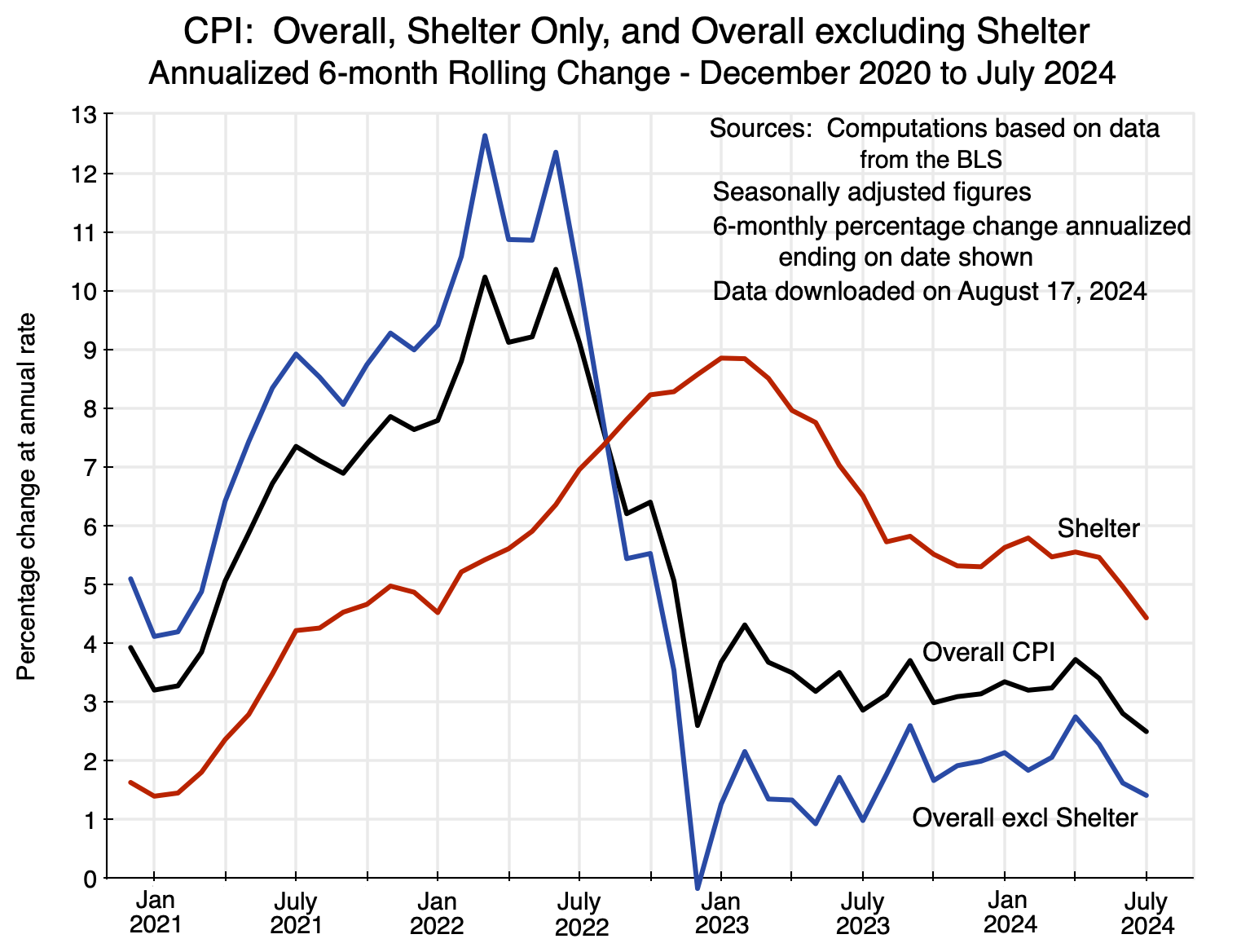
This chart shows the annualized inflation rates for 6-month rolling periods (ending on the dates shown) for the overall CPI, for the shelter component of the CPI, and for the CPI excluding shelter.  The overall inflation rate rose from an annualized rate of 3.2% in the six months ending in January 2021 (the end of Trump’s term) to a peak of 10.4% in the six months ending in June 2022.  It then fell remarkably fast, to an annualized rate of just 2.6% in the six months ending in December 2022.

This sudden drop in the inflation rate is seen even more clearly in the CPI index of prices for everything but shelter:  The annualized rate fell from 12.4% in the first half of 2022 (the six months ending in June) to a negative 0.2% rate in the second half of 2022 (the six months ending in December).  Why?  There was not a sudden collapse in consumer or other demand.  Rather, supply chains finally normalized in the summer of 2022, and this shifted pricing behavior.  When markets are supply constrained (as they were with the supply chain problems), firms can and will raise prices as competitors cannot step in and supply what the purchaser wants – they are all supply constrained.  But as the supply chains normalized, pricing returned to its normal condition where higher demand can be met by higher production – whether by the firm itself or, if it is unwilling, by its competitors.  It is similar to a phase change in conditions.

Shelter is different.  It covers all living accommodations (whether owned or rented), and as has been discussed in earlier posts on this blog (see here and here), the cost of shelter is special in the way it is estimated for the CPI.  It is also important, with a weight of 36% in the overall CPI index (and 45% in the core CPI index, where the core index excludes food and energy).  The data for the shelter component of the CPI comes from changes observed in the rents paid by those who rent their accommodation, and rental contracts are normally set for a year.  Hence, rental rates (and therefore the prices of the shelter component of the CPI) respond only with a lag.  One can see that in the chart above, with the peak in the inflation rate for shelter well after the peak in the inflation rate for the rest of the CPI.

Since mid-2022, the rate of inflation as measured by the overall CPI has generally been in the range of 3 to 4% annualized.  Increases in the cost of shelter have kept it relatively high and above the Fed’s target of about 2% per annum.  But as seen in the chart, it has recently come down – falling to an annualized rate of 2.5% in the six months ending in July.  For everything but shelter, the rate in the six months ending in July was only 1.4%.

One question that some might raise is whether the very tight labor markets – with an unemployment rate that was 4% or less until two months ago – might have led to the inflation observed.  The answer is no.  As noted above, inflation in all but shelter fell suddenly in mid-2022, falling from a rate of 12.4% in the first half of the year to a negative 0.2% in the second half, even though the unemployment rate was extremely low at 4% or less throughout (and only 3.5 or 3.6% in all of the second half of 2022).  Unemployment has remained low since while inflation has come down.  If the cause was tight labor markets, then the rate of inflation would have gone up rather than down.

Similarly, inflation as measured by the CPI was not high in 2018 nor in 2019 when labor markets were almost as tight during Trump’s presidency – with overall inflation then between 2 and 3% on an annual basis.  Nor did inflation go up during the similarly tight labor market of 1999 and 2000 during the Clinton presidency:  CPI inflation was generally in the 1 1/2 to 3 1/2 % range during that period.  All this calls into question the NAIRU concept, with its estimate that an unemployment rate below somewhere in the 5 to 6% range will lead to pressures that will raise the rate of inflation.

Managing inflation coming out of the chaos of 2020 was certainly difficult.  Inflation spiked in most countries of the world following the Covid crisis, reaching a peak in 2022.  But the rate of inflation has since come down as supply conditions normalized.  That does not mean that the absolute level of prices came down, only that they were no longer increasing at some high rate.  Wages and other sources of income will then adjust to the new price levels, and what matters in the end is whether real levels of consumption improve or not.  And they have:

The chart shows the paths followed for per capita real levels of personal consumption expenditures, as measured in the GDP accounts, during the presidential terms of Trump, Biden, and the second term of Obama.  The path followed under Trump was basically the same as that followed under Obama – until the collapse in the last year of Trump’s term.  The path followed under Biden has been substantially higher than either.  It was boosted in his first year as the successful vaccination campaign allowed people to return to their normal lives.  They could then purchase items with not only their then current incomes, but also with the savings they had built up in 2020.  But even if one excludes that first year, the growth under Biden has been similar to that under Obama and under Trump up to the collapse in Trump’s fourth year.

Once again, there is no basis for Trump’s claim of the “greatest economy”.

E.  Summary and Conclusion

The economy during Trump’s presidency was certainly not “the greatest in the history of the world”.  Nor was it even if you leave out the disastrous fourth year of his presidency.  Covid would have been difficult to manage even by the most capable of administrations, and Trump’s was far from that.  Instead of preparing for the shock this highly contagious disease would bring, Trump’s response was to insist – repeatedly – “it’s going to go away”.

Trump’s economic record was certainly nothing special.  Real GDP grew as fast or faster under Obama and Biden as it had under Trump.  Trump insisted that growth would be – and was – spurred by the tax cuts that he signed into law in late 2017 that slashed the tax on corporate profits.  But there is no indication of this in the data.  Nor is there even any indication that private investment rose as a result of the lower taxes.

Employment has grown far faster under Biden than it had under Trump, and also grew faster in Obama’s second term – even leaving out Trump’s disastrous fourth year.  Unemployment fell during the first three years of Trump’s term in office (before sky-rocketing in his fourth year), but here it just followed a very similar path to that under Obama.  For this, as with GDP and employment growth, perhaps the biggest accomplishment of Trump’s first three years in office was that he did not mess up the path that had been set under Obama.  And unemployment has been even lower under Biden.

Inflation was certainly higher in 2021 as the US came out of the Covid crisis.  Supply chains were still snarled, but there was pent-up demand from consumers who had had to avoid shopping in 2020 due to Covid and who also benefited from a truly huge set of Covid relief packages passed under both Trump and Biden.  Supply chains then normalized in mid-2022, sharply reducing pricing pressures for goods other than shelter.  Due in part to lags in how rental rates for housing are set (as they are normally fixed for a year) and then estimated by the BLS, the cost of the shelter component of the CPI came down more slowly than the cost of the rest of the CPI.  This kept inflation as measured higher than what the Fed aims for, although recently (in the last half year) it has come down again.  Most anticipate that the Fed will soon start to cut interest rates from their current high levels.  The inflationary episode resulting from the Covid crisis appears to be coming to an end.

There is thus no justification for the claim by Trump that “we had the greatest economy in the history of the world”.  Yet he has repeatedly asserted it, both now and when he was president.  Why?  Stephanie Grisham, who served in the Trump administration as press secretary and in other senior positions, and who had been – by her own description – personally close to Trump, explained it well in a speech she made on August 20 to the Democratic National Convention.  She noted that Trump used to tell her:  “It doesn’t matter what you say, Stephanie.  Say it enough, and people will believe you.”

Many do appear to believe that the economy was exceptionally strong when Trump was president:  that it was “the greatest in history”.  But that is certainly not true.  Facts matter; reality matters; and a president needs to know that they matter.

GDP Growth is Strong – Perhaps Too Strong

A.  Introduction

On April 25, the Bureau of Economic Analysis released its initial estimates of the GDP accounts for the first quarter of 2024 – what it calls the “Advance Estimate”.  These initial estimates of the growth of GDP and of its components are eagerly awaited by analysts.  While revised and updated in subsequent months as more complete data become available, it provides the first good indication of what recent growth has been.

In the first quarter of 2024, real GDP grew at an estimated annual rate of 1.6%.  This was viewed by many analysts as disappointing, as the average expectation (based on a survey of economists by Dow Jones) was for 2.4% growth.  And it was a deceleration in the rate of growth of GDP from 4.9% in the third quarter of 2023 and 3.4% in the fourth quarter.  The Dow Jones Industrial Average then fell by 720 points in the first half hour of trading (1.9%), with this attributed to the “disappointing” report on GDP growth.  It later recovered about half of this during the day.

One should have some sympathy for the commentators who are called upon by the media to provide an almost instantaneous analysis of what such economic releases imply.  But if they had examined the release more closely, the conclusion should not have been that economic growth was disappointingly slow, but rather that it has been sustained at a surprisingly high level.  After two quarters of extremely fast growth in the second half of 2023, some moderation in the pace should not only have been expected but welcomed.

The economy under Biden has been remarkably strong.  The unemployment rate has been at 4.0% or less for 28 straight months, and has reached as low as 3.4%.  Unemployment has not been this low nor for this long since the 1960s.  And an economy at full employment can only grow at a potential rate dictated by labor force growth and productivity.  The ceiling is not a hard one in any one quarter (labor utilization rates, and hence productivity, can vary in the short term), plus there is statistical noise in the GDP estimates themselves.  But growth in what is called “potential GDP” sets a ceiling on what trend growth might be.  And if the economy is at or close to that ceiling (as it is now), it can only grow over time at the pace that the ceiling itself grows at.

B.  Potential GDP

There are various ways to determine what potential GDP might be.  A respected and widely cited estimate is produced by the Congressional Budget Office (CBO), with figures on potential GDP for both past and future periods (up to 10 years out).  It is based on estimates of what the potential labor force has been or will be, accumulated capital, and technological progress.  In any given year, the CBO estimates reflect what GDP could be with the capital stock that would be available and the production that capital would allow, along with labor utilization at “full employment”.

The chart at the top of this post shows what real GDP per capita has been over the 11 years from the start of Obama’s second term (2013Q1) to now (2024Q1), along with the estimate by the CBO of potential GDP (expressed in per capita terms).  Not only is the economy now close to the potential GDP ceiling, it is a bit beyond it.  This is possible with the CBO estimates of potential GDP as they assume the labor market cannot sustain for long an unemployment rate of below roughly about 4.5% (which can vary some over time, based on the structure of the labor force).  Hence if actual unemployment is below this – as it is now and as it was for a period in 2019 – “potential GDP” as estimated by the CBO can be below actual GDP.  There are other factors as well, but the level of unemployment is the most significant.

This is also why actual GDP was below potential GDP from 2013 to late 2017 in the chart.  Unemployment was still relatively high in 2013 coming out of the 2008/09 economic and financial collapse.  As discussed in earlier posts on this blog (see here and here) limitations on government spending imposed by the Republican-controlled Congress slowed the recovery from that downturn and kept GDP well below potential for far too long.  This was the first time government spending had been cut following a recession since the early 1970s.  Federal government spending on goods and services fell at an average annual rate of 3.2% each year (in real terms) from 2011 to 2014.  In 2015 and 2016 it was finally allowed to grow, but only at a slow 0.3% per year pace on average.  Only after Trump was elected did Congress allow federal government spending to rise at a more significant rate – at 2.6% per year between 2017 and 2019 (and then by much more in 2020 due to the Covid crisis, by which time Democrats controlled Congress).

This lack of a supportive fiscal policy following the 2008/09 economic and financial collapse slowed the pace of recovery.  Unemployment fell only slowly, but did still fall, and reached 4.7% by the end of Obama’s second term.  The gap between actual and potential GDP diminished, and as seen in the chart at the top of this post, actual GDP has been close to potential GDP since 2018 (with the important exception of the 2020 collapse due to Covid).

The economy is now at – or indeed a bit above – the CBO estimate of potential GDP.  Although there may be quarter-to-quarter fluctuations – as noted above – going forward one cannot expect GDP to grow on a sustained basis faster than that ceiling.  And the CBO forecasts that potential GDP is growing at a 2.2% pace currently, with this expected to diminish over time to a 2.0% pace by 2030 and a 1.8% pace by 2034.  This is primarily due to demographics:  Growth in the labor force is slowing.

Real GDP grew at an average annual rate of 4.1% in the second half of 2023 (3.4% in the third quarter and 4.9% in the fourth quarter).  This is well above the CBO’s estimate of potential GDP growing at a 2.2% rate.  Some slowdown should have been expected.  Even with the 1.6% rate for the first quarter of 2024, real GDP has grown at an average annual rate of 3.3% since mid-2023.  It should not be surprising if GDP growth in the second quarter of 2024 comes in at a relatively modest rate, as the economy returns to the trend growth that potential GDP allows.

However, the initial indication from the Atlanta Fed’s GDPNow indicator is that GDP growth in the second quarter of 2024 will in fact be quite high at a 3.9% rate (in its initial estimate made on April 26 – the most recent as I write this).  If that turns out to be the case, it would not be surprising if the Fed becomes concerned with a pace of growth that is excessively fast.

C.  Other Indicators of an Economy Fully Utilizing Its Potential

One wants an economy that is fully utilizing its potential.  With full employment, one is not throwing away goods and services – as well as the corresponding wages and income – that labor and producers would be eager and able to provide.  But once an economy has reached that potential, it can only grow over time at the rate that that potential grows.  This pace is dictated by demographics (growth in the labor force) and growth in productivity.  While this will be a slower pace than what would be possible for an economy with underutilized labor and other resources – where a period of more rapid growth is possible by bringing into employment those underutilized resources – once one is at the ceiling one cannot grow on a sustained basis at a pace higher than that.  Trying to do so leads to inflation.

With this perspective, a number of observations come together from this release on 2024 first-quarter growth in GDP and its components:

a)  The 1.6% growth rate was viewed as “low”.  But as noted above, this followed exceptionally high growth, of 4.9% in the third quarter of 2023 and 3.4% in the fourth quarter.  One should have expected a slowdown.

b)  There is also evidence of the economy reaching its capacity limits in how the particular components of the GDP figures changed.  Keep in mind that GDP, while derived in these accounts from estimates of what was sold for final demand uses (consumption, investment, etc.), is still a measure of production, not just sales.  That is, GDP – Gross Domestic Product – is a measure of what is produced, produced domestically, and in “gross” terms (because investment is counted in gross terms rather than net of depreciation).

The reason this indirect approach to estimating production works is because whatever is produced and not sold will end up as an increase in inventories.  And this change in inventories is treated as if it were a final demand category.  It can be viewed as a form of investment (investment in inventories), and is included in the accounts as part of overall investment (i.e. it is added to fixed investment, which is investment in machinery and structures).

Furthermore, foreign trade is included in net terms:  exports less imports.  Part of what is produced domestically is sold for exports, while imports supply products that can be used to satisfy domestic demands.

When an economy is operating at or close to potential GDP, one can expect final demands to be increasingly met by drawdowns of inventory (or less of an increase in inventories compared to before) plus a decline in the net trade balance (less exports and/or more imports).  Each can supply product to meet final demands when domestic production is constrained because the economy is operating at close to the ceiling.

One sees both of these in the 2024Q1 figures.  While inventories still rose (by $35 billion, in 2017 constant prices), they rose by less than they had in 2023Q4 (when they rose by $55 billion).  Thus, while GDP includes the change in inventories as one of the demand components along with consumption and other investments, the change in GDP will be based on the change in the change in inventories.  (See this earlier post on this blog.)  And that fell in 2024Q1, as inventory accumulation – while still positive – was not as high as it had been in the previous quarter.  That change in the inventories component reduced GDP growth by 0.35% points relative to what it would have been had domestic production been such that inventory accumulation would have matched what it had been in the preceding quarter.  That it did not can be a sign that domestic production is being constrained by capacity.

Similarly and more importantly, the net trade balance fell.  While exports grew slightly (0.1% of GDP) imports rose by much more (1.0% of GDP), and hence the net trade balance fell by 0.9% of GDP.  This is consistent with domestic production being constrained by an economy that was already at full employment and could not immediately produce much more, and hence with demand that was increasingly met by net imports.

The changes in the net trade balance and in net inventory accumulation totaled 1.2% of GDP (before rounding).  That is, production (GDP) would have had to increase by 2.8% rather than 1.6% to supply domestic purchasers of final (i.e. non-inventory) product.  But with production constrained by capacity limits, the economy had to import more and limit inventory accumulation to less than before.

I should emphasize that this is not a bad position to be in.  One wants an economy operating at full capacity.  But when the economy is operating at full capacity, there will be limits on how much can be supplied domestically.  And as noted before, one cannot expect growth going forward – on average and recognizing there will be period-to-period fluctuations – to exceed the rate at which potential GDP can grow.

c)  Another indication of an economy reaching its potential ceiling is what is happening to prices.  This is more disconcerting.  Price deflators are estimated as part of the GDP accounts in order to convert (deflate) the nominal estimates of the various GDP components into estimates of what the real changes were.  While people focus on changes in real GDP and its components – and properly so – some may not fully realize that the data the BEA collects on production and sales are all in nominal money terms.  It is not really possible for producers to report anything else.  The BEA then converts those nominal money figures to changes in real terms by applying price indices to “deflate” the nominal figures – hence the term “deflator”.  The BEA obtains those price indices – tens of thousands of them – separately, primarily from the price surveys carried out by the Bureau of Labor Statistics.

The initial estimates of the GDP accounts released on April 25 indicated that the price deflators for both overall GDP and for the Personal Consumption Expenditures (PCE) component of GDP demand rose at higher rates than in the preceding several quarters.  The GDP deflator rose in the first quarter of 2024 at an estimated annual rate of 3.1% and the PCE deflator at a rate of 3.4%.  The PCE deflator receives special attention as it is the primary measure of inflation that the Fed focuses on as it considers what monetary policy to follow.  The Fed pays attention to much more as well, of course, but the PCE deflator is special.  And the Fed target for the PCE deflator is 2.0%.

The annualized rates for the GDP and PCE deflators were at 1.6% and 1.8%, respectively, in the fourth quarter of 2023.  They had been generally coming down since mid-2022, and had averaged 2.2% and 2.3% respectively in the final three quarters of 2023.  The increase in the first quarter of 2024 was therefore of some concern, especially when coupled with the other indications (discussed above) that the economy is now at or even above the potential GDP ceiling.

But it is also important to keep in mind that – as often said – one period’s figures do not constitute a trend.  There have been, and will be, quarter to quarter fluctuations.  But the increase in the price deflators from below the Fed’s 2.0% target to a level a good deal higher, coupled with the other indications of an economy operating at or close to capacity, is something to watch.  And it suggests that the Fed is likely to remain cautious and not reduce interest rates from where they now are until they find out more about what is happening to prices.

D.  The Federal Fiscal Deficit is Large

Finally, while not part of the report on the GDP accounts, it should be noted that the federal fiscal deficit remains extremely high.  Recent figures on the Federal Government’s fiscal outlays, receipts, and deficit, expressed here as a share of GDP in the periods, are as follows:

Federal Government Fiscal Accounts

GDP shares

Receipts

Outlays

Deficit

FY2023

16.5%

22.7%

6.3%

CY2023

16.5%

23.0%

6.5%

FY2023 H1

15.4%

23.7%

8.3%

FY2023 H2

17.5%

21.8%

4.3%

FY2024 H1

15.6%

23.1%

7.6%

The GDP shares are calculated from the dollar figures reported in the Monthly US Treasury Statement for March 2024, coupled with the GDP estimates of the BEA.  The Monthly Treasury Statements are definitive in that the reported dollar figures up to the current month rarely change later (although forecasts for the full budget year of course may).  Note also that the reported monthly figures are not seasonally adjusted but are rather the actual fiscal receipts and outlays for the period, while the GDP figures are seasonally adjusted.

In a period of full employment, these deficit figures are all high.  As was discussed in an earlier post on this blog, while high fiscal deficits may well be necessary and appropriate when unemployment is high, one should balance this with lower deficits when the economy is at full employment – as it is now.  The fiscal deficits need not be zero, but a good rule of thumb is to aim for a deficit of perhaps 3% of GDP and no more than 4% of GDP in an economy that is at full employment.  At such deficits, the government debt to GDP ratio will be stable or falling over time, which can then balance out the times when the appropriate policy is to allow for a higher deficit in an economic downturn in order to support a recovery.

The math is simple.  As of March 31, 2024, the total federal debt held by the public was $27.5 trillion (as reported in the Monthly Treasury Statement).  Nominal GDP in 2024Q1 was $28.3 trillion (at an annual rate).  The debt to GDP ratio was thus 97.3% (before rounding), or close to 100%.  If, going forward, one should expect trend growth of about 2% per year in real GDP, inflation of 2% (the Fed’s goal), long-term Treasury interest rates of 4% (i.e. 2% inflation and a 2% real rate of interest on longer-term securities), then a debt to GDP ratio of 100% will stay at 100% if the federal fiscal deficit is 4% of GDP.  The debt ratio will fall with a lower deficit and rise with a higher deficit.

But despite being at full employment, the federal fiscal deficit was 7.6% of GDP in the first half of FY2024.  That is well above the 4% level needed to keep the debt to GDP ratio from rising further.  However, It is not clear whether the deficit has been trending higher or lower.  While the 7.6% deficit in the first half of FY2024 was higher than the 6.3% deficit in FY2023 as a whole, and substantially higher than the 4.3% deficit in the second half of FY2023, it is less than the 8.3% deficit in the first half of FY2023.  There is likely a significant degree of seasonality in the fiscal figures.  But under any reasonable scenario, the deficit will be well above 4% of GDP again this fiscal year.

The issue facing the Democrats is that every time over the past more than 40 years that they have cut the fiscal deficit during their term in office, the subsequent Republican administration has then increased it – through a combination of tax cuts and expenditure increases.  Comparing fiscal years (and avoiding recession years given their special nature, and based on data from the CBO), the fiscal deficit under Ford in FY1976 was 4.1% of GDP.  Carter brought that down by FY1979 to just 1.6% of GDP.  Reagan tax cuts and expenditure increases then raised the deficit to 5.9% of GDP in FY1983, and it was 4.5% of GDP under Bush I in FY1992.  The fiscal accounts then moved into a surplus under Clinton following the steady and strong growth in real GDP during his presidency, reaching a surplus of 2.3% of GDP in FY2000.  On taking office, Bush II at first advocated tax cuts because the economy was strong and the fiscal accounts were in surplus, but then after the downturn a few months after taking office, Bush II promoted tax cuts because the economy was weak.  The tax cuts did go through, and with fiscal revenues falling as a share of GDP while expenditures rose, the fiscal deficit reached 3.4% of GDP in FY2004 – a huge shift of 5.7% points of GDP from where it was in Clinton’s last year in office.

With the economic and financial collapse in 2008 in the last year of the Bush II presidency, the deficit rose to 9.8% of GDP in FY2009 in Obama’s first year.  This stabilized an economy that had been in freefall as Obama took office (with the sharpest downturn since the Great Depression), but as noted above, subsequent cuts in government spending then slowed the full recovery.  Eventually the economy did recover, and the fiscal deficit was reduced to 2.4% of GDP in FY2015 and a somewhat higher 3.1% of GDP in FY2016 when federal government spending was finally allowed to grow, albeit modestly.

Taxes were then once again cut under the Republican presidency of Trump, and despite an economy at full employment, the fiscal deficit rose to 4.6% of GDP in FY2019.  It then exploded with the Covid crisis, to 14.7% of GDP in FY2020 and 12.1% in FY2021, before falling under Biden to 5.4% of GDP in FY2022 and 6.3% of GDP in FY2023.

So what should be done?  This is not the place for a full analysis, but broadly, fiscal revenues as a share of GDP are low in the US.  Total tax revenue (including by state and local governments) is lower in the US than in any other high-income member of the OECD with just one exception (Switzerland), with US tax revenues more than 6% points of GDP less than the OECD average (in 2022).  A post on this blog from 2013 – now perhaps out of date – showed that the federal government debt to GDP ratio would have fallen sharply – rather than increase – in the years then following if the Bush II tax cuts had been allowed to expire in full at the end of 2012.  The figures would be different now, but the basic point remains that both compared to other high-income nations and to the historical record, the US suffers from a chronic fiscal revenue problem.

A reasonable target for federal fiscal revenues might be 20% of GDP – the same share of GDP as in FY2000.  That would be an increase of 3.5% of GDP from the 16.5% collected in FY2023.  Taxes collected in the US would still be less – as a share of GDP – of all but two of the higher-income OECD members (Australia and Switzerland), and also far less than the OECD average.

There are also always some fiscal expenditures that could also rationally be cut (but where there is always disagreement on which), but even with no cuts in expenditures, revenues of 20% of GDP in FY2023 would have brought the deficit down from 6.3% of GDP to 2.8%.  And as discussed above, a deficit of 2.8% of GDP would be expected to lead to a downward trend over time in the government debt to GDP ratio.

One option to get fiscal revenues back to around 20% of GDP would be simply to bring back the taxation rules of that year.  They were not excessively burdensome – the economy was performing well at the time with solid GDP growth and low unemployment.  But better would be to introduce true tax reforms, such as ending the disparities in the tax system where different forms of income are taxed differently (as discussed, for example, in this earlier post on this blog).  The most significant such disparity is that income from wealth (which is, not surprisingly, mostly held by the wealthy) is taxed at lower rates than income from wages.  But with Republicans in control of Congress, such a reform would never be passed.

E.  Summary and Conclusion

The economy is at full employment and is producing at or close to the ceiling allowed by its productive potential.  Going forward, one should not expect growth in real GDP to be greater than the pace at which this ceiling grows.  There may well be quarter-to-quarter fluctuations around this, as the ceiling is not absolute (labor utilization can vary) plus there is statistical noise in the GDP estimates themselves, but over time one should expect – and indeed welcome – growth that averages what that ceiling grows at.  The CBO estimates that potential GDP is growing at a rate of about 2.2% per annum currently, and expects this to fall over time to a 2.0% rate by 2030.

The 1.6% rate of growth in the first quarter of 2024 should be seen in this light.  Real GDP had grown at rates of 4.9% in the third quarter of 2023 and 3.4% in the fourth quarter, and a slowdown from such a pace should not only have been expected but welcomed.

Indeed, there may be a concern that GDP growth has been too rapid since mid-2023.  Even with the 1.6% growth of the first quarter of 2024, growth has averaged 3.3% since the middle of last year.  And there are signs in the GDP accounts themselves of an economy producing at capacity.  Inventory accumulation slowed relative to what it was before while the foreign trade balance fell as imports rose substantially.  The deflators for GDP and for Personal Consumption Expenditures also rose – to annualized rates of 3.1% and 3.4% respectively – after following a downward trend since mid-2022.  This is, however, an increase for the deflators for just one period at this point, and one should not assume until there is further evidence whether this marks a change in that previous trend.

For an economy at full employment, the current size of the fiscal deficit is a concern.  At full employment one should be aiming for a deficit of below around 4% of GDP in order at least to stabilize and preferably reduce the government debt to GDP ratio.  But in FY2023, the deficit was 6.3% of GDP.  The US has been facing chronic deficit issues for decades now – a consequence of the tax cut measures pushed through by Reagan, Bush II, and Trump.  A reasonable goal now would be a tax reform that removes the distortions from taxing different types of income differently, with rates then set to obtain fiscal revenues of around 20% of GDP – an increase of 3.5% points of GDP compared to the revenues collected in 2023.  The tax rates on income from wealth would rise from the preferential rates they now enjoy, while the tax rates on income from wages (and other “ordinary income”) might well fall.

Even with such an increase, fiscal revenues collected would still be well below the OECD average, and below that of all but only two of the higher-income OECD members.  In contrast, cuts in expenditures (as was done, as a share of GDP, during the presidencies of Carter, Clinton, and Obama), are likely to be followed in the next Republican administration with another round of tax cuts.