Andrew Yang’s Proposed $1,000 per Month Grant: Issues Raised in the Democratic Debate

A.  Introduction

This is the second in a series of posts on this blog addressing issues that have come up during the campaign of the candidates for the Democratic nomination for president, and which specifically came up in the October 15 Democratic debate.  As flagged in the previous blog post, one can find a transcript of the debate at the Washington Post website, and a video of the debate at the CNN website.

This post will address Andrew Yang’s proposal of a $1,000 per month grant for every adult American (which I will mostly refer to here as a $12,000 grant per year).  This policy is called a universal basic income (or UBI), and has been explored in a few other countries as well.  It has received increased attention in recent years, in part due to the sharp growth in income inequality in the US of recent decades, that began around 1980.  If properly designed, such a $12,000 grant per adult per year could mark a substantial redistribution of income.  But the degree of redistribution depends directly on how the funding would be raised.  As we will discuss below, Yang’s specific proposals for that are problematic.  There are also other issues with such a program which, even if well designed, calls into question whether it would be the best approach to addressing inequality.  All this will be discussed below.

First, however, it is useful to address two misconceptions that appear to be widespread.  One is that many appear to believe that the $12,000 per adult per year would not need to come from somewhere.  That is, everyone would receive it, but no one would have to provide the funds to pay for it.  That is not possible.  The economy produces so much, whatever is produced accrues as incomes to someone, and if one is to transfer some amount ($12,000 here) to each adult then the amounts so transferred will need to come from somewhere.  That is, this is a redistribution.  There is nothing wrong with a redistribution, if well designed, but it is not a magical creation of something out of nothing.

The other misconception, and asserted by Yang as the primary rationale for such a $12,000 per year grant, is that a “Fourth Industrial Revolution” is now underway which will lead to widespread structural unemployment due to automation.  This issue was addressed in the previous post on this blog, where I noted that the forecast job losses due to automation in the coming years are not out of line with what has been the norm in the US for at least the last 150 years.  There has always been job disruption and turnover, and while assistance should certainly be provided to workers whose jobs will be affected, what is expected in the years going forward is similar to what we have had in the past.

It is also a good thing that workers should not be expected to rely on a $12,000 per year grant to make up for a lost job.  Median earnings of a full-time worker was an estimated $50,653 in 2018, according to the Census Bureau.  A grant of $12,000 would not go far in making up for this.

So the issue is one of redistribution, and to be fair to Yang, I should note that he posts on his campaign website a fair amount of detail on how the program would be paid for.  I make use of that information below.  But the numbers do not really add up, and for a candidate who champions math (something I admire), this is disappointing.

B.  Yang’s Proposal of a $1,000 Monthly Grant to All Americans

First of all, the overall cost.  This is easy to calculate, although not much discussed.  The $12,000 per year grant would go to every adult American, who Yang defines as all those over the age of 18.  There were very close to 250 million Americans over the age of 18 in 2018, so at $12,000 per adult the cost would be $3.0 trillion.

This is far from a small amount.  With GDP of approximately $20 trillion in 2018 ($20.58 trillion to be more precise), such a program would come to 15% of GDP.  That is huge.  Total taxes and revenues received by the federal government (including all income taxes, all taxes for Social Security and Medicare, and everything else) only came to $3.3 trillion in FY2018.  This is only 10% more than the $3.0 trillion that would have been required for Yang’s $12,000 per adult grants.  Or put another way, taxes and other government revenues would need almost to be doubled (raised by 91%) to cover the cost of the program.  As another comparison, the cost of the tax cuts that Trump and the Republican leadership rushed through Congress in December 2017 was forecast to be an estimated $150 billion per year.  That was a big revenue loss.  But the Yang proposal would cost 20 times as much.

With such amounts to be raised, Yang proposes on his campaign website a number of taxes and other measures to fund the program.  One is a value-added tax (VAT), and from his very brief statements during the debates but also in interviews with the media, one gets the impression that all of the program would be funded by a value-added tax.  But that is not the case.  He in fact says on his campaign website that the VAT, at the rate and coverage he would set, would raise only about $800 billion.  This would come only to a bit over a quarter (27%) of the $3.0 trillion needed.  There is a need for much more besides, and to his credit, he presents plans for most (although not all) of this.

So what does he propose specifically?:

a) A New Value-Added Tax:

First, and as much noted, he is proposing that the US institute a VAT at a rate of 10%.  He estimates it would raise approximately $800 billion a year, and for the parameters for the tax that he sets, that is a reasonable estimate.  A VAT is common in most of the rest of the world as it is a tax that is relatively easy to collect, with internal checks that make underreporting difficult.  It is in essence a tax on consumption, similar to a sales tax but levied only on the added value at each stage in the production chain.  Yang notes that a 10% rate would be approximately half of the rates found in Europe (which is more or less correct – the rates in Europe in fact vary by country and are between 17 and 27% in the EU countries, but the rates for most of the larger economies are in the 19 to 22% range).

A VAT is a tax on what households consume, and for that reason a regressive tax.  The poor and middle classes who have to spend all or most of their current incomes to meet their family needs will pay a higher share of their incomes under such a tax than higher-income households will.  For this reason, VAT systems as implemented will often exempt (or tax at a reduced rate) certain basic goods such as foodstuffs and other necessities, as such goods account for a particularly high share of the expenditures of the poor and middle classes.  Yang is proposing this as well.  But even with such exemptions (or lower VAT rates), a VAT tax is still normally regressive, just less so.

Furthermore, households will in the end be paying the tax, as prices will rise to reflect the new tax.  Yang asserts that some of the cost of the VAT will be shifted to businesses, who would not be able, he says, to pass along the full cost of the tax.  But this is not correct.  In the case where the VAT applies equally to all goods, the full 10% will be passed along as all goods are affected equally by the now higher cost, and relative prices will not change.  To the extent that certain goods (such as foodstuffs and other necessities) are exempted, there could be some shift in demand to such goods, but the degree will depend on the extent to which they are substitutable for the goods which are taxed.  If they really are necessities, such substitution is likely to be limited.

A VAT as Yang proposes thus would raise a substantial amount of revenues, and the $800 billion figure is a reasonable estimate.  This total would be on the order of half of all that is now raised by individual income taxes in the US (which was $1,684 billion in FY2018).  But one cannot avoid that such a tax is paid by households, who will face higher prices on what they purchase, and the tax will almost certainly be regressive, impacting the poor and middle classes the most (with the extent dependent on how many and which goods are designated as subject to a reduced VAT rate, or no VAT at all).  But whether regressive or not, everyone will be affected and hence no one will actually see a net increase of $12,000 in purchasing power from the proposed grant  Rather, it will be something less.

b)  A Requirement to Choose Either the $12,000 Grants, or Participation in Existing Government Social Programs

Second, Yang’s proposal would require that households who currently benefit from government social programs, such as for welfare or food stamps, would be required to give up those benefits if they choose to receive the $12,000 per adult per year.  He says this will lead to reduced government spending on such social programs of $500 to $600 billion a year.

There are two big problems with this.  The first is that those programs are not that large.  While it is not fully clear how expansive Yang’s list is of the programs which would then be denied to recipients of the $12,000 grants, even if one included all those included in what the Congressional Budget Office defines as “Income Security” (“unemployment compensation, Supplemental Security Income, the refundable portion of the earned income and child tax credits, the Supplemental Nutrition Assistance Program [food stamps], family support, child nutrition, and foster care”), the total spent in FY2018 was only $285 billion.  You cannot save $500 to $600 billion if you are only spending $285 billion.

Second, such a policy would be regressive in the extreme.  Poor and near-poor households, and only such households, would be forced to choose whether to continue to receive benefits under such existing programs, or receive the $12,000 per adult grant per year.  If they are now receiving $12,000 or more in such programs per adult household member, they would receive no benefit at all from what is being called a “universal” basic income grant.  To the extent they are now receiving less than $12,000 from such programs (per adult), they may gain some benefit, but less than $12,000 worth.  For example, if they are now receiving $10,000 in benefits (per adult) from current programs, their net gain would be just $2,000 (setting aside for the moment the higher prices they would also now need to pay due to the 10% VAT).  Furthermore, only the poor and near-poor who are being supported by such government programs will see such an effective reduction in their $12,000 grants.  The rich and others, who benefit from other government programs, will not see such a cut in the programs or tax subsidies that benefit them.

c)  Savings in Other Government Programs 

Third, Yang argues that with his universal basic income grant, there would be a reduction in government spending of $100 to $200 billion a year from lower expenditures on “health care, incarceration, homelessness services and the like”, as “people would be able to take better care of themselves”.  This is clearly more speculative.  There might be some such benefits, and hopefully would be, but without experience to draw on it is impossible to say how important this would be and whether any such savings would add up to such a figure.  Furthermore, much of those savings, were they to follow, would accrue not to the federal government but rather to state and local governments.  It is at the state and local level where most expenditures on incarceration and homelessness, and to a lesser degree on health care, take place.  They would not accrue to the federal budget.

d)  Increased Tax Revenues From a Larger Economy

Fourth, Yang states that with the $12,000 grants the economy would grow larger – by 12.5% he says (or $2.5 trillion in increased GDP).  He cites a 2017 study produced by scholars at the Roosevelt Institute, a left-leaning non-profit think tank based in New York, which examined the impact on the overall economy, under several scenarios, of precisely such a $12,000 annual grant per adult.

There are, however, several problems:

i)  First, under the specific scenario that is closest to the Yang proposal (where the grants would be funded through a combination of taxes and other actions), the impact on the overall economy forecast in the Roosevelt Institute study would be either zero (when net distribution effects are neutral), or small (up to 2.6%, if funded through a highly progressive set of taxes).

ii)  The reason for this result is that the model used by the Roosevelt Institute researchers assumes that the economy is far from full employment, and that economic output is then entirely driven by aggregate demand.  Thus with a new program such as the $12,000 grants, which is fully paid for by taxes or other measures, there is no impact on aggregate demand (and hence no impact on economic output) when net distributional effects are assumed to be neutral.  If funded in a way that is not distributionally neutral, such as through the use of highly progressive taxes, then there can be some effect, but it would be small.

In the Roosevelt Institute model, there is only a substantial expansion of the economy (of about 12.5%) in a scenario where the new $12,000 grants are not funded at all, but rather purely and entirely added to the fiscal deficit and then borrowed.  And with the current fiscal deficit now about 5% of GDP under Trump (unprecedented even at 5% in a time of full employment, other than during World War II), and the $12,000 grants coming to $3.0 trillion or 15% of GDP, this would bring the overall deficit to 20% of GDP!

Few economists would accept that such a scenario is anywhere close to plausible.  First of all, the current unemployment rate of 3.5% is at a 50 year low.  The economy is at full employment.  The Roosevelt Institute researchers are asserting that this is fictitious, and that the economy could expand by a substantial amount (12.5% in their scenario) if the government simply spent more and did not raise taxes to cover any share of the cost.  They also assume that a fiscal deficit of 20% of GDP would not have any consequences, such as on interest rates.  Note also an implication of their approach is that the government spending could be on anything, including, for example, the military.  They are using a purely demand-led model.

iii)  Finally, even if one assumes the economy will grow to be 12.5% larger as a result of the grants, even the Roosevelt Institute researchers do not assume it will be instantaneous.  Rather, in their model the economy becomes 12.5% larger only after eight years.  Yang is implicitly assuming it will be immediate.

There are therefore several problems in the interpretation and use of the Roosevelt Institute study.  Their scenario for 12.5% growth is not the one that follows from Yang’s proposals (which is funded, at least to a degree), nor would GDP jump immediately by such an amount.  And the Roosevelt Insitute model of the economy is one that few economists would accept as applicable in the current state of the economy, with its 3.5% unemployment.

But there is also a further problem.  Even assuming GDP rises instantly by 12.5%, leading to an increase in GDP of $2.5 trillion (from a current $20 trillion), Yang then asserts that this higher GDP will generate between $800 and $900 billion in increased federal tax revenue.  That would imply federal taxes of 32 to 36% on the extra output.  But that is implausible.  Total federal tax (and all other) revenues are only 17.5% of GDP.  While in a progressive tax system the marginal tax revenues received on an increase in income will be higher than at the average tax rate, the US system is no longer very progressive.  And the rates are far from what they would need to be twice as high at the margin (32 to 36%) as they are at the average (17.5%).  A more plausible estimate of the increased federal tax revenues from an economy that somehow became 12.5% larger would not be the $800 to $900 billion Yang calculates, but rather about half that.

Might such a universal basic income grant affect the size of the economy through other, more orthodox, channels?  That is certainly possible, although whether it would lead to a higher or to a lower GDP is not clear.  Yang argues that it would lead recipients to manage their health better, to stay in school longer, to less criminality, and to other such social benefits.  Evidence on this is highly limited, but it is in principle conceivable in a program that does properly redistribute income towards those with lower incomes (where, as discussed above, Yang’s specific program has problems).  Over fairly long periods of time (generations really) this could lead to a larger and stronger economy.

But one will also likely see effects working in the other direction.  There might be an increase in spouses (wives usually) who choose to stay home longer to raise their children, or an increase in those who decide to retire earlier than they would have before, or an increase in the average time between jobs by those who lose or quit from one job before they take another, and other such impacts.  Such impacts are not negative in themselves, if they reflect choices voluntarily made and now possible due to a $12,000 annual grant.  But they all would have the effect of reducing GDP, and hence the tax revenues that follow from some level of GDP.

There might therefore be both positive and negative impacts on GDP.  However, the impact of each is likely to be small, will mostly only develop over time, and will to some extent cancel each other out.  What is likely is that there will be little measurable change in GDP in whichever direction.

e)  Other Taxes

Fifth, Yang would institute other taxes to raise further amounts.  He does not specify precisely how much would be raised or what these would be, but provides a possible list and says they would focus on top earners and on pollution.  The list includes a financial transactions tax, ending the favorable tax treatment now given to capital gains and carried interest, removing the ceiling on wages subject to the Social Security tax, and a tax on carbon emissions (with a portion of such a tax allocated to the $12,000 grants).

What would be raised by such new or increased taxes would depend on precisely what the rates would be and what they would cover.  But the total that would be required, under the assumption that the amounts that would be raised (or saved, when existing government programs are cut) from all the measures listed above are as Yang assumes, would then be between $500 and $800 billion (as the revenues or savings from the programs listed above sum to $2.2 to $2.5 trillion).  That is, one might need from these “other taxes” as much as would be raised by the proposed new VAT.

But as noted in the discussion above, the amounts that would be raised by those measures are often likely to be well short of what Yang says will be the case.  One cannot save $500 to $600 billion in government programs for the poor and near-poor if government is spending only $285 billion on such programs, for example.  A more plausible figure for what might be raised by those proposals would be on the order of $1 trillion, mostly from the VAT, and not the $2.2 to $2.5 trillion Yang says will be the case.

C.  An Assessment

Yang provides a fair amount of detail on how he would implement a universal basic income grant of $12,000 per adult per year, and for a political campaign it is an admirable amount of detail.  But there are still, as discussed above, numerous gaps that prevent anything like a complete assessment of the program.  But a number of points are evident.

To start, the figures provided are not always plausible.  The math just does not add up, and for someone who extolls the need for good math (and rightly so), this is disappointing.  One cannot save $500 to $600 billion in programs for the poor and near-poor when only $285 billion is being spent now.  One cannot assume that the economy will jump immediately by 12.5% (which even the Roosevelt Institute model forecasts would only happen in eight years, and under a scenario that is the opposite of that of the Yang program, and in a model that few economists would take as credible in any case).  Even if the economy did jump by so much immediately, one would not see an increase of $800 to $900 billion in federal tax revenues from this but rather more like half that.  And other such issues.

But while the proposal is still not fully spelled out (in particular on which other taxes would be imposed to fill out the program), we can draw a few conclusions.  One is that the one group in society who will clearly not gain from the $12,000 grants is the poor and near-poor, who currently make use of food stamp and other such programs and decide to stay with those programs.  They would then not be eligible for the $12,000 grants.  And keep in mind that $12,000 per adult grants are not much, if you have nothing else.  One would still be below the federal poverty line if single (where the poverty line in 2019 is $12,490) or in a household with two adults and two or more children (where the poverty line, with two children, is $25,750).  On top of this, such households (like all households) will pay higher prices for at least some of what they purchase due to the new VAT.  So such households will clearly lose.

Furthermore, those poor or near-poor households who do decide to switch, thus giving up their eligibility for food stamps and other such programs, will see a net gain that is substantially less than $12,000 per adult.  The extent will depend on how much they receive now from those social programs.  Those who receive the most (up to $12,000 per adult), who are presumably also most likely to be the poorest among them, will lose the most.  This is not a structure that makes sense for a program that is purportedly designed to be of most benefit to the poorest.

For middle and higher-income households the net gain (or loss) from the program will depend on the full set of taxes that would be needed to fund the program.  One cannot say who will gain and who will lose until the structure of that full set of taxes is made clear.  This is of course not surprising, as one needs to keep in mind that this is a program of redistribution:  Funds will be raised (by taxes) that disproportionately affect certain groups, to be distributed then in the $12,000 grants.  Some will gain and some will lose, but overall the balance has to be zero.

One can also conclude that such a program, providing for a universal basic income with grants of $12,000 per adult, will necessarily be hugely expensive.  It would cost $3 trillion a year, which is 15% of GDP.  Funding it would require raising all federal tax and other revenue by 91% (excluding any offset by cuts in government social programs, which are however unlikely to amount to anything close to what Yang assumes).  Raising funds of such magnitude is completely unrealistic.  And yet despite such costs, the grants provided of $12,000 per adult would be poverty level incomes for those who do not have a job or other source of support.

One could address this by scaling back the grant, from $12,000 to something substantially less, but then it becomes less meaningful to an individual.  The fundamental problem is the design as a universal grant, to all adults.  While this might be thought to be politically attractive, any such program then ends up being hugely expensive.

The alternative is to design a program that is specifically targeted to those who need such support.  Rather than attempting to hide the distributional consequences in a program that claims to be universal (but where certain groups will gain and certain groups will lose, once one takes fully into account how it will be funded), make explicit the redistribution that is being sought.  With this clear, one can then design a focussed program that addresses that redistribution aim.

Finally, one should recognize that there are other policies as well that might achieve those aims that may not require explicit government-intermediated redistribution.  For example, Senator Cory Booker in the October 15 debate noted that a $15 per hour minimum wage would provide more to those now at the minimum wage than a $12,000 annual grant.  This remark was not much noted, but what Senator Booker said was true.  The federal minimum wage is currently $7.25 per hour.  This is low – indeed, it is less (in real terms) than what it was when Harry Truman was president.  If the minimum wage were raised to $15 per hour, a worker now at the $7.25 rate would see an increase in income of $15.00 – $7.25 = $7.75 per hour, and over a year of 40 hour weeks would see an increase in income of $7.75 x 40 x 52 = $16,120.00.  This is well more than a $12,000 annual grant would provide.

Republican politicians have argued that raising the minimum wage by such a magnitude will lead to widespread unemployment.  But there is no evidence that changes in the minimum wage that we have periodically had in the past (whether federal or state level minimum wages) have had such an adverse effect.  There is of course certainly some limit to how much it can be raised, but one should recognize that the minimum wage would now be over $24 per hour if it had been allowed to grow at the same pace as labor productivity since the late 1960s.

Income inequality is a real problem in the US, and needs to be addressed.  But there are problems with Yang’s specific version of a universal basic income.  While one may be able to fix at least some of those problems and come up with something more reasonable, it would still be massively disruptive given the amounts to be raised.  And politically impossible.  A focus on more targeted programs, as well as on issues such as the minimum wage, are likely to prove far more productive.
Allow the IRS to Fill In Our Tax Forms For Us – It Can and It Should

A.  Introduction

Having recently completed and filed this year’s income tax forms, it is timely to examine what impact the Republican tax bill, pushed quickly through Congress in December 2017 along largely party-line votes, has had on the taxes we pay and on the process by which we figure out what they are.  I will refer to the bill as the Trump/GOP tax bill as the new law reflected both what the Republican leadership in Congress wanted and what the Trump administration pushed for.

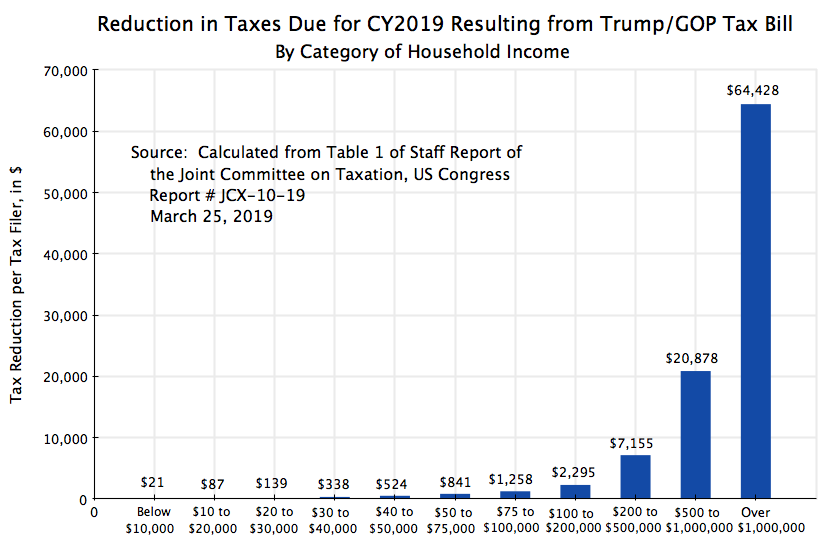
We already know well that the cuts went largely to the very well-off.  The chart above is one more confirmation of this.  It was calculated from figures in a recent report by the staff of the Joint Committee on Taxation of the US Congress, released on March 25, 2019 (report #JCX-10-19).  While those earning more than $1 million in 2019 will, on average, see their taxes cut by $64,428 per tax filing unit (i.e. generally households), those earning $10,000 or less will see a reduction of just $21.  And on the scale of the chart, it is indeed difficult to impossible even to see the bars depicting the reductions in taxes for those earning less than $50,000 or so.

The sharp bias in favor of the rich was discussed in a previous post on this blog, based there on estimates from a different group (the Tax Policy Center, a non-partisan think tank) but with similar results.  And while it is of course true that those who are richer will have more in taxes that can be cut (one could hardly cut $64,428 from a taxpayer earning less than $10,000), it is not simply the absolute amounts but also the share of taxes which were cut much further for the rich than for the poor.  According to the Joint Committee on Taxation report cited above, those earning $30,000 or less will only see their taxes cut by 0.5% of their incomes, while those earning between $0.5 million and $1.0 million will see a cut of 3.1%.  That is more than six times as much as a share of incomes.  That is perverse.

And the overall average reduction in individual income taxes will only be a bit less than 10% of the tax revenues being paid before.  This is in stark contrast to the more than 50% reduction in corporate income taxes that we have already observed in what was paid by corporations in 2018.

Furthermore, while taxes for households in some income category may have on average gone down, the numerous changes made to the tax code on the Trump/GOP bill meant that for many it did not.  Estimates provided in the Joint Committee on Taxation report cited above (see Table 2 of the report) indicate that for 2019 a bit less than two-thirds of tax filing units (households) will see a reduction in their taxes of $100 or more, but more than one-third will see either no significant change (less than $100) or a tax increase.  The impacts vary widely, even for those with the same income, depending on a household’s particular situation.

But the Trump/GOP tax bill promised not just a reduction in taxes, but also a reduction in tax complexity, by eliminating loopholes and from other such measures.  The claim was that most Americans would then be able to fill in their tax returns “on a postcard”.  But as is obvious to anyone who has filed their forms this year, it is hardly that.  This blog post will discuss why this is so and why filling in one’s tax returns remains such a headache.  The fundamental reason is simple:  The tax system is not less complex than before, but more.

There is, however, a way to address this, and not solely by ending the complexity (although that would in itself be desirable).  Even with the tax code as complicated as it now is (and more so after the Trump/GOP bill), the IRS could complete for each of us a draft of what our filing would look like based on the information that the IRS already collects.  Those draft forms would match what would be due for perhaps 80 to 85% of us (basically almost all of those who take the standard deduction).  For that 80 to 85% one would simply sign the forms and return them along with a payment if taxes are due or a request for a refund if a refund is due.  Most remaining taxpayers would also be able to use these initial draft forms from the IRS, but for them as the base for what they would need to file.  In their cases, additions or subtractions would be made to reflect items such as itemized deductions (mostly) and certain special tax factors (for some) where the information necessary to complete such calculations would not have been provided in the normal flow of reports to the IRS.  And a small number of filers might continue to fill in all their forms as now.  That small number would be no worse than now, while life would be much simpler for the 95% or more (perhaps 99% or more) who could use the pre-filled in forms from the IRS either in their entirety or as a base to start from.

The IRS receives most of the information required to do this already for each of us (and all that is required for most of us).  But what would be different is that instead of the IRS using such information to check what we filed after the fact, and then impose a fine (or worse) if we made a mistake, the IRS would now use that same information to fill in the forms for us.  We would then review and check them, and if necessary or advantageous to our situation we could then adjust them.  We will discuss how such a tax filing system could work below.

B.  Our Tax Forms are Now Even More Complex Than Before

Trump and the Republican leaders in Congress promised that with the Trump/GOP tax bill, the tax forms we would need to file could, for most of us, fit just on a postcard.  And Treasury Secretary Steven Mnuchin then asserted that the IRS (part of Treasury) did just that.  But this is simply nonsense, as anyone who has had to struggle with the new Form 1040s (or even just looked at them) could clearly see.

Specifically:

a)  Form 1040 is not a postcard, but a sheet of paper (front and back), to which one must attach up to six separate schedules.  This previously all fit on one sheet of paper, but now one has to complete and file up to seven just for the 1040 itself.

b)  Furthermore, there are no longer the forms 1040-EZ or 1040-A which were used by those with less complex tax situations.  Now everyone needs to work from a fully comprehensive Form 1040, and try to figure out what may or may not apply in their particular circumstances.

c)  The number of labeled lines on the old 1040 came to 79.  On the new forms (including the attached schedules) they come to 75.  But this is misleading, as what used to be counted as lines 1 through 6 on the old 1040 are now no longer counted (even though they are still there and are needed).  Including these, the total number of numbered lines comes to 81, or basically the same as before (and indeed more).

d)  Spreading out the old Form 1040 from one sheet of paper to seven does, however, lead to a good deal of extra white space.  This was likely done to give it (the first sheet) the “appearance” of a postcard.  But the forms would have been much easier to fill in, with less likelihood of error, if some of that white space had been used instead for sub-totals and other such entries so that all the steps needed to calculate one’s taxes were clear.

e)  Specifically, with the six new schedules, one has to carry over computations or totals from five of them (all but the last) to various lines on the 1040 itself.  But this was done, confusingly, in several different ways:  1)  The total from Schedule 4 was carried over to its own line (line 14) on the 1040.  It would have been best if all of them had been done this way, but they weren’t.  Instead, 2) The total from Schedule 2 was added to a number of other items on line 11 of the 1040, with the total of those separate items then shown on line 11.  And 3) The total from Schedule 1 was added to the sum of what is shown on the lines above it (lines1 through 5b of the 1040) and then recorded on line 6 of the 1040.

If this looks confusing, it is because it is.  I made numerous mistakes on this when completing my own returns (yes – I do these myself, as I really want to know how they are done).  I hope my final returns were done correctly.  And it is not simply me.  Early indications (as of early March) were that errors on this year’s tax forms were up by 200% over last year’s (i.e. they tripled).

f)  There is also the long-standing issue that the actual forms that one has to fill out are in fact substantially greater than those that one files, as one has to fill in numerous worksheets in order to calculate certain of the figures.  These worksheets should be considered part of the returns, and not hidden in the directions, in order to provide an honest picture of what is involved.  And they don’t fit on a postcard.

g)  But possibly what is most misleading about what is involved in filling out the returns is not simply what is on the 1040 itself, but also the need to include on the 1040 figures from numerous additional forms (for those that may apply).  Few if any of them are applicable to one’s particular tax situation, but to know whether they do or not one has to review each of those forms and make such a determination.  How does one know whether some form applies when there is a statement on the 1040 such as “Enter the amount, if any, from Form xxxx”?  The only way to know is to look up the form (fortunately now this can be done on the internet), read through it along with the directions, and then determine whether it may apply to you.  Furthermore, in at least a few cases one can only know if the form applies to your situation is by filling it in and then comparing the result found to some other item to see whether filing that particular form applies to you.

There are more than a few such forms.  By my count, one has just on the Form 1040 plus its Schedules 1 through 5 amounts that might need to be entered from Forms 8814, 4972, 8812, 8863, 4797, 8889, 2106, 3903, SE, 6251, 8962, 2441, 8863, 8880, 5695, 3800, 8801,1116, 4137, 8919, 5329, 5405, 8959, 8960, 965-A, 8962, 4136, 2439, and 8885.  Each of these forms may apply to certain taxpayers, but mostly only a tiny fraction of them.  But all taxpayers will need to know whether they might apply to their particular situation.  They can often guess that they probably won’t (and it likely would be a good guess, as most of these forms only apply to a tiny sliver of Americans), but the only way to know for sure is to check each one out.

Filling out one’s individual income tax forms has, sadly, never been easy.  But it has now become worse.  And while the new look of the Form 1040 appears to be a result of a political decision by the Trump administration (“make it look like it could fit on a postcard”), the IRS should mostly not be blamed for the complexity.  That complexity is a consequence of tax law, as written by Congress, which finds it politically advantageous to reward what might be a tiny number of supporters (and campaign contributors) with some special tax break.  And when Congress does this, the IRS must then design a new form to reflect that new law, and incorporate it into the Form 1040 and now the new attached schedules.  And then everyone, not simply the tiny number of tax filers to whom it might in fact apply, must then determine whether or not it applies to them.

There are, of course, also more fundamental causes of the complexity in the tax code, which must then be reflected in the forms.  The most important is the decision by our Congress to tax different forms of income differently, where wages earned will in general be taxed at the highest rates (up to 37%) while capital gains (including dividends on stocks held for more than 60 days) are taxed at rates of just 20% or less.  And there are a number of other forms of income that are taxed at various rates (including now, under the Trump/GOP tax bill, an effectively lower tax rate for certain company owners on the incomes they receive from their companies, as well as new special provisions of benefit to real estate developers).  As discussed in an earlier post on this blog, there is no good rationale, economic or moral, to justify this.  It leads to complex tax calculations as the different forms of income must each be identified and then taxed at rates that interact with each other.  And it leads to tremendous incentives to try to shift your type of income, when you are in a position to do so, from wages, say, to a type taxed at a lower rate (such as stock options that will later be taxed only at the long-term capital gains rate).

Given this complexity, it is no surprise that most Americans turn either to professional tax preparers (accountants and others) to fill in their tax forms for them, or to special tax preparation software such as TurboTax.  Based on statistics for the 2018 tax filing season (for 2017 taxes), 72.1 million tax filers hired professionals to prepare their tax forms, or 51% of the 141.5 million tax returns filed.  The cost varies by what needs to be filed, but even assuming an average fee of just $500 per return, this implies a total of over $36 billion is being paid by taxpayers for just this service.

Most of the remaining 49% of tax filers use tax preparation software for their returns (a bit over three-quarters of them).  But these are problematic as well.  There is also a cost (other than for extremely simple returns), but the software itself may not be that good.  A recent review by Consumer Reports found problems with each of the four major tax preparation software packages it tested (TurboTax, H&R Block, TaxSlayer, and TaxAct), and concluded they are not to be trusted.

And on top of this, there is the time the taxpayer must spend to organize all the records that will be needed in order to complete the tax returns – whether by a hired professional tax preparer, or by software, or by one’s own hand.  A 2010 report by a presidential commission examing options for tax reform estimated that Americans spend about 2.5 billion hours a year to do what is necessary to file their individual income tax returns, equivalent to $62.5 billion at an average time cost of $25 per hour.

Finally there are the headaches.  Figuring one’s taxes, even if a professional is hired to fill in the forms, is not something anyone wants to spend time on.

There is a better way.  With the information that is already provided to the IRS each year, the IRS could complete and provide to each of us a draft set of tax forms which would suffice (i.e. reflect exactly what our tax obligation is) for probably 80% or more of households.  And most of the remainder could use such draft forms as a base and then provide some simple additions or subtractions to arrive at what their tax obligation is.  The next section will discuss how this could be done.

C.  Have the IRS Prepare Draft Tax Returns for Each of Us

The IRS already receives, from employers, financial institutions, and others, information on the incomes provided to each of us during the tax year.  And these institutions then tell us each January what they provided to the IRS.  Employers tell us on W-2 forms what wages were paid to us, and financial institutions will tell us through various 1099 forms what was paid to us in interest, in dividends, in realized capital gains, in earnings from retirement plans, and from other such sources of returns on our investments.  Reports are also filed with the IRS for major transactions such as from the sale of a home or other real estate.

The IRS thus has very good information on our income each year.  Our family situation is also generally stable from year to year, although it can vary sometimes (such as when a child is born).  But basing an initial draft estimate on the household situation of the previous year will generally be correct, and can be amended when needed.  One could also easily set up an online system through which tax filers could notify the IRS when such events occur, to allow the IRS to incorporate those changes into the draft tax forms they next produce.

For most of those who take the standard deduction, the IRS could then fill in our tax forms exactly.  And most Americans take the standard deduction. Prior to the Trump/GOP tax bill, about 70% of tax filers did, and it is now estimated that with the changes resulting from the new tax bill, about 90% will.  Under the Trump/GOP tax bill, the basic standard deduction was doubled (while personal exemptions were eliminated, so not all those taking the standard deduction ended up better off).  And perhaps of equal importance, the deduction that could be taken on state and local taxes was capped at $10,000 while how much could be deducted on mortgage interest was also narrowed, so itemization was no longer advantageous for many (with these new limitations primarily affecting those living in states that vote for Democrats – not likely a coincidence).

The IRS could thus prepare filled in tax forms for each of us, based on information contained in what we had filed in earlier years and assuming the standard deduction is going to be taken.  But they would just be drafts.  They would be sent to us for our review, and if everything is fine (and for most of the 90% taking the standard deduction they would be) we would simply sign the forms and return them (along with a check if some additional tax is due, or information on where to deposit a refund if a tax refund is due).

But for the 10% where itemized deductions are advantageous, and for a few others who are in some special tax situation, one could either start with the draft forms and make additions or subtractions to reflect simple adjustments, or, if one wished, prepare a new set of forms reflecting one’s tax situation.  There would likely not be many of the latter, but it would be an option, and no worse than what is currently required of everyone.

For those making adjustments, the changes could simply be made at the end.  For example (and likely the most common such situation), suppose it was advantageous to take itemized deductions rather than the standard deduction.  One would fill in the regular Schedule A (as now), but then rather than recomputing all of the forms, one could subtract from the taxes due an amount based on what the excess was of the itemized deductions over the standard deduction, and one’s tax rate.  Suppose the excess of the itemized deductions over the standard deduction for the filer came to $1,000.  Then for the very rich (households earning over $600,000 a year after deductions), one would reduce the taxes due by 37%, or $370.  Those earning $400,000 to $600,000, in the 35% bracket, would subtract $350.  And so on down to the lower brackets, where those in the 12% bracket (those earning $19,050 to $77,400) would subtract $120 (and those earning less than $19,050 are unlikely to itemize).

[Side Note:  Why do the rich receive what is in effect a larger subsidy from the government than the poor do for what they itemize, such as for contributions to charities?  That is, why do the rich effectively pay just $630 for their contribution to a charity ($1,000 minus $370), while the poor pay $880 ($1,000 minus $120) for their contribution to possibly the exact same charity?  There really is no economic, much less moral, reason for this, but that is in fact how the US tax code is currently written.  As discussed in an earlier post on this blog, the government subsidy for such deductions could instead be set to be the same for all, at say a rate of 20% or so.  There is no reason why the rich should receive a bigger subsidy than the poor receive for the contributions they make.]

Another area where the information the IRS would not have complete information to compute taxes due would be where the tax filer had sold a capital asset which had been purchased before 2010.  The IRS only started in 2010 to require that financial institutions report the cost basis for assets sold, and this cost basis is needed to compute capital gains (or losses).  But as time passes, a smaller and smaller share of assets sold will have been purchased before 2010.  The most important, for most people, will likely be the cost of the home they bought if before 2010, but such a sale will happen only once (unless they owned multiple real estate assets in 2010).

But a simple adjustment could be made to reflect the cost basis of such assets, similar to the adjustment for itemized deductions.  The draft tax forms filled in by the IRS would leave as blank (zero) the cost basis of the assets sold in the year for which it did not have a figure reported.  The tax filer would then determine what the cost basis of all such assets should be (as they do now), add them up, and then subtract 20% of that total cost basis from the taxes due (for those in the 20% bracket for long term capital gains, as most people with capital gains are, or use 15% or 0% if those tax brackets apply in their particular cases).

There will still be a few tax filers with more complex situations where the IRS draft computations are not helpful, who will want to do their own forms.  This is fine – there would always be that option.  But such individuals would still be no worse off than what is required now.  And their number is likely to be very small.  While a guess, I would say that what the IRS could provide to tax filers would be fully sufficient and accurate for 80 to 85% of Americans, and that simple additions or subtractions to the draft forms (as described above) would work for most of the rest.  Probably less than 5% of filers would need to complete a full set of forms themselves, and possibly less than 1%.

D. Final Remarks

Such an approach would be new for the US.  But there is nothing revolutionary about it.  Indeed, it is common elsewhere in the world.  Much of Western Europe already follows such an approach or some variant of it, in particular all of the Scandinavian countries as well as Germany, Spain, and the UK, and also Japan.  Small countries, such as Chile and Estonia, have it, as do large ones.

It has also often been proposed for the US.  Indeed, President Reagan proposed it as part of his tax reduction and simplification bill in 1985, then candidate Barack Obama proposed it in 2007 in a speech on middle class tax fairness, a presidential commission in 2010 included it as one of the proposals in its report on simplifying the tax system, and numerous academics and others have also argued in its favor.

It would also likely save money at the IRS.  The IRS collects already most of the information needed.  But that information is not then sent back to us in fully or partially filled in tax forms, but rather is used by the IRS after we file to check to see whether we got anything wrong.  And if we did, we then face a fine or possibly worse.  Completing our tax returns should not be a game of “gotcha” with the IRS, but rather an effort to ensure we have them right.

Such a reform has, however, been staunchly opposed by narrow interests who benefit from the current frustrating system.  Intuit, the seller of TurboTax software, has been particularly aggressive through its congressional lobbying and campaign contributions in using Congress to block the IRS from pursuing this, as has H&R Block.  They of course realize that if tax filing were easy, with the IRS completing most or all of the forms for us, there would be no need to spend what comes to billions of dollars for software from Intuit and others.  But the morality of a business using its lobbying and campaign contributions to ensure life is made particularly burdensome for the citizenry, so that it can then sell a product to make it easier, is something to be questioned.

One can, however, understand the narrow commercial interests of Intuit and the tax software companies.  One can also, sadly, understand the opposition of a number of conservative political activists, with Grover Norquist the most prominent and in the lead. They have also aggressively lobbied Congress to block the IRS from making tax filing simpler.  They are ideologically opposed to taxes, and see the burden and difficulty in figuring out one’s taxes as a positive, not as a negative.  The hope is that with more people complaining about how difficult it is to fill in their tax forms, the more people will be in favor of cutting taxes.  While that view on how people see taxes might well be accurate, what many may not realize is that the tax cuts of recent decades have led to greater complexity and difficulty, not less.  With new loopholes for certain narrow interests, and with income taxed differently depending on the source of that income (with income from wealth taxed at a much lower rate than income from labor), the system has become more complex while generating less revenue overall.

But it is perverse that Congress should legislate in favor of making life more difficult.  The tax system is indeed necessary and crucial, as Reagan correctly noted in his 1985 speech on tax reform, but as he also noted in that speech, there is no need to make them difficult.  Most Americans, Reagan argued, should be able, and would be able under his proposals, to use what he called a “return-free” system, with the IRS working out the taxes due.

The system as proposed above would do this.  It would also be voluntary.  If one disagreed with the pre-filled in forms sent by the IRS, and could not make the simple adjustments (up or down) to the taxes due through the measures as discussed above, one could always fill in the entire set of forms oneself.  But for that small number of such cases this would just be the same as is now required for all.  Furthermore, if one really was concerned about the IRS filling in one’s forms for some reason (it is not clear what that might be), one could easily have a system of opting-out, where one would notify the IRS that one did not want the service.

The tax code itself should still be simplified.  There are many reforms that can and should be implemented, if there was the political will.  The 2010 presidential commission presented numerous options for what could be done.  But even with the current complex system, or rather especially because of the current complex system, there is no valid reason why figuring out and filing our taxes should be so difficult.  Let the IRS do it for us.

Taxes on Corporate Profits Have Continued to Collapse


The Bureau of Economic Analysis (BEA) released earlier today its second estimate of GDP growth in the fourth quarter ot 2018.  (Confusingly, it was officially called the “third” estimate, but was only the second as what would have been the first, due in January, was never done due to Trump shutting down most agencies of the federal government in December and January due to his border wall dispute.)  Most public attention was rightly focussed on the downward revision in the estimate of real GDP growth in the fourth quarter, from a 2.6% annual rate estimated last month, to 2.2% now.  And current estimates are that growth in the first quarter of 2019 will be substantially less than that.

But there is much more in the BEA figures than just GDP growth.  The second report of the BEA also includes initial estimates of corporate profits and the taxes they pay (as well as much else).  The purpose of this note is to update an earlier post on this blog that examined what happened to corporate profit tax revenues following the Trump / GOP tax cuts of late 2017.  That earlier post was based on figures for just the first half of 2018.

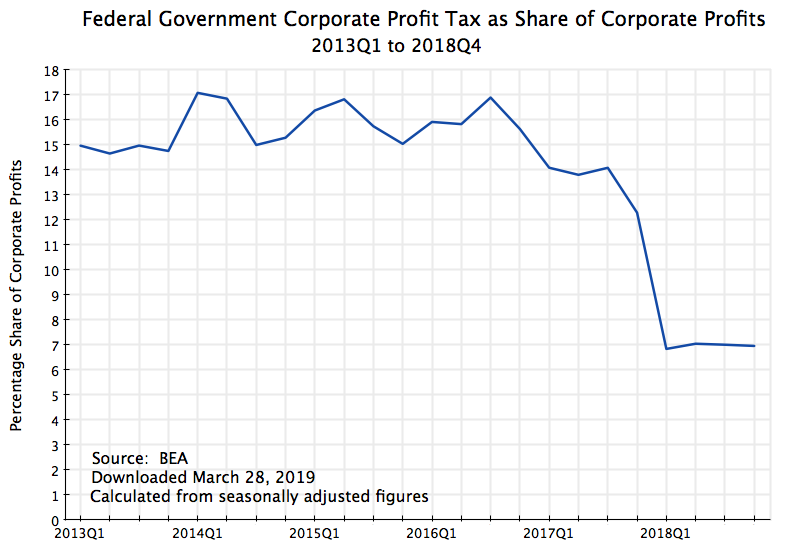
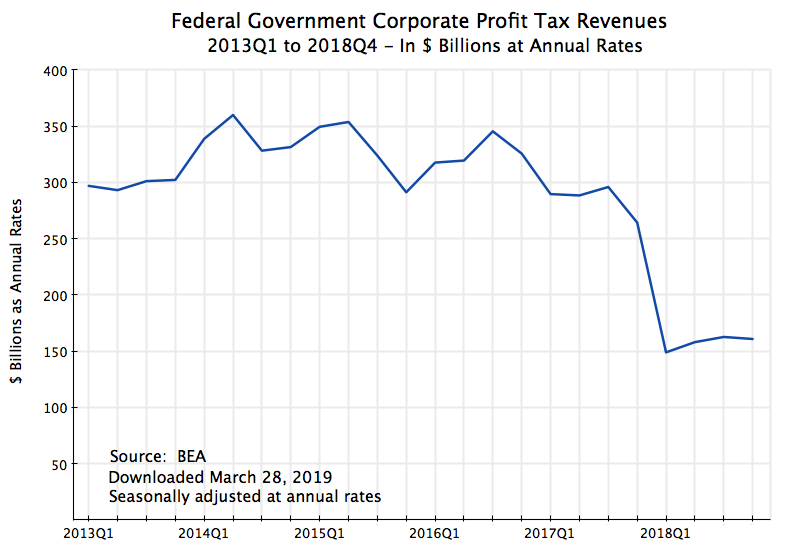
We now have figures for the full year, and they confirm what had earlier been found – corporate profit tax revenues have indeed plummeted.  As seen in the chart at the top of this post, corporate profit taxes were in the range of only $150 to $160 billion (at annual rates) in the four quarters of 2018.  This was less than half the $300 to $350 billion range in the years before 2018.  And there is no sign that this collapse in revenues was due to special circumstances of one quarter or another.  We see it in all four quarters.

The collapse shows through even more clearly when one examines what they were as a share of corporate profits:


The rate fell from a range of generally 15 to 16%, and sometimes 17%, in the earlier years, to just 7.0% in 2018.  And it was an unusually steady rate of 7.0% throughout the year.  Note that under the Trump / GOP tax bill, the standard rate for corporate profit tax was cut from 35% previously to a new headline rate of 21%.  But the actual rate paid turned out (on average over all firms) to come to just 7.0%, or only one-third as much.  The tax bill proponents claimed that while the headline rate was being cut, they would close loopholes so the amount collected would not go down.  But instead loopholes were not only kept, but expanded, and revenues collected fell by more than half.

If the average corporate profit tax rate paid in 2018 had been not 7.0%, but rather at the rate it was on average over the three prior fiscal years (FY2015 to 2017) of 15.5%, an extra $192.2 billion in revenues would have been collected.

There was also a reduction in personal income taxes collected.  While the proportional fall was less, a much higher share of federal income taxes are now borne by individuals than by corporations.  (They were more evenly balanced decades ago, when the corporate profit tax rates were much higher – they reached over 50% in terms of the amount actually collected in the early 1950s.)  Federal personal income tax as a share of personal income was 9.2% in 2018, and again quite steady at that rate over each of the four quarters.  Over the three prior fiscal years of FY2015 to 2017, this rate averaged 9.6%.  Had it remained at that 9.6%, an extra $77.3 billion would have been collected in 2018.

The total reduction in tax revenues from these two sources in 2018 was therefore $270 billion.  While it is admittedly simplistic to extrapolate this out over ten years, if one nevertheless does (assuming, conservatively, real growth of 1% a year and price growth of 2%, for a total growth of about 3% a year), the total revenue loss would sum to $3.1 trillion.  And if one adds to this, as one should, the extra interest expense on what would now be a higher public debt (and assuming an average interest rate for government borrowing of 2.6%), the total loss grows to $3.5 trillion.

This is huge.  To give a sense of the magnitude, an earlier post on this blog found that revenues equal to the original forecast loss under the Trump / GOP tax plan (summing to $1.5 trillion over the next decade, and then continuing) would suffice to ensure the Social Security Trust Fund would be fully funded forever.  As things are now, if nothing is done the Trust Fund will run out in about 2034.  And Republicans insist that the gap is so large that nothing can be done, and that the system will have to crash unless retired seniors accept a sharp reduction in what are already low benefits.

But with losses under the Trump / GOP tax bill of $3.1 trillion over ten years, less than half of those losses would suffice to ensure Social Security could survive at contracted benefit levels.  One cannot argue that we can afford such a huge tax cut, but cannot afford what is needed to ensure Social Security remains solvent.

In the nearer term, the tax cuts have led to a large growth in the fiscal deficit.  Even the US Treasury itself is currently forecasting that the federal budget deficit will reach $1.1 trillion in FY2019 (5.2% of GDP), up from $779 billion in FY2018.  It is unprecedented to have such high fiscal deficits at a time of full employment, other than during World War II.  Proper fiscal management would call for something closer to a balanced budget, or even a surplus, in those periods when the economy is at full employment, while deficits should be expected (and indeed called for) during times of economic downturns, when unemployment is high.  But instead we are doing the opposite.  This will put the economy in a precarious position when the next economic downturn comes.  And eventually it will, as it always has.