An Update on Progress in the Labor Market Recovery Under Obama

Cumul Private Job Growth from Inauguration to Oct 2015

Cumul Govt Job Growth from Inauguration to Oct 2015

A)  Introduction

The Bureau of Labor Statistics released on November 6 its most recent report on the state of the job market.  It was a strong report, with net job gains of 271,000 in October and the unemployment rate falling to 5.0%.  One should not, however, put too much weight on the figures in just one month’s report.  Indeed, the report for October followed relatively weaker reports in the two previous months.  Rather, one should put all these reports in the longer term context of how the labor market has moved in recent years.  And what they show is continued, and remarkably steady, improvement.

This post will look at that longer term context by updating several labor market charts that have been discussed in previous posts on this blog.  It will look first at net job growth in the private sector and in the government sector in the period since Obama’s inauguration, with a comparison to the similar period during George W. Bush’s term.  The post will then look at the continued fall in the unemployment rate, with a comparison to the similar period under Reagan, and finally to the share of part time workers in total employment.  The last is to see whether there is any evidence to support the assertion coming from Republican critics that Obamacare has led to a shift by employers to part time workers so that they can avoid providing health insurance in the overall wage compensation package for their staff.  We will find that there is no indication in the data that this has been the case.

B)  Total Job Growth

The charts at the top of this post show total net job growth, in the private sector and in the government sector, in the period since Obama’s inauguration (up to October 2015) and under Bush (for his two full terms).  They update similar charts discussed in several earlier posts on this blog, most recently from June 2014.

Private sector job growth has been strong under Obama, and continues to be.  And the record is clearly far better than that under the George W. Bush administration.  There has been a net increase of 9.3 million new private jobs under Obama since the month he was inaugurated, versus just 4.0 million new private jobs over the similar period in the Bush administration.  Furthermore, this 4.0 million additional private jobs was close to the peak achieved in the Bush years, before it started to fall and then plummet as the housing bubble burst and the economy collapsed in the last year of his second term.  By the end of his presidency there were fewer private jobs than there were on the day he was inaugurated, eight years before.

Obama faced this collapse in the jobs market as he took office.  The economy was losing 800,000 private jobs per month, with the economy contracting at the fastest pace since the Great Depression.  The new administration was able to turn this around with the stimulus package and with aggressive Fed actions, with the fall in employment first slowing and then turning around.  The result has been a net growth of 13.5 million new private jobs from the trough just one year into the new administration until now.

Government jobs, in contrast, have been cut.  This hurt total job growth both directly (government jobs are part of total jobs obviously) as well as indirectly.  Indirectly, the government job cuts (as well as the fiscal austerity that began in 2010) reduced demand for goods and hence production at a time when the economy was still depressed and suffering from insufficient demand to keep production lines going.  As discussed in an earlier post on this blog, without the fiscal austerity introduced from 2010 onwards the economy would have recovered from the economic downturn by 2013 and perhaps even 2012.  The initial stimulus package in 2009 turned things around.  It is unfortunate that the government then moved to cuts from 2010 onwards, which reduced the pace of the recovery.

It should be recognized that government jobs as recorded here include government jobs at all levels (federal, state, and local), with federal government jobs only a relatively small share of the total (12.4%).  But government jobs have fallen at all three levels, federal as well as state and local.

The cuts on government jobs during Obama’s time in office stand in sharp contrast to the growth in government jobs during Bush’s two terms.  Yet Obama is charged with being a big government liberal while the Republicans claim to be small government conservatives.

C)  The Rate of Unemployment
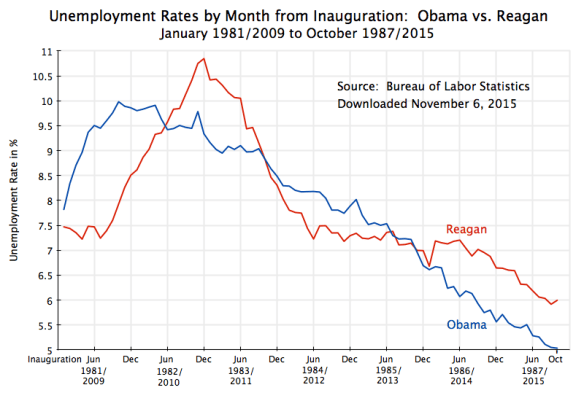
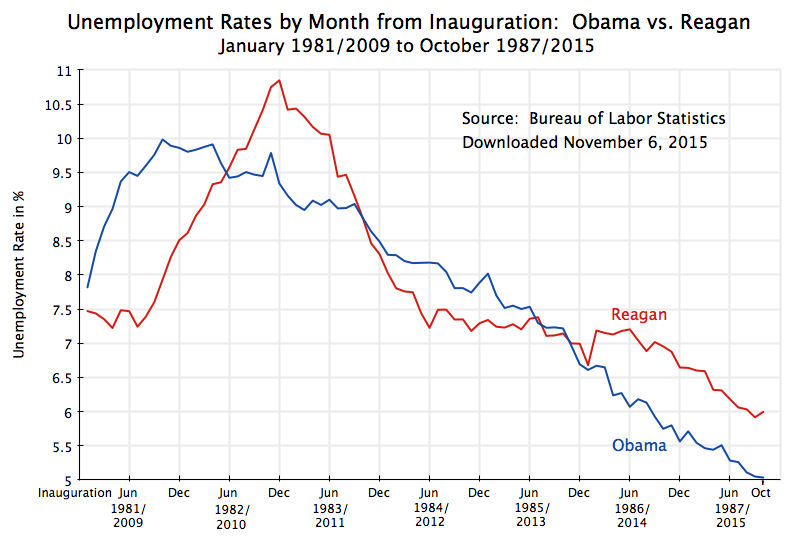
Unemployment Rates - Obama vs Reagan, up to Oct 2015After peaking at 10.0% in October 2009, the rate of unemployment has fallen at a remarkably steady pace under Obama (aside from the monthly fluctuations in the reported figures, which will in part be statistical noise as unemployment estimates come from household surveys).  This was discussed in this earlier post on this blog.  The record is certainly better than that under Reagan.  The unemployment rate is now 5.0%, while it was still 6.0% at the same point in the Reagan presidency.

Furthermore, Reagan was not confronted, as Obama was, with an economy in collapse as he took office.  Rather, unemployment began to rise only about a half year after Reagan took office, as he began to implement his new budgetary and other policies.  The unemployment rate then rose to a peak of 10.8% in late 1982 before starting to fall.  And while the recovery was then rapid for a period, supported by rising government spending, it stalled by mid-1984 with unemployment then fluctuating in the range of 7.0% to 7.5% for most of the next two years.  One does not see the steady improvement as one has had under Obama.

With the unemployment rate now at 5.0%, it is expected that the Fed will soon start to raise interest rates.  This would be unfortunate in my view (as well as that of many others, such as Paul Krugman).  Inflation remains low (only 0.2% over the past year for personal consumption expenditures for all goods, or 1.3% over the past year if one excludes the often volatile food and energy costs).  And while wages ticked up by 2.5% over the year before in the most recent BLS labor market report, this is still below the roughly 3 1/2% increases that would be consistent (after expected productivity gains in a normally functioning job market) with the Fed’s 2.0% inflation target.  And if wages are not allowed to rise faster than inflation, then by definition there will be no increase in real wages.

It is of course recognized that the rate of unemployment cannot fall forever.  There will always be some slack in the labor market as workers transition between jobs, and if the unemployment rate is too low, there will be excessive upward pressure on wages, and inflation can become a problem.  But where that “full employment rate of unemployment” is, is not clear.  Different economists have different views.  It does not appear to be at 5.0% under current conditions, as the rate of inflation remains low.  But whether it is at 4.5% or 4.0% is not clear.  At some point, it would be reached.

When it is, the pace of job creation will need to fall to match the pace of labor force growth (from population growth).  Otherwise, by simple arithmetic, the rate of unemployment would continue to fall.  And this cut in employment growth would be the objective of the Fed in raising interest rates:  It would be to slow down the pace of job growth to the rate that matches labor force growth.

Once the Fed does start to raise interest rates, one should then not be surprised, nor criticize, that the pace of job growth has slowed.  That is the aim.  And it will need to slow sharply from what the pace of job growth has been in recent years under Obama.  Over the past two years, for example, employment growth has averaged 236,000 per month. The labor force has grown at a pace of 101,000 per month over this period.  As a result, unemployment has fallen at a pace of 135,000 per month (= 236,000 – 101,000), with this leading the unemployment rate to fall to 5.0% now from 7.2% two years ago.  If unemployment is now to be kept constant rather than falling, the pace of job growth will need to fall by more than half, from 236,000 per month to just 101,000 per month (or slightly more, to be precise, taking into account the arithmetic of a constant unemployment rate).

I have no doubt that when this happens, and the pace of job growth slows, that Obama will be criticized by his Republican critics.  But this will reflect a fundamental confusion of what full employment implies for the labor market.

D)  Part-Time Employment as a Share of Total Employment

Part-Time Employment #2 as Share of Total Employment, Jan 2007 to Oct 2015

Finally, it is of interest to update the graph in an earlier post to see whether there is now any evidence that the Affordable Care Act (Obamacare) has led employers to fire their regular full time workers and replace them with part-timers, in order to avoid the mandate of including health insurance coverage in the wage compensation package they pay to their workers.  Conservative politicians and media asserted this as a fact (see the earlier blog post cited for several references).  But as discussed before, and as confirmed with the more recent data, there is no indication in the data that this has been the case. Indeed, the share of part time workers in the total has been falling at an accelerated pace in the most recent two years, at a time when the Obamacare insurance mandate provisions have come into effect.

The acceleration in the pace of this improvement is consistent with the improvement seen in the overall labor market over the past several years, as discussed above.  As the economy approaches full employment, those who are working part time (not by choice, but because they have no alternative) are able to find full time jobs.  The share of part-time workers in total employment is still somewhat above (at about 4%) what would be normal when the economy is at full employment (at about 3%), lending support to those arguing that while the labor market is improving, we are not yet at full employment (and the Fed should thus wait longer before it starts to raise interest rates).  But it is getting better.

I have also added to the graph a line (in red) showing what the share of part-time employment workers were in total employment during the Reagan years.  At the comparable time in his presidency, the share was higher than what it is now under Obama.  Furthermore, it had improved only slowly under Reagan over the three years leading up to that point.  Yet Reagan is praised by conservatives for his purportedly strong labor market.

E)  Conclusion

The labor market has improved considerably in recent years under Obama.  It could have been better had the government not turned to austerity in 2010, but even with the government cuts, job growth has been reasonably good.  The unemployment rate has now fallen to 5%, and it is expected the Fed will soon begin to raise interest rates in order to slow the pace of job creation.  One should not then be surprised if fewer net new jobs are created each month, nor criticize Obama when it does.  That will be precisely the aim of the policy.  But I strongly suspect that we will nonetheless hear such criticisms.

The Problems in Congress Come Not from Gridlock, But from Roadblocks

Republican Party Now.png


Gridlock, as originally defined, refers to a severe traffic jam in a grid of intersecting streets, where cars backed up on the intersecting roads block each other from moving.  No individual car is to blame, but rather all of them together are to blame.  The term is now also commonly used to refer to the inability of Congress to get things done.

But the problem in the US Congress is not really gridlock.  As will be clear from several examples discussed below, a majority in Congress exists for moving important legislation forward.  The problem, rather, is that congressional leaders, who decide what will be voted on and when, have acted to keep such legislation from coming to a vote.  But this is not gridlock.  Rather, it is deliberately placed roadblocks.

Events over the last month show what might be done when such roadblocks are removed. The resignation of John Boehner as Speaker of the House in late September created a narrow window when he could call up legislation for a vote while not being threatened by a minority of just 30 Republican congressmen on a motion to remove him from the Speakership.  He had already removed himself.  As discussed in the previous post on this blog, the traditional practice of straight party line votes for the position of Speaker means that a small group in the majority party (equal to just 30 in the current Congress) could deny the majority party candidate of this post.  A small group of the Republicans in Congress threatened to use this against Boehner should he move legislation forward that they opposed.

Boehner struggled to lead his party under such constraints, and eventually gave up and resigned.  But with that resignation, he was able to negotiate and push through to passage, with strong bipartisan support, a bill that addressed the immediate threat of default on the US debt (current borrowing authority limits would have been reached on about November 2), provided an overall budget framework for fiscal years 2016 and 2017 (with the sequester restrictions eased by $50 billion in FY16 and $30 billion in FY17, equal to a total of just 0.2% of GDP over the two years), and addressed immediate issues arising on Social Security Disability Insurance and on Medicare premiums.

The bill was approved 266 to 167 when put to a vote.  All Democrats voting approved, as did about a third of the Republicans:

Budget and Debt Ceiling Bill – House

Yes

No

Not Voting

Republicans

79

167

1

Democrats

187

0

1

Total

266

167

2


The bill then went to the Senate, where it was also approved by a strong majority (again with all Democrats in favor and about a third of the Republicans):

Budget and Debt Ceiling Bill – Senate

Yes

No

Not Voting

Republicans

18

35

1

Democrats

46

0

0

Total

64

35

1


In perhaps an even more surprising example of what can be done to get around the roadblocks being imposed, the House membership used a discharge petition to force a vote on renewing the US Ex-Im Bank charter.  Successful discharge petitions are rare: Only three times in recent history (since 1985) have they been approved and then led to new legislation.  They require the public signature of 218 congressional members (half of the chamber), and thus require the support of at least some in the majority party even if all of the minority party are willing to sign.  Such maneuvering to force a vote against the wishes of the congressional leadership can and does lead to retaliation by the leadership against the members.  The petition was filed on September 30, with the support of 176 Democrats and 42 Republicans.

The Ex-Im Bank’s charter authority lapsed on July 1.  Reauthorization is required periodically, and never before in its 81 year history has Congress failed to approve this.  A strong majority voted in favor in the Senate in a vote on July 27, with bipartisan support:

Ex-Im Bank Reauthorization – Senate

Yes

No

Not Voting

Republicans

22

28

4

Democrats

42

1

3

Total

64

29

7


Once the vote in the House was forced (it took place on October 27), a strong majority came out in favor, including not only almost all Democrats, but a majority of the Republicans as well:

Ex-Im Bank Reauthorization – House

Yes

No

Not Voting

Republicans

127

117

2

Democrats

186

1

1

Total

313

118

3

The bill, however, is not yet fully passed.  The Senate will now need to reconsider the bill, and despite the earlier strong vote in favor, it is not clear a vote will be held now. Republican Senator Mitch McConnell, the Majority Leader, has said he will not allow a vote to take place, at least on the stand-alone bill passed by the House.  And by attaching the Ex-Im legislation to some other bill McConnell would force it to be returned to the House again, where the leadership could again try to block any vote from being held.

Paul Ryan has now been elected to be Speaker of the House, succeeding John Boehner. Despite these examples of legislation that can move forward in the current congress with bipartisan support provided votes are held, the prospects that Ryan will act differently from Boehner are slim.  Ryan still faces the challenge that just 30 members of his party can choose not to vote for him in future votes for the Speakership, and he would then lose the office.  Indeed, nine members of his party voted for another candidate in the October 29 vote.  And while Ryan at first said that as a condition of becoming a candidate for the Speakership, he wanted agreement to change the House rules so that no future such votes on the Speakership could be held until the start of the next Congress in January 2017, he was not able to secure such a commitment from those who had brought Boehner down, and Ryan then backed down from this demand.

An example where important reform would probably pass with bipartisan support if a vote were held is immigration reform.  The Senate passed a bill on immigration reform (written in part by Senator Marco Rubio, who later denounced his own bill following conservative criticism) by a 68 to 32 majority (with 14 Republicans voting in favor) in June 2013.  But with the conservative criticism, Speaker Boehner refused to bring it up for a vote in the House.  And while it is now more than two years later, with the 2014 elections in between, it is likely that a majority of members in both chambers would still be in favor of immigration reform along the lines of the bill passed in the Senate in 2013.

However, Paul Ryan has publicly announced that he will not allow any such bill to come up for a vote.  And he insists it is Obama’s fault!  In an interview Sunday on CBS’s “Face the Nation”, Ryan said it would be “a ridiculous notion” to work with President Obama on the issue, because Obama is someone they “cannot trust”.  But there is no basis for such a charge.  Obama’s executive orders on immigration have been no different in nature from orders issued by Reagan and the first Bush when they were president.  And no such accusations were leveled against Reagan and Bush then.

But regardless of what one concludes on that issue, why such actions should preclude a vote in the legislative chamber is not at all clear.  Rather, the basic disrespect of the presidential office by Ryan appears to signal that Ryan intends to follow the same path as his predecessor, and allow a minority of about 40 congressmen to dictate what legislation will be brought to a vote, and what will be blocked.  As noted before, the problem is deliberately placed roadblocks, not gridlock.

Jon Huntsman for Speaker of the House!

Jon Huntsman.001


Congress should elect Jon Huntsman for its next Speaker.  Well, perhaps not Jon Huntsman specifically, but some moderate Republican (there are a few) who would appeal not only to those in the Republican Party who want to get things done in Washington, but also to most Democrats, who also want to get things done.  Perhaps Ray LaHood, a former Republican congressman who served as Secretary of Transportation under President Obama, would be a good choice, or even former New York Mayor Michael Bloomberg.  But we are getting ahead of ourselves.  First, we need to discuss why this has come up.

Under pressure from the far right in his party, Speaker of the House John Boehner announced on September 25 that he would resign as Speaker effective the end of October.  Boehner still clearly enjoyed the support of a substantial majority of his party’s members in the House.  But to understand why he ultimately decided he would need to resign or face an embarrassing vote that would remove him, one must understand the rules and customs followed in the House.

Traditionally, the congressional members of each party (Democrats and Republicans) vote in a unified fashion for whomever has been elected the leader of their respective party in the House.  The election of party leader might well be subject to a competitive election among the party members.  But once a party leader is chosen, 100% of the congressional members from that party have traditionally then voted for that leader in the election for the Speaker position.  Thus whichever party has a majority in the House, will elect its leader to the Speaker post.

But there is no rule that one must follow this tradition.  Members of a party can vote for someone else as leader.  And that has become increasingly common in recent years.  Ten Republicans did not vote for Boehner as Speaker in January 2013, and 25 did not in January 2015.  While those numbers seem small, and indeed are small, not many are necessary.  By House rules, the person to be voted Speaker must receive an absolute majority of the “votes cast for a person by name” (thus excluding those absent, as well as excluding those voting “present”).  If the majority party in the House has a majority of only a relatively small number of seats, then a few renegades who decide not to vote for their party’s chosen leader can deny that person the Speakership.

In the current 114th Congress, which was elected in November 2014 and took office in January 2015, Republicans enjoy a quite substantial majority, with 247 seats vs. 188 seats for the Democrats, or a majority of 30 seats.  This is indeed the largest Republican majority in Congress since 1929, when Herbert Hoover was elected president.  But had just 30 Republican members decided not to vote for their party leader (Boehner) to become the Speaker, then he would have been denied the position (assuming all House members are present and vote for a person).

Thus the revolt that led to 24 Republican members to vote for someone other than Boehner (plus one voting “present”) in the January 2015 vote for the Speakership, was significant.  It was, and was clearly intended to be, a warning to Boehner that the minority of the Republican members on the far right of the party were willing to vote against their own leader, if that leader did not act as they wished.

Following up on this threat, Representative Mark Meadows of North Carolina (one of the Republicans who voted for someone other than Boehner) introduced a motion on July 28 to “vacate the chair”.  This could have acted as a vehicle to force a vote on Boehner as Speaker.

Faced with this, Boehner faced the choice of either caving into the demands of the extreme right in his party, or gotten critical legislation passed to allow the government to continue to function from October 1.  Failure to pass such legislation would have been an embarrassment.  The legislation was necessary so that government departments could continue to spend funds with the start of the new fiscal year (as the Congress has not yet passed a budget for the year – a common occurrence).  Democrats supported keeping the government open, as did a substantial share of the Republican majority.  Together they could pass such a bill.  But they are only allowed to vote on measures in Congress that the Speaker chooses to bring up for a vote.  This is what makes the Speakership such a powerful position.  But if Boehner brought up such a bill, members on the extreme right wing of his party made clear that they would vote against Boehner in a vote on the Speakership.  With only 30 such votes necessary for Boehner to lose such a vote (amounting to just 12% of the 247 Republican held seats in the Congress), Boehner was in a bind.  He was being held hostage by a small minority within his party.

Boehner has of course faced this dilemma before.  So far he has chosen to try to work with the extreme right wing.  But as this became more and more difficult, as their demands became more extreme and as their criticism of Boehner grew, ultimately Boehner decided all he could do was resign.  Losing such a vote for the Speakership would be terribly embarrassing.  Better to resign first, and at least go out on your own terms.

Following his resignation, Boehner did indeed bring to a vote a bill to fund the government for almost two and a half months (until December 11).  And it passed easily, by a majority of 277 in favor and 151 opposed.  It received 186 votes in favor from the Democrats (all Democrats who voted) and 91 votes in favor from the Republicans (with 151 opposed).

It appears now that the current Majority Leader Kevin McCarthy will succeed Boehner, through the traditional process.  McCarthy appears in most respects to be similar to Boehner in his approach, although somewhat closer to the right-wing of his party than Boehner was.  But Boehner’s resignation and the expected selection of McCarthy to the Speakership changes little if anything.  There will be the need to pass a budget to fund the government by December 11, or we will once again be in the same situation as this past week.  The extreme right of the Republican members have made clear that they still want what they want, and that if that means shutting down the government, then that is a price they are willing to pay.

Even before December 11, it appears that the government will hit the debt ceiling. Congress sets the debt ceiling, and Treasury Secretary Lew stated in a letter to Congressional leaders on October 1 that they now expect to hit the current ceiling on or about November 5.  Unless Congress acts by then, the US would be forced to default on its financial obligations.  Once again, a broad majority in the Congress, made up of Republicans and Democrats together, would certainly vote in favor of a bill to address this. But they can vote on such a bill only if the Speaker allows a vote on it, and the extreme right wing of the Republican members see this as leverage to get what they want.  By threatening to vote out the Speaker if he does bring up such a bill, they can hold the Speaker hostage to their demands.

Thus there is every reason to expect gridlock to continue, despite Boehner’s resignation and the election of a new speaker such as McCarthy.  Can anything be done?

Yes, the members of congress have it within their power to address this.  Platitudes (such as we will all work together, or will work harder together) will not suffice.  Rather, one needs to address the traditional practices of the current system that empower a small minority within the majority party to hold hostage the Speaker to their demands.

This can be done by going outside the traditional system in the choice for Speaker. There is nothing in the Constitution that requires the Speaker to be a member of Congress.   While the Speaker has historically always been a member, the Constitution does not require this.  All the Constitution says on the institution is in one line at the end of Article I, Section 2, where it states the “House shall choose their Speaker and their Officers”. Anyone can be so chosen.

To change the dynamics, one needs a Speaker who will draw support from the large majority of members who do not represent the extremes of either party.  The Speaker role would change from highly partisan party leader, to a more balanced mediator who seeks a consensus that may well cross party lines to move needed legislation forward.  With Republicans in the majority, the person chosen should be a Republican.  But he or she should be someone who can work with both sides to try to reach a consensus that spans the broad middle ground, thus ending the current system that allows a small minority to hold the Speaker hostage to their demands.

Jon Huntsman might be such a candidate.  He might in particular be appropriate given his recent work as Co-Chair of “No Labels”, a bipartisan group that has proposed a set of process reforms not only to get congress to work, but also the presidency and government more broadly.  I would not necessarily endorse all of these proposals (and some are pretty broad and vague), but thinking along such lines will be necessary if we are to see an end to gridlock in Washington.

The new role of the Speaker would be to seek a broad consensus on issues, crossing party lines, and bringing to the floor measures that will be endorsed by a majority rather than voted up or down on strict party lines.  Voting solely on party lines is a characteristic of parliamentary systems, such as that of the UK.  Such a system works fine to move an agenda forward when the chief executive (the Prime Minister in a parliamentary system) is the head of the majority party in the parliament (or of a coalition that constitutes a majority). But the US Constitution did not establish a parliamentary system.  Rather, it established a system with a separately elected chief executive (the president), who runs the executive branch of government and where the government is made up of three equal and separate branches:  the executive, the legislature, and the judiciary.

Voting solely along party lines, as has become common in recent years in the Congress, works fine in a parliamentary system but not in the system of government established by the US Constitution.  This will not change as long as the Speaker sees his role as primarily that of a partisan leader of his party, rather than as a mediator seeking to produce a consensus on needed legislation with this then passed by a majority of members from both parties representing the middle rather than the extremes.  As long as an extreme can hold the Speaker hostage, he or she will not be able to act as such a mediator spanning the parties.

With such a change to this new type of Speaker, one can foresee a large set of measures passing soon, as a majority in the Congress have been in support.  These include not only necessary upcoming legislation such as for the budget and a bill to raise the debt ceiling, but other items as well.  For example, the previous federal highway funding bill expired in 2009, but since then Congress has not been able to pass any long term extension. Rather, Congress has passed 34 different short term extensions to keep road funding going, and with just these numerous short term extensions, states and localities could not plan in any reasonable way.  The Senate finally passed a longer term (six year) reauthorization this past summer, but the House has yet to act.  There is also a broad consensus on the need for immigration reform, and the Senate passed such a bill in 2013. And if one aimed at achieving a consensus in the middle, rather than appealing solely to one side or the other, one could envisage progress on bills that would address the underfunding and poor management of the VA health system.  One could even see measures to address the high cost of health care (instead of seeking to score political points by calling Obamacare an abomination despite its success in extending insurance cover).

None of this is realistic, of course.  I have no expectation that Washington will change. The point, rather, is that gridlock is not a necessary outcome of the system, but rather a choice that has been made.  Members of Congress have it within their power to change how their Speaker is chosen, and thus ensure the Speaker will abide by the interests of a majority in the Congress rather than a minority in one party.